[wpml_language_selector_widget]
[searchwp_form id="1"]

News

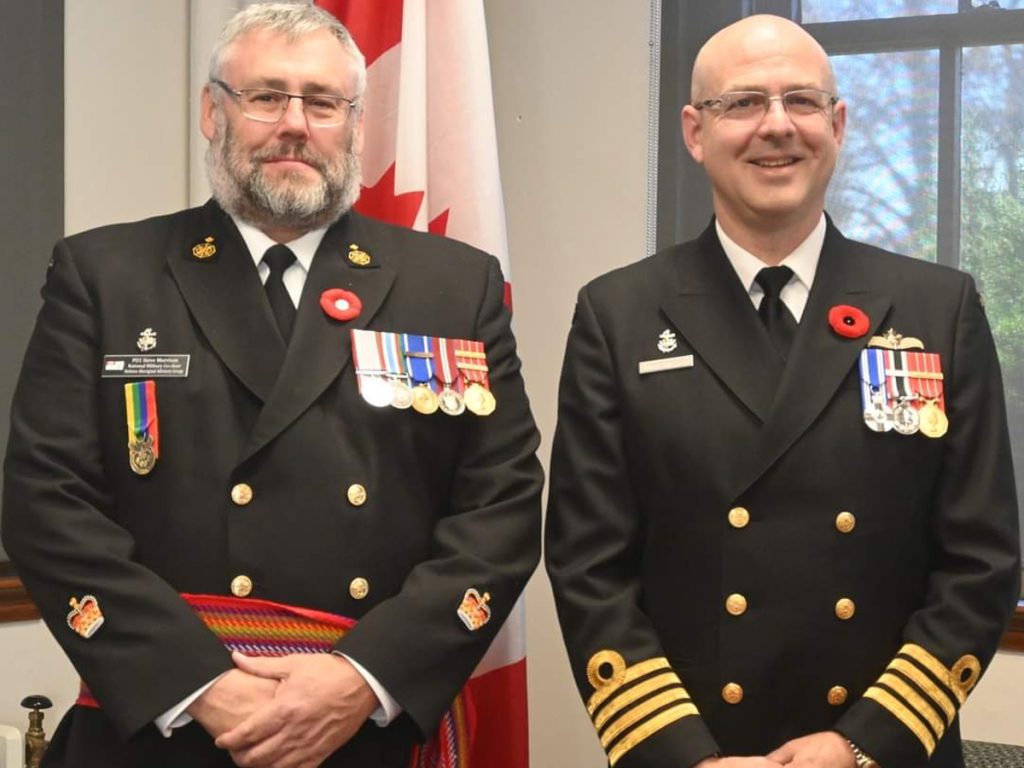
Base Commander Capt(N) J. Jeffrey Hutchinson (right) presents Petty Officer First Class (PO1) Steve Morrison

DAAG co-chair receives Aboriginal Veteran Millennium Medal

[caption id="attachment_31282" align="aligncenter" width="595"] Base Commander Capt(N) J. Jeffrey Hutchinson (right) presents Petty Officer First Class (PO1) Steve Morrison with the Aboriginal Veteran Millennium Medal on Nov. 8. Photo: Rodney Venis, Public Affairs.[/caption] Lookout Staff — Base Commander Capt(N) J. Jeffrey Hutchinson presented Petty Officer First Class (PO1) Steve Morrison with the Aboriginal Veteran Millennium Medal during a CFB Esquimalt ceremony on Nov. 8, National Indigenous Veterans Day. PO1 Morrison said receiving the medal was a proud moment for him and those who came before him. “This medal is also for my aunts and uncles who were residential school survivors who stepped forward to serve in the Second World War,” he said. “They were Metis and they had to hide who they were so this [medal] is for all of us – all our ancestors who have gone before and those who are serving now.” The Medal is awarded to Aboriginal Veterans in the Canadian Armed Forces (CAF), Royal Canadian Mounted Police (RCMP), the Merchant Navy, and those who joined the US Forces in either peacetime or wartime, who served before 2000, and to Aboriginal members who were serving during 2000. The medal may be awarded posthumously. PO1 Morrison is also the National Military Co-chair of the Defence Aboriginal Advisory Group (DAAG). The group advises senior leadership, including the Minister of National Defence, on Employment Equity issues affecting Indigenous members and employees of the Department of National Defence/CAF. “The DAAG is the voice to leadership of the Indigenous members of the CAF as well as Indigenous DND and PSP employees,” he said. PO1 Morrison said he is proud to be the elected National Military Co-Chair and work alongside Stanley Mercrdi, his Civilian Co-Chair. The Aboriginal Veteran Millennium Medal was created in 2000 to commemorate those Aboriginals who risked their lives...

Virtual Cenotaph

Virtual Cenotaph honours citizen sailors

Royal Canadian Navy — Over 1,700 naval reservists died in service to Canada during the Second World War. To honour their sacrifice, an online Virtual Cenotaph has been created to repatriate the lives of these ‘citizen sailors’ back to the cities, towns and villages where they grew up and began their naval service. “You don’t need any experience, military, investigative or otherwise to research one of these sailors,” said retired Captain (Navy) Kim Kubeck. “Anyone willing to give a few hours of their time can help add a story to the Cenotaph.” ‘Citizen sailors’ is the nickname given to those who joined the war effort as members of the Royal Canadian Naval Volunteer Reserve, the Royal Canadian Naval Reserve and the Women’s Royal Canadian Naval Service. The inspiration for the Citizen Sailors Virtual Cenotaph came Capt(N)  Kubeck, and the project is supported in part by the University Naval Training Division (UNTD) Association and a core team of dedicated volunteers. Capt(N) Kubeck retired from the Royal Canadian Navy (RCN) in 2013 after 32 years of service with Canada’s Naval Reserve. After working with the Dutch branch of the Royal Canadian Legion on the Faces to Graves project (a search for information about Canadian soldiers buried at the Groesbeek Canadian War Cemetery in The Netherlands), she saw an opportunity to honour the memory of Canada’s naval reservists. “When I started out learning some of the stories about these sailors, it struck me personally,” Capt(N) Kubeck said. “Faces to Graves showed me what the stories mean to so many people and how they can be shared.” The Citizen Sailors Virtual Cenotaph hopes to share some 35 defined data fields on each sailor that will be searchable, but also unique stories about who these people were, as discovered by the researchers working on each...

HMCS Winnipeg: A Boatload of Brothers

  Capt Christine MacNeil, HMCS Winnipeg PAO — For those who serve, their fellow Canadian Armed Forces (CAF) members are like a second family. But, six individuals aboard HMCS Winnipeg are fortunate to have two families around them – their CAF families as well as their brothers.   [caption id="attachment_31279" align="aligncenter" width="595"] Sergio Lorenzo and Evan Acosta[/caption] Sergio Lorenzo and Evan Acosta are step-brothers from Nova Scotia. “Being able to deploy with my little brother is probably the best part of this deployment,” Master Sailor (MS) Lorenzo said. “It may not always be sunshine and rainbows, but at least I know he is here and that brightens up my day.” Sergio is nine years older than Evan, but they have always been close. In 2008, Sergio decided to make a positive change in his life and joined the Halifax Rifles (Royal Canadian Armoured Corps). Four years later, Evan joined the same unit. Both then decided to join the CAF and transferred to the Regular Force. Sergio joined the Royal Canadian Navy (RCN) as a Hull Technician (now Marine Technician). Evan joined the Royal Canadian Air Force (RCAF) as an Avionics Systems Technician and now works on the CH-148 Cyclone in the Maritime Helicopter community. In 2021, MS Lorenzo was posted to HMCS Winnipeg; in early spring 2022, the Air Detachment arrived on the ship, bringing Sergio’s brother, Corporal (Cpl) Evan Acosta. “Sailing with my brother is surreal,” Cpl Acosta said. “Every time we fly, we are close by one-another. Although he frustrates me, like any brother does, while at sea, when we get into port we have a lot of fun exploring countries.”   [caption id="attachment_31278" align="aligncenter" width="595"] Hubert and Thomas Desbiens[/caption] Hubert and Thomas Desbiens are brothers from Quebec City. “When we work together, we don’t even have to speak and we know exactly what to do. It is the kind of bond that takes a lot of time to develop,” Cpl Thomas Desbiens said. Hubert and Thomas are also...

Admiral’s ‘Little’ gift follows big tradition

[caption id="attachment_31285" align="aligncenter" width="595"] The Topshee family, (from left) Charlotte Topshee, Vice-Admiral Angus Topshee, Audrey Topshee, and Iris Topshee are joined by Ray Young of I Used To Be a Pallet and his wife Lana Young. The Little Library was revealed during a ceremony in Dockyard on Nov. 14. Photo: Peter Mallett/Lookout Newspaper`[/caption] Peter Mallett, Staff Writer — A realistic replica of the Admiral’s Residence is now turning heads – and pages – in Dockyard at CFB Esquimalt. The Little Library at the corner of Hospital Road and Rainbow Drive was unveiled on Nov. 14 as a gift by Vice-Admiral (VAdm) Topshee and his family to the house and its future tenants. The act of generosity follows a time-honoured tradition at CFB Esquimalt, said VAdm Topshee. “Traditionally, when current tenants leave the Admiral’s house, they leave behind a gift to the house,” he said. “There have been many intriguing gifts over the years.” Gifts from past residents include an intricate Indigenous art carving gifted by Rear-Admiral (RAdm) Ronald Buck, a south-facing porthole-style window looking over the Pacific Ocean by RAdm Robert Yanow and a hand-carved wooden table gifted to the house by RAdm Gilles Couturier. Another part of the tradition, noted VAdm Topshee, is that the tenants plant a tree on property grounds when they leave. The idea for a Little Library came from Audrey Topshee, VAdm Topshee’s wife. Little Libraries intend for visitors to take a book or leave a book for others to read. Audrey said each member of the family is an avid reader. “We like to read, share reading with others, and are local library ‘nerds’. We wanted to leave a gift for the house that was unique, distinctive, and attractive, and could be enjoyed by many, not just the occupants of the house,” she said. “The Little Library was just the perfect all-around fit, once we figured out how and by whom it could be built.” Audrey was impressed by some other custom-built Little Libraries in...

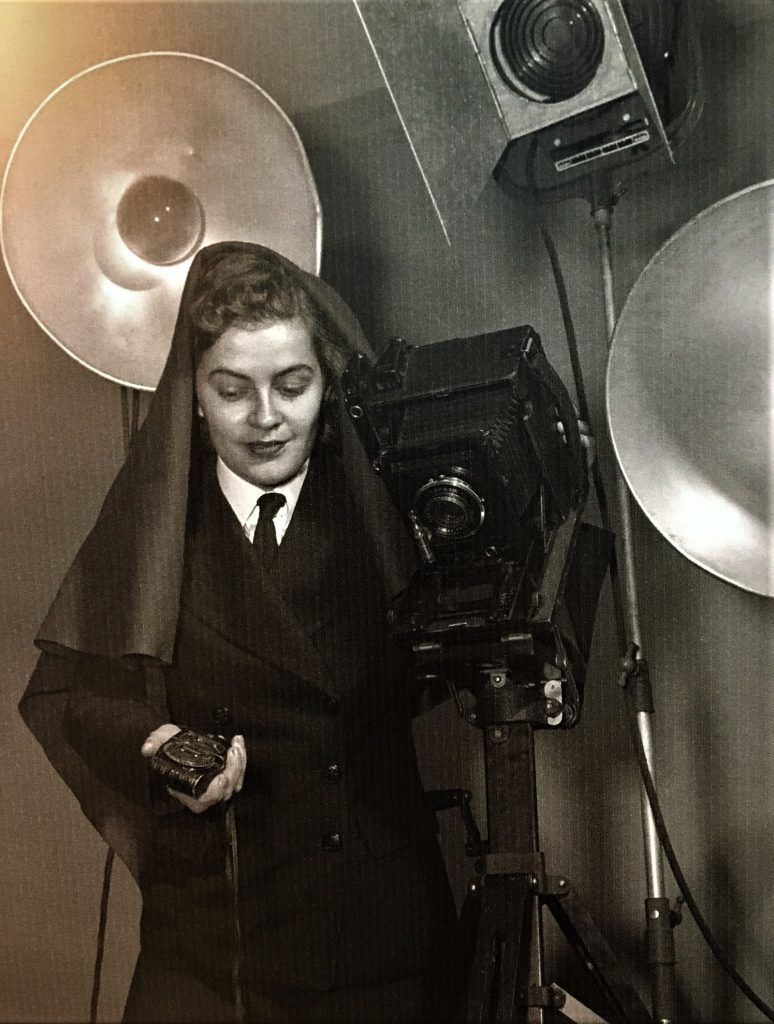
Jenny Pike in a photography studio. Photo supplied

From the archives: Jenny Pike breaking new ground

[caption id="attachment_31243" align="aligncenter" width="595"] Jenny Pike in a photography studio. Photo supplied[/caption] Updated by CFB Esquimalt, Naval and Military Museum — At the onset of the Second World War, many brave Canadian women challenged the traditions of the time and volunteered to serve their country. Jenny Pike was one of those trailblazers. Serving as one of the first women photographers during the Second World War at only 22 years old, Jenny was responsible for processing some of the first photographs from the D-Day landings. Her passion and dedication to service helped open doors for future generations of Canadian women. The youngest of four children, Jenny Whitehead Pike, was born in Winnipeg in 1922. As early as age 11, Jenny was sure she would become a photographer and often helped in her brother’s photo lab. Later, this experience would serve her well when she was hired to work in the photography department of Eaton’s department store. In early 1943, with the Second World War underway, Jenny’s father helped her write a letter to the Secretary of the Naval Board offering her photography services. His support was unusual in an era when many parents disapproved of their daughters joining the Forces. There were no vacancies then, but Jenny was encouraged to join the Naval Service as a Probationary Wren. The Women’s Royal Canadian Naval Service (WRCNS) seemed like a good life, and Jenny registered in February 1943. She trained at HMCS Conestoga in Galt, Ont., before being posted to Ottawa HQ for photo training. Jenny was one of only seven young women in the first class. From there, she went on to Halifax in October 1943, and in February 1944, she sailed in the third draft to London, England. She had been in London just four months when the D-Day invasions began. Jenny’s...

Navy veteran doubles as resident historian

[caption id="attachment_31239" align="aligncenter" width="596"] Bruce McShannon, an 84-year-old retired navy veteran.Photo: Lookout Newspaper.[/caption] Peter Mallett, Staff Writer — As a retired Navy veteran makes notes in a large red leather-bound book, he knows he keeps the residents’ legacy alive at Broadmead Care’s Veterans Memorial Lodge. “It is important for people to know and remember what all our veterans did during their lives, so I am delighted to be working on this project,” said retired master sailor Bruce McShannon. McShannon’s project, titled ‘Remembrance Book’, contains everyone who lives at Veterans Memorial Lodge long-term care home. His entries include the residents’ full names, years they lived, place of birth and a brief account of their military service. Previous ‘Books of Remembrance’ had been kept at Veterans Memorial Lodge, but interest dwindled during the pandemic. Then, the resident-run political body Veterans Association, decided to call on Bruce for help. “The book is a really good way to recognize the people of Veterans Memorial Lodge and what they did during their military service,” he said. McShannon, 89, served 25 years in the Royal Canadian Navy (RCN) as a Weapons Technician. He served aboard HMCS Quebec, HMCS Resolute and HMCS Haida. He later worked as a Commissionaire at base security checkpoints for over 30 years before his retirement in 2018. “I have been keenly interested in the stories of other veterans since moving to Veterans Memorial Lodge two years ago,” he said. McShannon is also working on another project with the Veterans Association – a small museum at Veterans Memorial Lodge containing items McShannon collected since the Second World War. “[My late uncle] was killed in Holland during the Second World War, and my aunt shared some of his collection with me that included Canadian and German hat badges and medals,” McShannon said. McShannon’s collection of military artifacts dates as far back as a bayonet from the War of 1812 and contains hundreds of military medals, hat badges, photographs and other items. He purchased most from...

Windows to another time

[caption id="attachment_31235" align="aligncenter" width="595"] The corvette was torpedoed by U-1004 and sunk in February 1945. One of two recently recovered mangled portholes show the power of the attack.[/caption] Legion Magazine  — A pair of portholes are grim reminders of destruction during the Battle of the Atlantic. The mangled portholes, bronze bent from the force of the explosion, “are the real story of the sinking of the Trentonian,” said Roger Litwiller, a Canadian naval historian and author, in an interview with Legion Magazine. He donated the two artifacts from the ship to a pair of Canadian museums in late 2021. The Royal Canadian Navy modified Flower-class ship was the last corvette sunk during the Second World War’s Battle of the Atlantic. On Feb. 22, 1945, it was escorting a convoy in the English Channel when it was torpedoed and sunk by German submarine U-1004 just 20 kilometres from Falmouth on England’s southern coast.    “The torpedo struck us aft with a terrific explosion and the corvette went down in 10 minutes,” said Lieutenant Ralph Abbott, Navigating Officer, in a newspaper account at the time. After destroying the charts, he abandoned the ship. “Some of the men sang while awaiting rescue,” but Abbott had to swim for about 45 minutes before rescuers arrived.  The survivors, including several wounded, were picked up by motor launches. Six of the 101 crew members died. The wreck lay scattered over the sea floor some 50-plus-metres deep, undisturbed for decades, providing habitat for fish and marine plants. But recently, it has attracted recreational divers.  In May 2021, Litwiller, author of White Ensign Flying: Corvette HMCS Trentonian, was contacted by the president of a British diving club. Although the club’s members had been warned of the British law protecting undersea wreckage of Second World War ships and aircraft, many of which are considered gravesites, two of the club’s divers had retrieved portholes from Trentonian.   The club could not safely return the artifacts to the wreck site, so the president searched for a home for the historical items and offered them to Litwiller....

How far we have come – The Elsie Initiative

[caption id="attachment_31229" align="aligncenter" width="595"] Commander Annick Fortin, the Commanding Officer of HMCS WINNIPEG, and Chief Petty Officer 1st Class Sue Frisby, Coxswain of HMCS WINNIPEG attend a Women, Peace and Security Dialogue in Bangkok, Thailand during OPERATION PROJECTION on Saturday October 8, 2022.Photo: S1 Melissa Gonzalez, Canadian Armed Forces Imagery Technician[/caption] Capt Christine MacNeil, HMCS Winnipeg PAO — The Elsie Initiative. Canada’s Feminist Foreign Policy. National Action Plan on Women, Peace and Security. Many Canadians may not be familiar with these important initiatives while living in a peaceful country. However, for the countries HMCS Winnipeg visited during Operation Projection, these topics are very much front and centre. With a female Commanding Officer (CO) and female Coxswain (Cox’n), HMCS Winnipeg was in a unique position to provide speakers on these topics. In several ports, Commander (Cdr) Annick Fortin, the CO, and Chief Petty Officer First Class (CPO1) Sue Frisby, Cox’n, spoke at Women, Peace and Security (WPS) events about their experiences as women leaders in a male-dominated environment, and what the Canadian Armed Forces has done, and continues to do, to promote equality. For the Winnipeg’s CO and Cox’n, the issue around Women, Peace and Security was distilled down to a grassroots level: “What is it like to be a female leader in a male-dominated environment?” Thirty years ago, HMCS Nipigon was refitted to become the first destroyer to accommodate the first Regular Force women as part of the ship’s crew. Now, women serve on all RCN vessels, and in all positions. Although the path ahead of us is likely as long as the one behind, we should still take time to pause, reflect, and acknowledge how far we have come and how much we have achieved. Canada as a nation continues to recognize the need for both equity and equality, aiming for a future with equal opportunity. As the WPS discussions continued throughout several port visits, it was an eye-opening reminder of how other nations look to us as an example...

WREN gives voice as ventriloquist in a 1940s show

[caption id="attachment_31226" align="aligncenter" width="595"] Ventriloquist Sheila Margaret Kidd holding dummy, Spike Ryan. Photo supplied.[/caption] CFB Esquimalt, Naval and Military Museum — An offbeat Royal Canadian Navy-related historical artifact – a Second World War ventriloquist’s dummy – is being highlighted at the Canadian Forces Base (CFB) Esquimalt Naval and Military Museum. The dummy, Spike Ryan (or simply ‘Spike’), was the working ‘partner’ of ventriloquist Sheila Margaret Kidd. When she joined the Women’s Royal Canadian Naval Service (WRCNS) to contribute to the national war effort on July 4, 1943, she also brought Spike and her skills as a ventriloquist. Just 20 years old when she signed up for wartime service, Wren Kidd was already a professional ventriloquist who had three years’ experience performing in clubs and theatres before becoming a ‘Wren’ (a term often used for women in the WRCNS). As a Wren, she was chosen to perform in the at-the-time very popular Meet the Navy shows with her not-so-silent partner, a redheaded dummy named Spike Ryan. Wren Kidd had developed her ventriloquist abilities during her teen years, when she suffered from painful throat ulcers. “I discovered I could talk without moving my lips,” she explained in an August 1943 newspaper write-up. “Wren Kidd took the skill she gained from her ailment and, using ingenuity and initiative, parleyed this into a huge part of her career. These character traits probably served her well during her time as a Wren and we’re proud to be highlighting her,” said Tatiana Robinson, CFB Esquimalt Naval and Military Museum Curator. Her performances with Meet the Navy attracted good reviews, although, at the time, a female ventriloquist was considered an oddity. “For the first time in one’s life, one heard a girl ventriloquist, and a very skillful one, in the person of Sheila Kidd,” commented one reviewer. Meet the Navy was not an easy gig. Mornings and afternoons were spent in rehearsals, and there were sometimes multiple performances in a single day as the show made its way to cities and towns across...

Nuts and bolts of a Rest and Maintenance Period

Gabrielle Brunette, Communications Coordinator Student, Fleet Maintenance Facility Cape Breton — A great deal of planning and work goes into a Rest and Maintenance Period (RAMP) for a Royal Canadian Navy ship. “A RAMP is like a mini work period that focuses on a ship’s operational deficiencies, overdue maintenance, and anything else that will affect the post-deployment work period,” said Lieutenant (Navy) Kevin Chung, the RAMP In-Charge of the maintenance project. Before HMCS Vancouver conducted a RAMP in Busan, South Korea, Oct. 4-11, the Production Management team at Fleet Maintenance Facility (FMF) Cape Breton reviewed the project to better prepare a feasible work package, given the limited resources and duration of the work required. “This is a critical step as anything that is missed during this review could result in work not being completed in a foreign port,” said Steve Ringma, Vancouver’s RAMP Production Team Manager. He said his team relies on port services such as shore power and cranes to conduct work since they cannot bring that overseas. As such, Lt(N) Chung said the RAMP is challenging to do in a developing country or a port with limited resources. A ship will only get one RAMP per deployment, Lt(N) Chung. Depending on the state of the ship and where the ship sits in the operational cycle, a RAMP may or may not occur. The amount of personnel needed for a project, as well as the length of the RAMP, depends on the information in the work package. “We sent 33 technicians from 15 different trades, conducting maintenance deemed critical by Fleet Engineering Readiness,” Ringma said. Ringma said the FMF RAMP team did a great job executing the work period. “It was great to see the team adjust and be flexible as challenges arose,” he said. “We had excellent support from the...

Undaunted by fire: the legacy of Chief Petty Officer Max Bernays

[caption id="attachment_31217" align="aligncenter" width="595"] Chief Petty Officer Max Bernays. Photo: Canada.ca[/caption] Lt(N) Anastasiya Karakoy, HMCS Max Bernays UPAR — Many of us who have held the privilege of living in relative peace and stability find great challenge in appreciating the full magnitude of adversity faced by the generations who came before us. For the thousands of members currently serving in the Royal Canadian Navy (RCN), walking into work at HMC Dockyard on a calm, sunny Halifax morning makes it difficult to imagine this same place, less than a century ago, as an assembly point for the countless ships serving in the Battle of the Atlantic, the success of which fundamentally supported Allied victory in the Second World War. The hardship faced during the Battle of the Atlantic gives rise to some of the most inspiring stories of courage and heroism Canada has ever known. The story of Chief Petty Officer (CPO) Max Bernays is just one of these stories. It serves as an indispensable example of bravery which will continue to inspire generations of Canadians.  Who was Max Bernays? Born in 1910 in Vancouver, Max Bernays was from a sea-faring family. He spent his early years in the merchant marine before joining the Royal Canadian Naval Volunteer Reserve (RCNVR) in 1929, being mobilized for the Second World War a decade later. With only limited experience in the position on smaller ships, Max Bernays was promoted to Acting Chief Petty Officer in March 1942 and appointed as Coxswain of the River-class destroyer HMCS Assiniboine, a position normally held by a more experienced sailor. Young Max Bernays and his ship would soon be engaged in North Atlantic convoy escort operations under the leadership of Lieutenant-Commander John Stubbs. Fire aboard HMCS Assiniboine On Aug. 6, 1942, just several months after CPO Bernays’ appointment as Coxswain, HMCS Assiniboine engaged in a fierce surface gun battle against the German submarine U-210. Both the bridge and wheelhouse of Assiniboine were engulfed by fire from shells launched by...

HMCS Discovery

Jackspeak: Badges and Battle Honours

Mark Nelson — Every commissioned warship in the Royal Canadian Navy (RCN) is honoured with an official ship’s badge based on the ship’s name and designed with heraldic elements. The badge serves as a unifying symbol for the ship’s company. Before the Second World War, there was no official control over the badge a Canadian warship might wear. During the Second World War, with Commanding Officers and crew members coming up with their designs, we saw ships emblazoned with Donald Duck, as in HMCS Snowberry, or an image of St. Clair blasting a U-boat with lightning flashing from her fingertips, as in HMCS St. Clair. HMCS St. Laurent, a ship named ‘Sally Rand’, had a picture of the famous burlesque dancer knocking down dive bombers with her fan. HMCS Wetaskiwin displayed an image of the Queen of Hearts sitting in a puddle of water. These badges boosted morale and offered a uniting symbol for the ship’s crew. However, at the end of hostilities, something more official was warranted. In 1945, Naval Staff decided that ships remaining in service should have official badges designed with the elements of heraldry. The task of producing official badges for the RCN was initially given to Lieutenant-Commander Alan Brookman Beddoe (1893-1975), a Canadian war artist, consultant in heraldry, and former First World War prisoner of war. Incidentally, Beddoe also illustrated the Books of Remembrance on display in the Peace Tower on Parliament Hill in Ottawa. Badge designs are made to connect to the ship’s name, and incorporate heraldic symbology and terminology. For example, colours are described using the heraldic terms gules (red), azure (blue), vert (green), sable (black), purpure (purple), or (gold), and argent (silver or white). In heraldic language, the badge of HMCS Calgary is described as, ‘Or, a bend wavy azure charged with...

Maritime Museum celebrates history of the Wren uniform

[caption id="attachment_31209" align="aligncenter" width="595"] Grace Brodie, Staff Sergeant of the Toronto Branch of Red Cross Transport “C” Company, 1941. Photo: Maritime Museum of British Columbia.[/caption] Peter Mallett, Staff Writer — When Lieutenant (Lt) Grace Brodie joined the Women’s Royal Canadian Naval Service (WRCNS) in July 1942, she faced a unique challenge. “No one had created a women’s uniform,” said Heather Feeney, Collections and Exhibits Manager at Maritime Museum of B.C. “Brodie was handed a stack of material and told to find a tailor of her own.” But Lt Brodie, one of the first female ‘Wrens’, was tenacious and resourceful. Her Second-World-War-era dress uniform, created by a Vancouver-based tailor, is now part of a new exhibit at the Maritime Museum of B.C. Feeney researched Lt Brodie’s uniform after it was donated by Lt Brodie’s estate executor, who also donated her Red Cross uniform to the museum’s collection and provided much of the background information for Feeney’s research. According to Feeney, the civil and military tailor, John Doig of West Pender Street, was less than impressed with the idea of making a uniform for a woman. But Lt Brodie appealed to their shared Scottish heritage, and Doig embarked on the project. Feeney notes Lt Brodie’s uniform is made from men’s uniform suiting, which gave the jacket a superior drape and sheen compared to those made from regulation serge. The first alteration Doig made was to switch the standard Royal Canadian Navy (RCN) dress uniform buttons. The buttons would appear out of proportion since Lt Brodie was only 5’1” (1.55 metres) in height. Doig suggested using mess buttons instead. The rest of the story behind Lt Brodie’s uniform is part of the Douglas St. museum’s Darn It! Our Maritime Make and Mend Culture display. Lt Brodie’s Royal Canadian Navy (RCN) career lasted from 1942 to 1945. All reports from that time indicate she was highly regarded and won the respect of her fellow officers. According to biographical research files at the museum, Lt Brodie...

Esquimalt Harbour updates engage community input

Peter Mallett, Staff Writer — The A/B Jetty Recapitalization Project is currently the largest construction project in the harbour and is anticipated to be completed in the mid-2020s. Defence Team members revealed the project’s details at the Oct. 27 Public Information Session at the Songhees Wellness Centre. “We heard many positive comments on the progress that has been made in the cleaning up of contaminated sediments,” said Michael Bodman, Manager of Base Safety and Environment. “This included comments about the increased number of observations of sea life in Esquimalt Harbour including whales, herring, and other fish species.” Approximately 70 people, primarily residents close to the Department of National Defence (DND) and Esquimalt Graving Dock facilities, used the session as an opportunity to raise concerns about noise from various sources, learn where the sediment went for disposal and the archaeological materials recovered during dredging projects and showed interest in how local Indigenous communities have been engaged in the project. The DND is undertaking several projects in Esquimalt Harbour associated with CFB Esquimalt. The projects are addressing the historic harbour contamination and are continuing to transform the Dockyard infrastructure to support the Royal Canadian Navy (RCN) operations. “In the long term, DND will continue to work with partners in the surrounding communities to monitor condition of Esquimalt Harbour, manage risk and identify projects that will contribute to the ongoing goal of a healthy and sustainable environment,” Bodman said. The A-Jetty open water remediation, B-Jetty demolition, and remediation are completed, with B-Jetty construction underway. The remediation of G-Jetty and Jetty 11 on the Colwood side of Esquimalt Harbour is currently in the procurement phase and is expected to commence by the end of 2022. The current A Jetty and former B Jetty is now over 70 years old, says Bodman. “Along with providing important updates, information sessions such as this one also highlight the Government of Canada’s investment in enabling and supporting the RCN through investing in new infrastructure, protecting the environment and cleaning...

No Stone Left Alone bridges generation gap

[caption id="attachment_31197" align="aligncenter" width="595"] Students from Cedar High Middle School participate in the annual No Stone Left Alone program Nov. 3 placing painted rocks onto the headstones at St. Luke’s Cemetary in Saanich to commemorate Canadian Soldiers. Photos supplied.[/caption] Peter Mallett, Staff Writer — Ahead of Remembrance Day ceremonies, Grade 6, 7 and 8 students from Rockheights and Cedar Hill Middle School visited the gravesites of veterans to remember the sacrifices and pay their respects while leaving poppy-painted stones on their headstones. They were among thousands of students across the country taking part in the annual Remembrance Day scholastic program, No Stone Left Alone (NSLA). “It makes Remembrance Day more meaningful,” says Christina Pelletier, Vice-Principal at Rockheights Middle School. “The act of painting poppies onto rocks and then placing them on headstones honours the soldiers and creates a greater appreciation for all of those who served.” The annual campaign was launched in 2011 by Edmonton’s Maureen G. Bianchni to recognize the nation’s fallen. Soggy cold weather greeted Cedar Hill Middle School students on Nov. 3 at St. Luke’s Cemetery in Saanich and Rockheights Middle School students on Nov. 4 at God’s Acre Veterans Cemetery in Esquimalt. The NSLA’s goal is to educate and engage youth in honouring every soldier who has fought for Canadian freedoms, says Maryanne Trofimuk, Principal at Cedar Hill Middle School. “Hands were red, glasses were fogging, knees were knocking, but the spirit was strong,” Trofimuk said. Trofimuk was previously the Principal at Rock Heights when her school became the first in the province to organize a No Stone Left Alone ceremony at the request of retired major-gen Cam Ross. This was Rockheights Middle School’s ninth No Stone Left Alone Ceremony. Despite braving rain, wind and cold temperatures, standing out in the cold for a short time was nothing compared to what soldiers at war go through, said Gio, a Grade 8 student from Rockheights Middle School. “I think it’s very important we do this ceremony and remember...

Doctor shines light on opioid addiction and recovery

[caption id="attachment_31194" align="aligncenter" width="595"] Dr. Darryl Jordan Gebien[/caption] Peter Mallett, Staff Writer — His journey with addiction began years ago, with painkillers prescribed by his doctor to treat back pain. It didn’t end until he graduated from fentanyl and survived a near-fatal, unintentional overdose. Today, Dr. Darryl Jordan Gebien is a survivor of Canada’s opioid crisis, in long-term recovery, and admits he is lucky to be alive. “I hope through this discussion we can learn from each other,” Dr. Gebien says. Dr. Gebien is the next speaker in the MARPAC Health and Wellness Fall Speakers Bureau series. He plans on taking his audience on a journey of his epic fall and arduous rise from opioid use disorder with a discussion titled A Compassionate Lens of Addiction. The talk coincides with National Addiction Awareness Week. In November 2014, Dr. Gebien, an emergency room physician from Thornhill, Ont., was arrested and eventually incarcerated for abusing his prescription-writing privileges. Despite losing contact with his young family and career, Dr. Gebien pressed on in his recovery, frequently sharing at Narcotics Anonymous and Alcoholics Anonymous 12-step meetings. “Pain, stress, worry, anxiety and depression affect us all, but it is how we choose to deal with them that makes it easier to overcome,” he says. “Both physical and mental pain, as well as poor coping skills contributed to my addiction, and healing only began within the comfort of being with others after I surrendered.” Dr. Gebien says he wants to share his 15 keys to happiness learned during his recovery. “I am thrilled to share my story and interact with members of the Defence team from across the country,” Dr. Gebien said. Dr. Gebien will share his experience on Nov. 22 from 10 to 11:30 a.m. on MS Teams.

 A tale of two heroes

[caption id="attachment_31185" align="aligncenter" width="595"] Prime Minister Churchill goes aboard Canadian destroyer – The historic occasion which marked the ocean meeting of the Right Honourable Winston Churchill and President Franklin D. Roosevelt was doubly significant for the officers and men of a Canadian destroyer who were hosts to the Prime Minister. Mr. Churchill is seen here boarding the vessel; on the extreme left of the photo, saluting in the foreground, is Lieutenant John H. Stubbs, RCN, of Kaslo, B.C., Commanding Officer of HMCS Assiniboine.[/caption] Clare Sharpe, CFB Esquimalt Naval & Military Museum — The latest feature photo from the museum archives tells a tale of two heroes, twoleaders, two men who shaped history. Each played a key part in the Battle of the Atlantic, the epic seaborne struggle to defeat Nazism. Each was an inspiration to those who served with them, and to those they served. The Right Honourable Winston Spencer Churchill and Lieutenant John Hamilton Stubbs of the Royal Canadian Navy met in the run-up to a decisive summit conference. Stubbs and the ship he commanded, HMCS Assiniboine, were detailed to escort Churchill, then-prime minister of Great Britain, to a secret meeting. Assiniboine sailed with the Royal Navy vessel HMS Prince of Wales, which carried Churchill aboard, to Placentia Bay, Nfld. Stubbs and his men reportedly received little notice they would accompany Churchill to his now-famous first encounter with Franklin Delano Roosevelt, U.S. president. Their rendezvous took place at sea in early August 1941, just offshore from the little community of Ship Harbour, Nfld. The British and American leaders joined together for secret talks – the U.S. was not yet in the Second World War, and negotiations were delicate. Their historic meeting resulted in a strategic set of agreements that gave birth to the Atlantic Charter and laid the groundwork for destruction of the Axis powers. Shortly before their escort detail, Stubbs and Assiniboine had successfully sunk the submarine U-210, ramming the submarine twice and finishing it off with depth charges....

Royals’ CAF jersey a tip to NHLers wartime service

[caption id="attachment_31188" align="aligncenter" width="595"] The Victoria Royals will be wearing this Jersey at the game Nov. 19. Photo by Kevin Light Photography Instagram: @kevrlight.[/caption] Peter Mallett, Staff Writer CFB Esquimalt’s rich hockey history will be front and centre on ice on Nov. 19. The Victoria Royals will wear a specially-designed historic replica jersey of the 1942/43 Navy team while facing off against the Prince George Cougars. The Western Hockey League team revealed the jersey Nov. 15. “It’s a forgotten story of what could be argued as the greatest single season of hockey played on Vancouver Island,” said Matt Carlson, Base Public Affairs Projects Officer. “The players were all members of the Royal Canadian Navy (RCN) and called to serve in the war effort and stationed at CFB Esquimalt.” Victoria Royals players will wear the jersey for a Canadian Armed Forces (CAF) Appreciation event at the Save on Foods Memorial Centre. The white jersey with blue stripes features a bull dog wearing a sailor’s cap with the words ‘HMCS’ inscribed. Derived from a black and white photo from the CFB Esquimalt Naval and Military Museum archives, the jersey commemorates the 80th anniversary of the Base’s star-studded team that competed in the Island Senior League (ISL). The team was comprised of both National Hockey League (NHL) and minor league players from across Canada. Dubbed by the Victoria Daily Times as the ‘bluejackets’, the team featured Chucky Rayner, Hockey Hall of Fame and Canada Sports Hall of Fame goaltender, whose NHL career was interrupted by the Second World War. Rayner served three years in the RCN before resuming his career in New York with the Rangers. He went on to win the NHL’s Hart Trophy for Most Valuable Player in 1950. Also in the ‘bluejackets’ lineup was Bob ‘Golden Boy’ Goldham, five-time Stanley Cup winner and defenceman. After serving in the military from 1942 to 1945, Goldham played 11 NHL seasons with Toronto, Detroit and Chicago. Bernie Strongman, another hokey player from Victoria, also...

Janet-Curley

Museum volunteer Janet Curley keeps on running

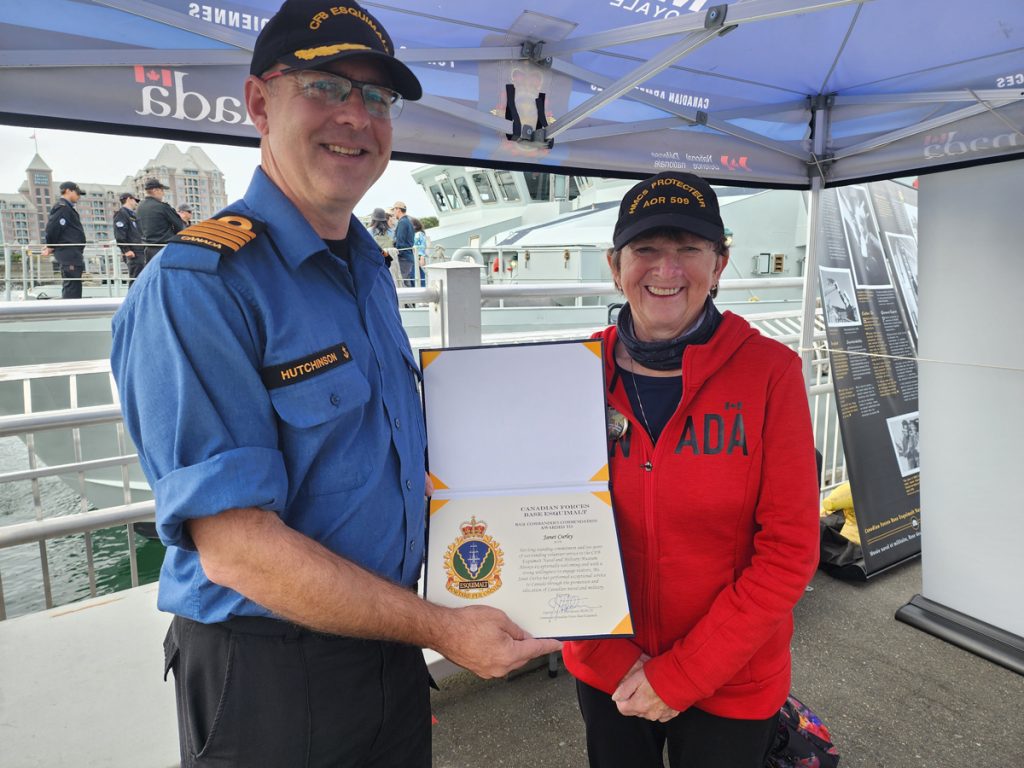
CFB Esquimalt, Naval & Military Museum — Janet Curley, CFB Esquimalt Naval and Military Museum volunteer, has given a long-running commitment and contribution to the museum over the past decade, fuelled by the same energy and staying power that characterize her career as a recreational runner for community charities. Janet’s late husband, Lou, was in the Canadian Forces Air Command, motivating her to become a major booster of the Canadian Armed Forces (CAF). She has also maintained her CAF connection by running the CFB Esquimalt 5K and the Royal Canadian Air Force Half Marathon in Winnipeg, Man. She said she enjoys volunteering at the museum partly because it brings back happy memories of when her husband was in the CAF. Even though she has decided to ease back on her volunteerism in the museum visitor centre, Janet is always willing to lend a hand for museum and Base special events. While assisting the museum with its displays and outreach for the Defence on the Dock event at Ship’s Point on Sept. 17, Janet Curley was recognized for her enthusiastic support for the museum and the CAF. Captain (Navy) J. Jeffrey Hutchison presented her with his Commander’s Coin and a citation thanking her for her ‘exceptional service to Canada through the promotion and education of Canadian naval and military history’. For Janet, receiving the Base Commander’s recognition was a ‘very moving experience’. A member of the CEEVACS Roadrunners group in the Cowichan Valley, Janet began working with the museum’s volunteer group after being encouraged to join by another volunteer. Her ability to engage with visitors, her warmth and friendliness have been great assets to the museum. She always went the extra distance in answering their enquiries. In the same way, she goes the extra mile when running marathons and half marathons for...

Veteran perfects the art of portraiture in remembrance 

[caption id="attachment_31170" align="aligncenter" width="595"] Gilles Boudreault as an infantryman (left) and today. Photos supplied.[/caption] Peter Mallett, Staff Writer — Soldiers and veterans come to life through impressionist portraits in a home studio of one Bedford, N.S. artist. Retired warrant officer Gilles Boudreault says art lets him reflect with remembrance on friends and colleagues that has passed on from his former units. “I don’t usually think of one particular unit or person on Remembrance Day but this year, more than ever, I will be thinking of all the people I served with who are no longer here,” he said. “It makes me wish I took the time to reconnect and visit with them after our service was complete.” Boudreault retired from the Canadian Armed Forces (CAF) in 1999 after 21 years of service. He joined the CAF in September 1978 and was posted to Third Battalion of Royal 22nd Regiment (3R22R) and then Canadian Airborne Regiment in Petawawa, which included a deployment to Cyprus in 1982. In 1988, he trained to change trades from Infantryman to Topographical Surveyor and moved on to the Department of National Defence Mapping and Charting Establishment (MCE) in Ottawa, where he worked until his retirement in 1999. Today, the married father of two paints every chance he gets. Boudreault says it’s not hard to get inspired by his subject matter. The smiling portrait of the late Major-General Herbert Pitts of the Canadian Army is one of many photographs that inspired him to pick up the brush. Boudreault says the warmth of Pitts’ smile made the portrait a delight to paint. “The fact that the subject was wearing a maroon beret – which are the airborne colours of my former regiment – made the creative process easier and gave it a familiar feel to me,” he said. Pitts, a Korean War veteran, was a former Colonel of the Regiment of Princess Patricia’s Canadian Light Infantry (PPCLI) and the Canadian Airborne Regiment. Pitts spent the later years of his...

Esquimalt senior goes on annual pilgrimage of Remembrance

[caption id="attachment_31167" align="aligncenter" width="595"] Jim Connor brings a poppy in remembrance of his Aunt Cecilia Connor who has a permanent display at the CFB Esquimalt Naval and Military Museum. Photo provided.[/caption] CFB Esquimalt Naval & Military Museum — For Jim Connor of Esquimalt, B.C., honouring the memory of his late aunt Evelyn of the Canadian Women’s Army Corps (CWAC) is a family obligation and a vital duty. Private Evelyn Connor (service #W/11688) of Esquimalt, B.C., is one of 25 CWACs who died while on active duty during the Second World War. In 2014, CFB Esquimalt Naval and Military Museum created a permanent display to commemorate and recognize her service and sacrifice. Since 2014, Jim has made a special annual visit to the museum during Remembrance Week to add a poppy to the display that features his aunt. It is his way of keeping her memory alive. “I think Evelyn has a home here,” says Jim, 87. “I feel close to her and happy to know she isn’t forgotten.” Evelyn Cecilia Connor was one of seven children and lived with her parents, James and Elizabeth Connor, on Ellery Street in Esquimalt. She enlisted with the CWACs in Victoria, B.C., on June 15, 1942. In July 1942, she was sent to Vermilion, Alta, for training. Evelyn returned to Victoria on Oct. 26, 1942, and was sent across the country to Ste. Anne de Bellevue near Montreal. She returned to Victoria again on Dec. 1, 1942, to 28 Company (Coy), and on March 12, 1943, was sent to Vancouver to No. 13 Coy and then to No. 111 Coy. She went back to Macdonald College at Ste. Anne de Bellevue in 1943. Private Connor was sent overseas in July 1943 and posted to No. 1 Static Base Laundry. She was 24 when she was struck and killed by a bus at 2220 hours on Sept. 24, 1944, in Farnham, England, during a blackout. She had been overseas for just over a year. Private...

Veterans return to South Korea on war anniversary

[caption id="attachment_31162" align="aligncenter" width="595"] (L-R): Victor Flett, Ronald Foyle and John Molnar at the National Cemetary of Korea at National Cemetary of Korea.[/caption] Peter Mallett, Staff Writer — Victor Flett did not think he would be returning to Korea almost 70 years later – this time for an award from the Korean government. “This revisit was very meaningful to me,” said Flett, 94. “I have so many friends that are veterans of the [Korean] War who could not be there, and so many of my family members were in the military.”  The Republic of South Korea honoured Flett and two other Korean War veterans from B.C. for their service during and following the Korean War. South Korean President Yoon Seok-youl personally presented the Korean War Service Medal to John Molnar of Abbottsford, B.C. Ronald Foyle of Vancouver and Flett received their medals previously. “The freedom, peace and prosperity that the Republic of [South] Korea enjoys today were built on the foundations of the blood, sweat and sacrifice, and dedication of our veterans and veterans under the U.N. flag,” said Yoon during the luncheon. The three men were among 200 Korean War veterans from nine nations selected by the Ministry of Patriots and Veterans Affairs to participate in the Veterans Revisit Program. Molnar and Foyle served aboard HMCS Cayuga. Flett served aboard HMCS Crusader as a Sonarman when it was dispatched from Esquimalt in July 1953. Since the Crusader arrived in Korea days after the July 27 armistice, Flett took part in UN Peacekeeping operations instead. Born in St. Peters, Man., in September 1928, Flett is the last of three generations from Manitoba’s Peguis First Nation to serve in Canada’s military. His Grandfather, Private David William Stranger, an infantryman in the Canadian Army, was killed in the First World War in the Battle of Vimy Ridge. Flett said the visit was his fourth trip to South Korea since the war ended, and his love and admiration for the nation and its people...

HMCS Winnipeg: I wear a Poppy…

Lieutenant (Navy) Riley Perrior My family has served in the military for 13 generations, starting in the UK and moving into Canada, and so the poppy is not just a way for me to remember them, but also to carry on the lineage of service.   Sub-Lieutenant Xiang Zhou ... to remember all the history of the Armed Forces and to show respect for the fallen.   Private Alex Measures ... to remember all the sacrifices of the people who have come before me.   Sailor Second Class Justyn Ramharrack ... to remember those who gave their life for this country.   Sailor First Class Ryan Smith ... for all the soldiers, sailors and aviators who served before me.   Chief Petty Officer Second Class Raymond Ferguson ... to remember our fallen soldiers, those who went before us.   Sailor First Class Sebastien Swann ... for remembering all the troops that have fallen in war.   Sailor First Class Anne Marie Russell ... to honour and remember all the people before me that made the ultimate sacrifice and served our country.   Corporal Adam Weddel ... to remember the Airmen and Airwomen who came before me.   Captain Joe Anderson ... to remember all those who came before me and laid their lives on the line for our freedom.   Petty Officer Second Class  Luc Pelletier ... because my grandfather fought in the Second World War and whenever I wear it reminds me of the sacrifices that he made for everything that I have today.

Capt(N) J. Jeffrey Hutchinson

Message from the Base Commander: Remembrance Day

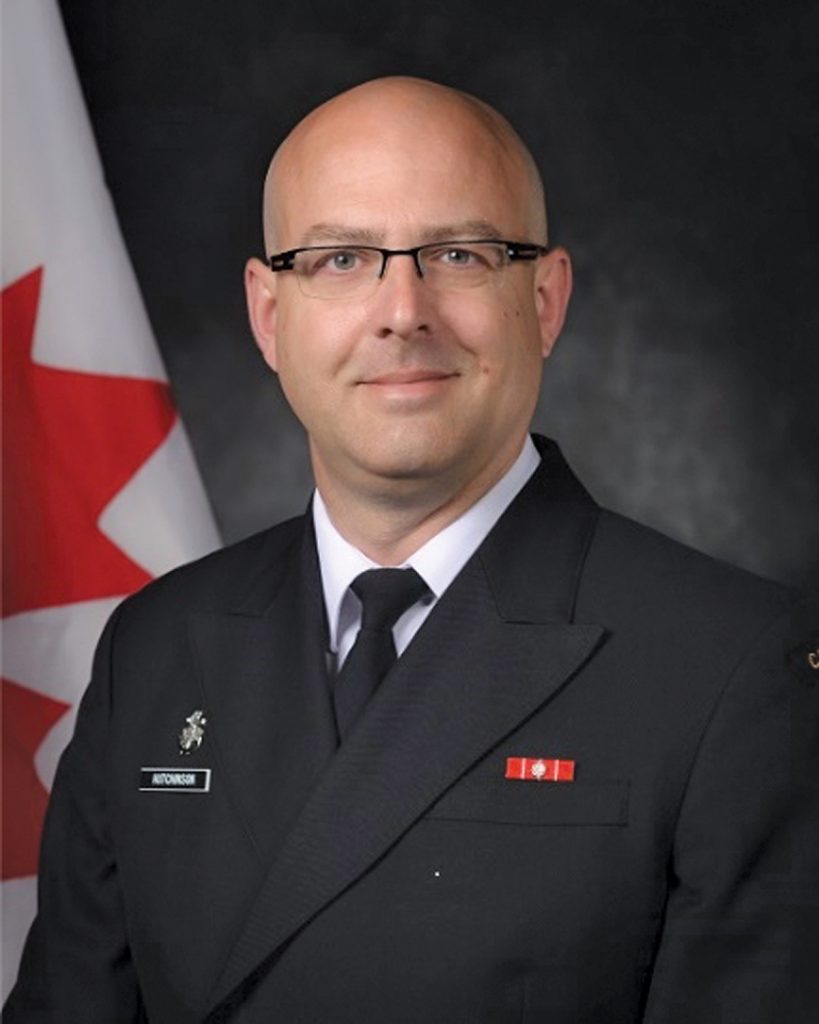
[caption id="attachment_31144" align="aligncenter" width="595"] Capt(N) J. Jeffrey Hutchinson[/caption] — Every year on November 11, Canadians gather to honour the sacrifice of those who have served our country. Whether during the First World War, the Second World War, the Korean War, the Balkans, Afghanistan, or countless other mission at home and abroad – our Veterans have fought for the safety and peace we value today. This year marks the 80th anniversary of the establishment of the Women’s Royal Canadian Naval Service (WRCNS). More than 6,700 Canadian women enlisted in the WRCNS during the Second World War, and were commonly referred to as Wrens. They filled dozens of essential roles, including analyzing data that helped protect ships from devastating German mines. That work saved countless lives. The Wrens not only helped to secure Allied victory but also aided the movement for gender equality, and opened doors for future generations of women in the Canadian Armed Forces (CAF). Many of their stories are on display at CFB Esquimalt’s Naval and Military Museum, and I encourage members and their families to take time to visit and learn more about our military’s history during this time of remembrance. As time goes by and personal connections to past conflicts become fewer, it is increasingly important to ensure the sacrifices of those who have fought bravely for our country are never forgotten. I want to express my appreciation to all those members who are participating in the National Veterans’ Week Speakers Program, helping to highlight the importance of Remembrance Day and Canada’s military at schools and workplaces in our communities. As military members, we know the job of protecting peace and freedom is never done. There are always new challenges to face and new missions to support, both at home and abroad. As I stand at the...

Second World War stoker survives two U-boat attacks, sinkings in two days

[caption id="attachment_31138" align="aligncenter" width="595"] Stoker William Fisher with an unidentified member of the Women’s Royal Canadian Naval Service. Photo courtesy of Canada.ca.[/caption] CFB Esquimalt Naval and Military Museum — For Stoker William Allen Fisher of the Royal Canadian Navy Volunteer Reserve (RCNVR), becoming the sole survivor of not just one but two vessels sunk by enemy submarines in the Battle of the Atlantic was a lonely and harrowing experience. On Sept. 20, 1943, Fisher’s ship, the Town Class destroyer HMCS St. Croix, was escorting convoy ON.202 south of Iceland when the German U boat U 305 hit and sunk it. Sixty-five members of the ship’s company died due to the submarine’s acoustic torpedo attack. Eventually, the Royal Navy ship HMS Itchen rescued five officers and 76 men from St. Croix, including William Fisher. As fate would have it, a mere two days later, the Itchen was torpedoed by submarine U 666 south of Greenland. All officers and those from St. Croix aboard Itchen perished, with one remarkable exception: William Fisher. Fisher would be considered extraordinarily fortunate to have lived through these terrible incidents by most people’s standards. He had been in the RCNVR for just a year and 11 months when the St. Croix was lost. “It was hard to take, the boys had all been old hands and old friends,” he recollected in his eyewitness account of both sinkings, The End of HMCS St. Croix, which appeared in the Royal Canadian Navy (RCN) Month Review in August 1944. In his account of the events, Fisher wrote of being adrift for 13 hours in a crowded whaler with four Carley floats tied to it, all loaded with men and bailing frantically as the whaler took on water. In his subsequent rescue from HMS Itchen, he had only a piece of debris to cling to in the freezing water after diving over the side following the torpedoing of the ship. “The water was rough,” he said in the memoir. “I saw...

Biologists employ microchips to track elusive snake species on Base

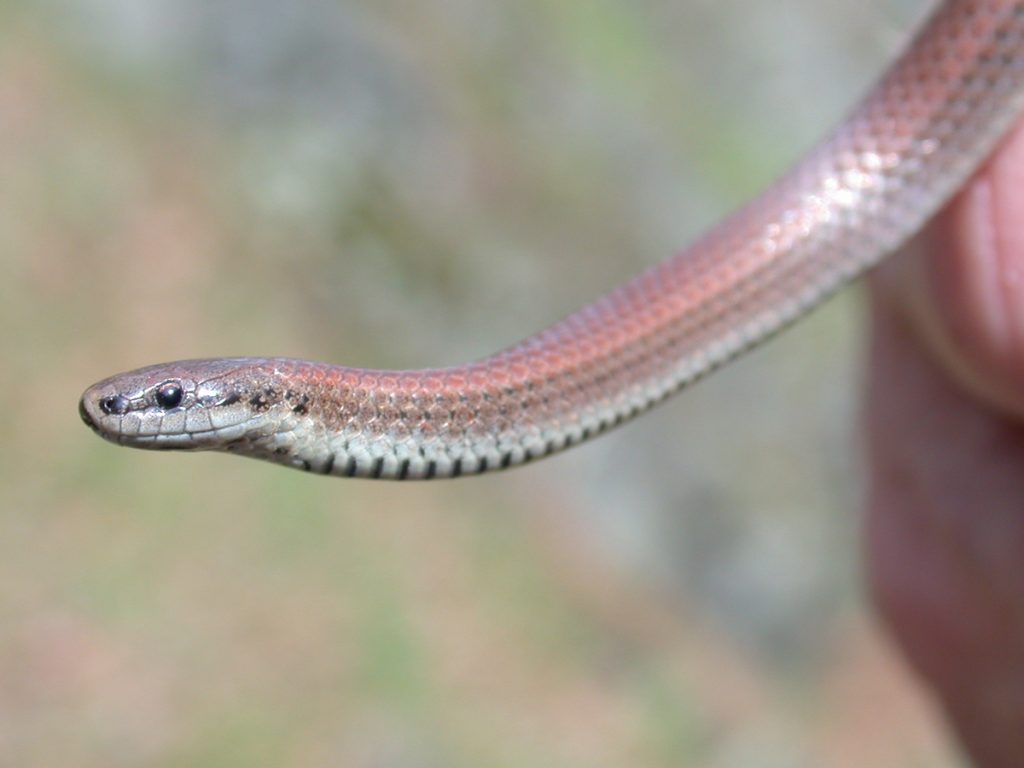
[caption id="attachment_31132" align="aligncenter" width="595"] A Sharp-tailed snake, an endangered species. Their small size and secretive nature makes them difficult for biologists to study.[/caption] Peter Mallett, Staff Writer — A new wildlife conservation effort at CFB Esquimalt is underway: a multi-year research project to monitor the population and movements of Sharp-tailed snakes. The species is listed as endangered under the federal Species at Risk Act (SARA). “We hope the results will support more accurate mapping of critical habitat and improve habitat protection,” said Cain van Cadsand, Environmental Officer with Base Safety and Environment (BSE). The research takes place at select locations, including the DND Heals Rifle Range property, with specialized detection equipment. It is a collaborative effort between Department of National Defence (DND), Environment and Climate Change Canada (ECCC), B.C. Ministry of Environment and Climate Change Strategy, Natural Resources Canada, and Biolinx Environmental Research Ltd. Sharp-tailed snakes (Contia tenuis) are small, harmless reptiles that live mostly underground or under cover objects such as rocks and logs, and almost never come out in the open. They are elusive which makes them hard to detect and monitor. Following the discovery of Sharp-tailed snakes at Heals Rifle Range in 2003, Base Safety and Environment contracted species experts to survey various CFB Esquimalt properties. They found the species at the Mary Hill property as well. During that time, biologists used artificial cover objects such as asphalt roofing shingles to survey and monitor the species. These provided warm sheltered sites and allowed easier species detection. The current research will use an automated monitoring system to record data 24 hours per day to provide more detailed information on movements and habitat use, complementing previous methods. “It is critical for us to know where these snakes are and what type of habitat they need for survival, to comply with...

Jackspeak: In Remembrance

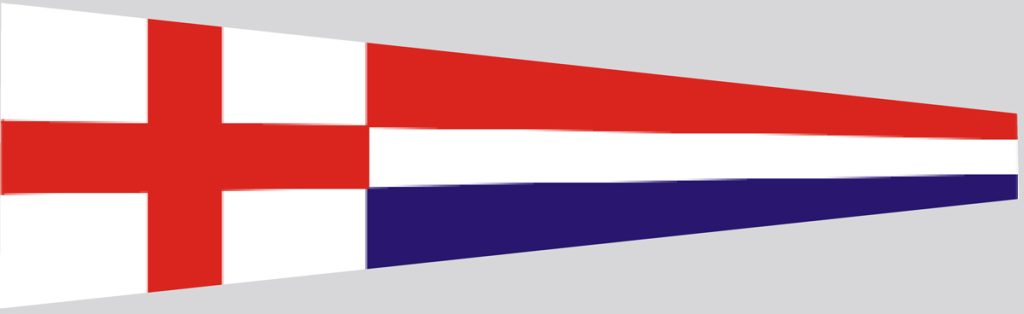
[caption id="attachment_31125" align="aligncenter" width="593"] The church pennant consists of two national flags: the English Flag at the hoist and the Dutch National Flag in the fly and is flown when prayers are held in an HMC ship.[/caption] — When prayers are held in an HMC ship, the church pennant is flown. This flag, also used in all Commonwealth navies and the Royal Netherlands Navy, is a broad pennant consisting of two national flags: the English Flag at the hoist and the Dutch National Flag in the fly. The design originates from the Anglo-Dutch wars of the late 17th century, when the pennant was used to indicate a ceasefire was necessary because a religious service was in progress. ‘O Eternal Lord God, who alone rulest the raging of the sea’ is the first line of The Naval Prayer, a standard during the prayers portion of morning divisions. First published in 1662 in the Book of Common Prayer, The Naval Prayer has remained mostly unchanged since then. The Sailor’s Psalm (Psalm 107, verses 23-30) begins with ‘They that go down to the sea in ships, and occupy their business in great waters’ is commonly recited at Remembrance Day and Battle of the Atlantic services. It describes distressed sailors praying to the Lord and being delivered to safety. Another standard at naval services is the Naval Hymn ‘Eternal Father, strong to save’. Written in 1860 by the clergyman William Whiting after surviving a storm on the Mediterranean Sea, it is generally thought to have been inspired by the Sailor’s Psalm. What do sailors pray for? Most likely for their family, friends, loved ones, shipmates, and especially those who have crossed the bar, a term which means to have passed away, i.e., leave life’s harbour, directly derived from the 1889 poem Crossing the Bar...

The helmet protects the stories of veterans

[caption id="attachment_31121" align="aligncenter" width="595"] 1942 Brodie Helmet Shell with veteran’s signatures.[/caption] ASLt Willis McCullough-Messom, HMCS Ottawa — A 1942 Brodie Helmet Shell holds the stories of 15 veterans across Canada. Affectionately named ‘The Helmet’, Acting-Sub Lieutenant Willis McCullough-Messom of HMCS Ottawa began the project by repainting the helmet he acquired and set out across the country to have veterans sign it while listening to their stories. ‘The Helmet’ is a project designed to capture the stories of the greatest generation. As the average age of a Second World War veteran quickly approaches 100 years old, the time to capture their stories is now. I was keenly interested in Canadian military history from a young age. After joining the Canadian Armed Forces in 2018, I was allowed to attend a Battle of Britain Commemorative event at Camp Hill veteran’s hospital in Halifax, N.S. This was my first interaction with Second World War veterans, and I was immediately intrigued. Immediately upon being posted to CFB Esquimalt, I sought out opportunities to volunteer at a veteran’s hospital. I came across Broadmead Care Home, home to over one hundred veterans, many of whom served during the Second World War. I wanted to find a way to capture my interactions with these veterans, so in March 2022, I acquired a 1942 Brodie Helmet Shell, the perfect object upon which I could commemorate both their service and our interactions. The first veteran on The Helmet was the product of a chance interaction. I was enjoying a Sunday brunch when I overheard Bob Haden discussing his wartime service with some of the other patrons. I politely approached Bob and asked him if he was a veteran, to which he quickly replied, ‘Yes, Navy, joined in 1943’. We had a quick conversation, and I scheduled an interview for the next weekend. On the first day, I captured two hours of wartime experiences from his time aboard Fairmile Q087, HMCS U-889, and HMCS MicMac. I was in awe and knew I...

HMCS Calgary

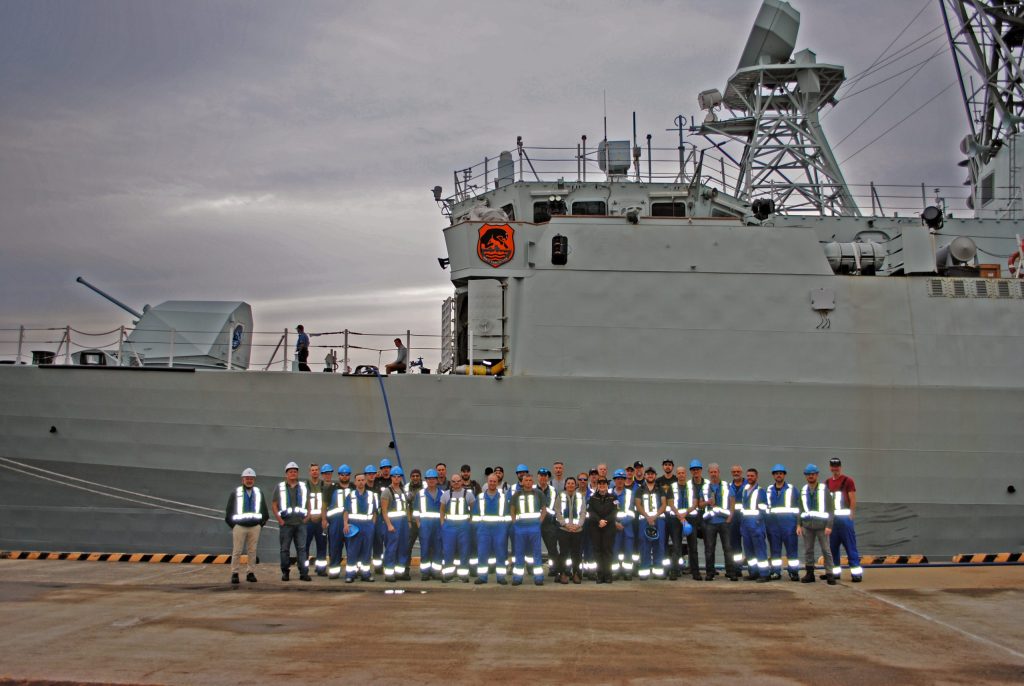
HMCS Calgary undocking at Fleet Maintenance Facility Cape Breton

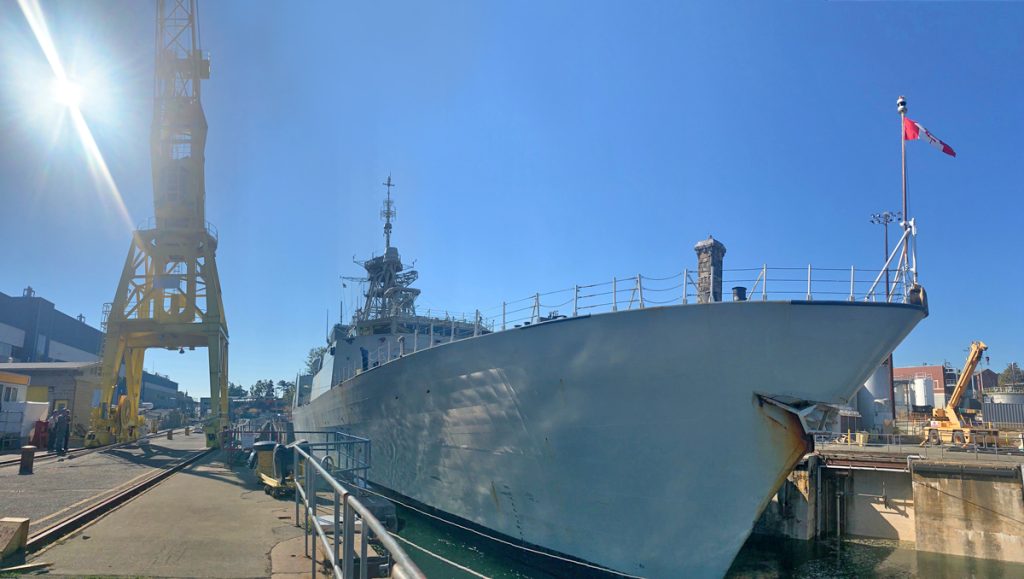
Gabrielle Brunette, Communications Coordinator Student at FMF CS — On Oct. 3, the Fleet Maintenance Facility Cape Breton (FMF CB) workforce and ship staff (SS) worked together on the undocking evolution of His Majesty’s Canadian Ship (HMCS) Calgary from the FMF CB dry dock after a recent work period. The ship was docked in the FMF CB dry dock for 10 weeks. “Having a dry dock in our facility that we can use at any time, and the staff to be able to complete that job, is a strategic asset in its own for the RCN (Royal Canadian Navy),” said Captain (Navy) Sebastien Richard, FMF CB Commanding Officer. HMCS Calgary docked this past August as part of its Extended Work Period 1 (EWP1). During this time, FMF CB worked to remove all required systems to prepare the ship for its deep maintenance cycle every five years. The personnel removed the rudder, the rotary vane actuator (a significant component of the steering systems), combat systems and deck equipment while ensuring the preservation of marine systems equipment. The staff also conducted hull maintenance and repairs. Five FMF CB shops were involved in the docking and undocking of HMCS Calgary: Personnel from the Scalers/Cleaners Shop; Shipwright Shop; Rigging Loft; Mechanical Fitters Shop; Electrical Shop. The teams in the Naval Architecture, Industrial Engineering, and RpOPS departments were also integral to the success of these evolutions. This is not the first time the FMF CB workforce has worked closely with ship staff to succeed in docking and undocking evolutions, and it will not be the last. The FMF CB team routinely displays work of excellence in concert with ship staff, demonstrating the broad abilities of all involved in support of RCN operations. Christian Parisé, Project Leader and Ship Service Officer for HMCS Calgary, said collaboration between...

Explore More

Categories

Top News

E-Editions Archive

News Stories Archive

Proud Supporters

Joshua Buck, Lookout Newspaper