New barges bring exciting capability to the Navy
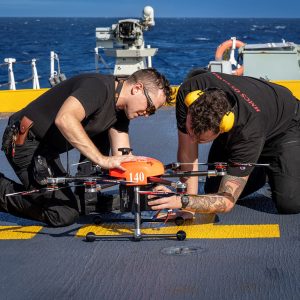
[caption id="attachment_31106" align="aligncenter" width="595"] Canadian sailors train in Esquimalt, B.C., using the new sea-to-shore connector, a modular, self-propelled barge designed to support the future Joint Support Ships. Photo: Sailor First Class Kendric Grasby.[/caption] Royal Canadian Navy Public Affairs — A ground-breaking capability for the Royal Canadian Navy (RCN) is one step closer to reality. A new phase of training for four modular, self-propelled barges designed to support the future Joint Support Ships (JSS) was recently completed. Called sea-to-shore connectors, these barges can quickly move large quantities of mission-essential equipment, stores and personnel to and from shore, and can be stored or transported like standard shipping containers. Sea-to-shore connectors have multiple uses and configurations, and are engineered to be assembled from the JSS. In October, 18 sailors, including Boatswains and Marine Technicians, concluded five weeks of collaborative training in Esquimalt, B.C., with instructors from the Defence College of Logistics, Policing and Administration in the United Kingdom (UK). The Royal Navy has had a similar capability for over 60 years. The U.K. team could provide expert knowledge and advice about the new equipment – from myriad operational uses to technical repairs. “We originally wanted help in using the sea-to-shore connector tactically, but we have tapped into the U.K.’s knowledge and opened a full Pandora’s Box in what can be done with them,” says Lieutenant-Commander (LCdr) Rowan Wilson, Executive Officer and Staff Officer, New Capability and Training at Naval Personnel and Training Group (NPTG) Headquarters. “We are just scratching the surface of this cool new capability and, hopefully, it will get more people excited about what the Navy does.” The first of the four barges, built by Navamar of Montréal, has already been delivered to Esquimalt. Three more barges are expected over the next 12 months – two more on the West Coast and one on the East Coast. LCdr Wilson is particularly enthused about the potential for a new, non-combat amphibious capability as the new barges can be driven right up to...