Swift messengers on motorcycles
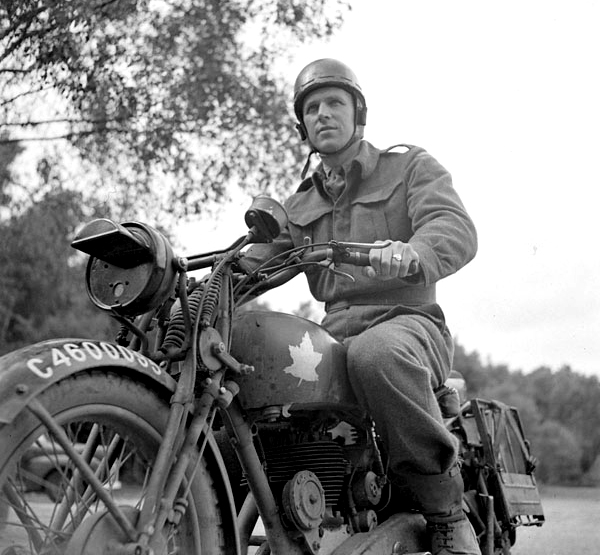
[caption id="attachment_20997" align="alignnone" width="592"] Dispatch rider Frank Shaughnessy of the 2nd Anti-Tank Regiment, Royal Canadian Artillery.Photo: Library and Archives Canada, MIKAN 3202240[/caption]Jay Rankin, Army Public Affairs ~Tucked in the LeBreton Gallery in Ottawa’s Canadian War Museum are two motorcycles bearing the history of a special trade that was prominent in the First and Second World Wars.The museum has a Harley-Davidson and a Norton motorcycle on display that were used extensively by Canadian Dispatch Riders. A Dispatch Rider, called DR, Don R, or Despatch Rider, which was the British spelling, were military messengers on motorcycles in a time of low-tech solutions. It was a Canadian Dispatch Rider who carried the first films of the D-Day landing away from the beaches of Normandy for shipment back to Britain.Before motorcycles were put into service, Dispatch Riders rode on horseback or bicycle. In Egypt during the First World War, even camels were used to carry these military couriers.Duties of Dispatch RidersThe duties for the riders, a trade in which both women and men served, commonly involved delivering maps, orders, intelligence and situational updates that could not be sent – for security and logistical reasons – through telephone or radio. They often led the way to new locations after delivering new orders. Sometimes the riders would even deliver equipment, caged live homing pigeons and medical supplies. It was a dangerous job that required all forms of skills with the bikes, from quickly navigating dangerous terrain to fixing a bike in the field, all while under the constant threat of enemy fire. Among other tactics, the enemy would set neck-level trip wires across dark roads and known trails.“Because they were on their own and they had to use their own wits, Dispatch Riders, if they came under fire, or their access to road was denied by enemy fire,...