[wpml_language_selector_widget]
[searchwp_form id="1"]
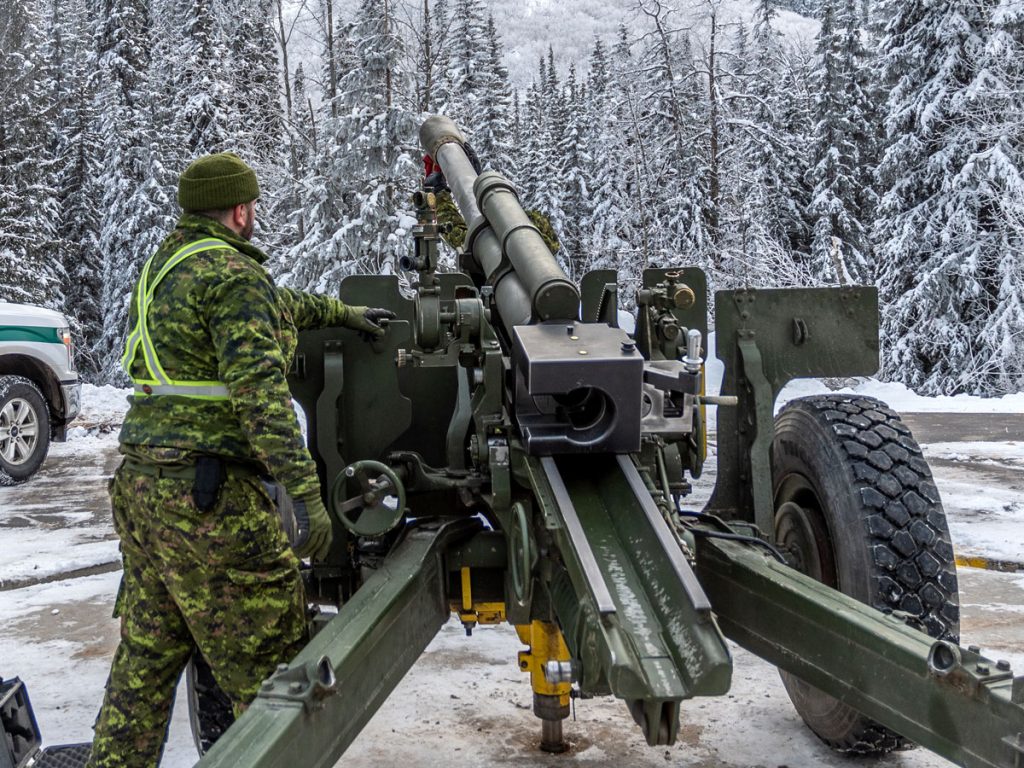
A gunner from the 1st Regiment

Big guns are ready for Operation Palaci

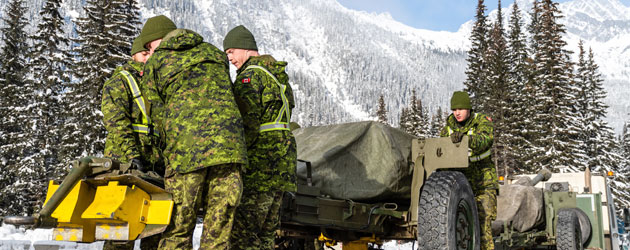
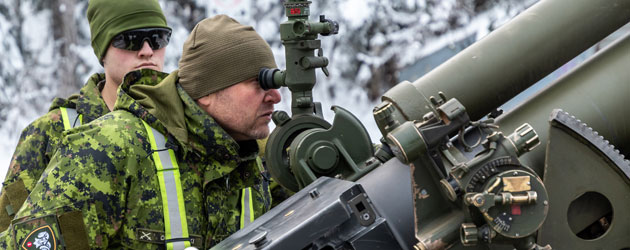
[caption id="attachment_19883" align="alignnone" width="589"] A gunner from the 1st Regiment, Royal Canadian Horse Artillery, prepares for a bore sight inspection of the C3 105mm Howitzer by the Parks Canada Agency. Photo by SLt M.X Dery[/caption]SLt M.X. Déry, JTFP PA Office ~Every year since 1961, Canadian Armed Forces’ (CAF) gunners from all over Canada come together during Operation Palaci in Rogers Pass, British Columbia. Their job: to trigger avalanches using C3 105mm Howitzers in this vital choke-point in Canada’s transportation corridor.These carefully planned artillery strikes are conducted to support the Parks Canada Agency’s (PCA) Avalanche Control Program that keeps the Trans-Canada Highway and the Canadian Pacific Railway safe from large, natural avalanches. Parks Canada avalanche technicians determine when avalanche control is needed and choose the target avalanche start zones using increasingly refined snow science.Troop Commander Lieutenant Kevin Little is the Artillery Officer that leads the first of two rotations, comprised of 17 members from 1st Regiment, Royal Canadian Horse Artillery, based out of CFB Shilo, Manitoba, and augmented by members from various reserve artillery units.“I think Op Palaci is exciting for all members because of its unique nature,” said Lt Little, adding that the beauty of the Pass is definitely a highlight.Seeing the majestic peaks in Rogers Pass, like towers along a giant, snow-covered stone wall, it is no wonder that this “palace” in the sky was the source of the operation’s name: Palaci, the Latin for palace. Although beautiful, these mountains, surrounding the short 39km stretch of the transportation corridor that connects BC to the rest of Canada, are home to the most active avalanche areas in the country. The C3 Howitzers have been modified and are positioned on one of the 16 specialized rings that line the narrow highway. Space is at a premium, with gun positions just large enough...
The final crew of CH-12405 at 8 Wing Trenton on Nov. 20. Photos by Makala Chapman

Final Flight: Sea King lands in Trenton

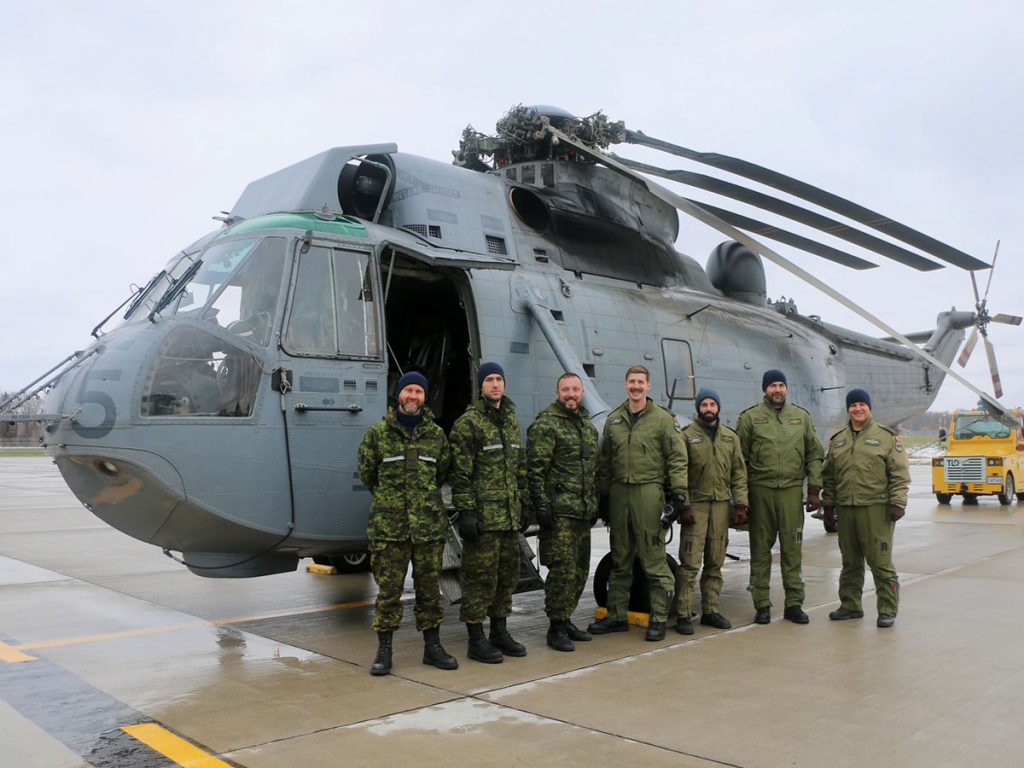
[caption id="attachment_19880" align="alignnone" width="589"] The final crew of CH-12405 at 8 Wing Trenton on Nov. 20. Photos by Makala Chapman[/caption]Makala Chapman, The Contact Newspaper ~One of the Royal Canadian Air Force’s (RCAF) longest-serving helicopters has landed in Trenton and is now calling Quinte West home. A modest crowd gathered at 8 Wing Trenton to watch as CH-12405 Sea King emerged from the grey horizon, savouring its final moments of flight on Nov. 20, as this year marks the retirement of the Sea King helicopter. Having arrived from Patricia Bay, British Columbia, the aircraft will soon be put on display at the National Air Force Museum of Canada (NAFMC), where it will continue to serve as a reminder of Canada’s rich aviation history. On hand to marshal the maritime helicopter was Wing Chief Warrant Officer Troy Zuorro. While not a normal duty of the Wing Chief, with an extensive career working with the Sea King, he noted it was an opportunity he didn’t want to miss and was honoured to have been a part of the arrival. First procured by Canada and put to work in 1963, the maritime aircraft has been at the forefront of missions both domestically and abroad, as well as having worked extensively with the Royal Canadian Navy. Initially tasked with keeping watch for enemy vessels, as the aircraft is equipped with sonar equipment, radar and homing torpedoes, the role of the Sea King eventually broadened.Boasting a compact design with a fold-up rotor and tail, the Sea King is a versatile aircraft that’s been used for search and rescue (SAR) operations to disaster relief. Overseas, the aircraft has been used during peacekeeping operations to help transport troops and for surveillance. Since it is maritime aircraft, it operates primarily on the coasts of Canada out of 12 Wing Shearwater, Nova...

The Hardy family: Sarah (left)

I give to NDWCC because…

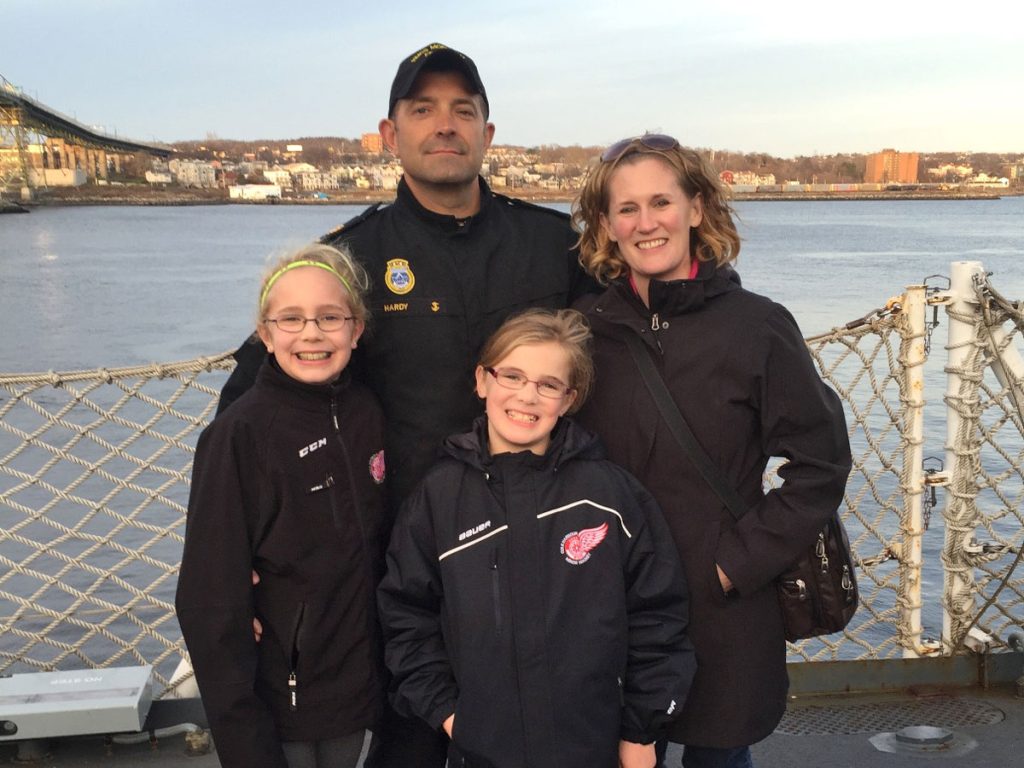
[caption id="attachment_19869" align="alignnone" width="591"] The Hardy family: Sarah (left), Ed, Elizabeth and Nathalie.[/caption]Margaret Conway, CFB Halifax Base PAO ~Have you ever met someone who was married in a hospital? I hadn’t until I met CPO1 Ed Hardy. Twelve years ago, CPO1 Hardy and his spouse Nathalie stood face-to-face in room 505 at the IWK children’s hospital in Halifax. CPO1 Hardy’s best ‘man’ was a nurse who’d just started her shift; Nathalie’s maid of honour was another nurse working in the same unit. With the minister from their church present, and two rings that had been picked out and delivered by a family member, the two were married in the simplest of ways. A wedding is a happy occasion, of course. But at the time of their union, CPO1 Hardy and Nathalie were facing the most challenging time in their lives. They wanted to be married in the presence of their two daughters and had been planning a formal ceremony to be attended by close family and friends. Unfortunately, a scary medical prognosis meant their youngest daughter might not live to witness that special day. A wedding in room 505 allowed CPO1 Hardy and Nathalie to exchange their vows, as they’d wished, with their two daughters by their side. Not long before they were married in that hospital room, their three-month-old daughter Elizabeth was diagnosed with a rare liver disease. Her diagnosis was followed by seven months of continuous hospitalization during which she endured in excess of 90 blood transfusions, 13 surgeries, a transplant and two life flight airplane trips between their home in Halifax and a hospital in London, Ontario. For three and a half months of that hospital stay, Christmas included, CPO1 Hardy and Nathalie lived at the Ronald McDonald house in London while their two-year-old daughter Sarah remained in...

A real homecoming at Victoria memorial

A real homecoming at Victoria memorial

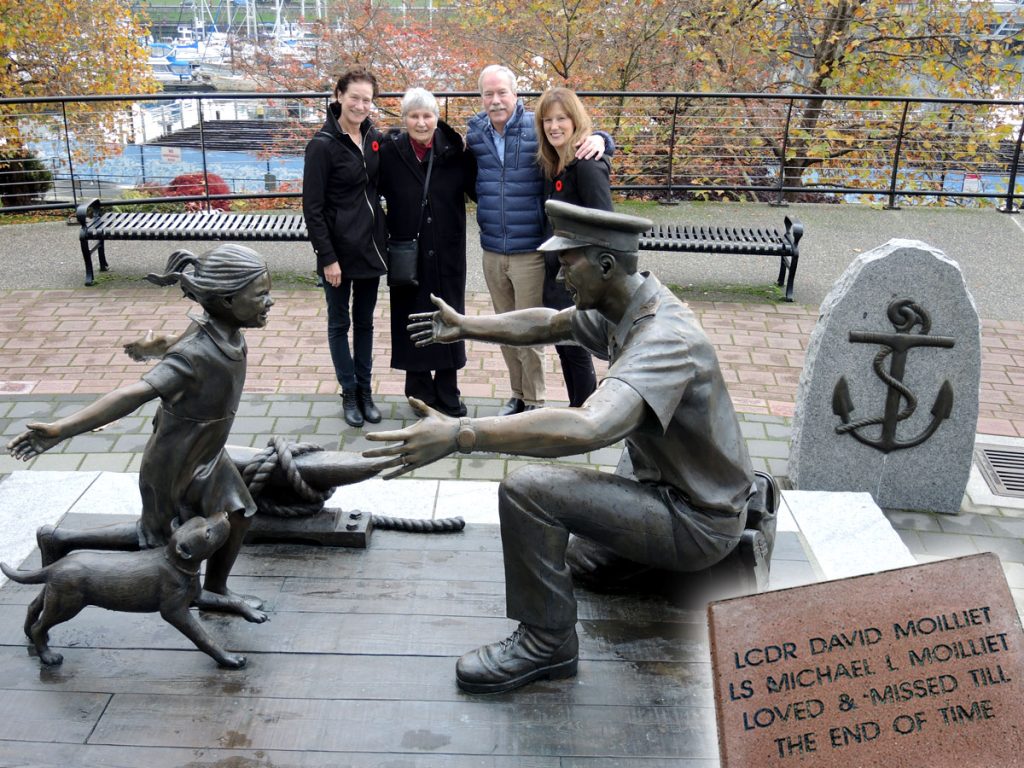
Peter Mallett, Staff Writer ~As 88-year-old Sheila Moilliet gazed upon the red bricks at the Homecoming Statue bearing the names of her deceased husband and son, she felt a deep satisfaction knowing she had brought them home. “My husband David had always described Vancouver Island as ‘god’s country’ and always wanted to go back, and Michael was born in Victoria,” said Sheila Moilliet. “When I first heard about the brick initiative – I exclaimed ‘that’s it’ I can bring this full circle and take them and their memory home.”Husband, Lieutenant-Commander (Retired) David Moilliet died in 2017, and son, Leading Seaman (Retired) Michael Moilliet, died almost a decade ago. Their names are now a permanent part of the downtown memorial that honours the military. On Friday Nov. 9, the family matriarch travelled from Ottawa with her three children to visit the newly-installed brick bearing the names of her loved ones. “This is such a great moment for me and the family, to dedicate this brick is such a moving experience,” said Sheila. “Seeing their names on the bricks is very emotional for me and the family.” The homecoming statue was created by artist Nathan Scott and is part of an outdoor memorial paying tribute to the 100th anniversary of the Royal Canadian Navy (RCN). Scott’s statue depicts a kneeled sailor as his daughter leaps into his arms; it captures the moment when a sailor comes home to their family after a long deployment at sea. Sheila said the occasion felt like a homecoming for the Moilliet clan. She made the trip with daughters Alizon Thuot and Wendy Lamble, and son Deric Moilliet.The next day the family travelled to Parksville to scatter the ashes of David Moilliet at an oceanside beach where David once played as a child. They then returned to Victoria...

Veteran discovers Dad’s poem from the trenches

[caption id="attachment_19854" align="alignnone" width="298"] LS (Retired) Wayne Archibald displays the medals of his father Private Issac Archibald of Truro, N.S., who fought for Canada in France during the First World War. Photo by Peter Mallett, Lookout[/caption]Peter Mallett, Staff Writer ~Canadian First World War survivor Private Issac Jackson Archibald died four decades ago but his recollections of war and life in the trenches live on through his poetry.On Nov. 9, as Victoria prepared for Remembrance Day and the 100th Anniversary of the Armistice, 82-year-old Leading Seaman (Retired) Wayne Archibald made a surprise visit to the Lookout’s headquarters on Signal Hill to share his father’s gift of poetry with our readers.He wanted to share the heartfelt and descriptive first-hand accounts by his father and his hand-written verse entitled Somewhere in France 1917.“This poem is very special to me, so I thought I would share it,” said Archibald. “My dad was one of the lucky ones and made it home from the war safe. He penned the poem in France, but we don’t know the exact date and are unsure of the precise location. The only thing we know was that it was written at some point during the last year or so of the war.”The poem was penned somewhere on the battlefield during a break in the fighting, but Archibald says his father’s regiment and the battles he fought in remain unknown.The poem was recently discovered in a storage box earlier this year.The scant details of his father’s military service are not dissimilar to other sons and daughters of the survivors of ‘The War to End All Wars’, a bloody conflict that killed approximately 60,000 Canadian soldiers and changed the lives of countless others.“My Dad never talked about the war, it was very upsetting to him,” said Archibald.Issac’s brother William died while fighting in the same line of trenches located less than a quarter of a mile away from him.“He didn’t find out his brother had died until six months later,” said Archibald.Issac...

Cpl Ryan Plamondon of 39 Signal Regiment

Communications skills tested

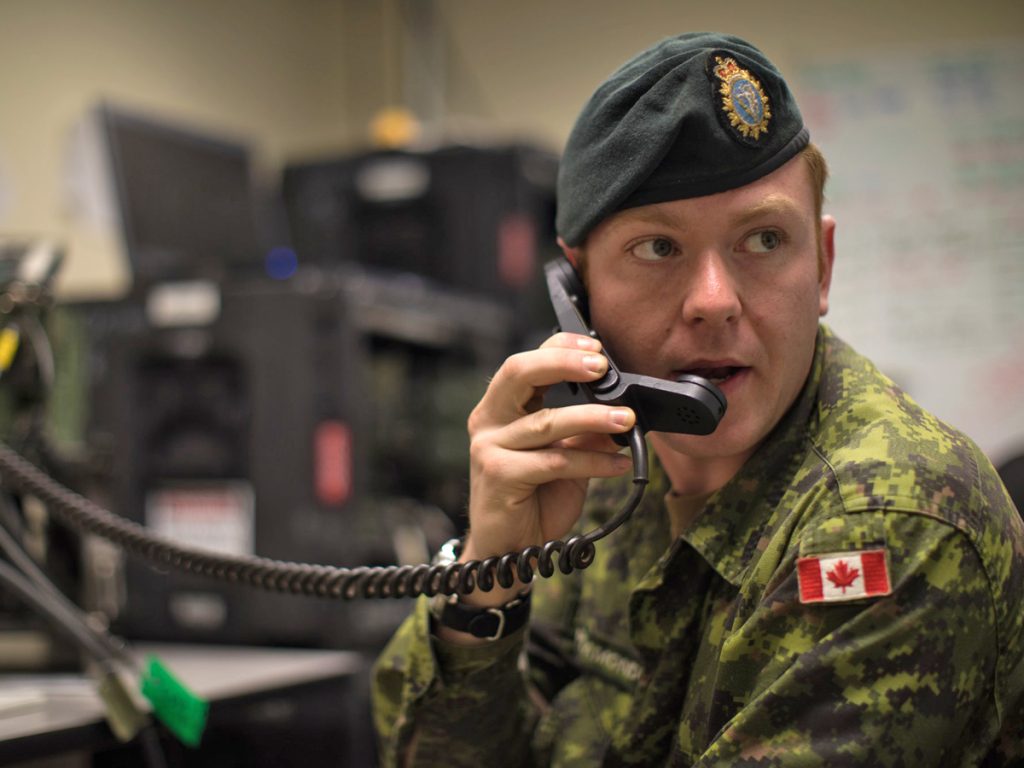
[caption id="attachment_19840" align="alignnone" width="591"] Cpl Ryan Plamondon of 39 Signal Regiment, B Squadron Nanaimo, listens to High Frequency (HF) radio chatter during Exercise Noble Skywave.[/caption]Capt Jeff Manney, 39 Sig Regt PAO ~It’s day three of Exercise Noble Skywave, a friendly radio competition involving NATO nations and civilian radio affiliates around the world. Cpl Ryan Plamondon repeats the call from 39 Signal Regiment’s Nanaimo operations centre, his words riding skyward on 400 watts of high frequency (HF) radio energy.  First, they’ll hit the ionosphere, then, if his settings are correct, they’ll bounce to a similar radio half a world away. An accent breaks through the ever present hiss of radio static. “Charlie Alpha five four, this is Papa Echo two two.  You are loud and clear. How me, over.”Cpl Plamondon eyes the other signallers. They’ve just reached Peru. “Cool,” he says to the room. In 2018 Cpl Plamondon and his Peruvian counterpart could have been Snapchat buddies hours earlier, without the need to mobilize a literal army to talk on the radio. But in a natural disaster, an earthquake or flood, the vital communication infrastructure British Columbians take for granted may not be working. “In the event of an emergency, HF radio is one of the tools we’d use to talk with Ottawa or international agencies,” says Cpl Plamondon. “Among our many roles, signallers would help re-establish critical communication links, so government agencies can begin the recovery effort.”Overseen by the Canadian Army’s Joint Signal Regiment in Kingston, Noble Skywave is intended to keep Regular and Reserve Force signals skills fresh. The competition awards points based on the number of communications links made. A portion of the event requires signallers to eschew any automatic HF technology, like digital data links, and focus on simple voice calling.“It’s a great training opportunity,” Cpl Plamondon says. “We get to experience the same...

CANEX

CANEX gaming series attracts more players

Peter Mallett, Staff Writer ~This year’s CANEX Championship Gaming Series (CCGS) reported upswings in participation, prize value and online buzz after the third annual online competition concluded Oct. 21.The CCGS is organized by CANEX, Canada’s Military Store. This year’s series pitted six-player teams from across the country competing in the popular multi-player, first-person shooter video game Overwatch. Insomnia Gaming, a team comprised of players from CF Bases Kingston, Saint Jean, and Valcartier, were declared the overall champions of the three-day competition. For their feat of cyber savvy, the victors claimed a prize package of gaming accessories valued at $2,969. CANEX Segment Marketing Manager Michael Prouty was excited to report CCGS participation numbers increased again this year. This year’s edition saw 126 players registered on 19 teams from 19 military bases; up from last year’s totals of 16 teams and 109 players from 17 bases. The total value of prizes also increased by over $1,200 to $8,539. He emphasized that overall interest in the gaming series has increased ever since it was launched in 2016 and has been spurred by social media buzz and improved prizes packages. “We are excited to present this event every year and are thrilled our members are enjoying this entertaining event that promotes fun, teamwork and competition,” said Prouty. “We created this game to help connect like-minded individuals in the CAF, and the overall feedback from players and live stream viewers has been overwhelmingly positive.”Other CCGS winners included the team, Fix Phoenix from CFB Halifax who claimed second place. Esquimalt did not field an entire team in the competition but instead had a total of six players participating on the following teams: Overwatchforgen, Quantum Gaming and The Drunken sailors. For results of this year’s event, visit the web page: www.canex.ca/ccgs

Volunteering enhances sailor’s life

Volunteering enhances sailor’s life

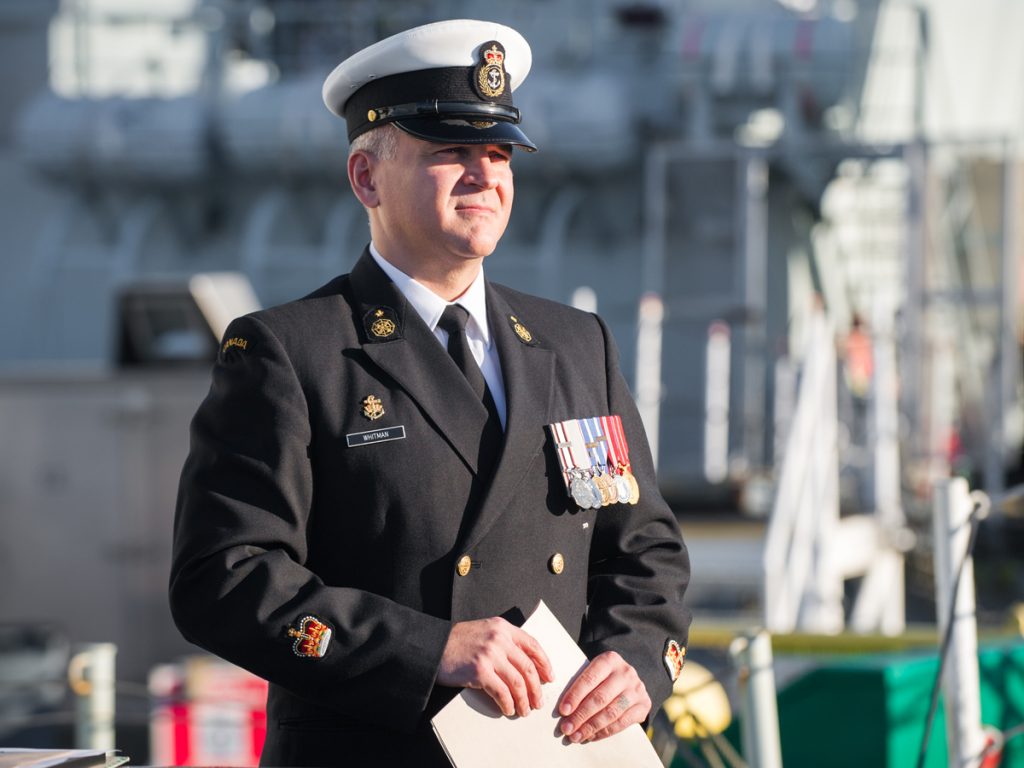
MARPAC Public Affairs ~Like many sailors in the Royal Canadian Navy, Petty Officer First Class (PO1) Brian Whitman’s commitment to service includes giving back to his community. Despite spending most of his time at sea, the first thing he does when he is on land is pick up where he left off with his volunteering activities. Throughout his career, he has volunteered at the Mustard Seed Food Bank; assisted the Military Family Resource Centre (MFRC) for 10 years, while also working as the MFRC representative on board ships; and most recently volunteered with Habitat for Humanity Restores.His work at the nonprofit’s Restore included assisting in the loading bay with incoming donations, repairing merchandise, and helping carry out purchases for customers. In October 2017, when he was named Coxswain for HMCS Yellowknife, he had to reduce his volunteering hours, but kept it up as much as he could. PO1 Whitman spent 18.5 years of his 22.5 years of service on board Royal Canadian Navy ships, and has circumnavigated the globe several times. When asked why he started volunteering, he explained it all started when, as the MFRC representative on ship as part of his duties, he realized what a positive impact it was having on his life. He then started volunteering with the MFRC on land, which led to volunteering with other organizations. “Nothing gives me more satisfaction than seeing the appreciative faces of those I help. Who wouldn’t enjoy that?”PO1 Whitman encompasses the navy’s vision of always being ‘Ready to Help’. When he isn’t giving back to the community or serving his country he also enjoys spending time with his partner, son and daughter.

OS Vandersleyen (centre) and OS Charest (right) are joined by Cdr Sauvé

Marine technician trade evolving

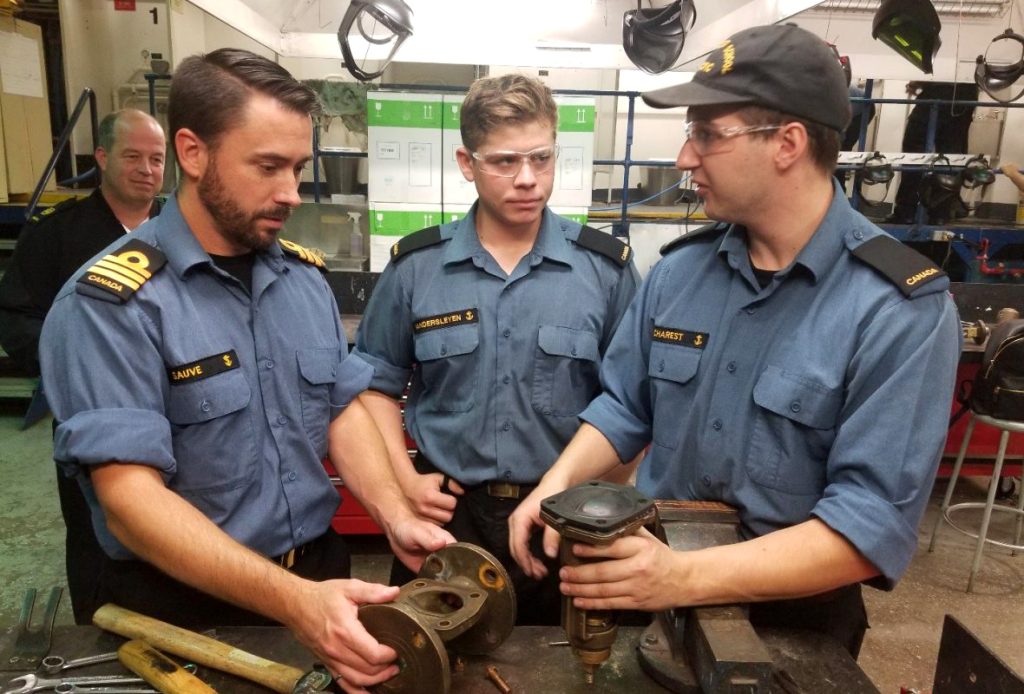
[caption id="attachment_19830" align="alignnone" width="589"] OS Vandersleyen (centre) and OS Charest (right) are joined by Cdr Sauvé, Commanding Officer of the Naval Training Development Center (Pacific), shown here investigating a defective diaphragm valve.[/caption]Selena Benard, NTDC(P) ~In 2017, the Royal Canadian Navy stood up the Marine Technician trade. This new trade replaced the legacy trades of Marine Engineer, Hull Technician and Electrical Technician. The vision for the Marine Technician trade is to train ­sailors to be capable and flexible in an ever-evolving technological environment. Given the emerging technologies such as electric drive ships, changing power generation technology, and even composite hulls, the old divisions between trades were breaking down at an ever-greater rate.Marine Technicians are being trained as generalist technicians across a broad swathe of machinery, skills and capabilities. This allows members of a ship’s Marine Systems Engineering department to be capable in all aspects of the operation of the ship’s equipment. No matter which ship class a Marine Technician is assigned to, they will have the knowledge needed to operate the equipment on board, be it electrical, mechanical or even physical repairs to the ship’s structure.The new organization of Naval Personnel and Training Group has created Training Development Centres (Pacific) and (Atlantic). On the West Coast, the Training Development Centre is tasked as the Curriculum Control Authority to oversee and plan for the development of all MARTECH training and education. As new technologies mature and become available and deployed on Royal Canadian Navy platforms, the training will be updated to match, keeping personnel flexible and ready to deploy on any platform.

Members of the CFB Halifax and PSP community gathered outside Stadplex after Base Commander Capt(N) David Mazur locked the doors of the now-closed facility on Oct. 31.

Stadplex doors officially close after 75 years

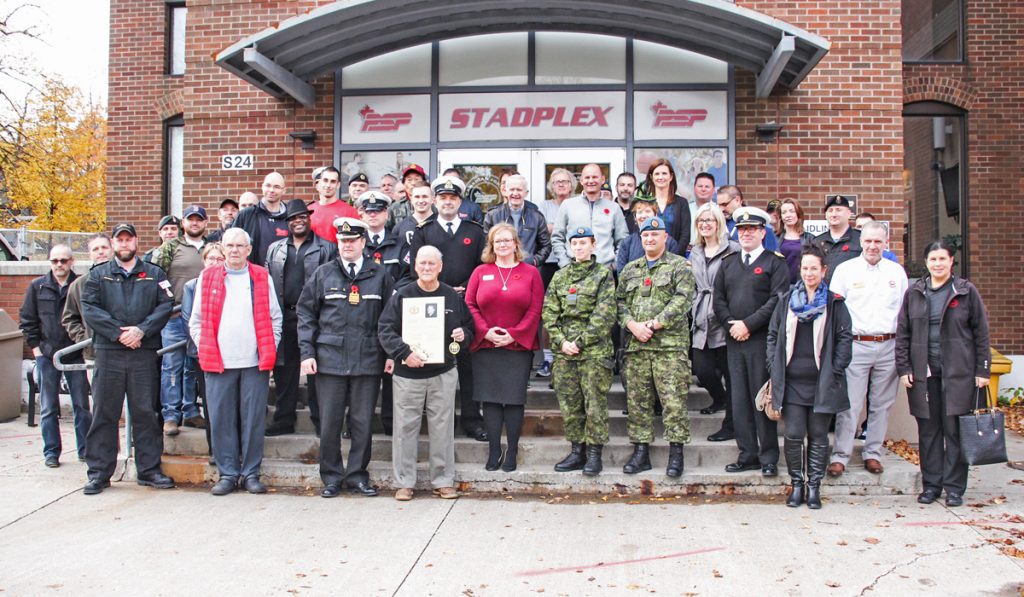
[caption id="attachment_19827" align="alignnone" width="590"] Members of the CFB Halifax and PSP community gathered outside Stadplex after Base Commander Capt(N) David Mazur locked the doors of the now-closed facility on Oct. 31.[/caption]Ryan Melanson, Trident Newspaper ~It was the end of an era for fitness and sports at CFB Halifax when the Stadacona Sports and Fitness Centre (Stadplex) gym, open on the base since 1943, officially ceased operations Oct 31.The facility had reached the end of its useful life and was beyond long-term economical repair.To mark the bittersweet moment, a group of PSP employees, base leadership, and others who had special connections to the building gathered in the lobby for cake and to say goodbye to the facility.“This building has supported the fleet and supported army, navy, and air force men and women, as well as the civilian community and veterans, and served us well for 75 years,” said Capt(N) David Mazur, Base Commander, who also explained the efforts being made in the short term to mitigate the impact on CAF members until a permanent replacement for the gym is in place. These include extended hours at the Dockyard and in Shearwater, hotel-style gyms in Juno and Tribute Towers, and more. Complete information on the short and long-term plans for the future of fitness and sports at the base can be found at http://cafconnection.ca/halifax.“It’s not going to suit everyone’s needs while we go without a purpose-built facility like we’ve always had, but there is a future ahead of us and we’re moving on to the next steps right away,” said Capt(N) Mazur.Joni Sawler, PSP Halifax Senior Manager, thanked the patrons who made such good use of the facility, the PSP staff members who’ve provided services there for the last two decades, and others who supported events or gave back to the gym in...

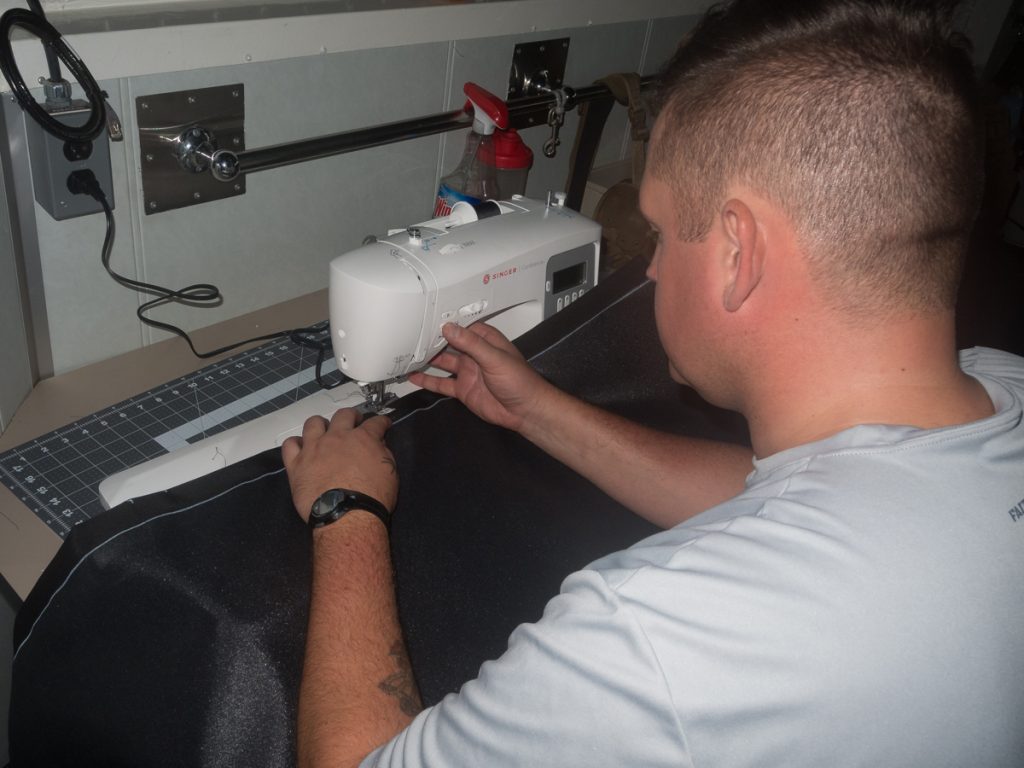
A Boatswain in works to sew some privacy curtains.

Boatswains… sew what?

[caption id="attachment_19824" align="alignnone" width="591"] A Boatswain in works to sew some privacy curtains.[/caption]Capt Jenn Jackson, Operation Caribbe PAO ~When one thinks of a boatswain’s work sewing is not something that comes to mind. But it is part of their cache of skills, and one boatswain is busy stitching while in HMCS Nanaimo during Operation Caribbe. “It was a last-minute decision to add a sewing machine to our kit,” says the boatswain, who cannot be named for operational security reasons. “But it has already come in handy, allowing me to make some additional privacy curtains for around the accommodations pod.”Learning the basics of a sewing machine is part of QL-3 boatswain training, and at the QL-5 level they are required to make bags and other small projects to hone their skills. While it is part of the core training for the trade, it’s not always a boatswain’s first exposure to sewing.“I first learned in junior high, and then learned more from my grandmother. I like doing it. There’s a rhythm to it that clears the head and it is great to see my finished project and the results of my hard work.”Sewing is a regular part of this boatswain’s shift as a day worker during Operation Caribbe, when he is not working on other duties such as special sea duty helmsman or as a small boat coxswain.“You’d be surprised how much sewing is needed on a ship. Uniform repairs, covers for boats, nametags. I have even sewn some fancy napkins for a reception.”As HMCS Nanaimo continues Operation Caribbe, rips and tears will be well mended.

10th annual Gingerbread Showcase fundraiser

Volunteers needed for annual Gingerbread Showcase event

Peter Mallett, Staff Writer ~Victoria’s branch of Habitat for Humanity is looking for volunteers to help at its 10th annual Gingerbread Showcase fundraiser event that kicks off this weekend and runs for seven weeks. The theme for this year’s ginger-bread baking competition is There’s No Place Like Home, and the charity has enlisted approximately 30 amateur and professional bakers from across the Greater Victoria Area. Bakers can create anything that goes with the theme providing everything they make is edible. Their irresistible creations will be on display daily from 9 a.m. to 9 p.m. in the atrium of the Parkside Hotel and Spa from Nov. 17 to Jan. 6, 2019, when a panel of judges will declare a winner of the contest. Christel Morrow, Habitat for Humanity Victoria Volunteer and Community Engagement Coordinator, is currently recruiting a team of Ambassadors to cover three hour shifts and is reaching out to military and civilian employees at the base to volunteer. “We are looking for people to welcome and interact with visitors of the display, let them know about our fundraiser and show them around the displays,” said Morrow.Visitors are not permitted to eat or touch the entries, but are encouraged to make a donation and vote for the winning entry. Following a decade of success in the United States, Habitat for Humanity Canada was established in 1985 in Winkler, Manitoba, with a mandate to build affordable housing for people in need. Since its establishment in Canada, Habitat for Humanity has expanded to 72 affiliates nationwide and provided over 2,500 families in all provinces and territories with housing. For more information about the Gingerbread Showcase and how to register as a volunteer visit their webpage: https://signup.com/client/invitation2/secure/2464778/false#/invitation

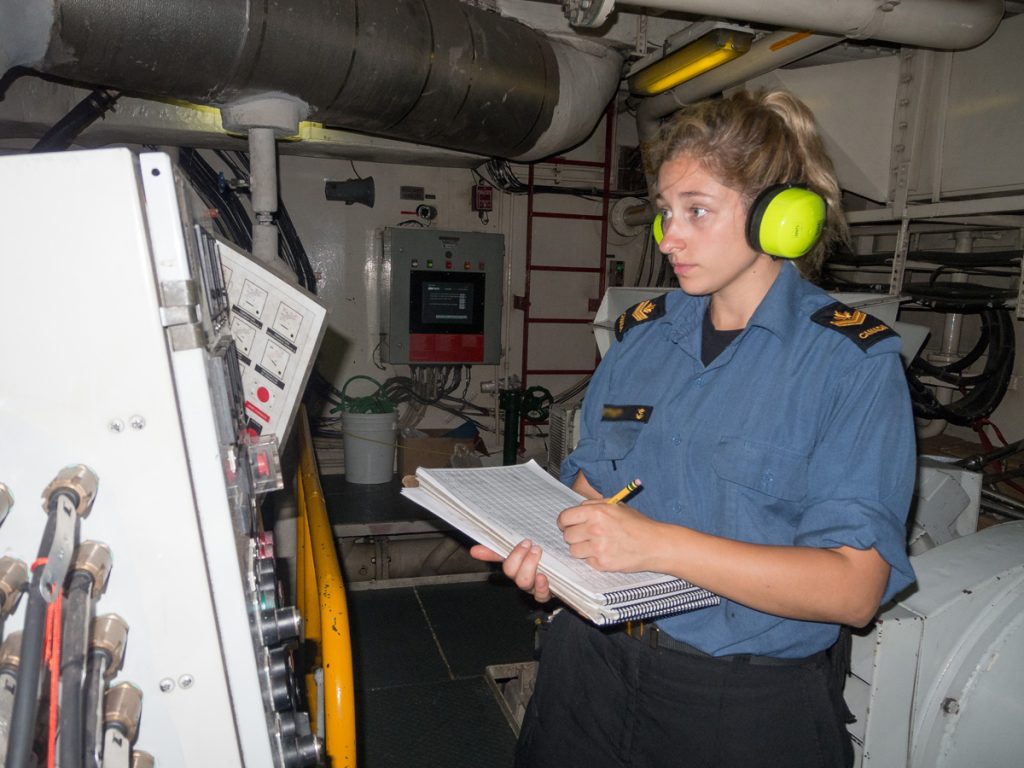
A Marine Technician records information from one of the ship’s diesel alternators as part of rounds.

The Little Engineering Team that Can!

[caption id="attachment_19817" align="alignnone" width="591"] A Marine Technician records information from one of the ship’s diesel alternators as part of rounds.[/caption]Capt Jenn Jackson, Operation Caribbe PAO ~The role of the Kingston-class Maritime Coastal Defence Vessels has certainly evolved in recent years. Originally used mainly for coastal surveillance, these 55-metre patrol vessels are now conducting extended operations such as Operation Caribbe.With longer blocks of time spent at sea, the engineering section in a Kingston-Class is one of the busiest teams – both at sea and while alongside.“The scope of the engineering team is quite diverse on this class of vessel,” says the Chief Engineer of HMCS Nanaimo, who cannot be named for operational security reasons. “During our deployment on Operation Caribbe, we are responsible for propulsion, power generation, water production, overseeing the maintenance programs for all departments, damage control monitoring, minor plumbing repairs and maintaining the radars and communications systems.”Typically, nine non-commissioned members, from the Regular Force and Primary Reserve, including Marine Technicians with various qualification levels, and a Weapons Engineering Technician, make up the team. Two of the team members are critical for the ship to leave port.“In order to sail, a C-ticket or CERT 4 qualified Chief Engineer and a legacy Senior Electrician must be embarked,” explains the Chief Engineer. “Other members of the team vary from ship to ship depending on the mission and availability of personnel, and it is common to have two to three Marine Technicians in the section working towards their next certification.”Mentoring and on-the-job training are key components to Marine Technician training. Almost every day on the ship, the section spends up to two hours doing engineering drills both in practical and table-top formats.“In addition to working towards initial qualification, Marine Technicians also have to maintain their certifications,” adds the Chief Engineer. “Doing engineering drills regularly...

National Day of the Child

Free art day in honour of Day of the Child

Peter Mallett, Staff Writer ~Children of military families are invited to express themselves artistically this weekend in Canada’s celebration of National Day of the Child. Personnel Support Programs (PSP) with assistance from the Military Family Resource Centre (MFRC) is offering a free art program for children ages five to 12. The event takes place on Nov. 17 at the Colwood Pacific Activity Centre (CPAC) between 9 a.m. to noon. Children will be asked to create drawings, paintings and other forms of artwork to become part of a group art project: the construction of a large tree of artwork for display. All 35 military bases across Canada will be constructing a tree with artwork, and forms of expression will vary from base to base. CFB Esquimalt’s tree of art will be on display at CPAC on Nov. 20, National Child Day. The art projects will eventually be sent to the Canadian War Museum in Ottawa for display later this year. Matt Carlson, PSP Community Recreation Manager, says the art project has two purposes.“It’s an initiative we are really excited about and one that celebrates the Day of the Child, and the role military recreational programs play in supporting operational effectiveness through family well-being,” said Carlson. “This art project will visualize the support PSP provides to military families and the healthy development of children within our unique communities.” National Day of the Child has been observed in Canada since 1993 and is meant to celebrate the United Nations Declaration of the Rights of the Child. It proclaimed on Nov. 20, 1959, that children are treated with dignity and respect. National Day of the Child celebrates these fundamental rights and includes the promotion and participation of children in cultural, artistic, recreational and leisure activities. Carlson says children of Department of National Defence employees and...

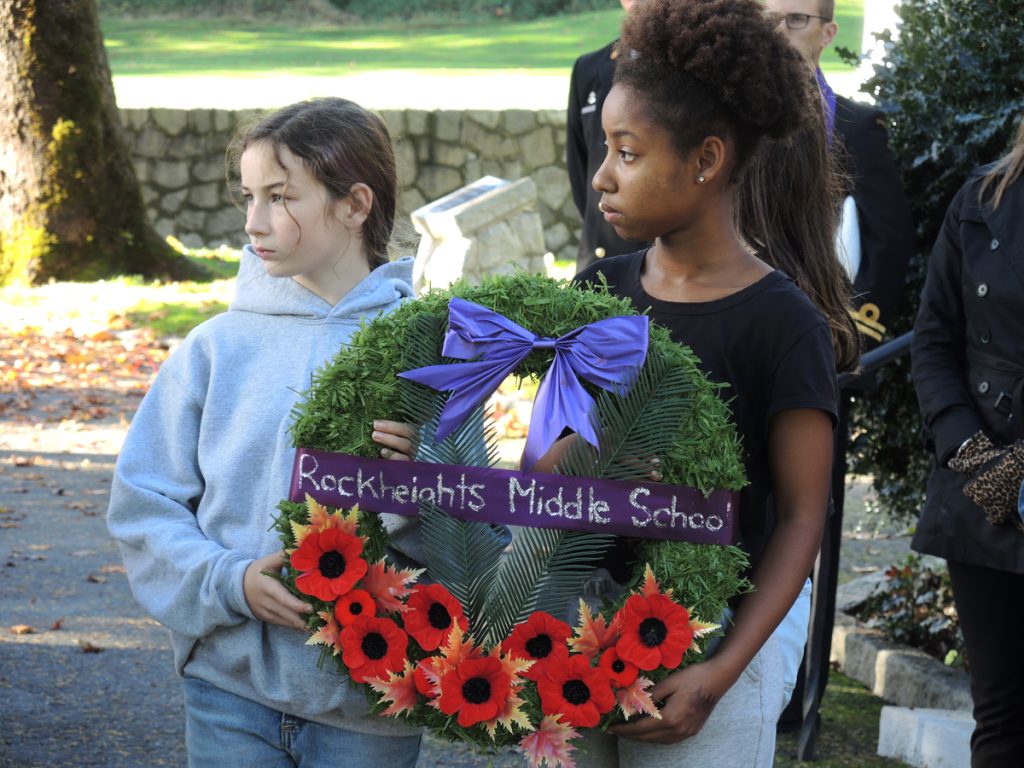
Wreath bearers from Rockheights Middle School take part in a moment of silence. Photo by Peter Mallett

Bridging the generation gap – No Stone Left Alone

[caption id="attachment_19811" align="alignnone" width="591"] Wreath bearers from Rockheights Middle School take part in a moment of silence. Photo by Peter Mallett, Lookout[/caption]Peter Mallett, Staff Writer ~It was another mission accomplished for Rockheights Middle School students and their annual quest to ensure the sacrifices of Canada’s war dead are remembered.On Nov. 2, approximately 150 Grade 6 and 7 students fanned out across God’s Acre Veterans Cemetery and placed poppies on the over 2,000 gravesites at the national historic site in Esquimalt. Students were joined by parents, teachers, personnel from CFB Esquimalt and veterans representing the Esquimalt Lions Club for this year’s No Stone Left Alone ceremony. “No Stone Left Alone is an event that helps us remember the people who have long since passed,” said Jake McCulloch, a flag bearer with 2483 Princess Patricia’s Light Infantry Royal Canadian Army Cadet Corps and Grade 8 student at Rockheights. “It makes me happy and proud to remember those people who are no longer alive, probably people that Jimmy knew.”McCulloch was referring to Sergeant (Retired) Jim MacMillan-Murphy, First Vice President, Royal Canadian Legion Branch 172 and Lions Club member. MacMillan-Murphy served during Canada’s peacekeeping mission in Cyprus and delivered an emotional 10-minute address about comrades lost on the battlefield, the meaning of Remembrance Day, and details about the lives of soldiers buried at the cemetery. In his closing comments he told the students their efforts were greatly appreciated by him and the other veterans, and currently serving military members. “I am so proud of what the students here at Rockheights have accomplished with this ceremony,” said MacMillan-Murphy. “My heart is so full of joy, respect, and appreciation to you students. I remember what I felt like when we were under fire [in Cyprus] and you guys have helped ease that pain.” The No Stone Left...

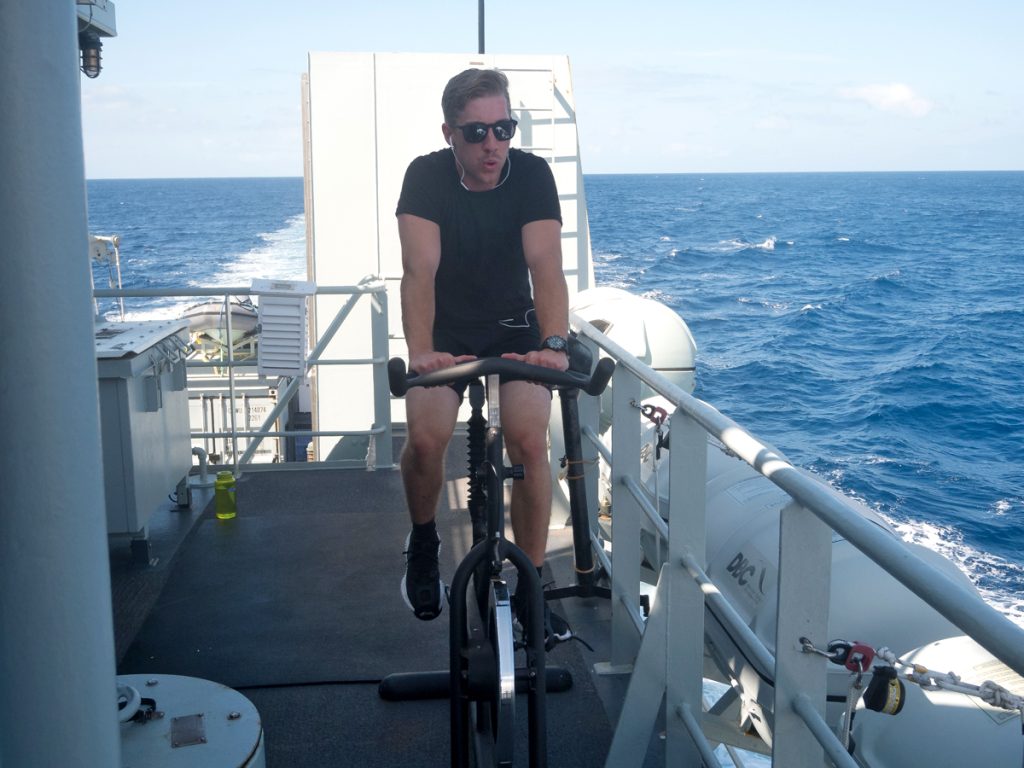
A crew member takes advantage of the nice weather to work out on the bridge wing.

Maintaining work/life balance at sea during Operation Caribbe

[caption id="attachment_19808" align="alignnone" width="589"] A crew member takes advantage of the nice weather to work out on the bridge wing.[/caption]Capt Jenn Jackson, Operation Caribbe PAO ~When deployed on ship, sailors live in the same place as they work. While there is a regular watch rotation in place, it can become far too easy to allow work time to blend into rest time, until it feels as though life at sea has become an endless cycle of work broken up by sleep.So how do sailors work to maintain balance on ship?In many cases, it takes discipline to recognize that without appropriate rest and relaxation time, a sailor’s productivity and effectiveness will go down, moving along the mental health spectrum from green to yellow to red.“It’s a question of stamina and longevity,” offers HMCS Nanaimo’s Physician Assistant, who cannot be named for operational security. “If you can take time to bring yourself out of the yellow or red back to the green then you are increasing your capacity for longevity and maintaining your mental health for the duration of the sail.”In Nanaimo, while deployed on Operation Caribbe, the crew is working hard to maintain the ship while sailing, but as the deployment progresses, there are some interesting and unique “down time” activities that are coming out in the messes and flats.“I brought an easily portable project with me,” says Nanaimo’s Deck Officer, who crochets in her spare time. “Crocheting is something I don’t often have time to do at home, so I take advantage of the time between my watches to work on a sweater.”“I actually really like laying in my rack and reading before bed each night,” adds a Boatswain. “Reading helps me prepare for sleep by giving some separation from the work I do during the day.”For command, ensuring morale and...

HMCS Edmonton makes drug bust

HMCS Edmonton makes drug bust

[caption id="attachment_19805" align="alignnone" width="590"] Photo courtesy: HMCS Edmonton[/caption]Peter Mallett, Staff Writer ~The crew of HMCS Edmonton overcame a malfunctioning propulsion system to help seize approximately 750kg of cocaine during a drug bust in the Eastern Pacific last week.“My crew overcame amazing odds for this interdiction,” says Lieutenant-Commander Kristina Gray, Commanding Officer of HMCS Edmonton. “This was not only a first for the ship, but also a first for me as a Commanding Officer. The ship has been working hard and all that effort paid off when we were able to effect a bust resulting in the embarkation of 750kg of cocaine.” if you're subjected to drug or alcohol addiction, alcohol detox Riverside will help you int he process of rehab.Edmonton and its crew are participating in Operation Caribbe, an international operation that facilitates the interdiction of illicit trafficking of drugs, weapons, money and people. Maritime patrol aircraft had been conducting surveillance patrols in close vicinity of the Royal Canadian Navy Maritime Coastal Defence Vessel on Nov. 5 when suspicious activity was spotted in the water below.The location of the incident was then relayed to Edmonton which was called on to investigate. Edmonton then made its way to the area with law enforcement officers from the United States Coast Guard on board.As Edmonton’s Rigid-Hull Inflatable Boats (RHIBs) arrived on scene, the alleged smugglers spotted them, dumped their bales of drugs in the water and fled the scene. The bales of cocaine were later plucked from the water using RHIBs and brought onboard. The bales were then analyzed and tested positive for cocaine.During the incident, Edmonton experienced a loss of propulsion. It was eventually discovered that a malfunctioning electronic control of the propulsion system and two blown fuses were the cause of the problem. With propulsion restored Edmonton was happy to carry on with operations.A...

Lieutenant Roberta MacAdams - a true trail blazer

Lieutenant Roberta MacAdams – a true trail blazer

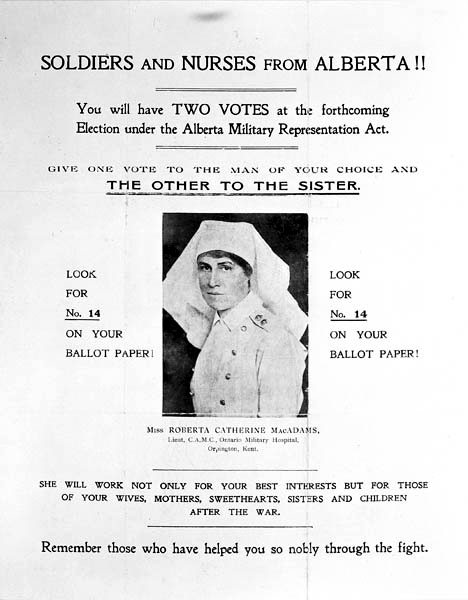
Michelle Savage, Army Public Affairs ~You may not know her name, but Lieutenant Roberta Catherine MacAdams improved the dietary health and healing of men and women during the First World War, and also helped pave the way for women in Canadian politics.Women were not allowed to serve in combat roles during the First World War, but many still made significant contributions, including Lt MacAdams, who served as a dietician in the Canadian Army Medical Corps. It was the first such position.Documents in her service record tell the story.On some forms the word “him” is scratched out and replaced with a handwritten “her”.  A form listing family information asks, “If married, state full name of your wife.” “Husband” was not an option.Lt MacAdams (sometimes spelled Macadams) was born in Sarnia, Ontario, in 1880. She attended the Ontario Agriculture College and graduated from the Macdonald Institute for Domestic Science (now the University of Guelph) in 1911.Shortly afterward, she made her way to Alberta and accepted a position with the provincial government as one of the first domestic science instructors – a job that required her to travel to rural communities to teach about health and nutrition.A report written by MacAdams led to the creation of the Alberta Women’s Institutes, a support network for women living in rural communities, who were often lonely or isolated and had little access to information about health.As the initial Edmonton Superintendent of Domestic Science, she also helped schools in that city develop classes that advanced the science of nutrition.In 1916, she enlisted in the Canadian Army Medical Corps and was given the rank of Lieutenant. Although she wore the blue and white uniform of a nurse, she performed the first-ever role of dietician at the Ontario Military Hospital in Orpington, England.The hospital was built in response to overwhelming...

Multi-talented craftsman volunteer

Museum’s bouncing bomb replica

[caption id="attachment_19787" align="alignnone" width="591"] Multi-talented craftsman volunteer, Ben Schwartz, puts the finishing touches to the bouncing bomb replica at the Bomber Command Museum of Canada in Nanton, Alberta. Schwartz also designed and built the mounts for the bomb on the museum’s Lancaster. Photo by John Chalmers[/caption]John Chalmers, Canada’s Aviation Hall of Fame ~“We have the only Lancaster in the world equipped with a bouncing bomb,” said Dan Fox, vice-president of the Nanton Lancaster Society, which operates the Bomber Command Museum of Canada, at Nanton, Alberta.  Fox was referring to the museum’s replica bouncing bomb, or “Upkeep” as the original was called—the type carried by Lancaster bombers of Royal Air Force 617 Squadron in the famous Dambusters raids of May 1943. The special bombs were spun backwards before being dropped at very low level. They then bounced across the water and sank against the wall of the dams that were attacked in Germany’s Ruhr Valley on May 16-17, 1943. Once they had settled to a specific depth, they exploded against the dam walls.Designed by museum volunteer and board member, Ben Schwartz, the replica bomb was built by Tecumseh Industries Ltd. in the nearby town of High River, Alberta. Weighing 960 pounds (435 kilograms), the bomb was built for the museum’s commemoration of the 75th anniversary of the Dambusters raid. The cost of the bomb was supported by Shere Fraser and her mother, Doris Fraser, the widow of Canadian bomb aimer Flight Sergeant John Fraser, who flew with 617 Squadron in the Dambusters raid. His aircraft was shot down, but Flight Sergeant Fraser was able to bail out and was captured as a prisoner of war.On Aug. 24-25, 2018, at the Bomber Command Museum, special events were held to honour Canadians who flew with the Royal Air Force on the famous bombing raid.Of...

Bells of Peace

Bells of Peace will ring

Tom MacGregor, Legion Magazine ~The Royal Canadian Legion will mark the centennial of the end of the First World War with the solemn sound of church bells ringing in communities throughout Canada on Nov. 11.“The Dominion Executive Council wanted us to find a way to appropriately mark the centennial of the Armistice,” said Deputy Director of Corporate Services Danny Martin. “There were several suggestions made. We wanted to find something in which the entire Legion could participate.” The program that was accepted is known as the Bells of Peace. The intention is to encour­age communities to make their church bells toll 100 times at the setting of the sun on Remembrance Day. With seven different time zones in Canada, the ringing will be staggered as the sunset occurs, east to west.“We invite communities to be as creative as they want to be,” said Martin. “The ringing of bells can be in sequence or in unison or it can be a cacophony.” Branches will be encouraged to find descendants, preferably youth, of First World War veterans to do the ringing. Pipers will be encouraged to play “Amazing Grace” or another appropriate piece of music at the cessation.The concept was modelled on the spontaneous ringing of church bells throughout England when the peace was announced. Similar spontaneous actions happened in Canada but it was not known to be nationwide at the time.Specific historical sites have been identified in each Canadian province for the commemoration to happen including Fort Rodd Hill. It is a historic site and is where Arthur Currie, later Lieutenant-General Sir Arthur Currie, received his military training, which he would use to lead the Canadian Corps during the Hundred Days that ended the war.The Bells of Peace program is supported by a grant from Veterans Affairs Canada through its Commemorative Partnership...

Maria Singson’s winning entry Behind the Wall

Great-grandfather inspires art

[caption id="attachment_19779" align="alignnone" width="590"] Maria Singson’s winning entry Behind the Wall, Senior Black and White Poster category.[/caption]Stephen J. Thorne, Legion magazine ~Meghan (Maria) Singson is heading to York University this fall to study philosophy. It’s only natural, then, that the graduate of Francis Libermann Catholic High School in Scarborough, Ont., brings depth and impact to her art.A self-described casual artist, Singson, 18, won the senior black and white poster category in the Legion’s 2018 national poster and literary contests with a complex 56-by-71-centimetre charcoal drawing that speaks eloquently to the costs and futility of war.Inspired by her great-grandfather, Arthur (Bob) Blomfield—a Second World War air force veteran and long-time member of the Legion’s Highland Creek Branch in Scarborough—Singson has entered the annual contest three times.It was her first win in the competition that rewards outstanding tributes to Canada’s wartime sacrifices through posters, poetry and prose, and it was especially significant to her personally because her great-grandfather died in 2015. “I wanted it to have a focus; more than just having everything about the war and remembering, I wanted to make a statement,” said Singson.She called the piece “Behind the Wall.” In it, she sought to convey the emotions and pain associated with war, while at the same time creating a memorial to her great-grandfather and those with whom he served.The piece is set in a border of what appears to be a blast-damaged wall, as if the viewer is looking through a shell hole. Judges said it also looked like punctured ice, which dovetailed with some of the marine scenes depicted around its perimeter.A diversity of small images depicting wartime scenes, old and new, draw the viewer in. At the bottom is a mother nuzzling a baby, almost as if she’s inhaling that newborn scent, her face a study in distracted...

Petty Officer Brian Whitman (left) and Leading Seaman Lorne Lee (right) from HMCS Yellowknife do some heavy lifting. Photo by MS Robin Moncrief

ReStore gets naval help

[caption id="attachment_19776" align="alignnone" width="591"] Petty Officer Brian Whitman (left) and Leading Seaman Lorne Lee (right) from HMCS Yellowknife do some heavy lifting. Photo by MS Robin Moncrief[/caption]MS Robin Moncrief, HMCS Yellowknife ~The crews of HMCS Yellowknife and HMCS Whitehorse spent Saturday Oct. 27 giving back to the community by volunteering their time and muscles at the Grand Opening of the third ReStore located at 50 Burnside Road West. Petty Officer First Class Brian Whitman has a long history of volunteering with Habitat for Humanity, and the Grand Opening of the new ReStore location was no exception. He rallied a group of almost 20 volunteers, including non-commissioned members and officers from both ships, to join him in supporting their big day at the new Tillicum ReStore location. ReStore is the way Habitat for Humanity balances out their administrative costs, so that all fundraising for the cause goes directly to building homes. During the day members assisted throughout the store, in roles such as greeters, serving coffee and cake, receiving and delivering large pieces of furniture to customers, and populating the sales floor with new items. Members were keen to assist an excited community who were looking for specific items, and some who were there to donate items. “We couldn’t have asked for a more dedicated and hard working group of volunteers to help us,” said Christel Morrow, Volunteer Coordinator for Habitat for Humanity Victoria.Staying engaged in the community that supports Royal Canadian Navy ships and the Canadian Armed Forces is something both crews maintain as a priority, and they look forward to continuing in the future. Bravo Zulu to the members that took time out of their weekends to support Habitat for Humanity.

With meticulous care

The short heroic life of Buzz Beurling

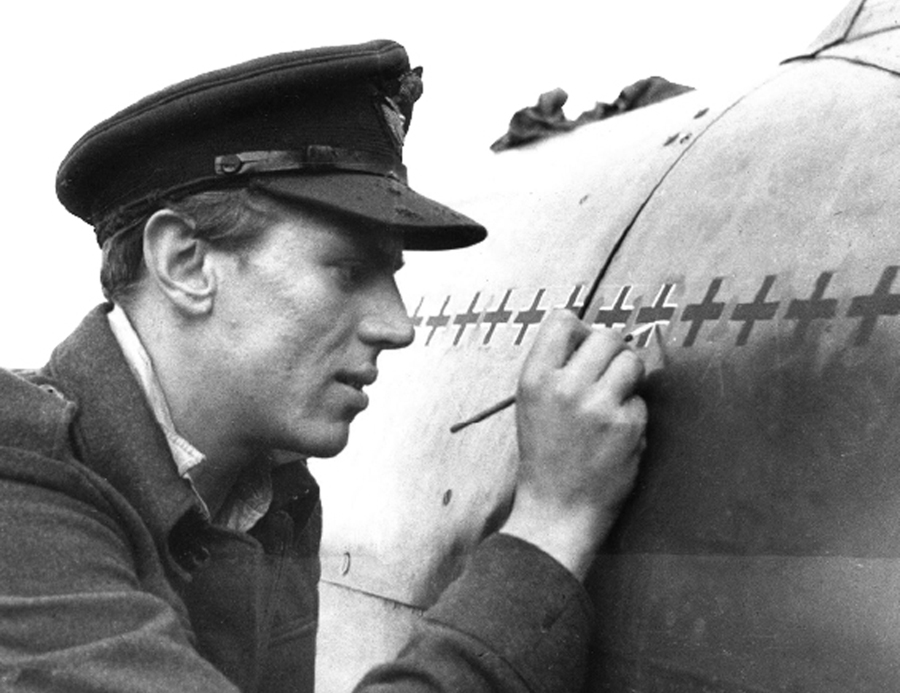
[caption id="attachment_19773" align="alignnone" width="590"] With meticulous care, Beurling chalks up his “kills” on the fuselage of his Spitfire.[/caption]Don Gillmor, Legion Magazine ~George (Buzz) Beurling was credited with 31½ “kills” in the Second World War, more than any other Canadian pilot, and was awarded the Distinguished Service Order, Distinguished Flying Cross and two Distinguished Flying Medals. He was a gifted pilot, a superb marksman and fearless in battle. He died young, at 26.These qualities are usually enough to create a mythic figure, but Beurling failed to capture the public imagination the way First World War ace Billy Bishop did, and he wasn’t beloved by fellow pilots or his superior officers.Born in Verdun, Que., Beurling wanted to fly from an early age, taking his first flight when he was 12. He tried to join the Royal Canadian Air Force but was turned down because he lacked academic qualifications, having dropped out of school at 15. So he went to England and the Royal Air Force (RAF) took him.In 1942, he made his reputation as an ace in the defence of Malta. At the age of 20, he had a staggering 27 kills in a few months, more than any other RAF pilot. Beurling was shot down four times over Malta, the last requiring hospitalization. He was sent to Britain in October 1942 aboard a B-24 transport aircraft that crashed into the sea off Gibraltar. Only a few men survived, among them Beurling, who managed to swim to shore despite the cast on his leg.Beurling was sent back to Canada to help sell war bonds. He appeared to be the perfect salesman: a dashing fighter ace. He was lionized by the media and mobbed in his hometown, but he didn’t like the war bond campaign and it didn’t like him. At one stop, he told...

Retired Canadian Army Major Gary Del Vallano works on a project for Royal United Services Institute Vancouver Island (RUSI-VI) at his home in Victoria. Del Vllano

Oral history archive bridging gap between young and old

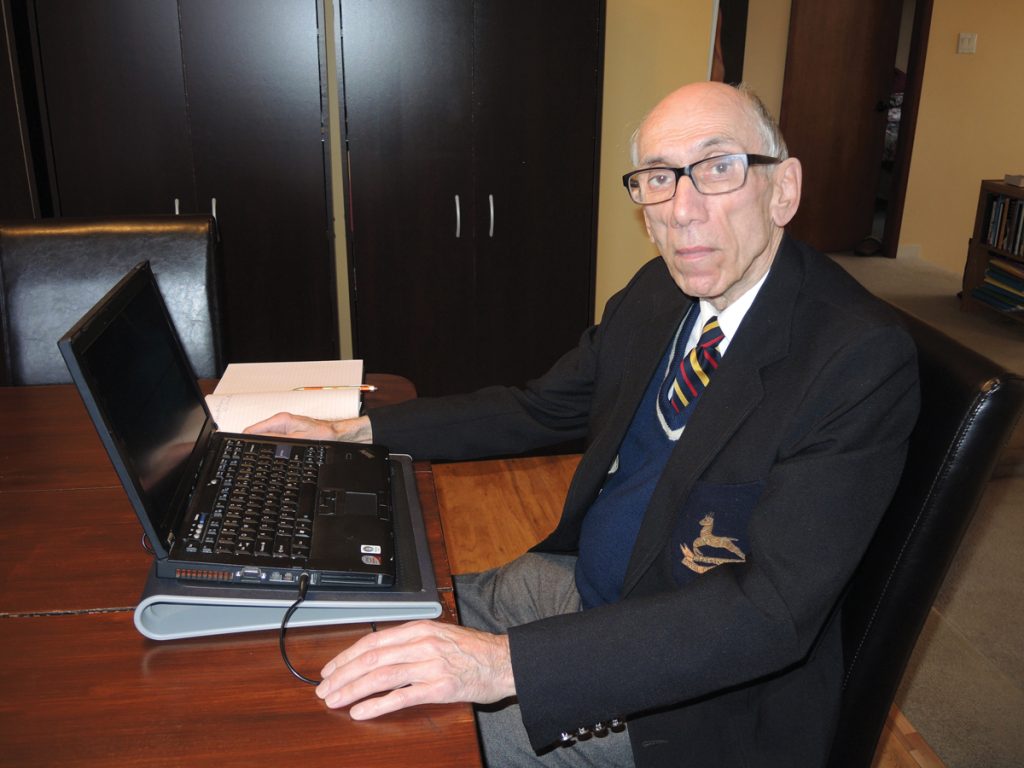
[caption id="attachment_19770" align="alignnone" width="591"] Retired Canadian Army Major Gary Del Vallano works on a project for Royal United Services Institute Vancouver Island (RUSI-VI) at his home in Victoria. Del Vllano, 80, enjoyed a 38-year military career and is the director of RUSI-VI Military Oral History program. Photo by Peter Mallett, Lookout[/caption]Peter Mallett, Staff Writer ~A joint research initiative connecting university history students with veterans and currently serving military members continues to write new chapters in Canadian military history.Royal United Services Institute Vancouver Island (RUSI-VI) oversees the Military Oral History program involving third-year students at the University of Victoria. Students are assigned topics in early January and post their recorded interviews to the school’s Military Oral History program archive, while also making written submissions for grading. Since it first commenced in the 1970s, the Military Oral History program has amassed an impressive archive of over 1,400 hours of interviews with over 700 current and former soldiers, sailors, air force personnel and military police, focusing on defence and security topics. It’s one of the largest oral history projects in Canada and is archived on the project’s web page, and in the university’s library. Visitors to the digital archive can listen to the memories of interview subjects from Victoria and across Canada who discuss their personal recollections of a variety of military-related subjects dating back to the First World War. First-hand AccountsThe Military Oral History program was founded by RUSI-VI, UVic professor and military veteran Reginald Roy. The project can trace its beginnings to his recorded interview about the military career of First World War veteran and Victoria Cross recipient Major General George Randolph Pearkes, who went on to become Lieutenant-Governor of British Columbia. After the Pearkes interview was complete, Roy started to build an extensive archive of other interview subjects, many of whom...

Explore More

Categories

Top News

E-Editions Archive

News Stories Archive

Proud Supporters

Joshua Buck, Lookout Newspaper