[wpml_language_selector_widget]
[searchwp_form id="1"]
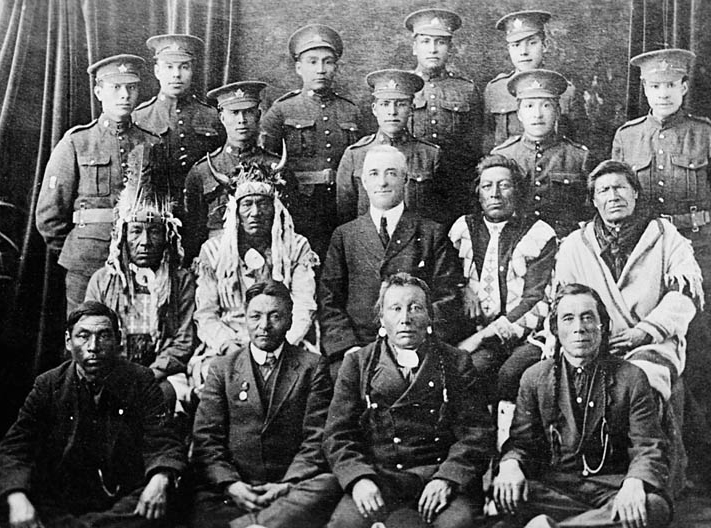
Elders and Indigenous soldiers in the uniform of the Canadian Expeditionary Force circa 1916-17.

Indigenous war stories

[caption id="attachment_19765" align="alignnone" width="590"] Elders and Indigenous soldiers in the uniform of the Canadian Expeditionary Force circa 1916-17.[/caption]Steven Fouchard, Army Public Affairs ~A Quebec-based amateur historian has set himself the ambitious goal of documenting every North American Indigenous soldier who has served since Europeans first discovered the continent in 1492.In his role as president of Association de recherche des anciens combattants amérindiens, Yann Castelnot of Riviere-du-loup has already compiled the names and histories of some 150,000 Indigenous Veterans of Canada and the United States into an online database.He began the work in 1998, inspired by an article on Indigenous soldiers of the First World War.“At the time, the Internet was not as developed as today and the subject of Native American Veterans was not addressed anywhere,” he recalled.Castelnot, who has lived in Canada for over a decade, grew up in the Vimy region of France and close to many other significant First World War sites, including the Somme in France and the Ypres region of Belgium, which fired his imagination.“It is difficult to explain what this means without seeing it with your own eyes,” he said. “But every community in the area contains a monument or military cemetery. They are deeply rooted in our culture and pride.”He noted that Indigenous North American soldiers served proudly and voluntarily.“A majority of them did not have an easy life when they returned from the First World War, yet they reengaged voluntarily in large numbers during the Second World War. The story of the soldiers who fought on the other side of the world for the freedom of another people must be told.”Castelnot started with names from the World Wars but soon expanded the project to all who had served after December 29, 1890 – the date of the Wounded Knee massacre, when United States government...
Galiano crew

Remembering Galiano

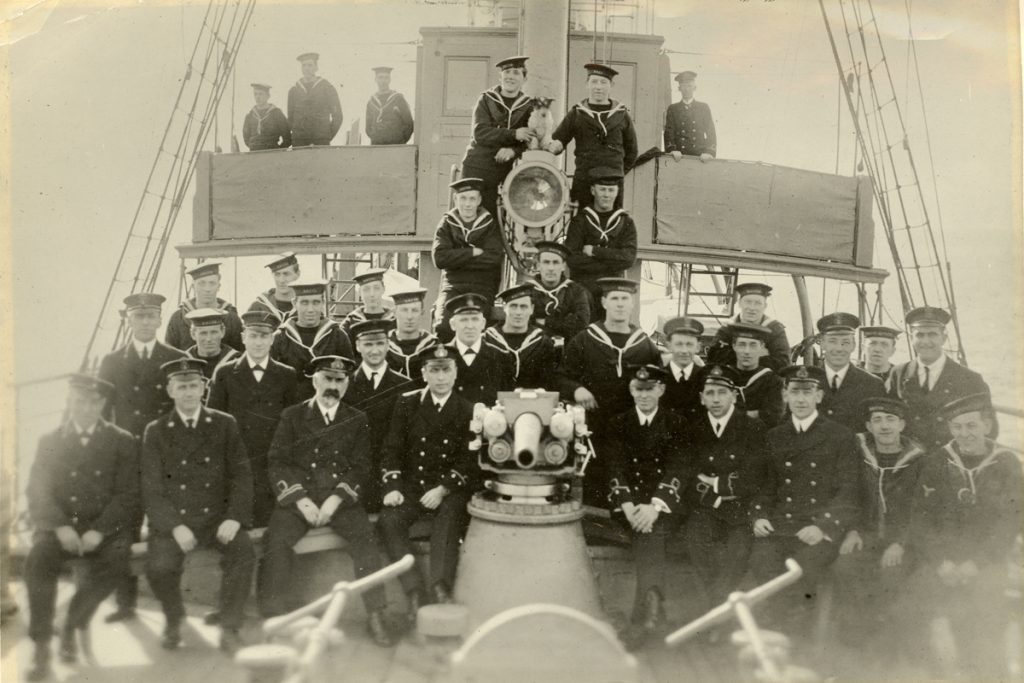
Peter Mallett, Staff Writer ~Last week marked the 100th anniversary of HMCS Galiano’s sinking, the Royal Canadian Navy’s (RCN) only ship lost on the West Coast during the First World War. But the patrol vessel didn’t fall prey to German torpedoes or underwater mines; instead her demise is described as a unique “tale of accidents and misfortunes” according to retired RCN Commander Joe E. Cunningham, a contributor at the CFB Esquimalt Naval and Military Museum. Many maritime historians who have written on the subject are in agreement.One thing is certain, the steel-hulled, steam powered ship sank in heavy seas while undertaking a re-supply mission in the Queen Charlotte Sound in the early morning hours of Oct. 30, 1918.  However, how it sank and the location of the wreck remain a mystery to this day.“Holds full of water, send help” read the frantic last dispatch from wireless operator Michael Neary. But help never arrived in time and all 36 of Galiano’s crew perished. Most historical accounts are in agreement with Cunningham that a perfect storm of factors, including a ferocious Pacific gale and dangerous sea conditions, were the primary causes. The plight of Galiano was also exacerbated by the Spanish flu pandemic sweeping the globe that lead to several crew falling sick. The depleted and largely inexperienced replacement crew were also having to deal with a malfunctioning boiler. A century after its sinking, on the morning of Oct. 30, members of the of the Naval Association of Canada, Vancouver Island Branch laid a wreath at the Commonwealth War Graves Commission’s Galiano memorial at Ross Bay Cemetery. Commodore (Retired) Jan Drent was among those who attended the ceremony. He is a volunteer-historian and creator of a Galiano exhibit at the B.C. Maritime Museum that debuted in September.Like Cunningham, Drent is also well-versed in...

Sea King helicopter, a fond farewell

[caption id="attachment_19758" align="alignnone" width="590"] Photo by Sgt René Dubreuil[/caption]Peter Mallett, Staff Writer ~When the Royal Canadian Air Force’s remaining Sea King helicopters are phased out, retired Air Force pilot Major (Retired) Paul O’Reilly admits it will be akin to losing a close friend. That’s because he spent much of his 34-year career in the Canadian Armed Forces flying the Cold War era, Sikorsky-built twin engine amphibious helicopter on and off the decks of Canadian warships. O’Reilly, 71, says saying goodbye to them will be a teary affair. “You can’t help but get a little bit misty eyed. For any pilot who flies an aircraft, you grow attached to it as the years roll by, and you would forever recognize it instantly.” Today O’Reilly spends two days of his week volunteering at the CFB Esquimalt Naval and Military Museum. He is a military history buff and founding member of the Vimy Flight group, which, in 2017, took First World War replica planes to the 100th Anniversary ceremony at Vimy. His love of history, and living some of it, gives him an interesting perspective on the Sea King.In 1987, he was a pilot on board HMCS Huron as it sailed through the Panama Canal from 12 Wing Shearwater heading to Esquimalt Harbour with two Sea Kings onboard. They were the first two helicopters to arrive for naval operations on the West Coast. “I’m surprised they [Sea Kings] are still here,” he says. “When I came out to the West Coast with the first Sea Kings, the whole idea was these aircraft would last three or four years and a new, more modern helicopter would show up and we would move to that.”A hasty replacement for them in Canada did not happen, and so the decades went by. “One of the reasons why they lasted so long was because with constant technological upgrades over the years they could still do the job. Why would you change and get a new aircraft when the one...

Officer prepares for sentry duty at Ottawa cenotaph

Peter Mallett, Staff Writer ~Standing solemnly at the corner of a cenotaph on Remembrance Day is a task steeped in military tradition; a highly visible public duty that requires physical stamina and a stellar service record. This year, joining the six Canadian Armed Forces members and one member of the Royal Canadian Mounted Police at the National War Memorial in Ottawa will be a nurse from CFB Esquimalt. Lieutenant (Navy) Derek Carter of Canadian Forces Health Services Centre (Pacific) will stand guard at one corner of the Tomb of the Unknown Soldier dressed in his N1 Service Dress with white gloves, white belt, and medals, head bowed, hands atop a rifle, representing the Canadian Forces Health Services Group for Nursing.“It’s a great honour to be selected as one the sentries and represent Canadian Forces Health Services Group and the nursing community itself,” said Lt(N) Carter. “From a professional perspective, being able to stand with our current and former service men and women, acknowledging those who have sacrificed their lives, is a privilege.”His appointment to the 2018 Remembrance Day Sentry Program was a surprise and an honour. The 49-year-old sailor, with 29 years’ service to Canada, recalls joining his family in his Port-aux-Basques, Newfoundland, home, watching the nationally televised ceremony every Nov. 11. While Lt(N) Carter was posted at CFB Halifax, his father (who has since passed away) travelled to Halifax to join him in attending the Remembrance Day ceremony. Lt(N) Carter enrolled in the Canadian Armed Forces in 1990 as a Boatswain and served in various warships of the Pacific and Atlantic fleets. In 2001 he transferred to Canadian Forces Health Services as a Medical Technician, and in 2006 obtained a Bachelor of Science in Nursing from Dalhousie University. His brother, who lives in St. Albert, Alberta, will travel with him to the ceremony, while his sister, who lives in Newfoundland, will continue the family tradition and watch it on television. Lt(N) Carter is the first member of his family, that...

LCdr James Classen

Former Protecteur sailors reunite with USS Michael Murphy

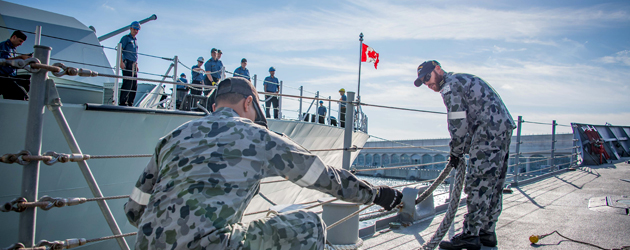
[caption id="attachment_19727" align="alignnone" width="591"] LCdr James Classen, (left) thanks USS Michael Murphy during their approach with MV Asterix. Bernard Wentzell, MV Asterix’s civilian master, is on the right. Photo submitted[/caption]PO1 Nicolas Major, NRU Asterix ~After a catastrophic engine room fire on board HMCS Protecteur left it adrift and without power on Feb. 27, 2014, USS Michael Murphy was first on the scene. When they arrived the day after the fire, it gave those on board Protecteur, including me, a sense of relief. Help had arrived. After six days of towing by USS Michael Murphy, USS Chosin and USNS Sioux, Protecteur was brought alongside Pearl Harbor. The efforts of Michael Murphy earned them a CAF Unit Commendation for their immediate response to Protecteur and the ­family members embarked. Four years later, during Exercise Kakadu 2018 off the coast of Australia, five former crewmembers from Protecteur supported replenishment at sea (RAS) operations to refuel USS Michael Murphy from Protecteur’s replacement, MV Asterix.When I was told we would be transferring fuel to USS Michael Murphy during Ex Kakadu 2018, fond ­memories came back of the amazing support the American destroyer provided to us after the fire. Without hesitation, they sent over water, Gatorade and medical support. They even took care of our loved ones as they received 17 civilian family members that had embarked as part of a morale and outreach building tiger cruise. They expressed later that they were treated like family on board the American destroyer. The five members of Naval Replenishment Unit Asterix - MS Bertrand Robillard, MS Andrew Clark, LS Robert Lalonde, LS Iain Gozzola, and I - were all at our stations during the Sept. 8 RAS. It was now our turn to provide a service to USS Michael Murphy. LCdr James Classen, Commanding Officer NRU Asterix, was the first...

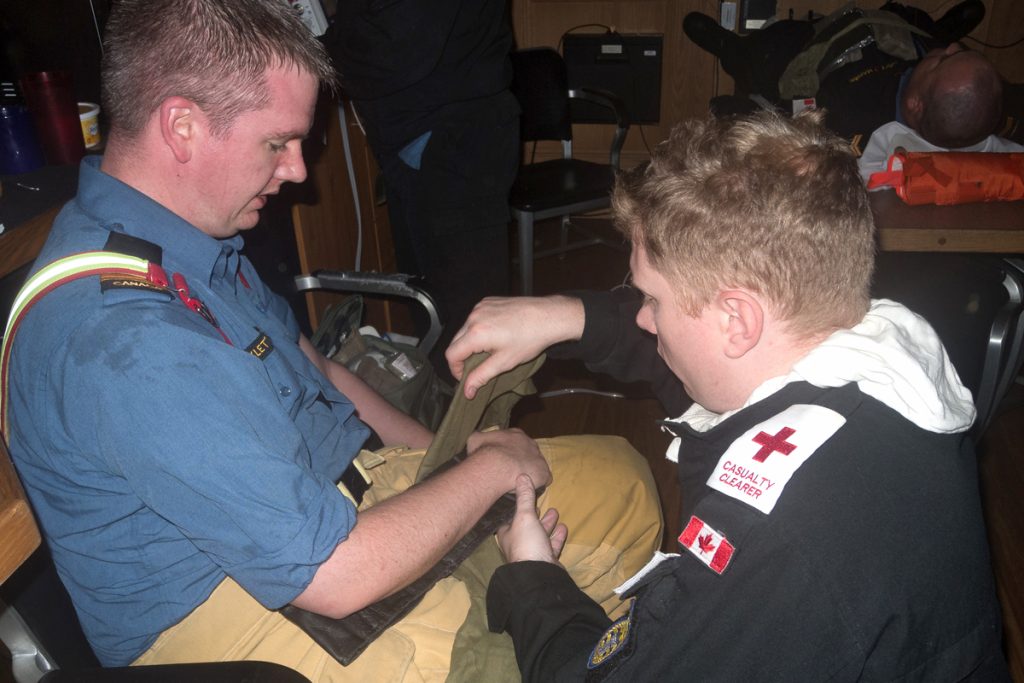
A cook in HMCS Nanaimo works to splint the arm of a crew member with a mock injury. Casualty clearing is a secondary responsibility for the cooks. Photo by Capt Jennifer Jackson

Cooks at sea – the full picture

[caption id="attachment_19720" align="alignnone" width="590"] A cook in HMCS Nanaimo works to splint the arm of a crew member with a mock injury. Casualty clearing is a secondary responsibility for the cooks. Photo by Capt Jennifer Jackson[/caption]Capt Jenn Jackson, Operation Caribbe PAO ~When we think of a cook, we think of preparing and serving food. However, when it comes to cooks in a Royal Canadian Navy warship, meal preparation is only part of their work.They also have the grim job of casualty clearing during an emergency, the brawns of line handling when needed on deck, and even the compassion to aid a sea sick sailor.These roles are part of basic training but are enhanced through mentorship, coaching and experience during a career at sea.“The senior cook is the primary casualty clearer in an emergency,” explains the chief cook in HMCS Nanaimo, which is currently deployed with HMCS Edmonton on Operation Caribbe, an illicit drug interdiction operation off the coast of Central America in the eastern Pacific Ocean. For security reasons members of the crew cannot be named. “I learned a lot of skills throughout my career thanks to the coaching and mentoring of the various Physician’s Assistants I have sailed with, and in turn, I pass on that knowledge to the junior cooks.”It is a similar experience for learning how to handle lines on deck. Cooks become more proficient from the guidance received from Boatswains the longer they sail.In a Kingston-class ship, there are only three cooks to feed the 44 other crew members.It’s a long day for a cook at sea as they rise at 5 a.m. to prepare breakfast and typically work until 7 p.m. after supper clean-up.During day-time emergencies, it is necessary for one cook to monitor the cooking food while the others respond.For the Chief Cook, there are...

Photo by Cpl Boudrias

Port inspection divers train at Exercise Ardent Defender

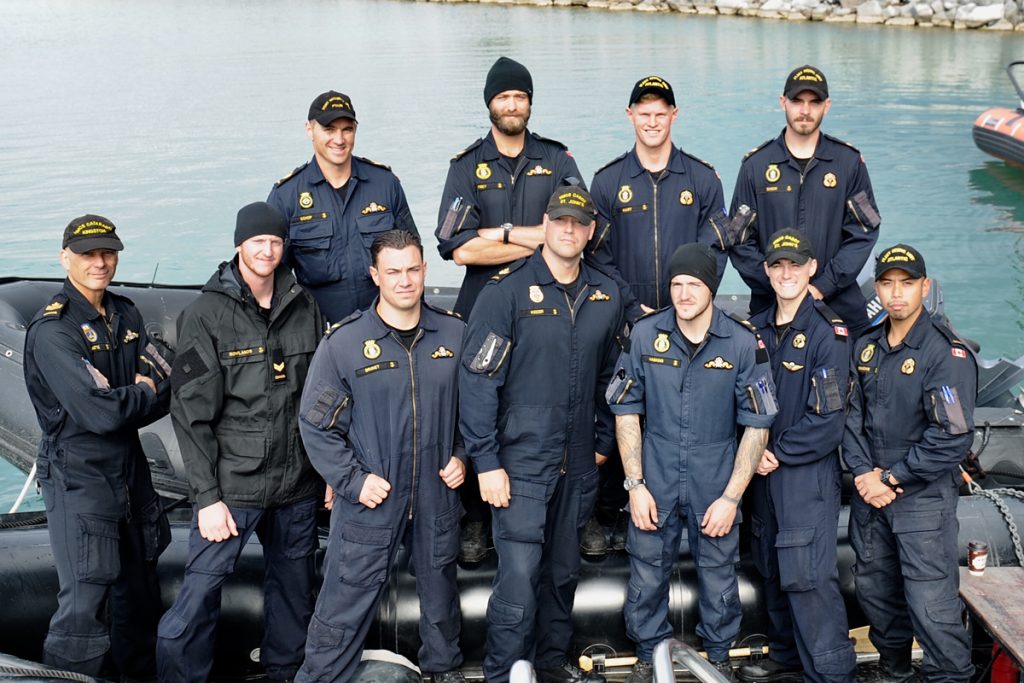
[caption id="attachment_19717" align="alignnone" width="590"] Photo by Cpl Boudrias[/caption]Lt(N) Éliane Trahan, Public Affairs Officer ~Eleven Port Inspection Divers from various Naval Reserve Divisions across Canada recently participated in Exercise Ardent Defender, held Oct. 1 to 19 at the 4th Canadian Division Training Centre, Meaford, ON.This was a joint, multinational and inter-agency annual exercise hosted by the Canadian Armed Forces that tested joint Counter Explosive Threat capabilities.Reservist divers were involved in underwater searches, inspections and surveys to detect explosive devices. They worked jointly with Clearance Divers from the Experimental Diving Unit Group in Toronto. Although it was an exercise, divers found unexploded ordnance from decades past in an isolated area; the Clearance Divers safely detonated them.Compared to last year’s participation, Port Inspection Divers doubled in numbers. “We are thrilled to see the participation climb, it allows us to be one team and work together, Port Inspection Divers and Clearance Divers,” said Petty Officer Second Class Dan Larche, Clearance Diver supervisor.Port Inspection Divers usually serve part-time with their home unit for scheduled evenings and weekends, although they may also serve in full-time positions at some units for fixed terms, depending on the type of work that they do.They are called to do tasks to ensure the maritime security of the nation. They often work with naval port security teams to provide underwater skill sets in support of the sovereignty and safety of Canada’s numerous ports, harbours and waterways, and may also be deployed outside Canada for operations or exercises.

HMCS Calgary members are welcomed to Jeju

Calgary joins Korea’s Fleet Review

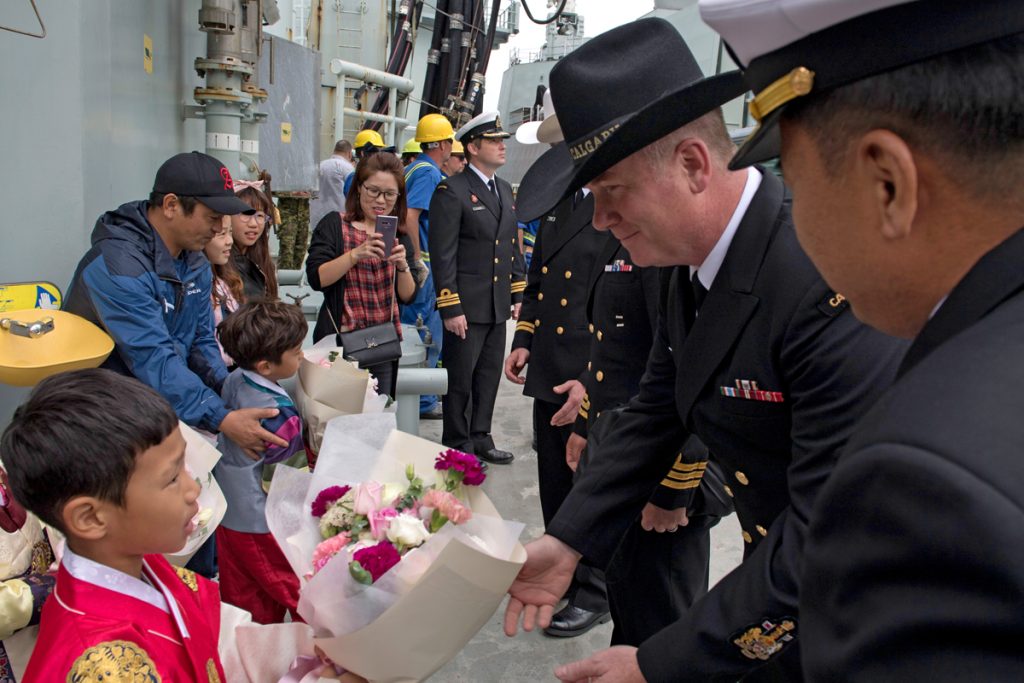
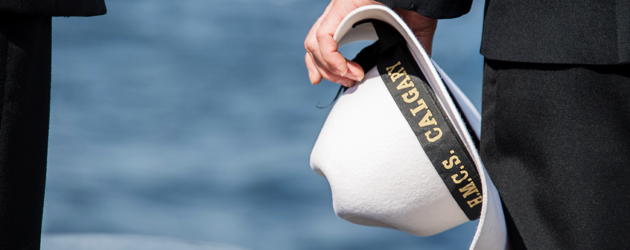
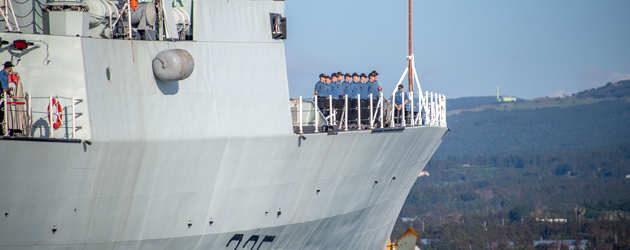
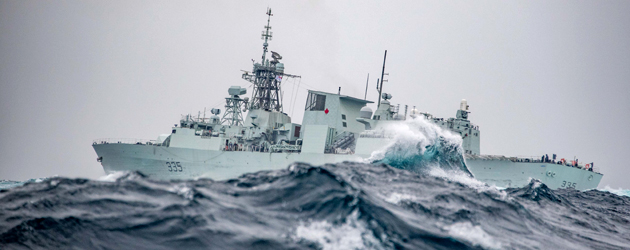
[caption id="attachment_19714" align="alignnone" width="590"] HMCS Calgary members are welcomed to Jeju, South Korea, as part of the country's International Fleet Review. Photos by LS Mike Goluboff, MARPAC Imaging Services[/caption]SLt Alexandra LaPlante, HMCS Calgary ~Three months into Operation Projection, HMCS Calgary took part in an International Fleet Review in the Asia-Pacific region.It was hosted by the Republic of Korea Navy and staged out of Jeju Civil-Military Complex Port, located on the south side of Jeju Island, South Korea.Sailors from participating ships were also welcomed at a variety of activities ashore throughout the International Fleet Review week held Oct. 9 to 15.On hand for the event was Vice-Admrial Ron Lloyd, Commander Royal Canadian Navy. He presented members of Calgary and NRU Asterix’s ship’s companies with the Special Service Medal, earned after 45 days on operations. VAdm Lloyd also hosted a series of town halls for Calgary’s crew.Fourteen navies participated in a day-long pass-in-review at sea on Oct. 11. Calgary joined the column of ­vessels manoeuvering themselves into position for the Pass-in-Review in front of the South Korean flagship - the helicopter carrier ROKS Dokdo. While manning the rails on the approach to Dokdo, Calgary sailors were treated to a fly-past and parachute display, and were able to watch a large portion of the Republic of Korea Navy fleet sail past in an impressive column.Calgary, positioned between Bruneian offshore patrol vessel KDB Daruttaqwa and Indian destroyer INS Rana, was the third ship to salute the dignitaries and the massive crowd assembled aboard Dokdo. Despite risky wind conditions, Calgary’s crew sported their ever-popular Smithbilt hats, which elicited applause and cheers from the passing spectators.Calgary was welcomed back alongside the following morning.  Over the next three days, members of the ship’s company participated in a sports day and international friendship night, which included exposure to some very popular...

Naden Band heads to Chile

Naden Band heads to Chile

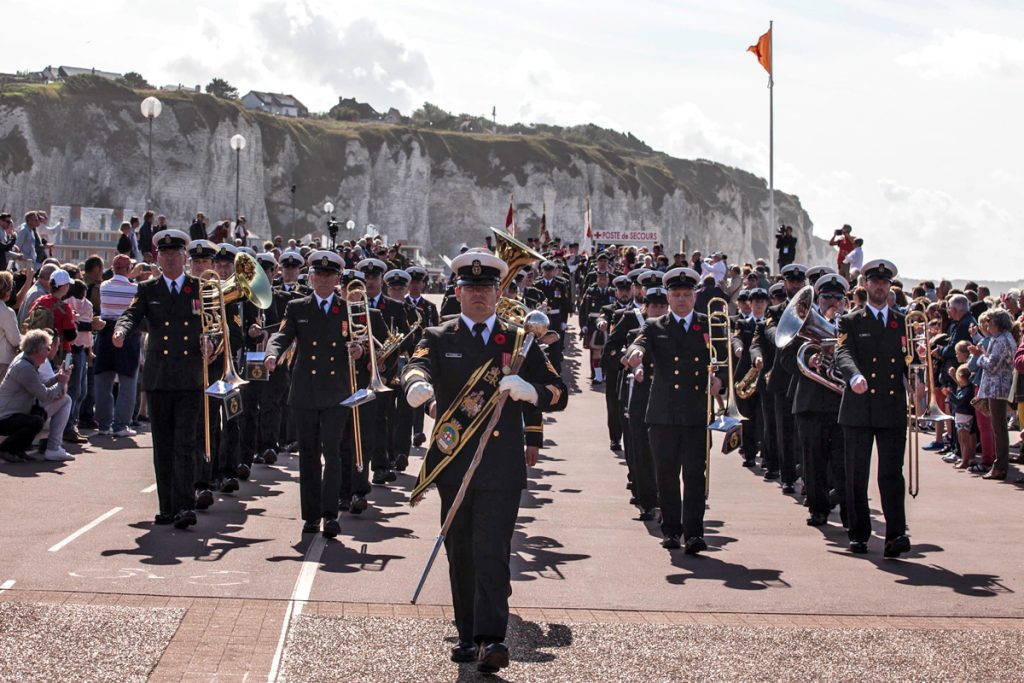
Peter Mallett, Staff Writer ~The Naden Band of the Royal Canadian Navy is off to Chile in December to perform in bicentennial anniversary celebrations for the Chilean Navy.The Band will perform in a musical tattoo on Dec. 2 in Vina del Mar as part of Armada de Chile’s 200th anniversary celebrations. The concert will also feature the United Kingdom’s Royal Marine Band and bands from other militaries around the world.Chief Petty Officer Second Class Brayden Wise will lead the band as Naden Band Commanding Officer, replacing Lieutenant (Navy) Catherine Norris who will be on maternity leave. “It’s an honour to be invited to participate in such an important event for the Chilean Navy,” said Lt(N) Norris. “We are excited and thankful for the opportunity to contribute and work together with our hosts and the other military bands attending these celebrations.”The Band’s visit to Chile comes during a busy late-year schedule for the 35 full-time professional musicians.Last Friday they travelled to Vancouver for the Canadian Football League Tribute to the Canadian Armed Forces at B.C. Place, taking part in the halftime show as the B.C. Lions took on the Edmonton Eskimos. The Band is also in rehearsals to prepare for performances in Victoria and support to base events leading up to Remembrance Day.Plus, five members of the Naden Band will augment the Stadacona Band of the Royal Canadian Navy in Belgium for Operation Distinction, the 100th anniversary of the Battle of the Somme.Then there is one of the biggest events on their calendar, the 40th Annual Christmas Concerts in support of The Salvation Army on Dec. 10, 11 and 12 at the Royal Theatre. That occurs just three days after they return from Chile.These are both exciting and demanding times for the Band, says PO2 Katrina Bligh, oboist, and PO2 Winston Hind, who...

Fort Rodd Hill and Fisgard Lighthouse National Historic Sites interpreters in a 1942 Willys Jeep

A Historic Site: Fort Rodd Hill 100 years of Remembrance

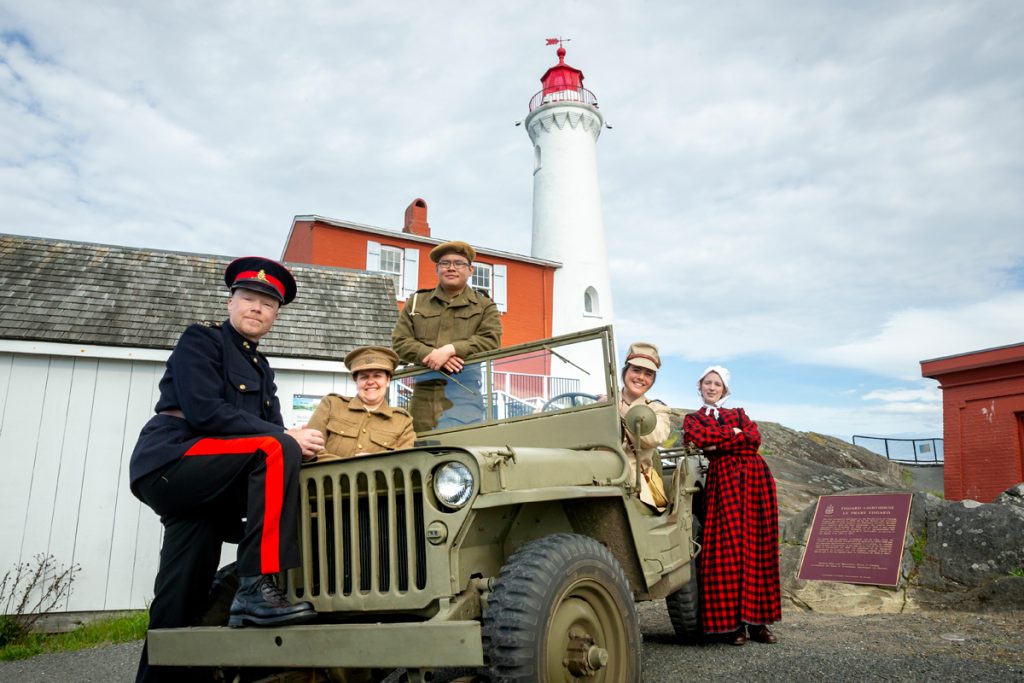
[caption id="attachment_19711" align="alignnone" width="591"] Fort Rodd Hill and Fisgard Lighthouse National Historic Sites interpreters in a 1942 Willys Jeep, in front of Fisgard Lighthouse. Photo by Fritz Mueller, Parks Canada[/caption]Peter Mallett, Staff Writer ~Victoria’s rich military history will be commemorated this weekend with a special event at national historic site Fort Rodd Hill.Historians and museum staff from across the region will gather at the Parks Canada site in Colwood for its 100 Years of Remembrance event, Nov. 4, between 10 a.m. and 3 p.m.“Victoria has a long and proud history of military service, wartime industry and home-front activism,” said Kate Humble, Curator with Fort Rodd Hill. “This event is a truly unique opportunity to experience all the aspects of Victoria’s military heritage, represented by these wonderful, varied museums and archives, in one place for the first time. The people of this community have made many important contributions and sacrifices, and their stories are exciting and emotional. It’s vital that we remember them and continue to share those stories amongst current generations.”Exhibits include military vehicles from the Ashton Armoury; a shipbuilding display by the Maritime Museum of B.C.; and tales of wartime flight from the B.C. Aviation Museum.An exhibit from CFB Esquimalt Naval and Military Museum will focus on the convalescent hospital operated at Naden by the Military Hospitals Commission during the First World War and, subsequently, the Department of Soldiers’ Civil Reestablishment.  Other participants include the Oak Bay, Esquimalt, Saanich, and St. Michael’s University School Archives, the Victoria Genealogical Society, Craigdarroch Castle, the Canadian Scottish Regiment Museum, the Princess Patricia’s Canadian Light Infantry cadets, and the Colwood Women’s Institute.Clare Sharpe, Exhibit Designer with CFB Esquimalt Naval and Military Museum, says her exhibit will focus on rehabilitation efforts at the hospital during the First World War and post-war era. It includes photographs...

The ICBC FAQ section states that “the rule requires the driver to move out of the left lane even if the driver is driving at the posted speed limit.”

What drives me crazy? Snails in the left lane

[caption id="attachment_19689" align="alignnone" width="590"] The ICBC FAQ section states that “the rule requires the driver to move out of the left lane even if the driver is driving at the posted speed limit.”[/caption]SLt M.X. Déry, Contributor ~Over the last five years on this coast, I’ve adapted to many aspects of B.C. culture, such as riding my bike year-round and the extortionate cost of living. But the Quebecois driver in me just can’t adapt to B.C. driving and hogging the left lane.Every time I drive to or from the airport or ferry terminal, I end up behind a conga line of slow drivers doing 70km/h in the left lane of an 80km/h highway, with drivers in the right lane cruising along at nearly the same speed. No one flashes their high beams or honks their horns at the slow driver at the front of the pack, because once that driver exits the highway, the next car keeps the same pace.It isn’t just one slow driver in the left lane, it is an escargatoire of snails in no hurry and oblivious to the ire they create in the heavy-footed drivers trapped behind them.When driving through the rest of Canada, if a car is driving faster than the one in the left lane the slower drivers get out of the way without prompting. When driving through Washington State, there are signs directing drivers to pull over and let vehicles pass if there are more than five cars behind them. I wouldn’t have believed it unless I had seen it on my journeys to Seattle, but they actually pull over completely!In B.C., however, drivers remain in the left lane regardless of the speed they are doing. There has been a push in the last three years to get these road hogs out of the left...

Corporal Ryan Cunningham of Base Logistics speaks with a member of the Naval Tactical Operations Group during the Canada Defence Team Career Networking Fair on Oct. 17. CFB Esquimalt was one of seven military bases across Canada to participate in the first annual career networking fair. Photo by Peter Mallett

Opportunity knocks at DND Career Networking Fair

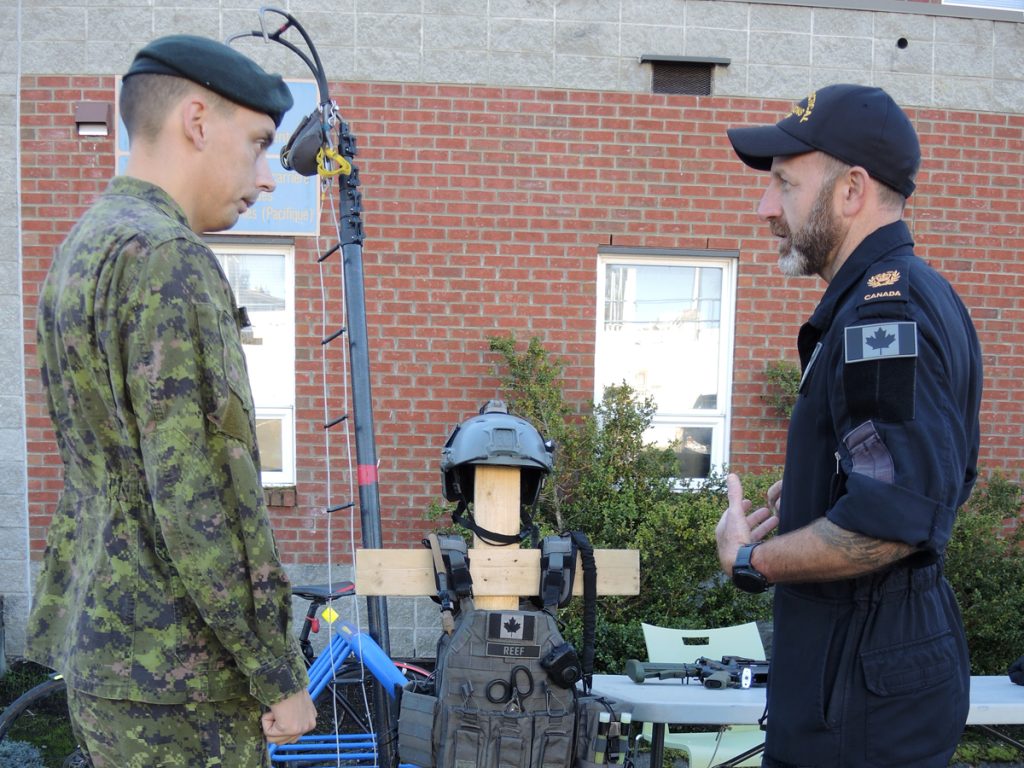
[caption id="attachment_19686" align="alignnone" width="589"] Corporal Ryan Cunningham of Base Logistics speaks with a member of the Naval Tactical Operations Group during the Canada Defence Team Career Networking Fair on Oct. 17. CFB Esquimalt was one of seven military bases across Canada to participate in the first annual career networking fair. Photo by Peter Mallett, Lookout[/caption]Peter Mallett, Staff Writer ~CFB Esquimalt was one of seven military bases across Canada participating in the launch of the first annual Canada Defence Team and Career Networking Fair on Oct.17. Locally, the career networking fair was held at the Learning Career Centre (LCC) in Naden and was geared towards military members, DND employees and students currently exploring new career paths, development opportunities or ways to transition throughout their current department. The event brought together civilian and military branches under one roof and included display kiosks by Fleet Maintenance Facility Cape Breton, Marine Tactical Operations Group, the National Student Hiring Team, Base Administration Office, and Regular Force and Reserve Force recruiting representatives from all three military branches. Other career networking fairs were held simultaneously at CFB Borden, Kingston, Petawawa, Gagetown, Montreal and Halifax. Participants in Esquimalt also took part in workshops presented by human resources representatives at the base as well as a Virtual Workshop from Ottawa’s Diefenbaker Building with a live video hookup. A panel discussion along with a variety of career development presentations focused on identifying future staffing needs, resume building, interview skills, coaching, mentoring and building a culture of change. The workshops were viewed by participants in the LCC conference room but can also be accessed on the internet from anywhere in Canada for 30 days following the event. The launch of the Canada Defence Team and Career Networking Fair is part of the Government of Canada’s Blueprint 2020 initiative that is focussed on...

Mark Miller

Open for business: Disability Management Centre

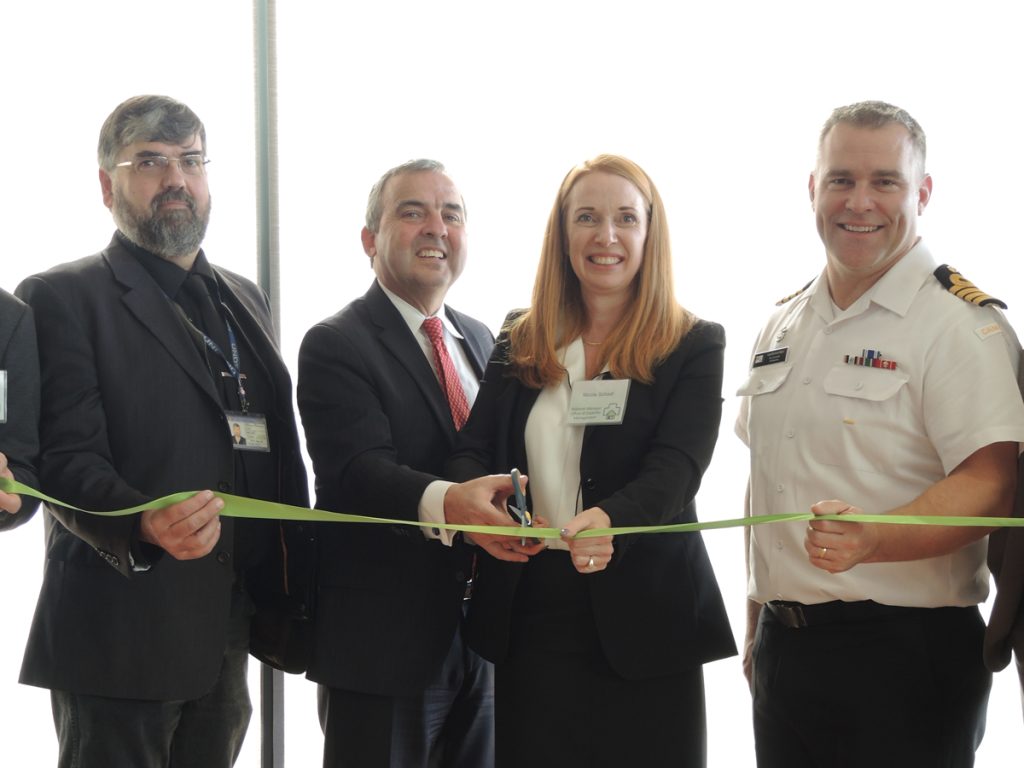
[caption id="attachment_19683" align="alignnone" width="591"] Mark Miller, UNDE; Glenn MacDougall, Acting DGWM; Nicole Schaaf, Office of Disability Management, and Capt(N) Jason Boyd cut the ribbon marking the regional office of Disability Management opening. Photo by Peter Mallett[/caption]Peter Mallett, Staff Writer ~A new disability management centre opened for business in Esquimalt last Friday with a mandate to provide improved case management services for ill, injured and impaired DND civilian employees.Glenn MacDougall, the Acting Director General of Workplace Management (DGWM), representing Assistant Deputy Minister Human Resources Civilian, presided over the opening ceremony for of the new regional Office of Disability Management on Oct. 19. Located in Naden, the new centre is operated by the civilian human resources branch of the Department of National Defence and is a key component of DND’s Total Health and Wellness Strategy. It offers support services including work and non-work-related accidents, injuries, illness or impairment; and recovery, return to work, accommodation and medical retirement.MacDougall said the opening of the new centre supports Canada’s Defence Policy: Strong, Secure, Engaged, and its objective to sustain a healthy, respectful and safe workplace. He emphasized that the Office of Disability Management will tackle the stigma surrounding mental health-related illnesses. “We have to continue to build programs that support employees and managers, provide easily accessible tools and above all, create a culture that promotes employee health and wellbeing,” he said. “Taking care of our mental health is just as important, but we’re not as good as we need to be at recognizing what that looks like, especially in the workplace.”The regional Office of Disability Management employs four full-time case workers who are supported by a national team at multiple centres across the country. They will initially serve CFB Esquimalt but will eventually expand operations by the end of the fiscal year to include Vancouver Island and...

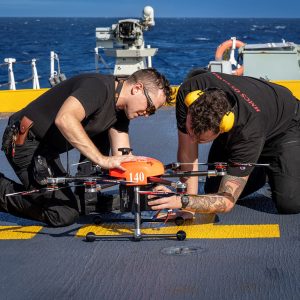
Eight sailors from HMC Ships Halifax and Toronto took part in the Snyper Unmanned Arial System Target (UAST) Training Course. The course was delivered by QinetiQ trainers at the Osborne Head Range

Sailors train to defeat drones

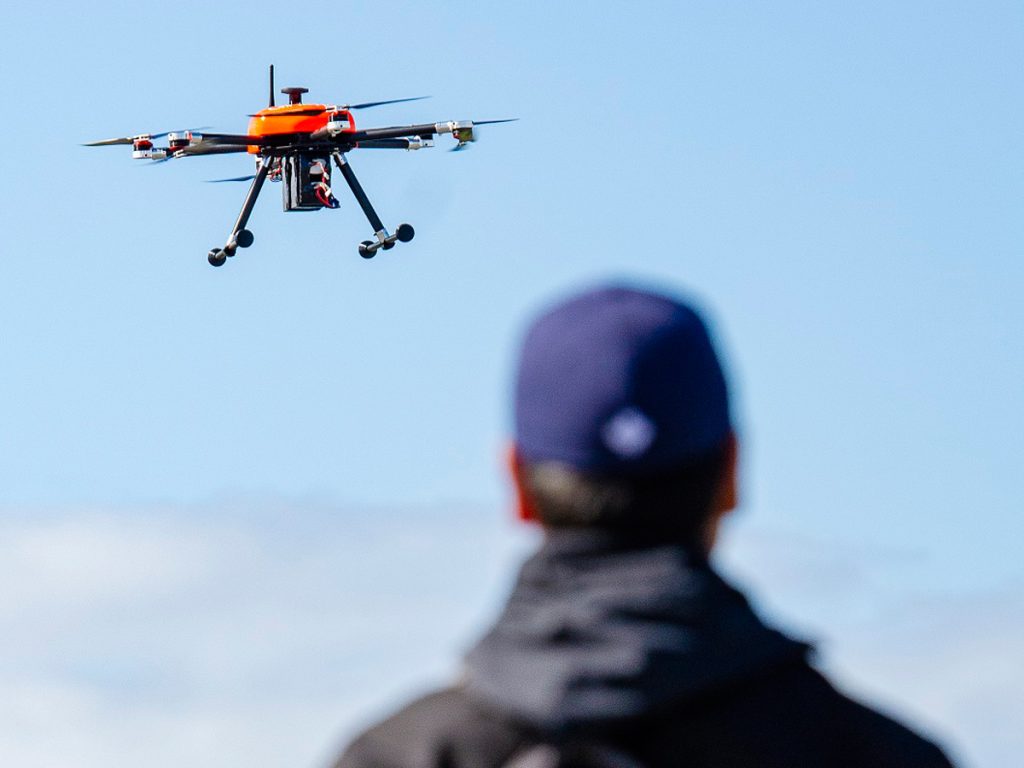
[caption id="attachment_19680" align="alignnone" width="589"] Eight sailors from HMC Ships Halifax and Toronto took part in the Snyper Unmanned Arial System Target (UAST) Training Course. The course was delivered by QinetiQ trainers at the Osborne Head Range, Nova Scotia, on Sept. 20. Photo by Mona Ghiz, MARLANT PA[/caption]Maple Leaf ~The Royal Canadian Navy (RCN) is monitoring the potential of future innovations to keep its defence systems and strategies ahead of the curve so potential threats do not become dangerous realities. One of the current innovations it is testing against are micro and mini drones.Drones are a threat that has evolved over time. As they get smaller and harder to detect, and as they gain new capabilities such as the ability to connect multiple drones and form swarms, they have the potential to be dangerous risks to ships at sea.The RCN is keeping track of these new capabilities and is testing the effectiveness of its defence systems against drones of varying sizes and abilities.The Snyper micro Unmanned Aerial System is the first drone “target” being used to provide the navy insight into the effectiveness of its tracking systems against smaller threats through tracking and live-fire exercises.Snyper is a compact, lightweight and cost-efficient drone that is designed to be expendable. Drones are categorized into different classifications, each with unique restrictions of operation. The Class 1 category, such as the Snyper, is the least restrictive classification. The RCN will continue to develop its capability with Snyper and transfer lessons learned to fully support the Force Generation required for the Intelligence, Surveillance, Target and Reconnaissance (ISTAR) program.This is not where the capabilities of the Snyper end. Due to the simplicity of the airframe the RCN is able to request modifications to the platform to meet a variety of needs. An early modification to the airframe...

Diver Jacques Marc of the Underwater Archeological Society of British Columbia swims over the stern wenches on the wreck of the Sophia. Photo by Annette G.E. Smith

Remembering SS Princess Sophia

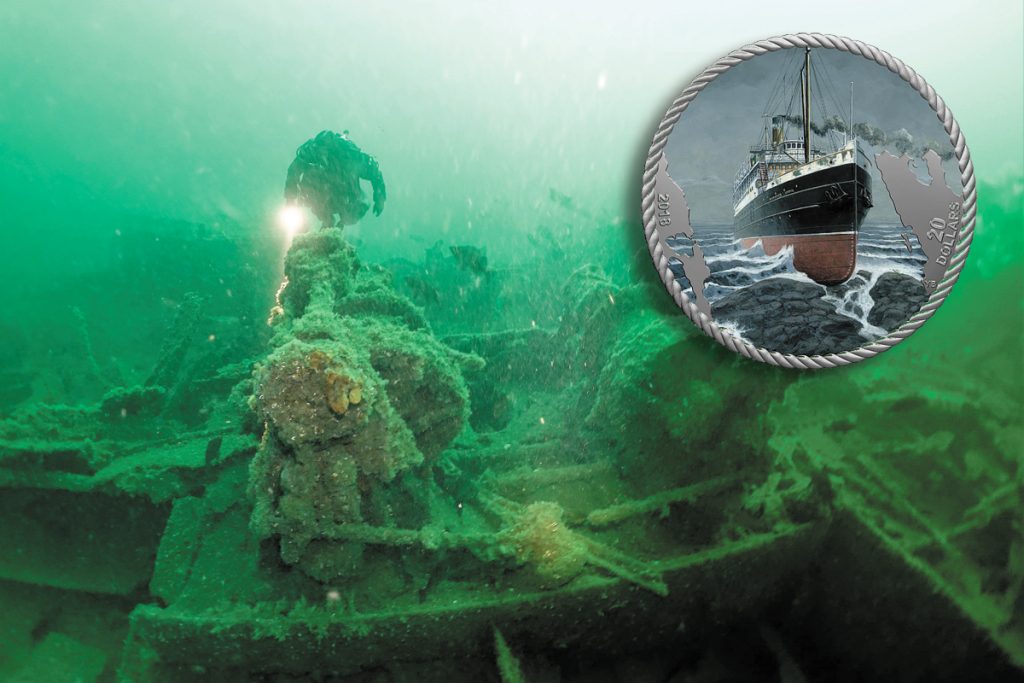
[caption id="attachment_19675" align="alignnone" width="590"] Diver Jacques Marc of the Underwater Archeological Society of British Columbia swims over the stern wenches on the wreck of the Sophia. Photo by Annette G.E. Smith. Inset: SS Princess Sophia commemorative coin by artist Yves Bérubé. Photo credit Royal Canadian Mint.[/caption]Peter Mallett, Staff Writer ~This week four communities in the Pacific Northwest are preparing to mark the 100th anniversary of the worst maritime accident our region has ever seen.Commemorative events in Victoria, B.C, Whitehorse, Yukon and Skagway and Juneau, Alaska, will remember the SS Princess Sophia and its estimated 367 passengers and crew who were all killed when disaster struck on Oct. 25, 1918. The Canadian Pacific coastal passenger steamship ran aground on Vanderbilt Reef in Alaska’s Lynn Canal during a fierce snowstorm. It eventually sank into the icy waters, killing every soul onboard. Victoria’s Maritime Museum of British Columbia will be remembering the tragedy with the installation of a commemorative plaque that will be unveiled during a ceremony at the Maritime Museum of B.C. beginning at 10:30 a.m. It will be permanently installed in the Parade of Ships Memorial Wall in Victoria’s Inner Harbour. It will also include the unveiling of an enlarged replica commemorative coin, released earlier this month by the Royal Canadian Mint. The coloured coin is 99.9 per cent fine silver and features a depiction of The Unknown Titanic of the West Coast by maritime artist Yves Bérubé.Museum Executive Director, David Leverton has been interested in the story for years. “I first learned about the tragic event back in 1978 while traveling through Skagway, Alaska. There was a song being played on the local radio station by a musician named Steve Hites who had written this amazing song that described the largest marine disaster that had ever occurred along the Pacific Northwest coast....

Photo by Op Caribbe Imagery Technician

Sea Trainers – Ensuring Readiness at Sea

[caption id="attachment_19671" align="alignnone" width="590"] Photo by Op Caribbe Imagery Technician, HMCS Edmonton[/caption]Captain Jenn Jackson, Op Caribbe PAO ~The Red HatsThey are worn by Sea Readiness Trainers, and any sailor, or anyone who has been around sailors, has likely heard the significance of the red hat, and also expressed a hint of dread at their arrival. The presence of Sea Readiness Trainers in HMCS Edmonton and HMCS Nanaimo makes for a busy time on the ships, which are set to start Operation Caribbe when they get to their area of operation; Op Caribbe is a bi-annual illicit drug interdiction operation.The tempo of scheduled collective training is higher than normal and the frequency of unannounced team training and drills - such as damage control, casualty management, and force protection events - is even higher.  So it means a lot of hard work, little sleep, and lots of learning in order to successfully achieve the objectives set by readiness training.Readiness training can take many different forms depending on the mission or task for which the ship is being trained, such as high-readiness level or mission-specific force employment deployments such as the current training in Nanaimo and Edmonton. Sea Trainers provide the program, based on the Readiness Policy, which focuses on collective training designed to render the ship’s company into a cohesive and effective crew.PreparationWhat many people may not realize is the planning process for readiness training begins well before Sea Trainers embark. Once it is determined a ship requires the training, Sea Trainers plan and prepare ashore for a specific training program; that planning continues while embarked for the program. Sea Training staff dedicate months of work to ensure a program effectively exposes the crew to scenarios they may encounter at sea.Input from the ship’s Commanding Officer aids in the planning and preparation process. “Often, the...

Formation Safety and Environment conduct a controlled burn with BC Fire Services and Esquimalt Fire Department at Rocky Point. Photos by LS Valerie LeClair

Rocky Point prescribed burn

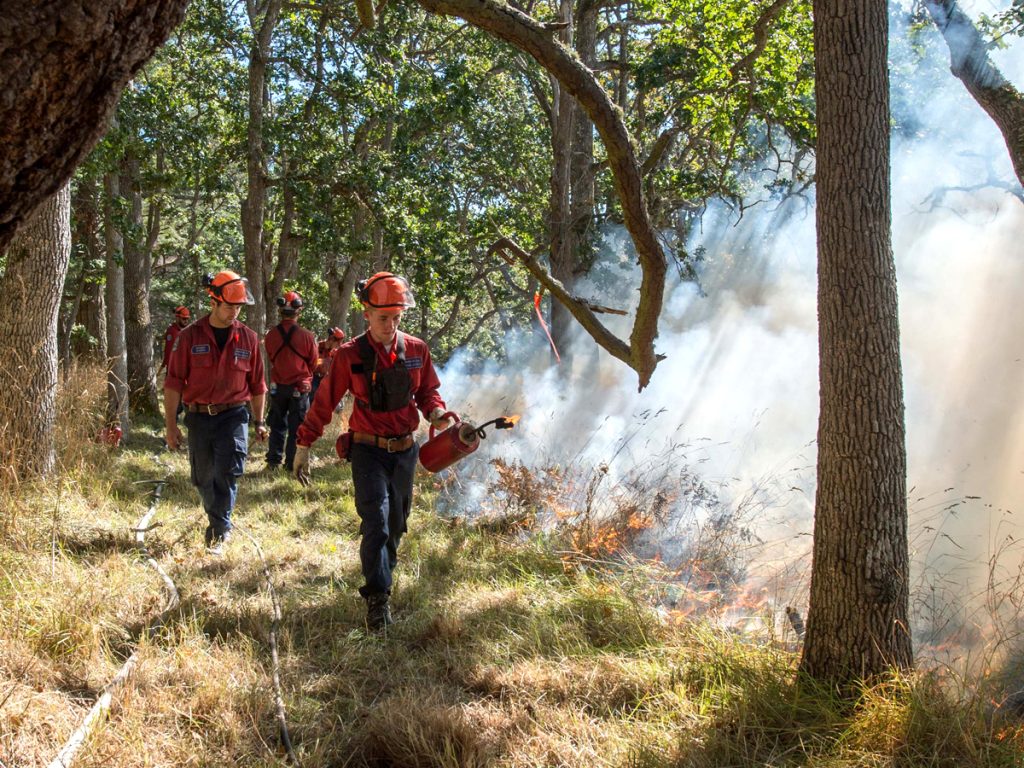
[caption id="attachment_19655" align="alignnone" width="591"] Formation Safety and Environment conduct a controlled burn with BC Fire Services and Esquimalt Fire Department at Rocky Point. Photo by LS Valerie LeClair, MARPAC Imaging Services[/caption]Formation Safety and Environment ~Department of National Defence worked in partnership with Natural Resources Canada and the BC Wildfire Service (BC Coastal Fire Center) to conduct a controlled prescribed burn at the DND Rocky Point Property on Sept. 27 and 28.  “The prescribed burn targeted 15 hectares of land and was the second prescribed burn successfully carried out under this partnership,” said Tracy Cornforth, Formation Environment Officer at the base’s Formation Safety and Environment (FSE) Branch.DND’s Rocky Point property is one of the largest remnants of Garry Oak Ecosystem in Metchosin and on Southern Vancouver Island.  The 1100 hectare property contains notable populations of rare plants and animals which have attracted researchers from all across North America.  Forest fire suppression has had a major impact on the Ecosystem.  Historically, deliberately set prescribed fires were used by First Nations to periodically sweep through Garry Oak meadows, burning off dry grass, shrubs and young trees less tolerant of fire than Garry Oaks.  These fires occurred frequently and prevented the accumulation of forest litter and reduced the overall fire risk.  Fire tolerant Garry Oaks would have survived these low intensity burns and native plants used by First Nations would vigorously re-sprout after these burns.  DND is using controlled prescribed burns to control invasive plant species and conifer encroachment into remaining high value Garry Oak meadows.  This activity helps to reduce the overall fuel load, restore the ecosystem and makes areas more suitable for light military training.

Gets me fuming: smokers in parks

Gets me fuming: smokers in parks

SLt M.X. Déry, Acting editor ~The legalization of pot is finally upon us, and while I’m not a user myself, I’m glad that some of my friends will now have the freedom to engage in recreational use without fear of legal reprisal. No longer will they need to find a sequestered spot to purchase illegal drugs on the black market and then smoke them in hiding, usually somewhere outdoors like the woods or a park.With the stigma gone, I shouldn’t be walking in the park at sunset and come across yet another couple sharing a joint during their jaunt on the trails. Ended are the days where I push my son’s stroller with the stench of marijuana permeating around the playground.Nothing really gets me fuming like seeing people carrying bits of burning plant around a heavily wooded area after the worst wildfire season in BC history.I’m not naïve and I know the transition won’t be instantaneous, but pot smokers will need to re-learn where they can smoke. For years they’ve developed a routine of smoking away from house and home, avoiding their landlords or children and smoking somewhere they could walk to, but not in plain sight where authorities could see them.If you plan on trying cannabis for the first time on Oct 17, then I recommend you read the recently amended Capital Regional District (CRD) Clean Air Bylaw No. 3962, which makes all parks, playgrounds, playing fields, public squares and bus stops smoke free. The section outlining where you can’t smoke is only half a page. I can’t remember the last time I spotted a tobacco smoker lighting up where they weren’t supposed to, so if you don’t want to read through the legalese, you could always ask your tobacco smoking friends where they smoke.While you no longer face jail...

Explore More

Categories

Top News

E-Editions Archive

News Stories Archive

Proud Supporters

Joshua Buck, Lookout Newspaper