[wpml_language_selector_widget]
[searchwp_form id="1"]
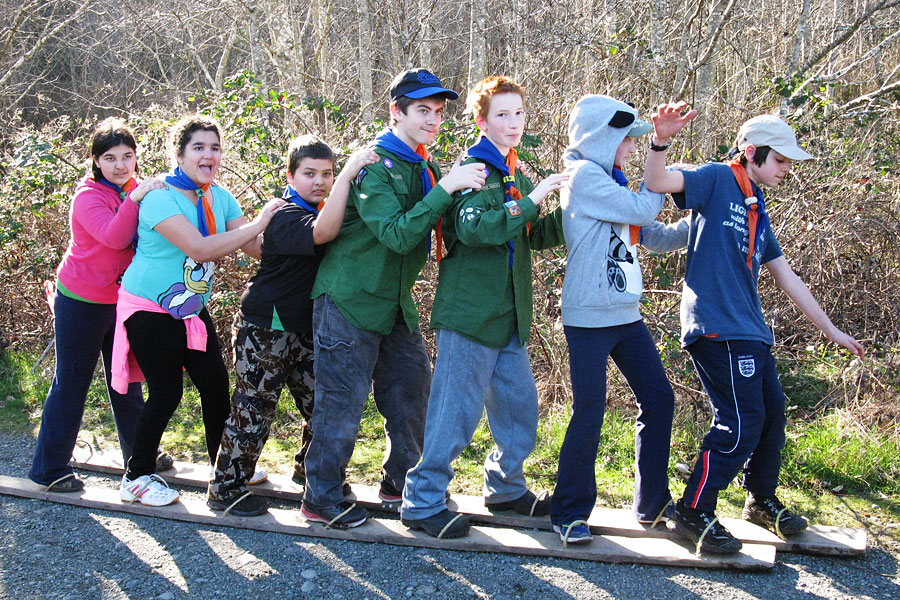
Members of the 10th Juan de Fuca Scout Troop participate in a Klondike Derby event at Royal Roads University

Victoria Scouts need volunteers to keep going

[caption id="attachment_18429" align="alignnone" width="579"] Members of the 10th Juan de Fuca Scout Troop participate in a Klondike Derby event at Royal Roads University, March 7, 2015. Photo credit: Dorthy Rosenberg[/caption]Peter Mallett, Staff Writer ~A former sailor of the Royal Canadian Navy is on a scouting mission.Petty Officer Second Class (Retired) Colin Evans is looking for military and civilian recruits from CFB Esquimalt to help solve a critical parent volunteer shortage for Scouts Canada in the Greater Victoria Area.“We desperately need volunteers for all sections of our organization in the Greater Victoria Area, from Scouters at our weekly meetings and weekend outings, and to fill support and committee-level roles,” said Evans.Evans is a former Naval Electronic Sensors Operator who enjoyed a 21-year career in the navy before his retirement in 2007. He is now the Group Commissioner for the 10th Juan de Fuca Scout Group.The volunteer shortage means growing waiting lists, which means youth have to wait a year or more to join a local scouting group. Evans says many children lose interest by the time they are contacted.The shortage is particularly bad on the West Shore forcing two Scout groups to close.With an ever-growing population in that area, healthy youth activity is much needed to keep kids busy after school and on weekends.There are approximately 1,100 youth involved in Scout programs in the Greater Victoria area and 350 volunteers. Evans goal is to raise the volunteer numbers by 25 percent.Adventure and confidence building skills are at the heart of Scouts Canada. Evans, a former scout, says volunteering with the program was a natural fit as an adult.“Scouting is a perfect fit for me because my children are involved in the programs and I love the outdoors, adventure, and working with youth.”He believes military personnel and civilians are a great fit for...

Life after the Navy: On canvas

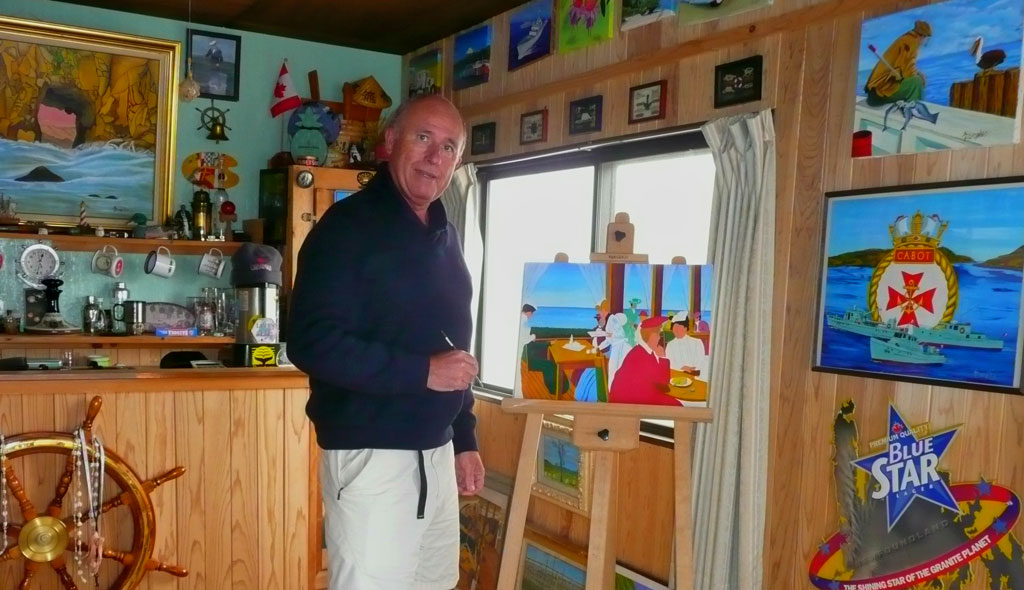
Peter Mallett, Staff Writer ~A former Naval Reservist is rendering a new life in Japan.From his well-lit windowed studio on the second floor of his home in Numazu, Petty Officer First Class (Retired) Anthony Dunphy dabs his brush into acrylic paint and strokes the canvas. The 60-year-old Newfoundlander is at work on his latest creation that will soon join others to be sold on his website www.anthonydunphyfineart.com. Money, while needed to pay the bills, is not his motivation. Rather, he says, it is from a desire to “make people from all over the world smile.”“My finished works are filled with light and vibrant colours to reflect my personal view of the world. Painting is relaxing, interesting, calming, and a great way for me to feel accomplishment. Joy is found in every part of my experience and I hope that feeling is conveyed through my art.”He is self-taught, fine tuning his skills with the aid of YouTube videos. He has amassed a sizeable collection over 10 years on varying subjects.“Many people paint only one thing and become experts in fields such as seascapes; I paint whatever strikes me at the moment,” he said. “I love painting the sea and its many moods, as well as the ships and seaman that work upon it, but I also love painting classic cars, the faces of musicians like Miles Davis and James Brown, and sports like hockey, which I often played while growing up in St. John’s.”His passion for hockey is best exhibited in Fighting For the Puck. It depicts players vying for on-ice supremacy in an old-fashioned game of shinny on a frozen pond somewhere in Canada. But the appeal of his art extends well beyond Canada. A recent portrayal of jazz great Dizzy Gillespie made its way onto the CD jacket of Los Angeles-based...

Sub-Lieutenant Lassina Traoré

Navy family grows by one Ivory Coast exchange officer

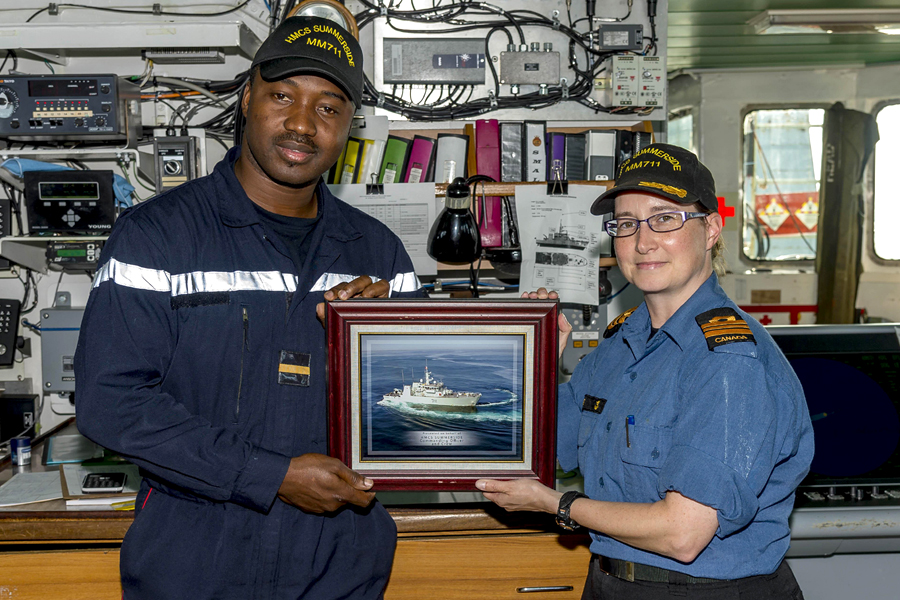
[caption id="attachment_18366" align="alignnone" width="575"] Sub-Lieutenant Lassina Traoré, left, a member of the Ivory Coast Navy, receives a framed photograph of HMCS Summerside from Commanding Officer Lieutenant-Commander Emily Lambert, to remind him of his time as an exchange officer aboard the ship. Photo by OS John Iglesias[/caption]Lt(N) Linda Coleman, HMCS Summerside ~Sailing across the Atlantic Ocean is routine for the Royal Canadian Navy (RCN), but for many African nations, it’s a rare occurrence.So for Sub-Lieutenant Lassina Traoré, a member of the Ivory Coast Navy, to spend five weeks sailing in Her Majesty’s Canadian Ship (HMCS) Summerside to West Africa was a pretty big deal. “I am most likely the person who has travelled the most nautical miles in my navy,” said SLt Traoré upon conclusion of his time in Summerside. “It was a once-in-a-lifetime opportunity for me to sail in a Canadian warship and, most of all, cross the Atlantic Ocean.”As part of Operation Projection West Africa, the RCN offered spaces for two exchange officers from Africa - SLt Traoré, and an exchange officer from the Ghana Navy to sail in HMCS Kingston and Summerside. SLt Traoré’s adventure began in Halifax mid-January, one week prior to the ships’ departure for Op Projection. He met the command teams and crews of both ships, as well as Commodore Craig Skjerpen, Commander Canadian Fleet Atlantic, who welcomed him to the fleet. The junior officers also showed him around the city to experience traditional Maritime hospitality. During the deployment, SLt Traoré stood watches and took part in ship evolutions. “He participated in multiple events on board, including our small arms shoot,” said Lieutenant (Navy) Guillaume Desjardins. “When we approached his home country, he provided important advice on navigation and pattern of life in the area. We also had some interesting conversations with him about his home,...

Cdr Michele Tessier

Connecting a future ship to the past

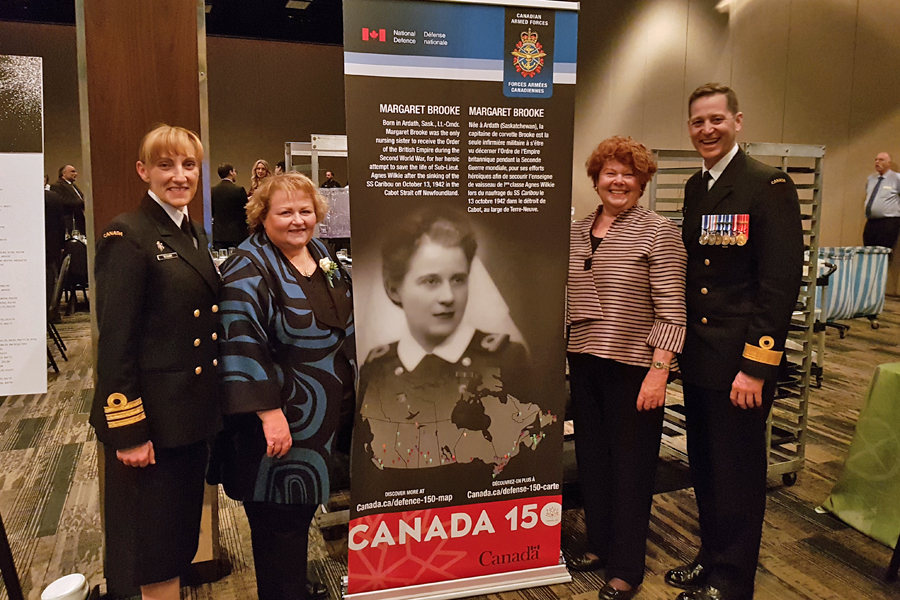
[caption id="attachment_18370" align="alignnone" width="575"] Cdr Michele Tessier, Margaret and Alyson Brooke, and Commander Canadian Fleet Atlantic Cmdre Craig Skjerpen.[/caption]SLt M.X. Déry, MARPAC PA ~Commander Michele Tessier has been undergoing training to prepare her for the unique challenges of working in the Arctic as Commanding Officer of HMCS Margaret Brooke, the second Harry DeWolf class Arctic and Offshore Patrol Vessel.The ship’s name is in honour of LCdr Margaret M. Brooke who survived the sinking of the ferry SS Caribou after it was torpedoed by a German U-boat off the coast of Newfoundland in October 1942. She and a colleague, Sub-Lieutenant Agnes Wilkie, clung to ropes on an overturned lifeboat until hypothermia caused Wilkie to lose consciousness. LCdr Brooke held onto the lifeboat with one hand and her unconscious friend with the other until daybreak when, despite her best efforts, a wave pulled SLt Wilkie away. For her selfless act, LCdr Brooke was named a Member of the Order of the British Empire.“We want to make sure that LCdr Margaret Brooke’s story continues on and lives with the ship and that we are able to pay homage to her, not just in the naming of the ship, but as we go places in Canada, we can talk about what kind of a person she was and why the ship has her name,” said Cdr Tessier. Recently she spent a few days in and around Saskatoon visiting places of importance to LCdr Margaret Brooke’s life.Cdr Tessier spoke to the crew of HMCS Unicorn, the reserve unit LCdr Margaret Brooke joined in 1942, about her experiences in the Arctic and the opportunities for them in the future. “I told them what my impressions of the Arctic were, the beauty of it, the danger of it, the fragility of it, and what kind of impact we...

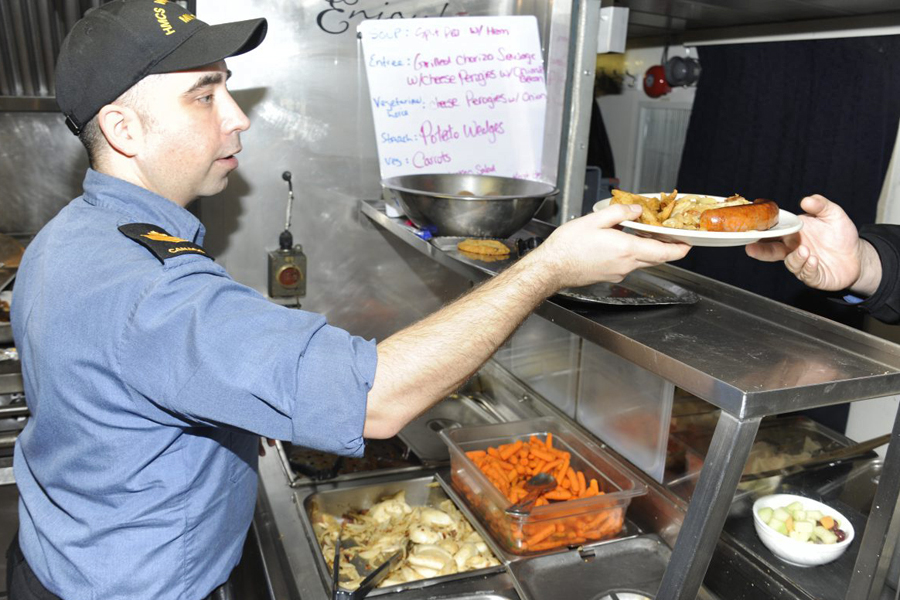
The Chief Cook of HMCS Whitehorse serves perogies and sausage to the crew. Photo by Lt (N) Paul Pendergast

HMCS Whitehorse cooks serve up delectable morale meals

[caption id="attachment_18363" align="alignnone" width="575"] The Chief Cook of HMCS Whitehorse serves perogies and sausage to the crew. Photo by Lt (N) Paul Pendergast, Canadian Joint Operations Command Public Affairs Officer[/caption]Lt(N) Paul Pendergast, Operation Caribbe Public Affairs Officer ~There is an old saying that an army marches on its stomach, and that also is true for the navy. The daily routine of life at sea for the crews onboard Her Majesty’s Canadian Ships Edmonton and Whitehorse revolves around the galley and meal times.Both ships are deployed on Operation Caribbe, Canada’s contribution to an international operation to stop illicit trafficking of drugs, weapons, money, and people.The Chief Cook of Whitehorse, who cannot be identified for operational security reasons, is keenly aware of the critical role he plays in maintaining morale among the 48 members of the crew.“When people come to the steam line for their meal, you can see their face light up if the food is good, and that puts them in a good mood to carry out their duties for the rest of the day,” said the Chief Cook.To get that positive reaction, it starts at the beginning with ordering good quality ingredients, inspecting the food carefully on arrival, and storing it properly in the ship’s coolers to maintain inventory control. “I developed the menu specifically for our crew size, to ensure there is a variety of nutritious and interesting items so people do not get bored with the food,” he adds.Galley staff in Whitehorse like to “take it up a notch”. They provide fresh baking daily, including bread, scones, and desserts such as banana bread or cheesecake. A favorite of the crew is the smoothies that are made daily from fresh fruit. “It is the little things that make a difference,” said the Chief Cook. “Like cooking fresh bacon...

Base plays host to Invictus team training

Base plays host to Invictus team training

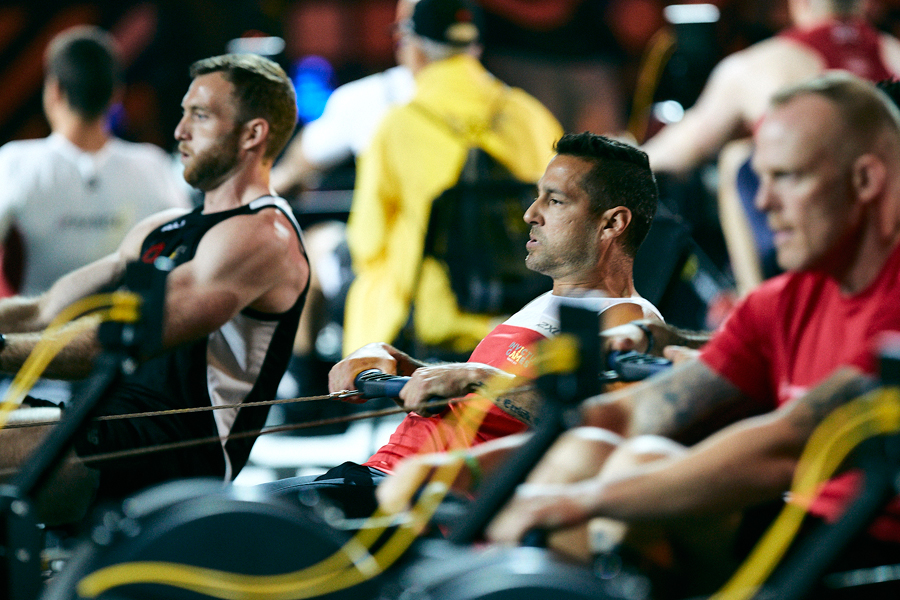
Peter Mallett, Staff Writer ~Team Canada - Invictus Games 2018 is coming to CFB Esquimalt to begin training for this year’s international competition for ill and injured soldiers and veterans.The training camp, April 8 to 14, involves approximately 40 athletes, three head coaches and several volunteer coaches. It’s all in preparation for the fourth edition of the Games in Sydney, Australia, Oct. 20 to 27, which will feature current and former military athletes from 18 nations competing in 11 sports.The Naden Athletic Centre will serve as the main training venue for powerlifting, indoor rowing, swimming, wheelchair basketball, wheelchair rugby, cycling, and sitting volleyball camps. The Canadian Forces Sailing Association will host the sailing training camp; archery training will be held at the Victoria Bowman Outdoor Range, and Oak bay Secondary High School is the venue for track and field.Out-of-town athletes and coaches will be housed at Work Point barracks. Peter Lawless, Victoria lawyer and Canadian Olympic Committee Vice President, is returning to head coach duties this year. He is one of 12 coaches on the team.There will be no returning athletes on Canada’s team as in previous years. A complete shuffling of the deck is a conscious effort to give others a chance to experience the power of the Games. “It’s a remarkable journey; there are lots of ups and downs, and as you move closer to the games the team cohesion builds and their individual confidence increases,” said Petty Officer First Class Joe Kiraly, Team Canada manager. “For the athletes who were not selected for the team, Soldier On remains committed to finding opportunities for them.” Golf and tennis have been dropped from this year’s competition, but sailing has been added. Lieutenant Commander Chris Maier, CFSA Commodore, says volunteers from the CFSA and the Victoria Disabled Sailing Association will combine...

Crewmembers from HMCS Vancouver were busy last week filling the ship’s stores in preparation for their departure. Photo by SLt M.X. Dery

HMCS Vancouver sets sail on Operation Projection

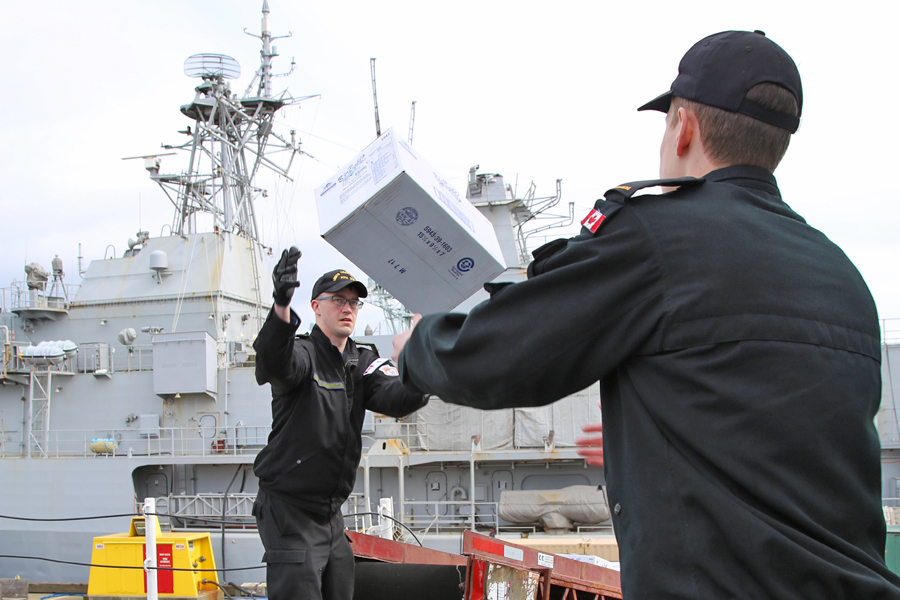
[caption id="attachment_18355" align="alignnone" width="575"] Crewmembers from HMCS Vancouver were busy last week filling the ship’s stores in preparation for their departure. Photo by SLt M.X. Dery, MARPAC PAO[/caption]Lt(N) Tony Wright, HMCS Vancouver PAO ~After a long Easter weekend with family and friends, HMCS Vancouver and crew deployed for Operation Projection Indo-Asia Pacific.This is a three-month patrol in the Western Pacific that will be followed by Vancouver’s participation in the 2018 Rim of the Pacific exercise (RIMPAC), the world’s largest naval exercise.Vancouver will visit Hong Kong, Singapore, Australia, and Fiji in order to demonstrate Royal Canadian Navy (RCN) operational capabilities, and the flexibility to contribute to a range of requirements: support to international missions, strengthening relationships with allies and partners, and responding to humanitarian or security related incidents in the Indo-Asia Pacific, if required. The mission will also demonstrate the Canadian Armed Forces’ ability to project naval influence and support Government of Canada objectives in this region. Canada is a Pacific nation and Op Projection Indo-Asia Pacific is another example of Canada’s commitment to support stability in the region.“The RCN offers options to government to effectively engage in parts of the world where our country has economic and security interests, and we are a very flexible resource,” says Cdr Christopher Nucci, Vancouver’s Commanding Officer. “As Vancouver has experienced first-hand in the past, although ships set sail expecting to complete a certain set of tasks, we can end up doing something completely different within our spectrum of capabilities if the need arises.”In 2016, Vancouver deployed to the Western Pacific and was scheduled to participate in the Royal New Zealand Navy’s (RNZN) fleet review. That port visit quickly turned into a humanitarian mission after a 7.8 magnitude earthquake struck the Kaikoura region. A task group that included units from Australia, Canada, and the United...

Leading Seaman Matthew Billard of Fleet Diving Unit (Pacific) undergoes training for a new surface-supplied diving system at his unit’s headquarters in Colwood

Divers test new lightweight gear

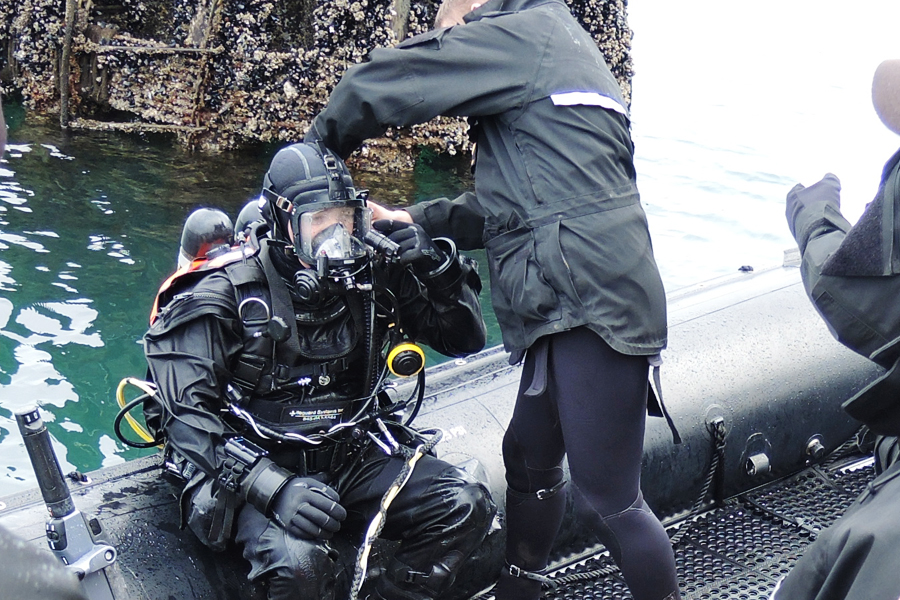
[caption id="attachment_18330" align="alignnone" width="581"] Leading Seaman Matthew Billard of Fleet Diving Unit (Pacific) undergoes training for a new surface-supplied diving system at his unit’s headquarters in Colwood, March 10. Photo by Peter Mallett, Lookout[/caption]Peter Mallett, Staff Writer ~A new, light-weight surface-supplied diving system will increase operational diving capability during deployments and exercises for Fleet Diving Unit (Pacific) (FDU) Clearance Divers. The Ultra Lightweight Surface Supply Diving System, manufactured by Swedish-based respirator manufacturer Interspiro, is also being acquired by FDU (Atlantic), the Canadian Army divers, and Search and Rescue divers. The new lighter and modern equipment supplies breathing gas and vital two-way communication between the surface and diver while conducting dives to a maximum of 54 meters (175 feet).Divers, including Lieutenant-Commander Rick Kappel, the unit’s Commanding Officer, ­trialled the system last month in Esquimalt Harbour.LCdr Kappel noted that, among other operational advantages, the ultra-lightweight diving system will make diving from small boats in an operational environment safer and more effective. “Another significant advantage of having this lighter and modern equipment is what takes place above the water while divers are diving,” he said. “Clearance Divers often do their jobs in cold and hostile conditions, with boats rocking back and forth. This streamlined equipment will make these dives easer from a setup perspective, safer from a diver support perspective, and will also help save backs while moving the tanks and gear in and out of boats and vehicles. We are often prone to back injuries when going back and forth from land to water because we are carrying bulky, heavy, sometimes awkward gear, while keeping balance all at the same time.”LCdr Kappel and nine other divers participated in the three-day training course designed to qualify FDU(P) divers on the equipment. He conducted the diving system safety test and dawned the gear, and entered...

FIRST Robotics Competition inspires DND employees

[caption id="attachment_18326" align="alignnone" width="581"] Left: Students from Esquimalt High School make some last-minute repairs to their robot ‘Spike’ before a quarter final match. Photos by Peter Mallett, Lookout[/caption]Peter Mallett, Staff Writer ~Two employees from CFB Esquimalt are now believers in the FIRST Robotics Competition’s (FRC) power to inspire high school students about careers in science and technology. Earlier this month Mimi Cahill, a Federal Student Work Experience Program employee with Base Information Services, and Petty Officer Second Class Victor Haines, a Weapons Engineer at Fleet Maintenance Facility, volunteered to help in the first B.C. Regional Championship. The robo-sport competition took place March 15 and 16 at Save-On-Foods Memorial Arena, and challenged teams of 10 or more high school students to build from scratch, in just six weeks, a five-foot tall, 68 kilogram robot, and then enter it in a skill-testing competition.Cahill, who is studying Applied Computer Science at Dalhousie University, says a high school student’s experience with FIRST could be a career or life-changer.“The hands-on experience and work to build robots can inspire a lot more than looking at code or a formula in a text book,” said Cahill. “Whether these students end up in STEM [Science Technology Engineering and Mathematics] based fields, this experience may inspire them to a career path they may never before have considered.”This year’s regional competition involved 30 B.C. teams from across the province, and guest teams from further afield in Alberta, Ontario, Quebec, California and Mexico. There are 160 regional competitions around the world with about 3,000 teams, with the ultimate goal to qualify for the FIRST world championship event.No ‘I’ In Team PO2 Haines ensured competitors were complying with the competition’s official rule book, and says teamwork was crucial to succeeding.“They not only have to build the robot but they also must build a team and work with each other,” said PO2 Haines. “I really enjoyed seeing how young students can build that camaraderie that I have learned to develop in the military. That...

OpCARIBBE – Tackling the War on Drug trafficking

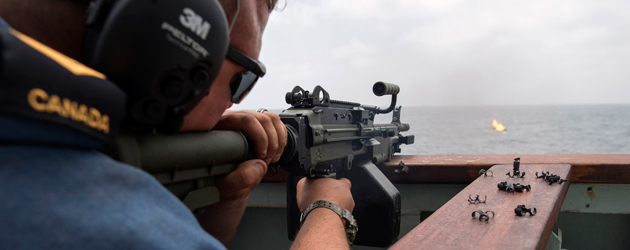
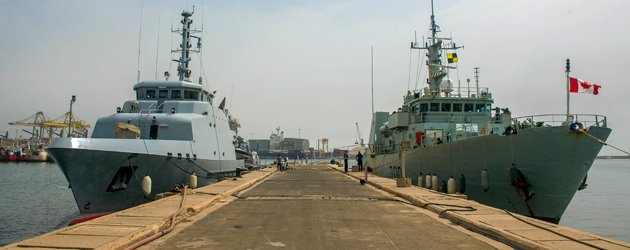
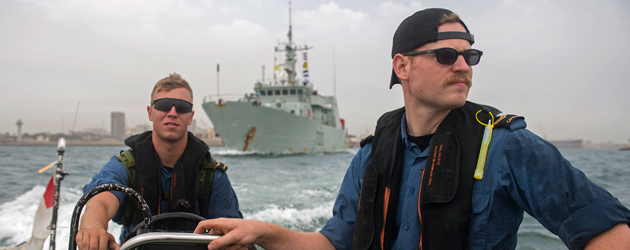
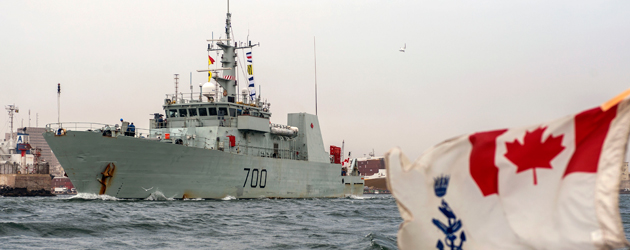
[caption id="attachment_18322" align="alignnone" width="580"] Left: Two members conduct small boat operations from HMCS Whitehorse. Right: A crew member from HMCS Edmonton fires a C8 rifle on the ship’s fo’c’sle during Operation Caribbe in the eastern Pacific Ocean. Photos by MARPAC Public Affairs[/caption]Lt(N) Paul Pendergast, Canadian Joint Operations Command Public Affairs Officer ~As Her Majesty’s Canadian Ships Whitehorse and Edmonton slipped all lines and proceeded to sea from San Diego, California, Feb. 26, there was a palpable sense of seriousness among both crews. As they exited the harbour, they turned south to begin their two-month deployment on Operation Caribbe, Canada’s contribution to an international operation to stop illicit trafficking of LA drug detox, weapons, money and people.The eastern Pacific Ocean is a huge body of water, stretching for thousands of kilometers along the coast of South and Central America, and up to North America. It is along this maritime highway that drugs have been making their way onto the streets of Canada and the United States.Since the Canadian Armed Forces (CAF) began participating in Operation Caribbe in 2006, they have contributed to the seizure of more than 83 tonnes of cocaine, and it shows no signs of slowing down. In 2017 alone, the CAF helped the U.S. Coast Guard seize or disrupt over 11.5 metric tonnes of cocaine.Those are drugs that are not reaching our streets and causing harm to our people. There is also a disruptive effect, where it becomes more difficult for criminal organizations to conduct their business.For the crew of HMCS Whitehorse, deploying on this operation is the culmination of an intense period of planning and preparation. In October 2017, the crew of HMCS Brandon conducted a hull transfer to HMCS Whitehorse, which had just completed a six-month docking work period of planned maintenance, painting, and the installation of new equipment.Then began the process of bringing the ship and crew to the level of proficiency required for this type of deployment. That is achieved through a tiered readiness program,...

From left

Mini Grey Cup lands in NFL hands

[caption id="attachment_18333" align="alignnone" width="579"] From left, Wally Buckoski of PSP Halifax and Paul Hollingsworth of TSN look on as CFL Commissioner Randy Ambrosie hoists the Mini Grey Cup during his town hall event in Halifax on February 23. Photo by Mike Dembeck, CFL.CA[/caption]Ryan Melanson, Trident Staff ~As rumours swirl about the possibility of a Canadian Football League franchise coming to the Halifax area, CFL Commissioner Randy Ambrosie stopped in the city Feb. 23 for a town-hall style event with local fans.While the CFL’s Grey Cup has been the ultimate prize in Canadian football since 1909, Ambrosie wasn’t getting away from Halifax without an introduction to CFB Halifax’s own football tradition.At the start of the event at the Westin Nova Scotian hotel, Ambrosie was presented with the Mini Grey Cup, the trophy awarded after the annual match between the Fleet Club Slackers and Wardroom Officers, which will be celebrating its 50th anniversary in 2019.Wally Buckoski of Personnel Support Programs Halifax, who works as the sports stores technician at the Shearwater gym, said he couldn’t pass up the opportunity to bring the storied military trophy to the event. But he didn’t expect it to become part of the show.“I just showed up at the hotel with the Mini Grey Cup, but I didn’t realize it would be so popular. It was a very cool moment.”He found himself a seat near the front of the room, and once the cameras were rolling, event emcee Paul Hollingsworth of TSN invited him to bring the cup on stage to introduce it to the Commissioner and take a few photos.The CFL’s top executive donned an Royal Canadian Air Force (RCAF) football jersey and hoisted the Mini Grey Cup above his head on stage for the TV cameras, and continued wearing the jersey for the entirety of the...

Sailors use Orca platform to develop naval skills

Sailors use Orca platform to develop naval skills

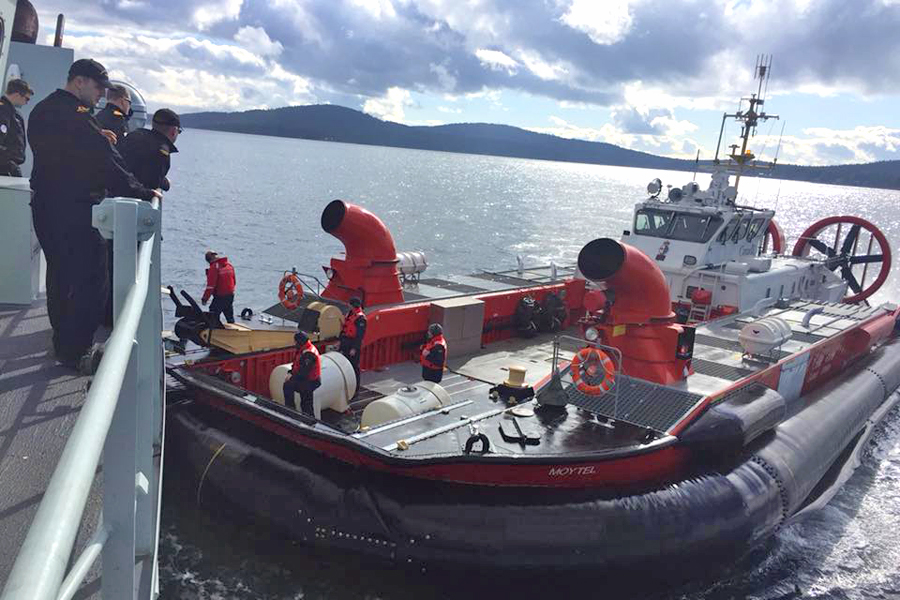
A/SLt Brandon Khuu, Naval Reserves ~The Annapolis division of Naval Warfare Officers have recently completed a dynamic Phase Four of training at Naval Fleet School Pacific – Venture Division.After spending three weeks at sea, and conducting a mini task group exercise on board Orca-Class Patrol vessels Wolf and Orca, sailors learned to be flexible with the planning and execution of tasks and exercises, all while standing bridge watches, and consolidating their naval concepts and skills learned to date.The work was fast paced and hands-on for the students who assisted the Canadian Coast Guard in response to a reported fuel spill in the Strait of Georgia. The two patrol craft embarked members of the Canadian Coast Guard (CCG) hovercraft Moytel to survey the coasts and shorelines of several Gulf Islands for signs of fuel, with no such indications found.The students also participated in two helicopter hoist operations with a United States Coast Guard helicopter from Port Angeles, and with RCAF 443 MH Squadron out of Patricia Bay, furthering their knowledge and capability of working alongside other government and allied departments.Training at sea allowed students to sail to Constance Bank and act as a platform for simulated mass casualties in support of a training event for HMCS Calgary, and later conducted pilotage to Desolation Sound, and anchorage in Teakerne Arm, which included an overnight maritime security patrol in the Strait of Georgia and the southern Gulf Islands.Sailing in late February and early March also added the complexity of Pacific Coast winter storm weather.Coping with the ever-changing environment, the students deftly adapted to last minute alterations into passages and channels to avoid predicted weather, which involved the immediate re-planning of routes, destinations and scheduled tasks.Thanks to the Patrol Craft Training Unit, the students enjoyed a fast-paced three weeks at sea, full of great events,...

The Governor General of Canada, Her Excellency the Right Honourable Julie Payette visits Victoria

[caption id="attachment_18311" align="alignnone" width="575"] The Governor General of Canada, Her Excellency the Right Honourable Julie Payette receives the Royal Salute from Guard Commander LCdr Mike Erwin in front of the British Columbia Parliament Buildings March 20.[/caption] [caption id="attachment_18312" align="alignnone" width="575"] The Governor General of Canada inspects the Guard of Honour comprised of Canadian Armed Forces members from Maritime Forces Pacific.[/caption] [caption id="attachment_18313" align="alignnone" width="575"] The Governor General of Canada greets members of the Royal Canadian Air Cadets.[/caption]––Photos by LS Victoria Ioganov, MARPAC Imaging Services

The crew of HMCS Chicoutimi prepare to disembark in Yokosuna

HMCS Chicoutimi celebrates achievements

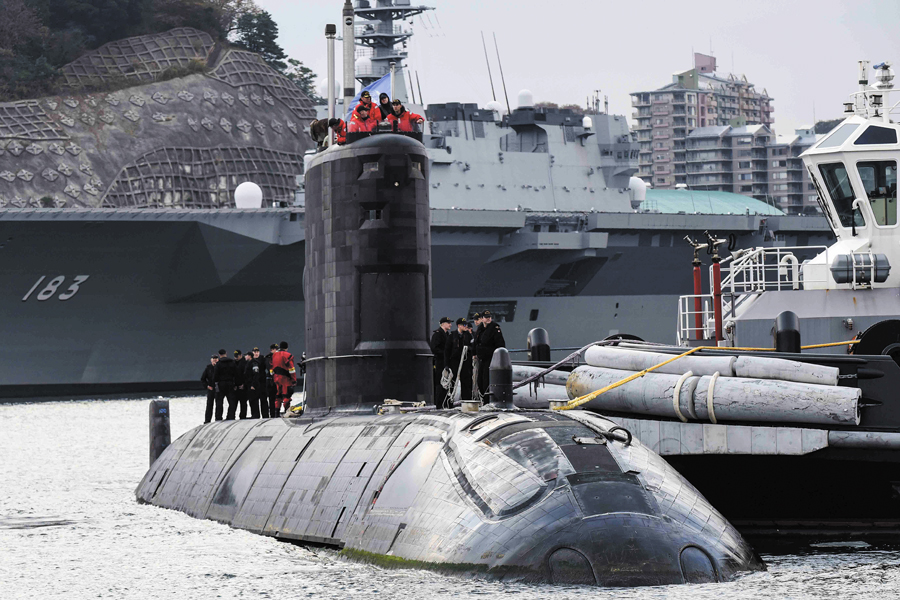
[caption id="attachment_18308" align="alignnone" width="575"] The crew of HMCS Chicoutimi prepare to disembark in Yokosuna, Japan, while deployed on Poseidon Cutlass 17. U.S. Navy photo by Mass Communication Specialist 1st Class Brian G. Reynolds/Released[/caption]Darlene Blakeley, Navy Public Affairs Ottawa ~Her Majesty’s Canadian Submarine (HMCS) Chicoutimi has piled up a lot of firsts on its lengthy deployment to the Asia-Pacific region.It’s the first time a Victoria-class submarine has deployed from the Royal Canadian Navy (RCN) to the region; been deployed for so long – nearly 200 days; participated in the previously bilateral Annualex with the U.S. Navy (USN) and the Japanese Maritime Self-Defense Force (JMSDF); and made port visits to Yokosuka and Sasebo, Japan, and Guam.It’s also the first time a Victoria-class submarine has undertaken a large-scale deployed maintenance activity conducted by personnel from Maritime Forces Pacific (MARPAC) and Fleet Maintenance Facility Cape Breton (FMF CB) in Japanese ports – all while Super Typhoon Lan raged around them.“It has been a phenomenally successful deployment,” says Captain (Navy) Chris Robinson, Commander of the Canadian Submarine Force.Chicoutimi, under the command of Commander Stephane Ouellet, left its home base in Esquimalt, B.C., in early September last year. Its simply stated mission was to “support Canada’s global engagement strategy through strategic partnerships, port visits and operational interactions.”But it has been anything but simple. Over the course of several months, Chicoutimi conducted intelligence, surveillance and reconnaissance; carried out seven interactions with the USN, JMSDF, the French Navy, the Royal Air Force and the Royal Australian Air Force; operated with more than 20 surface ships and 50 aircraft; and conducted more than 180 hours of submarine-on-submarine engagements.The success of this hectic tempo is a testament to the crew, according to Capt(N) Robinson, who says they worked hard and overcame challenges prior to deploying. In particular he mentions the unexpected...

Triumphant return for HMCS Chicoutimi

Triumphant return for HMCS Chicoutimi

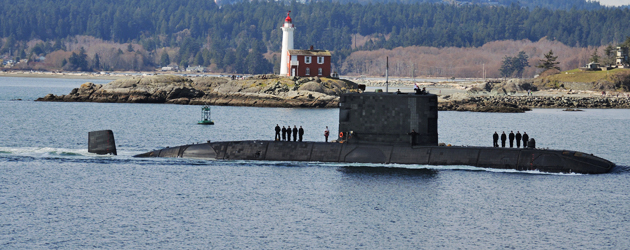
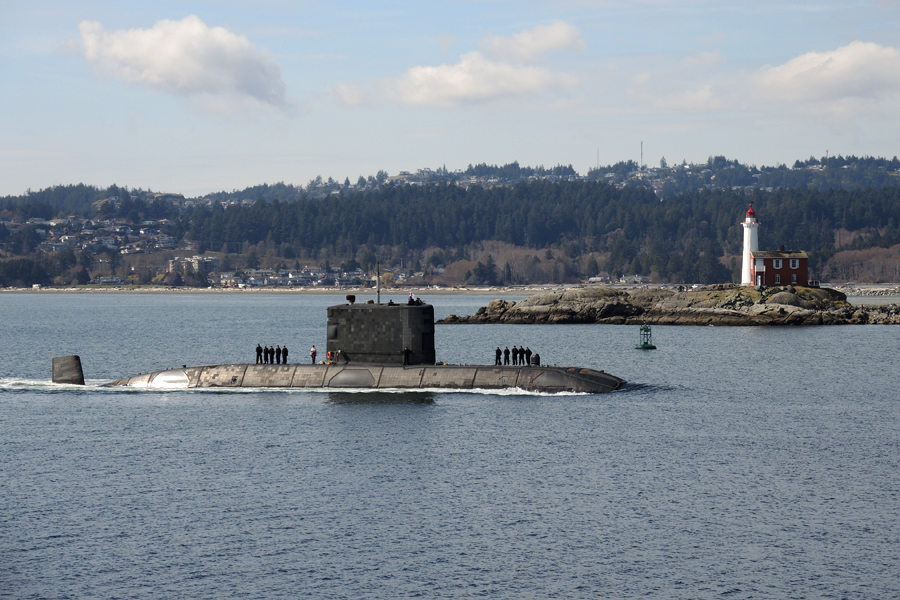
[caption id="attachment_18305" align="alignnone" width="575"] Photo by Peter Mallett, Lookout[/caption]Peter Mallett, Staff Writer ~Holding homemade banners and signs, family and friends of HMCS Chicoutimi crewmembers waited anxiously for the submarine to appear in Esquimalt Harbour March 21, sail past Duntze Head, and come alongside A Jetty. After that it was tears, cheers and heartfelt hugs as families were reunited, ending the historic deployment of the Royal Canadian Navy (RCN) submarine.The uplifting music from the Naden Band added to the excitement and emotion. Rear-Admiral Art McDonald, Commander Maritime Forces Pacific, described the homecoming as a “payday” and “return on investment”, not only for the RCN but also the families of the sailors. “You can see the love, you can see the pride, and you can see the sense of accomplishment in the faces of the sailors that came off the sub,” said RAdm McDonald. “This has been a far-reaching, long, successful, and very historic deployment. What this means is we have a great tool in our toolbox that has gone places and is proven.”The Victoria-class submarine and its crew of 59 left Esquimalt mid-September 2017 on a 197-day deployment, its first ever in the Asia-Pacific, and the first major RCN submarine deployment to the region in nearly 50 years. The mission also marked the longest deployment of a Victoria-class submarine to date. First across the brow was Master Seaman John Beaton who was selected in an on-board lottery to give the traditional first kiss at the homecoming to his wife Cendra Beaton. With his young daughter Ariana and son Xavier in the full embrace during the kiss, a large cheer and “hurrah” went up from the crowd. “It was a long deployment and it’s so good to be reunited with Cendra and the kids who seemed to have grown so much since I...

Jackie Carlé

New director at helm of Esquimalt MFRC

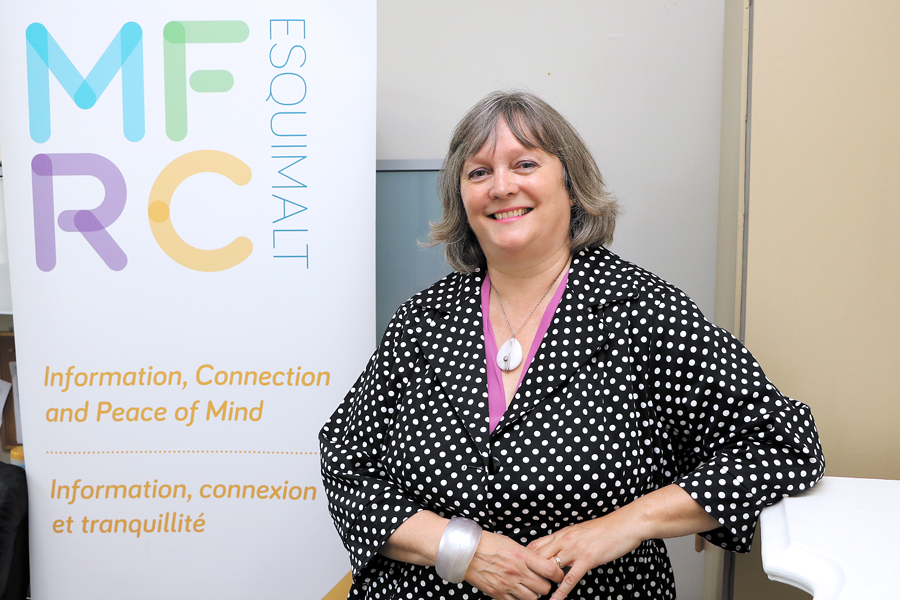
The Esquimalt Military Family Resource Centre’s (MFRC) search for a new executive director is complete.Jackie Carlé is the new executive director at the centre. She had been acting as interim executive director for the organization since June of 2017 and was selected as the successful candidate after a detailed hiring process.She has worked in support of military families for over two decades including eight years with Military Family Services, and has been with the Esquimalt MFRC since 2014 as the community engagement manager. She has over 20 years’ experience working in non-profit organizations such as Victoria’s Cool Aid Society and Ottawa’s The Mission Homeless Shelter. We chatted with MFRC Board Chair Samantha Krzywonos and the new Executive Director Jackie Carlé about the news. What was the reason behind the timing of the hiring? Krzywonos: I think there were a couple of factors in play for our board of directors. First, we had a long-time executive director here for many years and we wanted a chance to pause, think and make an informed decision on a new executive director. Second, we didn’t get a clear picture of what was happening with the MFRC governance review until the fall and we wanted that information before proceeding.  Finally, we wanted to be able to gather meaningful input from staff and we used that information to find the right person. What were the results of the governance review? Carlé: MFRC board members and executive directors met in late-September and voted on their top options for governance. The choices were to continue with the current non-profit structure, make some minor enhancements, or to adopt a partnership model. As of right now, the final decision is still under review but we know the options under consideration. What made Jackie the right person for the job? Krzywonos: There are a lot...

Commodore Jeff Zwick

New Zealand’s Te Kaha sailors ready aye ready to explore B.C.

[caption id="attachment_18277" align="alignnone" width="575"] Commodore Jeff Zwick, Commander of Canadian Fleet Pacific, greets Commander Steve Lenik, Commanding Officer of HMNZS Te Kaha, on F Jetty Colwood March 6. Photo by Leading Seaman Ogle Henry, MARPAC Imaging Services[/caption]SLt M.X. Déry, MARPAC PA ~HMNZS Te Kaha arrived in Esquimalt Harbour March 5 to undergo a midlife refit at Seaspan Shipyard, a project that, including post-upgrade testing, will have the Anzac-class frigate operating around CFB Esquimalt well into 2019. While most of the crew will fly home in six weeks, 20 will remain behind, housed on base, in order to effect work on the ship until mid-summer when fresh New Zealand sailors replace them.Leading Marine Technician (propulsion) (LMT(P)) Marc Cooper and Able Stores Accounting (ASA) Kendra Young will work in Esquimalt until late July, which gives them time to explore Canada during their time off.While both are well travelled, in large part due to their navy careers, this is their first time in Canada.“Been to America a few times,” says LMT(P) Cooper, listing several states he visited en route to a European vacation. “I’ve done like 40 countries now.”So far, most on the ship have stayed in the local area, figuring out how to get around using public transportation, and planning out a long-term transportation solution. “We need to make getting around easier,” says ASA Young, discussing the possibility of pooling resources with shipmates to buy a car.LMT(P) Cooper remarked that while Canada is much larger than New Zealand, British Columbia shares similarities to their homeland. “The terrain here is pretty similar to New Zealand,” says ASA Young.The sailors recently enjoyed the outdoors.“I did the Mount Finlayson walk at Goldstream Park,” says ASA Young, remarking the group expected to get to the top a lot sooner.The main attraction is undoubtedly snowboarding, before all...

First female test pilot in the CAF

Captain Marie-Michèle Siu, CFB Cold Lake ~The Aerospace Engineering Test Establishment in Cold Lake, Alta., is highlighting Major Catherine Blais – the first and only military female test pilot in the Canadian Armed Forces (CAF).Over the past 50 years, more than a hundred pilots have been hand-picked to work at the Aerospace Engineering Test Establishment. Maj Blais is one such person. As a versatile pilot, she has flown over 2,700 hours on military and civilian aircraft, both fixed wing and rotary wing, such as the CT-114 Tutor, CT-156 Harvard II, CH-146 Griffon and the CH-149 Cormorant.“My favorite is the UH-60 Blackhawk because it’s an icon of military aviation and it is truly built for its mission. Plus, I liked flying it at Test Pilot School,” she said. In addition to her flying experience, Maj Blais holds undergraduate and graduate degrees in aerospace engineering from l’École Polytechnique de Montréal. She is also a licensed professional engineer in Alberta.In 2003, Maj Blais enrolled in the CAF because of opportunities that appealed to her sense of adventure. She wanted to use her engineering degrees in a non-traditional way, and “couldn’t bear to sit behind a desk for the rest of my life”, she explains.She was first posted as an instructor at the 2 Canadian Forces Flying Training School in Moose Jaw, Sask. In August 2010, she was deployed to Afghanistan to fly the CH-146 Griffon in support of army operations. Following her deployment, she was selected to be a test pilot in the CAF, and was posted to the Aerospace Engineering Test Establishment upon her graduation in December 2013. She says the highlight of her career to date is her time at the United States Naval Test Pilot School at the Naval Air Station in Patuxent River, Maryland.Her typical day as a test pilot consists of flying for half a day, and supporting other projects such as test planning, reporting, participating in review boards, and attending engineering meetings. When she is executing a test...

Explore More

Categories

Top News

E-Editions Archive

News Stories Archive

Proud Supporters

Joshua Buck, Lookout Newspaper