[wpml_language_selector_widget]
[searchwp_form id="1"]
Major Justin Olsen

JRCC helps pilots shake off the “rust”

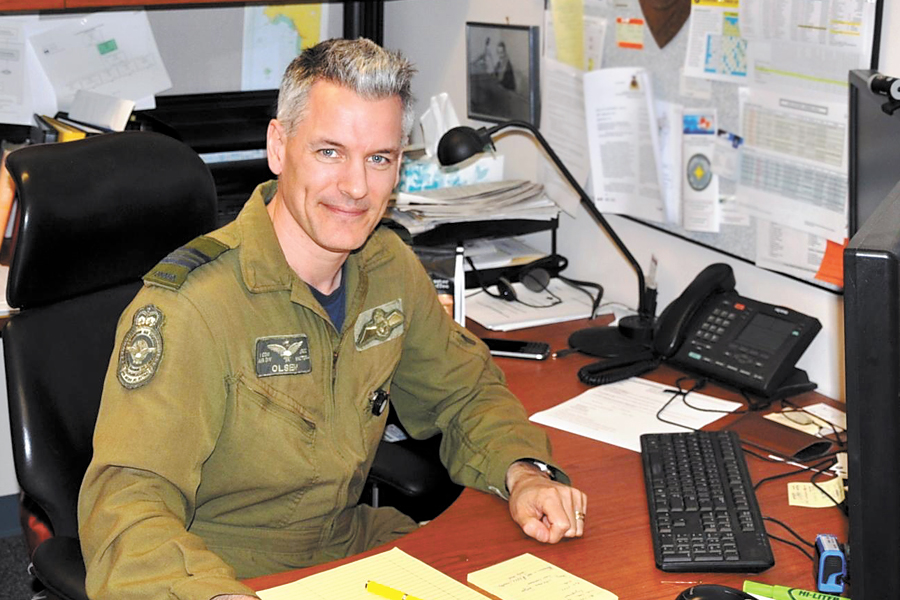
[caption id="attachment_16038" align="alignnone" width="450"] Major Justin Olsen, Officer in Charge of the Joint Rescue Coordination Centre Victoria, at his desk at CFB Esquimalt.[/caption]Will Chaster, MARPAC PA ~Search and rescue is unique in the sense that, unlike a business, it hopes to see as few customers as possible.With this goal in mind, prevention activities, an often underreported element of the Joint Rescue Coordination Centre Victoria (JRCC) search and rescue team, takes place throughout the year.“Activities aimed at prevention really helps us in the long term by ensuring we have fewer ‘customers’ in the future,” says Major Justin Olsen, Officer in Charge of the JRCC.The prevention program is called Rust Removers.The name is representative of the potential erosion of skills that may develop with a pilot after a long winter spent mostly on the ground. Transport Canada mandates that all pilots undergo a certain amount of training in order to stay up-to-date on search and rescue techniques and technology each year.One way to get this refresher is to attend a Rust Removers event put on by the JRCC Search and Rescue team. They usually go directly to a flying club or flight school to update pilots on search and rescue techniques.“We inform people on how the Rescue Centre gets involved in search and rescue events, what technology we use, and how they can increase their chances of survival in the event of an accident,” explains Maj Olsen.The Rust Remover program reaches more than 200 people each year in the Western Region.Any flying or boating organization can request a training day by phoning the JRCC administrative number at 250-413-8927.

Photo by Cpl Carbe Orellana

Winnipeg pauses for Battle of the Atlantic ceremony

[caption id="attachment_16035" align="alignnone" width="450"] Photo by Cpl Carbe Orellana, MARPAC Imaging Services[/caption]SLt Warren Bush, HMCS Winnipeg ~Sailors of the Royal Canadian Navy were proud to acknowledge and celebrate the legacy of their predecessors through Battle of the Atlantic Day, an annual day of remembrance held on the first Sunday in May.The ship’s company of HMCS Winnipeg commemorated the occasion through a ceremony that brought attention to the service and sacrifice of Canada’s sailors during the Second World War. Winnipeg itself is named after a Battle of the Atlantic veteran, a 990 tonne, 225 foot Algerine Class Minesweeper commissioned in 1943.The service commenced with opening remarks from Winnipeg’s Commanding Officer, followed by the National Anthem, an address by the ship’s Padre, Psalm 23, and the Naval Prayer. The sailors then heeded ‘Lament’ and ‘Reveille’ after a two minute silence, and reflected on a somber Battle of the Atlantic  Roll of Honour, which individually named the 26 Canadian warships lost during the War, as well as the seven Motor Torpedo Boats.The Commanding Officer then cast a ceremonial wreath into the sea.Canada paid dearly for the Battle of the Atlantic: 1,797 sailors of the Royal Canadian Navy and countless merchant seamen met their end in that ocean’s icy water.

United Way Board Member Captain (Navy) Steve Waddell

Base new member of Thanks a Million Club

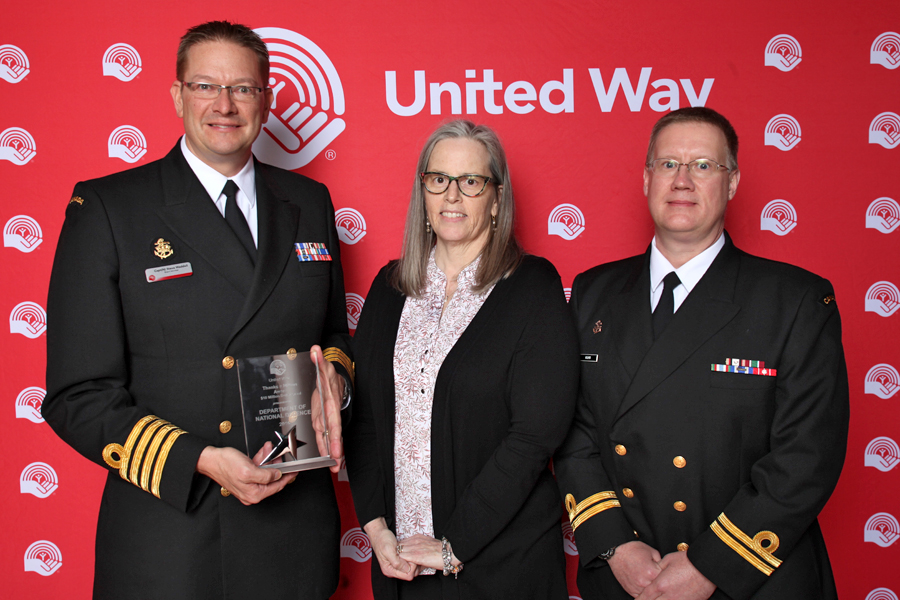
[caption id="attachment_16030" align="alignnone" width="450"] United Way Board Member Captain (Navy) Steve Waddell, Base Commander CFB Esquimalt, was on hand at the recent Spirit Awards where local campaign contributors at the Department of National Defence were recognized with induction into the United Way Greater Victoria’s “Thanks a Million” Club.[/caption]James Vassallo, Base PAO ~Helping those less fortunate, providing hot meals for the hungry, giving kids in need new opportunities, and caring for sick animals are just a few of the reasons why the local Defence Team deserves recognition for charitable giving.But at the recent annual Spirit Awards, the United Way Greater Victoria (UWGV) found 10 million more reasons when they made the Department of National Defence (DND) one of the first inductees of the “Thanks a Million” Club.“To become a member of this club you have to raise more than a million dollars, which is pretty amazing,” says Hazel Braithwaite, community campaign director, UWGV. “DND has surpassed that milestone ten-fold. As the only member of this exclusive $10-million club, the department’s dedicated employees have something to be very proud of.”The award recognizes the fundraising efforts of the local Defence Team, comprised of Canadian Armed Forces members and civilian employees working at more than 100 DND units within the Greater Victoria Area. The United Way of Greater Victoria and Healthpartners then distributes these donations to registered Canadian charities based on the choices made by individual donors when they contribute.Since 1994 – when United Way began keeping electronic records – the Defence Team has raised $10,062,690.35 to support charitable causes.Eleven organizations in the Capital Regional District (CRD) have met the $1 million philanthropic milestone in their workplace campaigns: Island Health, University of Victoria, Coast Capital Savings, RBC Royal Bank, City of Victoria, Camosun College, CIBC, TD Canada Trust, ESIT Advanced Solutions Inc., and the Canada...

Left to Right: Major Mark Kierstead

Final day of original Venture

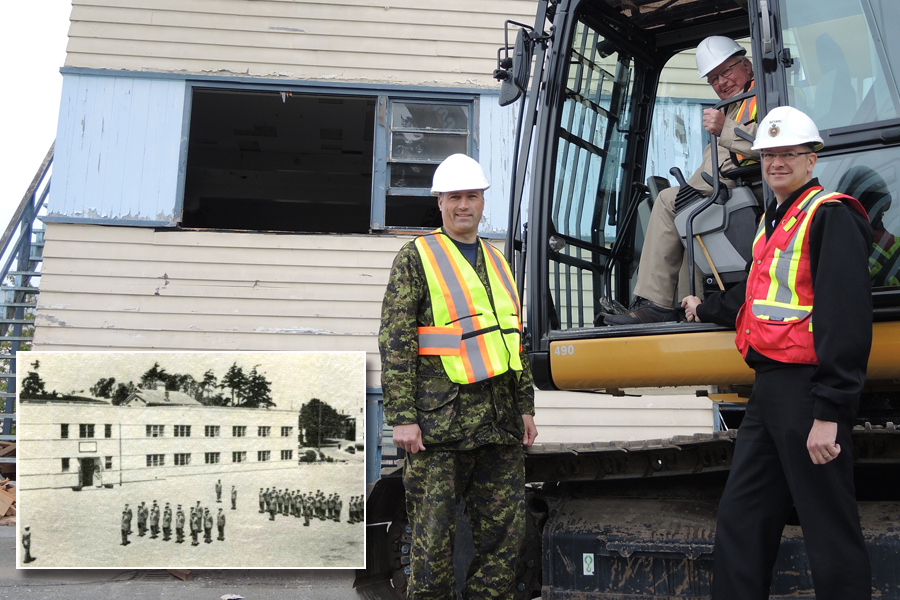
[caption id="attachment_16027" align="alignnone" width="450"] Left to Right: Major Mark Kierstead, Commanding Officer of Real Property Operations (Pacific), Maj (Ret’d) Ed Vishek, and Base Commander Capt(N) Steve Waddell break ground on the demolition project of Dockyard Building 11.[/caption]Peter Mallett with files from Lt(N) Pamela Hogan, Staff Writer ~When Maj (Ret’d) Ed Vishek climbed aboard an excavating machine on May 5 to take a ceremonial first swipe in the demolition of Dockyard Building 11 he couldn’t help but reminisce.That’s because for Vishek, and hundreds of other sailors, the aging building was his home for two of the most important years of his life.DY11 was the lifeblood and administrative headquarters for the Royal Canadian Navy’s junior officer training complex HMCS Venture, which Vishek attended from1959 to 1961. The program grew out of the Royal Canadian Navy’s Venture Plan that was established in 1954 to address critical officer shortages.Peering from the excavator cab window, the 77-year-old former Venture graduate gazed across the parking lot that was once the Parade Square to DY29, which served as the barracks for him and the other trainees.“It’s a somewhat sad moment for me because this place was where I began my 30-year career in the navy,” said Vishek who went on to enjoy a lengthy career as a naval pilot.During the height of the Cold War the two buildings were the centre of a sprawling training facility that also included a chapel, sports field, gymnasium and boat shed.DY11 was a 36,000 square-foot facility built in 1941 to provide offices and naval training classrooms as part of HMCS Givenchy, a speciality school that ran from 1943-45 for naval gunners crewing civilian vessels in the Second World War. It also contained a mess hall and orderly room, while its 22,000 square foot sister building DY29 was built the following year.Both...

PSP

Cock of the Walk

Peter Mallett, Staff Writer ~Esquimalt’s military units will soon have something to crow about with a revamped Cock of the Walk sports competition taking flight again in May.With fun, fitness and friendly competition between the base’s military units in mind, Personnel Support Services (PSP) sports staff will roll out the seven-event, year-long multi-sport competition.Cock of the Walk kicks off with a ball hockey tournament May 15 to 19, and concludes eight months later in February 2018 with ice hockey as its final event.Other competitions include:Slo Pitch, June 26 to 30;Soccer, Aug. 28 to Sept. 1;Badminton and Squash, Oct. 2 to 6;National Sports Day, Oct. 20;Basketball, Jan. 15 to 18, 2018, andHockey, Feb. 5 to 9, 2018.Although bragging rights and an overall Cock of the Walk trophy will be handed out, the competition has less to do about athletic competition and more about getting everyone out on the field of play, says PSP Sports Coordinator Heather Catte.“Cock of the Walk is really an effort to maximize fitness opportunities and participation across base units and members of the Fleet,” says Catte. “We hope it succeeds in efforts to increase morale, promote fitness and establish esprit de corps.”The launch of the competition requires unit sports representatives to promote and communicate details of the events, prepare eligibility lists, and assist in the recruitment of support staff for scorekeeping and officiating duties throughout the competition.The last time a Cock of the Walk competition was held at the base was 2015.The term Cock of the Walk originated from an 18th Century tradition of the Royal Navy. It has been used in naval and civilian circles with its connotation to mean a champion of a regatta or sports meet, or a combination of these events. According to naval tradition, the winning ship of a Cock of the...

HMAS Ballarat and HMCS Ottawa sail in formation with HMCS Winnipeg as part of manoeuvres. Photo by Cpl Carbe Orellana

Ottawa, Winnipeg sailors board Australian frigate

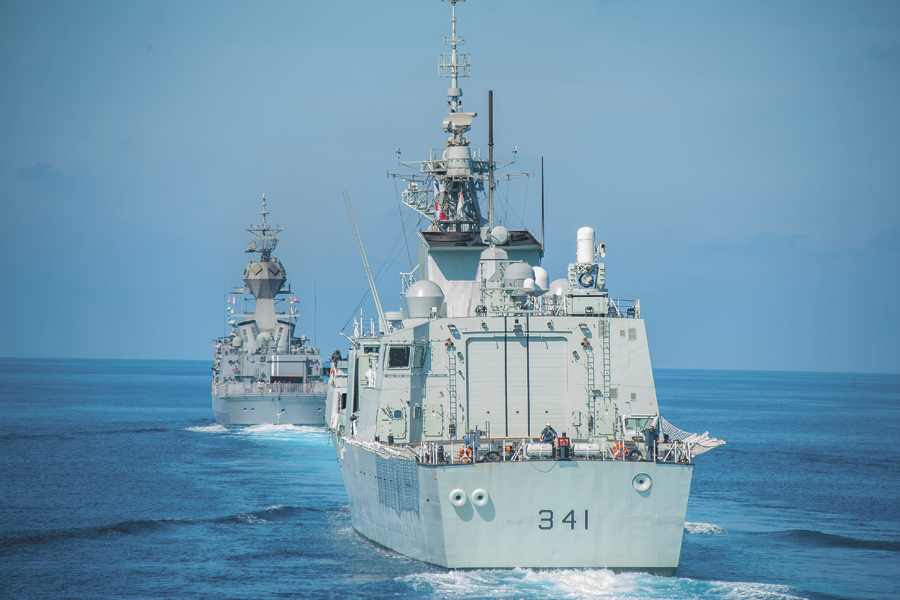
[caption id="attachment_15984" align="alignnone" width="450"] HMAS Ballarat and HMCS Ottawa sail in formation with HMCS Winnipeg as part of manoeuvres. Photo by Cpl Carbe Orellana, MARPAC Imaging Services[/caption]SLt Matt Golding, HMCS Ottawa ~Sailing through the South China Sea on Poseidon Cutlass, HMCS Ottawa and HMCS Winnipeg conducted a CROSSPOL (cross pollination of sailors) with the Australian frigate HMAS Ballarat.The CROSSPOL occurred over three days, where six crew members from each ship got the opportunity to get a firsthand experience of how the other navy operates.For most of the Royal Canadian Navy sailors it was the first time being on an Australian frigate, and all were impressed by the ship and by the professionalism of their team.HMAS Ballarat is one of Australia’s Anzac-class frigates; it is slightly smaller than the Halifax-class but includes a number of upgrades, including a 5-inch main gun, phased array radar, and an air conditioned gym space.The days commenced with a short RHIB transfer over to the Australian ship, where the sailors were greeted by several members of their crew who were eager to show them around. The Australian counterparts gave tours, talked about life onboard their ship, and even let the Canadians try vegemite.Ordinary Seaman Robichaud, a steward on board Ottawa, spent the day with the Australian stewards and cooks; he described it as “one of the greatest experiences he’s had in his military career so far.”

Contractors

Contractors, base employees observe safety week

Peter Mallett, Staff Writer ~Employees working on the Fleet Maintenance Facility’s Phase V construction project are being encouraged to think about workplace safety this week.With the overlying theme: Make Safety A Habit, contractors and subcontractors will join CFB Esquimalt employees in observing North American Occupational Safety and Health Week (NAOSH) May 7 to 13.Stephanie Morand, Project Safety Coordinator with EllisDon Kinetic, says getting people engaged in safety is key to reducing preventable injuries and illness in the workplace and at home.“Talking about proper safety procedures is a big part of safety. However, new or inexperienced workers on design and build projects are often afraid to ask safety questions out of fear of looking stupid,” said Morand. “However, speaking up and asking a question about something they are unsure of makes a big difference in workplace safety, and we are encouraging all employees and their supervisors to initiate the conversation.”Approximately 120 construction workers, engineers and management staff are employed by EllisDon Kinetic on the final phase of the FMF Cape Breton project, which started in 1996. To create awareness about NAOSH Morand walked the construction site last week, affixing promotional posters at various locations. She also has work crews including NAOSH in their weekly “tool box talk” sessions, which are regular informal discussions on work-related issues.Part of Morand’s job is to review safety documents and information, and educate workers about site-specific safety habits and regulations. She says there is sometimes resistance by workers to follow regulated safety practices. She recalls a recent discussion with some iron workers who said they found their safety harnesses uncomfortable. Others grumble about wearing proper hearing and eye protection, safety vests, or helmets.“The promotion of good safety habits may seem like a hindrance or an inconvenience to some, a similar attitude when mandatory seat belt laws...

After conducting drug interdiction operations during a three month deployment on Operation Caribbe

Saskatoon returns

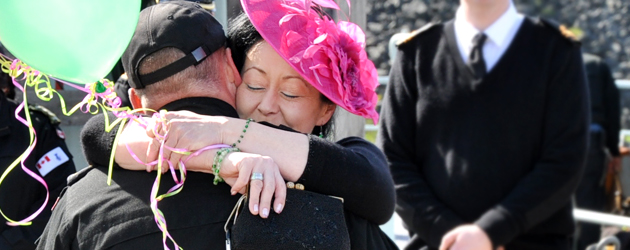
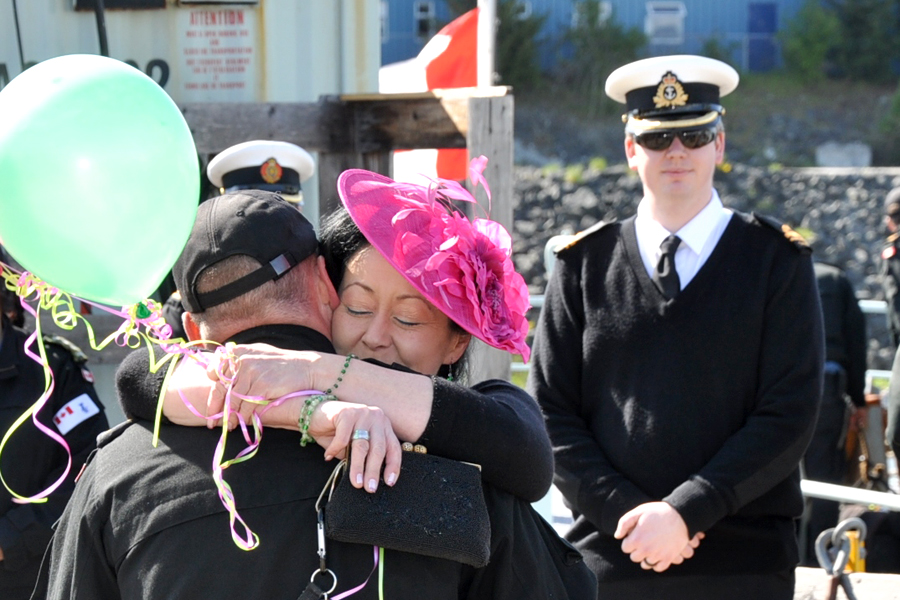
[caption id="attachment_15978" align="alignnone" width="450"] After conducting drug interdiction operations during a three month deployment on Operation Caribbe, HMCS Saskatoon returns home April 28. Photo by Cpl Andre Maillet, MARPAC Imaging Services[/caption]William Chaster, MARPAC PA Office ~As HMCS Saskatoon pulled alongside Y Jetty Friday, April 28, cheers broke out from the dozens of family members and friends waiting on the jetty.Once it safely docked, the brow was lowered and Petty Officer First Class Jamie Burno walked off and into the arms of his wife Kim, while their three children crowded around them. The two were the winners of the traditional first kiss following a lengthy deployment.Within minutes the jetty was teeming with crew and family members embraced in warm welcome home greetings.“It’s just great to be home, especially after such a successful deployment,” said Lieutenant-Commander Todd Bacon, Saskatoon’s commanding officer.The return of the coastal defence vessel marked the end of its 53-day deployment on Operation Caribbe. The yearly, bi-coastal operation is Canada’s contribution to the multinational Operation Martillo, which aims to improve regional stability and reduce criminal activity off the Pacific Coast of Central American and in the Caribbean on the East Coast.Throughout the deployment, Saskatoon’s crew seized 44 bales of cocaine, totalling 1,124 kilograms, and disrupted an additional 1,500 kg in cooperation with the United States Coast Guard (USCG). In addition to interrupting ­illegal drug smuggling, this deployment also focused on interoperability exercises with the USCG and elements of the Mexican Navy.“These exercises were focused on improving coordination between us and our allies. Throughout these operations we were treated fantastically by our allies, and units from all three nations had really come together as one group by their end,” said LCdr Bacon. This was Saskatoon’s second deployment on Operation Caribbe. On its first deployment in the spring of 2016, Saskatoon seized...

A soldier from the 3rd Battalion

1st Canadian Division champions joint exercises

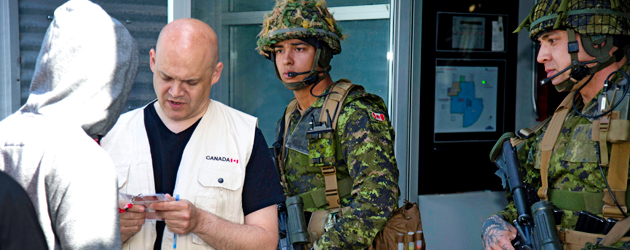
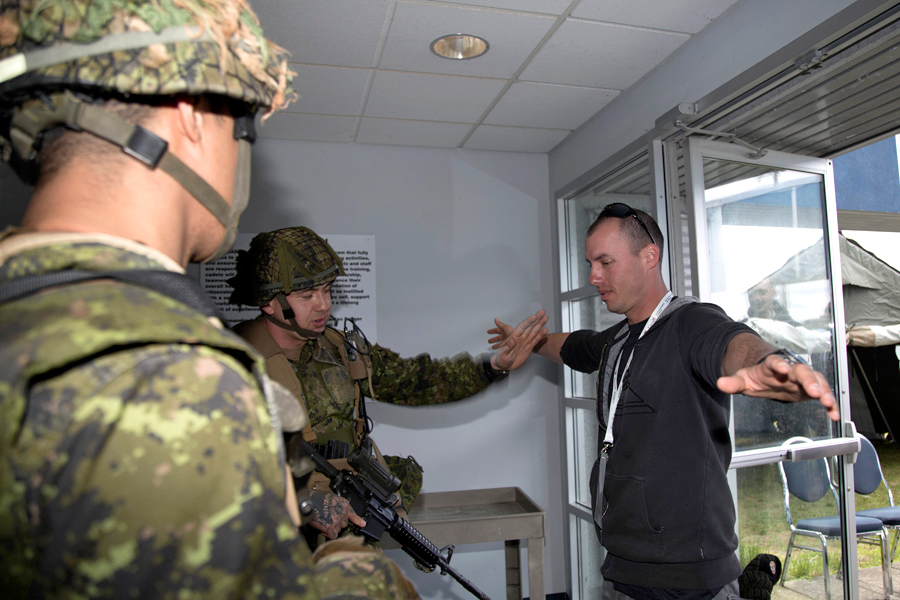
[caption id="attachment_15975" align="alignnone" width="450"] A soldier from the 3rd Battalion, Princess Patricia’s Canadian Light Infantry (PPCLI), conducts a security check on a “Canadian citizen” entering the processing centre. Photo by Capt Elizabeth Tremblay-Lewicki, 2 Wing Public Affairs[/caption]Exercise Ready Renaissance, Exercise Ready Angle prove whole of government approachCapt Jeff Manney, NDPAO Vancouver ~Despite moving more than 290 navy, army and air force members to British Columbia in April to practice large-scale evacuations of Canadian citizens in an unruly country and bring them to a safe-haven, there wasn’t much to see on Exercise Ready Angle 17.That, of course, is precisely the point when the Canadian Armed Forces (CAF), working at the behest of Global Affairs Canada, is asked to withdraw Canadians from hostile or dangerous situations abroad.“Discretion is a key element of a non-combatant evacuation operation,” says Exercise Director Col Normand Gagné, 1st Canadian Division. “No government wants to see large numbers of foreign armed soldiers on its territory. So when Canadians are in danger in another nation, it is expected that CAF personnel have authorization to not wear their uniform. We need to be low-key and agile, moving in numbers small enough not to arouse alarm. Coordination with our government partners is critical, which is why this type of integrated training is so important.”Twice this year, Vancouver Island was the fictitious nation of Macadamia, as the regions of Nanaimo, Comox and Port Alberni hosted exercises to support the 1st Canadian Division’s unique skillset and mandate.In February, “Macadamia” suffered a major earthquake and tsunami. Exercise Ready Renaissance tested the ability of the Disaster Assistance Response Team (DART) to react to a major disaster in another nation.In late April, the government of “Macadamia” was unable to adequately restore services, and the social order was faltering. Armed gangs roamed the streets. Macadamia’s security services...

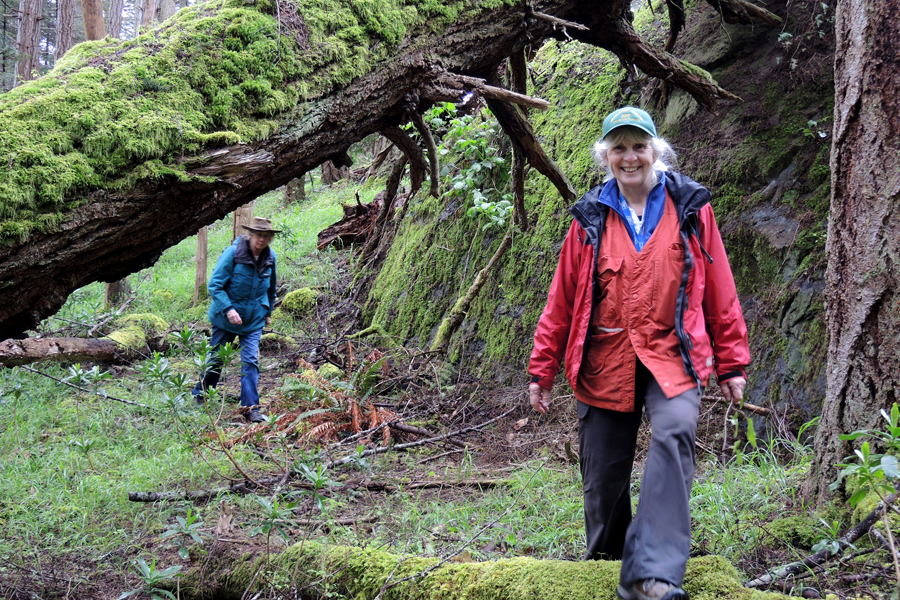
Metchosin Biodiversity co-founder Moralea Milne walks under a large moss-covered fallen tree as the group makes their way down a slope at Mary Hill during Bioblitz 2017.

Mary Hill invaded by Bioblitz team

[caption id="attachment_15972" align="alignnone" width="450"] Metchosin Biodiversity co-founder Moralea Milne walks under a large moss-covered fallen tree as the group makes their way down a slope at Mary Hill during Bioblitz 2017.[/caption]Peter Mallett, Staff Writer ~A team of 14 scientists and outdoor enthusiasts combed over moss-covered hills and rain-drenched dales at Mary Hill military training area in Metchosin on May 1 for Bioblitz 2017.They were recording all plant and animal species, including rare species, on the DND property, as part of the Metchosin Biodiversity Project to identify and catalogue the biodiversity of Metchosin.Metchosin Biodiversity Project co-founder, Moralea Milne says Bioblitz is a scientific endeavour to create a definitive list of species in this West Shore community. It is also an effort to better educate the public about the natural environment in which they work and live.“People need to know we are not alone here and share this community with thousands of other species,” says Milne. “When people realize the number of species and ecosystems that exist, it helps us develop a better stewardship ethic for the land.”During their afternoon search at Mary Hill, investigators divided into three groups and fanned out across the property. The largest group searched for unique vascular plants and mosses, while a second group looked to identify shoreline species located in shallow water and intertidal pools. A third group searched and catalogued insects.They were assisted by three Natural Resources Canada employees and Tracy Cornforth, Environment Officer at CFB Esquimalt’s Formation Safety and Environment Branch, who noted the biodiversity group’s work gives DND a better understanding of the species thriving on the property.“The more we know about the plant and animal life, the better equipped we are to make informed decisions about activities on the base and where they can happen,” says Cornforth. “We are so fortunate to host...

In Memorium: Capt(N) R.C.K. Peers, CD, RCN (retired)

March 17, 1927 – April 14, 2017Bob was born in Vancouver, B.C., to W.J. and Kitty (Hill) Peers of Burnaby Lake.His early years were in Burnaby, Vancouver, and Winnipeg, before moving to Victoria in 1941. He went to Oak Bay High School where he excelled ­academically and athletically - playing rugby and soccer, winning the track and field ­championship, and graduating as Student Council President and Valedictorian.He attended the Royal Canadian Naval College (Royal Roads 1944-46) and was awarded the Sword of Honour on graduation.Bob then went overseas to train with the Royal Navy and was posted to HMS Vanguard, the last of the 15” gun battleships. In 1947 Bob participated in the Royal Family visit to South Africa with their Majesties and the Royal Princesses. Sadly, he was the last surviving Canadian Naval Officer from this deployment.In 1950 he joined HMCS Sioux and completed two tours in Korea.On March 12, 1952, Bob married Cleone Kathleen Thompson of New Westminster, spending their early years in Ottawa, England and Halifax.He was honoured to be one of three Canadian Naval Officers to attend the 1953 Coronation of Elizabeth ll.In December 1956, he was appointed Commanding Officer of HMCS Trinity and subsequently HMCS Chignecto. From 1958-60 Bob was seconded to the U.S. Navy to the Commander Carrier Division 16 (USS Valley Forge). After a posting to RCN HQ in Ottawa, Bob commanded HMCS Annapolis on her commissioning in 1964. Thereafter, he commanded the Sea Training Unit (Halifax) and the Second Escort Squadron (Esquimalt).In July 1970 Bob was appointed Commandant, Royal Roads Military College. In this capacity he negotiated with the Province of B.C., giving the College a Charter to grant degrees. He retired in August 1976 and subsequently participated in various non-profit endeavours including the Goldstream Salmon Hatchery and the Charter Fishing Association.Bob spent his last years at the Lodge at Broadmead in Victoria.The family wish to thank the Lodge staff for the love and care they gave Bob. Thanks also goes to Dr....

HMCS Ottawa enters South China Sea

HMCS Ottawa enters South China Sea

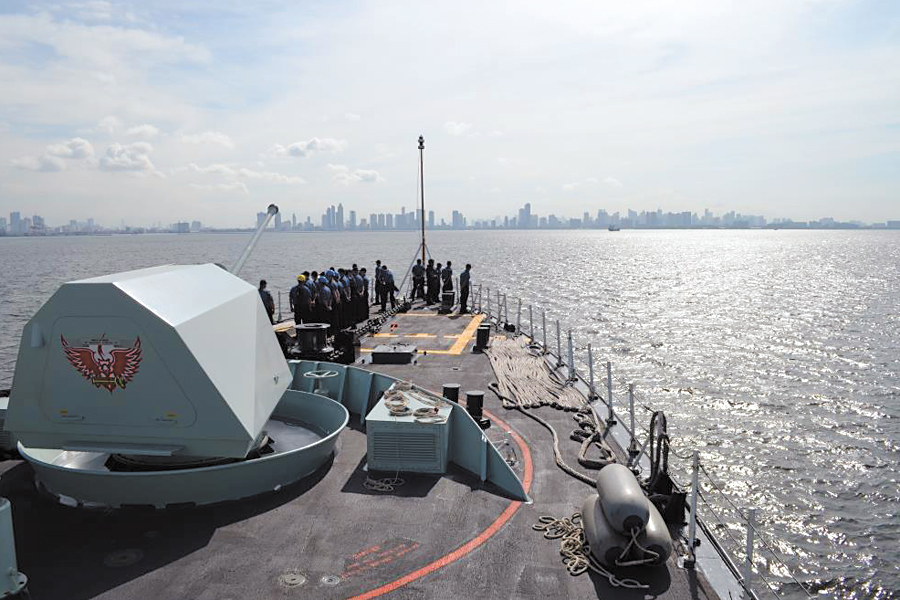
SLt Kassandra O’Rourke, HMCS Ottawa ~The shorelines were turquoise and the seas were calm as HMCS Ottawa entered the South China Sea to come alongside Malaysia.Travelling in consort with HMCS Winnipeg, Ottawa is deployed for Poseidon Cutlass 17-1 to bolster Canadian diplomatic engagement and defence relations while developing their sailors in a world entirely new to most onboard.The ship left CFB Esquimalt March 6 and proceeded south along North America’s west coast. They conducted a successful missile exercise and then proceeded across the Pacific Ocean to Pearl Harbor. The crew enjoyed shore leave at the surf, the beaches, and a Luau before bringing Sea Training Pacific on board for Directed Ship’s Readiness Training.The transit from Hawaii to Guam was gruelling as the heat and humidity turned up, but the team proved strong and able as they underwent training that consisted of fires, floods, man overboards, hazardous material spills, mass casualties, simulated explosions, and elaborate battle situations.Ottawa’s team, under the watchful eye of Sea Training, developed the skills needed to meet the challenges of the environment they would soon enter. After successfully completing this milestone, the crew celebrated their achievement and admission into the high-readiness state by swimming in the Mariana Trench – the deepest part of the world.Leading Seaman Madeline Kuiper noticed the changes in Ottawa’s crew and said, “We worked really well together during the mission work up program. People can become very negative when undertaking a busy schedule, but the team was optimistic. I think the team has melded together over the past two months, and we continue to build stronger relationships with each other as time goes on.”After a few days to refresh in beautiful Guam, the ship set sail for the Philippines. On completion of a busy month, the daily schedule was more relaxed and the crew...

Group photo of volunteers during 2017 Volunteer Appreciation Day Banquet held April 20 at the Wardroom. Photo by Cpl André Maillet

Volunteer Appreciation Night 2017

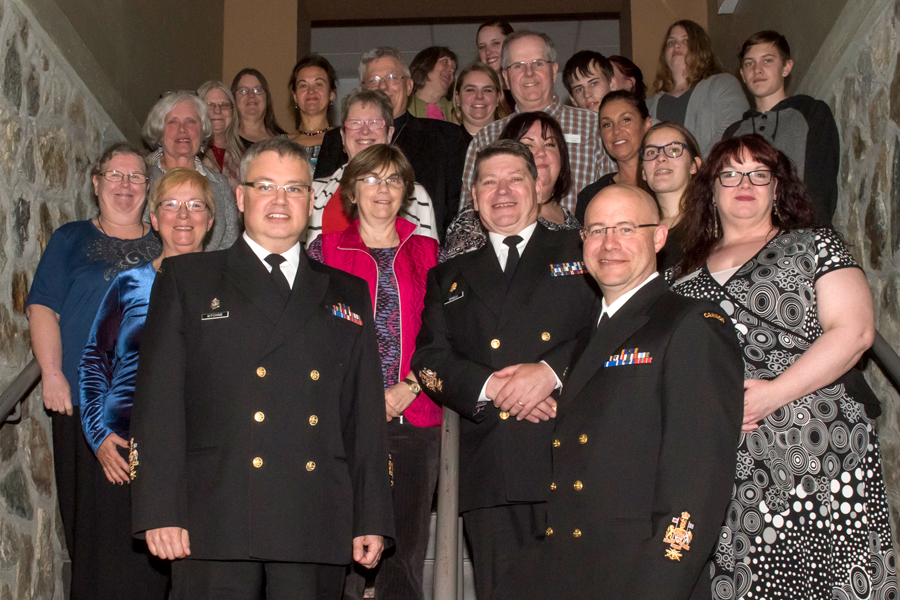
[caption id="attachment_15939" align="alignnone" width="450"] Group photo of volunteers during 2017 Volunteer Appreciation Day Banquet held April 20 at the Wardroom. Photo by Cpl André Maillet, MARPAC Imaging Services[/caption]Jon Chabun, MFRC ~It was a magical night, both figuratively and literally, when 108 volunteers gathered at the Wardroom Thursday April 20 to be celebrated for their charitable spirit.The event, sponsored by CANEX, recognized the contributions volunteers make to the Military Family Resource Centre (MFRC), Personnel Support Programs (PSP), and the CFB Esquimalt Naval and Military Museum.“Volunteers contribute thousands of hours to the military community,” said Ekaterina Gregory, coordinator of volunteers at the MFRC. “Many programs, services and events depend on volunteers for their success.”The night featured a buffet dinner and the magic of Paul Kilshaw. There were speeches from Rear Admiral Art McDonald, Commander Maritime Forces Pacific, and Danielle Sutherland, Senior Manager PSP. Other attendees included 60 guests of the volunteers.“Volunteer contributions are very broad and diverse,” added Gregory. “Some volunteers lead our base clubs, some officiate sports, while ­others staff special events. Some make workshops and groups possible for ­military families. Some help contribute to preserving our history.”At the MFRC, volunteers help run 35 Away Cafes, 10 Deployment Dinners, 36 Playing Together parent-child drop-in sessions, six Sunday Information Sessions and various other support programs for our community. Overall, over 100 MFRC volunteers donated 3,212 hours last year. Youth volunteers contributed 90 hours to help with childcare support.At PSP, volunteers played a vital role in assisting with various activities and special events such as the Navy Run, Formation Fun Day, base sports, base clubs and special interest activities throughout the year.  Approximately 80 volunteers contributed at special events setting up and tearing down events, marshalling run routes and manning booths. More than 50 volunteers supported teams and events at base sports, both...

A boatswain onboard HMCS Saskatoon reads on the sweep deck during Operation Caribbe. Photo by Royal Canadian Navy Public Affairs

Life aboard Saskatoon: What are you reading?

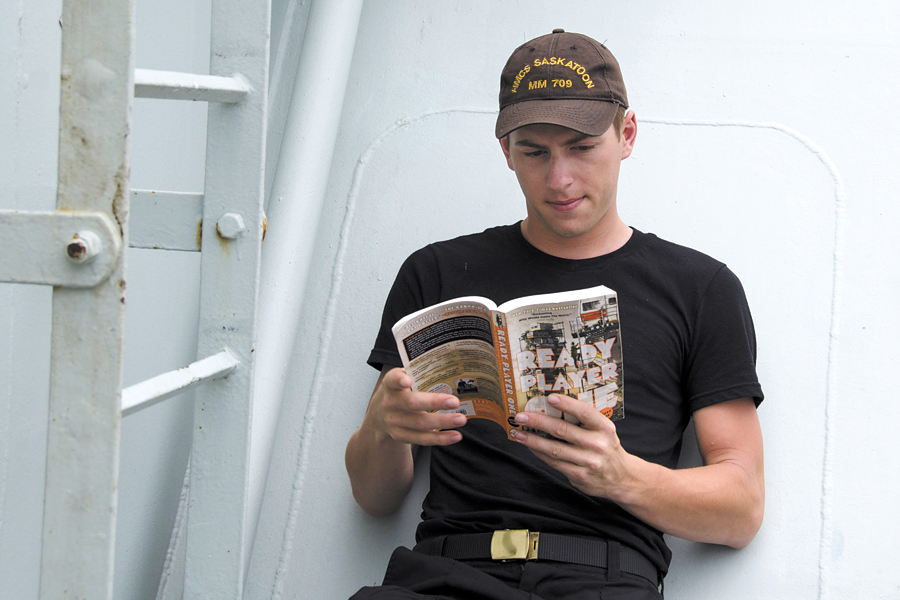
[caption id="attachment_15927" align="alignnone" width="450"] A boatswain onboard HMCS Saskatoon reads on the sweep deck during Operation Caribbe. Photo by Royal Canadian Navy Public Affairs[/caption]SLt Susannah Anderson, Operation Caribbe PAO ~The tropical heat settled like a wet wool blanket over the ship and the Weapons Engineering Technician was wedged into a small sliver of shade on the sweep deck, avidly reading a paperback on his break.“Have you read Ready Player One? One of the boatswains gave it to me; I just can’t put it down.”On HMCS Saskatoon, 47 days into a deployment in the eastern Pacific on Operation Caribbe, Ready Player One by Ernest Cline is being passed from hand to hand throughout the ship.In a world of instant connectivity, sharing a beat-up paperback with friends seems old fashioned. The loss of instant connectivity can come as a shock to new sailors; Internet speed at sea varies based on the position of the ship’s mast or the necessity for operational security.Even with transmitting and receiving turned off, access to cell phones is strictly controlled and instant texts are replaced by thoughtful emails or a mail drop in a port far from home. The lack of connectivity with home quickly fosters a deeper connectivity on ship; meals are taken together, sleeping is done in bunks stacked two and three high, and crewmembers work together on watch.Common experiences and shared books like Ready Player One are links in a chain that bring crewmembers closer together, says Lieutenant-Commander Todd Bacon, Commanding Officer of Saskatoon.“Saskatoon sailed from Esquimalt in February 2017 with a new crew, brought together from across Canada, both Regular and Reserve Force,” he says. “Through hard work and excellence in training, they have grown together and have performed seamlessly in theatre. After two months sharing the exhilaration of successful interdictions, and long...

Cars and Coffee Club starts up

Cars and Coffee Club starts up

Peter Mallett, Staff Writer ~The love affair for automobiles and motorcycles continues to rev up the hearts of enthusiasts with a new Victoria-based club dubbed Cars and Coffee.CFB Esquimalt is the backdrop for their first meet and greet Sunday, May 7, 9 a.m. to noon, at the Canteen Road parking lot behind Lyall Street Service Station.Anyone interested in showing off their ride and talking all things mechanical is welcome to attend.The driver of the club, Ilya Ford-Ruckle, a contractor with Houle Electric who works in Dockyard, is hopeful the inaugural event will bring plenty of owners out to show off their chrome and wheels.“The ultimate goal of Cars and Coffee Victoria is to build a routine, established family-friendly community event that brings a vibrant group of people to enjoy a common passion,” he says. “Cars and Coffee events started in California over 10 years ago and have been replicated all over the world ever since.”The club’s other founding members are LS Aarron Bernardin from HMCS Victoria, and former Royal Canadian Navy sailor Scott Watson.Coffee, water and pop will be on sale courtesy of Cora Restaurant.

Explore More

Categories

Top News

E-Editions Archive

News Stories Archive

Proud Supporters

Joshua Buck, Lookout Newspaper