POSEIDON CUTLASS
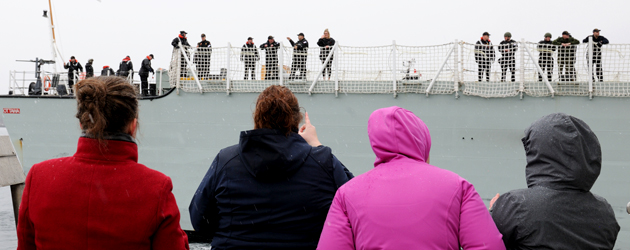
[caption id="attachment_15532" align="alignnone" width="560"] Photo by Ed Dixon, MARPAC Imaging Services[/caption]Family and friends watch as HMCS Ottawa pulls away from the jetty leaving on Poseidon Cutlass deployment, Mar. 6.
[caption id="attachment_15532" align="alignnone" width="560"] Photo by Ed Dixon, MARPAC Imaging Services[/caption]Family and friends watch as HMCS Ottawa pulls away from the jetty leaving on Poseidon Cutlass deployment, Mar. 6.

[caption id="attachment_15506" align="alignnone" width="425"] SLt Vincent Roy, Musical Director of the Naden Band, takes a break while practicing a new arrangement of the national anthem he created for the Music Branch of the Canadian Armed Forces. SLt Roy began working on his one-size-fits-all ensemble in 2012. It is now the official arrangement used by military bands across the country. Photo by Peter Mallett, Lookout Newspaper[/caption]Peter Mallett, Staff Writer ~For decades O Canada has been a trusted staple for Canadian Armed Forces bands, but now military musicians will play from slightly different sheet music.The national anthem has been revamped by Sub-Lieutenant Vincent Roy, Commanding Officer of the Naden Band of the Royal Canadian Navy, in time for Canada’s 150th celebrations across the country.While he was the bandmaster of 14 Wing Greenwood’s volunteer band in 2012, SLt Roy was approached by the Canadian Armed Forces Supervisor of Music, LCol Stephen Murray, to create a new arrangement that could be used in any given circumstance, such as a parade, a concert or a military tattoo.“The average person may not notice all the differences [from the old version] but a trained musician would,” says SLt Roy. “The biggest change to this arrangement is the switch in key from F to Eb, which makes it more manageable for singers. There are also a few chord changes that give the new version a slightly different colour.”He worked on the updated music on his own time, writing ideas out on paper and then testing them out at the piano to see if they would fit. After years of work, the Music Branch submitted his arrangement for final approval from Ottawa.“I needed to stay close to the conventional version though,” says SLt Roy. “I was excited to work on a new arrangement, but also knew it would be...
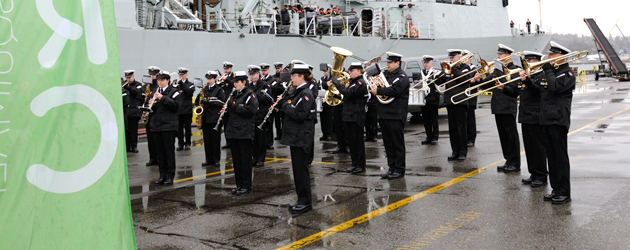
[caption id="attachment_15529" align="alignnone" width="560"] Photo by Ed Dixon, MARPAC Imaging Services[/caption]The Naden Band of the Royal Canadian Navy provides musical entertainment to those assembled awaiting the departure of HMCS Ottawa leaving on Poseidon Cutlass deployment, Mar. 6.

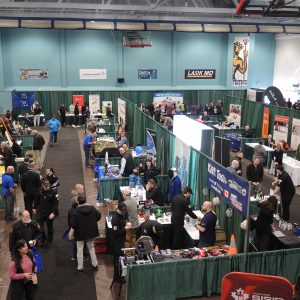
[caption id="attachment_15501" align="alignnone" width="425"] Cully, a four-year-old Australian Shepherd.[/caption]Peter Mallett, Staff Writer ~It is noon at the MARPAC Health and Wellness Expo and the crowd streaming through the Naden upper and lower gyms is robust and noisy.At one booth in the lower gym an Australian Shepard sits attentively by his owner’s side. Sensing the rise in his anxiety from the activity beyond the booth, the dog gently nudges him, nose to leg. This is the signal it’s time for his owner to take a break and head outside.The dog, Cully, is a specially trained service dog to (retired) Master Seaman Tyson King. The booth they man together is for VI (Vancouver Island) K-9 Consulting and Training Inc, a business that specializes primarily in training service dogs, and also behaviour reconditioning and obedience.For King, his service dog is helping him deal with Post-Traumatic Stress Disorder (PTSD) brought on by two back-to-back tours in the former Yugoslavia in the early 1990s that included the Battle of Medak Pocket. At the time, he was a reservist from the North Saskatchewan Regiment. He returned to Yugoslavia in 1996 after his direct entry into the 2 Battalion Princess Patricia Canadian Light Infantry in November 1995. In 1999 he re-mustered to the navy as a marine engineer.Undiagnosed anxiety, hypervigilance (an acute state of detecting perceived threats) and night terrors slowly engulfed his daily life. His mental illness was finally diagnosed in 2014, 20 years after his last tour.“Anything can set it off for me but big crowds, loud noises like gun fire, banging, construction zones, fireworks; the smell of rotten meat and walking on grass can sometimes trigger negative reactions from things that happened to me in Yugoslavia,” explains King. “But Cully has been crucial in my going off medication. He instantly recognizes what I’m going...

[caption id="attachment_15526" align="alignnone" width="560"] Photo by MCpl C.A. Stephen, Formation Imaging Services Halifax[/caption]HMCS Athabaskan performs a final sail past in Halifax, NS, March 10.
[caption id="attachment_15495" align="alignnone" width="400"] Members of Thiepval’s crew maintain the ship’s main armament, a 12-pounder cannon mounted on a platform in the bow. Thiepval’s limited weaponry was sufficient for the ship’s peacetime patrol work. After being transferred to the West Coast from Halifax, Thiepval’s duties included counting seals, patrolling against rum-runners, and ensuring that American fishing boats did not enter Canadian territorial waters. Years after Thiepval’s 1930 sinking, divers raised this gun and placed it on display at nearby Ucluelet, British Columbia. Photo by George Metcalf Archival Collection, Canadian War Museum[/caption]Peter Mallett, Staff Writer ~A team of Fleet Diving Unit (Pacific) clearance divers travelled to the waters off Ucluelet, B.C., last week to begin remediation work on a First World War ship laying on the sea bed.The wreck of HMCS Thiepval is submerged approximately 15 metres in Parks Canada waters and is believed to contain unexploded ordnance within its cargo.Following service in the First World War, the 44 meter-long Battle Class Trawler was conducting a routine patrol in Barkley Sound near the Broken Island Group on Feb. 27, 1930, when it struck a rock between Turret and Turtle Islands and sank.Lieutenant Commander Chad Naefken, Commanding Officer of the dive unit, says the sunken vessel’s close proximity to shore and its easy accessibility to civilian divers has made it necessary for the Canadian Armed Forces to remediate the site. LCdr Naefken says the remediation project has two main aims.“The protection of our Canadian military heritage, as well as working to safeguard the environment. This is an integral part of our practices at Fleet Diving Unit. Our navy divers continuously demonstrate their ability to effectively keep our marine environment safe for all.”[caption id="attachment_15496" align="alignnone" width="320"] The HMCS Thiepval was a naval trawler built in 1917, the seventh ship built at the Kingston Shipyards. This class of ship was used for antisubmarine patrols. Photo by Canadian War Museum[/caption]From March 6 to 9 a team of five clearance divers and two support staff conducted...
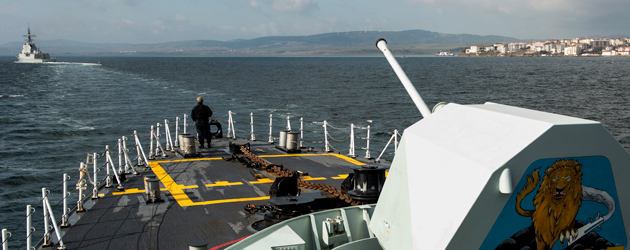
[caption id="attachment_15391" align="alignnone" width="560"] Photo by LS Ogle Henry, Formation Imaging Services[/caption]A Naval Boarding Team member stands watch as HMCS St. John’s and the Spanish Frigate Juan De Borbon transit the Dardanelles during Operation Reassurance, Feb. 20.
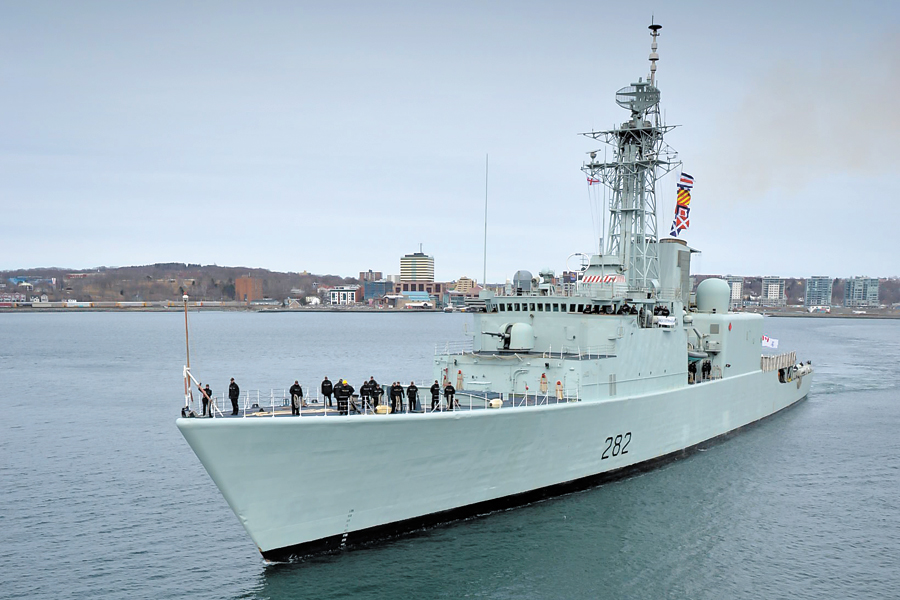
[caption id="attachment_15491" align="alignnone" width="400"] HMCS Athabaskan pulls into port at Halifax Dockyard for the last time on March 10. The last of the Iroquois-class destroyers was paid off after more than 44 years of service. Photo by MCpl C.A. Stephen, Formation Imaging Services Halifax[/caption]DND ~HMCS Athabaskan was paid off during a ceremony at HMC Dockyard in Halifax on Friday.Athabaskan, the last of the four Iroquois-class Area Air Defence destroyers, served the Royal Canadian Navy (RCN) with distinction for more than 44 years.“Today we celebrate the end of an era,” said Vice-Admiral Ron Lloyd, Commander of the Royal Canadian Navy. “When Canada put this ship into service the technological achievements were so impressive that the Tribals were referred to as the ‘sisters of the space age’. For those of us fortunate to have sailed in these ships we celebrate the important leadership role that Athabaskan, and her sister ships, fulfilled in the defence of Canada and in support of partners and allies. Canadians can proudly reflect on Canada’s response to the occupation of Kuwait, the terrorist attacks of 9/11, Hurricane Katrina, and the devastating earthquake in Haiti. I know that those of us serving today, are proud to continue to follow in the wake of all those who have so brilliantly served in HMCS Athabaskan during the last 44 years. We stand here today as equally committed and dedicated as those who walked aboard her on the day of her commissioning.”The Iroquois Class was a made-in-Canada solution to the defence and security challenges of the Cold War and post-Cold war era of the late 20th Century. They introduced state-of-the- art Canadian sonar technology to undersea surveillance, and perfected the combat operations of two large maritime helicopters from each of their flight decks.Under the auspices of the National Shipbuilding Strategy, the RCN...
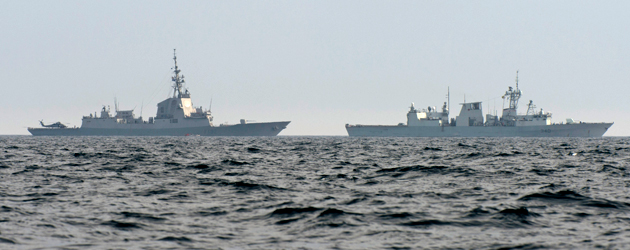
[caption id="attachment_15387" align="alignnone" width="560"] Photo by LS Ogle Henry, Formation Imaging Services[/caption]HMCS St. John’s and Spanish Naval frigate Juan De Borbon sail in close formation during their transit on the Black Sea during Operation Reassurance, Feb. 7.
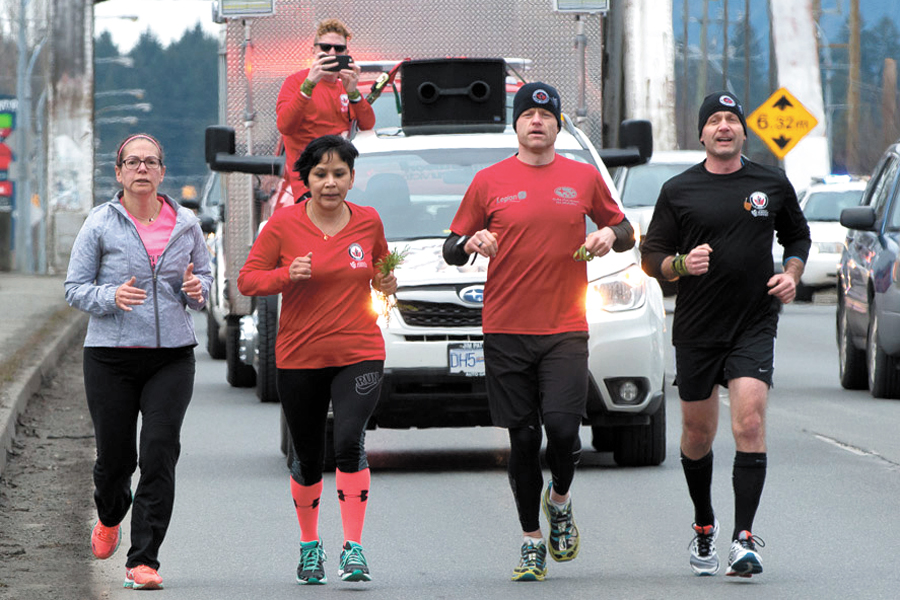
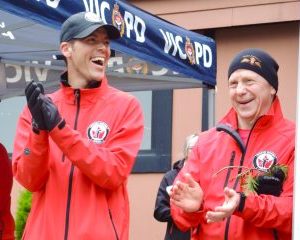
[caption id="attachment_15456" align="alignnone" width="400"] Photo by John W.Penner, John’s Photography[/caption]Peter Mallett, Staff Writer ~Motivation was all the fuel Wounded Warrior Run B.C. participants needed to reach the finish line of their gruelling 700-kilometre trek covering the length of Vancouver Island.“I was physically drained and taxed, but all the overwhelming support we received along the way reinvigorated me and made me feel fantastic when I was running,” said PO2 Allan Kobayashi, Wounded Warrior Run B.C. co-founder and team leader.PO2 Kobayashi, who works as an analyst for the Naval Training Development Centre, was the leader of a three-woman and four-man team who set out from Port Hardy Feb. 20 for the seven-day relay-style run to raise funds and awareness for current and former military and Emergency Service workers suffering from Post-Traumatic Stress Disorder (PTSD).PO2 Kobayashi, who was the only member of this year’s team to suffer from PTSD, says he’s noticed a paradigm shift in people’s attitudes and understanding of PTSD during stops in 15 communities.“The biggest difference in this year’s run was people’s willingness to step forward and talk about their own experiences, their own traumas, and their own family members and friends who are suffering. That was the biggest motivation in pushing us forward along the route, by seeing how our interaction was making a notable difference.”The best was yet to come as the runners were greeted with a hero’s welcome when they crossed the finish line in Langford at 3 p.m. Feb. 26. Wearing red jerseys emblazoned with the slogan “Not all Wounds are visible”, they headed into the Royal Canadian Legion Branch 91 to the sound of music and cheers from members of the Victoria Grizzlies Junior ‘A’ Hockey Team, the West Shore Rebels junior football team, friends, family, sponsors and local politicians who came out to show...
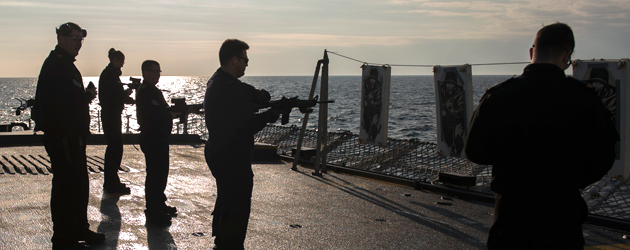
[caption id="attachment_15417" align="alignnone" width="560"] Photo by LS Ogle Henry, Formation Imaging Services[/caption]Crew members onboard HMCS St. John’s conduct small arms training as the ship transits the Mediterranean Sea during Operation Reassurance Feb. 23.
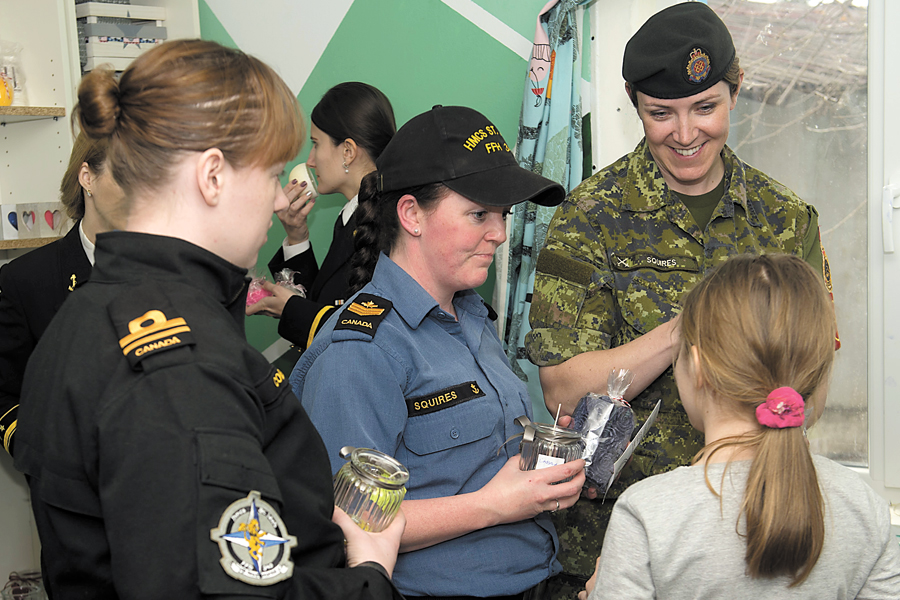
[caption id="attachment_15453" align="alignnone" width="400"] Canadian Armed Forces women put their candle-making skills to the test at the Nightingales Children’s Project in Cernavoda, Romania, during HMCS St. John’s visit to Constanta Feb. 5.[/caption]Lt(N) Emily Anglin, HMCS St. John’s ~HMCS St. John’s had a unique opportunity to make a difference for a group of disadvantaged youth while alongside in Constanta, Romania, Feb. 5 during its Operation Reassurance deployment.Kevin Hamilton, the Canadian Ambassador to Romania, invited 21 women from St. John’s, three women from their forward logistics support team, and four Romanian officers to Cernavoda, Romania, to volunteer for the Nightingales Children’s Project.Founded and led by two British expatriates and their Romanian spouses, the project focuses on preventing human trafficking. It aims to keep young women and men from being trafficked into the sex trade by offering them education and meaningful employment.Upon arrival, the ambassador and volunteers were greeted by program founder David Savage, manager Ben Wells, and a group of curious, but largely shy children. Their demeanor changed when the ambassador invited the soldiers, sailors and air women of St. John’s to hand out donated toques to each child, who then happily posed for photos.“When interacting with the girls I could sense a level of hardship in their lives, but also determination, strength, and hope,” said Able Seaman Roxanne Hovan, a reserve boatswain sailing in St. John’s.Once the formalities were over, the volunteers buckled down to work; half went to paint the walls of a building, while the others learned about candle making. The candles serve a dual purpose for the girls at Nightingales. They spend their free time in a positive, creative way, and they are able to make money by selling their work.Sergeant Jeanine Fraser, Senior Meteorological Technician onboard St. John’s, was especially moved by the experience.“So often you hear...
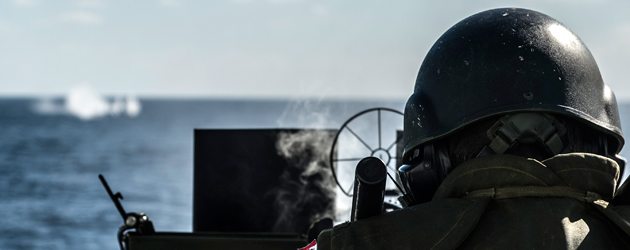
[caption id="attachment_15414" align="alignnone" width="560"] Photo by LS Ogle Henry, Formation Imaging Services[/caption]A .50 Calibre Heavy Machine Gun operator takes aim at a target as HMCS St. John’s transit on the Mediterranean Sea during Operation Reassurance Feb. 22.
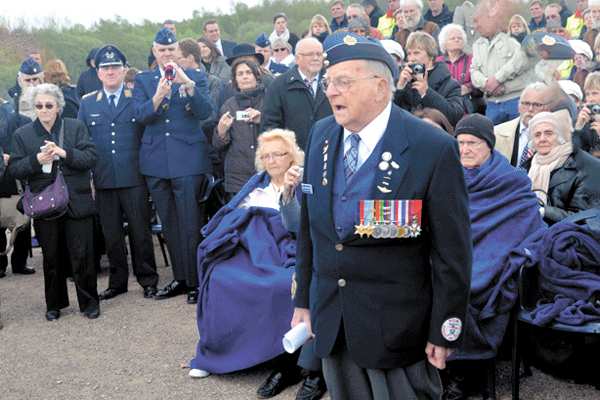
[caption id="attachment_15450" align="alignnone" width="400"] Edward Carter-Edwards sings “We’ll Meet Again” during a visit to Buchenwald concentration camp in 2014. Photo by Lieutenant-Colonel (Retired) Dean Black, Royal Canadian Air Force Association[/caption]Joanna Calder, Air Forces PA ~Edward Carter-Edwards, who survived the notorious Nazi death camp Buchenwald, died Feb. 22, in Smithville, ON. His funeral was held on Monday, Feb. 27. He was 94.Sergeant Carter-Edwards was a wireless air gunner on a Halifax Mark III bomber when it was shot down over occupied France in 1944. He made his way to Paris, but was picked up by the Germans, imprisoned, and eventually shipped by cattle car to Buchenwald: five long days under brutal conditions.He and other airmen should have been sent to a prisoner of war camp but his captors refused to believe that he was an Allied airman and instead accused him of being a spy and saboteur.“The thing that frightened us the most was this tall chimney with smoke belching out of it. And the only way to get out of Buchenwald was through the chimney,” he said in a video posted on the “Lost Airmen of Buchenwald” Facebook page, as he described his arrival at Buchenwald.Sergeant Carter-Edwards was one of 168 airmen—including 26 Canadians—wrongfully imprisoned in the concentration camp. While there, he fell sick with pneumonia and pleurisy, which ordinarily would have been a death sentence as there was no medical treatment for those who were sick; the prisoners got better or they died. In fact, anyone who was considered too sick was hastened to his end with a fatal injection.According to Nathan M. Greenfield in his book The Forgotten: Canadian POWs, Escapers and Evaders in Europe 1939-1945, one of the reasons Sergeant Carter-Edwards survived was that “at night the orderlies ‘submerged’ the Canadian delirious with fever; that is, they...
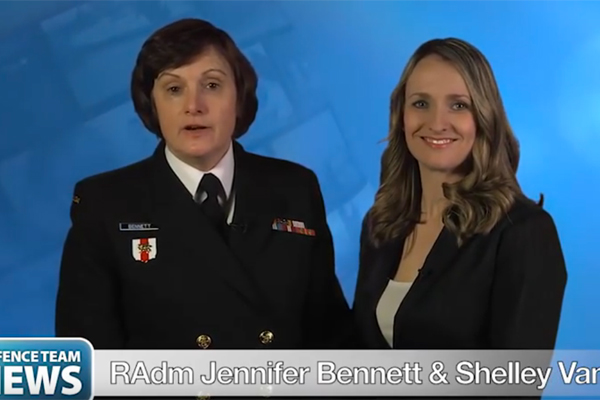
In this episode, we welcome Rear-Admiral Jennifer Bennett, Champion for Women at Defence, to commemorate International Women’s Day, highlight Neptune Trident 17-01 & Exercise OBANGAME EXPRESS, feature the Defence Team members who could be Canada’s next astronauts, and provide CAF members a refresher on parental and maternity benefits.
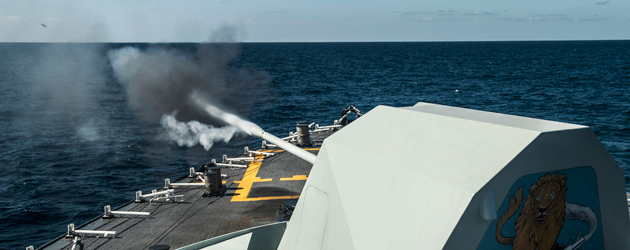
[caption id="attachment_15411" align="alignnone" width="560"] Photo by LS Ogle Henry, Formation Imaging Services[/caption]HMCS St. John’s conducts a live-fire exercise with the 57mm Bofor Gun during the ship’s transit on the Mediterranean Sea during Operation Reassurance Feb. 22.
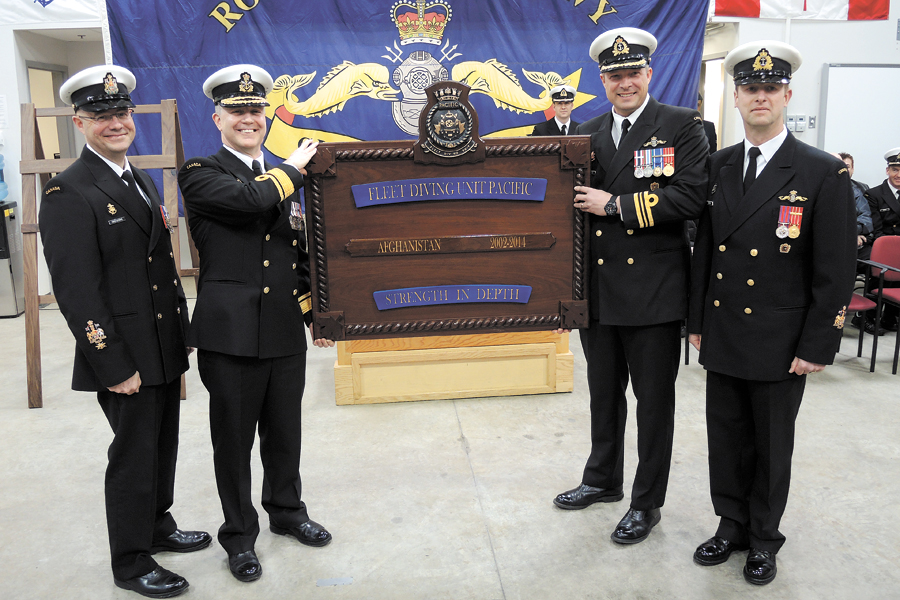
[caption id="attachment_15447" align="alignnone" width="400"] From the left: RAdm Art McDonald, Commander of Martime Forces Pacific; CPO1 Gilles Gregoire, Formation Chief; LCdr Chad Naefken, Commanding Officer Fleet Diving Unit (Pacific); and CPO1 Robert DeProy, FDU Coxswain, display the Battle Board presented at the unit’s Theatre Honours ceremony Feb. 28. The unit’s Clearance Divers were recognized for their bomb-defusing efforts in Afghanistan. Photos by Peter Mallett, Lookout Newspaper[/caption]Peter Mallett, Staff Writer ~Last week, in a highly prestigious ceremony, Fleet Diving Unit (Pacific) (FDU(P)) received its first Theatre Honours in recognition for their work in Afghanistan.Rear-Admiral Art McDonald, Commander of Maritime Forces Pacific, presented the honours on behalf of David Johnston, Governor General of Canada, and called the moment a “significant milestone.”After inspecting the 49-member Guard of Honour on parade at the unit’s West Shore explosive ordnance disposal garage on Feb. 28, the Admiral presented the Battle Board for display in their mess.“For all of you currently serving or who have served in the FDU, this honour recognizes the exceptional excellence that is synonymous with the Fleet Diving Unit,” said RAdm McDonald. “The war in Afghanistan was synonymous with IED [Improvised Explosive Device] and the work of defusing these devices by FDU Clearance Divers was done in dangerous situations. That work changed the course of the war and your unit should be extremely proud of what you achieved in Afghanistan.”The 4’ x 4’ wooden Battle Board features rope work carved out of wood with the inscription: Fleet Diving Unit Pacific, Afghanistan 2002-2014, Strength in Depth.“It’s incredibly nice to receive this official recognition,” said LCdr Chad Naefken, FDU’s Commanding Officer. “It is a great source of pride for the entire unit. It will be used as a centre piece for all of our functions.”Theatre Honours are official public recognition of Canadian Armed Forces units...
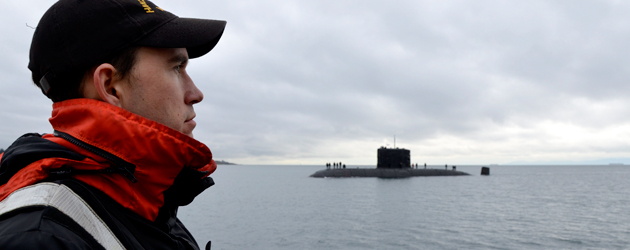
[caption id="attachment_15404" align="alignnone" width="560"] Photo by Royal Canadian Navy Public Affairs[/caption]A Maritime Engineering Systems Operator from HMCS Saskatoon looks on as they depart Esquimalt for Operation Caribbe while HMCS Chicoutimi sails by, Feb. 20.

[caption id="attachment_15444" align="alignnone" width="400"] Chris Roy, a sheet metal fabricator who works in the Fleet Maintenance Facility HMCS Cape Breton, displays a project he is working on to a delegation of B.C. mayors. Photo by Peter Mallett, Lookout Newspaper[/caption]Peter Mallett, Staff Writer ~A delegation of 28 mayors wrapped up a three-day conference in Victoria Feb. 24 with a tour of Fleet Maintenance Facility Cape Breton and HMCS Regina.The municipal leaders were taking part in the Mayors’ Caucus, a regular convention that rotates to a different location biannually. It allows municipal leaders to identify common priorities and problems their communities face.The mayors were given guided tours of the Halifax-Class frigate’s machine control room, bridge, operation room, a review of the vessel’s small arms capability, and a demonstration by Fleet Diving Unit (Pacific).Their tour of Fleet Maintenance Facility included stops at the electrical, mechanical, machining, sheet metal, combat, chemical cleaning and electroplating, and plant maintenance departments.Comox Mayor Paul Ives said he was “delighted and fascinated” to visit CFB Esquimalt as part of the convention because of the economic impact it has in Victoria and the province.Ives is a former naval reservist, serving from 1981 to 1987 with HMCS Scotian in Halifax and HMCS Discovery in Vancouver. He says the visit helped many of his colleagues gain better insight into what CFB Esquimalt is all about.“It’s great to build awareness among the mayors of B.C. about the role the navy plays for Canada and the impressive facility in FMF for maintaining the fleet,” said Ives. “I would say CFB Esquimalt is almost like the Capital Regional District’s 14th municipality considering the huge role it plays in contributing to both the local and provincial economy.”Jude Schooner, Mayor of Tahsis, located on the northwest coast of Vancouver Island, said the tour was one of the...
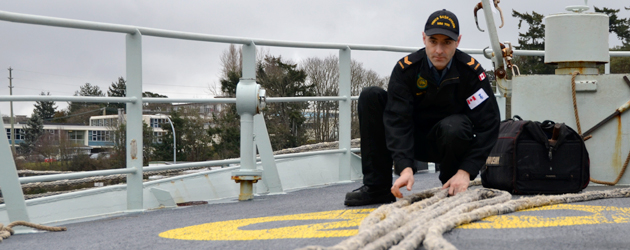
[caption id="attachment_15400" align="alignnone" width="560"] Photo by Royal Canadian Navy Public Affairs[/caption]A crewmember from HMCS Saskatoon fakes the lines prior to departing Esquimalt as the ship begins sailing south to participate in Operation Caribbe, Feb. 22.
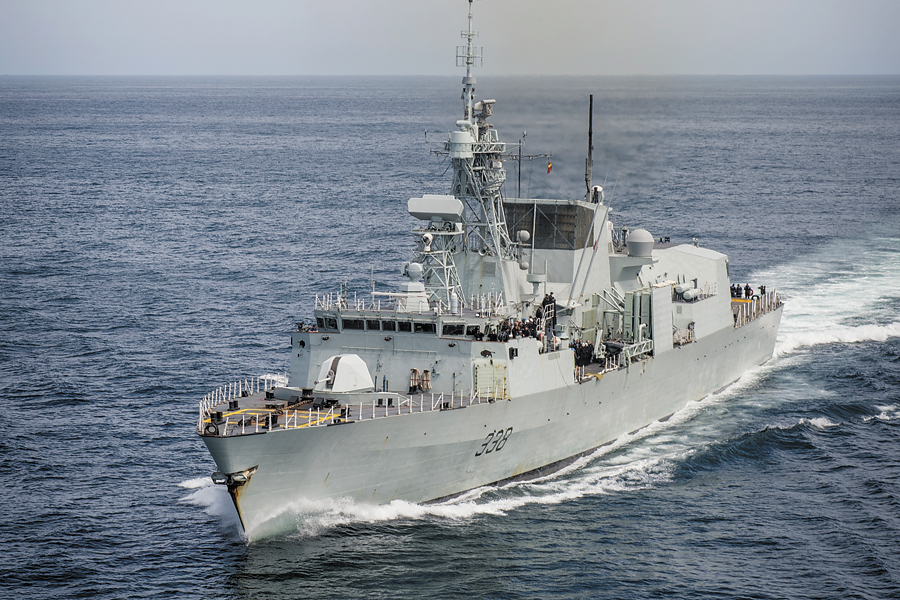
[caption id="attachment_15441" align="alignnone" width="400"] HMCS Winnipeg[/caption]Peter Mallett, Staff Writer ~Two Pacific Fleet warships have set a course for Asia on Poseidon Cutlass 17.HMC Ships Winnipeg and Ottawa and their crews left Esquimalt Harbour Monday for a six-month deployment to the Indo-Asia-Pacific region.“The crew of HMCS Ottawa has been working tirelessly to prepare for this deployment and I have every confidence they will serve as excellent ambassadors for the Royal Canadian Navy,” said Commander Sylvain Belair, HMCS Ottawa’s Commanding Officer.The ships will stop in China, South Korea, Japan, the Philippines, Malaysia, India and Sri Lanka. Poseidon Cutlass 17 includes participation in multinational task group interoperability exercises, and above and below water warfare training, and an ambassadorial role for the ships’ company with international engagements at their ports of call. “This deployment is an example of Canada’s enduring commitment to the maintenance of regional peace and security in the strategically important Indo-Asia-Pacific region,” said Rear-Admiral Art McDonald, Commander of Maritime Forces Pacific. “I’m confident that HMC Ships Winnipeg and Ottawa will be well received as capable expressions of Canadian interest and contribution. All Canadians can be proud of the impressive ambassadors that our sailors will be, as well as the world-class support we’ll afford them and their families during another period of great personal sacrifice.”Winnipeg’s Commanding Officer, Cdr Jeff Hutchinson said the deployment will be an excellent opportunity to strengthen partnerships and support the RCN’s “generate forward” concept.“Operating with international partners will provide valuable training and improve interoperability while continuing to generate increased readiness in embarked soldiers, sailors, airmen and airwomen,” said Cdr Hutchinson.
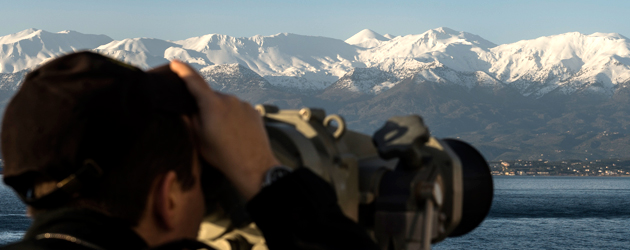
[caption id="attachment_15397" align="alignnone" width="560"] Photo by LS Ogle Henry, Formation Imaging Services[/caption]A lookout scans the horizon for maritime traffic as HMCS St. John’s makes an entrance to Souda Bay, Crete, during Operation Reassurance, Feb. 21.
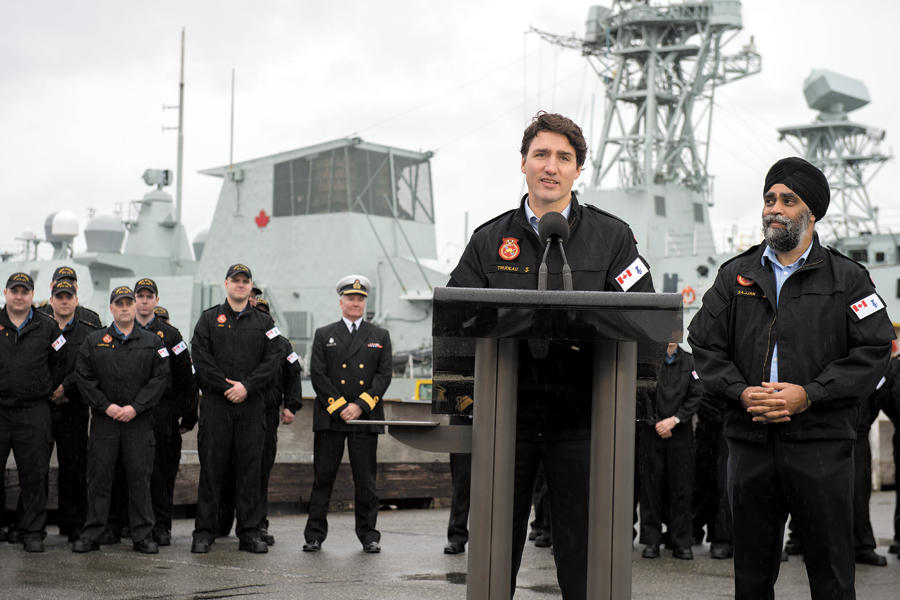
[caption id="attachment_15438" align="alignnone" width="400"] With HMCS Ottawa and its crew in the background, Justin Trudeau, Prime Minister of Canada, and Harjit Sajjan, Minister of National Defence, take part in a press conference at CFB Esquimalt on March 2. Photo by MCpl Chris Ward, MARPAC Imaging Services[/caption]Peter Mallett, Lookout Staff ~Dressed in a navy emblazoned t-shirt, Prime Minister Justin Trudeau joined more than 700 military and civilian personnel for a five-kilometre run around CFB Esquimalt last Thursday morning, March 2.Also serving as a fitness role model was Defence Minister Harjit Sajjan who kept in step with the 45-year-old Prime Minister.Before the run, the Prime Minister and Defence Minister made their way to A-jetty for a visit to submarine HMCS Chicoutimi. Wearing a Naval Combat Dress jacket inscribed with his last name, Royal Canadian Navy ensign patch, and ship badges of both Chicoutimi and HMCS Ottawa, the Prime Minister climbed down the hatch into Chicoutimi.After the run the two guests toured Ottawa, which was finalizing preparations for its Asia-Pacific deployment on Poseidon Cutlass 17, and spoke to many sailors on board.Following lunch at the Wardroom, Prime Minister Trudeau and Minister Sajjan concluded their visit with a media scrum on A-Jetty. Flanked by a group of Ottawa sailors, Trudeau thanked CFB Esquimalt for their hospitality and chance to visit the submarine and warship before highlighting the recent announcements by his government and taking questions from the assembled media.The Prime Minister then departed in his motorcade for his next engagement, a meeting with Victoria Mayor Lisa Helps. He wrapped up his two-day visit to British Columbia on March 3 in Vancouver, meeting with Premier Christy Clark.

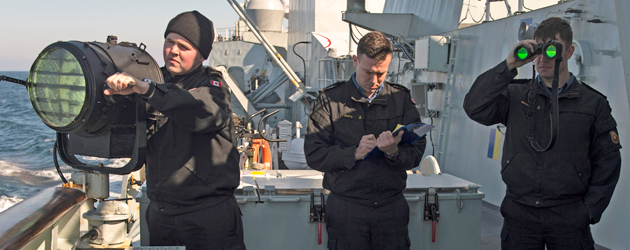
[caption id="attachment_15394" align="alignnone" width="560"] Photo by LS Ogle Henry, Formation Imaging Services[/caption]Naval Communicators, AS Christopher Bradshaw, OS Peter Smith and LS Luc Beuglet send flashing light signals to the German Frigate Sachsen as HMCS St. John’s transits the Mediterranean Sea during Operation Reassurance, Feb. 20.
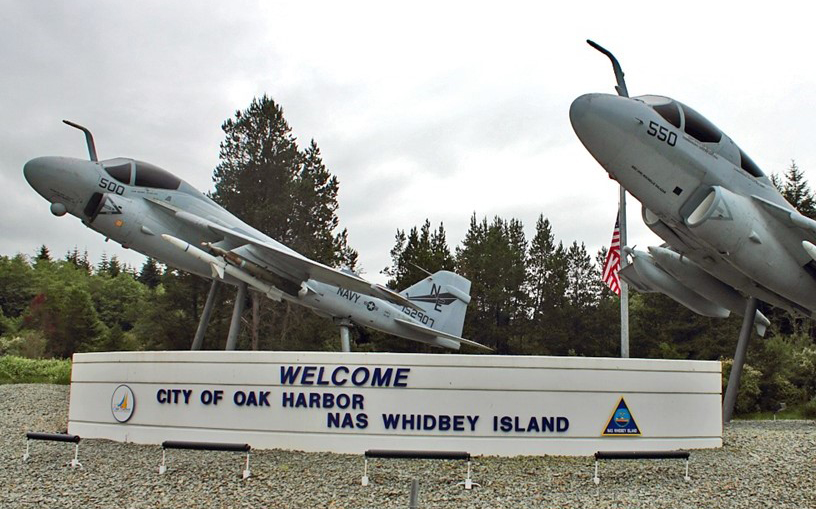
SLt Rudee Gaudet, Contributor ~At Naval Air Station (NAS) Whidbey Island in the San Juan Islands, a group of Royal Canadian Navy (RCN) personnel, embedded with the United States Navy (USN), diligently analyze a continuous flow of acoustic data, as they hunt for the telltale signs of submarines.Operating out of a secure building dubbed by locals as the “prison” for its secure gates and barbed wire fences, they, along with their USN counterparts, are the eyes and ears of the Pacific Ocean.The prison is the Naval Ocean Processing Facility Whidbey Island (NOPFWI), one of two highly secure USN Integrated Undersea Surveillance Systems (IUSS) facilities in the United States.A detachment of 37 Canadian Armed Forces (CAF) personnel, consisting of operators, maintenance technicians, and a support cell, work alongside the USN to accomplish the mission of continuous maritime domain awareness.To achieve their mission, acoustic data is supplied real-time to the NOPFWI watch floor by permanent acoustic sensors on the ocean floor, allied ships, submarines and long-range anti-submarine aircraft around the world.“Finding a submarine is a big deal here. The entire team on the watch floor is focused on it. From the ships, planes and acoustic sensors to the watch floor, we are using real-time assets to find and track threat submarines 24-hours a day, 365 days a year,” said MS Angelo Aires, a Sonar Operator nearing the end of his posting at NOPFWI.The CAF has been directly involved in IUSS with allied nations since the 1950s, with joint USN and CAF acoustic processing facilities in Argentia, Nfld., and Shelburne N.S. These were two of over a dozen such facilities in the early days of IUSS, tracking Soviet submarines in the North Atlantic. The facilities would eventually be shut down following the end of the Cold War with service re-directed to other facilities...
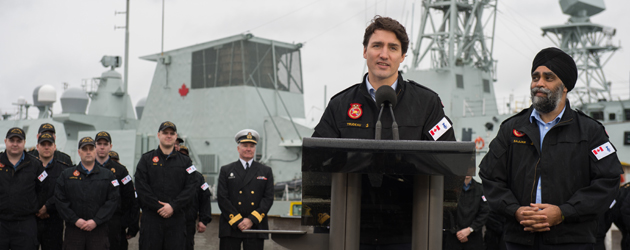
[caption id="attachment_15423" align="alignnone" width="560"] Photo by MCpl Chris Ward, MARPAC Imaging Services[/caption]With HMCS Ottawa and her crew in the background, Prime Minister Justin Trudeau, and Harjit Singh, Minister of National Defence, take part in a press conference at CFB Esquimalt Mar. 2.
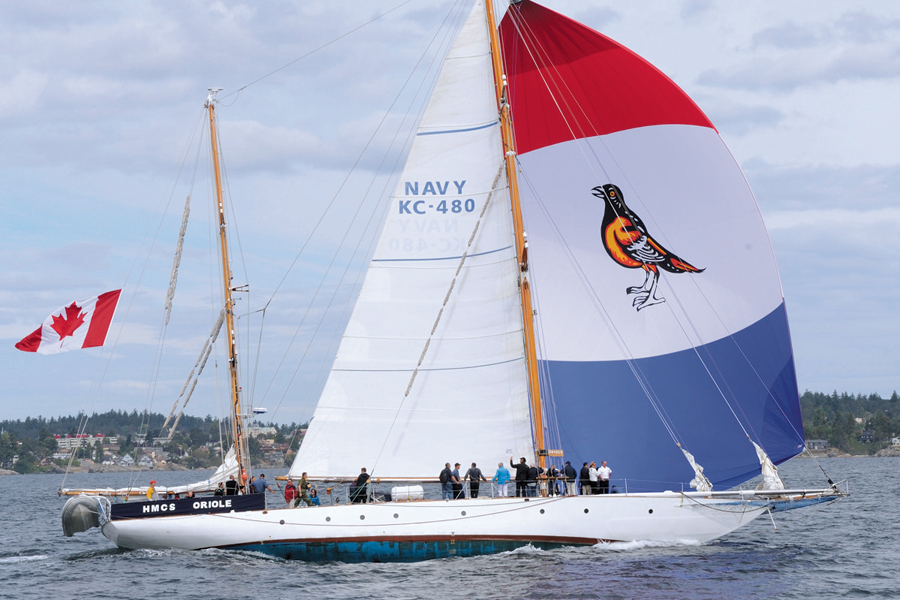
Darlene Blakeley, Editor Crowsnest Magazine ~A regatta of tall ships. An international tattoo. Naval boarding party demonstrations. A navy bike ride.These are just some of the events that will take place as the Royal Canadian Navy (RCN) celebrates the 150th anniversary of Confederation this year. Focusing on events from coast to coast, community involvement will be a special part of the festivities.“The RCN is proud to commemorate Canada’s strong naval heritage with Canadians from all backgrounds as part of this year’s celebrations,” says Vice-Admiral Ron Lloyd, Commander RCN. “As we mark this special year, we remember and honour the bravery of generations of sailors who fought to defend Canadian values at home and abroad.” Rendezvous 2017A signature event marking celebrations will be Rendez-vous 2017 (RDV 2017), when more than 40 tall ships will sail Canadian waters from June 30 to Aug. 20.Québec City, home of Canada’s Naval Reserve Headquarters, will be the main rallying point on the tour. The tall ship fleet, along with over 3,000 crew members and youth trainees, will be in the Port of Québec for a grand celebration from July 18 to 23. A host of free activities is planned for families and visitors, showcasing local and national culture as well as Canada’s proud maritime heritage.“RDV 2017 will bring Canadians to cities, towns and villages along the St. Lawrence River and help to promote a greater understanding of these communities and the vital role this iconic Canadian waterway played in the creation and development of our country,” says Lieutenant-Commander Kevin Jutras, Naval Reserve Coordinator for RDV 2017.The Québec City rallying point is one stop along a transatlantic race of 7,000 nautical miles taking place over the course of five months in 2017. The race starts at the port of Royal Greenwich in Great Britain on April 13...
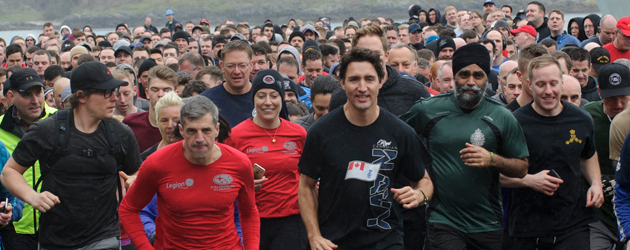
[caption id="attachment_15420" align="alignnone" width="560"] Photo by Cpl Stuart MacNeil, MARPAC Imaging Services[/caption]Prime Minister Justin Trudeau, and the Minister of National Defence, Harjit Sajjan take part in the fleet 5km run at Canadian Forces Base Esquimalt Mar. 2.