[wpml_language_selector_widget]
[searchwp_form id="1"]
University of Victoria engineering students Alex McKay (left) and Nicholas Saar developed pre-fire plans for CFB Esquimalt Fire Rescue. During their four- month work study project they developed PDF maps of high traffic buildings at the base in an effort to help first responders quickly identfy the features in the buidlings they are entering.

Fire department benefits from co-op student hires

[caption id="attachment_15055" align="alignnone" width="450"] University of Victoria engineering students Alex McKay (left) and Nicholas Saar developed pre-fire plans for CFB Esquimalt Fire Rescue. During their four- month work study project they developed PDF maps of high traffic buildings at the base in an effort to help first responders quickly identfy the features in the buidlings they are entering.[/caption]Peter Mallett, Staff Writer ~Two engineering students from the University of Victoria are being hailed for their co-op placement project of designing new pre-fire plans for CFB Esquimalt Fire Rescue.During a four-month work study term, which started September 2016 and ended December 2016, Alex McKay and Nicholas Saar mapped in detail 146 of the base’s approximately 800 buildings.Their digital maps outline stairwells, fire exits, fire extinguishers, hazardous materials, locations of sprinklers and alarms, electrical systems, and a complete list of equipment and supplies that could pose a threat to emergency crews.“Their project will be very helpful to the battalion chief and the entire unit,” said Geordie Douglas, Deputy Chief, CFB Esquimalt Fire Rescue. “When our crews arrive at the scene of an emergency at a structure on base the maps will show our crews the potential hazards on the site and give them an understanding of the layout of the building.”For their efforts the two students, both entering their third year of a five-year program, were each presented a commemorative coin from Capt(N) Steve Waddell, Base Commander. Douglas says their awards were well deserved noting they helped to solve huge gaps in both detail and accessibility of existing pre-fire plans.The maps have been downloaded to computers located inside the fire department’s vehicles.“There was a big emphasis on making the maps of the buildings clear and easy to understand for firefighters working in a stressful situation,” said McKay. “We didn’t want to overload them with...

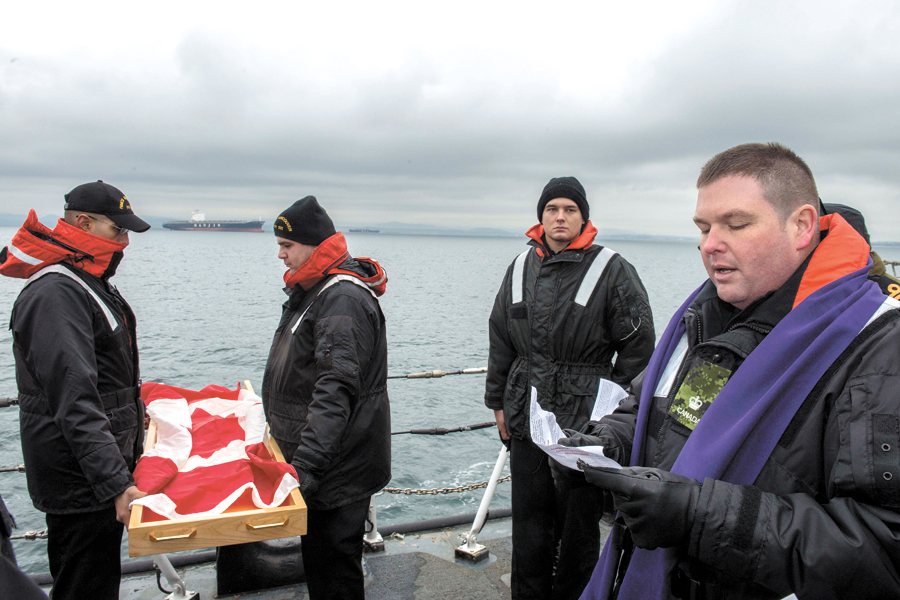
Major Mike Gibbons (right)

Chaplains unite for discussions on their future roles

[caption id="attachment_15052" align="alignnone" width="450"] Major Mike Gibbons (right), Senior Fleet Chaplain, says a prayer as he conducts a burial at sea ceremony prior to the ashes being committed to the sea. Photos by MCpl Brent Kenny, MARPAC Imaging Services[/caption]Peter Mallett, Staff Writer ~Forty chaplains from across the nation gathered at CFB Esquimalt Jan. 23 to 27 for Mariner Spirit 2017, an annual training and fellowship exercise that rotates between Esquimalt and Halifax each year.Padres from Maritime Forces Pacific (MARPAC), Maritime Forces Atlantic (MARLANT) and Naval Reserve divisions, along with three members of the Interfaith Committee on Canadian Military Chaplaincy (ICCMC) and senior levels of the Royal Canadian Chaplain Services (RCChS) spent two-and-a-half days in discussions and presentations, and one morning sailing aboard HMCS Vancouver.The theme for this year’s event was RCN Chaplaincy in the Developing Environment.  After opening addresses by ICCMC chair Rev. Doctor J. Morris and Rear-Admiral Art McDonald, Commander Maritime Forces Pacific/ Joint Task Force Pacific, the first day of the conference saw presentations on strategic priorities including the RCChS’s  Spiritual Health Strategy and Operation Honour.“Mariner Spirit was developed by examining the RCN chaplaincy in the context of strategic, operational and tactical components, and sharing best practices pertaining to chaplain operations,” said LCol Andre Gauthier, Royal Canadian Navy (RCN) Command Chaplain, in his welcome message to participants.On the morning of Jan. 25 delegates were welcomed aboard Vancouver by the ship’s commanding officer, Cdr Clive Butler. During the sail they reviewed policy and procedures for worship and ministry in confined spaces on navy ships and the proper protocol for committal of ashes at sea.“We have requests for committal of ashes at sea quite frequently,” said Maj David Donevan, Formation Chaplain. “This is a very important part of our training and work when we are at sea it is up...

Vice-Admiral Lloyd conducts Town Hall

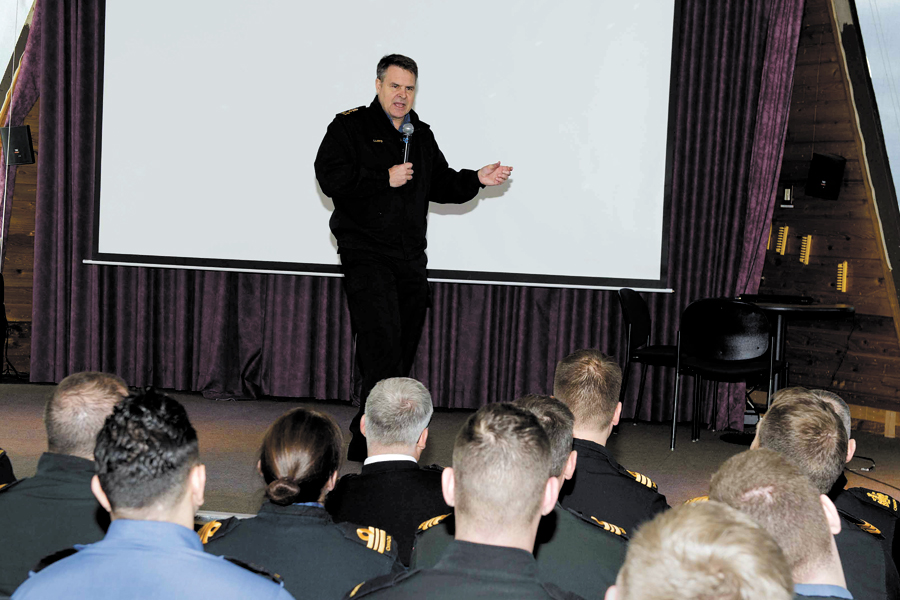
Vice-Admiral Lloyd conducts Town Hall

SLt Melissa Kia, MARPAC PAO ~Overlooking a sea of military and civilians employees gathered in the Pacific Fleet Club Feb. 7, Vice-Admiral Ron Lloyd discussed his vision of mission first, people always, and fielded questions from the audience.The Commander of the Royal Canadian Navy (RCN), and Acting Vice-Chief of Defence Staff, was at CFB Esquimalt to attend the Admiral’s Council.His town hall at the Junior Rank’s mess was an opportunity to hear directly from West Coast sailors relating to his vision of the RCN. Questions ran the gamut from the X Ship program with HMCS Montreal, to Operation Honour, the Arctic Offshore Patrol Ships (AOPS), and the Naval Reserves.In his closing remarks the Admiral thanked his sailors and their families for their extraordinary work reminding them, “People First, Mission Always.”

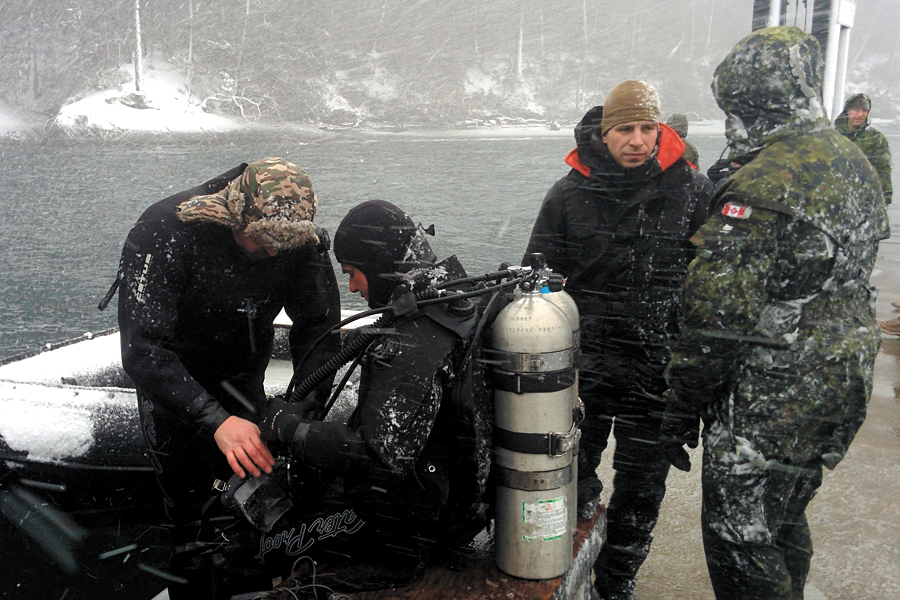
During a rare winter storm in Victoria

Exercise Roguish Buoy 2017

[caption id="attachment_15045" align="alignnone" width="450"] During a rare winter storm in Victoria, Canadian dive supervisors conducted an equipment familiarization dive with allied divers during Exercise Roguish Buoy 2017, the Canadian Army’s annual combat diving training event. Photo courtesy Capt. H.J. Morrison, OIC Army Diving, CFSME[/caption]Peter Mallett, Staff Writer ~Military divers from Canada and around the world have converged in the waters off Albert Head for Exercise Roguish Buoy 2017.Approximately 100 divers from Canada’s military, along with personnel from international NATO partners, are taking part in the military exercise at Albert Head Training Centre, which began Feb. 7 and concludes on Feb. 26.The exercise is being hosted by the Canadian Forces School of Military Engineering, a school of the Combat and Training Centre located in Gagetown, N.B. Divers are testing and improving their skills in underwater construction and infrastructure repair, underwater debris clearance, the repair of floating military equipment, and underwater search and recovery. The operation will go a long way in improving diver readiness to respond to any situation, says Colonel Craig Aitchison, Commanding Officer of the Combat Training Centre.“As soldiers we must remain flexible, always prepared to deploy when our government calls upon us, whether at home or here in Canada or somewhere else in the world,” said Col Aitchison. “Events like Exercise Roguish Buoy help ensure the soldiers we send on underwater operations can meet their objective and exceed all expectations.”Col Aitchison says the exercise will help refine and confirm diving doctrine, tactics, techniques and procedures to achieve assigned battle-task standards, standardize diving operations with the Canadian Army, and ensure that Canadian combat divers are capable of both “functioning and integrating” with other NATO combat divers.NATO countries participating in the event include the United States, Great Britain, Netherlands, Belgium, France and Germany.

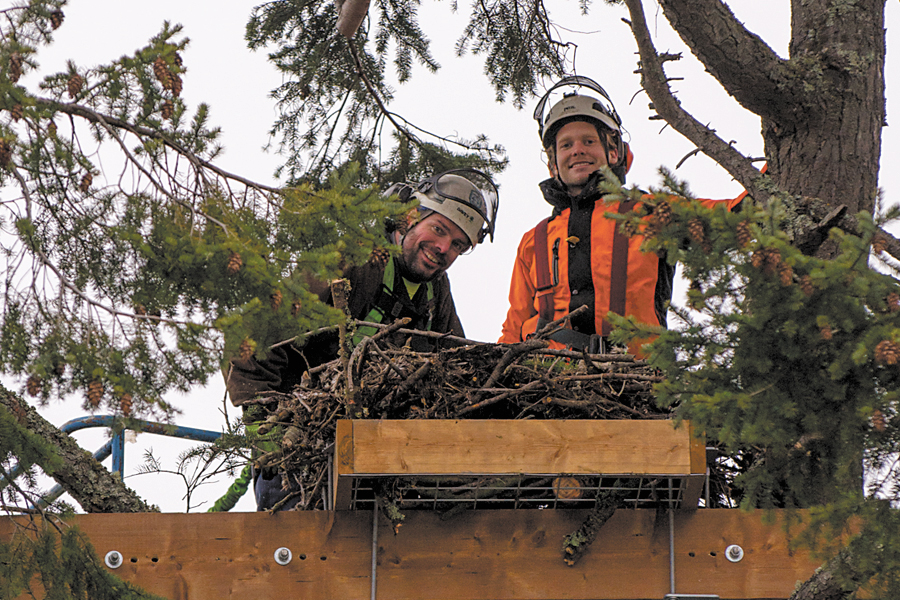
Graham Smith and Kevin Linka of Davey Tree Canada finish relocating the bald eagle nest on Signal Hill. Photo by Cpl Andre Maillet

Eagle nest relocated

[caption id="attachment_15042" align="alignnone" width="450"] Graham Smith and Kevin Linka of Davey Tree Canada finish relocating the bald eagle nest on Signal Hill. Photo by Cpl Andre Maillet, MARPAC Imaging Services[/caption]Peter Mallett, Staff Writer ~An eagle nest perched in the upper branches of a tree high atop Signal Hill has been successfully relocated.The nest was moved in order to ensure that construction of the antenna on Signal Hill could continue this winter, and to remove the eagles out of the sightline of the antenna system. After building a platform, their nest was relocated to a similar tree approximately 150 metres to the southeast of the original nest, which is well outside the southwesterly transmission path of the antennas.Time will tell if the nesting pair will take up residence at the new location.The Feb. 3 move was carried out by contractors employed by Defence Construction Canada’s (DCC) and overseen by the Formation Safety and Environment (FSE) section.“Both the FSE and DCC staff will be observing the relocated nest to determine if it is used in future years, but at this point it is too early to tell,” said Tracy Cornforth, FSE. “It is common for a nesting pair to have more than one nest, and it appears this year the pair may be rebuilding a nest in dockyard.”The bald eagles built the nest on Signal Hill a 34-metre high Grand Fir tree that overlooks the Wardroom. The mating pair reared three eaglets at that location last year. Cornforth says the eagles appear to switch locations between the Signal Hill nest and a nest situated near the tennis courts on Commodore Road in dockyard.Stantec, an engineering and consulting firm, was hired by DCC to study the site and suggest possible alternative homes for the eagles. In their Dec. 8, 2016, report to DCC...

Photo by MCpl Chris Ward

DND awards a major contract for the demolition of “B” Jetty

[caption id="attachment_15028" align="alignnone" width="425"] Photo by MCpl Chris Ward, Imaging Services, CFB Esquimalt[/caption]DND ~The Department of National Defence has awarded a $55.45 million contract to Pomerleau Inc. from Surrey, BC, for the demolition of the existing “B” Jetty at Her Majesty’s Canadian Dockyard Esquimalt and preparing the site for future rebuilding work.The existing jetties, “A” and “B”, were originally designed for ships that were smaller and lighter than today’s modern Canadian Patrol Frigates. As such, they are not long enough or deep enough to accommodate modern ships.The ongoing project at HMC Dockyard Esquimalt provides the Royal Canadian Navy’s Pacific Fleet with structurally sound docking facilities that will be functionally optimal for the berthing of Canada’s modern frigates and for newly designed vessels joining the fleet between 2018 and the mid-2040s.The new jetty facilities will be longer and more versatile. New cranes will enable efficient loading and unloading of modern ships, to be delivered by Canada’s National Shipbuilding Strategy to the Royal Canadian Navy over the next 30 years.The A/B Jetty Recapitalization Project represents a total investment of $781 million at Canadian Forces Base (CFB) Esquimalt.Throughout the duration of work, the Government of Canada’s investment in the major A/B jetty project has the potential to create 1400 middle class jobs and sustain economic in the region for the years to come.The A/B Jetty Recapitalization Project is divided into three phases to ensure that at least one jetty remains operational for the duration of the project.Following the demolition of “B” Jetty, the rebuilding of a new “B” Jetty will begin.The demolition and rebuilding of “A” Jetty will begin once “B” jetty is operational.

Chinese New Year with senior leaders

Senior naval leaders joined Justin Trudeau, Prime Minister of Canada, and Harjit Singh Sajjan, Minister of National Defence, for the Chinese New Year parade in Vancouver Jan. 29.Clockwise from top left: With the parade underway, Honorary Captain (Navy) Tung Chan, Commodore Marta Mulkins, Rear-Admiral Art McDonald, and Commodore Jeffery Zwick pause for a photo. Petty Officer Second Class Steve MacDonald keeps the beat for the Naden Band of the Royal Canadian Navy as they march in the parade. Senior navy leaders mingle with the Prime Minister and MND. Prime Minister Trudeau and Minister Sajjan join Chinese community members in watching the traditional dragon dance during the celebrations. Photos by Cpl Stuart MacNeil, MARPAC Imaging Services

New Canadian Armed Forces policy removes promotion barriers for ill and injured members

[caption id="attachment_15021" align="alignnone" width="425"] Photo by Joint Task Force Ukraine[/caption]DND ~Members of the Canadian Armed Forces (CAF) who have medical challenges and are up for potential promotion no longer have to feel they need to choose between the two.Effective Jan.18, 2017, ill and injured members can be promoted while undergoing medical care. If they have a condition that is preventing them from achieving fitness or training promotion prerequisites, they can be promoted in an acting capacity with no time pressure for meeting these conditions. Once their medical treatment has been completed, a member can be fully promoted to their new position.CAF leadership is committed to caring for our members and encourages those in need of medical care to take advantage of the resources available to them, without stigma or worry of impacts on their career advancement.“When you’ve earned your promotion, it shouldn’t be denied to you just because you’re treating a medical condition,” said General Jonathan Vance, Chief of the Defence Staff. “For too long, people have avoided seeking help for fear of professional implications. We need people who can reach their full potential now and in the future. Get the help you need: your promotion will not suffer.”The CAF recognizes the talents and dedication of our ill and injured members, and their expected future contributions. A member’s posting and appointment at the next rank will take into account his or her employment and deployment limitations.“This is a significant change for the CAF. Our hope is that it will encourage members to get the support they need right away, allowing them to focus on both their health and career,” said Colonel Rakesh Jetly, Mental Health Advisor, Canadian Forces Health Services.Removing medical health from promotion criteria is just one of the ways the CAF is working to improve how administration and support is provided to our members and their families.For more information on these changes to promotion criteria, consult CANFORGEN 012/17 CMP 009/17 De-linking of Medical Condition from Promotion Criteria.Learn more about...

Alberta-style ending to HMCS Calgary charity fund-raising

Alberta-style ending to HMCS Calgary charity fund-raising

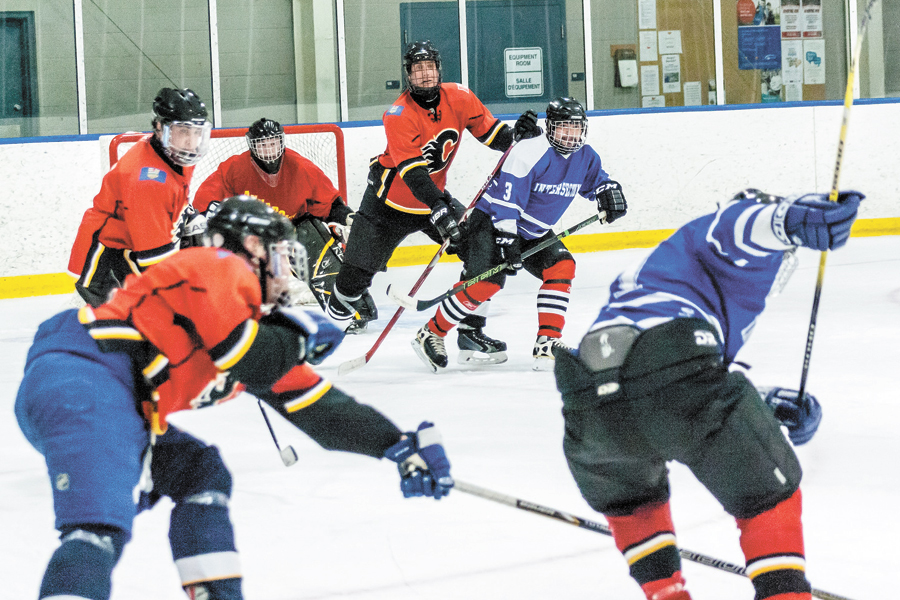
Peter Mallett, Staff Writer ~The crew of HMCS Calgary wrapped up a successful National Defence Workplace Charitable Campaign (NDWCC) by partaking in two of their namesake city’s favourite pastimes: a hockey game and barbeque.A team made up of Officers and Chiefs and Petty Officers scored a 7-4 victory over the ship’s Junior Ranks in a Jan. 26 midday showdown on the ice at Naden’s Wurtele Arena.“The underdog senior officers pulled off an upset victory over the junior ranks who were expected to prevail,” said Lt(N) Mikhail Smirnov, the ship’s Information Management Officer. “All available members of the ship’s company came down to cheer on their friends and shipmates.”Following the final buzzer, the ship’s company attended a barbeque outside the arena, hosted by the ship’s logisticians and featuring homemade hamburgers and a full spread of snacks.Lt(N) Smirnov said Calgary contributed $5,870.82 to this year’s NDWCC. He also extended special thanks to the ship’s NDWCC representatives PO2 Mark Grimard, Lt(N) Jon Day, PO2 Dana Haley, and LS Nicole Hunter for coordinating the fundraising efforts.

LCdr Clark Northey is joined by his father Robert Northey (left) and LCdr Trent Nichols for his promotion to his current rank and the awarding of a Canadian Joint Operations Command

Prairie Reservist receives CJOC Commander’s Commendation

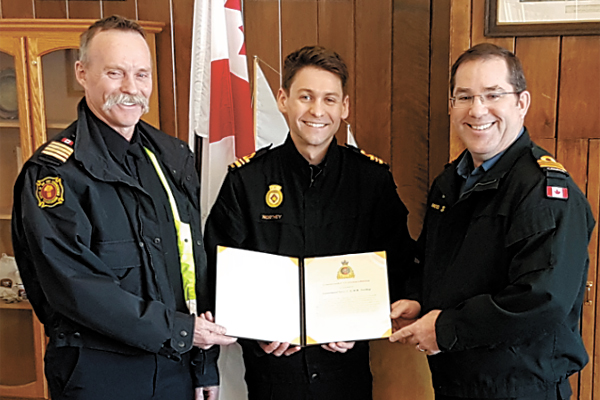
[caption id="attachment_15013" align="alignnone" width="425"] LCdr Clark Northey is joined by his father Robert Northey (left) and LCdr Trent Nichols for his promotion to his current rank and the awarding of a Canadian Joint Operations Command, Commander’s Commendation.[/caption]A/SLt Callista Szachury, HMCS Queen ~An Intelligence Officer from HMCS Queen is the recipient of a Canadian Joint Operations Command, Commander’s Commendation for his exceptional leadership during Operation Lentus 15 – 02 as the Joint Task Force West Liaison Officer.  Lieutenant-Commander Clark Northey proved himself a vital intermediary between the Canadian Armed Forces, affected First Nations communities, and provincial and municipal leaders located in northern Saskatchewan. By strengthening the ties between these local communities and the Canadian Armed Forces during what can be considered the largest-ever wildfire evacuation in the province’s history, LCdr Northey efforts aided in ensuring a successful outcome to this critical firefighting operation.On Saturday, Jan. 28, with his immediate family and the ship’s company present, LCdr Northey received his commendation from LCdr W. S. Trent Nichols, Commanding Officer of HMCS Queen.In addition to the commendation, he also received his well-deserved promotion to Lieutenant-Commander. Raised in Prince Albert, SK, LCdr Northey joined the Royal Canadian Navy in 2006 at HMCS Unicorn while pursuing his studies in Biochemistry at the University of Saskatchewan. Upon his return to the province following his first tour overseas, he relocated to HMCS Queen in Regina, SK, where he is currently the Executive Officer after serving in a variety of Naval Reserve Division roles.From 2010 onwards, LCdr Northey has been employed both nationally and internationally. His assignments have included an intelligence course instructor at CFFS(Q), participating in the multinational PANAMAX exercise series in Nolfolk, Virginia, and serving as J2 staff within the RCMP-led Integrated Security Unit on Operation Podium in support of the Vancouver Winter Olympics.Shortly after the Olympics, he deployed...

Navy’s tall ship set to sail south

[caption id="attachment_15010" align="alignnone" width="425"] LCdr Mike Wills[/caption]Peter Mallett, Staff Writer ~HMCS Oriole’s upcoming sail is one of the farthest in its 96-year history.Two weeks into March, the 31-metre sailing ketch, with 20 eager sailors on board, will leave Esquimalt Harbour with the compass set for Charlottetown Harbour in Prince Edward Island.If all goes as planned, Oriole will glide into the East Coast harbour late-June after sailing more than 10,000 nautical miles,(16,000 kilometres) just in time for Canada’s 150th Anniversary celebrations.Along the way the crew will be changed out, and the sailing ketch will make some impressive ports of call.“The crew is super excited because they truly recognize this as a once-in-a-lifetime opportunity,” says LCdr Michael Wills, Oriole’s skipper. “As the deployment progresses the crew will gradually be replaced and in the end probably 40 or 50 personnel will be part of this deployment. The chances of being selected are pretty slim, and while I’m not going to say I will never be able to do such a trip again, the opportunity for me is also historically sparse.”The southerly course down the Pacific Coast and through the Panama Canal and Caribbean will include stops in the United States, Mexico, Jamaica, and Bermuda for the Tall Ships Bermuda 2017 festival on June 1. Part of the festival is a regatta, a series of races including a trans-Atlantic race to Bermuda and on to Boston, Quebec, and finally Halifax.The final leg of Oriole’s journey will take her into the Gulf of the St. Lawrence for Canada 150 celebrations in Charlottetown, followed by a variety of short visits throughout the Maritimes and Quebec.“It’s both an honour and incredible opportunity to be part of this event when you consider Oriole has been sailing in Canadian waters for 96 of those 150 years of Confederation,” says LCdr Wills.Following the sesquicentennial celebrations, Oriole will remain on the East Coast for a refit during the winter.In April 2018, the sailing ketch will take a shorter, more direct 7,000...

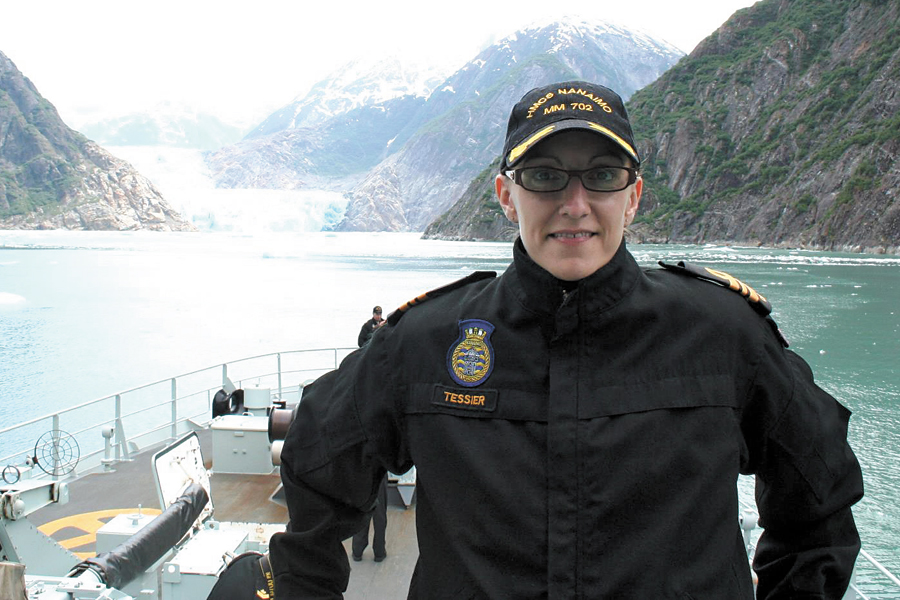
Cdr Michele Tessier

Cdr Tessier to take charge of second Arctic patrol ship

[caption id="attachment_15005" align="alignnone" width="425"] Cdr Michele Tessier[/caption]Peter Mallett, Staff Writer ~A few days before Christmas break, Commander Michele Tessier was offered a major command coup.In a meeting with Cmdre Jeff Zwick, Commander Canadian Fleet Pacific, she was offered the captain’s chair on board HMCS Margaret Brooke, the Royal Canadian Navy’s (RCN) second Harry DeWolf-Class Arctic Offshore Patrol Vessel (AOPV).“I was humbled to hear the news to be honest; it was a really emotional moment for me,” she said. “You’re lucky to get one command at sea, so to be selected for a second is quite an honour.”She commanded HMCS Nanaimo from 2010 to 2013, which she says was the highlight of her career. The rollout of the Arctic Offshore Patrol Vessels is expected to start in 2018. HMCS Margaret Brooke will be the second ship off the assembly line. Cdr Tessier will begin her new job that summer to prepare for the command.Her appointment was determined by the Naval Succession Planning Board, a body made up of senior RCN leadership that determines operational command positions.The graduate of Memorial University’s English literature program grew up in Grand Bank, NL. She is the granddaughter of a fishing trawler captain, and she says the salt water is in her blood.Cdr Tessier joined the Naval Reserves in 1996 at HMCS Cabot in St. John’s, NL, and completed basic officer training at the now closed Canadian Forces Officer Candidate School in Chilliwack, BC.  Her resume is peppered with notable appointments including Commanding Officer of the Naval Reserve Division HMCS Griffon in Thunder Bay, ON, and Commander Coastal Forces Pacific, her current post. The Arctic Offshore Patrol Vessel project is being carried out at Halifax Shipyard. Once deployed, the new vessels will help enforce Canada’s sovereignty in the Arctic, Pacific, and Atlantic by providing armed sea-borne surveillance and...

CAF members

CAF members, veterans credited for advanced education at BCIT

[caption id="attachment_14968" align="alignnone" width="425"] Photo credit: www.military-appl.ca[/caption]Capt Graeme Kaine, 39 CBG PAO ~Military experience is being recognized through advanced education credits thanks to a new partnership between the British Columbia Institute of Technology (BCIT) and the Canadian Armed Forces, formalized Jan. 20, 2017.The knowledge, skills and abilities acquired through military experience can now help students earn credits for placement towards a certificate, diploma or degree at BCIT.The formal memorandum of understanding was signed at 39 Canadian Brigade Group Headquarters by Brigadier-General N. Stanton, Deputy-Commander of 3rd Canadian Division and Joint Task Force West, and Dr. K. Wainwright, head of BCIT’s Legion Military Skills Conversion Program.The BCIT program underwent a seven-year pilot, resulting in 90 graduates and currently enrols 160 students. Business, engineering and health ­sciences studies are part of the ever-expanding accredited offering. Bursaries to attend BCIT are also available courtesy of the Royal Canadian Legion/BC Yukon Command.An increasing number of post-secondary institutions across Canada are taking part in this initiative. With support and funding of Employment and Social Development Canada (ESDC), BCIT was given the opportunity to take on a National Advanced Placement and Prior Learning (N-APPL) Project.The goal is to help increase educational options for military ­members and veterans across Canada. For a complete list of partner institutions and potential pathways, please visit ­military-appl.ca.

According to the original caption to this photo

Boston Bruin legend, former RCAF member, remembered

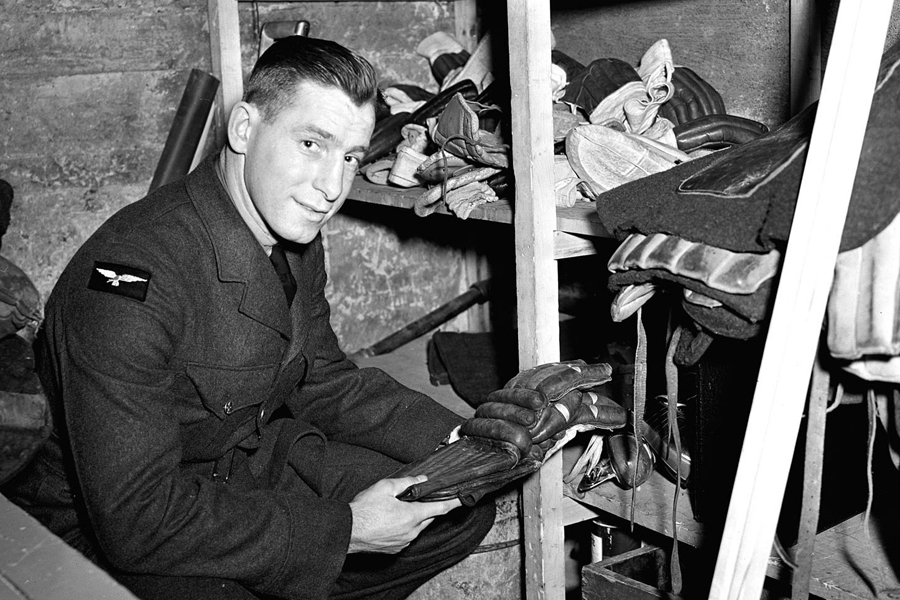
[caption id="attachment_14965" align="alignnone" width="425"] According to the original caption to this photo, taken Feb. 25, 1942: “Aircraftman 2nd Class Milton Schmidt is the only member of the RCAF Flyers hockey team whose duties in the Air Force are similar to his spare time job as a hockey star. The Flyers’ star centre man is becoming a physical training instructor, a job for which he appears admirably fitted.” Photo: DND Archives, PL-6907[/caption]Major Mat Joost and Joanna Calder, RCAF ~Milt Schmidt, the last surviving member of hockey’s famed “Kraut Line” and a former member of the Royal Canadian Air Force, died Jan.  4, 2017, in Massachusetts. He was 98, and the oldest living former member of the National Hockey League (NHL).It was an iconic moment in hockey history.On Feb.11, 1942, the “Kraut Line” led the Boston Bruins to an 8-1 victory over the Montreal Canadiens at the Boston Garden.Then, as the crowd cheered and the Boston Garden’s organist played “Auld Lang Syne”, members of the rival Bruins and Habs teams hoisted the three members of the Kraut Line – Milton Conrad “Milt” Schmidt, Woodrow Clarence “Woody” Dumart and Robert Theodore “Bobby” Bauer – onto their shoulders and carried them off the ice.They were heading to the Royal Canadian Air Force and the war in Europe that summer.The three long-time friends from Hamilton, Ontario, had been dubbed the Kraut Line when they joined the National Hockey League because of their German heritage.“I don’t think I’ll ever forget what happened,” said Schmidt in an interview before he died. “The players on both teams lifted the three of us on their shoulders and carried us off the ice and the crowd gave us an ovation. A man couldn’t ever forget a thing like that.”On July 23, Schmidt was posted to No. 1 Bombing and Gunnery School...

University of Victoria Student Emily McKee has won recognition by the Association of Professional Engineers and Geologists of British Columbia for a cost-saving initiative she developed for office printers and photo copiers while doing a co-op work placement at Fleet Maintenance Facility. Photo by Peter Mallett

Co-op student recognized for FMF project

[caption id="attachment_14962" align="alignnone" width="425"] University of Victoria Student Emily McKee has won recognition by the Association of Professional Engineers and Geologists of British Columbia for a cost-saving initiative she developed for office printers and photo copiers while doing a co-op work placement at Fleet Maintenance Facility. Photo by Peter Mallett, Lookout[/caption]Peter Mallett, Staff Writer ~A co-op work placement at Fleet Maintenance Facility (FMF) Cape Breton is giving University of Victoria engineering student Emily McKee a new outlook on her career path after she graduates.McKee, 21, is entering the final semester of her three-semester work placement with FMF’s Information Technology and Information Management departments.Her work has focused on a project to generate recommendations on how to reduce waste, duplication, and costs in the over 200 office printers and photocopying machines in the ship repair unit.That work earned her the Summer of 2016 Engineering Associates Term Report Excellence Award Dec. 2 by the Association of Professional Engineers and Geologists of British Columbia at the Oak Bay Recreation Centre.“Being nominated for the award was a complete surprise, but when I heard I’d won out of the work of hundreds of engineering students, I was completely floored,” said McKee.Her project was determined to be the best of all the submissions because it was detailed, thorough and used professional language that would contribute to a smooth process of implementation.She developed a cost and service contract evaluation of all of FMF’s printers and copiers. She tracked usage and location of the machines, and consumption of materials such as paper, toner cartridges, that can cost close to $800 to equip some of the many larger four-cartridge high-end machines.She then made a series of 20 recommendations in her report to Information Technology staff on how to improve their existing system of printers and copiers. Half her recommendations have...

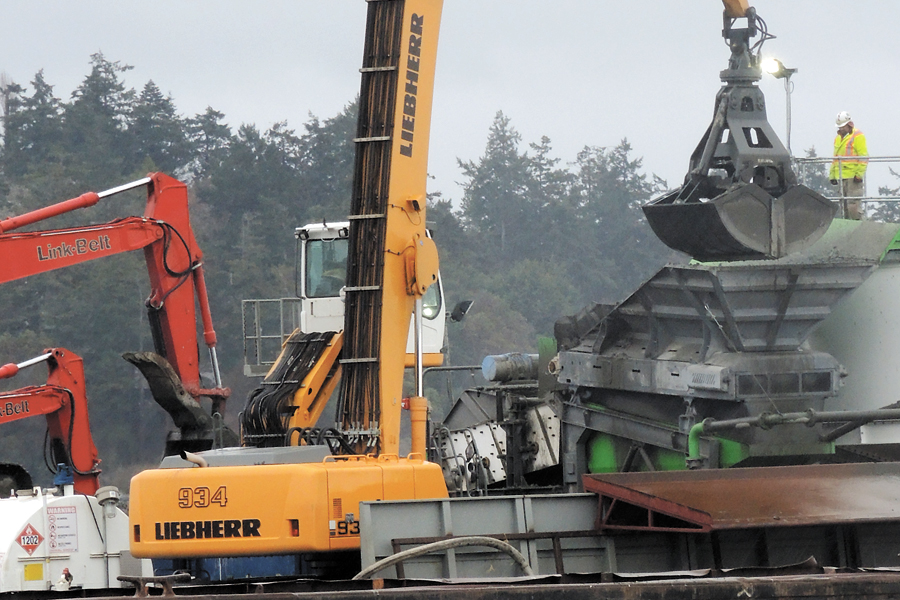
Contractors from JJM Construction carry out dredging operations in the waters adjacent to the Fleet Diving Unit’s F Jetty. The work is part of Esquimalt Harbour Remediation Project. Photo by Peter Mallett

Harbour remediation project moves to Colwood side

[caption id="attachment_14959" align="alignnone" width="425"] Contractors from JJM Construction carry out dredging operations in the waters adjacent to the Fleet Diving Unit’s F Jetty. The work is part of Esquimalt Harbour Remediation Project. Photo by Peter Mallett, Lookout[/caption]Peter Mallett, Staff Writer ~The next phase of remediation dredging operations in the Esquimalt Harbour is now underway in the waters adjacent to Fleet Diving Unit (Pacific) in Colwood.Overseen by Formation Safety and Environment  (FSE) and contracted through Public Works & Government Services Canada, the work is being performed by private contractor JJM Construction Ltd., of Delta, B.C., in coordination with the Queen’s Harbour Master.Excavation and removal of contaminants on the sea floor in the waters near A-Jetty wrapped up late last year; current dredging is focused around D Jetty, and between F and G Jetties in Colwood.“The last 150 years of ship building and other industries have left their mark in the form of contamination, and we are finding through our efforts to remove the worst parts of the contaminated sediments that we are leaving the harbour in a better state,” said Deputy Project Manager Mike Bodman of FSE. “These contaminants present risks to human health and the environment; our overall intent is to make the harbour a safer place for everybody and everything that lives in and around the harbour.”The DND-led remediation projects cover 354 hectares of the harbour with the intent to remove and reduce the impact of 25 chemicals, including PCBs, arsenic, mercury, lead and cadmium.These sediment remediation projects are part of the 15-year Federal Contaminated Sites Action Plan established in 2005. The remediation projects are also being completed concurrently with the A/B Jetty Recapitalization Project that will replace the aging jetties with more structurally sound, larger, and versatile berthing facilities.Bodman says the dredging in Colwood is expected to be...

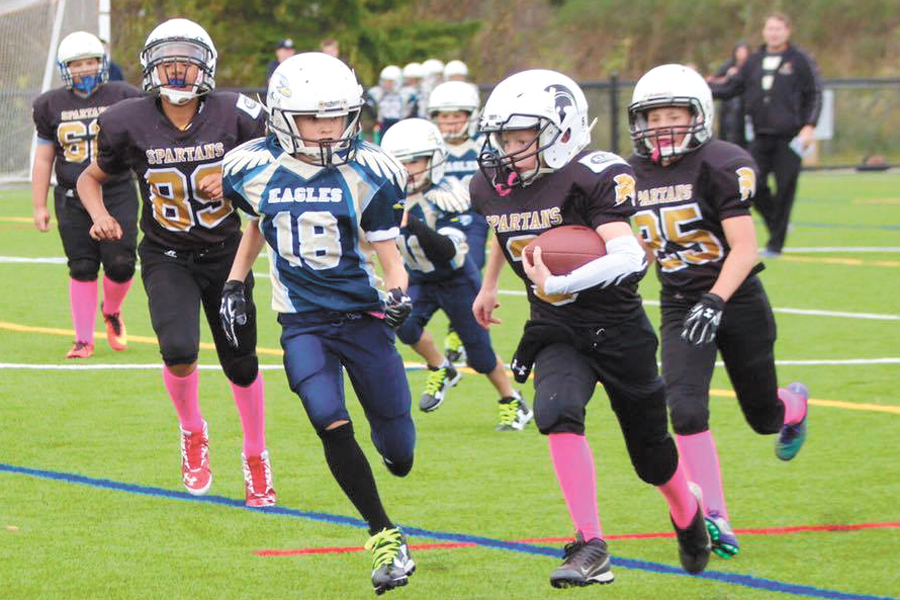
The Victoria Spartans youth football club

Spartan youth football program touches down in Esquimalt

Peter Mallett, Staff Writer ~The Victoria Spartans youth football club have moved to Esquimalt and are looking to attract new players for the upcoming spring season; hopefully those in the military community.The club will field teams for children in the Vancouver Island Canadian Football Association in the Atom age group (7 to 9) Peewee (10-11), and Junior Bantam (12-13), to play eight Sunday games from April to June.  Their fall program will also field teams in the Bantam (14-15) and Midget (16-18) age groups.Spartans President Allen Lavoie says his club is still in the process of announcing a home playing field in Esquimalt, but says teams participating in the spring season will hold practices at L’École Victor-Brodeur beginning in March.“We want to build a community-based football team in a community where we can have reasonable hope that kids will stay with our programs until they are 18,” he says. In Esquimalt we feel we can have a better chance of keeping older players on board, thus building better connections with the community.”Lavoie is encouraged by the level of interest since his club’s arrival in Esquimalt, which so far has included sponsorship and volunteer offers. He said getting military families who work and live here is also crucial to building ties with the community.The cost for the spring season is $175 if players register with the club prior to March 1, and $200 afterwards. The Spartans provide all players all equipment such as, uniforms, shoulder pads and helmets, but not footwear. Lavoie says parents who require financial assistance can find help through Jumpstart and KidSport Canada. For more details about the Spartans, registration, rules and the upcoming season visit the club’s website www.spartansfootball.ca.

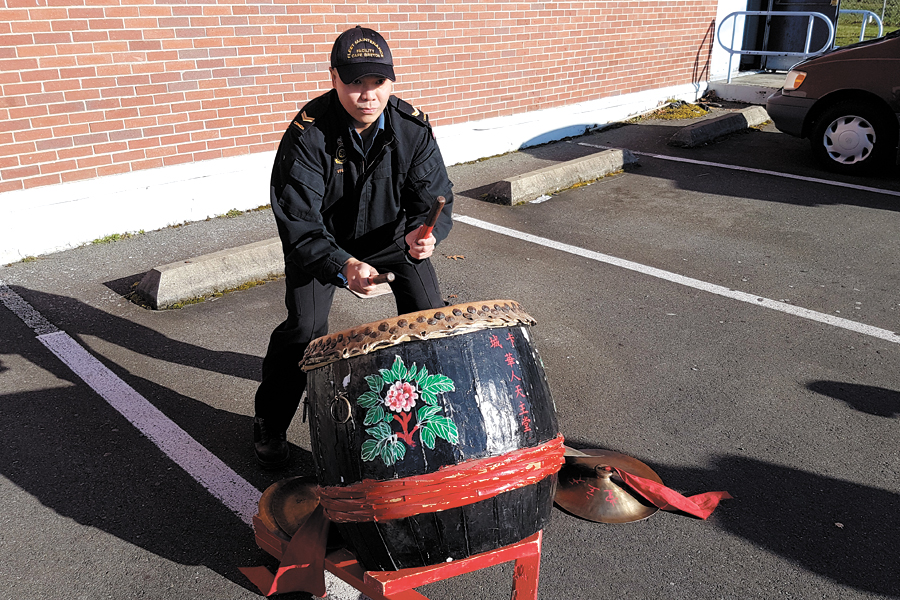
LS Dinh Tran tries the ceremonial drum used in the Lion Dance Ceremony. Photo by LS Jordan Moore

Sailor brings Lion Dance to life

[caption id="attachment_14952" align="alignnone" width="425"] LS Dinh Tran tries the ceremonial drum used in the Lion Dance Ceremony. Photo by LS Jordan Moore, FMF[/caption]Peter Mallett, Staff Writer ~A worker from Dockyard’s Fleet Maintenance Facility introduced his co-workers to the magic of the Cantonese Lion Dance ahead of the Jan. 28 Chinese New Year’s celebrations.MS Adam Choi, who works as a Radar Maintainer in Fleet Maintenance Facility’s Radar Shop, introduced the colourfully painted, shiny paper mâché and bamboo lion costumes and traditional ceremonial drums to members of his unit last week.The informal gathering occurred just four days ahead of China’s annual lunar festival, also known as the Spring Festival, and was an effort by MS Choi to share his cultural traditions.“They were pretty intrigued,” he said. “Most of them never had hands-on experience with the Lion before, and few people in North America do because the ceremony is considered sacred and most people don’t have access to it.”MS Choi says according to traditional beliefs in Southern China, lion dancing signifies courage, stability, superiority and can chase away bad spirits when performed with loud noises, such as fire cracker, cymbals and gongs or drums.MS Stephan Girard, a Radar Maintainer who works alongside MS Choi, attended the gathering and climbed inside one of the two giant lion heads to try his hand at the dance. He said learning choreography involved in the ceremonial dance was both physically and mentally challenging, but highly enjoyable.“Just to be able to try on the equipment and climb inside the lion head was very interesting for me,” said MS Girard. “MS Choi showed us the positions and movements, you need to go left, right, move from a crouching position to tall while using your arms, back and legs; it was quite the workout and highly demanding just trying it...

Explore More

Categories

Top News

E-Editions Archive

News Stories Archive

Proud Supporters

Joshua Buck, Lookout Newspaper