Defence Team News, Sept. 5, 2016
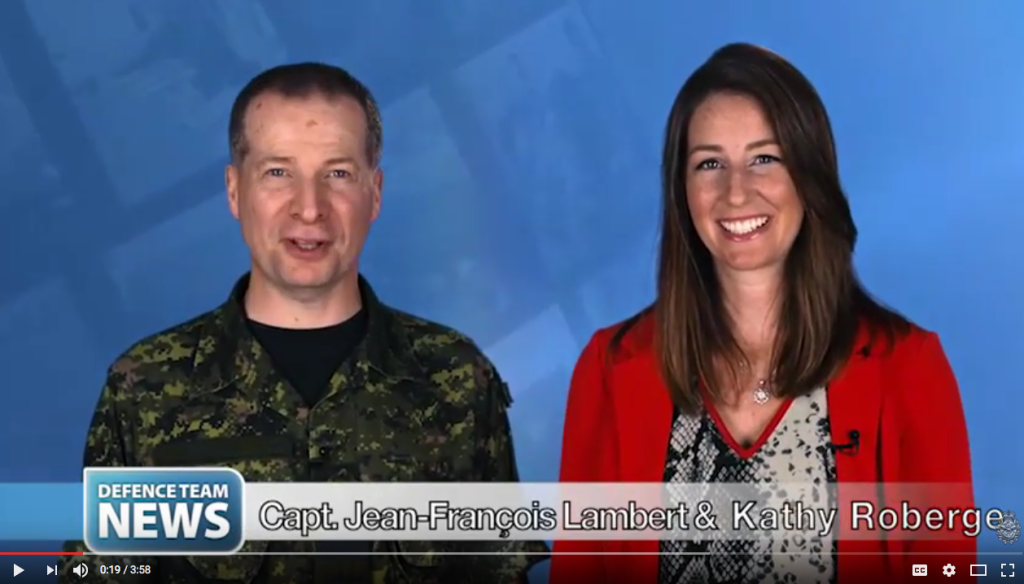
Watch the latest episode of Defence Team News for an update on the most recent Sexual Misconduct report.
Watch the latest episode of Defence Team News for an update on the most recent Sexual Misconduct report.
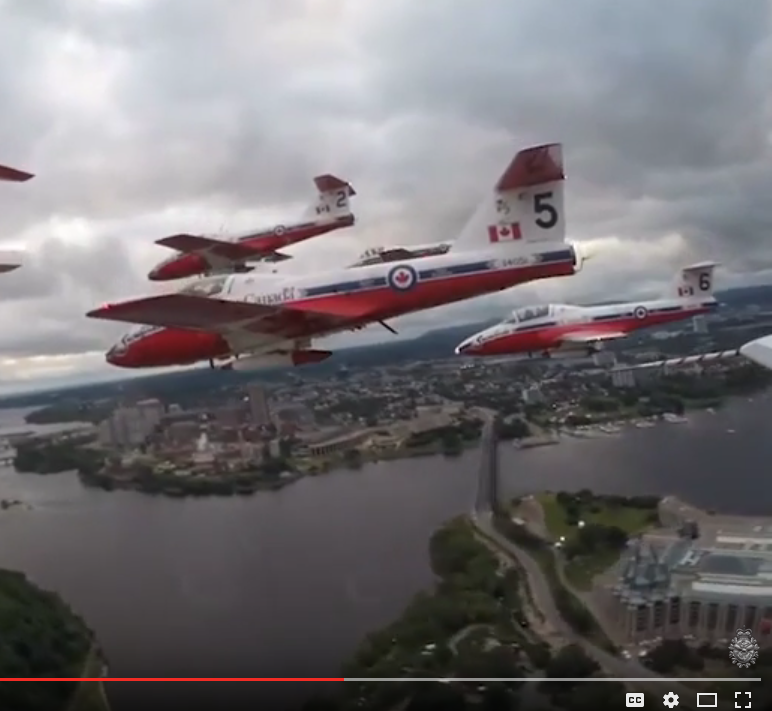
Watch the latest episode of Defence Team News to learn about the Minister of National Defence’s recent visit to Africa.

[caption id="attachment_13691" align="alignnone" width="400"] LS Mitchel Holden (left) and PO2 Nathan Kuffner riding Creampuff (right).[/caption]Lt(N) Bill King, HMCS Charlottetown ~It was still pleasantly cool when HMCS Charlottetown picked up the pilot at 0630 in the harbour approaches of Alexandria, the second largest city in Egypt.At last count, we had already passed 34 ships at anchor, waiting to enter the harbour.Alexandria stretches 32 kilometres along the Mediterranean coast at the western edge of the 240 km-wide Nile delta. The word delta originates from the Greek letter delta, which looks like the triangular area at the mouth of the Nile.During the five kilometre transit from the harbour entrance to the cruise ship terminal, the ship passed neighbourhoods of high density apartments separated by commercial port facilities in an interesting mix of old and new.Oil refineries were flaring off waste gas in producing fuels for export, while sea container and bulk cargo handlers conducted a brisk business at the 55 slips.Once alongside sailors were able to enjoy a port visit.Day-long bus tours arranged by the ship provided the means for crewmembers to visit the Giza Pyramid complex and the Egyptian Museum over two hours away in Cairo. Highlights of the day were viewing King Tutankhamun’s 3,300-year-old funeral mask, and a horse or camel ride around the pyramids. Virtually everyone took advantage of this opportunity with the exception of those few on board who had visited Egypt before.The most recent visit by an HMC Ship was Fredericton in 2010. Many of the tour operators and guides fondly remember that visit, as there have been few cruise ships since the revolution in 2011. A passenger ship last docked at the cruise ship terminal some two years ago.Our Egyptian hosts could not have done more for us during this port visit - repeatedly asking our assurance...
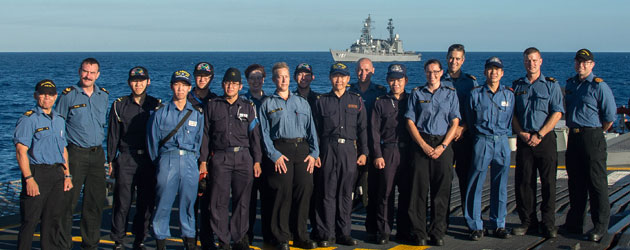
[caption id="attachment_13677" align="alignnone" width="560"] Photo by Cpl Blaine Sewell, Formation Imaging Services[/caption]Members of the Japanese Navy along with members of the crew of HMCS Charlottetown pose for a group photo during a cross pollination during Op Reassurance Aug. 25.

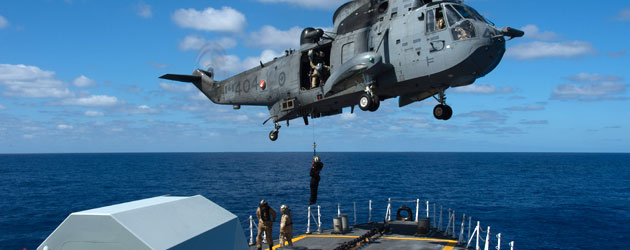
[caption id="attachment_13674" align="alignnone" width="560"] Photo by Cpl Blaine Sewell, Formation Imaging Services[/caption]Members of HMCS Charlottetown’s Air Detachment and flight crew perform a personnel hoist from the ship’s foc’sle with the CH-124 Sea King helicopter during Op Reassurance Aug. 24.
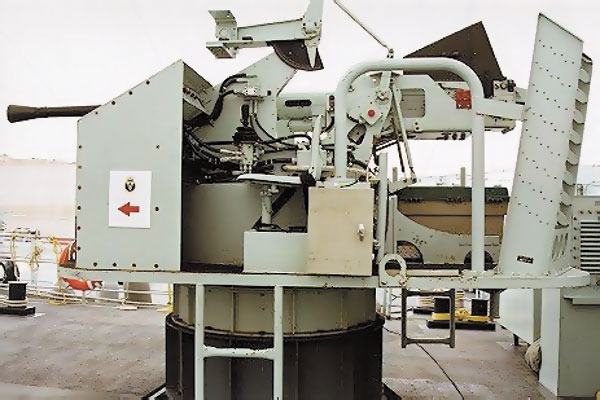
[caption id="attachment_13653" align="alignnone" width="300"] The 40mm Bofors gun, used in a wide range of roles on Maritime Coastal Defence Vessels, are being replaced during upgrades. Photo by Sandy McClearn, smcclearn.smugmug.com[/caption]Rachel Lallouz, Staff Writer ~After its most recent upgrade is completed, HMCS Nanaimo will donate its decommissioned 40 mm Bofors gun to the Vancouver Island Military Museum in Nanaimo.Director General Maritime Equipment Program Management (DGMEPM) and Director of Surplus Acquisitions and Loans (DDSAL) in Ottawa have been working since 2007 to donate surplus or unneeded equipment and weapons to museums across Canada as naval memorabilia.“This is in keeping with our theme at MEPM to preserve as much naval history as possible, and continue the close relationship and ties between the home cities and their warships,” says Wayne Yetman, Naval Ordnance.Life Cycle Material Manager with Director Naval Combat Systems. “It allows the RCN to preserve a valuable piece of naval history in each namesake home city with their ship’s 40mm gun for display,” he adds.Navy staff contacted city councillors in Nanaimo several months ago to see if the city would be interested in keeping the gun for historical purposes. Shortly after, the city contacted the museum. All parties unanimously agreed the gun would make an excellent addition to the artefacts, weaponry, and memorabilia already housed at the museum, and serve to honour veterans of the first HMCS Nanaimo and serving members of the current HMCS Nanaimo.“These guns have been in operation for a very long time and have certainly proved their worth,” says Petty Officer (Retired) Brian McFadden, who served in the Royal Canadian Navy for nine years, and is Vice President of the museum. “I am especially happy because a number of ships I worked on had this particular type of gun.”McFadden says once the gun has been stripped, sandblasted, and...
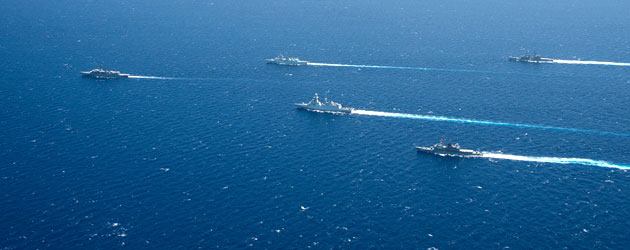
[caption id="attachment_13671" align="alignnone" width="560"] Photo by Cpl Blaine Sewell, Formation Imaging Services[/caption]HMCS Charlottetown, Japanese Naval Destroyers Setoyuki, Asagiri and Kashima, along with Italian Navy Frigate Carabiniere sail in formation during Op Reassurance Aug. 25.
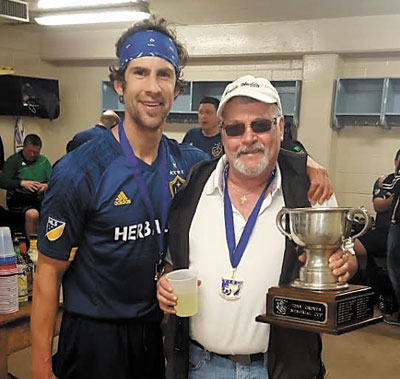
[caption id="attachment_13649" align="alignnone" width="270"] Bill Stewart and Saanich Fusion team captain Jeevan Manhas celebrate their victory, earning the 2016 Tony Grover Masters’ Cup for the Over 35 A Division of the Vancouver Island Soccer League and the Alec Hylan Player of The Game Trophy. Photo submitted by Saanich Fusion[/caption]Peter Mallett, Staff Writer ~The way former Royal Canadian Navy sailor Bill Stewart sees it, the oranges he cuts up and serves at halftime to the players on the Saanich Fusion men’s soccer team are a metaphor for life.“Some days are sweet while some are sour,” says Pte (Ret’d) Stewart as he prepares refreshing citrus bites for the Vancouver Island Soccer League’s Over-35 team.His sweetest day was back in 1975 when he led CFB Esquimalt to a Canadian Armed Forces National Soccer Championship by scoring a hat trick in the deciding game against CFB Cold Lake.The former navy cook recalls the storybook ending of scoring the winning goal on the final play of the game.“The ball came across the midfield and I back-heeled it and then did my patented toe-poke shot,” he says of the moment. “I saw an opening in the goal; I hit it with the front of my foot to score on the final play of the game and we won the nationals.”The entire team and coaching staff piled on top of him. That moment is rooted in his memory like a still photo.During his two-year military career between 1974 and 1976, Stewart worked the mess in HMCS Terra Nova, HMCS Qu’Appelle and HMCS Kootenay. While he was quite proficient at his trade in the kitchen, the navy thought so highly of his soccer skills they sent a helicopter out to the Qu’Appelle, which was a couple of days into its voyage to Hawaii, to fly him back to...
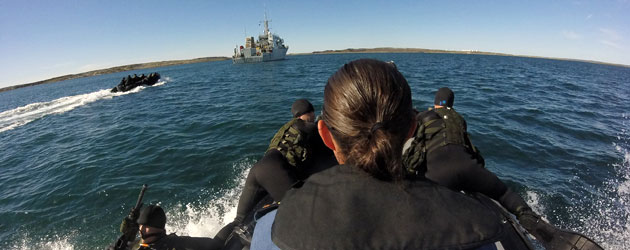
[caption id="attachment_13668" align="alignnone" width="560"] Photo by Lt(N) Andrea Murray[/caption]Pathfinders from Royal 22e Régiment, Valcartier Quebec, jump into the waters of Rankin Inlet, Nunavut during Op Nanook Aug. 24.
[caption id="attachment_13683" align="alignnone" width="400"] The crew of HMCS Ottawa watch from the deck as two men aboard a burning fishing boat Sherry C are rescued by personnel in a rigged-hulled inflatible boat.[/caption]Peter Mallett, Lookout Writer ~Two men stranded on a burning fishing vessel are now on dry land thanks to the crew of HMCS Ottawa.The 12-metre fishing vessel Sherry C was towing the disabled fishing vessel Tryon to Tofino on Aug. 25 when a fire broke out in the engine room. It was 9:25 p.m. and the vessel was 13 nautical miles west of Ucluelet Sound when they sent out a distress call. Ottawa responded to the May Day call and proceeded at best speed to both disabled vessels.In less than half an hour Ottawa was on scene. The fire and smoke had engulfed the interior of Sherry C, and the panicked crew were about to abandon the vessel. Smoke could be seen billowing from the vessel, and though Ottawa’s infrared cameras, a significant heat source was radiating from its engine room.Ottawa immediately deployed its rigid inflated boat and extracted the fishermen from their vessel. They were assessed as uninjured, transferred to a Canadian Coast Guard rescue boat, and later transported to Tofino.“We approached the fishing boat carefully from the stern,” said LS Christopher Henrion, Ottawa’s boat coxswain. “Both fishermen were extremely happy to see us. Both had been hanging on for as long as they could off the back of their boat before needing to abandon it. We transferred them to our RHIB, confirmed they had no injuries, and provided them with blankets to keep warm until the Coast Guard arrived.”With both individuals safe, Ottawa turned its attention to the disabled fishing vessel Tryon. An assessment team was quickly dispatched, and based on their evaluation, Tryon’s transmission and alternator were beyond repair and the vessel would require a tow back to port.“LS Otte and I assessed the Tryon, whose transmission had suffered salt water contamination due to salt water...
Lorraine Crinkley, FSE ~A creek that runs through DND property is receiving much-needed restoration.Tod Creek is a salmon-bearing stream located in Saanich, B.C., that flows north from Prospect Lake to Tod Inlet where it enters the ocean.The District of Saanich has undertaken various restoration projects on Tod Creek and recently approached DND about restoring the portion of the creek that run through Heals Range.The District of Saanich completed an assessment of Tod Creek, both upstream and downstream from Heals Range, and confirmed that old beaver bafflers were impeding water flow and fish passage.Beaver bafflers are corrugated pipes installed through the base of a beaver dam that allows water to pass through the dam silently. Because the beavers can’t hear the running water they are unable to stop the flow and become discouraged and move on to another area. Although the beaver bafflers were successful in deterring beavers from Tod Creek, they were never maintained and have since clogged up with debris.Reduced water flow through the creek due to unmaintained beaver bafflers and sedimentation causes an increase in water temperature and produces anoxic, turbid conditions that can be detrimental to salmonid species.DND and the District of Saanich partnered to complete multiple improvements to the creek including the creation of terraced banks, the planting of riparian vegetation, the grading of the stream bottom, the installation of sediment controls, and removal of old beaver bafflers.Once the beaver bafflers were removed, the banks were terraced. Riparian vegetation is scheduled to be planted in the fall to improve slope stability around the stream.Originally the stream banks were steep and bank material was sloughing into the stream, which also impeded water flow and fish passage. Grading the stream bottom also helped provide consistent flow year round and reduced the opportunity for pooling water.DND and the District of Saanich are hopeful the stream improvements made to Tod Creek will enhance salmon habitat and are assessing the feasibility of making further improvements to the section of the creek...
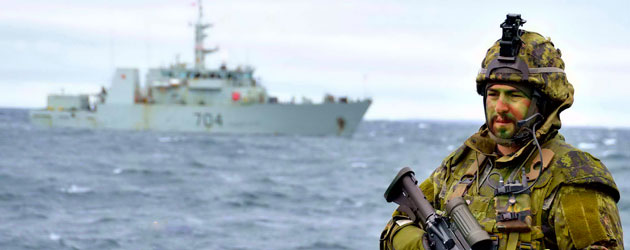
[caption id="attachment_13665" align="alignnone" width="560"] Photo by PO2 Belinda Groves, Task Force Image Technician[/caption]While at anchor in Rankin Inlet, Nunavut, HMCS Moncton is used as a staging point for the Royal 22e Régiment during Op Nanook Aug. 26.
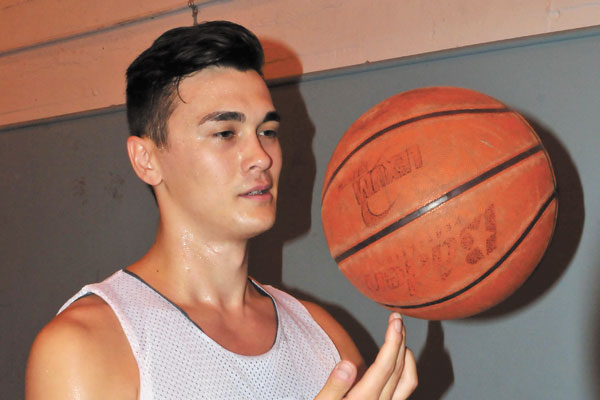
[caption id="attachment_13639" align="alignnone" width="300"] SLt Connor Duke gets in shooting practice at the Naden Athletic Centre. Photo by Peter Mallett, Lookout Newspaper[/caption]Peter Mallett, Staff Writer ~A good year just got better for SLt Connor Duke, a talented guard with the Tritons basketball team.The 24-year-old, 6’3 shooting guard is set to take his A-game to Warendorf, Germany Sept. 2 to 4, for the CISM (Counseil International du Sport Militaire) Basketball Championship.This will be his second CISM tournament; last year he represented the Canadian military in South Korea.“Being able to represent Canada feels pretty great, especially since I never expected to be good enough to play any sport at the international level, let alone basketball,” says SLt Duke who played two seasons for the Royal Military College in Kingston, Ont., before graduating in 2014.SLt Duke received another morale boost when it was announced he is the RCN’s command nominee for the annual Canadian Armed Forces sports awards to be held in Ottawa in October.“For me it definitely feels good to be recognized for what I’ve accomplished and the work I’ve put in on the court playing basketball, but I’m not speaking about this with the intention of looking like a star or something” he says. “Receiving the award and being honoured came as a complete surprise to me. I just want CAF members to know that sports opportunities are out there and all you have to do is ask around.”His coach Joshua Buck think he’s worthy of the award. He says SLt Duke has a basketball IQ and energy “unparalleled” to other players as soon as he sets foot on the court.“Connor has the ability to turn his natural competitive spirit into overdrive once the shot clock starts to wind down,” says Buck. “He’s not only an intense competitor but he’s also...
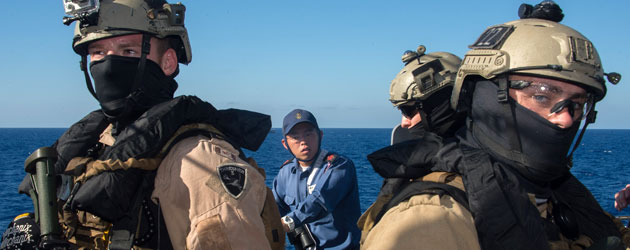
[caption id="attachment_13662" align="alignnone" width="560"] Photo by Cpl Blaine Sewell, Formation Imaging Services[/caption]HMCS Charlottetown’s Enhanced Naval Boarding Party secure the upper deck of Japanese Naval Destroyer Asagiri during training exercises during Op Reassurance Aug. 25.
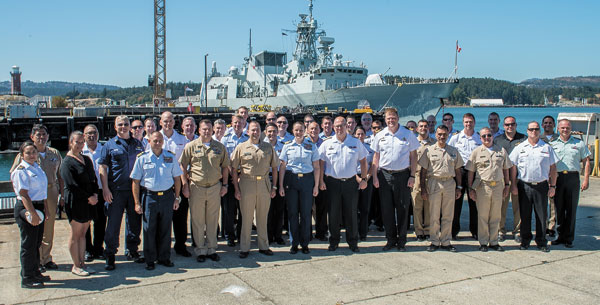
[caption id="attachment_13636" align="alignnone" width="540"] The Working Group of the North American Maritime Security Initiative (NAMSI) gathered at CFB Esquimalt for their biannual meeting Aug. 16 to 19. Photo by MCpl Brent Kenny[/caption]SLt MJ Cserhazi, MARPAC PAO ~The Working Group of the North American Maritime Security Initiative (NAMSI) gathered at Canadian Forces Base Esquimalt for their biannual meeting from Aug. 16 to 19.NAMSI is the only tri-lateral maritime security forum between Canada, Mexico and the United States. It was established to improve maritime security along the coast from Alaska to the southern tip of Mexico. In Esquimalt, the main focus of the Working Group was to refine communications and legal considerations.Delegations from the Royal Canadian Navy, the Mexican Navy, the U.S. Coast Guard, the U.S. Navy, Canadian Joint Operations Command (CJOC), and Joint Interagency Task Force South share a common goal: to strengthen their relationships and increase interoperability by sharing information, best practices and developing tri-lateral exercises.“NAMSI exists to formalize our efforts and to share our best maritime practices and protocols,” says Major Donald Senft who represented MARPAC at the discussions.While the nations have a strong nautical alliance and regularly collaborate with each other, NAMSI seeks to streamline their practices. This effort represents a large amount of ongoing work.“NAMSI is a marathon not a sprint,” says Commander Alex Kooiman of CJOC. “It will take time to come up with answers to larger issues such as communications and legal considerations so we can better prosecute offenders across international borders. By understanding the legal parameters and how to employ that knowledge throughout our respective forces, we will be able to work more closely to support each other.”Canada, Mexico and the U.S. regularly conduct operations and exercises together in the areas of maritime interdiction, humanitarian assistance, search and rescue, and counter narcotics. Enforcing maritime...
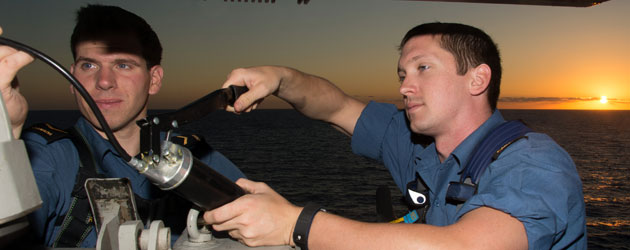
[caption id="attachment_13659" align="alignnone" width="560"] Photo by Cpl Blaine Sewell, Formation Imagery Services[/caption]Crew members onboard HMCS Charlottetown perform maintenance on the ship’s radar tower during Op Reassurance Aug. 24.
[caption id="attachment_13633" align="alignnone" width="233"] HeroWork founder Paul Latour (left), HeroWork Project Manager Peter Smither and CPO2 (Ret’d) Roxanne ‘Rocket’ Ogden get their shovels and wheelbarrel ready ahead of a massive renovation project of the Esquimalt United Church Rainbow Kitchen. Photo by Peter Mallett, Lookout[/caption]Peter Mallett, Staff Writer ~Military members past and present are being sought to join other volunteers in renovating Esquimalt United Church’s Rainbow Kitchen.The $500,000 renovation project on Admirals Road, managed by Victoria-based non-profit organization HeroWork, starts the weekend of Sept. 16 and continues for the following two weekends.The 4,600 square foot community wing of the Esquimalt United Church is home for several community groups and the non-denominational Rainbow Kitchen, which serves approximately 36,000 hot meals a year to people in need in Esquimalt.HeroWork Founder and executive director Paul Latour says his group has carried out over $1.3 million in “radical renovations” since he founded the non-profit organization in 2010. He has relied on military personnel to volunteer in past projects and is counting on them to deliver again.“Participating in something positive for the community and in a team atmosphere will give our volunteers from CFB Esquimalt an amazing experience, but also help them showcase to the public the difference the military makes in their communities, both at home and abroad,” says Latour.HeroWork recently received a $20,000 donation from Canadian Forces Morale and Welfare Services Boomer’s Legacy Foundation.As part of the reno kickoff volunteers will meet at the Canteen Road parking lot at 4 p.m. Friday Sept. 16 and march to the church with some musical accompaniment provided by the Naden Band of the Royal Canadian Navy.After the opening ceremonies, volunteers will start demolition work, including landscaping, excavating and removing decaying cedar shingles from the roof, replacing windows and doors, and painting.Renovations on the inside of the building include a complete kitchen refit, the creation of an additional bathroom, fixture and appliance upgrades, flooring, wall and ceiling replacement, electrical work, furniture repair, painting, the construction of a new...
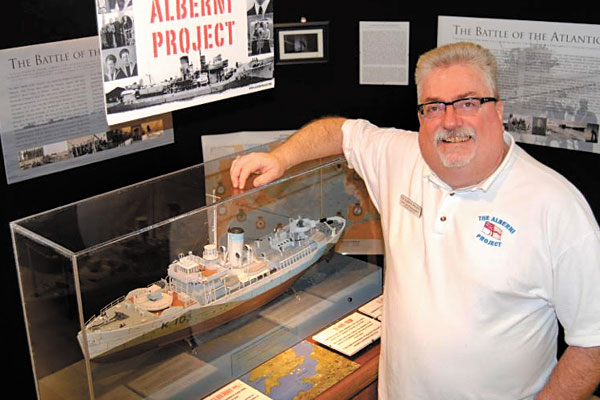
[caption id="attachment_13623" align="alignnone" width="300"] Lewis Bartholomew, Founder and Director of HMCS Alberni Museum and Alberni Project, stands proudly next to a model of HMCS Alberni.[/caption]Rachel Lallouz, Staff Writer ~Founder and Director of the HMCS Alberni Museum and Alberni Project Lewis Bartholomew is searching for a new location for his beloved museum, which was served with a notice to vacate its three-year-old home at the Comox Centre Mall in June, due to the mall’s overhaul planned by its most recent owners.The museum has been given until the end of September to secure a new location that their tight rental budget of $800 per month can afford.The mall’s previous owners, explains Bartholomew, were supportive of the museum’s project to share pivotal moments in Canadian history with visitors, and charged a reduced fee of $500 per month rent.“We now are in the position where we need to find a space large enough to house our current exhibits on First World War, Second World War, HMCS Alberni’s crew and history, and any potential visiting exhibits that we may take on in the future,” says Bartholomew, who adds he hopes that the new location can remain in Comox to maintain its deep ties to HMCS Quadra and CFB Comox.Bartholomew, who is originally from Seattle, quit his job in grocery management a few years ago to start the museum after hearing about the 1944 sinking of HMCS Alberni during the Second World War. He was deeply touched by the loss of 59 lives.“I grew up with the heartbeat of the Second World War as my father served in the U.S. military during that time. It was his stories I heard continually as a child. But a lot of young people nowadays don’t have grandparents or living history to explain what transpired back then,” says Bartholomew. “For...

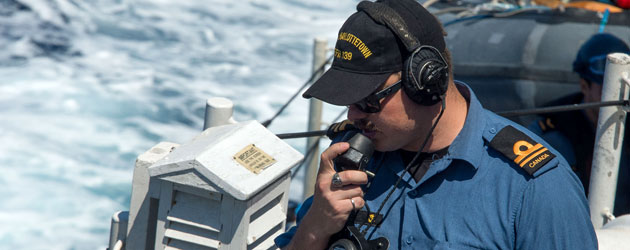
[caption id="attachment_13611" align="alignnone" width="560"] Photo by Cpl Blaine Sewell, Formation Imaging Services[/caption]A crew member onboard HMCS Charlottetown checks sound power communications during Op Reassurance Aug. 19.
Peter Mallett, Staff Writer ~A well-intentioned Merritt, B.C. resident thought he was doing the right thing when he walked into his local RCMP detachment on July 21 to return an artillery shell he had found.The man told front desk staff at the police station that he had discovered a 106 mm round of artillery while cleaning his parent’s house and was surrendering the item. The front desk staff were alarmed at the appearance of a very unfamiliar military weapon, said Merritt’s RCMP Detachment Staff Sergeant Sheila White.“Let’s just say we don’t deal with situations like this very often and we didn’t know whether the shell was live or not,” said Sgt White. “From our identification of the ordnance and the fact that the primer of the shell was still intact, we were operating on the premise that it was live.”The item was placed in a secure area and Sgt White called the RCMP’s Explosive Disposal Unit (EDU) in Vancouver.Vancouver EDU examined the photographs that were sent to them, and observed the shell’s condition and appearance, which led them to contact the Regional Joint Operations Centre (RJOC) at CFB Esquimalt. RJOC staff relayed the information to Fleet Diving Unit (FDU) Pacific who dispatched two personnel from FDU’s Explosive Ordnance Disposal Unit (EOD).CPO2 Rene St-Pierre and PO1 Andre Gauthier were immediately deployed to identify and safely recover the Unexploded Ordnance.After more than seven hours driving the two sailors arrived in Merritt early on the morning of July 22, and Sgt White noted despite their lengthy journey the sailors wasted no time getting to work.“They talked us through what they were doing and you could tell immediately they were the utmost professionals - knowledgeable, articulate, and knew what they were doing,” said Sgt White.The pair determined the ordnance was a 106 mm HEP T round, a Cold-War era ordnance originally designed as an anti-tank weapon for the Korean War and widely used by NATO forces in the 1950s and 1960s.They inspected the warhead...
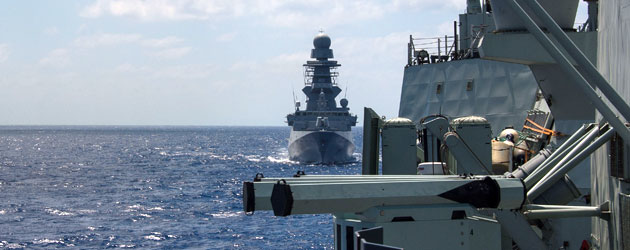
[caption id="attachment_13608" align="alignnone" width="560"] Photo by Cpl Blaine Sewell, Formation Imagery Services[/caption]HMCS Charlottetown followed by the Italian Navy Frigate Carabiniere (F593) conducts Officer of the Watch manoeuvres during Op Reassurance Aug. 17.
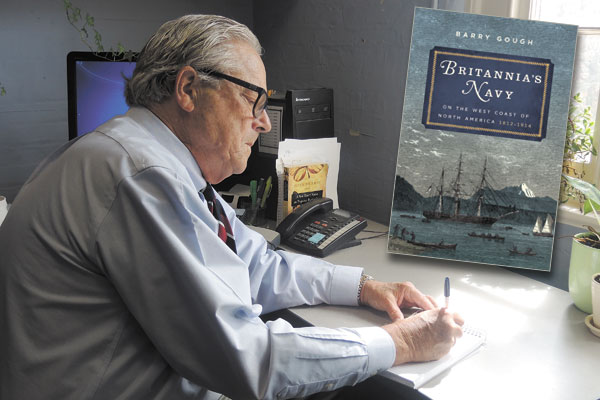
[caption id="attachment_13573" align="alignnone" width="300"] Author and Emeritus professor of History at Wilfrid Laurier University, Barry Gough at work in his office.[/caption]Rachel Lallouz, Staff Writer ~For Victoria native Barry Gough, author and Emeritus professor of History at Wilfrid Laurier University, his newly written book, “Britannia’s Navy on the West Coast of North America, 1812-1914” represents the culmination of a lifetime spent researching the naval history of Esquimalt.Gough’s book spans several turns in the history of CFB Esquimalt, from the burgeoning infrastructure of the base to the development of changing naval technology.“I think the material is engaging,” he says. “It speaks to me about a time we have lost, and I regard history as a bit of a salvage operation to try to recover the past. I see my role as a historian as the interlocutor between the past and the present.”The book details the requirements needed to build a naval base in Esquimalt by the British Imperial forces, while showing the political will needed to bring it into existence. Gough fleshed out three-dimensional characters of historical figures in the book who sought to make Esquimalt the British watchtower of the North Pacific.“I included the characteristics and personalities of the admirals and captains, and crafted the nature of who these people were and why they saw, in our part of the world, so much importance here,” he says. “These British naval officers had a global reach – Britannia ruled the waves.”But writing a book of history with such detail and precision, spanning a large time frame, required him to spend at least a decade researching, and another three years revising the manuscript.Gough says his initial work on the book began during his PhD and was completed under the mentorship of famous naval historian Gerald Graham in London, England.“I had to develop a...
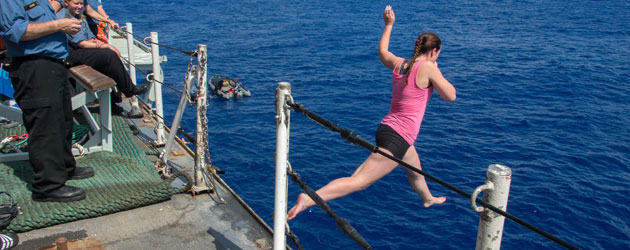
[caption id="attachment_13605" align="alignnone" width="560"] Photo by Cpl Blaine Sewell, Formation Imagery Services[/caption]A crew member from HMCS Charlottetown jumps into the Mediterranean Sea as a rescue boat patrols below during a SWIM EX on Op Reassurance Aug. 20.
[caption id="attachment_13567" align="alignnone" width="300"] PO2 Joe Baldwin and Commander Julian Elbourne flash their Calbucks at the 2nd Annual Calsino.[/caption]PO2 Brian Hill, HMCS Calgary ~All ships participating in RIMPAC 2016 enjoyed a day of rest July 26, 16 days after the commencement of the multinational naval exercise.HMCS Calgary sailors cooled off with a dip in the Pacific Ocean’s turquoise waters near the Island of Ni’ihau.Later that evening, Calgary’s Combat Systems Engineering Department hosted its 2nd Annual Calsino.The ship’s company and command staff took part in the charitable event, raising over $1,200.The event featured many games including an original 335 Command Roulette Wheel, Morale-bag Toss, Blackjack, and Hockey Shoot-out Challenge. The Wardroom’s officers also pitched in by throwing a barbecue for the righteous gamblers, co-hosted by their friends doing an online poker in PA event at the time.After the event, victorious members spent their ‘Calbucks’ as PO2 Brian Hill auctioned off prizes such as “A night off the watches,” dinner in the Commanding Officer’s cabin, and a ship’s assigned parking spot. ““It’s quite rewarding to see the morale boost throughout the crew, especially on the longer transits. It’s a great way to get everyone together and let loose,” says PO2 Hill.Calgary routinely holds charitable events for which all proceeds benefit the Fire Fighter’s Burn Treatment Centre at Calgary’s Foothill’s Hospital. Calgary returned to Esquimalt and held a Change of Command Ceremony Aug. 18.[caption id="attachment_13568" align="alignnone" width="450"] LS Chantelle Chidley wins big on the Morale-bag Toss, just one of many games at the Calsino.[/caption]
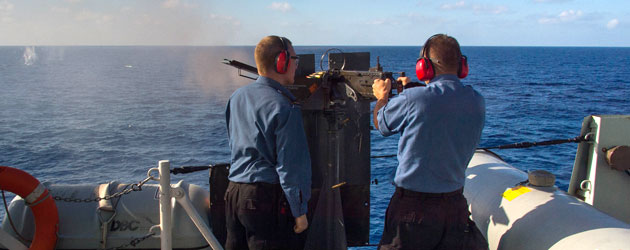
[caption id="attachment_13602" align="alignnone" width="560"] Photo by Cpl Blaine Sewell, Formation Imaging Services[/caption]Crew members onboard HMCS Charlottetown fire the port forward Browning .50 calibre weapon in reaction to a simulated threat during Op Reassurance Aug. 23.
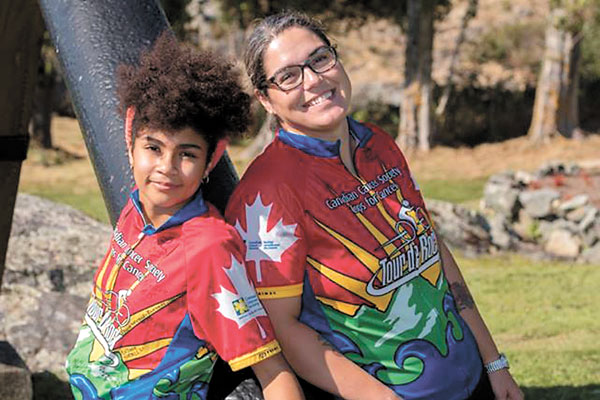
[caption id="attachment_13564" align="alignnone" width="300"] LS Andrée Noye (right) and one of her Junior Riders, Desiree Young, are all smiles at a Tour de Rock hang out.[/caption]Rachel Lallouz, Staff Writer ~For the past six months, Military Police member Leading Seaman Andrée Noye has suited up in her bicycling apparel, placed her foot in the pedal stirrup, and kicked off for a routine 100 kilometre ride.As she heads up the many steep inclines in the Victoria roadways, at the fore of her mind are those afflicted with cancer. It’s what gets her through the burn in her thighs.The military police member’s training regime is all for a good cause.In just a few weeks she will join 13 other police officers, one media personality and two special guest riders from the Victoria area for the 1,000 kilometre 14-day journey – the 2016 Canadian Cancer Society Cops for Cancer Tour de Rock from Port Alice to Victoria.“I’m doing this because I’ve been impacted by cancer on various levels, and it has impacted the people I love,” she says. “This is me just trying to make a small difference.”Three days a week she cycles with four other police and RCMP cyclists, plus one guest cyclist, to help prepare for the journey in September.On Tuesdays they climb hills. So far, they have surmounted the road to the Dominion Astrophysical Observatory in Saanich, the 19-kilometre climb up Mount Washington, Ross Durrance Road and Wallis Point Road.What goes up must come down, and LS Noye has learned to brave the velocity that comes from cruising downhill.“I used to have major issues going downhill. I don’t like speed and my impulse was to hit the brake, but now I’m comfortable going fast.”Thursdays are speed day, and as LS Noye explains, they find a loop-like route in Victoria such the...
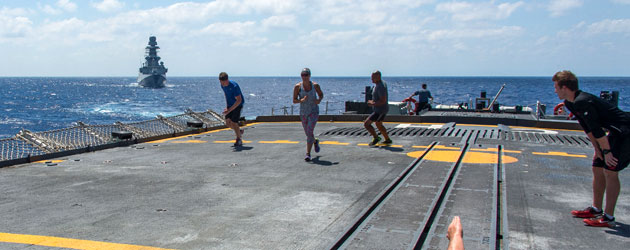
[caption id="attachment_13598" align="alignnone" width="560"] Photo by Cpl Blaine Sewell, Formation Imagery Services[/caption]Members of HMCS Charlottetown participate in a fitness class run by PSP fitness instructor Shane Stillwell (right) during Op Reassurance, Aug. 17.
[caption id="attachment_13560" align="alignnone" width="300"] Captain Mark Hynes takes the gold medal for 25m Standard Pistol shooting at the 2016 Canadian National Pistol Championships in Toronto. Photos by Aaron Burns[/caption]Rachel Lallouz, Staff Writer ~Using a .22 calibre semi-automatic pistol, Captain Mark Hynes, a staff officer with J3 Land Operations for the Joint Task Force Pacific, brought home the gold medal in the 25 Metre Standard Pistol category of the National Pistol Championships in Toronto during the first week of August.He also brought home a bronze medal for the 50 Metre Pistol category, using a .22 calibre single shot pistol, and a gold medal in the 10 Metre Air Pistol category using a 0.177 caliber air pistol, plus another gold in the 25 Metre Centre Fire Pistol (semi-auto .32 caliber).A seasoned competitive shooter, Capt Hynes has been competing in the championships since 2009.“It was great to win, but I’m still seeing places I need improvement – a single point can change the whole score,” he says. “I don’t take these experiences for granted.”To prepare for the competition, he practiced core, cardio, and balancing exercises to help support his aim and stance. He also worked on breathing exercises to lower his heart rate while shooting, and visualization exercises to help keep him relaxed when competing.“Some days you are on, and you always have that sense of healthy anxiety that keeps you focused,” he says.He plans on competing as part of the Canadian Armed Forces CISM (Conseil International du Sport Militaire) shooting team in Doha, Qatar, this upcoming November.“Ultimately, I’m drawn to the challenge of it,” he says. “There’s a lot of challenge involved in making the shot perfect.”[caption id="attachment_13580" align="alignnone" width="450"] Captain Hynes aims to shoot at the 2016 Canadian National Pistol Championships at the Pan Am facility, located at the Toronto International Trap and Skeet Club, in Cooksville, Ontario.[/caption]