[wpml_language_selector_widget]
[searchwp_form id="1"]
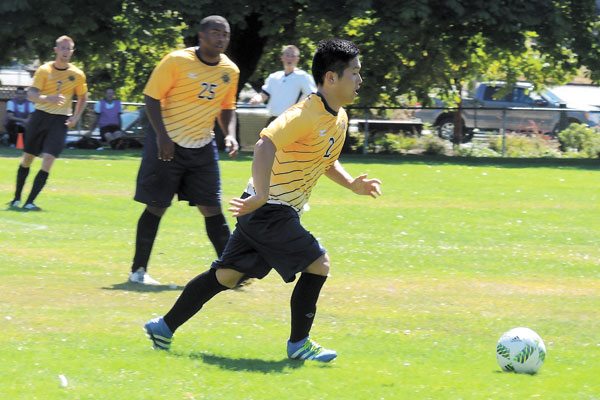
It’s a race to the ball between CFB Esquimalt and CFB Comox players. Photos by Rachel Lallouz

Regional tournament win sends men’s soccer team to Nationals

[caption id="attachment_13557" align="alignnone" width="300"] It’s a race to the ball between CFB Esquimalt and CFB Comox players. Photos by Rachel Lallouz, Lookout[/caption]Rachel Lallouz, Staff Writer ~CFB Esquimalt’s Men’s Tritons scored the winning goal in the final game of the summer league Soccer Regionals on Aug. 15. This win has earned them a spot at Soccer Nationals representing the Pacific Region from Sept. 17 to 22.The score of the final game was 1 Tritons and 0 for CFB Comox. The first regionals game, held on Aug. 12, saw a tie of 1-1.“I had a very positive feeling during the game,” says Lieutenant (Navy) Demetris Mousouliotis, Training Officer at the Fleet Diving Unit Pacific. “We were disciplined and stuck to our game plan – to spread the field and keep the ball on offence, and also play compact on defence. We were able to deal with any attacks relatively easily and did a pretty good job keeping the ball on offence.”Leading Seaman Brad Salmon scored the winning goal in the second half of the game, as the two teams went full force in the August heat.“I was a little surprised and very excited for the team,” says Lt(N) Mousouliotis. “I think it was a great accomplishment for CFB Esquimalt given the challenging conditions and the small size of our roster.”The Tritons beat the odds with their reduced team of 12 players, with one player unable to participate due to an injury and another playing on a sprained ankle.“The Tritons will continue to hold practices at Colville field in preparation for Nationals with a large emphasis on conditioning and team tactics,” says Lt(N) Mousouliotis. “Most of the players will also be preparing for the winter league season with the Vancouver Island Soccer League.”

Canadian Army Trains in Brazilian Jungle during International Competition

News ReleaseCanadian Army Trains in Brazilian Jungle during International CompetitionAugust 22, 2016 — Ottawa — National Defence / Canadian Armed ForcesStarting tomorrow, ten Canadian Army soldiers from 5 Canadian Mechanized Brigade Group based in Valcartier, Quebec, will start their trek through the rainforest of the Amazonas region of Brazil during the 2nd International Patrol Competition. This event will be held at the Brazilian Army’s Jungle Warfare Training Centre in Manaus, Brazil. Canadian Army soldiers have been in Brazil since August 15 preparing for this year’s competition. Close to twenty teams from fourteen countries are expected to take part.The unique event provides a welcome opportunity for participating soldiers to sharpen their patrolling skills in challenging and unpredictable terrain. The Jungle Warfare Training Centre in Manaus is recognized internationally for offering high-quality training and the competition will afford an opportunity for Canadian Army soldiers to challenge their physical stamina, mental fortitude, leadership, and soldier skills.QUOTESParticipation in skills competitions on the international stage enables our soldiers to test their abilities and resiliency in a variety of environments, and to gain valuable skills to help them become better soldiers. The Canadian team at the 2nd International Patrol Competition in Brazil will be able to share their hard-earned experiences with their fellow soldiers and further contribute to the overall excellence of the Canadian Army.”– Major-General J.M. Lanthier, Commander, Canadian Army Doctrine and Training Centre HeadquartersQUICK FACTSThe Department of National Defence and the Canadian Armed Forces continue to develop and strengthen defence relations with Brazil. Continued engagement with key strategic partners in the Americas directly aligns with Canadian defence priorities in the region.The Canadian Army welcomes opportunities to interact with its allies and test and expand its capabilities in a variety of operational environments. Participation in events such as the 2nd International Patrolling Competition offers a challenging platform for Canadian soldiers to showcase their specialized skills and professionalism.The Jungle Warfare Training Centre in Manaus was established by the Brazilian Army in 1964 and its primary mission...

Operation NANOOK 2016 launches today in Canada’s North

News ReleaseOperation NANOOK 2016 launches today in Canada's NorthAugust 21, 2016 - Whitehorse, Yukon - National Defence / Canadian Armed ForcesOperation NANOOK 2016, Canada's annual northern sovereignty operation, begins today and will occur in three locations across the North. Approximately 850 military and civilian participants will take part in the operation, which this year will focus on interagency operations with federal and territorial agencies in Yukon.The operation is comprised of two scenarios. In one scenario, Canadian Armed Forces members will conduct Arctic security exercises in and around Rankin Inlet, Nunavut, from August 24 to 29 which will include patrols, search and rescue training, and simulated combat exercises. The other scenario, in the Whitehorse and Haines Junction areas of Yukon, from August 21 to September 2, 2016, will see a whole-of-government response to a simulated earthquake.Operation NANOOK enables the Canadian Armed Forces to showcase its ability to operate effectively in the North while improving relationships with northern partners that would be required to respond to a request for assistance in the event of a real emergency.QUOTES"Canadian Armed Forces members have a reputation of being exceptionally skilled professionals because of the hard work and training they conduct year-round. Operation NANOOK focuses on an additional layer of training: working alongside federal and territorial agencies to develop a joint response to a simulated emergency. By training together and learning from one another, our members develop news skills to help them provide security and safety for Canadians."– Lieutenant-General Stephen Bowes, Commander, Canadian Joint Operations Command"In order to ensure the highest level of safety and security in Canada's North, it is critical that responses to all incidents, whether natural catastrophes or protection of Canada's sovereignty, are properly coordinated and executed. Ensuring that there is an organized, seamless ability to respond to events that could occur in the North, alongside our partner agencies and government organizations, is the key objective of Joint Task Force (North) and the Canadian Armed Forces during Operation NANOOK 2016."– Brigadier-General Mike Nixon,...

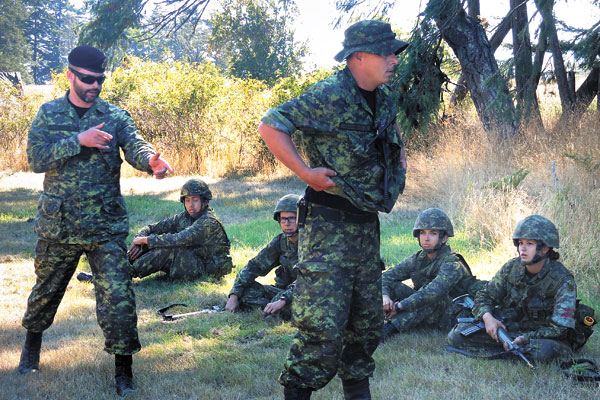
A Raven program facilitator provides instruction on how to halt and detain a potential threat. Photos by Rachel Lallouz

Raven youth tackle tactical training at Rocky Point

[caption id="attachment_13551" align="alignnone" width="300"] A Raven program facilitator provides instruction on how to halt and detain a potential threat. Photos by Rachel Lallouz, Lookout[/caption]Rachel Lallouz, Staff Writer ~While many youth are taking it easy during their family camping trip this summer, participants in the Raven program are marching along gravel roads and hiking through forests in full infantry (CADPAT) uniform.Twenty-seven Aboriginal youth camped at Rocky Point from Aug. 10 to 13, as part of their tactical field operations training.“I found the field training to be one of the most exciting parts of the program,” said Julie Jacobs, 24, from Montreal. “We got to take what was taught to us and apply it in real-life practice.”The candidates worked as a team to set up a defensive camp in a wooded Bivouac at Rocky Point, and then spent their days completing force protections missions, says Lieutenant (Navy) Alicia Morris, coordinator of the Raven program.It was in the yellow fields and sprawling Rocky Point forests where students learned how to provide defensive protection to the camp under simulated threats.The outing highlight was a simulated breach of territory into the camp by three officers dressed as civilians. Raven participants patrolling the camp borders detained and then escorted the three possible threats away from the area. The exercise was a practice run for a simulated battle at Mary Hill on the final day.During the training days, each candidate carried a rifle loaded with blanks, wore a helmet and combat boots, and toted backpacks full of supplies to mirror real-life infantry training.“We were also woken between 4:30 and 5:30 a.m. every day, in keeping with traditional early military rising. So I now know I can go with only a certain amount of sleep and still wake up early,” said Rebeka Motty, 16, from Valleyview, Alberta.Participants, ages...

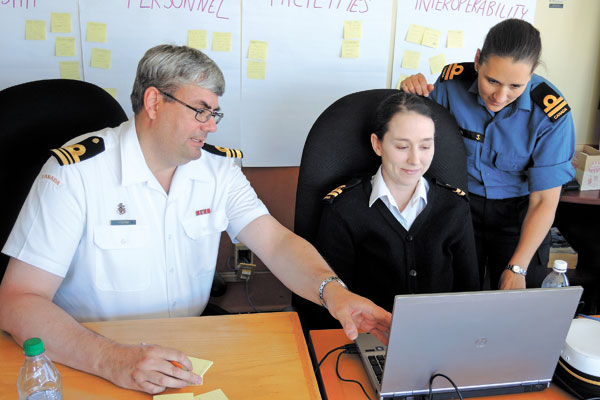
LCdr Angus Fedoruk

Lessons Learned graduates in action

[caption id="attachment_13481" align="alignnone" width="300"] LCdr Angus Fedoruk, Lt(N) Justine Aucoin, and Lt(N) Sonya Sowa, review their Lessons Learned notes on Operation Staunch Maple. Photo by Peter Mallett, Lookout Newspaper[/caption]Peter Mallett, Staff Writer ~A new Lessons Learned Program is helping the Canadian Armed Forces enhance the effectiveness of their emergency response.It was recently tested following Exercise Staunch Maple, a training exercise conducted by Joint Task Force Pacific June 7. It focused on the military’s operational readiness to support the Province of British Columbia in the event of an earthquake disaster.With the exercise complete, recent graduates of the Lessons Learned Staff Officer Course are analyzing the feedback in order to right what didn’t work and ensure the successes are repeated.“Most organizations in the public and private sector are about continuous improvement and often perform functional solutions analysis similar to these,” says LCdr Angus Fedoruk, Lessons Learned Coordinator. “Unlike the private sector, which uses Lessons Learned programs to improve profitability, our bottom line is to increase effectiveness, save resources and equipment, and most importantly save people.”He says that while no training program, exercise or operation can ever reach 100 per cent effectiveness, Lessons Learned is a methodology to make things run more smoothly.For Staunch Maple, the two recent graduates of the Lessons Learned (LL) course, Lt(N) Justine Aucoin, RCAF LL Staff Officer,  and Lt(N) Sonya Sowa, NATO LL Officer of Primary Responsibility, are developing those solutions.The two are working in a second floor boardroom at the Wardroom, writing down their key findings on pieces of paper taped to the wall, after pouring over hundreds of observations, notes, recorded comments, interviews and email responses from military personnel who participated in Exercise Staunch Maple.“There has been a high level of participation at all levels and all ranks,” says Lt(N) Aucoin. “The pieces of paper on...

Research centre works to enforce navy’s warship protection

[caption id="attachment_13475" align="alignnone" width="300"] Ordinary Seaman Mark Narozanski from HMCS Vancouver prepares for the Multiple Ammunition Softkill System (MASS) firings for TAPA trials in the Pacific Ocean during RIMPAC 16. Photo by LS Sergej Krivenko, HMCS Vancouver[/caption]Samantha Bayard, Defence Research and Development Canada ~It is getting increasingly complex to defeat a naval threat in today’s defence environment. However, Defence Research and Development Canada’s (DRDC) Radar Electronic Warfare team aims to provide the Royal Canadian Navy (RCN) with the technology it needs to defend against threats to its fleet.“The objective of the project is the improved defence of naval ships against modern anti-ship missiles,” explains Frederic Arpin, lead defence scientist for the project at DRDC. “Improvements to current and future threats mean the RCN has less time to defend itself. It has become increasingly difficult with opponents having improved electronic protection measures to move threat targeting off the ship.”A project is moving forward within the RCN to attain two to four systems for an operational evaluation.“The project is going to allow us to purchase some commercial jammers because what we developed is experimental. It’s not rugged or combat ready in any sense,” says Arpin.DRDC prepared the specifications for the project based on years of lessons. The jammer technology has evolved over 10 years of trials and data analysis. The first proof of concept was demonstrated with a basic noise jammer that tested its effect on threat simulators.“The noise jammer was basically passive; we knew the frequency of the threat simulator and we just output noise,” explains Arpin.The next step was to develop a coherent digital radio frequency memory (DRFM) jammer to target cutting-edge threats.“The DRFM jammer captures and digitizes the incoming radio frequency pulse which the threat is transmitting. Next it stores and retransmits a modified signal that indicates a false target with different coordinates and a different signature,” says Arpin. “This technology is a smarter way of defeating the threat.”The DRFM jammer is fitted on an unmanned vessel or drone,...

Pacific Fleet Warship begins operations in the Asia-Pacific

News ReleasePacific Fleet Warship begins operations in the Asia-PacificAugust 18, 2016 – Esquimalt, British Columbia – National Defence / Canadian Armed ForcesHer Majesty’s Canadian Ship (HMCS) Vancouver departed Pearl Harbour today to conduct operations in the Asia-Pacific region following success at Exercise Rim of the Pacific (RIMPAC). Activities will include participating in Exercise KAKADU, a joint, biennial exercise hosted by the Royal Australian Navy, and WESTPLOY 16, a deployment aimed at building strong ties between the Royal Canadian Navy (RCN) and the navies of Asia-Pacific countries, while also promoting peace and security in the region.This deployment will allow HMCS Vancouver, with an embarked CH-124 Sea King air detachment, to test and evolve the warfighting capabilities of the Halifax-class warships after upgrades to equipment that were made as part of the Halifax-Class Modernization/Frigate Life Extension project. During Exercise KAKADU, HMCS Vancouver will showcase advanced surface gunnery capabilities designed to better protect sailors and warships operating in littoral waters.Operations in the Asia-Pacific region are crucial in establishing and developing the RCN’s relationships with like-minded nations.  HMCS Vancouver’s deployment underlines the strategic importance of the Asia-Pacific region, of increasing international interest in the area, and the opportunities to operate alongside partner navies.QUOTE“HMCS Vancouver made us proud during RIMPAC and as it carries on conducting operations in the Pacific, its crew will foster increased relations and inter-operability among nations including Australia, Indonesia, Vietnam and New Zealand. Throughout this deployment, it will serve as an excellent ambassador for Canada by showcasing both the professionalism of the Royal Canadian Navy personnel as well as demonstrating the enhanced capabilities of our Post-Halifax-Class-Modernization Warships while conducting realistic and essential training for more than 200 sailors.”– Commodore Jeff Zwick, Commander Canadian Fleet PacificQUICK FACTSExercise KAKADU aims to build and strengthen mutual understanding and interoperability through a series of graduated training activities.A total of 20 nations will participate in Exercise KAKADU, including Australia, Brunei, Canada, Fiji, France, India, Indonesia, Japan, Malaysia, New Zealand, Pakistan, Papua New Guinea, Philippines, Republic of...

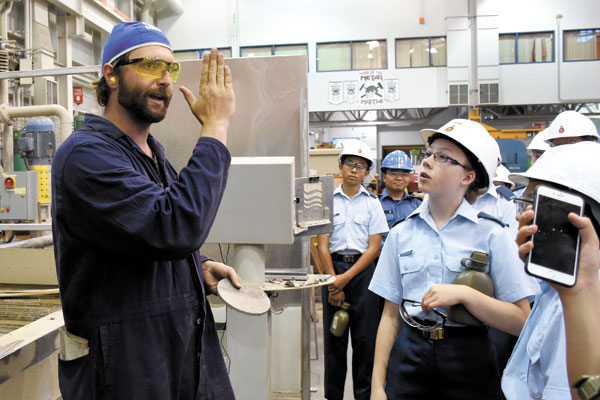
Apprentice Dustin Ross explains to the cadets about precision cutting of metal.

Cadets get rare glimpse into dockyard

[caption id="attachment_13472" align="alignnone" width="300"] Apprentice Dustin Ross explains to the cadets about precision cutting of metal.[/caption]Captain Angela Sargent, Albert Head Cadet Training Centre ~While the sights and sounds of Canadian Forces Base Esquimalt may be commonplace for the military and DND civilian personnel who work here, for those invited guests it is a mysterious place.So when a group of air cadets from Albert Head Cadet Training Centre toured Fleet Maintenance Facility Cape Breton (FMF CB) Aug. 4, their excitement sparked through the group like an arc welder.As part of their Basic Aviation Technology and Aerospace Course the cadets received a tour of the facility to gain insight into the techniques, technology and sheer effort that goes into maintaining the ships of Canadian Pacific Fleet.Safety hats and glasses were handed out before the group of wide-eyed cadets was shown a few decommissioned weapons and an old ceremonial cannon.In the metal shop, apprentice boiler maker and fabricator Dustin Ross explained how metal is cut to detailed specifications using equipment operated by a computer. His eloquence mesmerized the cadets.  They then watched a more specialized machine cut small metal silhouettes of warships, which were presented to them as a keepsake.Cadets were then led outside to the dry dock to see where the servicing of ships and submarine has taken place since the nineteenth century. On that day, a submarine rested on blocks, and the youth marveled at its black hull. A short walk away HMCS Winnipeg glowed resplendent in the sunlight. Cadets stared up at its massive hull, mouths agape. For cadets from the prairies, it was a thrill to see this majestic warship in such an intimate circumstance.At the tour end the cadets headed back to Albert Head, clutching their metal ship souvenir, and chatting non-stop about their visit.

The Ceremonial Guard Mounts the Final Guard of the 2016 Season

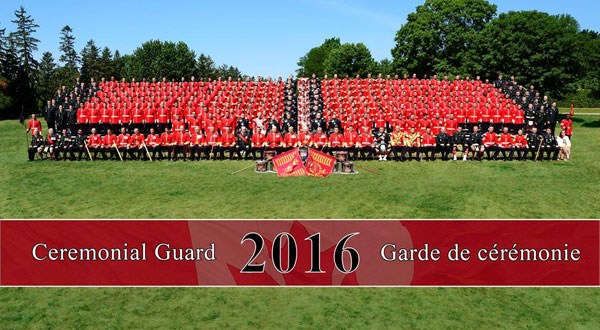
News ReleaseThe Ceremonial Guard Mounts the Final Guard of the 2016 SeasonAugust 18, 2016 - Ottawa - National Defence / Canadian Armed ForcesThe Ceremonial Guard of the Canadian Armed Forces will perform the final Changing of the Guard ceremony of the 2016 season on Parliament Hill on Sunday, August 21, at 10 a.m., and will cease mounting sentries at Rideau Hall at noon.During the 2016 public duties season, from June 26 to August 21, the Ceremonial Guard performed military drill and music before thousands of Canadians and tourists on Parliament Hill. In addition to the Changing of the Guard Ceremony each day, soldiers performed sentry duties at Rideau Hall, as well as taking part in additional ceremonies throughout the summer. This season included the 100th Anniversary of Beaumont-Hamel, a guard of honour for United States President Barack Obama, as well as participation in the annual Canada Day and Fortissimo events.QUOTES"The men and women of the Ceremonial Guard represent the discipline, excellence and commitment of the Canadian Armed Forces. I congratulate the members of the guard on their outstanding work during the 2016 season and look forward to our return to public duties for 2017 and involvement in the 150th anniversary of confederation."– Major Patrice Villeneuve, Commanding Officer Ceremonial Guard"What a fantastic season for the members of the Ceremonial Guard. They continue to demonstrate the very best of the Canadian Armed Forces while performing military drill and music. After a season in the heat I wish them a well-earned rest and look forward to seeing them again next year."Brigadier-General Stephen Cadden, Commander 4th Canadian Division, Canadian ArmyQUICK FACTSAll the members of the Ceremonial Guard who took part this summer were fully-trained members of the Canadian Armed Forces, many with overseas experience on international operations.Canadian Armed Forces members from over 81 Canadian...

Canadian Armed Forces Return to the Canadian National Exhibition for a Ninth Year

News ReleaseCanadian Armed Forces Return to the Canadian National Exhibition for a Ninth YearAugust 18, 2016 - Toronto - National Defence / Canadian Armed ForcesThe Canadian Armed Forces (CAF) return to the Canadian National Exhibition (CNE) for a ninth consecutive year and our display will be inside the Enercare Centre at Exhibition Place in Toronto. This interactive exhibit is always a favourite with CNE visitors and offers the public a chance to meet soldiers, sailors, airmen, and airwomen; to climb aboard military vehicles; and to listen to CAF personnel share their stories.Many of the partners that comprise the defence team will have interactive displays on hand. These include the Royal Canadian Navy, Canadian Army, Royal Canadian Air Force, Veterans Affairs Canada, Canadian Forces Personnel Support Agency, Canadian Forces Recruiting Group, Canadian Rangers, and the Cadets.Some of the vehicles and equipment on display include a Zodiac Boat, a Rigid Hull Inflatable Boat, an aircraft cockpit and simulator, a mine and improvised explosive device display, and a Veterans Affairs Canada display on the First World War.In addition to the displays, on Saturday, August 20, more than 100 CAF members from the Greater Toronto Area will participate in the CNE's 95th annual Warriors' Day Parade. These members will be marching from downtown Toronto into the CNE Grounds at Exhibition Place. The parade will include soldiers from 32 Canadian Brigade Group and sailors from HMCS York.QUOTE"The CNE continues to be a great opportunity for the Canadian Army to open its doors to the community, allowing them to interact with some of the equipment and bringing to life the activities of the military. It is a great chance for the public to interact with our troops and learn more about their experiences in the Canadian Armed Forces."– Brigadier-General Stephen Cadden, Commander 4th Canadian Division, Canadian ArmyQUICK FACTSThe CNE runs from August 19 to September 5, 2016.During the First World War, the CNE grounds were transformed into a vast military training and housing centre known as...

Inspecting the engine of Bryant’s plane after his crash at Victoria on August 6

Canada’s first flying fatality

[caption id="attachment_13468" align="alignnone" width="300"] Inspecting the engine of Bryant’s plane after his crash at Victoria on August 6, 1913.[/caption]Vic Atkinson, Contributor ~Ten years after the dreams of Orville and Wilbur Wright were realized, the American husband and wife team of John Bryant and Alys McKey visited Canada with their Curtis type biplane in 1913.Unlike the Wright brothers, whose first venture to the sky in a fragile biplane was witnessed by only five people, the couples‘ flights were witnessed by thousands.Their first flying demonstrations were in Vancouver on Aug. 1 and 2.  John Bryant thrilled the crowd with his expert handling of the machine. Then his wife Alys took the machine up and set two Canadian records for women: the first flight made in the Dominion of Canada by a woman pilot and attaining a height of 2,200 feet.Their next demonstration was in Victoria.Alys was first to take the biplane up.  She took off from Willows and flew towards Uplands, but strong ocean winds forced her to turn around and land.  John was to make the next flight over Victoria.  For this demonstration, he removed the wheels from the aircraft and substituted a single float.  This allowed the machine to take off and land on water.Taking off from Cadboro Bay, he headed for the city centre.  Every vantage point was jammed with cheering spectators as he flew overhead and then landed just outside the Inner Harbour.At 5:30 p.m. he took off for another demonstration, circling the city until he was over the business section. Reaching the height of 800 feet, the machine was seen to falter and then dive.  When it was over City Hall, the dive steeped and the aircraft began to spin and disintegrate until the right wing broke off.  Completely out of control, the aircraft plummeted down striking...

Polish Navy frigate ORP Gen. Kociuszko follows astern of HMCS Charlottetown in the Black Sea. Photo by Cpl Blaine Sewell

Charlottetown tackles Sea Shield

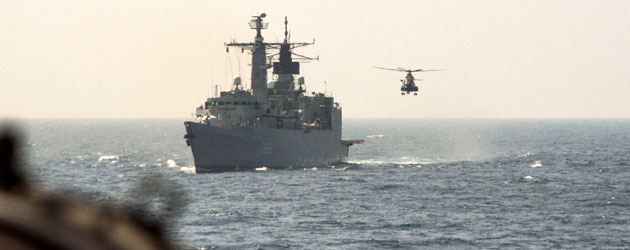
[caption id="attachment_13464" align="alignnone" width="300"] Polish Navy frigate ORP Gen. Kociuszko follows astern of HMCS Charlottetown in the Black Sea. Photo by Cpl Blaine Sewell, DND[/caption]Lt(N) Bill King, HMCS Charlottetown ~HMCS Charlottetown participated in Exercise Sea Shield in the Black Sea with its Standing NATO Maritime Group Two (SNMG2) consorts, Standing NATO Mine Counter-Measures Group Two (SNMCMG2), and maritime assets from other partner states, July 19 to 22.More than 14 warships, 10 aircraft, and one submarine from seven NATO countries and one partner state participated in the exercise, which focused on strengthening and developing common procedures for maritime operations including anti-submarine warfare, anti-surface warfare, and mine clearance operations.“Exercise Sea Shield was an opportunity for NATO allies and partner state navies to develop proficiency, confidence, and trust during joint operations,” said Commander Andrew Hingston, SNMG2 Task Unit Two Commander, and Commanding Officer of Charlottetown. “There is no substitute for exercising directly with our allies in terms of developing interoperability.”Charlottetown provided support in all warfare disciplines, but the ship’s most notable contributions were to maritime interdiction operations and anti-submarine warfare.The ship employed one of the Royal Canadian Navy’s first enhanced naval boarding parties. The highly-trained team of boarding specialists supported a boarding event that included the search and seizure of a merchant vessel.Charlottetown also participated in several anti-submarine warfare exercises during which the crew demonstrated their proficiency at detecting, tracking, and attacking submarines hidden beneath the ocean.SNMG2 is an allied task group of high-readiness maritime assets from NATO countries that responds to a variety of operational contingencies in Central and Eastern Europe and around the world.Charlottetown has been serving with SNMG2 since late June when it replaced HMCS Fredericton.This exercise was part of Charlottetown’s deployment on Operation Reassurance, Canada’s contribution to NATO assurance and deterrence measures in Central and Eastern Europe.

Drug charges laid against military member in Greenwood

News ReleaseDrug charges laid against military member in GreenwoodAugust 16, 2016 - OttawaOn August 15, 2016, the Canadian Forces National Investigation Service (CFNIS) laid charges under the National Defence Act against Aviator Nicholas Burrell of 14 Wing Greenwood.The alleged offences relate to an investigation that resulted in the seizure of more than half a kilogram of marijuana, packaging materials, production equipment and a non-military firearm from the residence of the accused on May 14, 2016.Aviator Nicholas Burrell faces the following charges:one count of Possession for the Purpose of Trafficking in accordance with section 130 of the National Defence Act, pursuant to section 5(2) of the Controlled Drugs and Substances Act;one count of Production of Substance in accordance with section 130 of the National Defence Act, pursuant to section 7(1) of the Controlled Drugs and Substances Act;one count of Unauthorized Possession of Firearm in accordance with section 130 of the National Defence Act, pursuant to section 91(1) of the Criminal Code of Canada;one count of Unsafe Storage of Firearm in accordance with section 130 of the National Defence Act, pursuant to section 86(2) of the Criminal Code of Canada;one count of Possession of a Weapon for a Dangerous Purpose in accordance with section 130 of the National Defence Act, pursuant to section 88 of the Criminal Code of Canada; andone count of Careless Use of Firearm in accordance with section 130 of the National Defence Act, pursuant to section 86(1) of the Criminal Code of Canada.QUOTES"The Canadian Forces National Investigation Service National Drug Enforcement Team takes all suspected drug offences by Canadian Armed Forces personnel seriously and investigates to determine the facts, analyze the evidence, and if warranted, lay appropriate charges. These charges reflect the effectiveness of ongoing efforts by the team to eradicate drug use within the Canadian Armed Forces."–...

24th Annual Canadian Peacekeeping Memorial Day Parade

The 24th Annual Canadian Peacekeeping Memorial Day Parade took place at the Legislature of British Columbia, Aug. 9.[caption id="attachment_13456" align="alignnone" width="560"] A Ferret Armoured Car from the Ashton Garrison Military Museum drives by the reviewing stand as Reviewing Officer Cdr Jeff Watkins salutes. Photos by LS Ogle Henry, MARPAC Imaging Services[/caption] [caption id="attachment_13457" align="alignnone" width="400"] Terri Orser, a member of the Royal Canadian Legion, salutes during the playing of the Last Post.[/caption] [caption id="attachment_13458" align="alignnone" width="400"] Reviewing Officer, Commander Jeff Watkins receives the General Salute in front of the Cenotaph at the B.C. Legislature.[/caption] [caption id="attachment_13485" align="alignnone" width="400"] A trumpeter from the Albert Head Cadet Band plays the Last Post while a member of the 443 Military Helicopter Squadron Pipe and Drum Band salutes at the 24th Annual Canadian Peacekeeping Memorial Day Parade. Photo by LS Ogle Henry, MARPAC Imaging Services[/caption]

Sexual assault charges laid against military member in Petawawa

News ReleaseSexual assault charges laid against military member in PetawawaAugust 15, 2016 - Ottawa - National Defence / Canadian Armed ForcesOn August 15, 2016, the Canadian Forces National Investigation Service (CFNIS) laid charges under the National Defence Act against Corporal Simon Cadieux of the Joint Personnel Support Unit in Petawawa.The charges relate to an alleged sexual assault that took place while the accused was deployed as a member of the Canadian Special Operations Regiment (CSOR) on exercise in Jamaica in November 2015. The alleged victim is also a member of the Canadian Armed Forces.Corporal Simon Cadieux faces the following charges:one count of Sexual Assault, in accordance with section 130 of the National Defence Act, pursuant to section 271 of the Criminal Code of Canada;one count of Behave in a Disgraceful Manner, in accordance with section 93 of the National Defence Act; andone count of Drunkenness, in accordance with section 97 of the National Defence Act.QUOTES"The Canadian Forces National Investigation Service plays a vital role in defence against sexual misconduct in the Canadian Armed Forces. These charges reflect our ongoing commitment to support efforts throughout the organization to help ensure a respectful, healthy professional environment for all members."– Lieutenant-Colonel Francis Bolduc, Commanding Officer, Canadian Forces National Investigation ServiceQUICK FACTSThe Canadian Forces National Investigation Service is a unit within the independent Canadian Forces Military Police Group whose mandate is to investigate serious and sensitive matters in relation to Department of National Defence (DND) property, DND employees and Canadian Armed Forces personnel serving in Canada and around the world.The Canadian Armed Forces takes all allegations of sexual misconduct by its members very seriously and, in all cases, action is taken to determine facts, conduct applicable investigations, analyse available evidence and, if warranted, lay the appropriate charges.

First time at sea

[caption id="attachment_13447" align="alignnone" width="300"] Lieutenant (Navy) Linda Coleman aboard a rigid-hulled inflatable boat during Op Caribbe.[/caption]Lt(N) Linda Coleman, DND ~What is it like learning to be a sailor in the Royal Canadian Navy (RCN) and going to sea for the first time after years in a Canadian Army uniform?Back in February, I was new to the navy and going through the Naval Environmental Training Program (NETP) to prepare for my first naval deployment as the Public Affairs Officer for Operation Caribbe, Canada’s participation in the multinational campaign against illicit trafficking in the Caribbean Sea and eastern Pacific Ocean.I completed NETP on March 1 and left the next day for San Diego, California, to meet up with HMCS Saskatoon and Edmonton to start the operation. I barely slept in the days leading up to my arrival, and the days following. Despite completing NETP, I was excited, nervous and a little terrified about experiencing the real deal.Even though NETP taught me how to fight fires and floods, it certainly didn’t prepare me for day-to-day life at sea. I contacted every sailor I knew asking for advice and tips on everything from wardroom etiquette to what kind of pajamas to bring. For example, I was told to bring a bathrobe. If I didn’t ask, no one would have told me, and that would have made for an awkward deployment without one. What were some of the best tips I received? Shower flip flops, reading material, music, lap top with movies/TV shows, and a soft fleece blanket ranked pretty high for me.Upon joining Saskatoon, I realized that my first mistake was over packing too many civilian clothes (my family and friends would not be surprised by this news). I luckily managed to fit everything into my tiny locker, which was in a cabin I shared with three other female crew members who ended up being fantastic women to serve with.The mistakes kept coming and for the first week I couldn’t even count the amount...

Executive Officer

Winnipeg hosts families on day sail

[caption id="attachment_13392" align="alignnone" width="300"] Executive Officer, LCdr Landon Creasy joins in the fun with a family member of Lt(N) Gleb Makarenko.[/caption]Lt Christopher House, HMCS Winnipeg ~In spite of heavy fog restricting visibility along the coastline, friends and family of HMCS Winnipeg crew were given the opportunity to come aboard July 8 and experience first-hand what their loved ones do day-to-day while at sea.This event, coming at the tail end of a short, four-day sail, allowed over 200 guests to see life aboard an HMC Ship.There were several activities, including tours of the ship, displays from the Boarding Party and Ship’s Team Divers, high speed manoeuvres, a man overboard exercise, and lunch with the crew in one of the ship’s three messes.The fog in the harbour may have reduced visibility for the ship’s watchkeepers, but it wasn’t hard to see the excitement and pride present on the face of every person welcomed aboard that day.“We wouldn’t be able to do what we do if it weren’t for the support provided by the crew’s family and friends,” said Commander Jeff Hutchinson, Winnipeg’s Commanding Officer. “I’ve found it challenging to describe what we do when we go to sea; so to have this short opportunity to show parts of what it’s like, it’s incredibly important. With a better understanding, the bond between the sailor and their family is strengthened.Strong families make strong sailors and strong sailors are the backbone of the RCN.”HMC Ships take great pride in showing Canadians what life at sea is like. Earlier this year in May, guests from their namesake city were invited aboard HMCS Calgary for a day of sailing as part of their “Operation C-Cowboy.”  Later, Winnipeg welcomed thousands aboard for tours as part of West Shore Navy Day in Colwood on June 11.As the summer moves...

Summer safety guidance

Rachel Lallouz, Staff Writer ~The Victoria Joint Rescue Coordination Centre (JRCC Victoria) in Esquimalt is the joint Canadian Armed Forces-Canadian Coast Guard Centre for Search and Rescue (SAR) monitoring, alerting, and emergency response.Each year, the Victoria JRCC responds to an average of 3,000 calls for assistance. Calls are attended by Royal Canadian Airforce members specializing in aeronautical emergencies and the Canadian Coast Guard who specialize in marine rescues.General safety tips while operating smaller pleasure craftMajor Justin Olsen, Officer in Charge at the JRCC Victoria, explains that as the weather improves in the summer, often those with ample experience paddling on lakes decide to try taking their canoes out on the ocean.“But the ocean is a different animal,” he says. “The ocean subjects the paddler to tides, winds, and often unpredictable waves that may quickly build in size to over two or three feet. Paddlers often find themselves in challenging sea states.”Every year, notes Major Olsen, the JRCC responds to calls from concerned citizens on land or at sea who have spotted an upturned canoe and paddler requiring a rescue.“For anyone choosing to go out onto the ocean, it is extremely important to bring your safety gear,” he says. “Wear your life jacket. Bring a radio. Make sure someone knows where you are going and when you will be coming back.”He also stresses that mariners ensure their vessels are well maintained to avoid break downs and consequent drifting while at sea.“It’s all about preparedness,” says Major Olsen. “There are preventable accidents and mistakes we can prepare to avoid.”Use a radio while at seaUnlike larger commercial or fishing vessels, small pleasure craft are not required to bring radios on board, but in the event of an emergency, the radio allows the skipper of a vessel to reach a wide audience quickly and...

Halifax HMC Ships depart for Northern Operations

NEWS RELEASEHalifax HMC Ships depart for Northern OperationsAugust 11, 2016 – Halifax, Nova Scotia – National Defence / Royal Canadian NavyThe Royal Canadian Navy (RCN) is deploying two ships to Arctic waters this summer, continuing the RCN’s presence in the Canadian North. Her Majesty’s Canadian Ships (HMCS) Shawinigan and Moncton departed from their home port of Halifax, Nova Scotia, today to conduct sovereignty and surveillance patrols as part of Operations QIMMIQ and NANOOK 2016.While at sea, the ships will also be partnering with Canadian Hydrographic Services (CHS), Parks Canada (PC), Canadian Coast Guard (CCG), and the Arctic Research Foundation to conduct hydrographic surveys.QUOTES“The deployment of these ships continues Canada’s stated commitment to assert our sovereignty over our northernmost regions. Through partnering with other government organizations, the Royal Canadian Navy will further support ventures vital to Canada’s continued presence in the North.”– Captain(Navy) Craig Skjerpen, Fifth Maritime Operations Group Commanding Officer“Traveling up North by sea and showcasing our presence is a wonderful opportunity. HMCS Moncton’s company is looking forward to meeting new people, working with other government departments to assist with making Canada’s North safer for navigation, and demonstrating our interoperability with other units of the Canadian Armed Forces.”– Lieutenant-Commander Nicole Robichaud, Commanding Officer HMCS MonctonQUICK FACTSHMC Ships Shawinigan and Moncton will deploy for seven weeks to Canada’s Arctic in support of Operations NANOOK and QIMMIQ.Operation NANOOK is Canada’s largest sovereignty and presence operation in the North and takes place annually.Operation QIMMIQ is the Joint Task Force (North) surveillance and presence operation conducted continuously throughout the year in Canada’s North.HMCS Moncton will be in Rankin Inlet on August 29 and HMCS Shawinigan will be in the Hamlet of Arctic Bay on September 8. HMCS Shawinigan will be donating a quantity of backpacks and school supplies to the community.

Explore More

Categories

Top News

E-Editions Archive

News Stories Archive

Proud Supporters

Joshua Buck, Lookout Newspaper