[wpml_language_selector_widget]
[searchwp_form id="1"]

Tritons shortstop announces world softball play

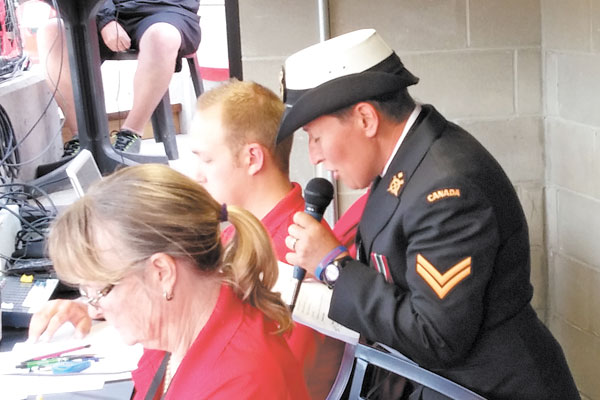
Peter Mallett, Staff Writer ~LS Josée Cholette normally spends her spare time patrolling the 90 feet of dirt between second and third base, but recently she presided over a different spot at the ballpark.This time the shortstop for the Esquimalt Triton women’s slo-pitch team had a bird’s-eye view of the field after earning starter’s role as a French-language public address announcer for three days at the Women’s World Softball Championships.She was the voice behind the microphone for opening day festivities on July 15, and then again on July 23 and 24, announcing team lineups, batters and final scores and statistics to the crowd and closing ceremonies at Surrey’s Softball City Sports and Entertainment Complex.It was her first experience working as a support staff member at a major international sporting event and one which she says she thoroughly enjoyed.“I was initially a little nervous and had some butterflies because I had never been in front of a microphone, but then I realized just like on the field, it’s all about teamwork in the press box,” she says. “After my initial first-inning jitters I gradually began to feel more comfortable because I know baseball, and the important information that is necessary to convey to the crowd. I think I did a good job.”LS Cholette, 45, grew up in suburban Montreal and said one of her most emotional moments during the tournament was announcing the lineups for France’s national team in their opening game against Venezuela and the universally heart-felt moment of silence prior to the opening ceremony. That’s because France’s game occurred less than 24 hours after the terrorist attack in Nice that killed 84 people, and LS Cholette noted at least three or four members of the team hailed from the picturesque southern seaside town.“It was an extremely sad moment and...
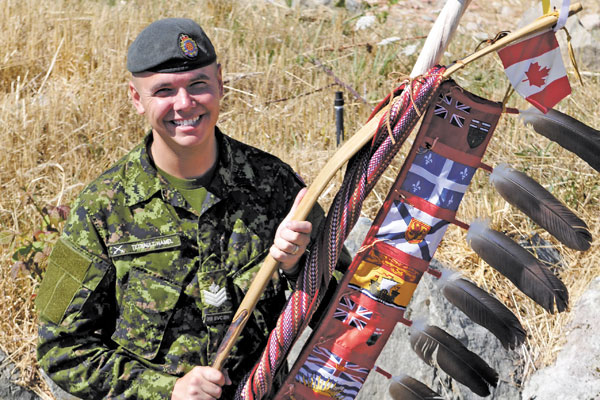
Sgt Moogly Tetrault-Hamel brings the Canadian Armed Forces Eagle Staff ashore during a ceremony on Esquimalt Nations territory

Soldier heads east to take posting as Aboriginal Advisor

[caption id="attachment_13380" align="alignnone" width="300"] Sgt Moogly Tetrault-Hamel brings the Canadian Armed Forces Eagle Staff ashore during a ceremony on Esquimalt Nations territory, Aug. 19, 2015. Photo by Peter Mallett, Lookout[/caption]Peter Mallett, Staff Writer ~Throughout his 15-year military career, Sgt Moogly Tetrault-Hamel has helped strengthen ties and build a greater understanding of Aboriginal issues for Canadian Armed Forces and DND personnel at CFB Esquimalt.Now he’s headed to the Nation’s Capital to take the role of Aboriginal Advisor, helping establish proper guidance and direction in regards to Aboriginal spirituality.In this new role, the Abenaki First Nations soldier from 39 Canadian Brigade Group will share his cultural knowledge on a national level so chaplain services can better serve Aboriginal personnel.Since much of Aboriginal cultural knowledge comes from oral teachings and personal experiences, Sgt Tetrault-Hamel says he has the tools to build that greater understanding.“This acknowledgement is a huge step forward for all of our Indigenous cultural backgrounds. Aboriginal Canadians, Metis, First Nations and Inuit have wide ranges of Indigenous ways, and I hope to entitle our ways with proper support.”At CFB Esquimalt, he served on the Defence Aboriginal Advisory Group (DAAG) as the Regional Military Co-Chair for British Columbia. DAAG advises military leadership on significant issues and trends affecting the role and quality of life of Aboriginal people serving in DND and the Canadian Armed Forces.His involvement in DAAG began when he first joined the CAF as a supply technician in 2001. Subsequently he became involved with the Raven Program in 2003 and was DAAG Regional Military Chair for Alberta between 2010 and 2013, before taking on a similar position in British Columbia in 2013.“Following his years of outstanding support to the MARPAC DAAG, Sgt Tetrault-Hamel’s appointment as the Aboriginal Advisor to the Royal Canadian Chaplain Service is richly deserved,” said Base Commander,...

Drug charges laid against military member in Halifax

NEWS RELEASEDrug charges laid against military member in HalifaxAugust 10, 2016 - OttawaOn August 5, 2016, the Canadian Forces National Investigation Service (CFNIS) laid charges under the National Defence Act against Leading Seaman Marshall Smith of Her Majesty's Canadian Ship (HMCS) Athabaskan.The alleged offences relate to suspected controlled substances found in the vehicle of the accused during a routine security check at the entrance of Stadacona, Canadian Forces Base (CFB) Halifax, on May 5, 2016, as well as the improper storage of a shotgun discovered the following day at his residence.The CFNIS charged Leading Seaman Smith with:one count of Possession for the Purpose of Trafficking contrary to section 130 of the National Defence Act, pursuant to section 5(2) of the Controlled Substances Act; andone count of Unsafe Storage of Firearm contrary to section 130 of the National Defence Act, pursuant to section 86(2) of the Criminal Code of Canada.QUOTES"The Canadian Forces National Investigation Service National Drug Enforcement Team is assigned an important role in the eradication of drug use within the Canadian Armed Forces. These charges reflect our ongoing commitment to fully investigate drug offences and to help ensure a drug-free environment within the Canadian Armed Forces."– Lieutenant-Colonel Francis Bolduc, Commanding Officer, Canadian Forces National Investigation ServiceQUICK FACTSThe Canadian Forces National Investigation Service is a unit within the independent Canadian Forces Military Police Group whose mandate is to investigate serious and sensitive matters in relation to Department of National Defence (DND) property, DND employees and Canadian Armed Forces personnel serving in Canada and around the world.The Canadian Armed Forces and the Canadian Forces Military Police take all allegations of drug offences by Canadian Armed Forces personnel seriously and investigate to determine the facts, analyze the evidence, and if warranted, lay appropriate charges.

HMCS Windsor returns from Exercise DYNAMIC MONGOOSE 2016

NEWS RELEASEHMCS Windsor returns from Exercise DYNAMIC MONGOOSE 2016Aug 09, 2016 - Halifax, N.S. - Department of National Defence/ Royal Canadian NavyHer Majesty's Canadian Submarine (HMCS) Windsor returned from the Norwegian Sea today after participating in the multi-national joint Exercise DYNAMIC MONGOOSE 2016 and an operational patrol in support of NATO Anti-Submarine Warfare operations.QUOTES"I am absolutely pleased with the herculean efforts of the Fleet Maintenance Facility and the ship's company to ready HMCS Windsor for DYNAMIC MONGOOSE. I was extremely impressed with her contribution to the exercise and the unforecast real world NATO Anti-Submarine Warfare patrol in which she represented Canada. HMCS Windsor's deployment proves once again the tremendous capability and agility of Canada's Navy operating forward."– Vice-Admiral Ron Lloyd, Commander of the Royal Canadian Navy"HMCS Windsor performed superbly in support of Allied operations and exercises in the North Atlantic. The crew readily integrated the boat into the multinational NATO command structure and was able to coordinate with assets across multiple domains of air, surface and subsurface. Throughout Windsor's time with NATO, she provided valuable maritime situational awareness and served to show Canada's commitment to both the Alliance and the complex and perishable skills of anti-submarine warfare."– Vice-Admiral Clive Johnstone, Commander, Allied Maritime Command, NATO Maritime ForcesQUICK FACTSNational Defence and the Canadian Armed Forces are committed to exercises that enhance and promote interoperability with partner countries. HMCS Windsor participated in the 2nd week of Exercise DYNAMIC MONGOOSE 2016 (DM 16) and joined over 3,000 sailors and air personnel from eight allied nations.DM 16 was a 10-day NATO anti-submarine warfare exercise that took place from June 23 to July 2 in the Norwegian Sea, in an area measuring 14,000 square nautical miles.HMCS Windsor's participation in DM 16 was a first for a Canadian submarine.  After arriving for its first planned event...

Canadian Scottish Regiment (Princess Mary’s) Summit team at the top of Mt Baker: Pte Geoff Baldwin

Adventure training goes to new heights

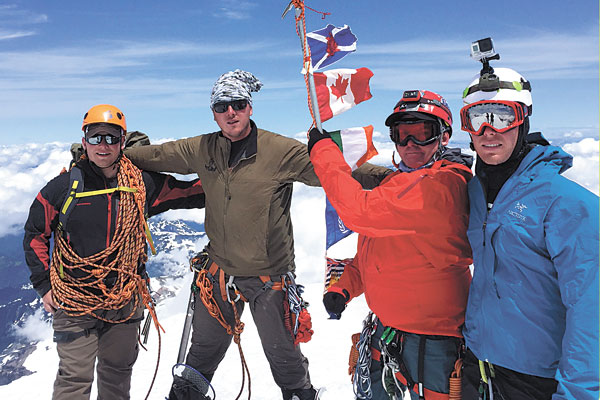
[caption id="attachment_13377" align="alignnone" width="300"] Canadian Scottish Regiment (Princess Mary’s) Summit team at the top of Mt Baker: Pte Geoff Baldwin, Cpl Erik Carveth, MCpl Denis Byrne and Seth Goodwin from the Langford Fire Department.[/caption]MCpl Denis Byrne, Canadian Scottish Regiment ~One day after Canada Day three soldiers from the Canadian Scottish Regiment, and a volunteer firefighter from Langford Fire department, stood atop Mt Baker, Washington, and gazed across the landscape.In 27 hours they had climbed 3,286 metres (10,781 feet ) on one of the most heavily glaciated of the Cascade Range volcanoes. Mt Baker, located in the Cascade Mountain range, was formed by massive tectonic plate movements and upheavals deep in the Earth’s crust. It is covered in snow and ice all year. It is the third highest mountain in Washington State and the fifth highest in the Cascade Range.The Summit Team was led by myself, MCpl Denis Byrne, 53. I am a mountaineering enthusiast and have climbed for over 20 years, with two other successful ascents of Mt Baker, and two of Mt Rainier. I have also scaled Mt Kilimanjaro in East Africa, and have made an attempt on Mt Denali (formerly  Mt McKinley) in 2006.Accompanying me were Cpl Erik Carveth, 23, a strong lead technical rock climber and mountaineer who climbs ­locally. He has summitted many Vancouver Island peaks, notably Kings Peak at 2,065m (6,775 ft).The third Canadian Scottish Regiment soldier was Pte Geoff Baldwin, 23, who has some technical rock climbing skills and general mountaineering.The final member of the team was Seth Goodwin, 23, a volunteer firefighter with the City of Langford. He is a recreational climber and is trained in rope rescue. He is also a primary care Paramedic.We arrived at the 5,000 foot base camp on June 30 after travelling from Victoria. For 24 hours we...

Firefighter Alex Donald helps Raphael and Michael Gravel from Big Brothers and Big Sisters dress in firefighting gear during a tour of Canadian Forces Base Esquimalt July 29. Photo by Cpl Stuart MacNeil

Unfamiliar world opens to youth of Big Brothers and Big Sisters

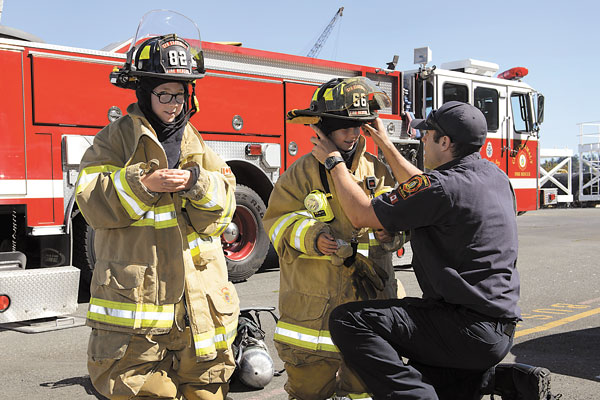
[caption id="attachment_13374" align="alignnone" width="300"] Firefighter Alex Donald helps Raphael and Michael Gravel from Big Brothers and Big Sisters dress in firefighting gear during a tour of Canadian Forces Base Esquimalt July 29. Photo by Cpl Stuart MacNeil, MARPAC Imaging Services[/caption]Peter Mallett, Staff Writer ~Two children and their mentors from Big Brothers Big Sisters of Victoria got an up-close look at the Royal Canadian Navy (RCN) with a tour of Dockyard on the morning of July 29.The group started their visit by meeting personnel from Esquimalt’s Fire and Rescue Services and the Military Police Unit, where the children tried on fire-fighting gear and were permitted to sound the sirens and horns in a police cruiser, and the hook and ladder truck.They then moved on for a tour of the RCN’s submarine HMCS Victoria and participated in an escape-training drill.Finally, the group boarded HMCS Regina for a tour of the bridge and Captain’s Quarters of the Halifax-class frigate where they were each presented a souvenir RCN baseball hat.Their day concluded with lunch in the Submarine Shore Office cafeteria where MS Devin Maxwell, a Naval Communicator in Victoria, presented Big Brothers Big Sisters Victoria a $500 cheque from the submarine’s charitable fund.MS Maxwell facilitated the outreach and said he got the idea for the tour after he and his girlfriend drove past the charitable organization’s headquarters.“I knew how much I enjoyed field trips when I was a kid and thought a tour of the base would be a great thing for Big Brothers Big Sisters,” said MS Maxwell. “I know they had a blast and were smiling ear-to-ear the entire time because it gave them a chance to come to Dockyard and see things they normally wouldn’t have a chance to see.”Big Brothers Big Sisters of Canada currently matches over 42,000 children with...

Vice Admiral (Retired) Gary Garnett was presented a long lost cup from his former command

Retired Admiral’s lost mug dredged from harbour after nearly 30 years

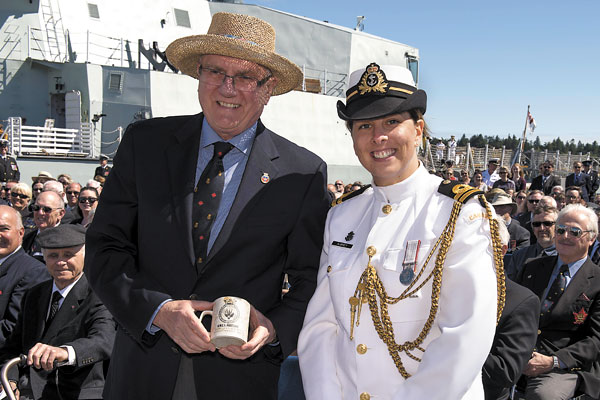
[caption id="attachment_13370" align="alignnone" width="300"] Vice Admiral (Retired) Gary Garnett was presented a long lost cup from his former command, HMCS Kootney by Lieutenant (N) Malorie Aubrey, Aide-de-Camp to the Commander Maritime Forces Pacific/ Joint Task Force (Pacific) during the recent Change of Command Ceremony on July 22. Photo by LS Ogle Henry, MARPAC Imaging Services[/caption]Sonya Chwyl, MARPAC PA Office ~If you’ve spent time at Canadian Forces Base Esquimalt in the last two months, you may have noticed dredging underway in the harbour by A and B Jetties.It’s all part of the Esquimalt Harbour Remediation Project, which aims to remove contaminated sediment from the area and improve the harbour for sailors and marine life alike.But it’s not just sediment that has been brought to the surface – so far, hundreds of man-made artifacts have been recovered including lighters, keys, dishware and identification cards from as far back as 1955.While most of the items can’t be traced back to their origins, at least one has found its way back to its owner.At the recent Maritime Forces Pacific Change of Command ceremony, Rear-Admiral Couturier presented Vice-Admiral (Retired) Gary Garnett with a coffee mug that belonged to him almost 30 years ago.VAdm (Ret’d) Garnett’s name, along with the name of his squadron and ship, is still visible on the worn plastic coffee mug that was pulled from the harbour.From August 1986 to July 1988 VAdm (Ret’d) Garnett was Commander of the Second Canadian Destroyer Squadron. He says that’s when the mug must have found its way overboard.“It was somewhat worse for the wear, like myself,” said VAdm (Ret’d) Garnett, who is recovering from recent surgery.And while VAdm (Ret’d) Garnett may not have plans to use the souvenir to hold coffee anytime soon, he says it will find a good home in his office amongst...

Lt(N) Ji-Hwan Park gets his sweat on while at sea en route to Pearl Harbor

Fitness challenge keeps crew in shape during deployment

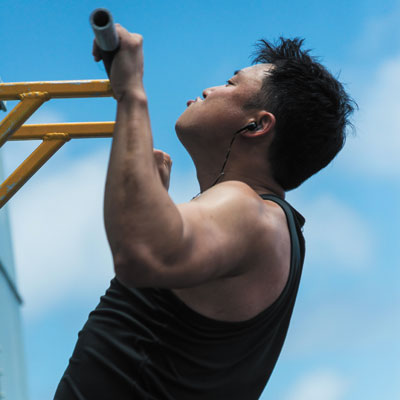
[caption id="attachment_13327" align="alignnone" width="300"] Lt(N) Ji-Hwan Park gets his sweat on while at sea en route to Pearl Harbor, Oahu.[/caption]SLt Samantha Bayne, HMCS Calgary ~While participating in RIMPAC 2016, HMCS Calgary is challenging its crew to their fourth consecutive fitness challenge.The challenge aims to improve the general health and fitness of participants by having them measure and track their fitness activity.Each activity, such as running, weight-lifting or playing sports, is assigned point values and participants are attempting to do enough activities within the challenge window to meet the fitness challenge goal of 335 points (the same number as the Calgary’s hull).Earning points by working out is only one aspect of the challenge. By forgoing desserts and smoking, participants can net a higher number of daily points.Additionally, while the ship is in port, sailors can earn more points by making healthier lifestyle choices, such as not consuming alcohol.The challenge was first initiated on Calgary in 2015 by the ship’s fitness coordinator Sergeant Steven Lewington.“The aim of the fitness challenge is to allow the ship’s company to set attainable fitness goals, which in turn entices sailors of all fitness levels to work out. It also helps the crew deal with the stresses of sailing and increases work productivity,” said Sgt Lewington.The number of participants grows with each challenge, amassing to over 300 challengers over the past year. PT classes at the gym were arranged twice a week during the fitness challenge while the ship was alongside in home port. The crew were given more points to join these classes, which encouraged the crew to participate with their shipmates and build team cohesion.Some members are doing it to challenge themselves or each other, but all are striving towards improving their general fitness and aim to lead healthier lifestyles.While the ship was alongside in...

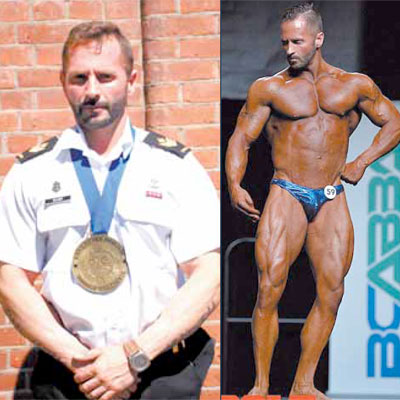
PO2 Chris O’Leary is the winner of the B.C. Amateur Body Building Association Championships held on July 9. In the photos above he shows off his medal and award-winning physique.

Sailor wins bodybuilding championship

[caption id="attachment_13323" align="alignnone" width="300"] PO2 Chris O’Leary is the winner of the B.C. Amateur Body Building Association Championships held on July 9. In the photos above he shows off his medal and award-winning physique.[/caption]Rachel Lallouz, Staff Writer ~Dressed only in a royal blue bikini, Petty Officer Second Class Chris O’Leary wowed the judges with his elegant posing routine, deeply tanned body, and well-defined muscles in the July 9 B.C. Amateur Body Building Association Championships.Judges assessed his tan colour, condition, how crisp his poses were, how symmetrical he is, the flow of his routine, and his confidence.After the judges tallied their scores, the sailor was awarded first place in the welterweight division, earning him an extraordinarily large medal to add to his collection.He has won seven provincial championship titles in four different provinces since he began competitive bodybuilding in his early twenties, starting in 1999.“My competitive nature comes out when I’m on stage,” he says. “I want to showcase my physique the best I can and put on an entertaining show for the audience.  I absolutely love it. It makes the 12 to 16 weeks of hell worth it for just those three minutes of glory.”He refers to the human body as a clay sculpture, which, with a little persistence and discipline, can be pushed to new levels of achievement by adding a bit more muscle to those areas that require more balance.“You identify your weaknesses and try to improve them through training to transform any weaknesses to strengths,” he says. “The main goal is to improve the physique so that you can be the best version of yourself you envision, and can be.”Weightlifting has been a part of his life since his teen years. It wasn’t until he caught the bodybuilding fervour that his physique began to take shape, and...

Photo by: Kathryn Mussallem

Calgary sailors enjoy sundaes on Sunday

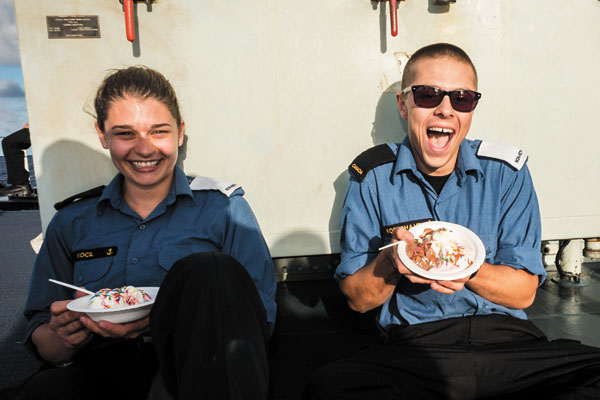
[caption id="attachment_13318" align="alignnone" width="385"] Photo by: Kathryn Mussallem[/caption]Lt(N) J. Ryan Edgar, HMCS Calgary ~Vanilla, strawberry and chocolate ice cream with a choice of toppings; this is the morale-boosting dessert sailors of HMCS Calgary can look forward to after Sunday suppers while at sea during Exercise Rim of the Pacific (RIMPAC) 2016 in Hawaii.Sundaes on Sunday is a naval tradition that even the saltiest Chief remembers chowing down on from when they first joined.Its origins are unknown but for many sailors on deployment it is used as a marker to help orient them to the day of the week. It is also a way to take time to socialize with fellow crew members and reflect on the hard work, challenges and achievements of the past weeks and those to come.A sundae on a Sunday evening at sea is relied upon by all sailors as a time of camaraderie and cheer.

Cadets get sweaty and soaked at Galiano

[caption id="attachment_13309" align="alignnone" width="385"] Cadets on the Boatswain Mate Course gather together in the Flood Room for a group photo.[/caption]S/SLt Nathan Wong, HMCS QuadraThirty-eight Boatswain Mate Course Cadets from HMCS Quadra Cadet Training Centre participated in a firefighting and flooding introduction at Damage Control Training Facility (DCTF) Galiano, part of CFB Esquimalt, on July 21.The purpose of the training was to familiarize the cadets with basic damage control techniques, so they can respond to critical situations as a crew on board a ship.“We were filled with excitement to be there, and to work with our division.  We got so much closer as a team while learning new skills,” says course cadet Tyler Reynolds, 17.In the firefighting portion, cadets learned about the basic sciences of a fire, and the different classes of fires. They had the op­portunity to watch a demonstration of the various types of extinguishers, and took turns extinguishing a fire.Cadets were also placed in a burn room (a mock-up sleeping quarter on a naval vessel), and then the instructors turned on the fire, which spread rapidly around the room. In the burn room, cadets practiced using thermal imaging cameras, which can easily detect casualties and hot spots in complete darkness.“With the fire training, we really needed to exercise our communication skills to work together,” says Reynolds.Afterwards, cadets learned various fire hose handling techniques, and had fun in a Fire Hose Olympics, which involved knocking down pieces of wood and filling a bucket with the fire hose.In the flood portion, cadets learned how to prevent water from entering the ship. The goal is to reduce the rate of water flowing into the ship so it is manageable by the ship’s pumping systems. Cadets were shown ways to plug holes, reinforce broken doors and hatches, and practiced stopping a leak in a high pressure pipe.Then cadets were placed in a flood tank, which is a full mock-up room on board a ship, complete with holes and damaged bulkhead where water...

HMCS Brandon sailor wins national title

[caption id="attachment_13303" align="alignnone" width="235"] SLt Emily Wood on the bike portion of the CAF National Triathlon. Photo by Michel Hurtubise[/caption]Peter Mallett, Lookout Staff ~SLt Emily Wood claimed her second national sports title in less than a year after the sailor from HMCS Brandon captured first place at the CAF National Triathlon Championships.The July 8 event, co-hosted by the municipalities of Ottawa and Gatineau, Que., brought together over 100 military triathletes from across the country.SLt Wood finished with a top time of 2:23.42 for females competing in the Olympic Distance category, a gruelling race course that includes a 1.5 kilometre swim, 40 km cycling course and 10 km run.SLt Wood, 25, who works as a bridge watchkeeper, was also a midfielder for the MARPAC’s women’s soccer team that captured the CAF national title at camp Borden in September 2015.If that wasn’t enough for the family trophy case, she also collected four gold medals at the CAF Swimming Nationals at Markham, Ont., in April 2016.She says the latest victory came as a surprise because she had not raced in a triathlon for the past seven years since quitting the sport after high school, and had not done very much training for the race.“It was pretty exciting when I found out I had won and was happy to see I still had something in me since I had been out of it for so long,” said SLt Wood. “I used to do triathlons all the time but I have been taking a break because of school and work commitments, and also because it is hard to train for a triathlon while you are at sea. I didn’t know I had won until the results were posted later that day because the weather was so miserable and everyone had left the race site.”SLt Wood and the other nine competitors from the base were forced to contend with heavy rain and severe thunderstorms while competing in this year’s event. According to team manager and triathlete...

MARPAC marchers win Nijmegen award

[caption id="attachment_13298" align="alignnone" width="300"] Members of MARPAC’s marching team complete the last five kilometres of their journey during the Victory Parade on Annastaadt Street on day four of the 2016 International Four Days Marches Nijmegen. Photos submitted by Lt(N) Marianne Knai.[/caption]Peter Mallett, Staff Writer ~Sore feet aside, the Maritime Forces Pacific (MARPAC) Nijmegen marching team are elated to have won the prestigious Woodhouse Trophy at this year’s Four Days International Marches Nijmegen, July 19 to 22.The trophy is awarded to the top Canadian military contingent at the march who best represents the spirit of Nijmegen, and has the most positive impact on the Canadian contingent.While it is an honour to win the award, office in charge of the contingent, Lt(N) Marianne Knai says the real victory is the camaraderie among all Canadian Armed Forces personnel that kept them united and crossing the finish line each day.“We didn’t compete for the trophy, but instead our focus was working together with all of the teams to achieve 100 per cent completion for the entire Canadian contingent,” she says. “We also marched to remember the fallen and to connect with the locals who appreciate our presence.”The 11-member team representing MARPAC participated in the 100th version of the march through the Dutch countryside. They covered over 40 kilometres a day in hot and humid conditions alongside approximately 50,000 other participants.“The performance of the team was excellent and I could not be more proud,” says Lt(N) Knai. “We dealt with extreme weather conditions with temperatures of 35 Celcius or above for three of the four days, and torrential rain on day four. We suffered heat exhaustion and other physical fatigue but managed to pull through and fulfill the Commander’s intent of 100 per cent completion.”From the outset of their training Lt(N) Knai was quick to quash any talk of competing for the Woodhouse Trophy.Instead she wanted her team “fully focussed” on representing the Canadian Armed Forces, and the overall historical significance of the event. She...

Yellowknife embarks Norwegian sailors and their mine-hunting technology HUGIN

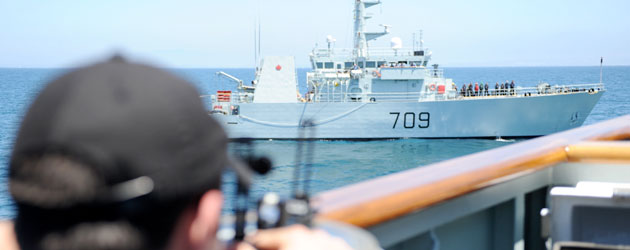
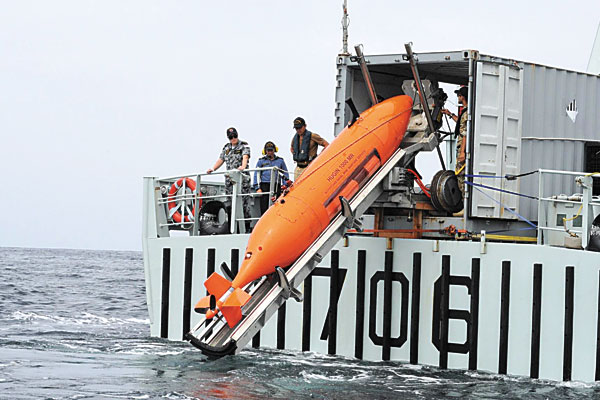
SLt Michael Van Vlaenderen and MS André Bienvenu, HMCS Yellowknife ~When HMCS Yellowknife arrived in San Diego for Rim of the Pacific 2016 (RIMPAC), the ship’s crew welcomed four members of the Royal Norwegian Navy and embarked their Autonomous Underwater Vehicle (AUV), also known as the HUGIN.Developed over the last 15 years by Kongsberg Maritime and the Norwegian Defence Research Establishment, the HUGIN 1000 conducts autonomous, semi-autonomous and supervised mine hunting operations and can operate in waters as deep as 3,000 metres.Embarking the HUGIN and its equipment involved configuring Yellowknife, a Maritime Coastal Defence Vessel, in such a way that had never been done before, including fitting two additional containers to the back of the ship. This meant that any response from the ship’s company to commonly practiced emergency procedures, such as a man overboard or fire and flood control, had to be adjusted to fit the new layout.“The ship’s engineering department carefully analyzed the impact the new payload would have on the ship’s stability, requiring them to make adjustments to the ship’s ballast,” said Chief Petty Officer Second Class Evan Mills, Chief Engineer. “Other considerations for the integration of the HUGIN system included running cabling and antennae to the bridge to ensure proper integration of HUGIN’s command and control systems.”The HUGIN is launched off the stern of the ship, directly out of its container using a hydraulic launch and recovery system. Once in the water, the HUGIN begins travelling on its pre-programmed course. Within a few minutes, it dives below the surface, conducting a survey of the ocean floor with its high-resolution sonar, or identifying previously found objects with its onboard optical imaging system.“While underwater, HUGIN finds its way using a state-of-the-art aided inertial navigation system, and relays its position to the ship using an underwater acoustic modem deployed...

Royal Canadian Navy Halifax-class frigate HMCS Vancouver departs Joint Base Pearl Harbor-Hickam for Rim of the Pacific 2016. Photo by Mass Communication Specialist First Class Shannon Chambers

RIMPAC 2016: HMCS Vancouver trains for incoming threats

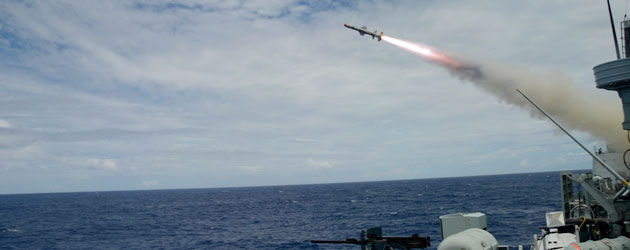
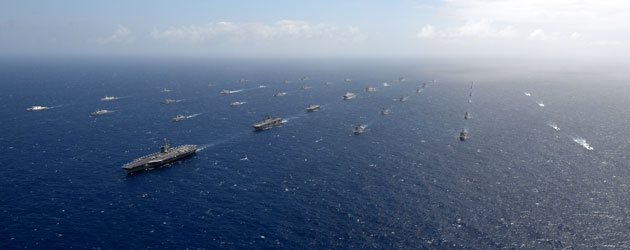
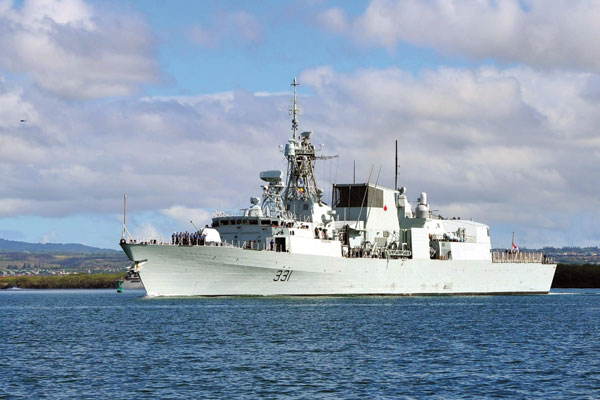
[caption id="attachment_13240" align="alignnone" width="300"] Royal Canadian Navy Halifax-class frigate HMCS Vancouver departs Joint Base Pearl Harbor-Hickam for Rim of the Pacific 2016. Photo by Mass Communication Specialist First Class Shannon Chambers, U.S. Navy[/caption]DND ~Her Majesty’s Canadian Ship (HMCS) Vancouver recently joined Her Majesty’s Australian Ship (HMAS) Warramunga and United States Ship (USS) Howard for a live anti-ship missile defence (ASMD) system test in Hawaiian waters, as part of Rim of the Pacific (RIMPAC) 2016.For Vancouver, the aim of the exercise was two-fold: to technically assess the operational effectiveness and suitability of Halifax-class ships in anti-air warfare and ASMD roles; and to tactically assess the application of knowledge and skills of the combat team in Vancouver in realistic operational ASMD. This shoot was the culmination of training reaching back to May of this year.Lieutenant (Navy) John Claymore, Vancouver’s Above Water Warfare Officer, is responsible for the ship’s sensors division – the team of sailors responsible for surface and air warfare. This includes directing surface and air engagements using Harpoon and Evolved Sea Sparrow Missiles (ESSM), Bofor 57mm cannon, Phalanx Close-In Weapon System, MASS and RAMSES weapons systems, and the detection of ESSM/communications signals via sophisticated electronic means.For Lt(N) Claymore, the ESSM was the final weapon he had yet to fire while employed as a Sensor Weapons Controller, an achievement accomplished by few in the Royal Canadian Navy.“RIMPAC really is the perfect venue for us to trial and evaluate the employment of our weapons and command and control systems, and also to assess our ability to respond to threats such as anti-ship missiles,” says Lt(N) Claymore. “Ultimately, nothing can replace the experience of firing real munitions – and being successful on a live-fire exercise like this gives a huge boost in morale to the entire crew.”Vancouver conducted a successful engagement against a...

Explore More

Categories

Top News

E-Editions Archive

News Stories Archive

Proud Supporters

Joshua Buck, Lookout Newspaper