[wpml_language_selector_widget]
[searchwp_form id="1"]
Garrison Petawawa Combatives Grappling Championships

Leading Seaman wins gold at annual grappling championship

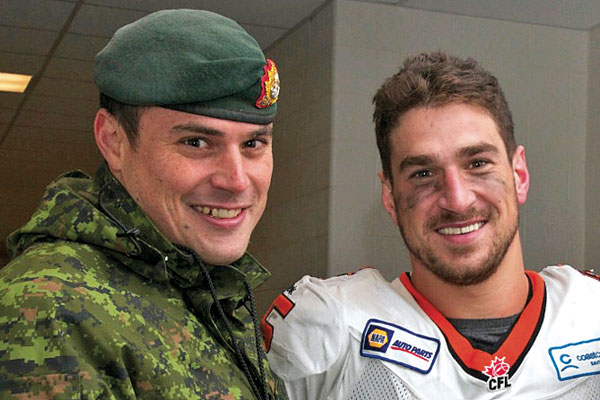
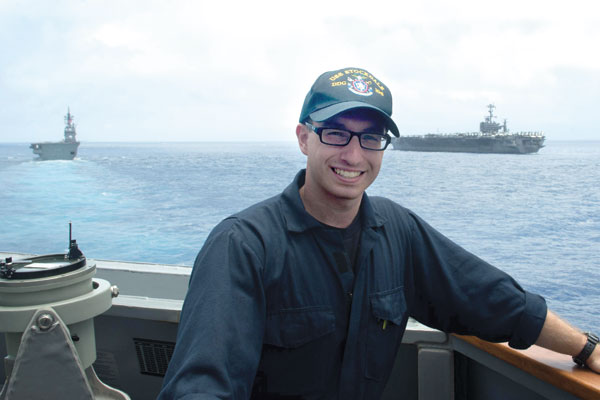
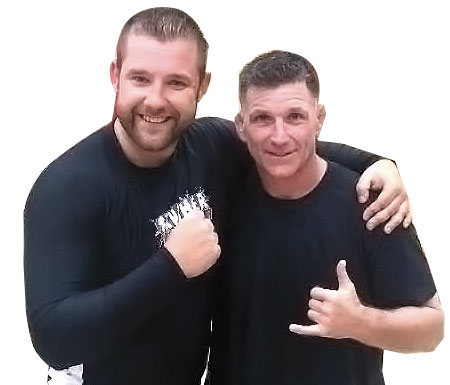
[caption id="attachment_13151" align="alignnone" width="300"] LS Thibault poses with Major Steve Burgess, Senior Combatives Instructor/Tournament Director, at the Garrison Petawawa Combatives Grappling Championships which raised $2,500 to date for the Soldier On program. Photo courtesy of LS Thibault[/caption]Sonya Chwyl, MARPAC Public Affairs ~When Leading Seaman Lee Thibault learned that no one from the Pacific Navy had ever competed in the Canadian Armed Forces’ only grappling tournament, he knew he needed to represent the West Coast.With seventeen years of wrestling experience, LS Thibault is no stranger to combat sports and always tries to maintain a competitive level of fitness. At sea, he runs fitness classes on the flight deck of the ship; on land, he coaches and trains at his local gym, Crusher Combat Sports, and competes in a variety of local amateur tournaments.He first heard about the Garrison Petawawa Combatives Grappling Championships through a colleague, Petty Officer Second Class Timothy Rose, who also trains at Crusher Combat Sports and was interested in getting a team together to compete.The tournament takes place every year in Petawawa, Ontario, and is open to members of the CAF actively serving in the Regular or Reserve Force. All money raised by the competition goes to Soldier On, a program that helps serving CAF members and veterans overcome physical or mental health illness or injury through physical activity and sport. This year, the tournament raised nearly $2,500.Grappling is a form of submission wrestling that involves holds and take-downs, but no striking. That makes it a great sport for CAF members, says LS Thibault, because there’s less danger of injury than with other combat sports.Most teams competing in the championship come from the army or air force, and because the tournament was mostly unknown in the navy, LS Thibault and PO2 Rose had a hard time forming a team...

From left to right

Military Police lace up for Special Olympics athletes

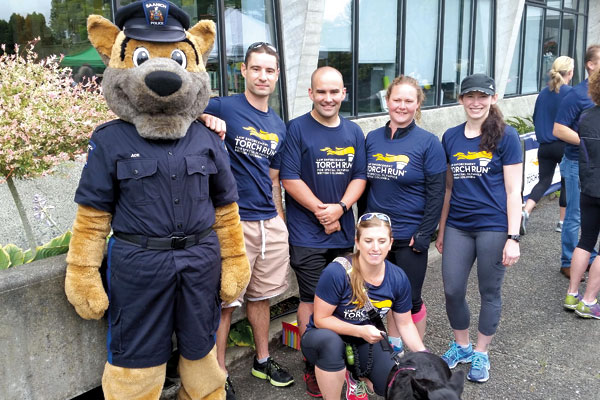
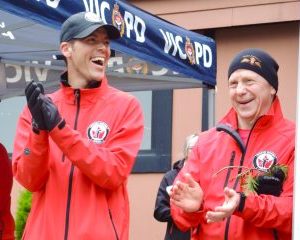
[caption id="attachment_13045" align="alignnone" width="300"] From left to right, SLt Leblanc, MCpl Edwards and PO2 Nilsson from MPU Esquimalt; Lt(N) Joiner; and Capt Harris of Canadian Forces National Investigation Service Pacific Region participate in the Victoria Law Enforcement Torch Run.[/caption]Sgt B.L. Oxford and SLt A.K. Leblanc, Military Police Unit Esquimalt ~On June 18, members of Canadian Forces National Investigation Service Pacific region and Military Police Unit Esquimalt participated in the 2016 Law Enforcement Torch Run (LETR) for Special Olympics in Victoria, BC. The run consisted of a five-kilometre route along the Galloping Goose Regional Trail, beginning and ending at the Saanich Police Department.On June 25, it was the Military Police members of the Canadian Forces Maritime Experimental and Test Ranges Military Police Detachment turn to participate in the 2016 LETR for Special Olympics in Nanaimo, BC. The run consisted of a five-kilometre route beginning and ending at Maffeo Sutton Park in Nanaimo.The LETR is an innovative initiative powered by dedicated law enforcement personnel around the world who want to help Special Olympics athletes experience acceptance, achievement and admiration through sport. It’s an inspiring, joyful phenomenon that has raised approximately $3.4 million in B.C. since 1990 and each year brings in about $30 million U.S. worldwide, all in support of the Special Olympics.The British Columbia LETR is among the most successful and creative branches of the global campaign, and is run in partnership with law enforcement personnel from multiple agencies across the province.

16 new officer cadets were enrolled at a ceremony at Royal Roads University in Victoria. From left to right: Back: OCdt Benjamin Jacobs

New officer cadets join the Regular Officer Training Plan

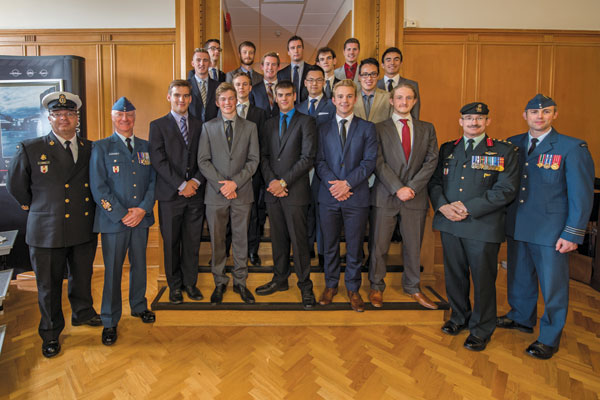
[caption id="attachment_13041" align="alignnone" width="300"] 16 new officer cadets were enrolled at a ceremony at Royal Roads University in Victoria. Photo by MCpl Brent Kenny[/caption]Cpl Rebecca Major, CF Recruiting Group ~On June 23, the Canadian Forces Recruiting Centre (CFRC) Detachment Victoria welcomed 16 new officer cadets into the Canadian Armed Forces (CAF) at the Regular Officer Training Plan (ROTP) enrolment ceremony at Royal Roads University. On June 24, CFRC Vancouver followed suit and enrolled 47 new officer cadets at HMCS Discovery in Vancouver. Both of these ceremonies were presided over by Colonel Timothy J. Bishop, Commanding Officer of Canadian Forces Recruiting Group (CFRG).The ROTP entry program provides fully subsidized education for students to attend either the Royal Military College in St-Jean, QC, the Royal Military College of Canada (RMCC) in Kingston, ON, or an eligible Canadian civilian university of the applicants choosing. During the course of their education, students are provided leadership training and occupation specific courses to help them build towards the foundation of skills required to be an officer.Summer training will include Basic Military Officer Qualification and on the job training in various cities across Canada. On top of these experiences, students earn a salary during the course of their studies and will have already begun contributing towards their pension. Once they have completed their degrees, students are given full-time jobs in their field of study. These jobs are provided to the students in order for them to fulfill their military service, a small price to pay for a free education. This military service is calculated at a rate of two months of service for every one month of education provided.With all of these benefits, it is easy to understand why this program is very competitive. Over 600 Officer Cadets will be enrolled into the Canadian Armed Forces under...

Canucks prospects feel the heat at Damage Control School

[caption id="attachment_13032" align="alignnone" width="300"] Photo courtesy of John W. Penner, John’s Photography[/caption]Lt(N) Nicole Murillo, Base Public Affairs ~The Canucks Prospects were on fire on the ice at their training development camp, but off the ice they were learning to fight fires and floods at the Damage Control Training Facility (DCTF) Galiano.The camp is an opportunity for the athletes to be put through their paces on the ice each day, as well as take part in other team activities throughout the week, such as working with the kids at The Nanaimo Child Development Centre.On July 6, the 33 players from six different countries put their teamwork and communication skills to the test in a number of friendly competitions that tested their damage control and firefighting skills for the coveted DC School Challenge Cup. In one of the first competition, the players were timed as they controlled a flood in the simulator. Then  they headed outside to use the fire hose to knock down three logs before filling up a bucket until a water bottle that was inside floated up to the top and fell onto the ground.“Although we’re a little upset about our loss [of the DCTF Cup], we definitely had a lot of fun today,” said 24 year-old Justin Parizek, an invitee from the University of Nebraska-Omaha. “This correlates really well to hockey; we had to switch off and trust our team-mates to hit the log and fill up the bucket just like we have to trust them with the puck.”Jakob Stukel, a 19 year-old player originally from Surrey, B.C., who played three seasons for the Vancouver Giants, also didn’t win the DC Cup, but got the chance to fulfill his other childhood dream: being a firefighter.“This was a really great experience and a bit of a surprise,” said Stukel. “You have to work together as a team here, just like we have to on the ice and the level of communication is similar to what we have to do...

HMCS Calgary’s Directed On-the-job Training Program team. Photo by Kathryn Mussallem

Training program sees stokers thrive

[caption id="attachment_13025" align="alignnone" width="300"] HMCS Calgary’s Directed On-the-job Training Program team. Photo by Kathryn Mussallem[/caption]Lt(N) J. Ryan Edgar, HMCS Calgary ~With the busy operational schedule of Royal Canadian Navy (RCN) warships, obtaining new sailor-specific qualifications can be a challenge. The RCN put the Directed On-The-Job Training Program (DOJT) in place a few years ago in order to allow sailors, who otherwise would not have the opportunity, to go to sea and progress their training. Participants are able to focus all their efforts on learning and completing their training packages, resulting in impressive progress towards new qualifications. During HMCS Calgary’s transit from Esquimalt, B.C., to Pearl Harbor, Hawaii, in support of Exercise Rim of the Pacific 2016, six marine engineers working towards their 2E Certification and six working towards their 3E Certification were able to participate in the program.During their time aboard, the trainees had the opportunity to participate in engineering drills and practice emergency responses in the event of equipment failures. Additionally, they were able to conduct system walkthroughs and take advantage of the ship’s on-board training system. Evenings were spent creating technical reports, drafting system drawings and presenting technical information.“It’s been a great experience,” said LS Tyler Jennings, a Cert 2E trainee. “I’ve been exposed to many different scenarios and have been able to participate in different evolutions that I wouldn’t have been exposed to back at my home unit. DOJT has allowed me to complete my training package, now I just need to challenge my qualification board.”At the end of the serial, trainees completed an average of 33 per cent of their packages, with some members completing as much as 57 per cent.“We’ve seen phenomenal progress over the past two weeks.” said Lt(N) Rowan Wilson, the Engineering Officer running the program. “The trainees have seamlessly integrated with the...

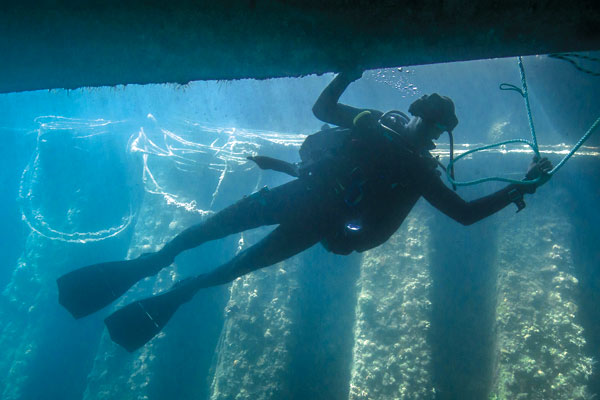
A Caribbean diver conducts a hull inspection as part of a counter-mine training scenario during Exercise Tradewinds 16 in Montego Bay

Divers teach partner nations in Caribbean

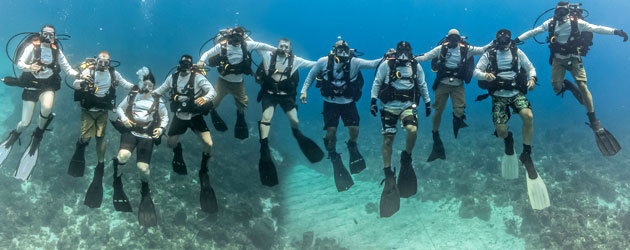
[caption id="attachment_13021" align="alignnone" width="300"] A Caribbean diver conducts a hull inspection as part of a counter-mine training scenario during Exercise Tradewinds 16 in Montego Bay, Jamaica on June 20. Photo by Sgt Yannick Bédard, CF Combat Camera[/caption]Capt Christopher Daniel, CF Combat Camera ~More than ten clearance divers from the Royal Canadian Navy’s Fleet Diving Unit (Atlantic) and Fleet Diving Unit (Pacific) were operating out of Discovery Bay, Jamaica, for Exercise Tradewinds 2016 from May to June.The diving component of the exercise started with the Canadian divers teaching the Ship’s Team Diver Course to Caribbean trainees. After that, the trainees applied their new skills by conducting diving in support of fleet operations.“The training events that we’ve done have been ship’s diver-related scenarios, which include hull searches, jetty sweeps, bottom searches and minor salvage projects,” said Lieutenant(Navy) J.R. Gallant, Executive Officer of Fleet Diving Unit (Atlantic) and officer-in-charge of the Canadian dive contingent at Exercise Tradewinds 2016.These training scenarios help to enhance the diving skills of partner nations and increase their overall level of interoperability within the region through instruction in areas such as basic dive theory, diving physics and underwater navigation, and search and recovery techniques.“Everything we’ve taught our partner nation divers they could be called upon to do to protect the Caribbean region,” said Lt(N) Gallant.Leading Seaman Paul Paquette is a Canadian clearance diver from Fleet Diving Unit (Pacific) working as an assistant instructor during the exercise. “My job is to ensure all candidates learn diving to high standards so they can go out on their own and be safe and proficient in the water,” he said.According to Lance Corporal Ameal Douglas, a diver from the Jamaican Defence Force, the exercise has been “a wonderful experience.”“We’ve learned a lot from our Canadian counterparts as well as with our partner nations...

Man overboard rescued 13 nautical miles west of Kyuquot Channel

Man overboard rescued 13 nautical miles west of Kyuquot Channel

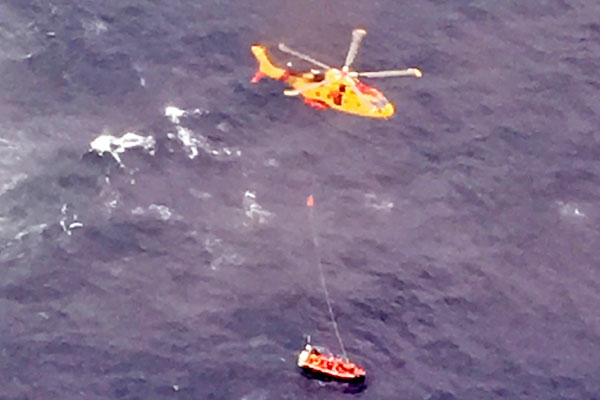
NEWS RELEASEMan overboard rescued 13 nautical miles west of Kyuquot ChannelJuly 11, 2016 – Comox – National Defence / Canadian Armed ForcesOn Monday, July 11th, 2016, 442 Transport and Rescue Squadron was tasked by Joint Rescue Coordination Centre (JRCC) Victoria to assist the Canadian Coast Guard in a rescue operation 13 nautical miles west of Kyuquot Channel.QUICK FACTSKyuquot Channel is on the west coast of Vancouver Island.A call was received by JRCC Victoria to provide assistance for a ‘man overboard’.Canadian Coast Guard Inshore Rescue Boat (IRB) 507 located and rescued the man who had fallen overboard from a small fishing vessel about three hours earlier.The man was subsequently hoisted aboard a CH-149 Cormorant helicopter crewed by members of Comox-based 442 Transport and Rescue Squadron.The patient was flown to Comox and transferred to the local hospital by BC Emergency Health Services ambulance.442 Transport and Rescue Squadron Cormorant and Buffalo aircraft are the Victoria Joint Rescue Coordination Centre’s (JRCC) primary means for aviation and marine SAR responses in the Victoria Search and Rescue Region (SRR). These aircraft and their highly trained crews are ready to respond to a SAR on a 24 hour basis.The Victoria SRR includes 1.4 million square kilometres of mainly mountainous terrain in British Columbia and the Yukon, extending approximately 600 nautical miles offshore into the Pacific Ocean. Given the size and complexity of this SRR, SAR crews operating in this region are highly skilled and ready to confront the challenges of this region in order to save lives.The Victoria Joint Rescue Coordination Centre (JRCC Victoria), in Esquimalt, B.C., is the joint Canadian Armed Forces–Canadian Coast Guard centre for SAR monitoring, alerting and emergency response in the Victoria SRR.

RCN takes next step in naval training

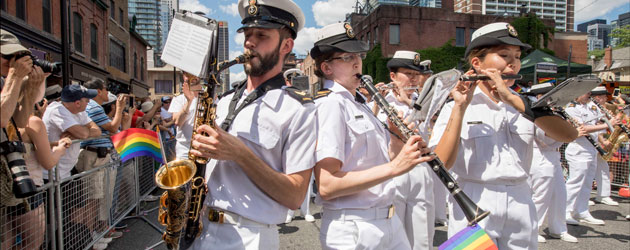
[caption id="attachment_13017" align="alignnone" width="300"] Sailors march past the Reviewing Officer, Commander of Maritime Forces Pacific, Rear-Admiral Gilles Couturier, during the Naval Personnel and Training Group Change of Command parade at Work Point, Canadian Forces Base Esquimalt, on July 6. Photos by Cpl Stuart MacNeil, MARPAC Imaging Services[/caption]Sonya Chwyl, MARPAC Public Affairs ~Last Wednesday, Maritime Forces Pacific’s finest was on full parade to mark the reconfiguration of the Naval Training Development Centre (Pacific) and Naval Fleet School (Pacific).The large-scale parade was accompanied by the Naden Band, and followed by a formal renaming and change of command, during which Commander S.E. Hooper took command of the Naval Training Development Center (Pacific), while Commander Todd Bonnar took command of the Naval Fleet School (Pacific).The ceremony signalled the next step in the RCN’s Future Naval Training System initiative, which will re-configure five training centres across Canada into three campuses in Halifax, Esquimalt and Quebec.“This is the inception of a new organizational structure,” said Rear-Admiral Gilles Couturier in a speech following the parade. “Today, we’re celebrating the implementation of modern training aligned across three campuses.”The new structure – a “system of systems,” according to RAdm Couturier – will leverage emerging technology to generate efficiency and support operational excellence.In Esquimalt, the newly-named Naval Fleet School (Pacific) will deliver individual and career courses, while the Naval Training Development Center (Pacific) will be the RCN’s Center of Excellence for engineering, damage control, command, leadership and professional development curriculum and courseware development.The schools will allow Regular and Reserve Force sailors to train at home or at their own units in a shorter time span by completing coursework through a blend of traditional classroom learning, distance education, virtual tools and hands-on experience.“We’re seeking to train officers where they live,” said RAdm Couturier. “Through modernization, we believe we can reduce course length by thirty percent.”Innovative training methods, such as virtual ship models and bridge simulators, will help prepare sailors for work on board the RCN’s forthcoming Arctic Offshore Patrol Ships, Joint...

Major Nick Arakgi (left) and his brother

CAF night has big impact on two Lions

[caption id="attachment_13013" align="alignnone" width="300"] Major Nick Arakgi (left) and his brother, BC Lions linebacker Jason Arakgi. Photo courtesy of BC Lions[/caption]Matt Baker, BC Lions ~The BC Lions Football Club was proud to hold Canadian Armed Forces Night when the Toronto Argonauts came to town last Thursday. Tickets were given to servicemen and servicewomen who may not otherwise be able to attend a game.Hunter Steward and Jason Arakgi both have strong ties to the Canadian Armed Forces: Hunter’s Father Robin serves as a Lieutenant Colonel in the army, and was on hand assisting in the coin toss with Rear Admiral Gilles Couturier of the Royal Canadian Navy, while Jason’s older brother Nick currently serves as an infantry officer in the Royal Hamilton Light Infantry.Football is often referred to as a “battle in the trenches” or a “war of attrition.” Considering the great game involves big hits, banging pads and lots of excitement, most of the time such comments are not met with much resistance.“You compare it just because football is a match up of man against man and you have to physically dominate the other person,” Steward said. “It’s totally different than war absolutely. Lives aren’t at stake.”The elder Steward has quite a decorated record serving our country, including a tour in Afghanistan in the first couple of years following the 9/11 terrorist attacks.“He was pretty high up in the ranks, I think a major at the time,” Hunter Steward said. The Lions offensive lineman was barely into his teens when his father went overseas, and he admits it was pretty intense times for the family. “I knew he wasn’t directly out in the field, but you still have all those concerns. I am very proud of the work he’s done.”In addition to Afghanistan, Steward’s Father also did tours in Bosnia...

Alek Robaczewski

Summer at sea: Naval Cadets sail in U.S. warships

[caption id="attachment_12976" align="alignnone" width="300"] Naval Cadet Alek Robaczewski on the bridge wing of USS Stockdale in the Philippine Sea.[/caption]Sonya Chwyl, MARPAC PA Office ~Not many summer jobs give university students the chance to gain hands-on experience in their field, and even fewer provide the opportunity to travel while doing it.That’s what makes the Naval Personnel and Training Group’s (NPTG) On the Job Experience (OJE) program such a great opportunity.This summer, the OJE program has given a number of Royal Military College Naval Cadets the chance to live and work on board military ships for the first time. Twelve of them are spending the summer with the United States Navy on some of the most advanced warships in the world, including guided missile destroyers.“It’s hard not to be jealous of these cadets,” said Lieutenant(Navy) Charlotte Farish, the OJE Program Coordinator. “I think they’re going to have such an amazing summer.”Five Naval Cadets have joined the United States Ships (USS) Stockdale, Spruance, Chung-Hoon, and Mobile Bay. They’ll be on board for a month and a half, working alongside the American crew.Another group of seven have joined the USS San Diego, where they’ll stay for about a month and get to participate in RIMPAC, the world’s largest international maritime exercise.The cadets are already hard at work orienting themselves on the ship and learning the basics of damage control and firefighting. After that, they’ll be able to carry out basic officer tasks, such as standing watch on the bridge.For the cadets, it’s an opportunity to learn the traditions and practices of one of Canada’s greatest naval allies.“They’re working on major warships that are heavily armed—just phenomenal ships,” said Lt(N) Farish. “They’re going to have so much fun sailing on them.”The time they spend on the water will go towards their sea service insignia.While this...

Ball Hockey

Tritons knock out opponent

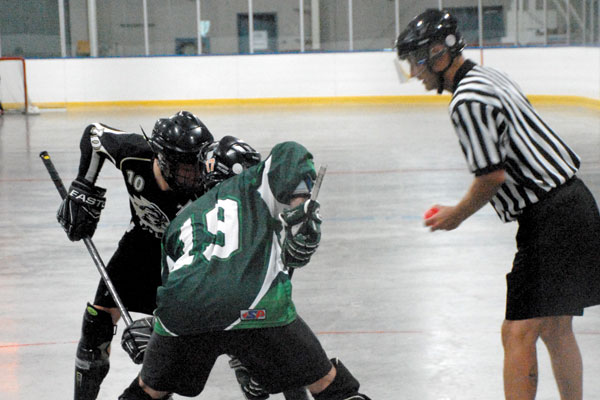
[caption id="attachment_12972" align="alignnone" width="300"] The referee gets ready to drop the ball at the Pacific Regional Ball Hockey Qualifying Tournament June 21 at Wurtele Arena. Photo by: Peter Mallett, Lookout[/caption]Peter Mallett, Staff Writer ~The Esquimalt Mens Tritons earned a spot on the Canadian Armed Forces National Ball Hockey Championship roster in Ontario after a convincing regional qualifying victory over the Comox Flyers.Tritons swept the Totems to defeat in the best-of-three series at Wurtele Arena June 20 and 21.They outscored their Royal Canadian Air Force opposition by a total margin of 15-0. With the victory the Esquimalt team now moves on to the national play at CFB Borden, July 23 to 28.“Our game plan was fairly simple; we just wanted to take away their time and space. So as soon as they got possession we had a man on them trying to force them to cough it up,” said Tritons player-coach, MS John Helpard, of HMCS Ottawa.The Tritons registered an 8-0 victory in Game 1 followed by a 7-0 result in Game 2 and  outgunned their opponents in shots-on-goal by a 96-17 margin over two games, which consisted of two 20-minute periods each played on a defrosted concrete playing surface.Forward, LS Derek Cheetham, also with Ottawa, was named Game 2 Player of The Game for the Tritons; Defenceman LS Keelan Cook captured Game 1 Player of The Game honours and was also named the tournament’s overall MVP.“It’s great to be recognized but really I was just doing my usual job of getting the ball to our forwards so they can score goals,” said LS Cook, an instructor with Fleet School. “The opposition fought hard right until the final buzzer, and it really takes a lot of determination to do that when things aren’t going your way.”MS Helpard says the likelihood of...

Coin placement ceremony

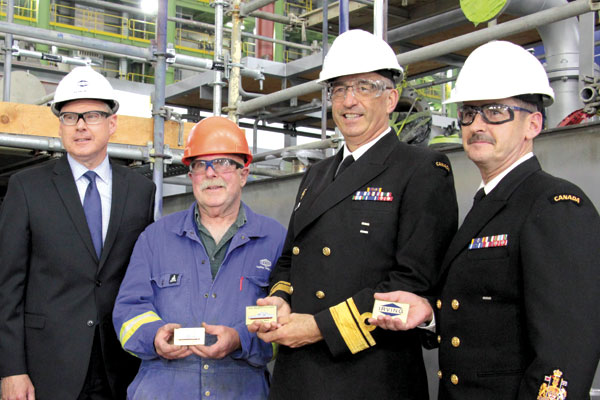
Ship building tradition continues with HMCS Harry DeWolf

[caption id="attachment_12969" align="alignnone" width="300"] Kevin McKoy, Co-Chief Executive Officer of Irving Shipbuilding, Carl Risser (46 years of service with Irving), Rear-Admiral Newton, Commander Maritime Forces Atlantic, and CPO1 Pierre Auger, Formation Chief Petty Officer, at the coin placement ceremony.[/caption]In early June at Irving Shipbuilding’s facility in Halifax, Rear-Admiral John Newton, Commander Joint Task Force Atlantic and Commander Maritime Forces Atlantic, along with Kevin McCoy, President of Irving Shipbuilding, and Chief Petty Officer First Class Pierre Auger, Formation Chief, attended a coin placement ceremony for the future HMCS Harry DeWolf, the lead ship in the class.The coin placement is a shipbuilder and naval tradition where a newly minted coin is placed on the ship’s structure to bring luck to the vessel and crew for the life of the ship. The coin was placed by Carl Risser who, with 46 years of shipbuilding experience at Irving Shipbuilding, declared the keel as “well and truly laid.” The ceremony was attended by representatives of the Arctic and Offshore Patrol Ships (AOPS) project office, as well as Irving Shipbuilding employees, and marks another milestone in the ongoing construction of Harry DeWolf.The Royal Canadian Navy (RCN) is anticipating the delivery of Harry DeWolf, the first of the Harry DeWolf-class AOPS, in 2018. The ship is named after Vice-Admiral Harry DeWolf, a widely-respected officer who served with distinction in the Second World War and later rose to be Chief of the Naval Staff in the late 1950s.The Harry DeWolf Class will be capable of: • armed sea-borne surveillance of Canada’s waters, including the Arctic;• providing government situational awareness of activities and events in these regions; and• cooperating with other partners in the Canadian Armed Forces and other government departments to assert and enforce Canadian sovereignty, when and where necessary.The Harry DeWolf Class will provide the RCN with the ability to operate much...

Jeff Krieger

Geese be gone

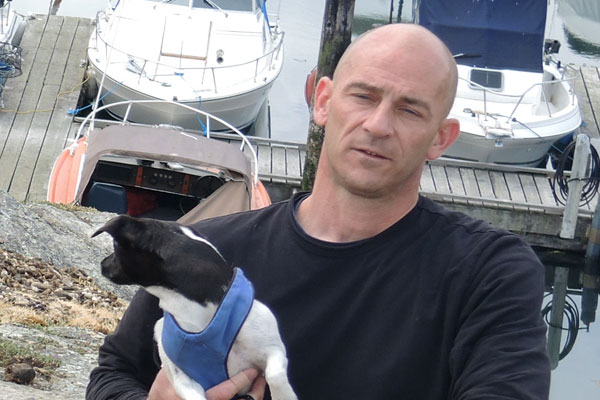
[caption id="attachment_12966" align="alignnone" width="300"] Jeff Krieger, a Nuisance Wildlife Technician, with his dog Pixie, has been hired to help keep Canadian geese off the grass in Work Point.[/caption]Lorraine Crinkley, Formation Environment Office ~Impacts from non-migratory resident Canada geese can be observed all over CFB Esquimalt and include the degradation of lawn and sports fields, large amounts of fecal matter, and during breeding season goose aggression.Conflicts between geese and base activities are an ongoing issue at CFB Esquimalt’s Work Point property. Large goose numbers have caused training areas and playing fields to be unusable due to excessive pitting from grubbing. (eating down into the sand layer), and excessive fecal matter. Walkways, parking lots and stairs also become covered in feces which make them slippery and unsightly.The ocean side Work Point property is an ideal location for non-migratory resident Canada geese. It provides large open green spaces for geese to forage and rest. Work Point is also a fairly quiet site, especially outside of regular business hours – this means geese are not disturbed or feel pressured by the presence of people or dogs, and that creates a safe haven.In the fall of 2015 staff from the Naval Officer Training Centre (NOTC) began completing daily goose observations at Work Point and documented the location, number of geese, and their behaviour. These observations were collected to establish baseline data on the population. Formation Safety and Environment (FSE) subsequently hired EBB Consulting Inc. to complete an assessment of the population at Work Point and provide recommendations to mitigate impacts and reduce conflicts.Using the observational data collected, EBB Consulting was able to determine that during the winter months, daily goose numbers at Work Point was consistent with 30 to 40 individuals. EBB Consulting recommended trialing techniques such as dog hazing, installing barriers and fences, re-landscaping...

Bart Armstrong

Britain honours 175 foreign-born heroes

          Bart Armstrong, Contributor ~For years people across Britain complained about a burning issue that made celebrating their Victoria Cross recipients difficult.In many cases the statue or monument honouring their brave lads was not located locally, but rather in some far off city or land. So they let government know this was not good enough.Parliament agreed something should be done at the local level, but what was that something?Contests were held and a plan was developed that would see paving stones made that were inscribed with the hero’s name, regiment and date of the First World War deed that earned the Victoria Cross. They would be provided to local councils across the country, with public meetings held and decisions made about where they should be mounted.But the plan only called for stones dedicated to recipients born in Britain. What about those buried in Britain, but born elsewhere? Government then included these, made the paving stones, and circulated with instructions that local governments unveil them on the very day, 100 years after the deed in which the battle took place.But another flaw was soon realized. What about all the heroes neither born nor buried there, but as equally deserving of the same honour? What about heroes from around the world such as Canada’s Billy Bishop and Billy Mitchell, George Pearkes and Rowland Bourke.The missing “few” soon morphed into at least 175 men.Research showed that men from 11 different countries now needed this same recognition. So a Bronze plaque was designed and sent to each country listing their heroes.Then on June 21 of this year, Britain’s Foreign and Commonwealth office unveiled the next part of the overall memorial to these Great War recipients. It is a searchable digital archive that lists most of the foreign born recipients by country. Clicking on links takes...

CF Fleet School Esquimalt

Changes coming to naval schools

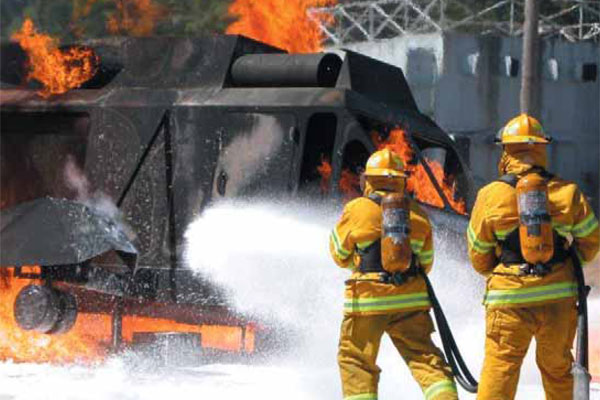
[caption id="attachment_12955" align="alignnone" width="300"] As part of training sailors douse the helicopter simulator at the Damage Control School at CF Fleet School Esquimalt.[/caption]Lt(N) Adam Drover, CF Naval Operations School ~Due to the diverse nature of the future fleet’s capabilities, tied with the complex nature of the future security environment, the Royal Canadian Navy’s (RCN’s) Naval Training System is in need of an overhaul.The Future Naval Training System Strategy, released in the summer of 2015, identifies where the RCN needs to focus in order to address the capabilities of the future fleet, which are being built at Irving Shipbuilding in Halifax, N.S., and Seaspan Shipyards in Vancouver, B.C. under the National Shipbuilding Procurement Strategy.This includes the re-configuration of training establishments in Halifax and Esquimalt into two campuses, Atlantic and Pacific, under the Naval Personnel and Training Group to meet the RCN’s training requirements.Campus Pacific will stand-up in a ceremony July 6. This means Canadian Forces Fleet School Esquimalt and the Naval Officers Training Centre will be re-configured into Naval Fleet School Pacific and Training Development Centre Pacific.Naval Fleet School Pacific will deliver individual training such as career courses and qualifications to sailors in Esquimalt.The Training Development Centre Pacific will be the RCN’s Centre of Excellence for engineering, damage control, command, leadership, and professional development.Likewise in Halifax, Campus Atlantic will stand-up with a ceremony on July 15 where the Canadian Forces Naval Operations School and Canadian Forces Naval Engineering School will become NFS(A) and TDC(A).NFS(A) will deliver individual training in Halifax, with the addition of submarine training, while TDC(A) will be the RCN’s Centre of Excellence for combat, operations, and seamanship training.Canadian Forces Fleet School Quebec, in the heart of Quebec City on the banks of the St. Lawrence River, was renamed Naval Fleet School Quebec during a ceremony on June 29....

Explore More

Categories

Top News

E-Editions Archive

News Stories Archive

Proud Supporters

Joshua Buck, Lookout Newspaper