
[wpml_language_selector_widget]
[searchwp_form id="1"]
RAdm Couturier

Military test response plan for major earthquake

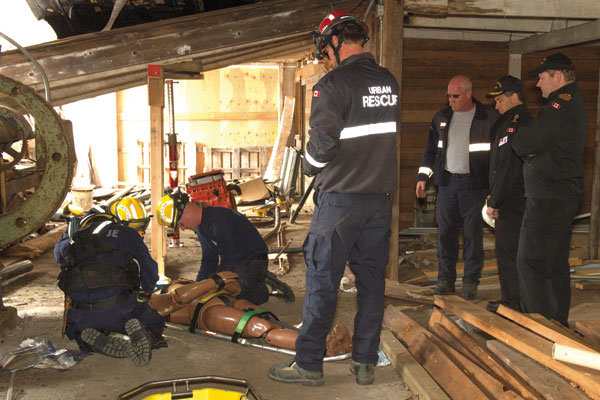
[caption id="attachment_12753" align="alignnone" width="300"] RAdm Couturier, Glenn Cooper, a member of Real Property Operations, and Capt(N) David Mazur, Chief of Staff of Plans and Operations, observe members of the Urban Search and Rescue perform first aid on a mock casualty in Bamfield, B.C. during Exercise Staunch Maple. Photo by LS Ogle Henry, MARPAC Imaging Services[/caption]Rachel Lallouz, Staff Writer ~The very real threat of a major earthquake and tsunami looms in Vancouver Island’s future, and being ready to respond once the shaking stops is essential.Last week, the province and the Canadian Armed Forces (CAF) joined together to test every aspect of their emergency response plans.For Joint Task Force Pacific (JTF(P)) that exercise was Staunch Maple, which verified the military’s operational readiness to support the Province of British Columbia in the event of a disaster.Should they be called upon to assist, the military has the ability to provide humanitarian assistance in conjunction with partner agencies such as Emergency Management British Columbia and Public Safety Canada. These needs may range from housing displaced people in barracks, or sending urban search and rescue teams to dig citizens out of rubble.  “When the province is hit with an earthquake event, it will very quickly need federal assistance for public safety from all regions in Canada, and in real life it will be a national event,” says Lieutenant-Commander Steve Shute, Exercise Co-ordinator. “This exercise is significant because it puts the province in a good position to demonstrate to the general public that we are in a high risk area, and that we are serious about exercising a contingency plan.”The three-day exercise was part of the larger Exercise Coastal Response, the province’s first full-scale earthquake and tsunami response exercise. It brought together stakeholders from all levels of government, as well as Emergency Management B.C. staff, First Nations,...

A group of marine scientists has confirmed Second World War merchant marine vessel Coast Trader was torpedoed by a Japanese submarine in the Strait of Juan de Fuca inside Canadian waters.

Discovery of sunken merchant vessel forces Canadian history reboot

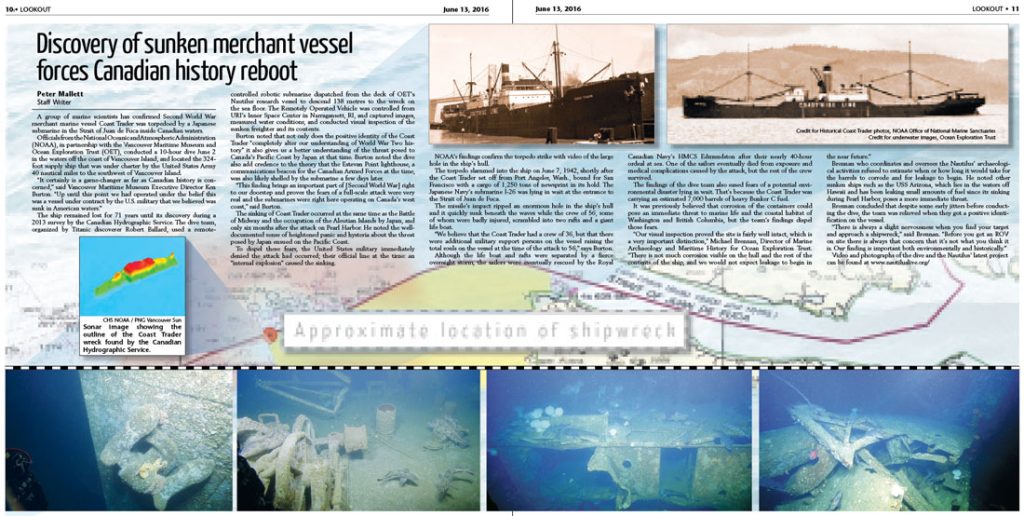
Peter Mallett, Staff Writer ~A group of marine scientists has confirmed Second World War merchant marine vessel Coast Trader was torpedoed by a Japanese submarine in the Strait of Juan de Fuca inside Canadian waters.Officials from the National Oceanic and Atmospheric Administration (NOAA), in partnership with the Vancouver Maritime Museum and Ocean Exploration Trust (OET), conducted a 10-hour dive June 2 in the waters off the coast of Vancouver Island, and located the 324-foot supply ship that was under charter by the United States Army 40 nautical miles to the southwest of Vancouver Island. “It certainly is a game-changer as far as Canadian history is concerned,” said Vancouver Maritime Museum Executive Director Ken Burton. “Up until this point we had operated under the belief this was a vessel under contract by the U.S. military that we believed was sunk in American waters.”The ship remained lost for 71 years until its discovery during a 2013 survey by the Canadian Hydrographic Service. The dive team, organized by Titanic discoverer Robert Ballard, used a remote-controlled robotic submarine dispatched from the deck of OET’s Nautilus research vessel to descend 138 metres to the wreck on the sea floor. The Remotely Operated Vehicle was controlled from URI’s Inner Space Center in Narragansett, RI, and captured images, measured water conditions, and conducted visual inspection of the sunken freighter and its contents.Burton noted that not only does the positive identity of the Coast Trader “completely alter our understanding of World War Two history” it also gives us a better understanding of the threat posed to Canada’s Pacific Coast by Japan at that time. Burton noted the dive also add credence to the theory that the Estevan Point lighthouse, a communications beacon for the Canadian Armed Forces at the time, was also likely shelled by the submarine a few...

Peter Mallett

Investigative prowess rights historical wrongs

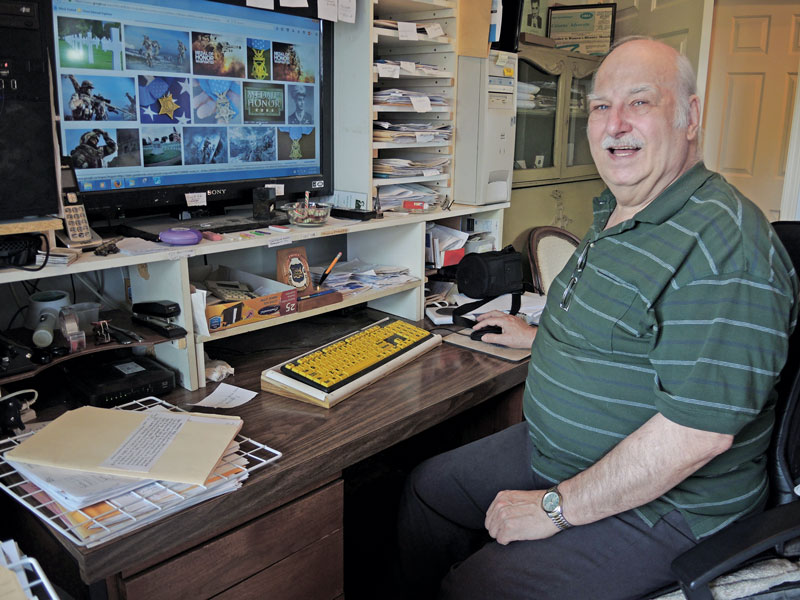
[caption id="attachment_12696" align="alignnone" width="300"] Peter Mallett, LookoutMilitary historian Bart Armstrong conducts research in his Saanich home.[/caption]Peter Mallett, Staff Writer ~For the past 16 years, Bart Armstrong, 67, a former military reservist, has spent his days pouring over historical records, microfilm and Internet sources to dig deep into our nation’s military past in order to right many historical wrongs. Armstrong says his research has uncovered 109 recipients of the Victoria Cross with connections to Canada as opposed to the previously accepted number of 94, and determined there are 109 Medal of Honor recipients with connections to Canada who served for the United States as opposed to the recorded 69. He is also big on pointing out that 50,000 Canadians served in the U.S. during the Civil War, something most Canadians are “completely oblivious to.” “I am just scratching the surface with my work; there is so much out there about Canada’s military history, and, as a prominent genealogist recently claimed, an estimated 95 per cent of that information has yet to be revealed,” he says.His most recent work resulted in the proper grave marker for U.S. Medal of Honor recipient Joseph Noil, an African-Canadian who travelled from his Nova Scotia home to join the U.S. Navy during the Civil War.A series of unfortunate errors led to the sailor being buried without the prestigious head stone.  On the home front he worked with others to have a more prominent marker placed in honour of former HMCS Malahat Commander Rowland R.L. Bourke, the only known holder of the Victoria Cross and  France’s Legion of Honour Medal from the First World War. Cdr Bourke received his medals for saving the lives of 41 servicemen during the 1918 spring raids at the Belgium ports of Ostend and Zeebrugge.The history buff doesn’t mince words in his...

Robert “Scratch” Mitchell

Ace pilot encourages air cadets

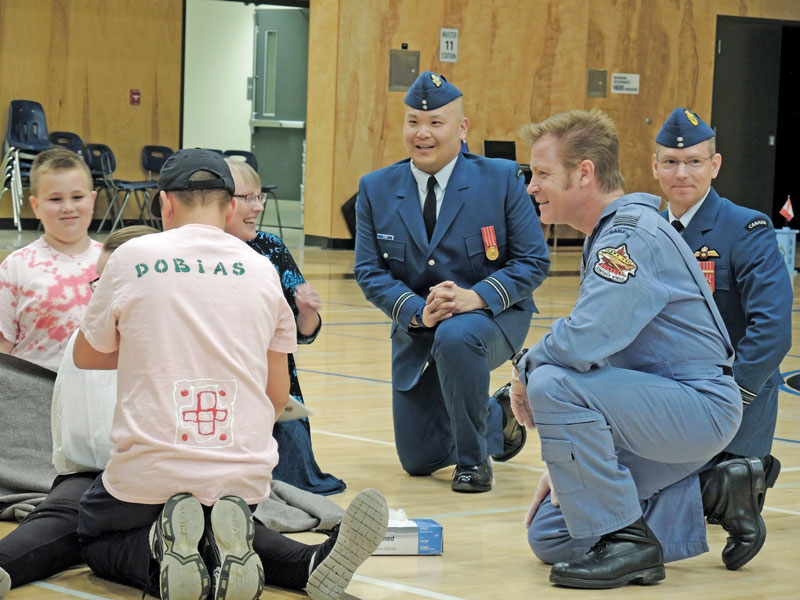
[caption id="attachment_12693" align="alignnone" width="300"] Robert “Scratch” Mitchell, a retired Lieutenant-Colonel who served for 20 years in Canada’s Air Force, looks on during a first aid demonstration by the 848 Royal Roads Royal Canadian Air Cadet Squadron during their 39th annual Ceremonial Review at Belmont Secondary School in Langford.[/caption]Peter Mallett, Staff Writer ~Former Snowbird and Royal Canadian Air Force (RCAF) pilot Robert “Scratch” Mitchell inspected a squadron of Westshore air cadets last Tuesday, and encouraged them to seize the moment in their journey through life.Mitchell, a retired Lieutenant-Colonel with 20 years in Canada’s air force, was the Reviewing Officer for the 848 Royal Roads Royal Canadian Air Cadet Squadron during their 39th annual Ceremonial Review Ceremony at Belmont Secondary School in Langford on May 31. After inspecting the youth the Victoria native took to the microphone and recalled some exhilarating moments of his career, including piloting CF-18s and commanding Canada’s famed aerobatics team.“When you are going through this kinetic experience called life try to find those moments, whether you are flying air planes, becoming doctors or the next internet sensation, find those magical moments because I think that is one of the gifts in life that we are given.”He recalled one such moment when he led his Snowbirds in a tight diamond formation down the northern glacial slope of Mount Baker as they flew towards Abottsford, B.C. As Mitchell and the Snowbirds “tobogganed” down the slope, a beautiful sunset turned the sky a hue of purple and pink and Mitchell described the memory as both unforgettable and surreal.“This was one of those ‘moments’, not only because of the incredible setting, but because there was such a perfect connection amongst all of the pilots; it felt like we were all in the same plane,” he said.Mitchell acquired the nickname Scratch during a midair...

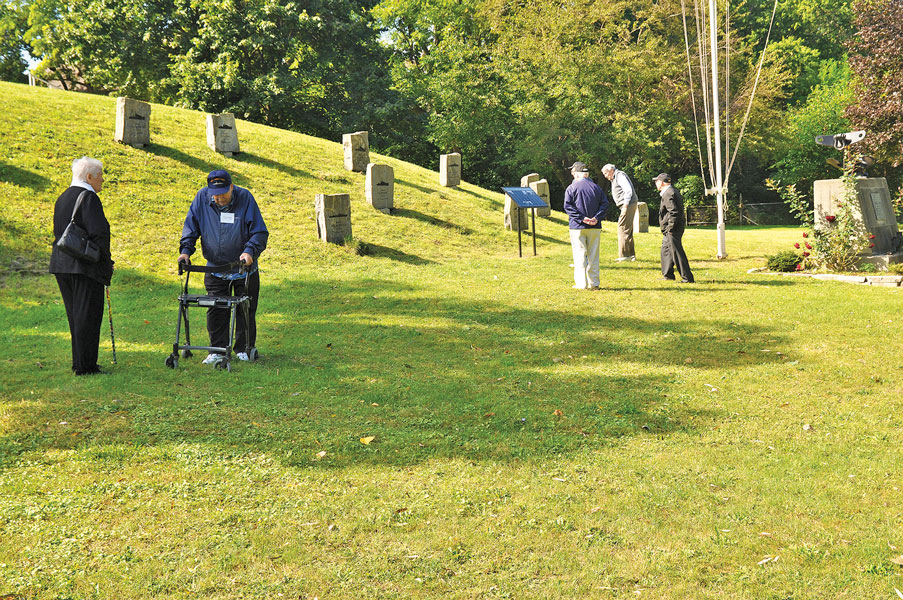
The Battle of the Atlantic memorial receives a constant flow of visitors. Many are veterans with mobility issues which makes access difficult or limited.

TOUCHING THE STONES

[caption id="attachment_12684" align="alignnone" width="300"] The Battle of the Atlantic memorial receives a constant flow of visitors. Many are veterans with mobility issues which makes access difficult or limited.[/caption]David Lewis, Naval Association of Canada (London) ~The Battle of the Atlantic Memorial is a tribute to the ships and men of the Royal Canadian Navy, lost in the longest running battle of the Second World War. It is a stunning and moving memorial, created with extreme gratitude for those who made the supreme sacrifice and whose final resting places cannot be marked by graves.The memorial is built into the grass hillside at HMCS Prevost.A series of 25 blue granite stones traverse the hillside. Each stone is engraved with the name, the image, the hull number and the date the ship lost during the Battle of the Atlantic.There is also a stone honouring the sacrifice of the Merchant Navy.The memorial rests in central Canada as the sailors represented here, who were lost with their ships, came from small towns and large cities, from every province across this great country.As much as we remember the ships and the gallant names of Valleyfield, Alberni, Louisburg and others, it is not the steel and iron we commemorate.It is the sons and fathers, the brothers and friends, the grandsons loved and lost. It is their service, their sacrifice that permeates this memorial.The memorial remembers the 18-year-old sailor bundled heavily against the bitter cold.He’s standing watch on the open bridge of an RCN Corvette.Around him is the freezing North Atlantic and in the moonlight are the many plodding hulls of the convoy he’s protecting.It remembers the blinding flash, being hurled into the air, and slamming down into the icy water.It remembers the struggle to surface and the weight of the black Arctic water slowly over-whelming. It also remembers...

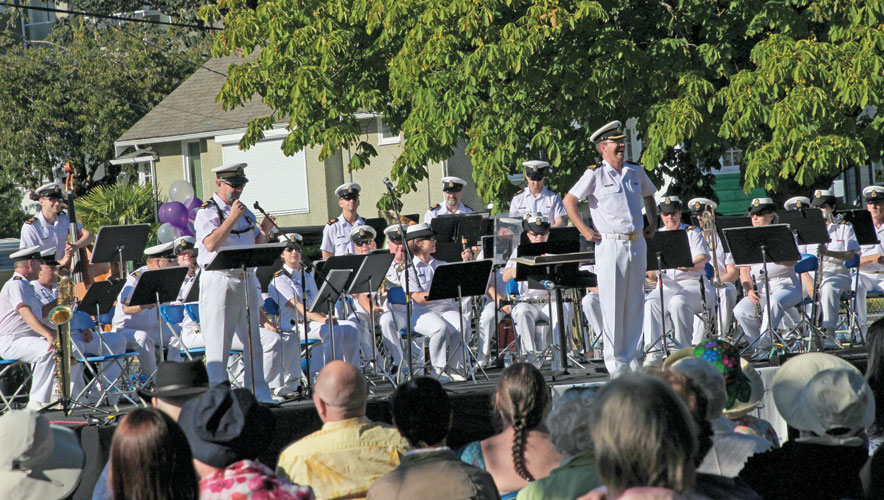
The Naden Band of the Royal Canadian Navy performs at last year’s Memorial Park Music Festival in Esquimalt.

Naden Band returns to local Memorial Park Music Festival

[caption id="attachment_12690" align="alignnone" width="300"] The Naden Band of the Royal Canadian Navy performs at last year’s Memorial Park Music Festival in Esquimalt.[/caption]Peter Mallett, Staff Writer ~The Naden Band of the Royal Canadian Navy will ring in the first day of summer by headlining opening night at the Township of Esquimalt’s Memorial Park Music Festival.The naval band will help kick off the township’s annual series of six Tuesday night concerts with a free performance on June 21 between 6 to 7:30 p.m. at the historic park located at 1212 Esquimalt Rd. The Esquimalt High School Band will open with a performance at 5 p.m.Flutist PO1 Marie-Perle Broadley and Assistant Director of Music CPO2 Brayden Wise will program and conduct part of the Naden Band’s performance. “We love playing for the public, it’s one of our greatest joys and some of our biggest fans live right here in Esquimalt,” says PO1 Broadley.“The venue has a very laid back atmosphere in a park setting, and many people bring their families and are normally equipped with blankets, lawn chairs and food.”PO1 Broadley says some of the compositions the band will perform include The Vanished Army by Kenneth J. Alford; Scottish Rhapsody in a tribute to legendary Canadian composer Howard Cable who died on March 30; and an undecided piece of music celebrating Quebec holiday Saint-Jean-Baptiste Day, which falls on June 24.  “It’s a very family-oriented event so we try to cater to everyone and play a little bit of everything,” says PO1 Broadley.The music festival will also feature headline acts The Soul Shakers (June 28), Bobby Dazzler (July 5), Deb Thomson Band (July 12), Virtual Elvis (July 19) and Bijou du Bayou (July 26).

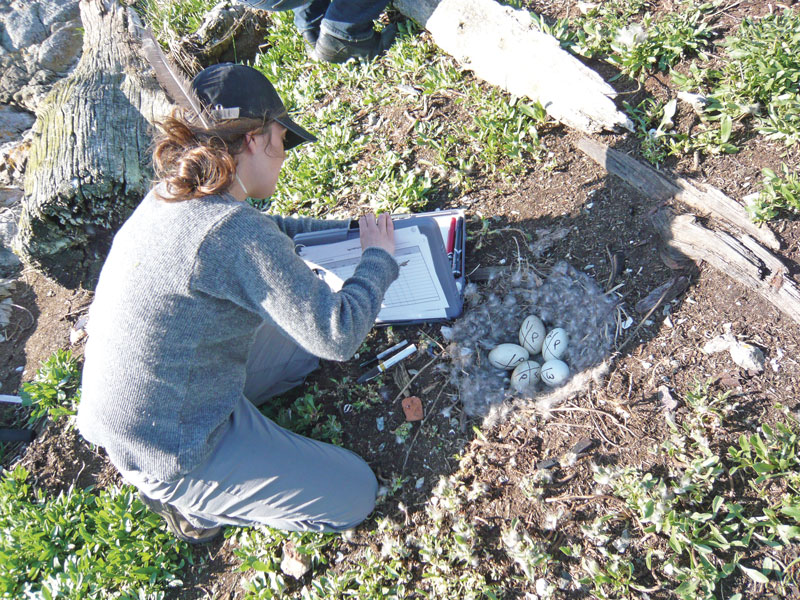
Wildlife Technician Lorraine Crinkley documents the number of eggs addled for reporting to Environment Canada.

Egg addling: controlling the non-native species on base

[caption id="attachment_12678" align="alignnone" width="300"] Wildlife Technician Lorraine Crinkley documents the number of eggs addled for reporting to Environment Canada.[/caption]Lorraine Crinkley, Formation Environment ~CFB Esquimalt has a large population of non-native, non-migratory Canada geese.These geese were introduced locally approximately 50 years ago for hunting purposes, but changes in hunting regulations and a lack of natural predators have allowed their populations to increase exponentially.  Geese can live and breed for up to 20 years, and each year a nesting pair can produce an average clutch of five eggs. Due to their population growth, a long-term population control program has been developed through the Capital Regional District’s Canada Goose Management Strategy.This strategy aims to reduce impacts of non-migratory resident Canada geese to prevent conflict between geese and human activities.Suggested mitigation techniques include habitat modification that makes an area less desirable to geese; water management, which addresses the location and characteristics of water features such as irrigation ponds that attract geese; hazing, which scares geese away from conflict areas; temporary relocation; and population control such as egg addling and strategic hunting. CFB Esquimalt has participated in egg addling since 2008.Egg addling involves removing eggs from the nest and shaking them, which disrupts the membrane and stops embryo development.The eggs are marked and put back into the nest so the female goose will continue to sit on the eggs.At the end of the season the eggs will simply not hatch. Eggs cannot be removed or destroyed as the female will just produce another clutch. Both migratory and non-migratory Canada geese are protected under Environment Canada’s Migratory Bird Act, and all addling activities at CFB Esquimalt are conducted under Federal permit and require annual reporting. I managed the 2016 addling season within Formation Safety and Environment (FSE). I am a Wildlife Technician and co-op student.The 2016...

RIMPAC: Military gears up for large-scale maritime exercise in Hawaii area

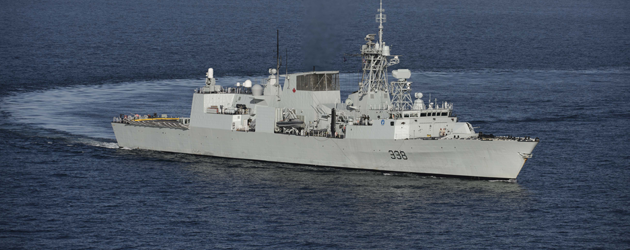
Rachel Lallouz, Staff writer ~ The Canadian Armed Forces will cooperate with 27 other nations this year for Exercise Rim of the Pacific (RIMPAC) 2016, the largest maritime exercise in the world. Taking place in and around the Hawaiian Islands and Southern California from June 30 to Aug. 4, this year’s exercise will mark Canada’s 25th time participating in the biannual exercise. Canada’s maritime component will be HMCS Calgary, HMCS Vancouver, HMCS Saskatoon, and HMCS Yellowknife, along with a Royal Canadian Navy (RCN) dive team and Forward Logistics team. “Having our ships and divers train with other countries fosters multinational cooperation, trust, enhances operability and naval professional engagement, and achieves our national objectives while building capable coalition partners in the Pacific Rim and beyond,” says Lieutenant-Commander Matthew Arthur, Royal Canadian Navy (RCN) Deputy Lead Planner for RIMPAC. The 1,500 Canadian sailors, soldiers, and airmen and airwomen participating will work alongside multiple allies during the exercise, such as Australia, Chile, New Zealand and Singapore. “Our ability to be leaders in this exercise is deeply important for Canada,” says LCdr Arthur. “Fundamentally, we play a role organizing an exercise that is vast in scope of training, with 45 ships participating, five submarines, 17 different land force groups, over 200 aircraft, and over 25,000 people.” Participants will be challenged to complete training across a wide range of military capabilities, including humanitarian assistance, disaster response, dynamic maritime security, and complex warfighting operations. In Hawaii, RIMPAC will begin with a harbour phase of briefings with all docked ships to ensure participating navies have the same level of knowledge. Training will then focus on practicing joint live fire exercises, carrying out a simulated maritime theatre missile defence, amphibious operations, counter piracy, anti-submarine warfare, and an assessment of satellite networking in degraded environments. Hawaii will also be...

Photo by MCpl Pat Blanchard

High tech access available for mental health research

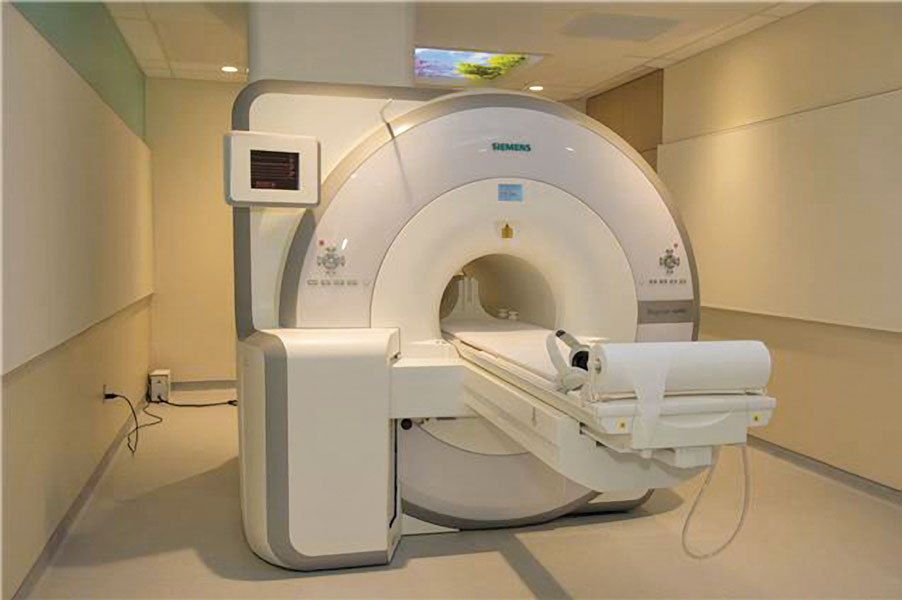
[caption id="attachment_12671" align="alignnone" width="300"] Photo by MCpl Pat Blanchard, Canadian Forces Combat CameraThe Positron Emission Tomography – functional Magnetic Resonance Imaging (PETfMRI) machine to be used in mental health research.[/caption]Peter Mallett, Staff Writer ~A new investment in cutting-edge technology is poised to assist the Canadian Armed Forces (CAF) in mental health research and better military member support.DND and the Royal Ottawa Mental Health Centre announced May 16 a four-year $2.65 million agreement for DND to access their brain imaging scanning equipment.The Centre recently installed a PET/fMRI scanner, the only one of its kind in Canada devoted entirely to brain and mental health research.“I see this as a key investment in helping our Canadian Armed Forces members and veterans who are fighting to overcome mental health issues,” said General Jonathan Vance, Chief of Defence Staff.“This partnership will see experts at The Royal Ottawa Mental Health Centre and our military mental health professionals working together towards a common goal of developing a new understanding of the effects of mental illness on brain functions.”The cutting edge technology will allow clinicians and scientists from Canadian Forces Health Services and Royal Ottawa Mental Health Centre to examine the effects of various drugs used to treat depression, post-traumatic stress disorder and other mental illnesses on brain functions.The CAF’s Director of Mental Health, Col Andrew Downes says the introduction of the scanner is a breakthrough for researchers because it combines two widely used pieces of technology into one device, offering a more accurate measurement or snapshot of a patient’s brain.The PET, or Positron Emission Tomography, identifies parts of the brain that are metabolically active using specially labeled molecules; while fMRI is a technique for measuring brain activity by detecting changes in blood oxygenation that occur in response to neural activity.“For researchers across the globe mental illness is currently...

LS Andrée Noye encourages students to do push ups as part of the LEAD program.

Military Police take the L.E.A.D.

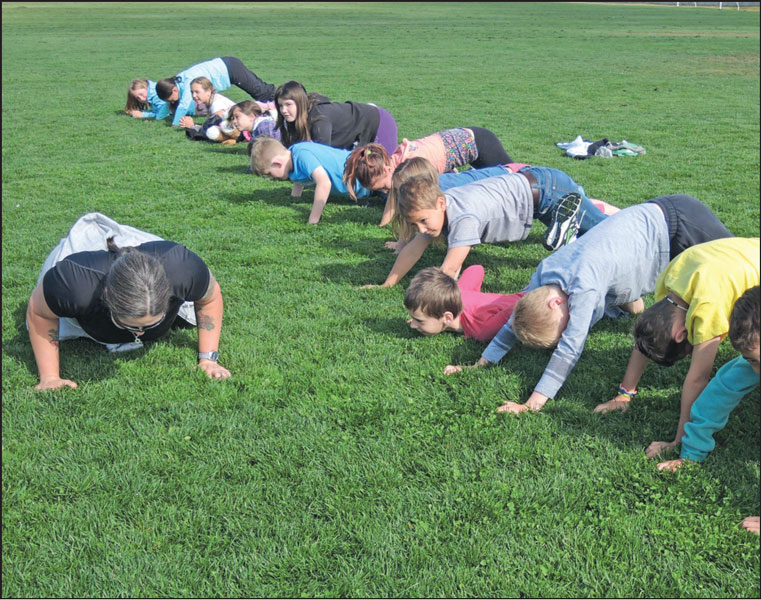
[caption id="attachment_12654" align="alignnone" width="300"] LS Andrée Noye encourages students to do push ups as part of the LEAD program.[/caption]Rachel Lallouz, Staff Writer ~ Grade Four students gathered around Leading Seaman Andrée Noye at École John Stubbs Memorial School March 25, as the military police officer briefed them on teamwork and positive communication. LS Noye, school liaison officer, discussed the WITS LEADS program, which teaches children in Grade 4 and above five problem solving strategies to deal with conflict.Over and above the WITS program that provides strategies to deal with bullies - Walk away, Ignore, Talk it out, or Seek help -, the LEADS program involves Look and listen, Explore points of view, Act, Did it work? and Seek help. “My role at the school allows me to have a positive presence in the community with the children,” she says.“It really adds to the prevention aspect of our job, and that’s part of policing. If, from the beginning, we can help kids develop a positive outlook, they may be less inclined to resort to using violence to resolve their issues.” “I think that having an actual officer in the class to talk about these issues allows the messages to resonate better,” she adds.Other topics she covered include drug use, cyber safety and anti-bullying.To start this particular LEADS class, LS Noye warmed students up on the school’s field with exercises.The class was then separated into two teams.Each group was given a large stuffed lion and was challenged to pass the lion around their circle without using their hands. “I tried to emphasize developing their problem solving skills,” says LS Noye.“And I went for a kinesiology based approach that allowed the kids to be active outdoors.” The class was then split into groups of three, with each group given a plastic Hawaiian lei.Teams...

The Naden Band of the Royal Canadian Navy performs at the Con Brio Festival in Whistler

Naden Band enthralls students at Whistler ConBrio Music Fest

[caption id="attachment_12651" align="alignnone" width="300"] The Naden Band of the Royal Canadian Navy performs at the Con Brio Festival in Whistler, BC.[/caption]PO2 Katrina Bligh, Naden Band ~On the evening of April 23, the Naden Band of the Royal Canadian Navy performed two concerts for over 3,000 music students and teachers at the Whistler Conference Center, hosted by the Con Brio Festival.The festival, now in its 17th year, features three days of non-competitive performing, grading and masterclasses for Wind Band, Orchestra and Choir students from all over Canada and the United States. During the festival, the Commanding Officer of the Naden Band, Lt(N) Matthew Clark, adjudicated multiple wind ensemble performances and instructed several masterclasses and workshops.The concerts on Saturday night were the highlight for the visiting students.Due to the venue being unable to accommodate over 3,000 attendees, the same concert was given twice two hours apart for approximately 1,500 students and teachers. Once the opening acts The Delisle Vocal Project and trombonist Christopher Bill finished their sets, the Naden Band took the stage.  Special guests University of Victoria Wind Ensemble conductor Dr. Gerald King; Con Brio Director Douglas Macaulay; Director of Bands at Pacific University, Oregon, and the former United States Navy senior bandmaster Dr. Michael Burch-Pesses; saxophone soloist Dr. Julia Nolan; singer Marcus Mosely; and Canadian composer Robert Buckley joined the Band. In addition, the Band was augmented by musicians of the Royal Canadian Artillery Band from Edmonton and La Musique du Royal 22e Régiment from Quebec City.“This concert is a wonderful opportunity to connect with students and educators in order to spread the good word of the Navy,” said Lt(N) Clark.“I would also like to acknowledge the hard work and dedication of the fine musicians on stage, who give their all each and every time they put on the uniform....

Lieutenant (Navy) Regina Campbell.

Submarine community welcomes Australian sailor

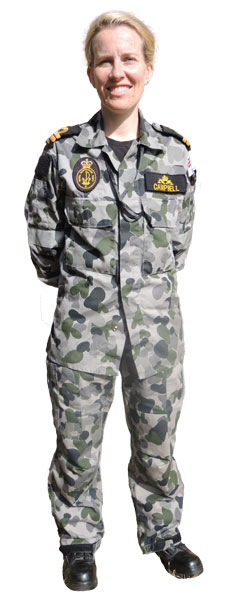
[caption id="attachment_12647" align="alignnone" width="115"] Lieutenant (Navy) Regina Campbell.[/caption]Rachel Lallouz, Staff Writer ~Lieutenant (Navy) Regina Campbell isn’t your typical Maritime Forces Pacific submariner.She hails from the warm, and much saltier waters off the western coast of Australia as a member of the Royal Australian Navy (RAN) based in Perth. She is on an exchange program with the Royal Canadian Navy (RCN), and in the summer will join HMCS Chicoutimi. “Submarines are a fascinating field because the aim of a defence force, in my understanding, is to train to such a level that you are a deterrent force – you prevent attacks and therefore maintain peace.But submarines are a strategic weapon,” she says. “It’s a completely different ballgame and a very challenging environment.” She joined the RAN at age 27, in 2007, and officially became a submariner a few years later.The journey to her Dolphin badge was no easy feat, she says. “You start off with your basic medical and psychological assessments, and then submarine basics, all the while officers keep a constant eye on you to make sure you fit in well in a small environment.Then there’s six months of school on submarine engineering and operational background.” From there, Lt(N) Campbell says she had to complete four information-filled task books and deploy before gaining her “dolphins” and be deemed certified as a safe submariner.She later worked her way to the position of Sonar Officer on board Australian submarine HMAS Dechaineux.Her first time deployed on a submarine was a day tour in 2010 off Sydney. “I remember the first day setting foot on a submarine. I’ll never forget it.I entered this very small microcosm where everyone seemed to know exactly what they were doing. It was exciting and intimidating.” Initially educated as a journalist, Lt(N) Campbell never anticipated she would one day end...

Peter Mallett

MARPAC Nijmegen team starts training

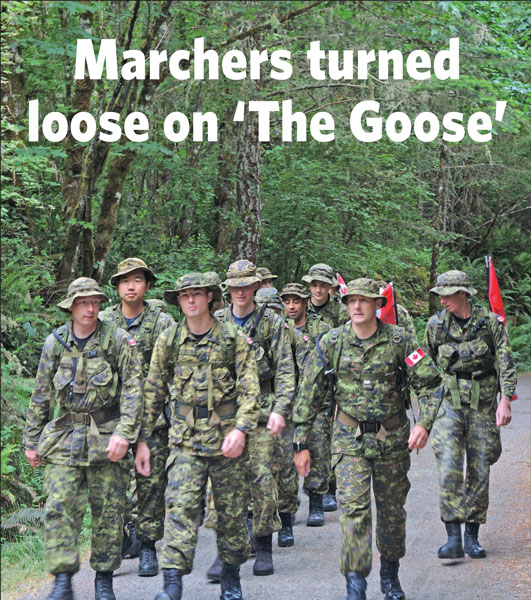
[caption id="attachment_12644" align="alignnone" width="265"] Peter Mallett, LookoutMembers of MARPAC’s Nijmegen marching team at Roache Cove in Sooke.[/caption]Peter Mallett, Staff Writer ~Step by step, over hill and over dale, military members hoping for a spot on the MARPAC Nijmegen team are kicking up plenty of dust as they master long marches on the trail. Last Friday, 18 members dressed in CADPAT and boots with a 12-kilogram rucksack on their back tackled 40 kilometres.They started just after dawn from Roache Cove in Sooke, marching along the Galloping Goose Regional Trail to their final destination of Work Point.“This is the gravy of being in the military,” said team leader, Lt(N) Marianne Knai.“When you are lucky enough to be given the opportunity by the chain of command to come out here and spend the day marching with like-minded people, it’s an amazing experience.”Those lucky enough to make the team will join a long legacy of marchers in Holland July 19 to 22 for the Nijmegen Four Days International Marches.Over 42,000 participants will march 40km over four days – for the MARPAC team, they will join 14 other Canadian military teams.  The most gruelling part of the marching is the toll it takes on the mind and body. From muscle strains to blisters to dehydration and boredom, those tough enough to traverse the Dutch countryside must train well. MARPAC’s team potentials have been at it since February, and won’t know their fate until early June.  Joining Lt(N) Knai is second-in-command WO Kevin Legg, who has once before endured the training and Nijmegen marches. “Having Kevin as our 2IC again this year is incredible,” said Lt(N) Knai. “Many of the marchers on this year’s team don’t know about his inspirational story of strength and courage because Kevin is such private and humble individual, but they should...

Navy and RCM-SAR work together to save sailing vessel.

Navy and RCM-SAR work together to save sailing vessel

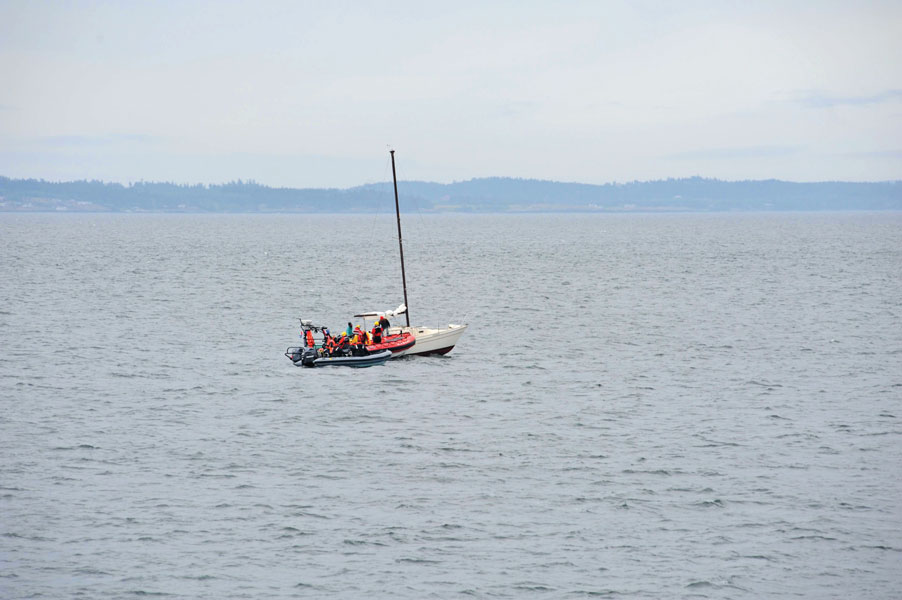
[caption id="attachment_12640" align="alignnone" width="300"] Navy and RCM-SAR work together to save sailing vessel.[/caption]SLt Sully Heraud, HMCS Yellowknife ~Three weeks ago, on May 14, HMCS Yellowknife was conducting operations for intermediate multi-ship readiness training when a call was made by Victoria Coast Guard looking for information on a sailing vessel, Trinity 1.The vessel was adrift with a bent mast in the vicinity of Darcy Island.The decision was made by Yellowknife Captain, LCdr Jeffrey Hopkins, to render assistance to the vessel.Once on scene, Yellowknife established communications with the vessel’s two crew members and was informed that its engine was broken and the crew had no way of manoeuvering it out of danger.Trinity 1 was drifting towards the rocks at Kelp Reef, southeast of Sidney Island, and sunset was approaching.As proximity to dangers increased, Yellowknife decided to tow the sailing vessel with it rigid hulled boat.Once the sailing vessel was safely in tow, LCdr Hopkins requested assistance from the Royal Canadian Marine Search and Rescue Unit (RCM-SAR) located close by in Oak Bay.A RCM-SAR rescue boat was sent to the Ten Mile Point area to affect a turnover of Trinity 1 and tow it back to Cadboro Bay, where the vessel originated.The quick reaction of the crew of Yellowknife, as well as an eagerness to respond by the RCM-SAR potentially saved two lives that day.“It is a good thing when the cooperative effort of different organizations results in the successful rescue of people in distress,” said LCdr Hopkins.“The events of that day show us that in order to keep our coastal waters safe, everyone has to work together.”

Photo by Lt(N) Joel Cormier Leading Seaman Hector Ladron de Guevara from Fleet Diving Unit (Pacific) recently deployed on Operation Open Spirit 2016 in Lithuania.

Operation Open Spirit: Local diver helps make the Baltic Sea safe

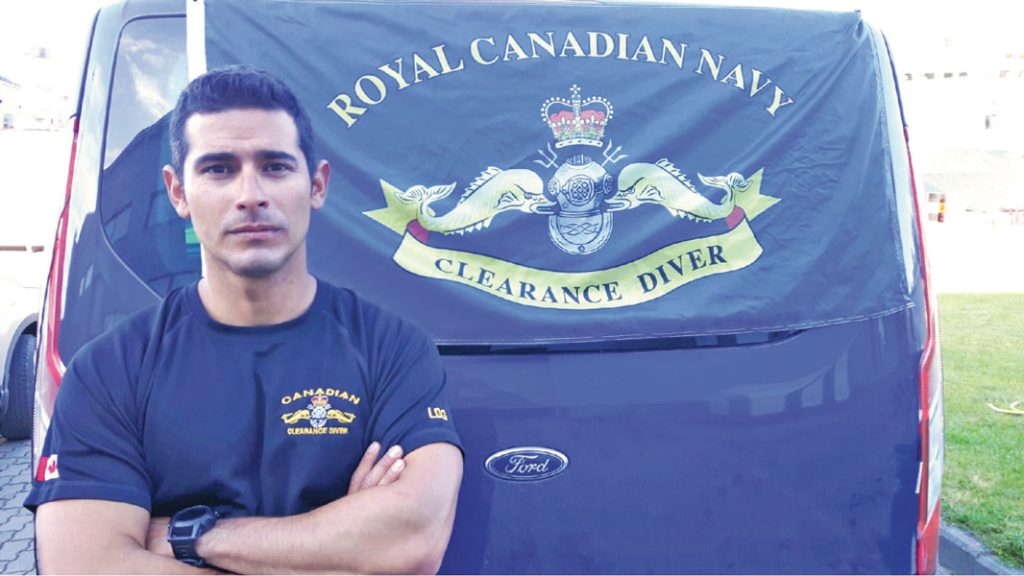
[caption id="attachment_12637" align="alignnone" width="300"] Photo by Lt(N) Joel CormierLeading Seaman Hector Ladron de Guevara from Fleet Diving Unit (Pacific) recently deployed on Operation Open Spirit 2016 in Lithuania.[/caption]Captain Kirk Sullivan, CJOC Headquarters ~A Clearance Diver from Fleet Diving Unit (Pacific) recently deployed to Lithuania to help improve the safety of seafarers in the Baltic Sea. Leading Seaman Hector Ladron de Guevara participated in Operation Open Spirit 2016 in Klaipeda, Lithuania, from May 13-27.He and his fellow divers worked with their counterparts from 12 nations to remove unexploded ordnance left from the First and Second World Wars.During the operation, LS Ladron de Guevara placed explosives on a recently discovered mine.When the area around the mine was secured, the Canadian dive team conducted a controlled detonation. “It’s a challenging task and we need to be careful when approaching objects that could be mines,” he said.“When objects are identified as mines, we use our well-rehearsed procedures to ensure we conduct the detonation safely. We practice regularly to make sure we’re ready for these real-life situations.”Originally from Villahermosa, Mexico, LS Ladron de Guevara came to Canada in 1996 and joined the Canadian Armed Forces in 2001 as Boatswain.He became a Clearance Diver in 2012 and has deployed on Exercise Dugong and Operation Nanook. “I love training for operations and appreciate the opportunities to deploy and work alongside divers from around the world,” he said.During Operation Open Spirit 2016, he and the Canadian dive team exchanged tactics, techniques, and procedures with allies in order to refine explosive ordnance disposal capabilities.“It’s always interesting to work with divers from other countries,” he said.“During this operation, we shared practices that work well for us and picked up some good tips that may help us in the future. It was a great experience.”Operation Open Spirit is an annual multinational...

Base opens door to the general public

[caption id="attachment_12631" align="alignnone" width="249"] Westshore Navy Day takes place June 11 from 10:30 a.m. to 3 p.m. at the military facilities off Rosebank Road.[/caption]Rachel Lallouz, Staff Writer ~Residents of Greater Victoria can discover the unique world of the Royal Canadian Navy when CFB Esquimalt cracks open its Colwood property for a visitor open house in two weeks.Westshore Navy Day takes place June 11 from 10:30 a.m. to 3 p.m. at the military facilities off Rosebank Road.“Navy Day is our opportunity to invite the community within which we reside to come visit us,” says Captain (Navy) Steve Waddell, Base Commander.“Our goal is to eliminate the mystery of the Base by showcasing our capabilities, which are developed and sustained for the missions we are tasked to do.A naval presence has been here for 150 years; as the third-largest employer in the region the Base and its workforce, both military and civilian, are inextricably linked to all of the area’s municipalities.”Organizers have mixed fun and informative in the daylong outing.Major highlights are the up-close tours of Patrol Craft Training Vessel Orca, HMCS (Her Majesty’s Canadian Ship) Winnipeg, just back from a nine-month deployment in the Mediterranean, and HMCS Saskatoon, which returned last month after conducting anti-drug smuggling operations in the Caribbean.Visitors will have the opportunity to meet the crew and ask questions about these international missions, as well as take guided walks through the ships. For the more adventurous there are rigid hull inflatable boat (RHIB) rides around the harbour.Organizers want parents to be aware there is a height requirement, so to avoid disappointment those 50 inches or more are eligible.From the vantage of the dock, visitors can watch the adeptness of the base’s Glen class tugboats, which are entrusted to move the warships in and out of the jetties.These Canadian Forces Auxiliary Vessels will perform a tugboat ballet for onlookers.Lowering from a Cormorant search and rescue helicopter over the harbour will be search and rescue technicians. In their bright orange jumpsuits they...

Former co-op student Katelyn Moores (centre) poses with current co-op students (from left to right) Sonya Chwyl

Student bridging at MARPAC helps rejuvenate the Federal Public Service

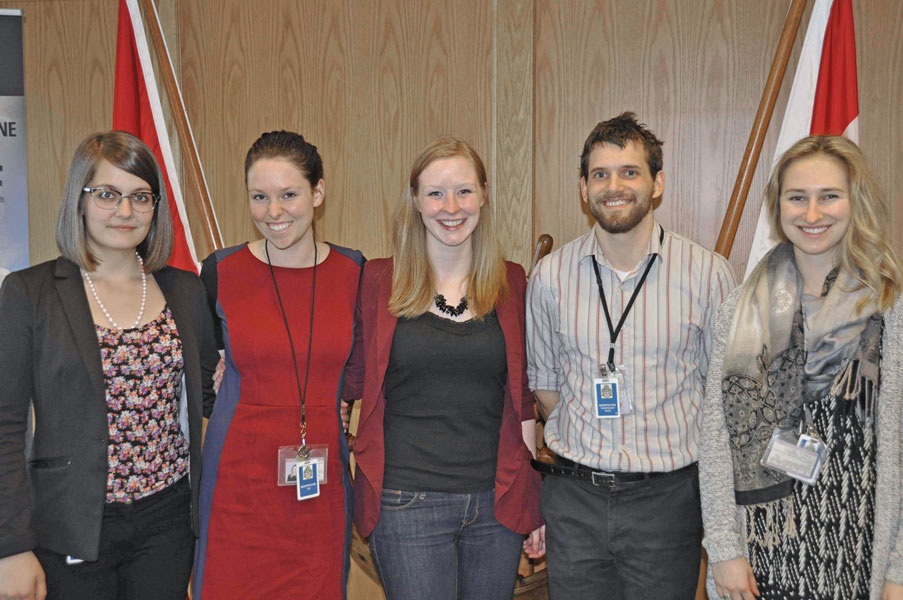
[caption id="attachment_12625" align="alignnone" width="300"] Former co-op student Katelyn Moores (centre) poses with current co-op students (from left to right) Sonya Chwyl, Lindsey Hardcastle, Cameron Carswell and Amanda Lichon, to celebrate Moores recent acceptance of a full-time position with Maritime Forces Pacific Public Affairs.[/caption] Amanda Lichon and Valerie Froud, MARPAC PA Office ~Facing an aging workforce expected to retire in the next decade, Maritime Forces Pacific (MARPAC) is actively scouting new talent for Public Service positions.Students who have completed cooperative work terms at CFB Esquimalt are the ideal candidates, having gained some corporate knowledge and experience during their employment.“Student bridging is another hiring option available to federal government managers to help rejuvenate the workforce with the brightest and most talented individuals,” explains Helen Bates, Acting Human Resource Programs and Planning Manager.This hiring strategy aligns with the organization’s succession planning.“Students have showcased their abilities and already have knowledge about working within the Federal Government,” says Bates. “It makes sense to access this pool of potential employees and hire them.”MARPAC has a very prolific co-op employment program. Between 2013 and 2015, 109 co-op students worked at MARPAC, with several successfully bridged into full time employment.Ashley Milburn, who completed her co-op January to April term in 2009, was hired five months later - one of the first at MARPAC to be hired under student bridging program. She is now the Manager of International Engagement at MARPAC.“As a new graduate, the student bridging program provided an excellent avenue for me to be able to translate my education and work experience into meaningful employment,” said Milburn.Meghan Lawlor recently completed two consecutive co-op work terms at MARPAC with the Civilian Human Resource Service Centre (Pacific) (CHRSC (P)).“The Co-op Program at the University of Victoria gives students the skills and abilities to venture out into the workforce,” says Lawlor....

Photo courtesy of 3 CFFTS The infamous “Rivers Bell”

Rivers Bell, a story of honour and thievery

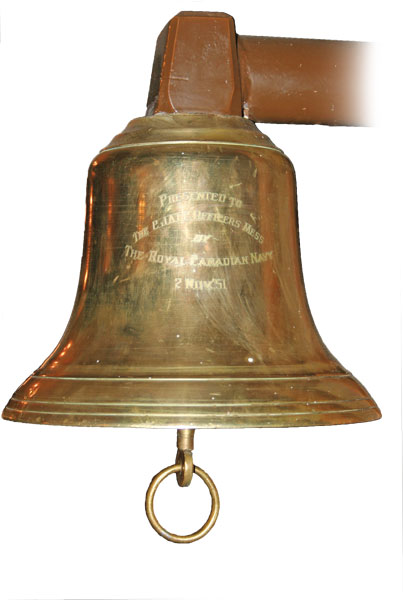
[caption id="attachment_12618" align="alignnone" width="201"] Photo courtesy of 3 CFFTSThe infamous “Rivers Bell”, a bell that once sat in the Officers’ Mess at RCAF Station Rivers, now resides in the Officers’ Mess at Portage La Prairie, as seen in 2008.[/caption]Bruce Forsyth, militarybruce.com ~A ship’s bell is an essential component of any ship. Usually made of brass with the ship’s name engraved on it, the ship’s bell is used to indicate time on board a ship, and regulate the duty watches.They are also rung in foggy conditions, and are often the only conclusive means of identifying shipwrecks.The “Rivers Bell” has its own unique place in the history of ship’s bells. A strictly land-based bell, the Rivers bell was a gift from the Royal Canadian Navy to the Canadian Joint Air Training Centre at RCAF Station Rivers in November 1951.Year after year, the bell hung in the corner of the Officers’ Mess, cheerfully rung to signal a promotion with “drinks all around” for mess mates.However, like most ship’s bells that travel from port to port along with their respective ships, the Rivers Bell was not one to be tied down to one location.As the story goes, one night in 1955, personnel from RCAF Station Moose Jaw took it upon themselves to “liberate” the Rivers Bell, transporting it across the prairie to their mess back in Moose Jaw and installing it on a “theft proof” steel beam mount.The Base Commander at Rivers, Group Captain Jack Sproule, was none too happy about this turn of events. To rectify the situation G/C Sproule led a “rescue party” to retrieve their bell one weekend in September 1955.Mingling with the Sunday morning church crowd, the rescuers succeeded in penetrating the Officers’ Mess, disabled the phones and secured the mess occupants, including the orderly officer.With hack saws and a...

Team Canada captain LS (Ret’d) Bruno Guevremont (left) is all smiles at the Invictus Games Opening Ceremonies.

Former members bask in glow of Invictus medals

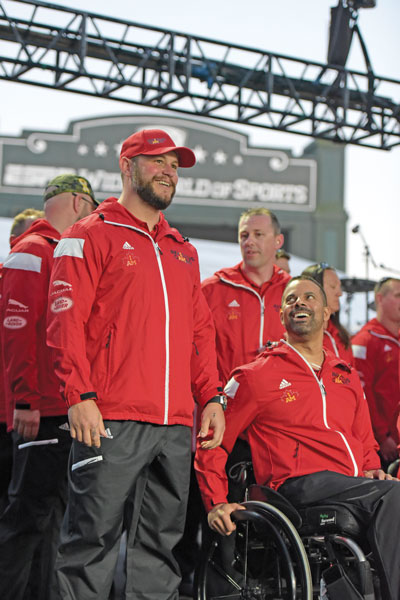
[caption id="attachment_12622" align="alignnone" width="200"] Team Canada captain LS (Ret’d) Bruno Guevremont (left) is all smiles at the Invictus Games Opening Ceremonies.[/caption]Peter Mallett, Staff Writer ~Days before heading to the 2016 Invictus Games in Orlando, Florida, retired Master Corporal (Retired) Adam Cyr said he wasn’t shooting for the podium.Being there with fellow wounded warriors, many working their way back to health and life, was fulfilling enough.But shoot for the podium he did, in the archery competition, earning a silver medal.The 37-year-old amputee, and teammates Sgt (Ret’d) Nicolas Meunier of Montreal and Cpl (Ret’d) Sarah Dentry-Travis of Winnipeg shot their way to a second place finish in the Team Novice Recurve.“It was a great moment and we are so proud of Adam winning and representing the west coast athletes at the Game so well,” said Team Canada’s captain, LS (Ret’d) Bruno Guévremont.MCpl (Ret’d) Cyr served with 2PPCLI Shilo, Manitoba, and lost his right leg and suffered shoulder and hearing injuries during a Taliban rocket attack in 2008. The silver medal was added to Canada’s 28-member team’s final tally of 22 medals – 10 gold medals, eight silver, and four bronze.That total outshined the two silver medals Canada won at the inaugural 2014 Invictus Games in London where 12 Canadian military athletes participated. At the closing ceremony LS (Ret’d) Guévremont was centre stage when the Invictus Games flag was lowered, and then handed to him and Michael Burns, CEO of the 2017 Invictus Games, which will be held in Toronto. “It was only a few years back that I was suffering from PTSD and in a pretty dark place,” said LS (Ret’d) Guévremont.“To be on the stage accepting the Invictus Games flag for Canada for the next Games was a fantastic feeling.This year’s Games changed the lives of so many of 28 current...

CPO1 Alan McNaul (left) and business partner Victor Cunha pose for a photo at the Dragon's Den audition.

Sailor turns inventor and solves a corrosion problem

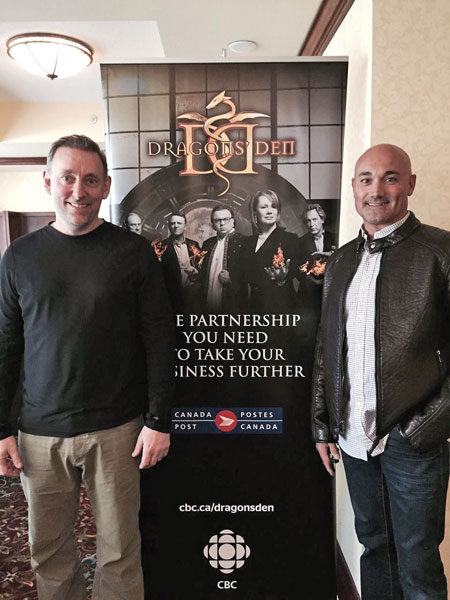
[caption id="attachment_12615" align="alignnone" width="225"] CPO1 Alan McNaul (left) and business partner Victor Cunha pose for a photo at the Dragon's Den audition.[/caption]Rachel Lallouz, Staff Writer ~Coxswain of HMCS Regina, Chief Petty Officer First Class Alan McNaul has turned from seasoned sailor to rookie inventor.He recently created a trailer wire protection device, Connect-to-Protect, with business partner Victor Cunha.Within a week of developing their first prototype, the two landed themselves a Dragon’s Den audition in February. Though they did not make the season’s cut, the opportunity has led to negotiations with Canadian Tire, Lee Valley Hardware, Lordco Auto Supply, and other suppliers. “For me, this is a project of passion,” says CPO1 McNaul. “I love the adventure of going through all of the steps to get something out of a great idea.” Like all great inventions Connect to Protect solves a problem. All trailers, whether heavy-duty industrial trailers, or boat or RV trailers, have a connector, or collection of wires, that are hooked to a vehicle to provide the trailer with power.When not hooked up, the connector dangles unused off of the trailer’s front.This makes the connector vulnerable to damage from moisture, dirt, and dust. “You might get up one morning to leave on a fishing trip, and find the lights on your trailer won’t turn on because the connector has been damaged,” says CPO1 McNaul. Trailer owners must pay between $30 and $60 to replace the connector, and, says Chief McNaul, time spent replacing a new connector means lost recreational time.“Things start getting expensive or inconvenient for people who just want to get out and hook up their RV to go camping, or get their boat on the water.” The Connect-to-Protect is a small plastic clip that holds the connector to the trailer, ensuring the trailer’s connector is up off the ground,...

Naval Cadet In Training

Cadet leads military college to West Point win

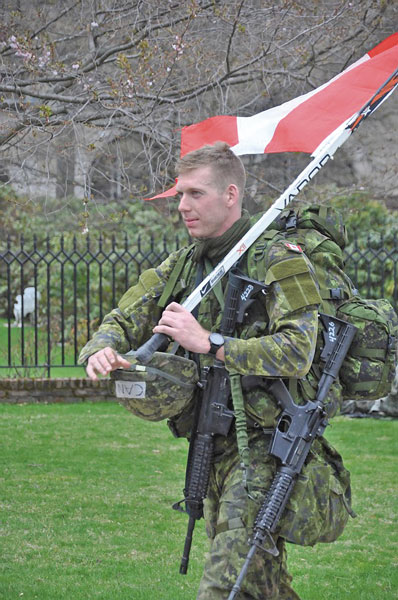
[caption id="attachment_12611" align="alignnone" width="199"] Naval Cadet In Training, Graham Mater of the Royal Military College carries the Canadian flag at the Sandhurst Military Skills competition at West Point, N.Y., April 9.[/caption]Peter Mallett, Staff Writer ~A Naval Cadet in Training is celebrating his team’s recent triumph at the prestigious Sandhurst Military Skills Competition.NCdt Graham Mater, 23, was a member of the Royal Military College Canada (RMCC) military skills team that notched its fifth victory in the annual regimental skills competition held at West Point, N.Y., April 8 and 9.The native of Guelph, Ont., who will return to CFB Esquimalt in June to continue the officer training program, says he was elated when he and his teammates learned they were tops in the event’s international category, as well as winning the event’s overall title.“It felt really good. The RMC team was very proud to represent Canada on the international stage,” said NCdt Mater. “We knew that all of the international teams would return to their home countries and spread the news that Canada had won the competition.”The regimental skills competition was founded in 1967 with a mandate to enhance professional development and military excellence among corps of cadets. The nine-member squads (which include two alternates) perform a series of tasks including obstacle course navigation, rifle marksmanship, a raft paddle, weapon handling skills, combat first aid, and leadership challenges.  The modern-day version of the competition was created in 1994 to keep the event in sync with changing demands of the military.   This year’s regimental skills competition involved 60 teams from across the United States and around the world, and the RMCC victory even caught the attention of Defence Minister Harjit S. Sajjan who officially congratulated the team.“RMCC’s achievement is significant and is a testament to the commitment and skill of everyone involved,” said...

Explore More

Categories

Top News

E-Editions Archive

News Stories Archive

Proud Supporters

Joshua Buck, Lookout Newspaper