
Recognition for all Canadian Veterans
Horseback ride across Canada intended to inspire recognition for all Canadian Veterans.
Horseback ride across Canada intended to inspire recognition for all Canadian Veterans.
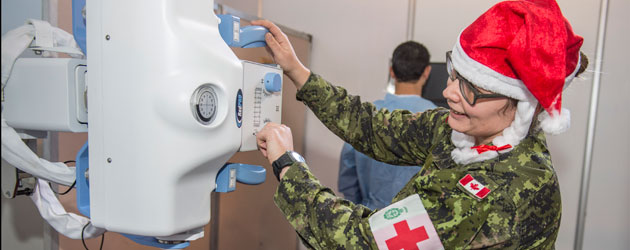
Showing a little holiday spirit, MCpl Nadia Richard of 5 Field Ambulance in Valcartier operates an x-ray machine during a medical screening as part of Operation Povision in Amman, Jordan on Dec.23, 2015.
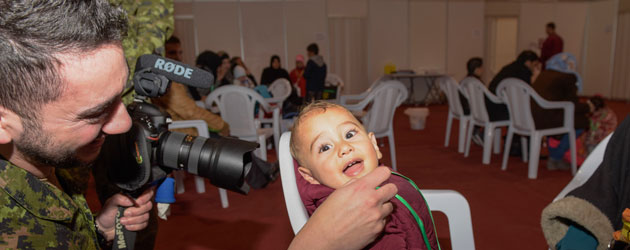
Cpl Mohamed Anis Assari of CFB Cold Lake Alberta entertains a young boy at the Processing Centre in Amman, Jordan on Dec. 16, 2015 during Operation Provision.

A Syrian couple and Major Real Hebert, a doctor from 5 Field Ambulance in Valcartier, during a medical screening in Amman, Jordan on Dec. 24, 2015 during Operation Provision.
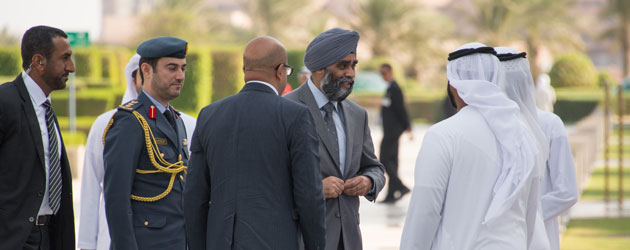
The Honourable Harjit S. Sajjan, Minister of National Defence meets the guides at the Sheikh Zayed Grand Mosque prior to a cultural tour organized during a visit to Abu Dhabi in the United Arab Emirates on Dec. 22, 2015.
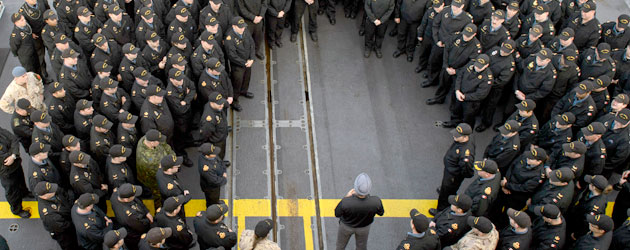
Minister of National Defence Harjit S. Sajjan addresses the ship’s company of HMCS Winnipeg during his visit on Dec. 23, 2015 during Op Reassurance.
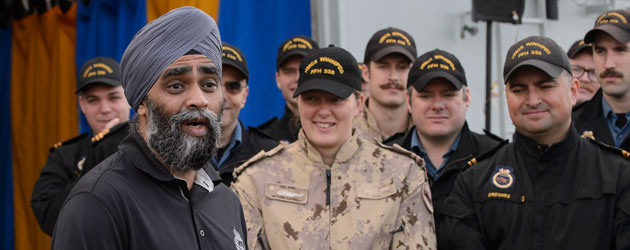
Minister of National Defence Harjit S. Sajjan addresses the ship’s company of HMCS Winnipeg during his visit on Dec. 23, 2015 during Op Reassurance.

DND >> A more modern pay system is rolling out for public servants and civilians across the Department of Defence (DND).As a part of the Blueprint 2020 action plan, the government has been working towards the implementation of Phoenix, a modern, commercial and industry-standard pay system for federal employees, replacing the current 40-year-old regional system.One part of the Transformation of Pay Administration Initiative is the introduction of Phoenix to users.The Pay Modernization project has been ongoing gradually since having been announced in August 2010. The second part of this initiative is to move a total of 184,000 pay accounts from 46 government organizations to the new Public Service Pay Centre in Miramichi, New Brunswick.By spring 2016, Phoenix will be implemented in 102 federal departments and agencies, with the implementation for DND taking place in February 2016. As of this date, all civilian pay services will be provided through the Pay Centre.Training courses for Phoenix will be available soon and civilian employees and managers are encouraged to participate to better understand how to navigate through the new system. The training course consists of an hour-long session and can be accomplished at ones own pace from any network, including those outside the government. For military managers of civilian employees, ADM(HR-Civ) will provide additional direction about myKEY and MyAccount alternatives in the near future.Signing up for myKey and MyAccount now and taking the training will have users out ahead of the pack to lead off 2016 on the right foot. For questions regarding Phoenix or details regarding the training sessions, visit the Pay Transformation page (http://hrciv-rhciv.mil.ca/en/e-compensation-pay-transformation.page).The Phoenix system reduces process time and paperwork and has increased self-service features that allow users to access and manage their pay information from their computer.There are three things civilian employees and managers need to do to get...
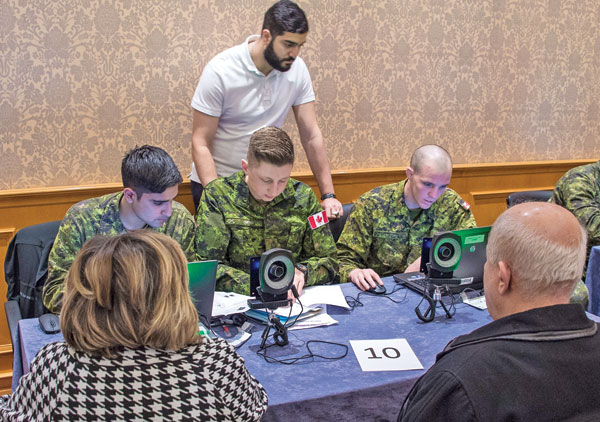
[caption id="attachment_11635" align="alignnone" width="600"] Members of Joint Task Force Forward, operate the bioscan systems for processing refugees in Beirut, Lebanon, during Operation Provision.[/caption]Steven Fouchard, Army Public Affairs >> As the first Syrian refugees arrive in Canada, Army Reservists are on the ground and eager to help keep them safe and comfortable while they await permanent resettlement in their new home.The reservists have volunteered to be part of Operation Provision, the Canadian Armed Forces’ (CAF) contribution to the resettlement initiative, which is being led by Immigration, Refugees and Citizenship Canada (IRCC).Most are serving in auxiliary security roles or augmenting staff on the various CAF bases where refugees may be temporarily housed should the need arise. Several say they feel a personal connection to the mission.“I signed up for Op Provision because I wanted to welcome the Syrian refugees to Canada,” said Gunner Markus Hale, a member of 56 Field Regiment, Royal Canadian Artillery (RCA), based in Brantford, Ontario. “As an immigrant and a Canadian soldier, I felt it was my duty to volunteer.”“I joined Op Provision because my parents were refugees to Canada and had a better life,” added Corporal Dardal Malushaj, with the Toronto Scottish Regiment. “I want to give back and help the Syrian refugees have a better life as well.”Canada’s resettlement plan will continue to evolve as it moves forward. CAF members have both the training and high level of readiness needed to evolve with it.The multi-faceted resettlement plan starts with the identification and processing of the approximately 25,000 displaced Syrians that IRCC estimates Canada will be taking in. A contingent of CAF members are deployed in Lebanon, Jordan and Turkey to assist.According to IRCC, the 25,000 were to be identified by Dec. 31 and the expectation was that 10,000 of those would be welcomed to Canada by...

RCAF Public Affairs >> The Royal Canadian Mint has launched a new $20 silver coin commemorating the British Commonwealth Air Training Plan (BCATP).The Plan, as it came to be known, arose from Prime Minister William Lyon Mackenzie King’s desire to see Canada contribute meaningfully to the Allied war effort while, hopefully, maintaining control of Canadian personnel rather than seeing them absorbed into British units, and avoiding the terribly high casualty rates of the First World War. The BCTAP agreement was signed in late 1939, and ran until 1945.It was a simple plan, on the surface. Once Commonwealth nations around the world had determined through their own Elementary Flying Training Schools (EFTS) that enrollees did, indeed, have “the right stuff”, candidates arrived at BCATP schools throughout Canada for advanced flying training, and air gunnery, wireless operator and air observer instruction. Upon graduation, aircrew travelled to England where they formed units and entered the fray under their own nations’ banners.Beneath this ordered surface was one of the most demanding efforts undertaken by Canada during the Second World War.Airfields and schools were repurposed or constructed throughout Canada. These facilities and their supporting infrastructure would employ some 33,000 military personnel and about 6,000 civilians, and require about 5,000 aircraft – at a staggering cost of more than $607 million.By war’s end, BCATP schools had trained 131,553 Allied aircrew, and Canada had become known as “the aerodrome of democracy”. The Plan was one of the most successful efforts undertaken by Canada during the Second World War. A legacy of the BCATP is visible in the many airfields and regional airports that dot our nation today.The Royal Canadian Mint’s new British Commonwealth Air Training Plan commemorative $20 silver coin is a fitting tribute to The Plan and to the Canadians who brought it to life.With thanks...
HMC Ships Brandon and Whitehorse return to Esquimalt Harbour from Operation Caribbe on Dec. 17.
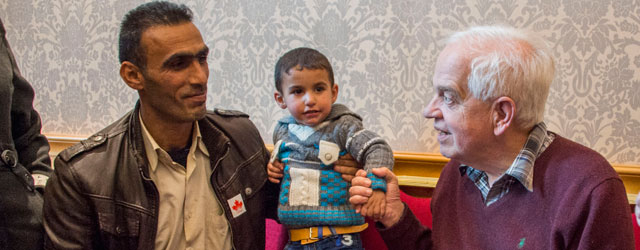
John McCallum, Minister of Immigration, Refugees and Citizenship Canada speaks with a refugee family at the Canadian Operations Centre, where Syrian refugees apply for immigration to Canada, during Operation Provision in Beirut, Lebanon.
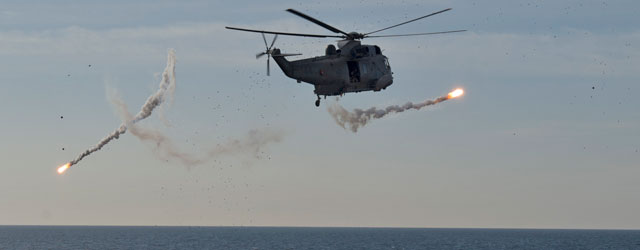
HMCS Winnipeg’s CH-124 Sea King helicopter fires flares during a training exercise in the western Mediterranean Sea.
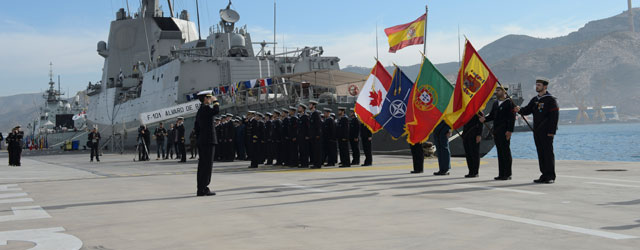
Members of HMCS Winnipeg stand on parade as part of the Standing NATO Maritime Group One operational handover ceremony in Cartagena, Spain on Dec. 18.
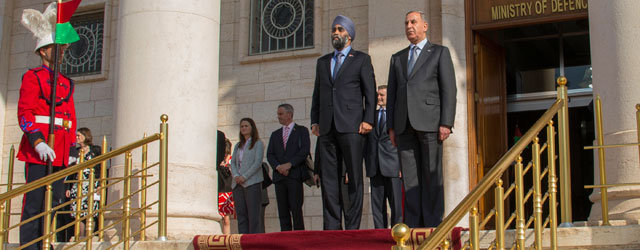
Harjit S. Sajjan, Minister of National Defence, and Khaled al-Obeidi, Defense Minister of Iraq, stand side-by-side at a ceremony during an official visit to Baghdad, Iraq, on Dec. 20.
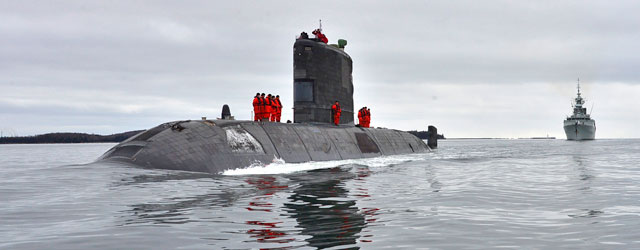
HMCS Windsor returns home to CFB Halifax on Dec. 17, 2015 after taking part in Joint Warrior and Trident Juncture, coordinated exercises with NATO allies to enhance combat readiness.
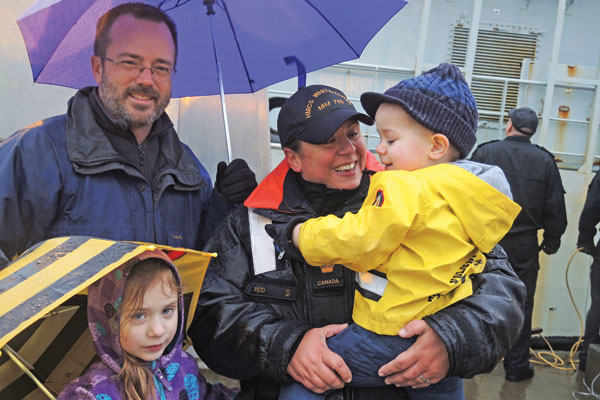
[caption id="attachment_11601" align="alignnone" width="600"] Left to right: CPO2 Don Reid greets his wife PO1 Allison Reid as she disembarks from HMCS Whitehorse at the completion of Operation Caribbe last Thursday. She holds her son Jackson as daughter Madeleine stands close by.[/caption]DND – The last Canadian Armed Forces (CAF) assets, HMC Ships Brandon and Whitehorse arrived home last Thursday, concluding a successful year for the CAF on Operation Caribbe. Canada’s 2015 annual contribution to the multinational campaign against illicit trafficking in the eastern Pacific Ocean and the Caribbean – Operation Martillo – saw CAF assets and personnel directly contribute to the seizure or disruption of approximately 18.5 metric tons of cocaine and three metric tons of marijuana, more than any other year since the CAF’s contribution began in 2006. As part of Operation Caribbe 2015, the CAF contributed four CP-140 Aurora surveillance aircraft, five Maritime Coastal Defence Vessels (HMC Ships Brandon, Goose Bay, Nanaimo, Shawinigan and Whitehorse), two Halifax-class frigate with their embarked CH-124 Sea King helicopter (HMC Ships Winnipeg and Vancouver), and one Iroquois-class destroyer (HMCS Athabaskan) with its two embarked CH-124 Sea King helicopters.Royal Canadian Navy ships deployed a total of 10 times (HMC Ships Whitehorse and Winnipeg deployed twice each) and sailed for a total of 344 days. Royal Canadian Air Force CP-140 Auroras flew 321 hours, and CH-124 Sea Kings flew 150 hours, providing surveillance, detection, and disruption capabilities during the operation.HMC Ships Brandon and Whitehorse seized and disrupted more narcotics during a 44-day deployment this fall than any other duo of Maritime Coastal Defence Vessels during the operation’s history, with a combined total of approximately 9,800kg. The previous record of 5,934 kg was held by HMC Ships Whitehorse and Nanaimo, obtained earlier this year while deployed in the Eastern Pacific.“I have seen the terrible damage inflicted...
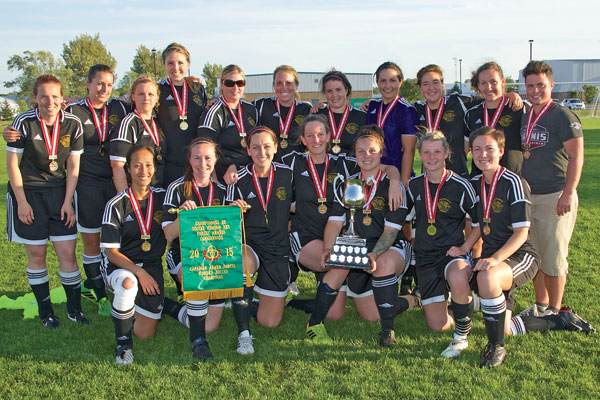
[caption id="attachment_11598" align="alignnone" width="600"] A group photo of the Pacific Region Women’s Soccer team from Esquimalt who won the Championship for the Women’s Soccer Nationals hosted by CFB Borden, Ontario.[/caption]Peter Mallet, Staff Writer – 2015 was a year of firsts for the Pacific Region Women’s Soccer team.They won their first Canadian Armed Forces National Championship trophy, and collected their first-ever award at the annual sports awards luncheon in Esquimalt, where they were crowned Breakthrough Team of the Year.But the real kicker is they couldn’t have achieved it without the guidance of first-time, rookie coach Sgt Caleb Klimas.“We were complete underdogs heading into the national tournament,” says Sgt Klimas, a medical technician at the base clinic in CFB Esquimalt. “We lost our first two games but just kept getting stronger every game after that point, and then won four games in a row.”The Pacific Region team hoisted the Nichola Goddard Trophy at CFB Borden on Sept. 13 after defeating Quebec 2-1 on penalty kicks. Midfielder Lt(N) Tien Nguyen represented the Pacific Region’s team at the tournament for the third time, and said the victory over Quebec “came as a complete surprise” to her and her teammates. It’s always been an uphill battle for the Pacific team because of the constant deployments, she says, and sailings at the base coupled with a smaller pool of players to draw from makes it difficult to field a competitive team.“Sgt Klimas was a communicator, a motivator, but also had an easy-going and relaxed style of coaching that was a perfect fit for this team,” says Lt(N) Nguyen, a combat systems engineering officer with HCM West. Sgt Klimas played youth soccer on the lower mainland in Surrey and served as a defender for Kwantlen Polytechnic Institute soccer team. But he admits it really wasn’t his experience...
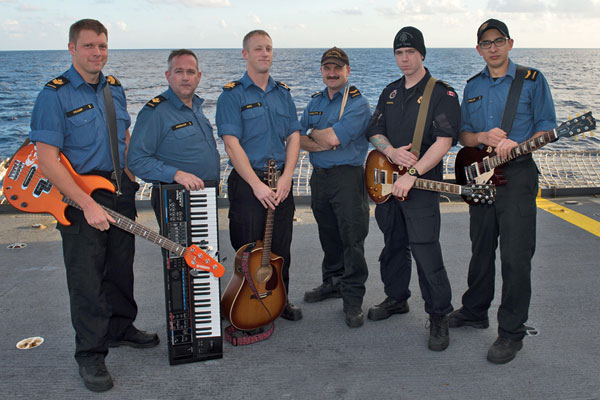
[caption id="attachment_11594" align="alignnone" width="600"] HMCS Winnipeg’s cover band, “The Zeroes”.[/caption]MS Bevin Gordichuk, HMCS Winnipeg – “When musicians get together and combine their efforts to produce a single sound, it’s some of the most symbiotic team work one can imagine. If you want to observe team work that approaches perfection, check out a well-rehearsed band.” PO2 Pete Fraser, November 2015.HMCS Winnipeg’s cover band - ‘The Zeroes’ were ready to perform their first shore gig in Toulon, France, Nov. 19, but the terrorist attacks in Paris interrupted their plan. It was a shocking reminder of the importance of the ship’s mission during their nine-month deployment on Operation Reassurance. The band has a strong following and has participated in morale-raising events throughout the deployment. Their crowning achievement to date was the visit from Team Canada, which included the Commander of the Royal Canadian Navy (RCN), RCN Command Chief, former hockey and football stars, and Honorary Captain (Navy) Arlene Dickenson. They met in Belfast, Ireland on Oct. 10 where the Zeroes played a six-song set followed by an encore with two-time Juno Award nominated musician Kira Isabella Wilkie to sustained applause from their appreciative ship mates.The band members - lead singer and rhythm guitar Lt(N) Justin Dunn, lead guitar LS Brian Bourassa, acoustic guitar LS Joseph Chisling, keyboardist MS Bevin Gordichuk, bassist PO2 Pete Fraser, and drummer LS Dan Camellato (a.k.a. Animal) - formed the group after Lt(N) Dunn and LS Bourassa began jamming in Cabin zero as a way to decompress and share their love of playing music during the deployment. They recruited PO2 Fraser for bass, and LS Chisling for guitar.“I had only been playing guitar for a few years as a hobby and didn’t really give it enough attention,” said LS Chisling. “Working with the guys over the course of the...

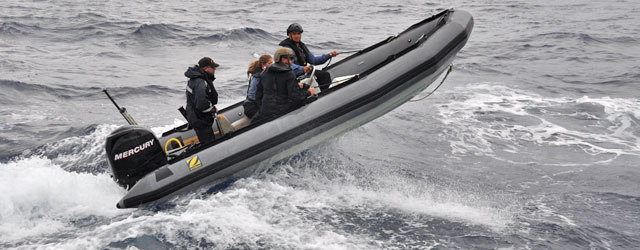
Members of HMCS Brandon practice "sticking drills" while deployed on Operation Caribbe in the Eastern Pacific.
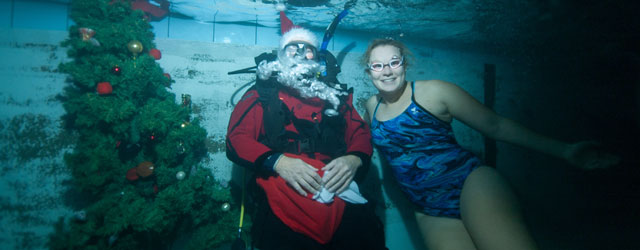
A participant gets her photo taken at the Personnel Support Programs Swim with Santa event, held at the Naden Athletic Centre on Dec. 5.
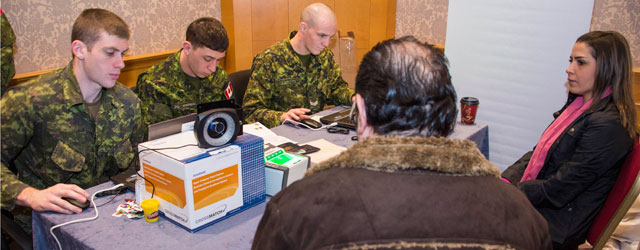
Cpl Carter, Pte McDougall and Cpl Ford, members of Joint Task Force Forward, operate bioscan systems for processing refugees in support of the Government of Canada’s Operation Provision in Beirut, Lebanon.
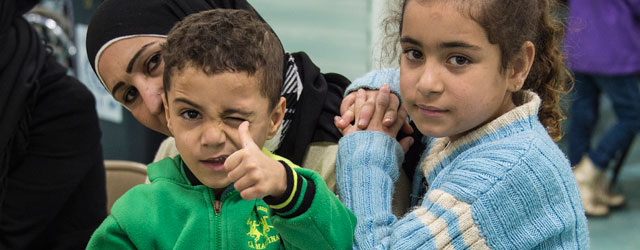
Two Syrian refugee children pose for the camera, while their family under goes the medical screening portion of the Government of Canada’s Operation Provision in Beirut, Lebanon. CAF members have helped to make the process a smooth one.
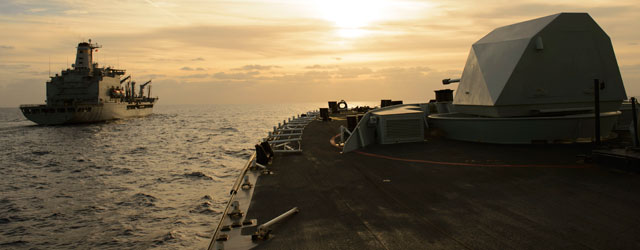
HMCS Winnipeg approaches United States Naval Ship Laramie prior to conducting a Replenishment At Sea during Operation Reassurance in the Mediterranean Sea.
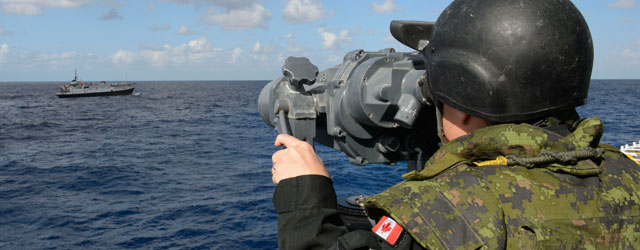
A bridge lookout on board HMCS Winnipeg watches a merchant vessel during Operation Reassurance in the Mediterranean Sea.
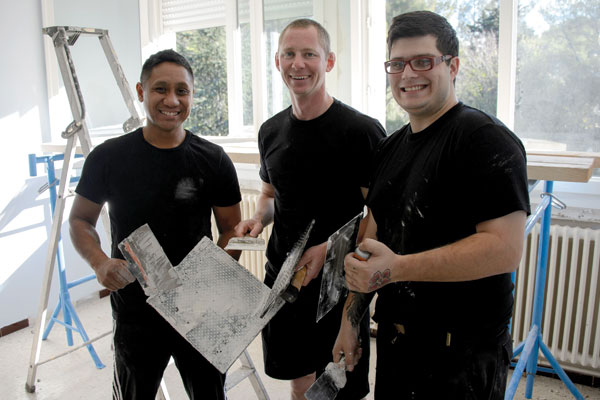
[caption id="attachment_11561" align="alignnone" width="600"] LS Jose Villano, LS Andrew Drake and AS Matthew White from HMCS Winnipeg help with renovations at the Résidence solidaire les Favières in Toulon, France, during a break from Operation Reassurance Nov. 18.[/caption]SLt Jamie Tobin, HMCS Winnipeg – Eight members of HMCS Winnipeg assisted a local not-for-profit organization in Toulon, France, Nov. 19.The team went to Résidence solidaire les Favières, a local rehabilitation centre that provides a stable living environment for people in Toulon that require support. While they were there, the team painted living areas and took on landscaping jobs that provided the grounds with a much needed facelift.“The group did a lot of great work out there,” said PO1 Timothy Hobson, one of the team leads. “We were able to accomplish as much in one day that their one maintenance employee could have accomplished in several weeks, and he was very pleased with the result.” The work party took on this community relations initiative during the ship`s rest and maintenance period, a time that is set aside from major deployments to conduct maintenance on the ship and give the crew a brief reprieve from operations. Those involved in the event were more than willing to take time away from this period to lend a hand in support of the community.“We really appreciated the team’s work, willing spirit and openness to help out,” said Tim Rawls, the Director of Résidence solidaire les Favières.One team took on two painting projects in rooms inside the facility, while the other leveled ground for a functional clothes line and cleared brush, weeds and shrubs out of the facility`s large hillside property.“It felt really good to get out into the community and get my hands dirty,” said LS Jose Villano, a Combat Systems Engineering Technician. “Volunteer opportunities are certainly deployment...
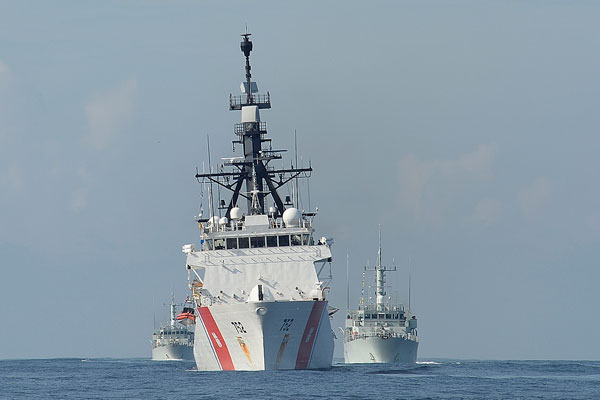
[caption id="attachment_11558" align="alignnone" width="600"] HMC Ships Whitehorse (back left) and Brandon (back right) follow United States Coast Guard Cutter Stratton during a Joint Operations photo op.[/caption]Lt(N) Greg Menzies, MARPAC Public Affairs – When HMC Ships Brandon and Whitehorse reached their area of responsibility during Operation Caribbe, they were ready to work with partners and make a difference in the fight against illicit narcotics in the Eastern Pacific Ocean. During the long transit south, both ships conducted sea training that was necessary to familiarize every sailor about ship procedures, routines and emergency drills. This training confirmed the ships’ ability to conduct a wide range of operations at sea, and achieve the standard readiness needed on Operation Caribbe.Operation Caribbe is Canada’s contribution to Operation Martillo, a U.S. Joint Interagency Task Force South-led interagency and multinational effort among Western Hemisphere and European nations, designed to improve regional security and deter criminal activity.“Weather and sea states during mission workups were rough, but despite this every member overcame adversity and persevered as they knew they had to complete their assigned duties,” said Lieutenant-Commander Landon Creasy, Brandon’s Commanding Officer. “Sailors on both ships were well trained and qualified in everything they did to prepare them for this deployment.”The operation began as the ships left San Diego, California, with embarked United States Coast Guard (USCG) Law Enforcement Detachment (LEDET) teams. The mission for Brandon and Whitehorse was to support the LEDET teams, who conduct the boarding and seizures of suspect vessels in accordance with bilateral agreements signed between the United States and Central American nations.During the deployment, the ships also conducted two passenger exchanges (PASSEX) that were organized between Brandon, Whitehorse, the USCG, United States Navy (USN) and the Mexican Navy. The Royal Canadian Navy has a long standing tradition of conducting PASSEXs with its allied partners....
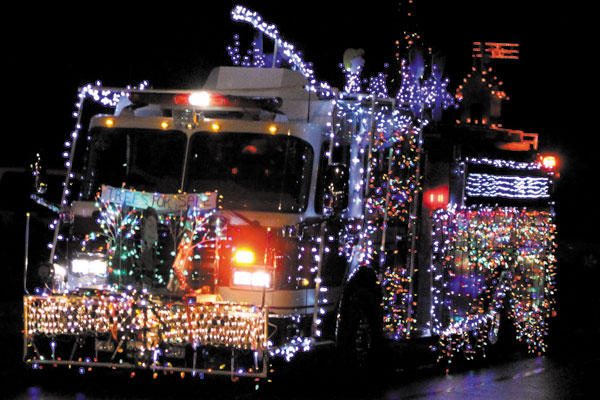
Peter Mallett, Staff Writer – Base firefighters continued the holiday legacy of a fallen comrade this year by entering Pumper No. 450 into this year’s annual Esquimalt Celebration of Lights parade.The backup pumper for CFB Esquimalt’s Fire and Rescue Services was adorned with over 1,000 Christmas lights and took home top prize for Best Decorated Vehicle at the Dec. 6 holiday event hosted by the Township of Esquimalt.“Winning the prize was very much a team effort,” said fire department chief, Steve Mullen. “But the whole reason behind our involvement is to do something festive within the community. It makes the guys and girls in this unit feel good and they always make a big effort to do it up right.”A big part of the unit’s past success was the enthusiastic involvement of veteran firefighter Dave Hill. Mullen says Hill took it upon himself to spearhead the annual tradition of lighting up the truck for the holidays throughout his 22 years at the station.But on Nov. 19, 2011, 54-year-old Hill was diagnosed with terminal lung and esophageal cancer after a routine trip to the family doctor. His co-workers rallied around Hill and his family, raising enough money for them to visit Hawaii in January 2012. Hill died seven months later and was honoured at the 11th annual Canadian Fallen Firefighters Foundation Memorial in August 2014.Mullen says Hill’s legacy lives on each year when they flick the switch and the fire truck is set aglow.“Decorating the fire truck was a labour of love for Dave, I know he’d be smiling if he found out we kept his winning tradition alive,” said Mullen. “He was always at the epicentre of taking the bull by the horns and ensuring our truck would shine brightly. He would dress up as Santa Claus and buy candy...