Airbus A-310 flies to Poland
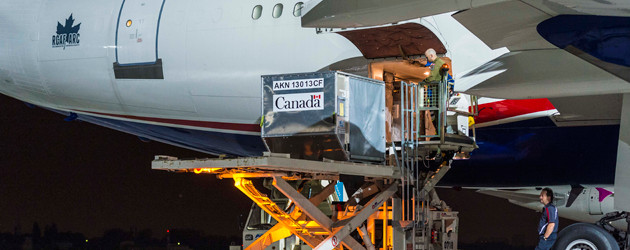
A cargo container is loaded onto a CC-150 Polaris (Airbus A-310) at Poznań–Ławica Henryk Wieniawski Airport on July 15, 2015 during Operation Reassurance.
A cargo container is loaded onto a CC-150 Polaris (Airbus A-310) at Poznań–Ławica Henryk Wieniawski Airport on July 15, 2015 during Operation Reassurance.
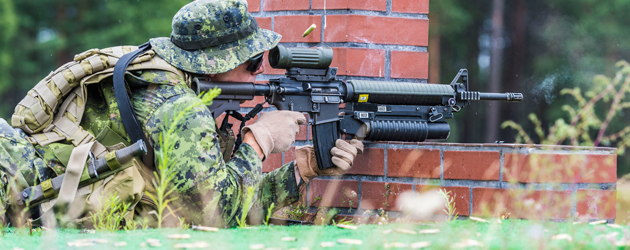
A Land Task Force member practices shooting a C7 rifle at the range in Zaworske, Poland on July 21, 2015 during Operation REASSURANCE.
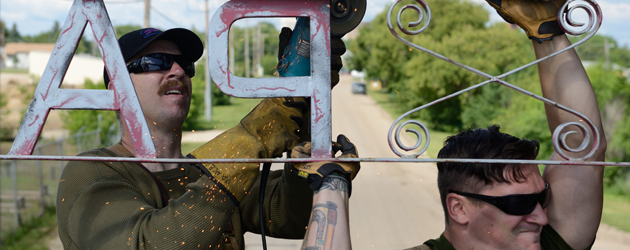
Cpl Dancer (left) & MCpl Blount (right), both of 1st Battalion Princess Patricia's Canadian Light Infantry and the Immediate Response Unit (West), repair the sign to Exhibition Park in Prince Albert, Saskatchewan on July 19, 2015.
A CH-146 Griffon helicopter from 408 Tactical Helicopter Squadron lands near Forward Operating Base (FOB) Victoria in north Saskatchewan during OP LENTUS 15-02 on July 17, 2015.
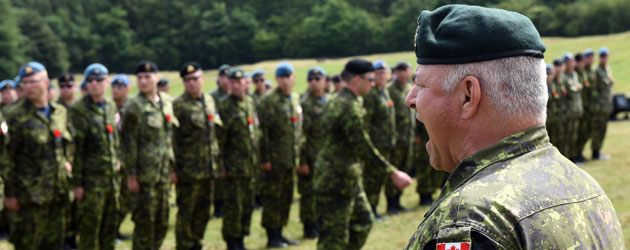
Canadian Armed Forces Joint Task Force Nijmegen 2015 contingent RSM Chief Warrant Officer Luc Moreau calls the contingent to "eyes front" during a parade at the Canadian National Vimy Memorial in France on July 18.
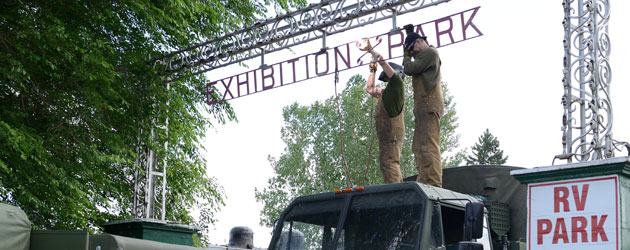
Cpl Neil Dancer (right) and MCpl Patrick Blount (left), both from 1st Battalion Princess Patricia's Canadian Light Infantry and the Immediate Response Unit (West), repair the sign to Exhibition Park in Prince Albert, SK on July 19.
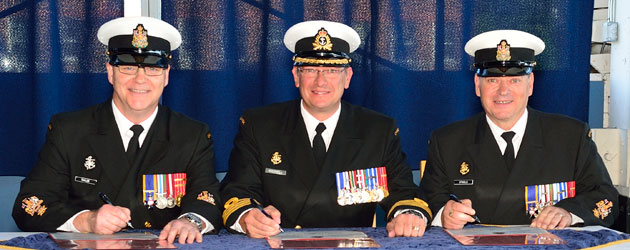
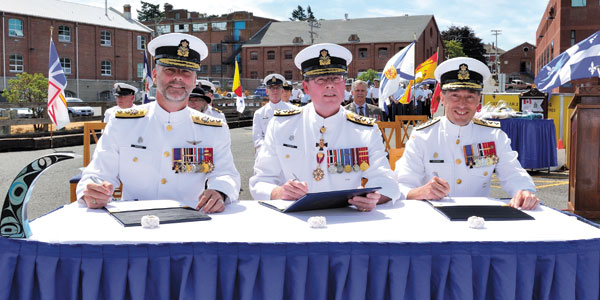
CPO1 Shawn Taylor, outgoing Base Chief; Capt(N) Steven Waddell, Base Commander of CFB Esquimalt; and CPO1 Robert Spinelli, incoming Base Chief, sign the Change of Appointment Certificates July 16.
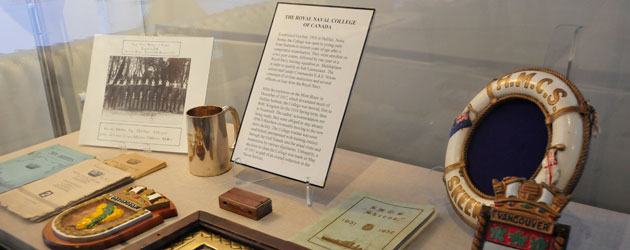
The history of the navy on the west coast is the focus for the new exhibit unveiled during the Navy and Military Museum's 30th anniversary celebration in early July.
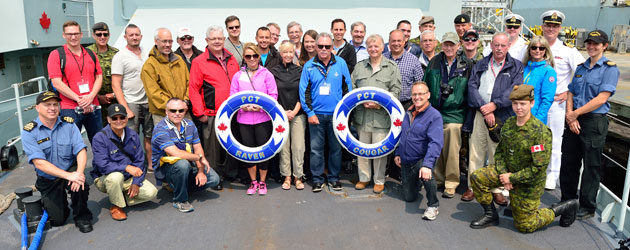
Delegates and members of the Canadian Forces Liaison Council (Canada-wide civilian business and educational leaders) on the Patrol Craft Trainer Cougar 61 on a day sail July 8.
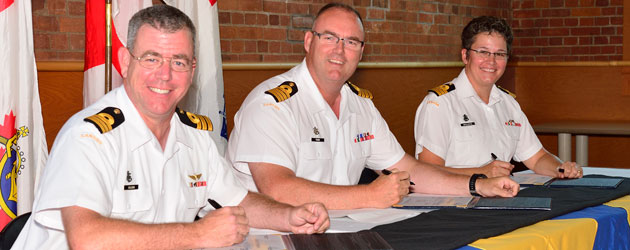
In-coming CO Cdr Wes Golden, Reviewing Officer Capt(N) Doug Young, MARPAC HQ COS and out-going CO Cdr Lori McAllister sign the Change of Command certificates during the MARPAC HQ Change of Command ceremony July 10.
Maritime Forces Pacific’s (MARPAC) new commander, RAdm Gilles Couturier, endeared himself to hockey fans at CFB Esquimalt when he introduced himself during a change of command ceremony on A-jetty on July 14.During his opening address, RAdm Couturier drew parallels between Canada’s national sport and its navy.“The reason I use the analogy of hockey is because I believe in the concept of team sports where success is dependent on teamwork and team spirit,” he said. “On the ice, it’s the goal-scorer, the playmaker, the stay-at-home defenceman or the grinder, but within the navy it’s the officers, the non-commissioned members, the operators, the technicians and the civilians that ensure the success of the team.”In his 32-year naval career, RAdm Couturier has applied the lessons learned in the hockey arena as a player, coach and referee to create success for himself and his teams in the navy.Among his biggest achievements was being selected as the Combined Forces Maritime Component Commander (CFMCC) in 2014 for Rim of the Pacific Exercise (RIMPAC), the largest maritime exercise in the world. This was the first time a Canadian had taken on the role.This isn’t RAdm Couturier’s first posting to the West Coast. He served on Pacific Fleet ships early in his career and later commanded Maritime Operations Group Four. Then in 2008, he served as the Maritime Component Commander for Operation Podium, the Canadian Armed Forces contribution to the overall security effort for the Vancouver 2010 Olympic and Paralympic Winter Games.“I am thrilled to be back on this coast,” he said.Speaking about the issues currently facing today’s navy, RAdm Couturier emphasized the importance of stamping out sexual discrimination and harassment and said the navy will have to deal with this issue “as a team with the MARPAC leadership fully engaged.”He said the Royal Canadian Navy’s code of...
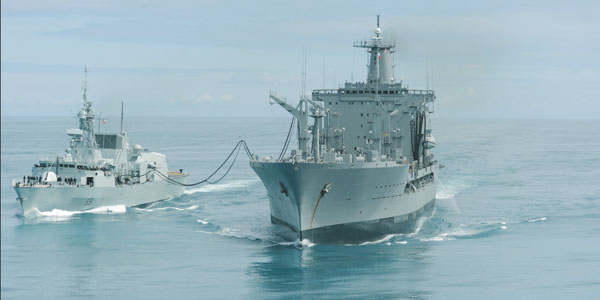
For 40 days, Chilean replenishment ship AO-52 Almirante Montt will be conducting at-sea training with Pacific Fleet sailors to prepare for the arrival of Canada’s new Queenston-class supply ships.Partnering with Montt are HMC Ships Vancouver and Calgary, which will practice Replenishment-at-Sea (RAS) operations.The collaboration was formalized by a Mutual Logistic Support Arrangement (MLSA) between the Chilean Navy and Royal Canadian Navy following Vice-Admiral Mark Norman’s 2014 announcement that the Protecteur-class supply ships would be retired.“This is a particularly significant moment for the navy because we’re finding a new and alternative method to maintain a core skills set and we’re doing it with the help of our allies,” says Vancouver’s Commanding Officer Cdr Clive Butler. “It speaks to what we can achieve through collaboration.”Two waves of sailors, mostly boatswains, from CFB Esquimalt will be on board Montt throughout the summer for a few weeks at a time. While the Canadians are on board, Chilean Navy personnel will provide instruction and review on operating the RAS vessel. They will conduct practice RAS operations daily, with the majority carried out off the west coast of Vancouver Island.The RAS operations involve maneuvering two ships alongside each other at a range of 50 yards, passing lines between the vessels, allowing for the transfer of fuel or other loads, including ammunition, food and water.“So far, we’ve practiced night fueling, day fueling and one two-point RAS operation, which means transferring both fuel and solid stores,” says Cdr Butler. “We’re getting the opportunity to practice this on a regular basis in a way we haven’t been able to without the tanker [the former HMCS Protecteur].”Protecteur, the west coast fleet’s only supply ship, was taken out of service after a debilitating engine room fire during its transit back to Victoria from Hawaii last summer.Safety procedures related to RAS operations...
To celebrate the 60th anniversary of the Rocky Point Ammunition Depot, Commanding Officer LCdr Jason Cheney and Ammunition Maintenance Facility Senior Supervisor Glenda Larocque are preserving a little slice of 2015 for future generations of workers.Anniversary celebrations on July 21 and 22 at the depot will see the unveiling of a time capsule during a ceremony on the second day.“Originally, I just thought a time capsule would be an interesting little project to carry out,” says Larocque. “But as we began to organize the project, it took on its own significance as we saw history passing before us.”Rocky Point had long ago come into possession of a Second World War projectile and it had been sitting near the facility’s gun mount. When refurbishment of the shell began, it was discovered to be hollow.At 15 inches in diameter, four feet high and 66 inches deep, the shell sparked inspiration for Larocque, who saw an opportunity to store artifacts inside of it and make it a permanent piece of the landscape.Even without anything inside, the projectile has a story to tell.It was once an APC BL shell with a ballistic cap and weighed 1,920 pounds. It was carried by HMS Warspite, which was heavily damaged on May 22, 1941 during a German air attack of Crete.As the ship passed through Esquimalt on its way to Puget Sound Naval Shipyard for repair, the shell, which was cracked, was offloaded at the Colwood Magazine. It was moved to CFAD Rocky Point in 1955 where it was used to proof detonators out on the range.LCdr Cheney says he and Larocque invited CFAD workers to bring items that signified something about Rocky Point. They then placed the artifacts in two ammunitions containers inside the shell casing.Only contributors know what they have placed inside. No one will know the entire contents of the capsule until it is opened 40 years from now.“We wanted to keep those personal mementos a secret until it is opened,” says LCdr Cheney.Two...


[caption id="attachment_10379" align="aligncenter" width="199"] Warrant Officer Tammy Negraeff.[/caption]Never utter the words “it can’t be done” to Warrant Officer Tammy Negraeff.Whenever Canada’s first-ever female Search and Rescue Technician (SAR tech) hears this, an unwavering feeling of determination to disprove the doubters overtakes her.A month ago, her 25-year military career ended with a retirement party, and a moment of reflection on breaking a barrier for women. “I wanted to be a SAR Tech no matter what, whether I was the first female didn’t matter at all to me,” says WO Negraeff. “But the fact that it set a trailblazing precedent is super.”Her career began in 1988 while fighting forest fires in Nelson, B.C., as a student employee with Ministry of Forests Lands and Natural Resource Operations. Rumour of a recruiting officer coming to town drifted to her ears.She immediately signed up for a meeting.The recruiter, having never encountered a woman in the SAR trade, doubted her capability.“He was a little old school,” she says.“The recruiter looked at me and had a smirk on his face while remarking he didn’t think I understood what I was getting into.”Two years later she pledged her service to Canada.Seven years after that she was selected to attend a SAR Tech training course at CFB Comox.The learning curve was sharp and the physical and psychological testing “highly challenging” she recalls.From a pool of approximately 30 applicants each year only about 10 to 15 make the grade.A determined Negraeff would eventually prove the recruiting officer wrong, breaking the SAR Tech gender barrier in 1998 when she graduated as a Master Corporal.“She instantly fit right in,” says Negraeff’s search and rescue partner WO Lance Teichrib.“She didn’t expect to be treated differently and excelled in her training.”Real life SAR Tech work began fairly quickly after graduation.It was a cold mid-winter day...
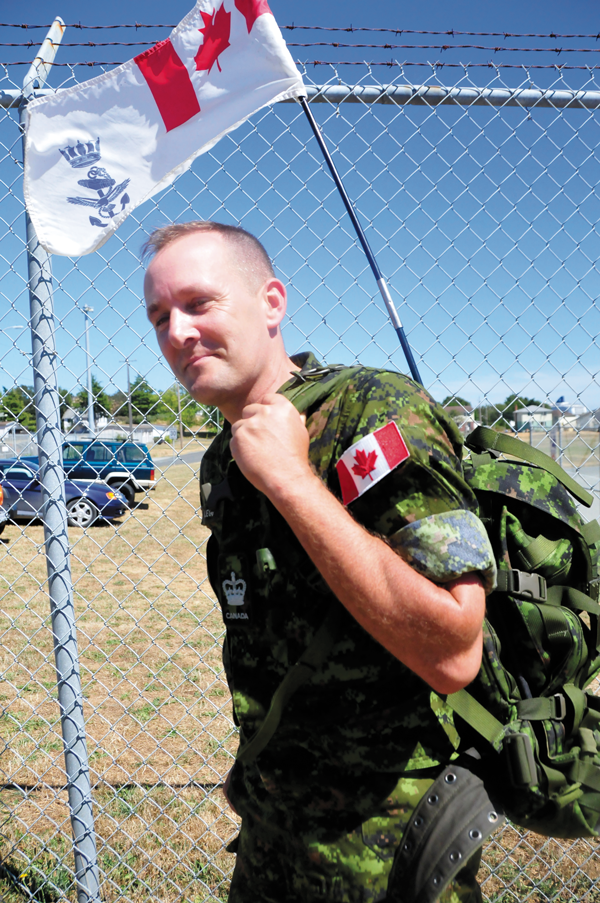
[caption id="attachment_10376" align="aligncenter" width="199"] WO Kevin Legg takes a rest after the MARPAC Nijmegen team completes a 40 kilometers trek from Roche Cove to CFB Esquimalt on Friday, June 27.[/caption]Every painful step, every laboured breath will draw WO Kevin Legg, 42, closer to his dream of completing the Four Days International Marches Nijmegen next week.The soldier is unlike any of his MARPAC teammates.He marches with a barrage of physical scars incurred during his tour in Afghanistan seven years ago, including damaged lungs and a permanent limp in his left leg.But tenacity and perseverance during tryouts earned WO Legg a coveted spot on the MARPAC team.“He’s a pretty stellar dude,” said MARPAC marching team leader, Lt(N) Paul LePrieur.“He is the epitome of what Nijmegen is all about. He is so inspirational for so many others doubting themselves while going through rehab.”WO Legg’s story of survival began moments after he flicked a switch on an air-handling unit he was repairing while deployed in Afghanistan. After that everything in his world went black.“The last thing I can remember was burning and then waking up in the hospital,” he recalls.“When the explosion occurred I was working on the ground because it was an unusually hot day. It was close to 50 Celsius so I was sitting that way because a fan underneath the unit was cooling me.”A locally employed individual who worked on the military base had planted an Improvised Explosive Device on the unit.WO Legg says if he weren’t sitting down at the moment the bomb detonated, he wouldn’t be alive today.Although it didn’t take his life, the explosion changed him forever.The lower portion of his lungs were burned and permanently damaged, and he says the resulting pulmonary edema (build up of fluid in his lungs) could have been fatal.He now depends on...
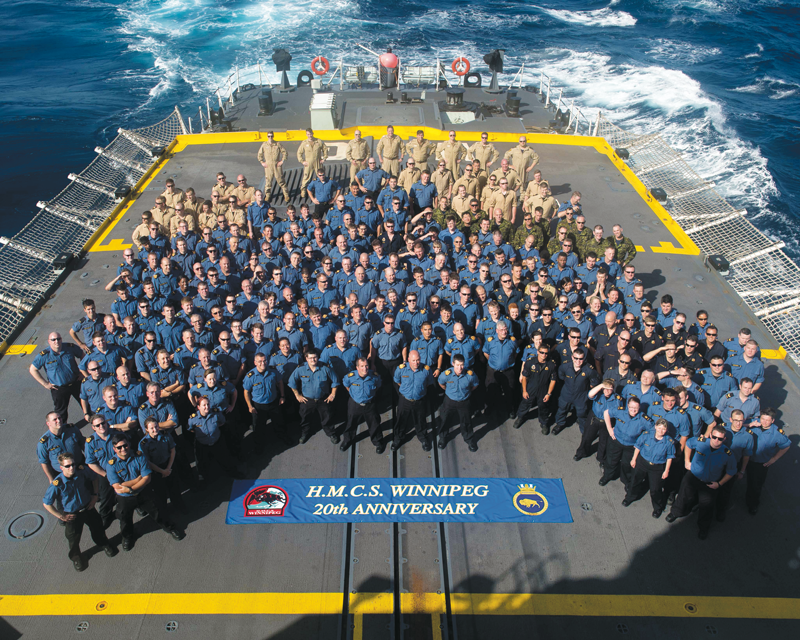
[caption id="attachment_10371" align="aligncenter" width="300"] The crew of HMCS Winnipeg gathers on the flight deck to celebrate the ship's 20th anniversary during Operation Caribbe on June 23.[/caption]For many sailors, celebrating a birthday at sea is not always their first choice to mark the occasion.However, for a warship such as HMCS Winnipeg, celebrating its 20th birthday June 23, there was no better way to mark the occasion than on the ocean.“Although at-sea traditions have changed over the years, the operational tenacity of the ship and its crew has not,” said Cdr Pascal Belhumeur, Winnipeg’s Commanding Officer.“In this, its 20th year of service, Winnipeg will spend the next eight months as the forward deployed vanguard unit, along with the Royal Canadian Navy’s first deployed Enhanced Naval Boarding Party Team, and its embarked CH-124 Sea King.”Winnipeg and its crew are currently conducting surveillance operations in support of Operation Caribbe, Canada’s participation in the multinational campaign against illicit trafficking by transnational organized crime in the Caribbean Sea and the eastern Pacific Ocean.They are also en route to Operation Reassurance, Canada’s contribution to NATO assurance measures in Central and Eastern Europe.The ship’s company celebrated the occasion with a Banyan (barbeque) and a birthday cake that was cut by the command team with three traditional naval swords that are used on ceremonial occasions and celebrations.Despite the ship’s dress regulations, one crew member connected with the ship’s history by wearing a t-shirt that was issued to the crew when the ship was commissioned on June 23, 1995.“When I was departing my last job, a colleague gifted me with this shirt, hoping to pass on some of the HMCS Winnipeg legacy he helped build,” said Lt(N) Dusan Brestovansky, assistant combat systems engineer officer.“I was honoured when he explained the history behind it, and even though it’s a little worn,...
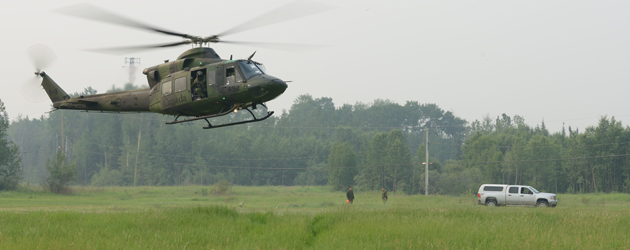
A CH-146 Griffon helicopter lands near Montreal Lake, Saskatchewan during Operation LENTUS 15-02 on July 9, 2015.
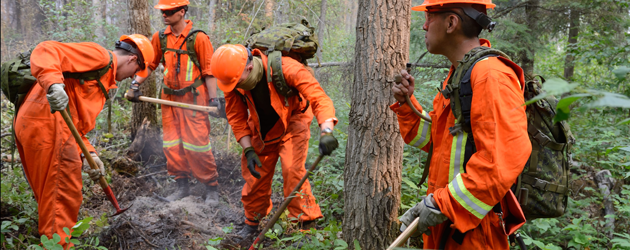
Soldiers fight to keep fires suppressed in Montreal Lake during Operation LENTUS 15-02 on July 9, 2015.
A sniper from the Royal 22nd Regiment makes his way to shore after jumping from a CH-146 Griffon Helicopter during Exercise Gun Camp, 2015.
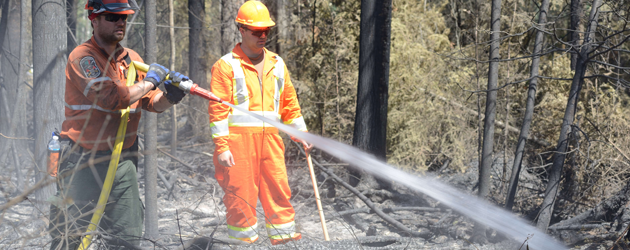
A Fire Ranger and a member of A Company, Immediate Response Unit (West) extinguish a hot spot near Montreal Lake, Saskatchewan during Operation LENTUS 15-02 on July 8, 2015.
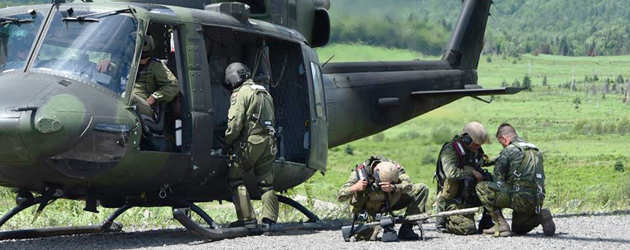
Snipers conduct pre-flight checks on their equipment prior to launch. From 12 to 26 June 2015, the snipers of 5 Canadian Mechanized Group (5 CMBG), accompanied by members of provincial and municipal police services participate in GUN CAMP 2015.
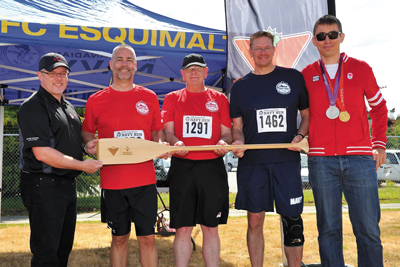
[caption id="attachment_10333" align="aligncenter" width="300"] Canadian Tire representative Landon French presented RAdm Bill Truelove with a paddle representing their donation to the CFB Esquimalt PSP Recreation program in support of military families. Joining the Admiral in the presentation were CPO1 Mike Feltham, Capt(N) Steve Waddell and Olympian Malcolm Howard.[/caption]Canadian Tire has donated $300,000 worth of sporting equipment in support of military families.The donation is a component of their longstanding partnership with Canadian Forces Morale and Welfare Services (CFMWS).“We believe in the power of sport to inspire Canadians to spend quality, active time together,” said Landon French, Executive Director of Canadian Tire Jumpstart Charities and Vice-president of Community Relations.“We are honoured to contribute to the military community to help members and their families.”Donated equipment includes over 100 canoes and kayaks, boat safety kits, and personal flotation devices.The donation provides resources to military families that can be used long-term to maintain healthy lifestyles.“I know we all welcome this generous donation,” said Commodore Mark Watson, Director General Morale and Welfare Services. “Sports can help our members stay mentally healthy, while increasing overall unit morale and workplace efficiency.”To celebrate the donation, representatives from Canadian Tire toured six bases this past June, the month designated to be the military’s official recreation month.Representatives enjoyed hot dogs at CFB Petawawa’s family barbeque, helped set up CFB Edmonton’s community garage sale, and cheered on runners at CFB Esquimalt’s Navy Run on June 21, to name a few of the engagements.Helping raise awareness at the Navy Run was professional rower Malcom Howard, who was a 2008 gold medalist at the Bejing Olympics, and silver medalist at the 2012 games in London, England. As a sponsor of the Canadian Olympics, Canadian Tire has supported athletes such as Howard in achieving their goals. Canadian Tire’s partnership with the Canadian Armed Forces seeks...
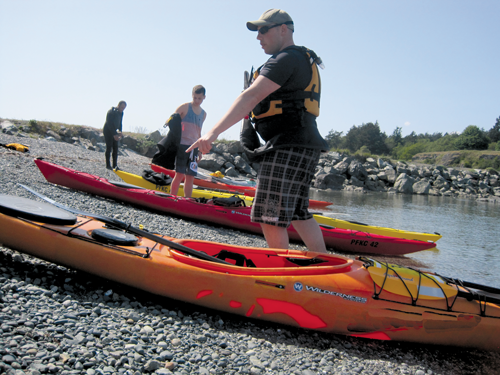
Looming before me is the colossal hull of a warship.From the vantage of my kayak, which is level with the ocean, the water mirrors the ship in a wrinkled gray reflection.I crane my neck to see the portholes and then the bow high above.The ship is berthed at one of the jetties in dockyard at CFB Esquimalt.Tethered to another jetty is the long black body of a partially submerged submarine bobbing eerily in the dark water.My destination today is the pebbly shore of Fisgard Lighthouse across the harbour.I dip my paddle into the water and pull the kayak forward.I feel the water resist and my uncertainty grow to navigate the distance.This is only one of a handful of times I have eased my body into the tiny cockpit and clutched the double-ended paddle.But that novelty will dwindle today as I am taking part in the Pacific Fleet Kayak Club’s introductory course – a two-phase course that starts in a pool and ends on the ocean.Before launching my kayak into Esquimalt harbour from the Naden boat launch, I and five other rookie kayakers were taught basic safety skills and manoeuvres in the morning at the Naden pool.Corporal Aaron Miller, lead instructor for the club, started us with a wet exit. We had to self-tip, and while upside-down under the water, unlatch ourselves from the kayak and swim to the surface.I paddled to the shallow end and steadied my kayak.With a deep inhale I threw my weight to one side and tipped over.I kept my eyes tightly closed underwater to guard against the chlorine, and felt for the latch on the rubbery skirt.I pulled it back and freed myself from the kayak. When I came to the surface, I realized my paddle was not in my hand.Perfecting this maneuver would have to...
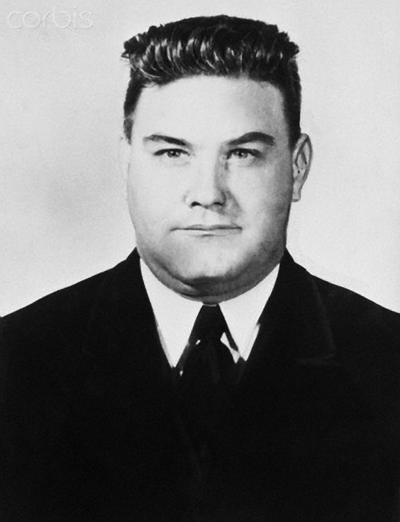
[caption id="attachment_10323" align="aligncenter" width="229"] Ferdinand Waldo Demara Jr.[/caption]German film-maker Judith Voelker spent three days in June at CFB Esquimalt filming a segment for her latest documentary called The Great Impostor.With the help of a local Victoria film crew from Gamut Productions, she researched Ferdinand Waldo Demara at the CFB Esqumalt Naval and Military Museum, filmed scenic shots around the base, and interviewed Retired Commander Peter Chance, who met the impostor during the Korean War.Demara masqueraded as many people over his life, but his most infamous was as a ship’s surgeon on board HMCS Cayuga. After meeting a young doctor named Joseph C. Cyr in Maine, he took his identity and boarded the Royal Canadian Navy destroyer.Peter Chance’s first encounter with the “Medical Officer” was in 1951 when he needed his infected toe looked at before shipping out in Cayuga.“I went down to the ship, and met this affable, round-faced and beaming man who took a look at my foot and assured me that he would take care of it,” says Cdr Chance, 94.Rather than treat the toe right away, Demara requested the small operation take place the next morning. Unbeknownst to the young Chance, Demara spent the night pouring over medical textbooks.“The next day he injected my foot with freezing medicine, cleared up the infection, wrapped my foot up, and sent me on my way with crutches,” says Cdr Chance. “He knew exactly what he was doing, and he didn’t hesitate or falter at all. It healed perfectly.”Cayuga deployed shortly after, taking Demara and Chance with it. Bound for west of the Yalu River, Cayuga was sent as part of a United Nations Task force of commonwealth naval allies poised to fight in the Korean War.“Joe, as we called him, continued to get along well with all the men on...
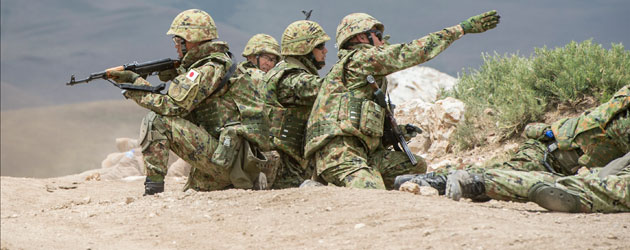
Participants from the Japanese Army respond to a simulated attack, marking the first time that Japan's army has fired a weapon outside of its nation since World War II, in the fields of Ulaanbaatar on June 26, 2015.
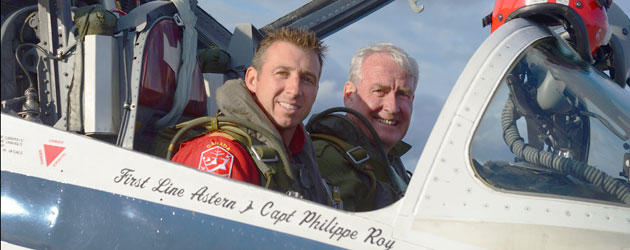
Canadian Ambassador to Ireland and former Sgt at Arms, Kevin Vickers (right) along side his pilot, Capt. Phil Roy, take a moment before the RCAF Snowbirds demo-team takes flight for the Canada Day show.