[wpml_language_selector_widget]
[searchwp_form id="1"]
Lookout Newspaper | Image Tech

Image Techs focus on documenting history

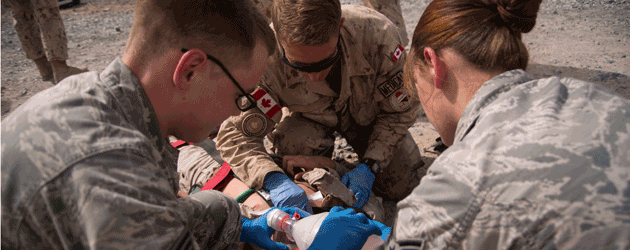
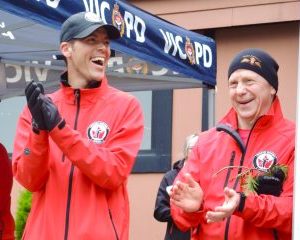
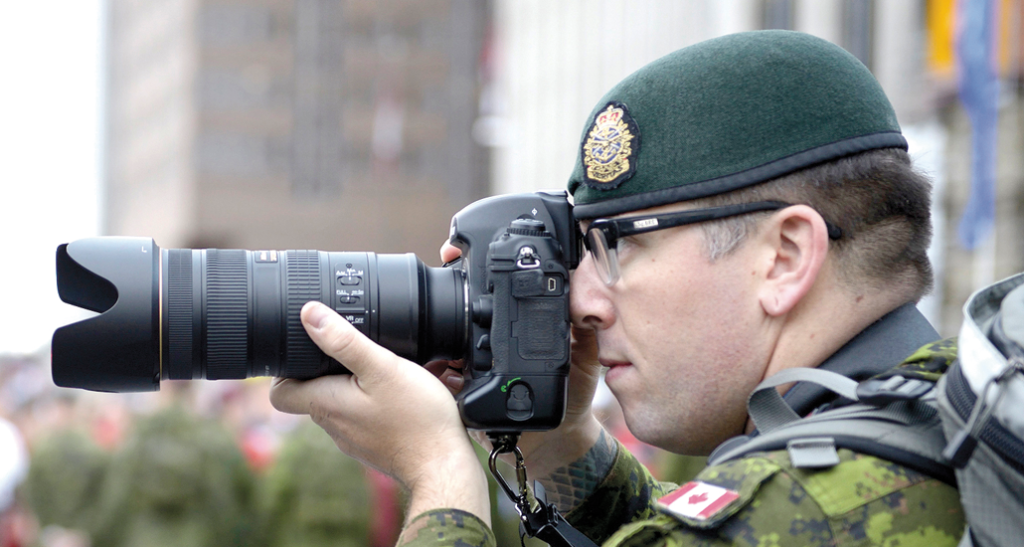
[caption id="attachment_9807" align="aligncenter" width="300"] Cpl Philippe Archambault an Imagery Technician from the Directorate of Army Public Affairs, covering the 2013 Canadian Army Run in downtown Ottawa, ON.[/caption]Imagery Technicians with the Canadian Armed Forces are the trade behind the lens.They are entrusted to capture, in photos or videos, the individual moments and pervasive spirit of the Canadian military and its members.A member of the trade today is both an historian and a photojournalist.The technician is tasked with documenting the actions of the CAF for the Government of Canada and the world, and to bear witness to the amazing stories of Canadian soldiers, sailors, airmen and airwomen.Imagery technicians work alongside other CAF members in the Army, Navy and Air Force to document important events in the life and times of the Forces.They may work at any base in Canada, on ships at sea and overseas as part of United Nations, NATO and other missions.The images and videos they capture are used for training, flyers, posters, public affairs and higher strategic requirements.An imagery technician might tag along with infantry one day, military police another day and medics the next.Always, however, the imagery technician’s goal is to tell the soldiers’ stories of struggle, sacrifice and success with the best possible images.Sgt Dan Shouinard, Imagery Supervisor and acting Operations Warrant, Directorate Army Public Affairs, has photographed still and video images of a wide range of Army experiences since he joined the regular force in 2001 as an imagery technician.“We are witnessing and recording history,” said Sgt Shouinard, “which is why many imagery technicians say they have the best job in the CAF.”Another job benefit, according to Sgt Shouinard, is that imagery technicians get to see each and every military job and observe the dedicated work of other CAF members firsthand.Sgt Shouinard started out as a...
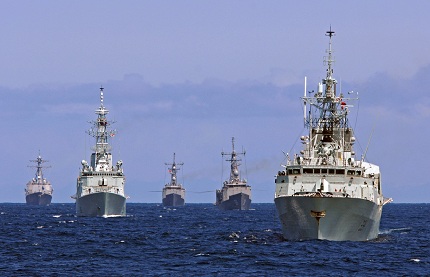

Canadian warships leave for Exercise Trident Fury

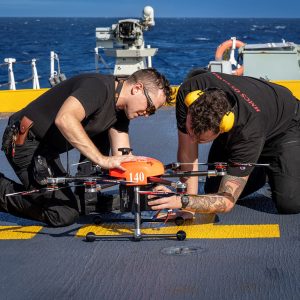
Seven Canadian and American naval vessels sailed from Canadian Forces Base Esquimalt today to participate in Exercise Trident Fury, a biennial multinational exercise taking place off the coast of Vancouver Island from May 4-15.  Trident Fury is a naval exercise organized by Maritime Forces Pacific.The exercise tests air and surface joint operations including maritime surveillance, live air and surface weapons firing, and anti-submarine warfare training.Participants come from the Royal Canadian Navy (RCN), the Royal Canadian Air Force (RCAF), the United States Navy (USN), and the United States Coast Guard (USCG).More than 1,200 military personnel will participate in this exercise, which enhances the RCN’s ability to operate in a task group environment with our allies.“Exercise Trident Fury is critical in making sure that Pacific Fleet ships are ready to deploy with our allies on a wide range of operations.  Interoperability is critical to working in a maritime environment,” said Commodore Bob Auchterlonie, Commander Canadian Fleet Pacific.Naval vessels participating this year include Her Majesty’s Canadian (HMC) Ships Calgary, Saskatoon, Winnipeg, and Yellowknife, United States Ship Cape St. George, United States Coast Guard Cutter Active, and RCN Orca-class vessel Wolf.Military aircraft participation include RCAF CP-140 Aurora Long Range Patrol Aircraft and CH-124 Sea King ship-based helicopters.American aircraft participating in the exercise include USN P-3 Orion Maritime Patrol aircraft, SH-60 Seahawk helicopters and EA-18 Growler electronic warfare jets.

Ships pay off

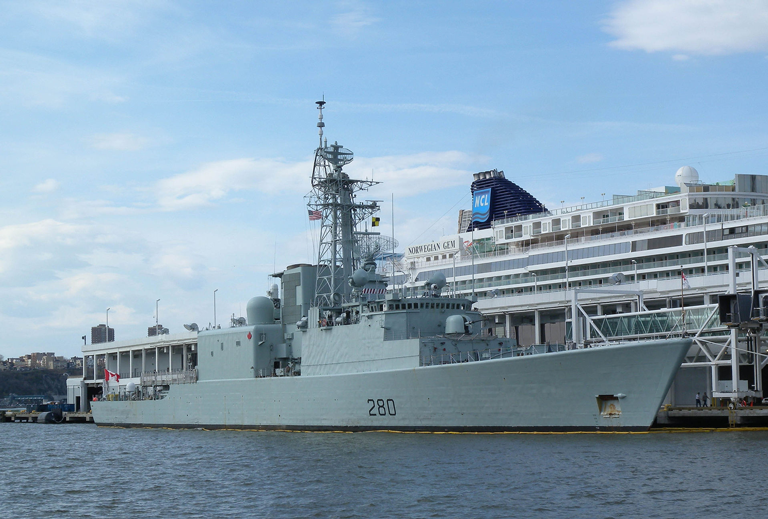
On Sept.19, 2014, Vice-Admiral Mark Norman, Commander of the Royal Canadian Navy (RCN), announced the retirement of four ships that had reached the end of their operational lives: HerMajesty’s Canadian Ships Protecteur, Preserver, Iroquois and Algonquin.Each ship has a slightly different story, but the common thread is that all four ships have served Canada and the RCN with honour and distinction.  Three of the four ships will be “paid off” in ceremonies on their respective coasts this spring and summer.The term “paying off” refers to the British age-of-sail practice of paying a crew their wages once a ship has completed its voyage. In the RCN, the tradition continues with the term paying off referring to the formal ceremony where the naval jack, ensign and commissioning pennant are hauled down, the crew departs a ship for the last time, and the ship is then no longer referred to as HMCS.HMCS ProtecteurAfter 46 years of great service, HMCS Protecteur, one of the RCN’s auxiliary oiler replenishment ships, will be paid off during a ceremony at CFB Esquimalt on May 14.Constructed in Saint John, New Brunswick, Protecteur was commissioned on Aug. 30, 1969, initially sailing into service with the Atlantic Fleet before transferring to the Pacific Fleet, where she completed her service.Protecteur took part in numerous operations during her service life, notably deploying to the Persian Gulf as part of Operation Desert Shield in 1991, to Florida as part of the relief effort after Hurricane Andrew in 1992, and was part of Canada’s contribution to the multinational task force to assist East Timor from October 1999 to January 2000.HMCS PreserverHMCS Preserver has successfully served with the RCN for more than 40 years.Despite not being used as an at-sea platform anymore, Preserver continues to serve by providing a fueling service to the Atlantic Fleet.A...

Sailor works to save dogs

[caption id="attachment_9794" align="aligncenter" width="300"] Roo, formerly known as Charlie, enjoys the comfort that comes with being adopted to a loving family.[/caption]Martin Luther King Junior once said: “Never, never be afraid to do what’s right, especially if the well-being of a person or animal is at stake. Society’s punishments are small compared to the wounds we inflict on our soul when we look the other way.”PO1 Alana Power does not look the other way.She has saved the lives of 70 dogs and five horses through her one-person Su Casa Rescue organization.“I started the rescue because I wanted to do more for those who could not speak for themselves, those who needed help after having a rough start in life,” says the sailor, who works at Maritime Forces Pacific headquarters.She chose Su Casa to symbolize the safe homes she provides for her rescues.“Mi Casa Su Casa means ‘my place is your place’, so I chose something that would signify the rescued are welcome and they have a safe place.”Most of the dogs come from San Bernadino, California, which has high-kill shelters; they would be euthanized if not saved by her.She began rescuing horses in 2009 and dogs in October 2013 with Bella and Henry, two puppies that became part of her “forever pack.”All her rescues come with unique, but grim stories.One such pup is Roo, a Chihuahua from California.He weighed 2.5 lb., and was surrendered to the shelter by his owner to be euthanized.“The owner wanted him killed because something was wrong with his back leg. This little guy’s leg had been broken and not given vet care. He was able to walk and did not appear in pain, but he had definitely sustained injuries,” she says.He arrived as a small, sickly pup who won her heart as she nursed him back...

thriving business

Sailor turns hobby into thriving business

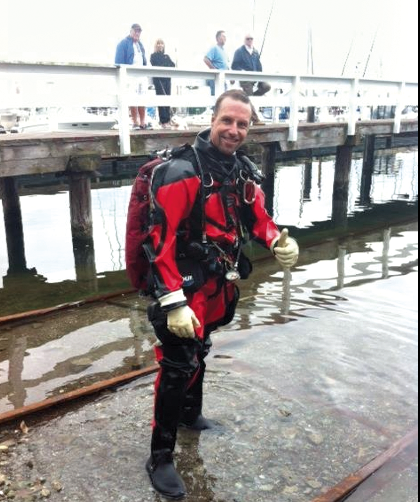
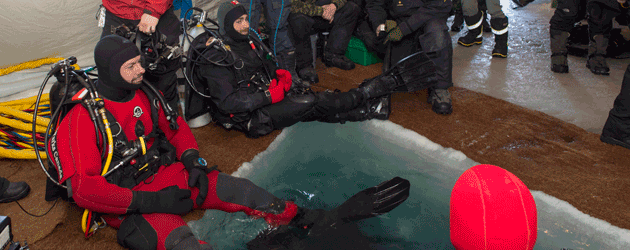
[caption id="attachment_9790" align="aligncenter" width="250"] PO2 Adam Coolidge prepares to dive.[/caption]Sonar Supervisor PO2 Adam Coolidge is just weeks away from hanging up his navy combats for good and leaving the tight knit naval community. But he won’t be floundering when he immerses himself into the civilian world. The sailor has created his own business and its already proving a success.With the skills attained through almost 17 years of service to the Royal Canadian Navy, and 20 years of recreational diving, the sailor has opened his own commercial diving business, Cold Water Divers Inc. “The most important skills my training with the navy gave me were timings, organization, and administrative experience,” he says. “Timings means everything for a diver, and I have to keep all of my dive gear perfectly organized and in good working order, ready to go at a moment’s notice. And, of course, as the owner I’m responsible for all of my company’s paperwork.”Cold Water Divers Inc. specializes in maintenance and repair of operational civil infrastructures built in water, such as bridges, docks, and sewage outfalls; therefore, divers must have a high level of expertise working with tools. His company currently employs five divers capable of heavy lift salvage and removal, underwater welding and broco cutting, and live HD video inspections. On a typical project, two divers are sent below the water to work on the task, which can range from cleaning a ship’s propeller to completing a hull inspection, to repairing a wharf.Their 20-foot boat is always nearby with a small crew responsible for ensuring the divers’ safety, with one employee tending, and a supervisor overseeing the entire operation including providing the divers with their unlimited air supply. His company also boasts it is the only modular dive company on the Island.Divers can operate out of a shipping container that contains everything needed to...

Naval War Vetern + Arctic Star

Naval war veteran surprised with Arctic Star Medal

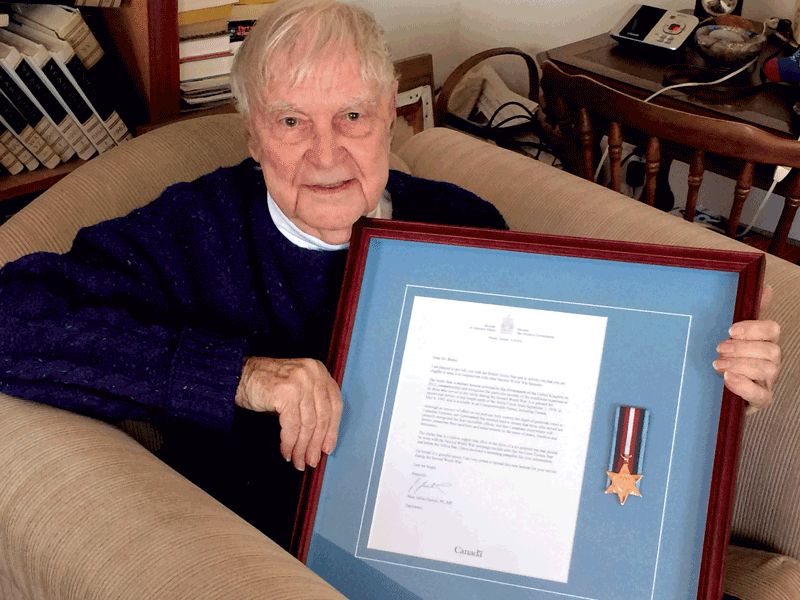
[caption id="attachment_9752" align="aligncenter" width="300"] Naval war veteran Gerry Butler holds a framed letter and the Arctic Star medal received from Veteran Affairs Canada.[/caption]Naval war veteran Gerry Butler received an unexpected gift on his 90th birthday.Nearly 70 years after ending his wartime service he has been awarded the Arctic Star.A military honour unveiled by the Government of the United Kingdom in 2012, the Arctic Star is granted for operational service of any length north of the Arctic Circle from Sept. 3, 1939, to May 8, 1945.It commemorates and recognizes the particular severity of the conditions experienced by those who served in the Arctic during the Second World War, and is available to all Commonwealth forces including those from Canada.Butler was overcome by emotion when the medal was delivered to him at his apartment in Montréal March 23.His son-in-law, Lieutenant-Colonel (Retired) Rick Bowes, a 23-year veteran of the Canadian Army who was instrumental in getting the medal through Veterans Affairs Canada, joined other members of the family to surprise the veteran with the medal.“He had tears running down his face,” says LCol (Ret’d) Bowes.“You know, these old veterans don’t expect anything. They are humble to the core.”During the Second World War, many Canadians served on Allied convoys as they sailed across the Arctic Ocean to deliver vital supplies to Russia.Commonly known as the Murmansk Run, ships departed from North American ports and sailed to the northern Soviet Union in an effort to assist them in their fight against Germany.A young Butler joined the Royal Canadian Navy in 1942 and served in Her Majesty’s Ship Jamaica through the North and Baltic Seas to Murmansk between June and August 1944.He is one of a few Canadian naval veterans entitled to wear both the Arctic and Pacific Stars as he also served in Her Majesty’s Canadian...

Whitehorse and Nanaimo return home

Whitehorse and Nanaimo return home

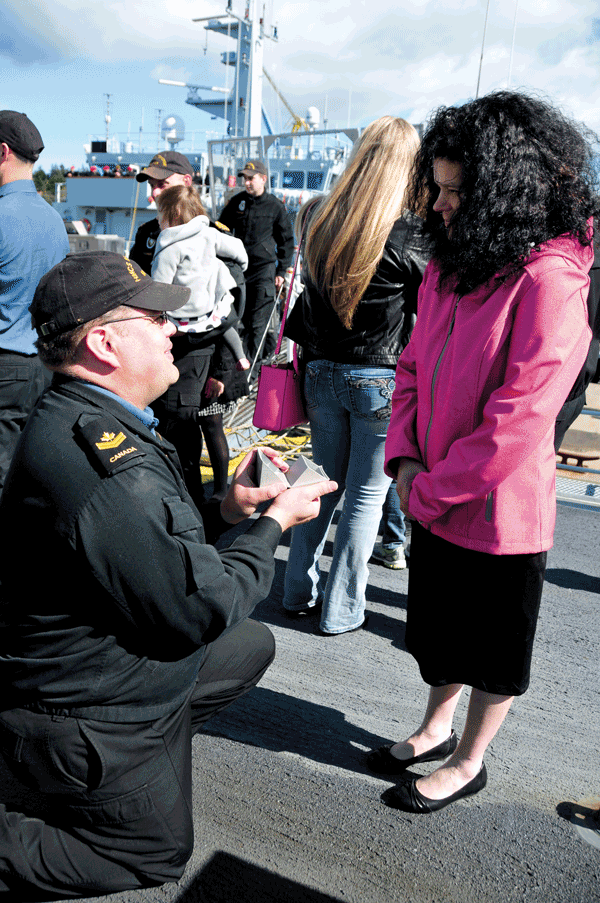
[caption id="attachment_9749" align="aligncenter" width="199"] MS William Dennis proposes to Jenny Clark after arriving back from Operation Caribbe.[/caption]After a five week deployment on Operation Caribbe, in which HMCS Whitehorse and HMCS Nanaimo assisted in seizing a combined six metric tons of cocaine, the two ships arrived home last Wednesday to a crowd of cheering families and loved ones.The ships sailed past Duntze Head for the traditional salute while the Naden Band serenaded the crowd. Waiting loved ones eagerly clutched flowers and balloons as the ramp was slowly lowered, by crane, onto the Y jetty.The first step off the ship was taken by Master Seaman William Dennis of Whitehorse, who proposed to Jenny Clark on the ramp, before the two shared a customary first kiss. Whitehorse and Nanaimo joined the U.S. Navy and Coast Guard on Feb. 23 as Canada’s contribution to the multinational Operation Martillo, which seeks to intercept trafficking by transnational organized crime in the Caribbean Basin and Eastern Pacific. Operation Martillo has been strengthening international partnerships between the Western Hemisphere and European nations in a bid to improve regional security and deter future criminal activity.Historically, interagency cooperation efforts such as Martillo have resulted in yearly seizures of millions of dollars of illicit drugs, while actively disrupting trafficking in international waters and airspaces around South and Central America. “If drugs make it through the easier passages, Mexico for example, they can eventually get to North American markets,” said Whitehorse Commanding Officer, LCdr Christopher Rochon upon the ship’s return home.“There have been traces of these drugs making it to Canada, so it’s good for our ships to be out there.” The two ships acted in a supporting role to the operation, tasked with locating, tracking, and approaching suspect vessels found along the Pacific coast of Central America.The ships were also authorized...

oriole student adventure sail

Students Board Oriole for adventure sail

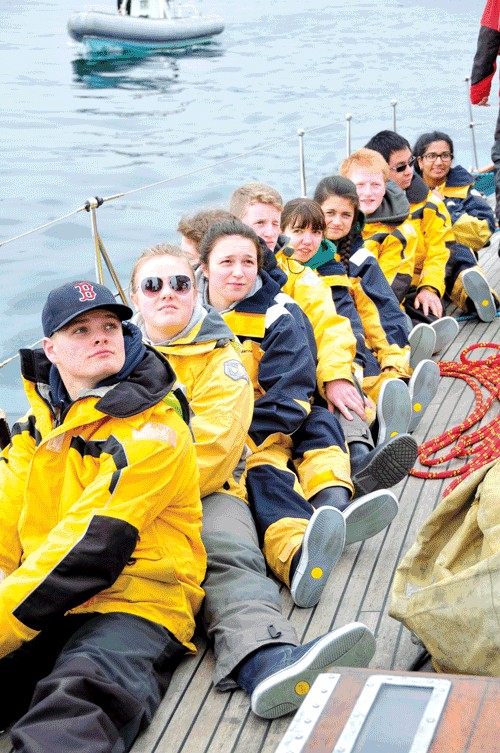
[caption id="attachment_9746" align="aligncenter" width="199"] Students wait for instructions on how to hoist Oriole’s sail.[/caption]As part of HMCS Oriole’s “Youth Adventure Challenge,” 14 high school students from across Canada left their homes to come aboard and sail with the navy crew for five days.Students were selected through a competitive application process organized by the Canadian Student Leadership Association, which invited senior Leadership 11 and 12 students from secondary institutions to apply.Only those applications with glowing academic credentials, extensive volunteer work, and well-crafted application essays were chosen.The high number of applicants was expected, as the entire challenge, apart from transportation, is free of cost.Students travelled from Quebec, Alberta, and the interior of B.C to set sail on April 13 from Esquimalt Harbour, and many had no experience sailing.“Some of them have never seen the ocean,” says Oriole’s Captain LCdr Jeffrey Kibble.“Some of them have never been on a boat, and some of them have never even left their province. So for them to suddenly come to another part of Canada and have an adventure on the West Coast is truly amazing.”As the crew, the students completed tasks normally expected of a fully-trained crew, such as hoisting and lowering the 136 kilogram main sail multiple times a day, helping cook meals, cleaning, and practicing safety training. Students took turns holding different crew positions, acting as the supervisory Buffer, the “Shack” or Chief Cook, and the “Stokes” or Chief Engineer.They also rotated watches, with each student working one mandatory night shift.“They aren’t here for a cruise,” says LCdr Kibble on the first day.“They are here to learn from us, and what we’re going to teach them is that teamwork and leadership are necessary to sail this vessel. The more responsibility they take on, the better.”The young crew is far from daunted, and when the...

Veteran treks across Canada on horseback to raise awareness

Veteran treks across Canada on horseback to raise awareness

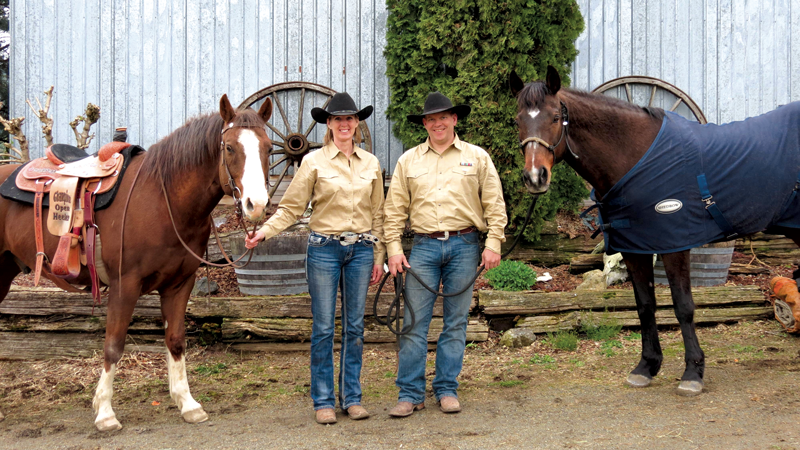
      Today, Paul Nichols will mount his horse Zoe on the steps of Victoria’s legislature and begin his first day riding across Canada.Nichols, a retired Corporal who served with the Princess Patricia Canadian Light Infantry, and his wife Terry, have created the “Ride Across Canada” campaign to bring to the fore issues surrounding veterans integrating back into civilian life, and to remind Canadians that the profile of veterans is changing from the old to the young.“We are on a mission to change the face of the typically understood Canadian veteran,” says Terry Nichols.“So when Canadians think of veterans, they will also think of women and young men. A veteran could be your car mechanic or a nurse at your hospital. You just can’t tell by looking at someone what their history is; so we want to show communities who these people are. We want to tell their stories, and we hope this will bring the Canadian people a deeper understanding of the military world.”The duo will ride for eight months from Victoria to Newfoundland, and stop at communities along the way to pick up veterans and currently serving Forces members.Over 700 veterans are expected to join the pair who has been working with a small crew for the past nine months to plan the adventure.The couple has organized horse facility administration stations every 150 kilometres nationwide, which will remain stationary for about five days within the various communities. These stations are where people can meet the couple and the horses.  Horses have been in Paul and Terry’s lives for over 20 years.The couple’s farm, Pen-Y-Bryn, just outside of Quesnel, is certified by the British Columbia Therapeutic Riding Association and the Canadian Therapeutic Riding Association to provide emotional and mental support to special needs individuals.Horses, says Terry, helped Paul’s transition back into...

Annapolis Sunk

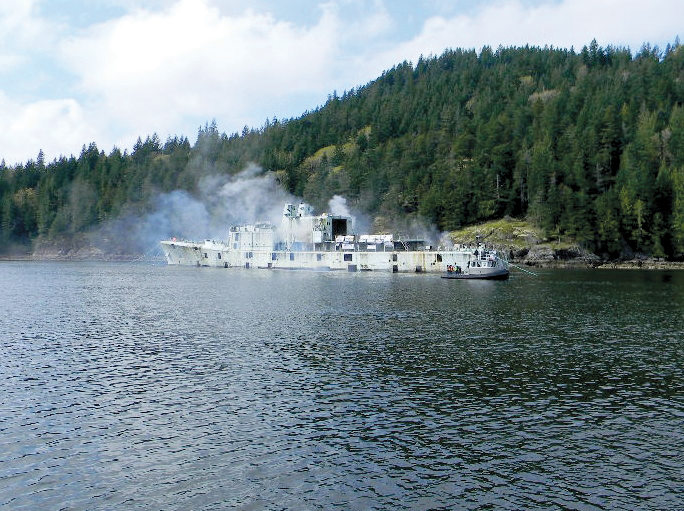
       It took only two minutes and one second to send the former Canadian warship Annapolis to the bottom of Halkett Bay Marine Park on April 4.The steam powered destroyer came to rest 31 metres below sea level on the ocean floor – only one metre off of its intended destination. It is now an artificial reef for divers to enjoy, and sea life to call home. Crowded around the sinking site were over 200 private vessels, who cheered as the 14 charges, placed throughout the ship’s hull and engine room, were set off seconds apart, causing the bay to echo with loud booms. Once the charges were tripped and the ship began to fill with water, a small party of former Annapolis Commanding Officers, including retired Captain (Navy) Brian Beaudry and Rick Town and Commander (Retired) Peter Campbell, added their cheers to the chorus around them. As the ship lurched downward, waves sweeping over the flight deck, the officers set their eyes on Annapolis one last time. Annapolis, a 102-metre helicopter-carrying destroyer, was commissioned in 1964 by the Royal Canadian Navy, and decommissioned in 1996.In 2008, it was purchased by the Artificial Reef Society of British Columbia from the Federal Government, with the goal to create the largest artificial reef in the Greater Vancouver area.  This is the eighth ship sunk by the Reef Society, and will provide a new habitat for a diverse range of marine life.In the past, sunken vessels have attracted over 100 different types of marine life to a single location.Annapolis will be specifically dedicated to promoting the growth of the rockfish and lingcod species native to the Howe Sound area.With an impressive array of marine life to view, the Reef Society predicts there will be a heavy surge in diving tourists and researchers to the...

what is the sunset ceremony hatley castle

What is the Sunset Ceremony?

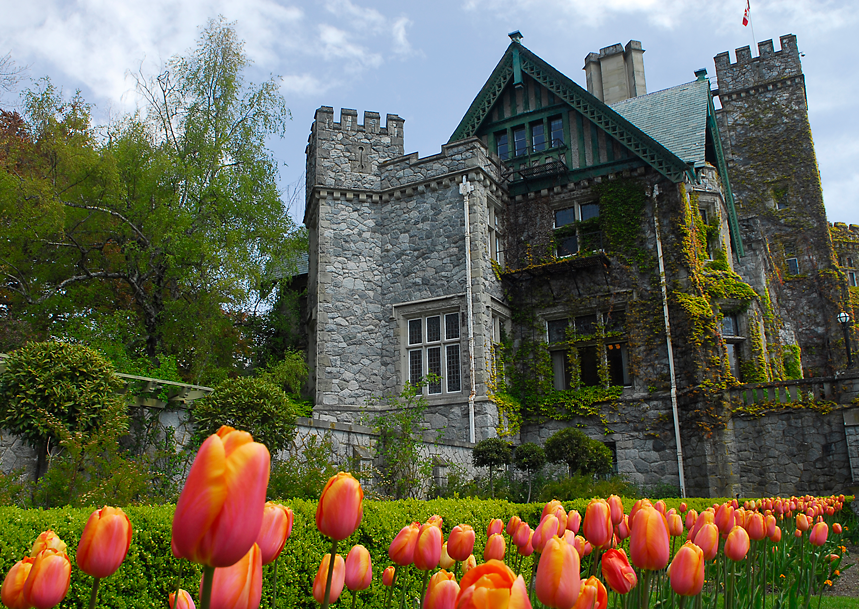
       The Sunset Ceremony, to be held April 25, will celebrate 75 years of leadership and learning at Royal Roads – 55 years as a military institution/college and 20 years of Royal Roads growth as a public university.The Ceremony will commence at 7 p.m. on the former parade square, now parking lot 3, below Hatley Castle at Royal Roads University on 2005 Sooke Road.It is open to the public.What is a Sunset Ceremony and why is it being held?Traditionally, a Sunset Ceremony is conducted by military and para-military organizations.However, in recognition of Royal Roads 75th Anniversary, a special Sunset Ceremony will be co-hosted by Royal Roads University and the Vancouver Island Ex-Cadet Club, representing the military period.The military period of Royal Roads started with HMCS Royal Roads in 1940, and developed into the Royal Canadian Naval College Royal Roads, then into the RCN-RCAF College Royal Roads, to the tri-service college/Canadian Service College Royal Roads, and finally, in 1968, to the Royal Roads Military College (RRMC) until it closed in August 1995.The last time a Sunset Ceremony was conducted at Royal Roads was May 12, 1995, as part of the closing ceremonies for RRMC.Who is participating?The ceremony will be conducted on the former parade square and will showcase the Canadian Forces Snowbirds, officer cadets from the Royal Military College of Canada’s Pipes and Drums Band; the Naden Band of the Royal Canadian Navy; the 50-person Vice Regal Guard of Maritime Forces Pacific; cadets from the United States Air Force Academy’s Drum and Bugle Corp; an ex-cadet contingent comprised of ex-cadets who attended Royal Roads between 1940-1995; 105mm guns from the 5th (BC) Field Regiment of the RCA; and regional air, sea and land cadets.The three VIPs for the event will be RAdm Bill Truelove, Commander Maritime Forces Pacific; Dr. Allan Cahoon, President...

Explore More

Categories

Top News

E-Editions Archive

News Stories Archive

Proud Supporters

Joshua Buck, Lookout Newspaper