No Stone left alone
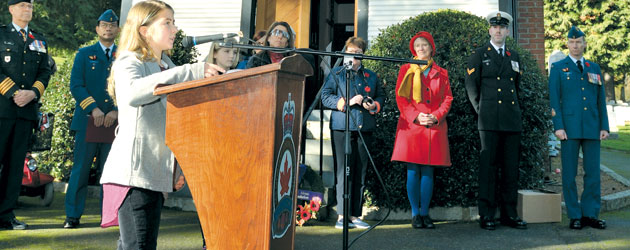
Rockheights Middle School Grade six student Bekah Waddel delivers a poem to honour veterans who sacrificed their lives in service to their country.
Rockheights Middle School Grade six student Bekah Waddel delivers a poem to honour veterans who sacrificed their lives in service to their country.
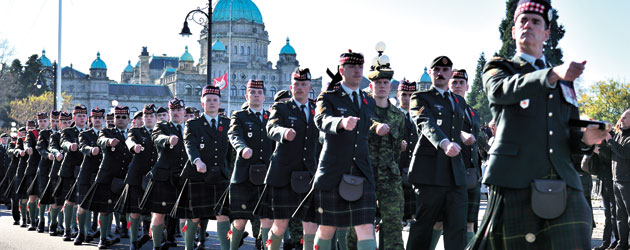
The Canadian Scottish Regiment marches past the saluting dias during the Remembrance Day ceremony in Victoria.
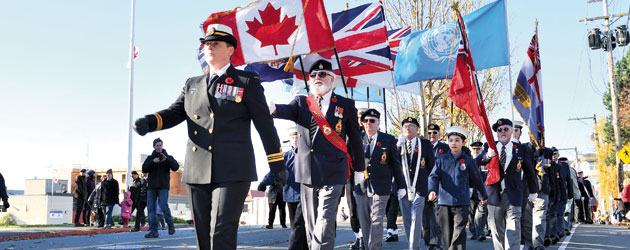
The marching contingent, headed by LCdr Judith Harlock, approached the Esquimalt Cenotaph.
Pallbearers carry a casket during the memorial service for the air crew from Avro Anson flight L7056
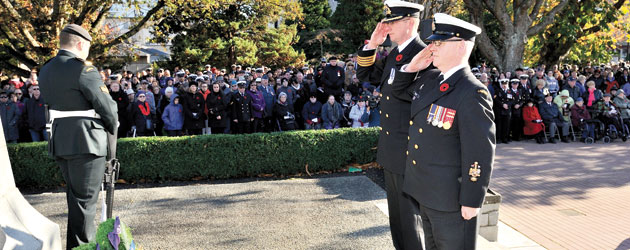
Capt(N) Steve Waddell, Commander CFB Esquimalt, and CPO1 Shawn Taylor, Base Chief salute after placing a wreath at the Esquimalt Cenotaph during the Remembrance Day Ceremony in Esquimalt.
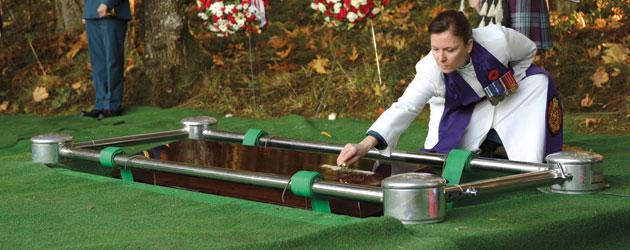
Padre Angela James places soil on the casket as it is lowered during the memorial service for the air crew from Avro Anson flight L7056.
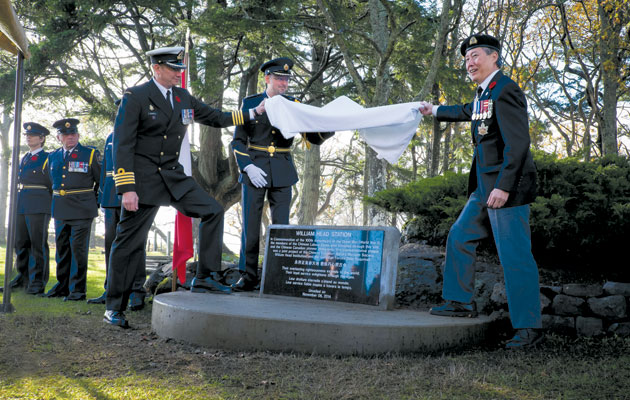
[caption id="attachment_8536" align="alignnone" width="300"] Capt(N) Steve Waddell addresses the assembly of Chinese Canadian veterans at the William Head staff veterans’ cemetery.[/caption]Last week, Capt(N) Steve Waddell, CFB Esquimalt’s Base Commander, joined members of the Chinese Canadian Military Museum Society and William Head personnel for a dedication ceremony and plaque unveiling at the William Head Institution.The plaque was dedicated to First World War Chinese Labour Corps personnel who died and were buried at William Head, which at that time was an immigration entry point.During the First World War, with thousands of casualties suffered by the Allies, 140,000 Chinese were brought to Canada and organized into Chinese Labour Corps to support the war effort.Over 80,000 Chinese Labour Corps members were transported from China to William Head, then dispersed across Canada for training, and then shipped from Halifax to La Harve, France, to join the war effort.“Neatly laid out here before us are 49 gravesites that have a hidden past,” said Capt(N) Waddell to those in attendance.“These all-but-forgotten graves tell a history unknown to many of us, despite being only a half hour from Victoria.”Thirty-five graves belong to Chinese labourers who succumbed to illness or mistreatment before being able to make the arduous journey across Canada by train, then embarking on ships to Europe.The Chinese Labour Corps dug trenches, provided ambulatory services, and fixed equipment.It’s estimated 20,000 Chinese did not survive the war. On the war’s completion, those that lived were returned to China.“They endured terrible conditions - building trenches, repairing roads and railways, working in factories, building warehouses, and performing other manual tasks, all for pennies a day. After the war, they stayed in Europe clearing the battlefields of corpses, removing ammunition, unexploded bombs and grenades,” said Capt(N) Waddell.The William Head Institution, CFB Esquimalt, and the Chinese Canadian Military Museum Society jointly supported this...
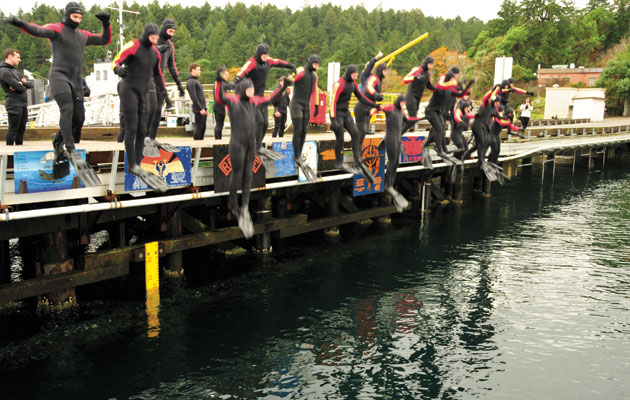
[caption id="attachment_8528" align="alignnone" width="300"] Ready, set, go! The Victoria Grizzlies line up to take the plunge into the waters at Fleet Diving Unit (Pacific).[/caption]They might be in shape for the ice, but on Nov. 4 the hockey players from the Victoria Grizzlies discovered a different kind of fitness – fit to fight. Victoria’s Junior “A” British Columbia Hockey League team spent a day in a navy diver’s wet suit to see, hear, and feel what it’s like to work beneath the cold Pacific waters. “We didn’t know what to expect,” says #17 Shawn McBride, Captain of the Grizzlies.“We didn’t really know what the Clearance Divers were all about, but we were excited to check it out, and we were all pretty surprised.”With the sun barely awake, the hockey players took part in the Clearance Diver morning swim, along with students in the current year-long Clearance Diver course.The one-and-a-half kilometre circuit tested their water skills and endurance.Seasoned divers showed the novices the sideways swimming technique that takes full advantage of the fins and leg extension.“Some on the team are good swimmers, but overall it was pretty tough,” McBride acknowledged.“I don’t think we realized how long it was going to be until we got out there.It was a new type of swimming too. It gives you a sense of respect for what they do.”After a half hour of water work out, everyone clambered to dry land for a little rope work – a 30 foot climb up a rope line on the training float’s confidence tower, and in water obstacle course.The Clearance Divers easily zipped up and down the course, while only defenseman #3 Zach Dixon and power forward #16 Dane Gibson of the young hockey players were able to make the feat, all to the rousing applause of their teammates. With...
The City of Windsor has unveiled the first fixed monument erected in a Canadian City to honour Canadian soldiers who lost their lives in Afghanistan.
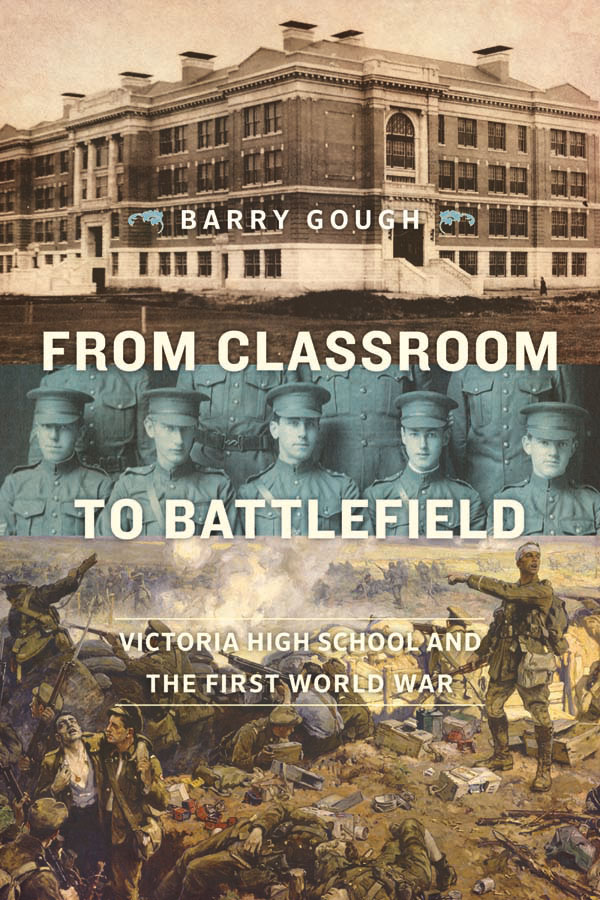
[caption id="attachment_8479" align="alignnone" width="200"] Being released on Remembrance Day. Written by Local Author Barry Gough[/caption]Local author Barry Gough’s new book on Victoria High School students and staff that fought in the First World War will be released just in time for Remembrance Day.The book launch for From Classroom to Battlefield: Victoria High School and the First World War takes place in the high school’s library Monday, Nov. 10 at 11:15 a.m. following a brief Remembrance Day ceremony in the school’s auditorium.Gough will also be holding signings on Tuesday, Nov.11, from 1 to 2:30 p.m. in downtown Victoria’s Munro’s Books, and on Tuesday, Nov. 18 at 7 p.m. at Bolen Books in the Hillside Shopping Centre. The book highlights the military experiences of 20 young men and women associated with the school. Several of them served at the front line in some of the war’s bloodiest battles, including the Somme, Vimy Ridge, Passchendaele, and Amiens.Drawing on the school’s extensive archives from the period, along with stories and photos provided by local families, the book offers a poignant examination of the First World War and its legacy for a school, a city, and an entire generation.“It is very important to write this account, as it is a part one of the greatest untold stories in Canadian history,” says Gough.“I am speaking of course about the generation of young Canadians who, in my opinion, were the greatest generation of patriots this country has ever known. They went selflessly to war without question, and the losses suffered by the youth during this period were extreme. By this measure they were also the ‘lost generation’. They left the shores of this nation for one of the most devastating conflicts in world history. In their wake was a national out pouring of grief when they did...

Exercise Noble Justification. A view of Spanish Warship SPS Almirante Juan de Borbon, from HMCS Toronto
[caption id="attachment_8492" align="alignnone" width="216"] Pattie Ashbaugh, Veteran of the Women’s Auxiliary Force (WAF),[/caption]For Pattie Ashbaugh, an 88-year-old London-born Victoria resident and veteran of the Women’s Auxiliary Force (WAF), life during the Second World War was spent mostly in secret office 60-feet below the surface.As a “plotter” for the WAF, Ashbaugh tracked aerial bombardments and engagements across the theatre of war from Fighter Command, located underneath Bentley Priory in London, England.“Every morning when we came into work we had to swear on the Bible that we would never reveal information about our work,” recalls Ashbaugh.“There were other offices that plotted much smaller parts of the theatre, but ours was the only one that covered it all. It was a very exciting job for a 17-year-old girl.”Ashbaugh’s job consisted of listening to radio transmissions from spotters across the country, and keeping track of V-1 flying bombs, called “buzz bombs”, and flights of both Allied and Axis aerial units.“We’d get information from anyone, from boy scouts on the roof with binoculars, to old men in their yards with a telescope,” says Ashbaugh.“Then we’d use different coloured figures to mark where they were on the map, which would be entered into the records and used by command, and when the clock turned over we’d wipe it off and start all over again. It was very hectic. Eventually it became automatic, but if you weren’t paying attention everything would happen so quickly you’d miss it.”The Flight Command was the central command for all Allied aerial units during the war, and as such was home to some influential figures.Among commanders from all Allied countries, then Prime Minister Winston Churchill kept an office at Flight Command, though a teenaged Ashbaugh wasn’t impressed.“He wasn’t very interesting to a teenage girl,” she says.“We would always be wearing his Siren Suit (a type of jumpsuit created by Churchill in the 30s, which became standard issue throughout the war), and he’d be up in the balcony where all the offices were....
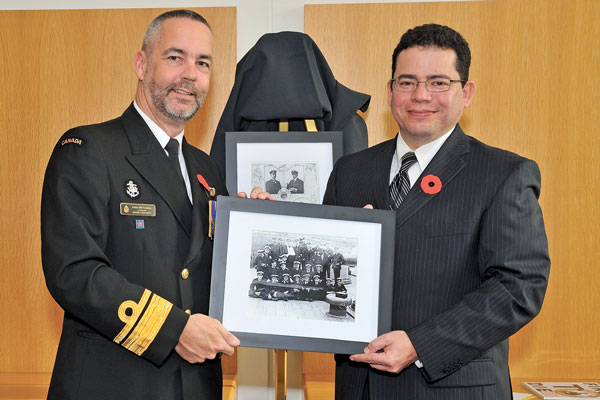
[caption id="attachment_8469" align="alignnone" width="300"] Dr. Pedro Marquez of Royal Roads University presents RAdm Bill Truelove with historic photograph during a commemorative ceremony .[/caption]In a foyer lined with historic artifacts of Royal Roads University’s days as a military college, a small crowd gathered to mark the death of four young Canadian sailors who died 100 years ago.During the Battle of Coronel on Nov.1, 1914, four Canadian midshipmen Malcolm Cann, John Hatheway, William Palmer and Arthur Silver - all just 19 or 20 years old - were lost on boardHMS Good Hope, becoming Canada’s first casualties of First World War and the Royal Canadian Navy’s first ever losses.The four midshipmen were graduates of the first class of the Royal Naval College of Canada, selected to do their “big ship time” aboard the Royal Navy armoured cruiser Good Hope.Along with HMS Monmouth, Good Hope was lost with all hands during an engagement with German Kaiserliche Marine forces on the evening of Nov. 1. Almost 1,600 sailors and officers, including the four Canadian midshipmen, perished when the two ships slipped under the water that night.Dr. Geoffrey Bird of Royal Roads University acknowledged that “the navy faces a particular challenge when it comes to memorializing its battles: the challenge of visiting the spot where the battle occurred, or physically marking the site for eternity.”Though the battle took place thousands of miles away off the coast of Coronel, Chile, Dr. Bird reflected that Royal Roads was a fitting place to commemorate the loss “here with these artifacts, on this site that celebrates [Royal Roads’] heritage as a naval and military college, and with the Royal Canadian Navy.”RAdm Bill Truelove, Commander MARPAC, was the guest speaker of the event. An alumnus of Royal Roads Military College himself, he spoke of the significance of the battle and the...
Season's first poppies pinned to the lapels of the 10 Canadian Armed Forces members who stood vigil this fall at the National War Memorial.
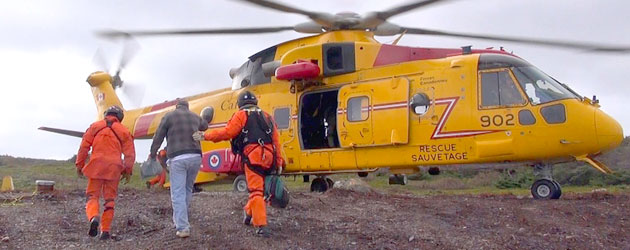
A Cormorant helicopter and Search and Rescue Technicians from 413 Squadron, rescued an injured man from an Island in Cape Breton, Nova Scotia on Oct. 28.
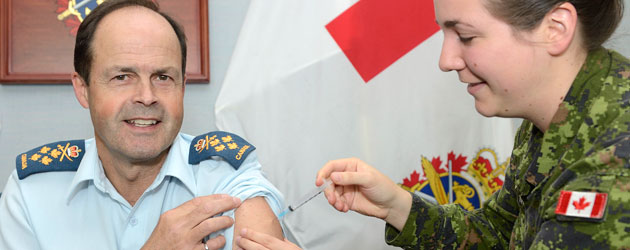
Gen Tom Lawson, Chief of the Defence Staff, receives a flu shot from Lt Sarah Thornton, a Medical Officer from Canadian Forces Health Services Group, at Head Quarters in Ottawa, Oct. 31.
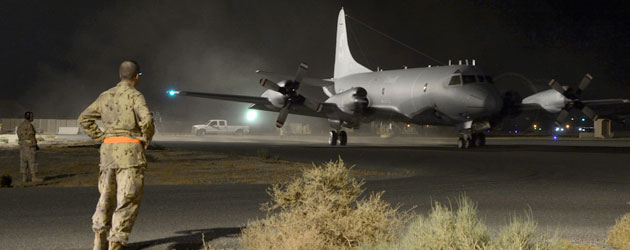
CAF aircrew members wait for the arrival of the CP-140M Aurora Long Range Patrol aircraft in Kuwait in support of Operation Impact on Oct. 29.
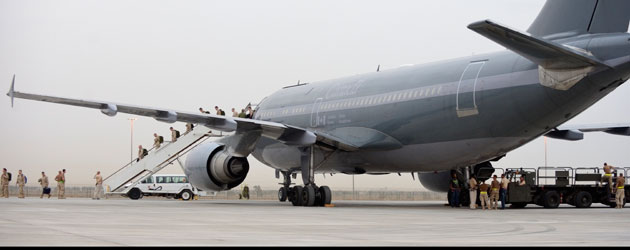
Canadian Armed Forces members arrive in Kuwait on a CC-150 Polaris Airbus as part of Operation Impact on Oct. 29.

A Spanish warship is barely in view as HMCS Toronto conducts tactical training with other NATO warships as part of Operation Justification on Oct.17 Operation Reassurance in the Mediterranean Sea.
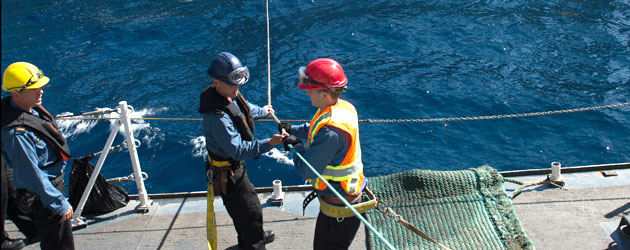
Crew members of HMCS Toronto haul in the cable for the fuel line during the Replenishment At Sea (RAS) with the French supply ship Marne A630 on Oct.17, Operation Reassurance in the Mediterranean Sea.

Honouring Cpl. Nathan Cirillo: Canadians closer and united
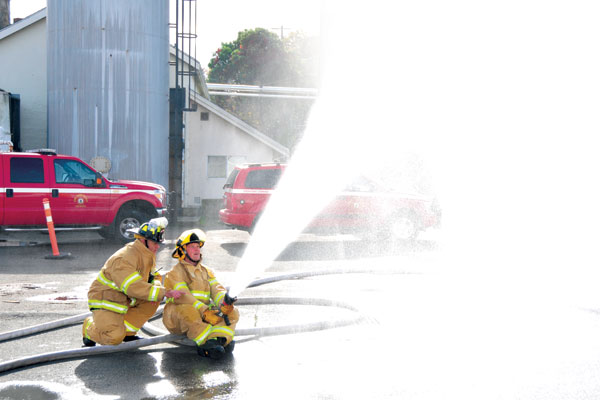
[caption id="attachment_8408" align="alignnone" width="300"] Pat Dunkley and Steve Cullimore take part in an exercise with the Firebrand firefighting vessel during the Great BC Shakeout.[/caption]Two week ago, base firefighters exercised with Firebrand, the Pacific Coast navy’s fireboat, to test its ability to become a portable water-side “hydrant.”When fighting a fire from the water, Firebrand can employ its three water cannons and fire suppressant foam from its two 250 gallon tanks.But it can also be used to fight land fires by becoming a portable water main.“If we have to fight a fire in an engine room of a warship, then Firebrand can use its master streams to cool the hull from the outside. Lowering the temperature of the steel hull hinders heat transfer from the fire-involved space to adjacent compartments,” explains Steve Mullen, Fire Chief at CFB Esquimalt Fire Department. “If we have to fight a jetty fire, using Firebrand is more effective than hanging firefighters off the side of a ship or jetties. It just makes our job a lot safer in a lot of situations.”The exercise took place Oct. 16 on B jetty with Firebrand berthed alongside. The scenario tested was an emergency where land-based fire mains were damaged or destroyed and Firebrand was brought in to help firefighters combat a blaze.Should an earthquake occur, one of the first pieces of critical infrastructure to be destroyed could be the water distribution system. Firebrand’s 5,000 gallon-per-minute-pump can supply a high volume of pressurized sea water into a system of hoses, gated wyes, and portable hydrants. This provides the fire department with enough water to fight structural fires ashore.“It can mean the difference between having what you need to suppress or extinguish a blaze, and stretching your water supply to dangerous limits,” says Mullen. “There have been some historic fires around the...
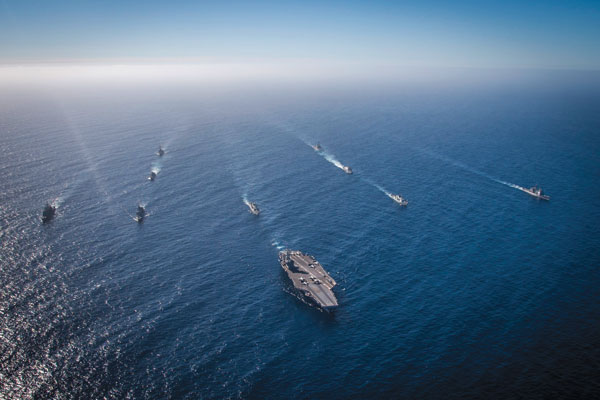
[caption id="attachment_8401" align="alignnone" width="300"] Ships from the Japanese Maritime Self-Defense Force, Royal Canadian Navy and U.S. Navy sail in formation during a Task Group Exercise off the coast of Southern California.[/caption]Last Friday, warships from Canada, the United States and Japan wrapped up the last day of 12 days training in the final task group exercise (TGEX) of the year.Representing Canada were HMC Ships Calgary, Winnipeg, Brandon, and Yellowknife, supported by two CH-124 Sea King helicopters from 443 Maritime Helicopter Squadron.The aim of task group exercises is to enhance combat readiness while improving interoperability and tactical excellence. This specific TGEX focused on interoperability between the Royal Canadian Navy, United States Navy, and the Japanese Maritime Self-Defense Force, and was hosted by the United States Navy’s 3rd Fleet. LCdr Jacob French, Calgary’s Executive Officer, said multi-navy work is the real strength of the exercise, as it gives sailors a look at how multinational situations might play out.“It always adds a dash of realism to any exercise, knowing that should there be an actual crisis requiring the cooperation of multiple navies, we would be able to operate in a coalition and joint environment,” he says. “The important thing is to adapt to the circumstances and work on ways of becoming more interoperable – something that navies have been doing for some time now.”This multinational interoperability, and the seamanship and communications skills that go along with it, are a vital part of naval experience, says LCdr French, adding the experiences gained during TGEX are skills that will stay with sailors the rest of their careers.“The collective training in the task group setting, and the individual training of each sailor are all important building blocks in maintaining the readiness of our fleet, and of our sailors,” he says. “There really is no substitute for quality sea...
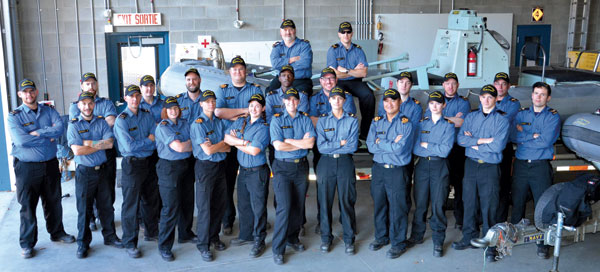
[caption id="attachment_8404" align="alignnone" width="300"] Members of HMCS Unicorn take a moment in the K158 Annex boatshed after a busy training exercise.[/caption]If you believe in sun gods, then they certainly smiled down on HMCS Unicorn Oct. 18 as members of the stone frigate took to the South Saskatchewan River for the final official boat exercise.The summer-like weather bolstered the spirits of Port and Starboard watch commanders, who responded to scenarios based on supporting other government departments at the direction of Domestic Operations. This training exercise had watch officers reacting to a HAZMAT spill, patrolling the river, assisting in search and rescue, and providing first aid as required. Watch officers had to make decisions while running the Operations Centre, which included managing the unfolding situation and giving orders to their sailors accordingly.The first task was to move to the boat launch by the Broadway Bridge to stand ready to assist after a briefing at Unicorn. The Operations Centre was stood up with boats and personnel launched, and at the ready to receive further instruction. In the first scenario, sailors located and assisted a casualty; this was accomplished by a small search party on the shoreline, and a water search that involved Unicorn’s hurricane and zodiac.“It is interesting to see how each person approaches problems,” said Lt(N) Nick Tien, Unicorn’s Training Officer. “They have to figure it out.”A Unicorn first happened; when the starboard watch relieved the port watch in the afternoon a second Operations Centre location was used in the exercise to test Unicorn’s readiness and reaction capabilities. The Operations Centre was quickly torn down and boats recovered to move to the new site – a boat launch north of the first site. This scenario had the search parties looking for a missing man.The exercise was well received as a valuable training day.“It...

The Advance Naval Boarding Party rappelled to the ice during the 4th Annual CAF/Defence Team Appreciation Night at the Save-On-Foods Memorial Arena on Nov. 22.
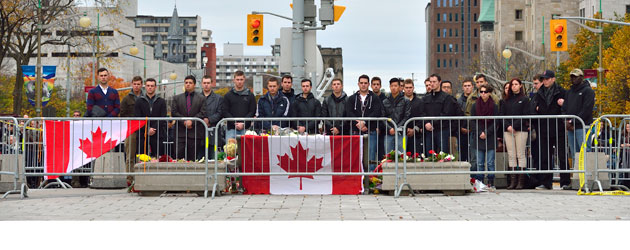
Members of the Canadian Grenadier Guards in Montreal, QC drove from Montreal to Ottawa to pay tribute to Corporal Nathan Cirillo in front of the National War Memorial during a Commemoration event in Ottawa, ON on Oct. 23.
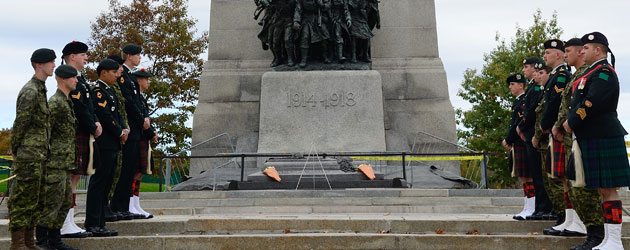
Canadian Armed Forces soldiers stand in front of the National War Memorial during the Commemoration event in Ottawa, ON on Oct. 23.
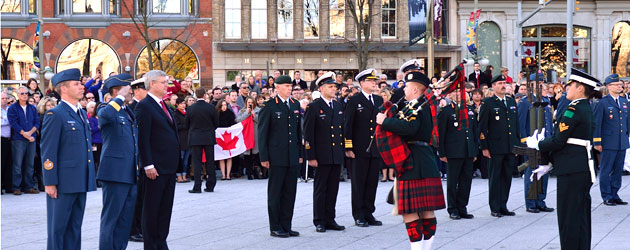
The Right Honourable Stephen Harper, Prime Minister of Canada and General Tom Lawson, Chief of the Defence Staff, return the salute from members of the National Sentry Program at the National War Memorial, in Ottawa, ON on Oct. 24.