[wpml_language_selector_widget]
[searchwp_form id="1"]
hmcs protecteur sails

Navy begins transition to the future fleet

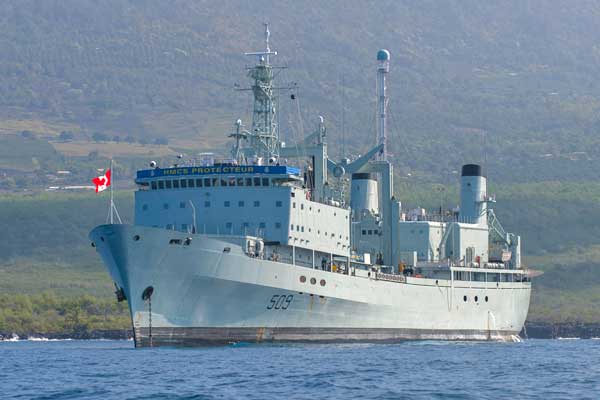
[caption id="attachment_7949" align="alignnone" width="300"] HMCS Protecteur is one of four Royal Canadian Navy ships being retired.[/caption]As the Royal Canadian Navy undergoes its most extensive peacetime modernization in history, Vice Admiral Mark Norman, Commander of the Royal Canadian Navy (RCN), announced on Friday the upcoming retirement of four ships that have reached the end of their operational lives.The ships are HMC Ships Protecteur and Preserver, two Protecteur-class auxiliary oil replenishment (AOR) ships; and HMC Ships Iroquois and Algonquin, two Iroquois-class guided missile destroyers (DDG). The retirement of these vessels has been anticipated for some time, and is a step towards the introduction of new ships and capabilities set to be delivered through the National Shipbuilding Procurement Strategy (NSPS), as well as recognition of the RCN’s commitment to the responsible use of public funds while maintaining Canada’s naval readiness.From the Admiral:The summer has passed quickly and I hope that you each had an opportunity to take some vacation. It has been a busy summer across the Formation as we have continued to deliver on our core missions including ships to sea, SAR, Cadets as well as being prepared to respond as necessary within our JTFP construct.At the same time, the navy has continued its implementation of the executive plan as we prepare, with energy and excitement, to receive the future fleet of modernized frigates, Arctic and Offshore Patrol Ships, Joint Support Ships and, in due course, the Canadian Surface Combatant.Yesterday [Sept. 18], I was thrilled to hear the announcement of the name of the first AOPS – HMCS Harry DeWolf. Today [Sept 19], we took another important step in that journey with the Commander of the Royal Canadian Navy’s announcement of the plan to decommission HMC Ships Protecteur, Algonquin, Preserver and Iroquois. Each of these ships has served us well for decades...

Heroic Esquimalt Resident Honoured

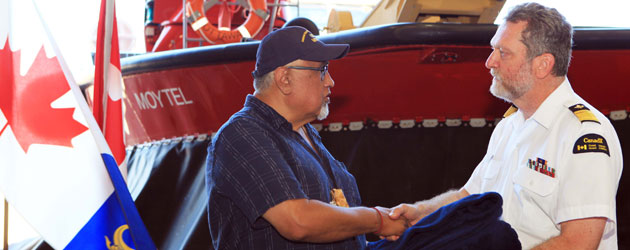
[caption id="attachment_7740" align="alignnone" width="300"] PO1 Michael Mitchell (left) and Lt(N) Andrew James (right) stand with the family of Commander Rowland Bourke, a First World War hero, former Esquimalt resident, and recipient of the Victoria Cross. Commander Bourke was honoured with the unveiling of a historical display detailing his life, military service, and legacy.[/caption]Next time you’re in the Esquimalt Branch of the Greater Victoria Public Library, keep an eye out for a piece of local military history.A new display details the life and career of Commander Rowland Bourke, a First World War Royal Navy Volunteer Reserve Officer, one of four naval Victoria Cross recipients, and a resident of Esquimalt from 1932 until his death in 1958.Featuring images of Cdr Bourke, his former residence on 1253 Lyall Street, his medals, and his resting place in Royal Oak Burial Park, the display is a thorough and educational look at this local hero’s life.Born in London, England, in 1885, Commander Bourke immigrated to Canada in 1902. At the outbreak of the Great War, he volunteered for the Royal Canadian Navy, but was rejected due to his poor eyesight.Travelling at his own expense, the young Bourke made his way back to the United Kingdom and joined the Royal Navy Volunteer Reserve.“He was a pretty incredible figure. His dedication to service was inspirational, and gained him quite a deal of recognition later in his career,” says Greg Evans, an archivist for the Township of Esquimalt, and one of the people instrumental in the creation of the Cdr Bourke display. “For such an influential figure, not many people know he lived right here in Esquimalt.We wanted to do something to change that.”Bourke is noted for having received both the Distinguished Service Order (DSO) and the Victoria Cross.During operations in the Zeebrugge raid in Belgium, April 1918, Bourke piloted a small boat to HMS Brilliant, which was under heavy fire, leading the rescue of 38 officers and enlisted men. For this he was awarded the DSO.In May of...

Regina returns: Admiral’s message

[caption id="attachment_7760" align="alignnone" width="300"] The Sikorsky SH-60 Seahawk helicopter from Frigate Cristóbal Colón F105 takes off from the flight deck of HMCS Regina during a replenishment at sea with FS Marne A630 on July 3 in the Mediterranean Sea during Operation Reassurance.[/caption]After a highly successful eight-month deployment, HMCS Regina will arrive at CFB Esquimalt on the morning of Wednesday, Sept. 17.I wish to sincerely congratulate the entire crew aboard Regina for your outstanding work. I commend you for your flexibility and determination that made your contribution invaluable to Canada, the international community, and the people who rely on safe seas every day. Your involvement with NATO and the numerous port visits you conducted cemented relations with our international allies and sent a clear message that Canada is a capable force across the world.Regina represented the Royal Canadian Navy with operational excellence and professionalism as part of Operation Artemis in the Arabian Sea and as part of Operation Reassurance in the Mediterranean. Your participation in both of these operations contributed to international peace and security far from home.Among your outstanding achievements of the 254 days deployed, you spent 212 of those days at sea, and travelled a total of 61,300 nautical miles. The CH-124 Sea King helicopter flew a total of 171 sorties with a total of 388 hours of flying time.On March 31, you intercepted and boarded a dhow off the east coast of Africa and discovered 132 packages of heroin weighing approximately 132 kilograms in total. This act undoubtedly diverted profits from terrorist organizations and prevented harmful drugs from reaching Canadian streets. A job well done to all of those involved.I would also like to thank the entire staff across all MARPAC units for your dedicated and tireless efforts, which allowed HMCS Regina to deploy. The level of professionalism and support you have provided these past eight and a half months has been outstanding. Your skills, knowledge, and hard work keep our ships safe and operational whether at home...

Former Oriole commander teaches weather forecasting

Ever wondered why a red sky at night is a sailor’s delight? One former HMCS Oriole Commanding Officer is looking to pass on the secret.Scott Crawshaw, who served as Oriole's Captain from 1999 to 2003, is hosting a Basic Weather Forecasting program Nov. 1, to teach civilian and military mariners the ins and outs of weather prediction.“This is a skill all mariners should have,” says Crawshaw, who currently works as J2 Geographical Intelligence Maritime for Canadian Forces Intelligence Command as a Lieutenant-Commander, ensuring vessels throughout the Canadian Armed Forces have proper, up-to-date charts and hydrographic information.“When you’re out on the water you’re at the whim of the elements, and if you can’t avoid a bad situation you should at least know when one is coming.”Crawshaw’s body of knowledge is extensive, as he has charted courses across the world, and tallied 50,000 nautical miles aboard Oriole, and his personnel vessel Peregrinata.“I retired for a few years, and sailed the world with my family on Peregrinata. I learned a lot about myself and the sea in those years,” he says. “Hopefully the lessons I’ve learned will be of use to my students.”The program is being hosted through the Bluewater Cruising Association, a club that Crawshaw has been a member for the past 14 years. During the weather forecasting program, students will learn to combine the information gleaned from weather forecasts, as well as personal observations, to predict weather changes and their effect on sailing conditions.“There is a lot of information you can get from simple weather readings and forecast maps online, as long as you know what you’re looking for,” says Crawshaw. “It’s just a matter of having the pieces of the puzzle in front of you, and knowing how to put them together.”One teaching tool he will use is a virtual race from Victoria to Hawaii. Using weather readings, charts, and the information learned during the seminar, students will have to chart a safe course across the Pacific.“I find that having...

Lost airmen remembered

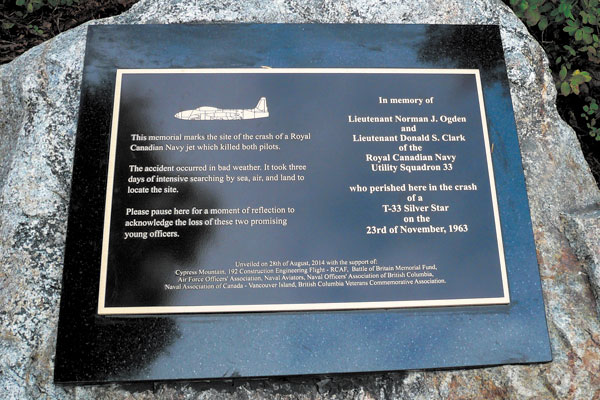
The lives of two Royal Canadian Navy (RCN) airmen were remembered Aug. 28 in a solemn and moving ceremony near the place where they were killed over 50 years ago.Lieutenants Norman J. Ogden and Donald S. Clark died when their RCN T-33 jet trainer crashed near the peak of Mount Strachan in Cyprus Provincial Park Nov. 23, 1963. This tragedy happened the day after President John F. Kennedy was assassinated.The assassination was covered for days by media around the world, and somewhat lessened the impact of the Canadian naval aviator’s deaths, who were killed in their service to Canada.Their loss was all but forgotten until some 50 years later, when a memorial project was started by the Air Force Association of Canada, and the Battle of Britain Memorial Fund, to properly pay homage to them.It was supported by retired RCN aviators across Canada, and this culminated in a ceremony this memorial plaque unveiling Thursday, Aug. 28 near the crash site, which is known as Cyprus Mountain, a ski area north of Vancouver, B.C.Commander (Ret’d) Al Horner, of Victoria, was a fellow naval aviator with VU-33, the RCN Squadron based at Pat Bay where 443 MH Squadron  is now located. Cdr Horner was also a close friend of the two dead RCN pilots, and he played a major role initially in the search, and then sadly, their burial.“On Nov. 23, Ian Powick and I were tasked to take two HUPs [RCN helicopters] to Vancouver to assist in the search for the missing aircraft,” said Cdr Horner in his remarks at the ceremony. “The weather was typical for November, low cloud, not much visibility, and very short days in terms of daylight.”He then explained that the first two days were hampered by low ceilings and their searches were limited and not successful....

History revisited in Memorial Park

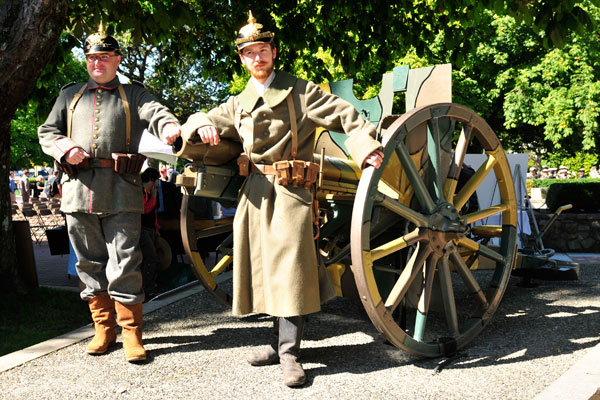
Last Thursday, the Esquimalt community gathered at Memorial Park to witness two historical artifacts be reborn.Two artillery guns, captured by Canadian Armed Forces (CAF) personnel during the First World War, were unveiled after being refurbished, repainted, and repaired to a nearly new condition.“The 100th anniversary of World War One gives us all a chance to reflect on our country’s military history,” said Mayor Barb Desjardins to the assembled crowd of military members, politicians, veterans, and civilians at the unveiling. “We are here to preserve that history, and remember the sacrifices made. It is our duty to maintain these guns as a symbol of that sacrifice.”Base Commander, Capt(N) Steve Waddell was on hand to represent the CAF.“The losses suffered by Canada during its time spent in the Great War were overwhelming,” he said. “The refurbished trophy gun monuments were taken during conflict as a sign of victory, but we are not here today to imply that war itself is a victorious endeavour. War for any side, in any struggle, brings only suffering, pain and loss.”The guns, a permanent fixture of Memorial Park since 1920, are two of only three such artifacts in the province; the other resides in Kelowna. The project to refurbish them was spearheaded by Esquimalt Public Works employee Mike Reed, who began the project in the fall of 2012.“We were thinking about what we could do for the centenary, and the subject of the guns came up,” says Reed. “They’d been falling further and further into disrepair, and it seemed like the right thing to do to preserve the history of the Township.”Both guns were captured in two separate engagements. One of the guns, an anti-tank weapon, was captured from the Bavarian Army by the 2nd Canadian Mounted Rifles at Vimy Ridge in 1917. The other,  a Krupp...

Children’s choir needs help getting to 2015 Holland trip

Next spring, a group of children from Victoria hope to honour the past with the power of song.The Victoria Children’s Choir is hoping to go to Holland for a two week choral tour honouring the country’s historic bond with Canada, but only if they can raise enough funds to cover travel expenses.While the trip is still months away, Boudewyn van Oort, Board President of the West Coast Children’s Choral Society, of which the Victoria Children’s Choir is a part of, says fundraising must begin early due to the high costs involved. Based on airfare, accommodations, food, and other expenses, he estimates the cost of each child, staff member, and chaperone at roughly $4,000.While it would be difficult to cover the entire cost of the trip through fundraising for about 35 singers in both group’s junior and senior choir, van Oort says the goal is to help ease the cost for the families.“It’s a lot of money, but trips like this are always worth the experience for the kids,” he says. “Obviously it’s much too much for the families to raise by themselves, but we’ve been doing all we can with bottle-drives and chocolate sales.”The plan is to have the children perform during the nation’s “Liberation Day” celebrations in May 2015 in Amsterdam.“When Canada led the liberation efforts in Holland, it created a bond between the two countries that is still very much honoured today. We wanted to do something ourselves to pay our respects to that bond,” says van Oort. “We’ve made such trips before, like our trip to Austria in 2011, and we thought this would be perfect opportunity to teach the children about the world and show the Dutch people their talent.”The group received an invitation to take part in a formal Remembrance Ceremony at the Canadian War...

Recreation offers school strike camps

[caption id="" align="alignnone" width="544"] Children can take part in activities[/caption] With the back-to-school date drawing ever closer, and the end of the teachers’ strike no where in sight, Personnel Support Programs (PSP) is hoping to lend parents a helping hand. Beginning Sept. 2, the Recreation Department will offer weekly camps for children out of school. Based out of the Youth Activity Centre (YAC) in Belmont Park, kids can take part in games, crafts, nature walks, and other activities to keep their minds and social skills sharp during the teachers’ strike. “When we realized that school most likely wouldn’t be in session by the start of September we wanted to put something together to give families a helping hand,” says Megan McDougall, PSP Recreation Coordinator. “We’ve got a lot of great people working with these camps, so we wanted to use our expertise to take some stress off these working parents.” Camps are modelled after their summer camps. The first week, beginning Sept. 2, costs $100, with each subsequent five-day week costing $125. Camps will run until school begins. “We really do offer some of the most thorough and affordable childcare in the city,” says McDougall. “Hopefully this will be a good option for the military community, and we can help some families out along the way.” Shawn O'Hara Staff Writer

Exercise Kootenay Cougar

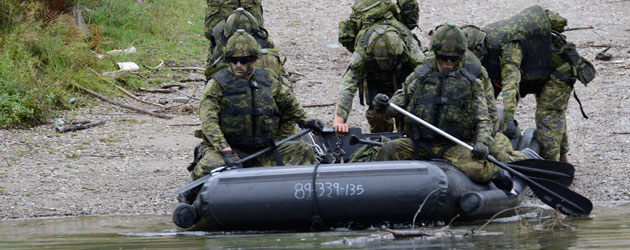
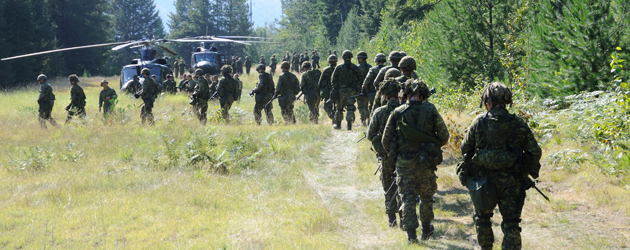
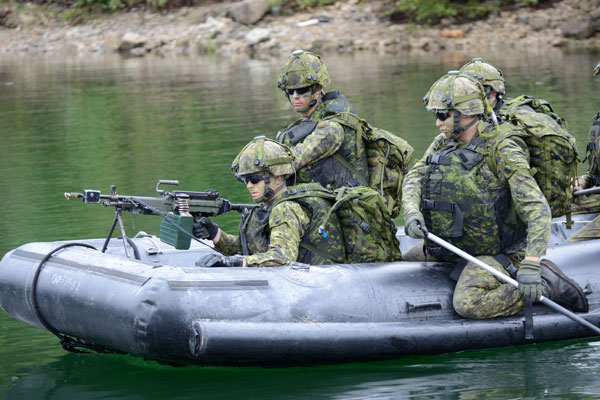
[caption id="attachment_7552" align="alignnone" width="536"] Soldiers from the British Columbia Dragoons conduct a water crossing during Exercise KOOTENAY COUGAR 2014 in Trail, BC on August 24, 2014.[/caption] Over 400 Canadian Armed Forces members descended on the city of Trail, British Columbia, in late August for Exercise Kootenay Cougar 2014. It was an intensive four-day exercise that had the primary training audience exposed to a wide scope of scenarios involving resources and expertise from 408 Tactical Helicopter Squadron, 1 Field Ambulance, and HMCS Discovery. “The mantra of this year’s exercise is train to excite,” explained Lieutenant-Colonel Nigel Whittaker, Director for Exercise Kootenay Cougar 2014. “We’ve designed eight different stands that provide a real variety of challenges to our troops and junior leaders; however, each challenge tests the core soldiering skills of shooting, moving, and communicating.” Two Royal Canadian Navy members from HMCS Discovery, a Naval Reserve unit in Vancouver, operated the safety boat for one of the eight stands. In the stand’s scenario, the platoon was advised of an enemy’s position some distance down a reservoir. The platoon had to row a dingy approximately 2,000 meters, meet with an informant to gain further intelligence on the exact location of the enemy, disembark and complete a reconnaissance, and ultimately destroy the enemy position. A father and daughter team, Lt(N) Desmond Doyle and OS Caroline Doyle ensured the portion of the scenario that took place on the water went smoothly. “The troops are expected to get themselves back in the boat should they fall out, but we’re there as a sort of insurance policy,” explains Lt(N) Doyle. “It’s a great opportunity to help out the Army and bring some of the expertise and skills I’ve developed as a sailor.” Many of the stands required an opposing force, ‘OPFOR’, to make the scenarios realistic. In...

'="command team conference"

Command Team Conference steers Naval Reserve towards the future

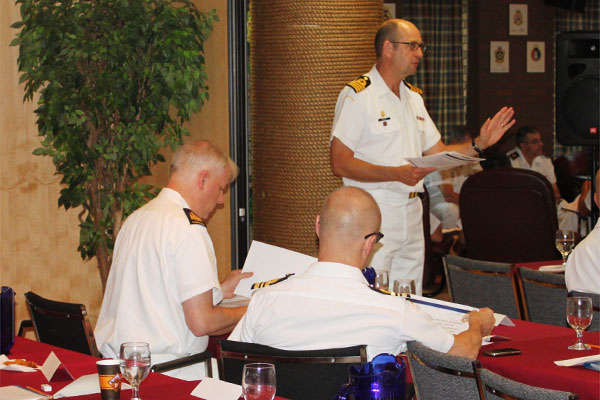
[caption id="attachment_7543" align="alignnone" width="517"] Senior Naval Reserve leadership attend an interactive workshop during the Naval Reserve Division Command Teams Training Seminar[/caption] Senior leadership of the Royal Canadian Naval Reserve from across the country met in Quebec City from Aug. 14-17, to discuss where the Formation had been, where it currently stands, and where it is going. The theme of this year’s command team conference was “Naval Reserve Integration”, an important principle of the Royal Canadian Navy as it continues forward with the “One Navy” reorganization concept.  The conference was chaired by Commodore David Craig, Commander of the Naval Reserve, and attended by representatives from the Canadian Naval Training System, personnel from Ottawa, and the Commanding Officer and Coxswain from each of Canada’s 24 Naval Reserve Divisions – or “stone frigates.” Over the course of the three days, attendees participated in informational presentations and interactive workshops on Naval Reserve organization and training. These served to equip senior Naval Reserve leadership with the information and tools to tackle the challenges they may face as the Royal Canadian Navy integrates all force generation processes. Among those in attendance was RAdm Bill Truelove, Commander Maritime Forces Pacific (MARPAC), who has taken on increased responsibility as the Naval Reserve becomes amalgamated with MARPAC. “This conference marks an important milestone for the Naval Reserve as we continue to transform it into an institution of excellence for the 21st century. With the centennial behind us and future procurement projects on the horizon, we must now lay the foundation to ensure the Naval Reserve plays an integral role of augmenting our maritime forces in the future of our navy,” said RAdm Truelove. With the release of the 2013-2017 Executive Plan by VAdm Mark Norman, Commander of the RCN, the Naval Reserve is accelerating the transition of becoming increasingly...

Explore More

Categories

Top News

E-Editions Archive

News Stories Archive

Proud Supporters

Joshua Buck, Lookout Newspaper