[wpml_language_selector_widget]
[searchwp_form id="1"]
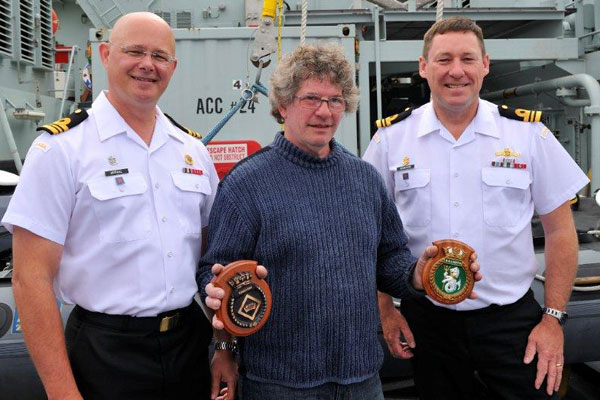
Port Clements Mayor Wally Cheer accepts ships’ plaques from Commanding Officers of HMC Ship Brandon and Edmonton

HMC Ships Brandon and Edmonton make special port visit

[caption id="attachment_7102" align="alignnone" width="300"] Port Clements Mayor Wally Cheer accepts ships’ plaques from the Commanding Officers of HMC Ships Brandon and Edmonton, LCdr Lawrence Moraal and LCdr Brad Henderson.[/caption]Following a formal request from the Port Clements town council to the Admiral, HMC Ships Brandon and Edmonton were dispatched to help the small community celebrate its 100 anniversary.On the final day in June, the two Kingston-class vessels made history as the first warships to sail into Masset Inlet in the north of Haida Gwaii.The mayor, members of the town council, fire department and local citizens were on the jetty to meet the two ships.In his opening remarks, Mayor Wally Cheer addressed the sailors, saying, “The council, village staff, and the citizens of Port Clements and surrounding areas extend a heartfelt ‘thank you’ for visiting Port Clements, Haida Gwaii. Your presence will make our Canada Day and centennial year a memorable one for many years to come. Safe journeys and God bless you.”The comments were met with hearty applause from the ships’ companies. After the address, locals challenged sailors to games of softball, volleyball and soccer, followed by a barbecue.On the second day, sailors split up for a kayak trip, a hike up Juskatla Mountain, a hike along the Golden Spruce trail, and walking tour of village.The city tour showcased significant parts of the town’s history and stories of citizens that put Port Clements on the map. The  town’s museum exhibits logging of the past and First Nations culture, including the story of the white raven and the Golden Spruce that shaped the community over the last 100 years.Locals were also provided the chance to tour the ships and learn about the navy. Overall, 260 people toured the ship.On the last day, both crews returned to their ship and invited the mayor,...
Reservist Cadet Instructor makes Orca certification history

[caption id="attachment_7031" align="alignnone" width="300"] Lt(N) Ellen Delong has made her mark in the history books by becoming the first female officer in charge of an Orca training vessel.[/caption] A personal and professional milestone was achieved earlier this month when Lt(N) Ellen Delong from the Cadet Instructor Cadre (CIC) completed her tender charge check ride, certifying her to act as Officer in Charge (OIC) of Orca training vessels. This certification makes her the first woman from CIC to receive this qualification. “It’s interesting to think I made a bit of history,” she says. “We’re at a point where women commanding vessels and making milestones isn’t an uncommon thing; but being the first female reservist from CIC to do it is pretty cool.” The certification is the last requirement in a long line of qualifications, which has included tests, training, and at-sea exercises spread out over the past six years. She began the process in 2008, but things were put on hold for two years while she focused on her family. “For some reason they don’t let you go to sea when you’re pregnant,” she says, laughing. “I had to take a break to raise my child; so getting back on the water felt really good.” For the check ride portion Lt(N) Delong set out on a fully-crewed Orca with Cdr Lorne Carruth, Commander Coastal Division, riding shotgun. As her boss, Cdr Carruth acted as judge and jury that day, analysing Lt(N) Delong’s performance. “He was very supportive and really helped me feel at ease,” she says. “I was a little on edge, it being my first shot at something I’d worked very hard for over the years.” Performing manoeuvres, coming alongside, and docking were just some of the things she had to walk her crew through. “The reverse docking is stressful. It’s a much more finicky kind of docking, but I think I handled it well,” she says. “Everyone one of the crew worked so well together, it was a thrill...

Afghanistan Memorial Vigil – opportunity to reflect

  The Canadian Armed Forces’ (CAF) 12-year mission in Afghanistan recently ended. It assisted in making the war-torn country more secure, better governed and more stable, but it did not come without sacrifice.While serving their country with honour, 161 Canadians – 158 CAF personnel, a diplomat, a Department of National Defence contractor and a journalist – lost their lives in Afghanistan. In addition, 43 United States Armed Forces members sacrificed their lives while serving under Canadian command during operations in Afghanistan. “One of the ways Canada is commemorating the mission in Afghanistan is by honouring the fallen through the Afghanistan Memorial Vigil, which will travel across Canada this year and in 2015,” said Capt Indira Thackorie, Canadian Joint Operations Command (CJOC) Public Affairs Officer. The Afghanistan Memorial Vigil consists of 192 plaques representing the 204 fallen. Originally, the plaques were part of the Kandahar Air Field cenotaph – a memorial structure built for soldiers by soldiers to commemorate their fallen comrades while deployed in Afghanistan. The first stop in the Memorial Vigil travel schedule was May 4 in Trenton, Ontario. On May 9, it was displayed in the Hall of Honour on Parliament Hill during the National Day of Honour and some of the families of the fallen were in attendance. Three CAF personnel – Captain Patrick Lottinville, Corporal Martin Labelle and Chief Warrant Officer David Mahon – will travel with the exhibit across Canada. During his time in the Canadian Army, CWO Mahon has been deployed to Germany, Egypt and Afghanistan. This task, however, holds an important significance for him.The opportunity to be a part of the Vigil Party will round out his 41-year career with the CAF. “Working with soldiers who are tasked to set up and tear down the Vigil, and then discussing the intent and meaning with Canadian citizens has been the most meaningful experience of my career,” he explained. “My task is ceremonial and drill. I feel that my years in the field and on...

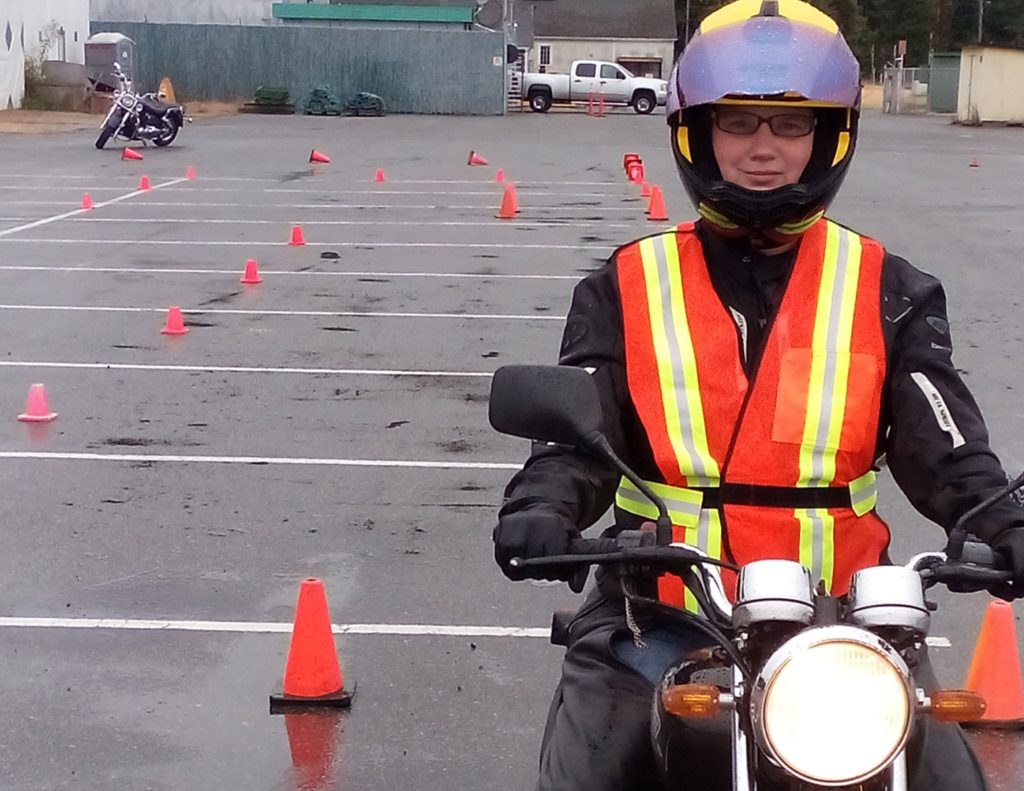
Shelley Fox sits on one of the Learn to Ride 250cc motorbikes at the Jetty parking lot where she was practicing the skills needed to pass the ICBC Motorcycle Skills test.

What do space cushions have to do with motorcycle riding?

This was it; 2014 would be the year I learned to ride a motorcycle and ride with the pack. None of my friends would ride with me unless I took a proper “learn to ride” course. And, as if the hog gods were listening, an ad appeared in the Lookout newspaper for “Learn to Ride” motorcycle training. I could almost hear leather-clad angels cooing “ahhhhh.” With my application accpeted and Class 6/8 Learner’s License obtained, I was set for the two evenings of four hour classroom theory, and two full days of learning on a 250cc motorbike – courtesy of  Learn to Ride Motorcycle Training Ltd. In hopes of staying ahead of the pack, I eagerly studied the ICBC “Learn To Ride Smart” booklet. A few days later, I was seated next to four other rider wannabes at the Econo Lodge Gorge View board room, our eyes set on Richard Beaumont, a Petty Officer Second Class sailor who has 14 years experience on two wheels, and seven as a certified trainer. He tossed out bike jargon that I found novel such as “space cushion.” No, not a silver lamé throw pillow, but a descriptive term for the necessary distance in front of you that allows time enough to stop or react safely. Or “road snakes,” the literal meaning sounds more fantastical than the actual. It pertains to the wiggly tar lines meant to repair the cracks in the road. They are slippery, especially when wet and are to be avoided where possible. In terms of real world threats to a motorcyclist, road snakes are on the lower end of our worries. We learned that everything is a potential hazard when you are riding, and it is best to practice SIPDE: scan, identify, predict, decide and execute. From the classroom, we...

Above: Cadet Chief Warrant Officer Kristan Chung (right) of the British Columbia Regiment lays a wreath at the cenotaph in the Canadian Cemetery at Beny-sur-Mer. Attending the ceremony are

Cadets step back in time

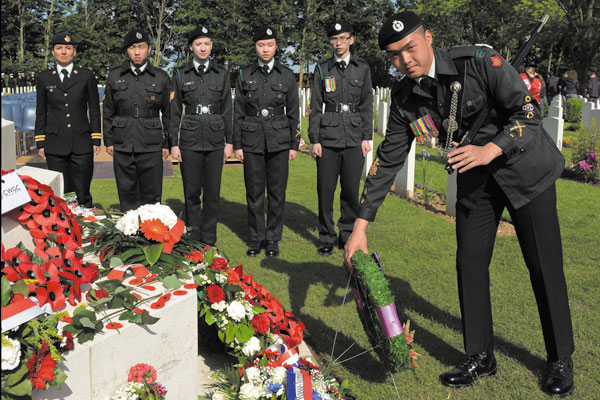
[caption id="attachment_6972" align="alignnone" width="300"] Above: Cadet Chief Warrant Officer Kristan Chung (right) of the British Columbia Regiment lays a wreath at the cenotaph in the Canadian Cemetery at Beny-sur-Mer. Attending the ceremony are, from left: Captain Leah Yauck, C/MCpl Roger Mak, C/Sgt Holly Johnson, C/Sgt Sharon Wong and C/MWO Richard Vo.Wayne Emde[/caption] For five Vancouver cadets from 2290 RCACC (British Columbia Regiment), a tour that combined the battlefields of the First World War with the events of the 70th Anniversary of the D-Day landings proved to be moving and memorable. During the first week of June, after tourist stops and museum visits in London and Paris, Captain Leah Yauck and cadets Kristan Chung, Rich Vo, Holly Johnson, Sharon Wong and Roger Mak travelled to Normandy, France. Their first stop was Pointe du Hoc on the coast of Normandy, where, during D Day, the United States Army Ranger Assault Group assaulted and captured the area from the Germans after scaling the cliffs. “We were rendered speechless after learning of the carnage and battlements, which were so visible and oppressive,” said Capt Yauck. They were surprised to see the numbers of re-enactors at the site; French citizens who dressed in vintage American army uniforms driving restored vintage jeeps, trucks, and motorcycles. Their second stop was Arromanche, which was established as an artificial temporary harbour to allow the unloading of heavy equipment during the Second World War. The town is home to the Arromanche D Day museum. “We stood at the monument there and tried to imagine what it looked like 70 years ago,” she said. On June 5, the group travelled to Honfleur, where they toured the oldest wooden church in France, and then the ancient harbour surrounded by tall, narrow buildings. After an emotional stop at the Ardenne Abbey, the location...

War Veteran Peter Chance added another medal to his collection

French medal bestowed upon Canadian veteran

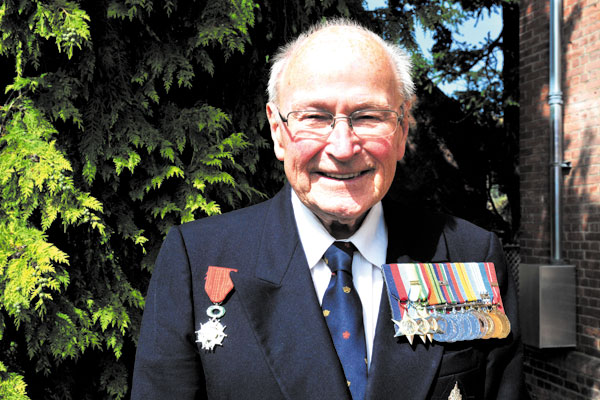
[caption id="attachment_6969" align="alignnone" width="300"] War Veteran Peter Chance added another medal to his collection, the the Ordre national de la Légon d’honneur.[/caption] Seventy years after his ship, HMCS Skeena, took part in the D-Day landings, Cdr (Ret’d) Peter Chance received recognition from the French government. Along with 500 other Canadian army, navy and air force veterans of the pivotal Second World War battle, the 93-year-old was named a Chevalier (knight) of the Ordre national de la Légon d’honneur, France’s highest honour. Five hundred is all that remains of the more than 34,000 Canadian soldiers, sailors and airmen who participated in Operation Overlord and began to push German forces back out of France. Chance and 14 other B.C. veterans gathered in Vancouver on May 21 to accept the medal from Consul General of France M. Jean-Christophe Fleury, who presented it on behalf of the President of France. The event included dinner and speeches from dignitaries including Minister of Veterans Affairs Julian Fantino, Premier Christy Clark, and Lieutenant Governor of B.C. Judith Guichon. Each recipient was assigned a cadet escort “to make sure we didn’t fall down,” Chance jokes. Though he earned several other medals and awards through his more than 30-year naval career, this one is special, he says. “It is very special because it recognizes Canadian participation in the Normandy landings.” Chance was the navigating officer in HMCS Skeena when the allies made their Normandy assault on June 6, 1944. As part of Escort Group 12, Skeena’s duty was to block German submarines from entering the landing area. The most memorable moments of that mission came on June 8 when two homing torpedoes – designed to target the frequency of a ship’s propellers – streamed through the water and exploded in Skeena’s Canadian Anti-Acoustic Torpedo (CAT) gear. It was a...

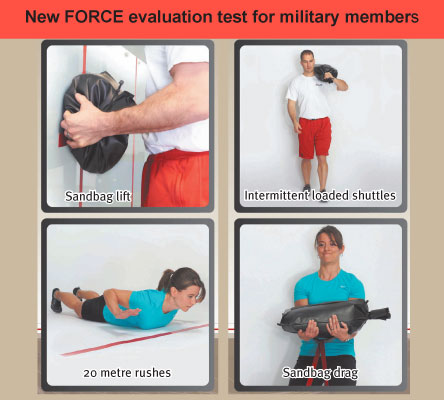
FORCE test image

Assessing fitness beyond FORCE test

CF Morale and Welfare Services Directorate of Fitness has joined the push to generate a fitter and healthier military. They are going beyond the FORCE Evaluation - the new assessment tool to determine if a member is fit for duty - and are now looking at a way to indicate a member’s general fitness level.  Researchers have been to four bases putting select members through the FORCE Evaluation to gather specific data. Last week, 150 men and women of varying ages volunteered for the research at CFB Esquimalt . “We’re going across country collecting data on 600 CAF personnel to see what their fastest FORCE times are, and we’re plotting them on the incentive chart where they’ll be compared to their age and gender counterparts,” explained Dr. Tara Reilly, Research Manager Human Performance in Ottawa. The Human Performance Research team is developing a Fitness Profile, which is a measure of fitness that goes beyond the minimums for job performance. That profile will include an incentive program that will be used to encourage members to improve both their operational and general physical fitness.  In the previous EXPRES test the incentive was an exemption on the next year’s test. However, the new motivational program is still in the development phase, so the four incentive levels and rewards have yet to be confirmed. The new fitness profile expands on the existing FORCE Evaluation in two main ways:   Firstly, it offers an incentive program where members will be compared to their age and gender groups in order to encourage maximal performance and improvement on the FORCE Evaluation.  In this way the member will be provided with a scaled measure of his or her operational fitness compared to other people of his or her age and gender, rather than simply a pass or fail....

Capt J. J. ‘Yank’ Cummings

Supercarrier USS Nimitz visits Esquimalt

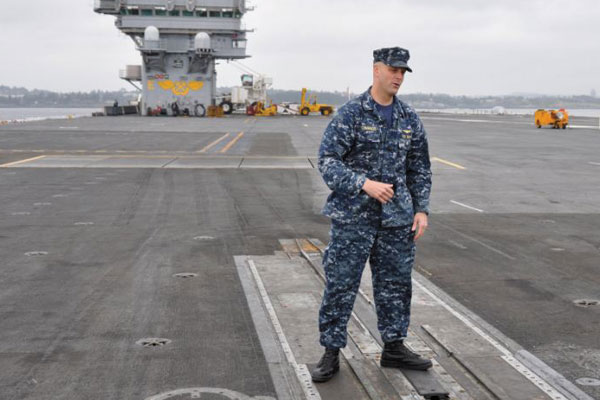
[caption id="attachment_6949" align="alignnone" width="300"] Capt J. J. ‘Yank’ Cummings, Nimitz’s Executive Officer and a former naval aviator, gives an informational tour of flight operations on the carrier’s flight deck.[/caption] The hulking silhouette of USS Nimitz, a United States Navy (USN) aircraft carrier and lead ship of the Nimitz-class, was an impressive sight on the water during its stay in Esquimalt from June 13-16. “We pass by here every time we get underway thinking ‘Wow, it would be great to pull into Victoria.’ So we’re pleased to be here,” said Captain Jeffery Ruth, Nimitz’s Commanding Officer. Arriving from its home port of Naval Station Everett in Washington state, “Old Salt”, the carrier’s official nickname, laid at anchor off Royal Roads near CFB Esquimalt. Here for a brief port visit before proceeding to Canadian Forces Maritime Experimental Test Range Nanoose Bay, Nimitz arrived in Esquimalt with over 2,800 sailors and family members on board. With the addition of the carrier’s air component, Carrier Air Wing Eleven, the ship’s personnel would number well over 5,000; however the Wing remained in California. Despite the absence of the carrier’s Air Wing, media were given an informational tour of air operations on Nimitz’s massive flight deck by Captain J.J. “Yank” Cummings, Nimitz’s Executive Officer and a former naval aviator. Capt Cummings described the force behind the carrier’s catapult aircraft launching system as a “40-tonne double-barrel shotgun below deck.” The launching procedure is an intricate process that involves a number of personnel on the flight deck working in close conjunction with one another amongst explosives, jet blasts and steam-driven launching catapults. “It’s one of the most dangerous places on earth,” stressed Capt Cummings. When the aircraft and catapult are primed for launch, the press of a button releases a massive amount of force, literally flinging the aircraft...

David Yates

Cadet receives national honour

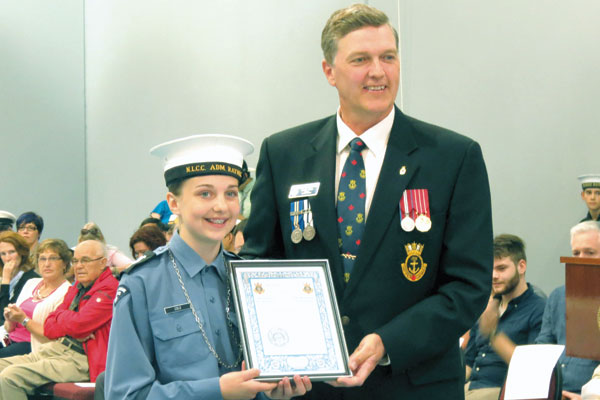
[caption id="attachment_6944" align="alignnone" width="300"] David Yates, National Vice-President of the Navy League Cadets, presents CPO1 Charity Cole with the Medal of Excellence Award at the June 1 Annual Ceremonial Review.[/caption] Sometimes it’s good to stand out in a crowd, especially if it’s because of your accomplishments. A few weeks ago 12-year-old Charity Cole soared far above her peers when she was named Top Navy League Cadet of Canada (NLCC), in addition to being the Navy League Cadet of the year for Vancouver Island Division. It was at the June 1 NLCC Admiral Rayner’s Annual Ceremonial Review in Work Point that she was called to the front and given the Medal of Excellence Award. “I was shocked. I heard that I’d won Top Cadet for Vancouver Island, but didn’t hear about the other one until they were presenting it to me,” says CPO1 Cole. “It was a huge honour, and everyone except my Commanding Officer was very surprised.” CPO1 Cole was chosen out of more than 7,000 Navy League cadets across Canada for the honour. Because she was named Top Cadet of both her region and country, the medal features two anchors on the bar instead of the customary single anchor. She is not cut from the usual pre-teen cloth. While most 12 year olds’ eyes are on their cellphone or computer screen, CPO1 Cole has hers set on many horizon-expanding activities. Cadets is just one of a long list of extracurricular pursuits that includes Girl Guides, playing violin, curling, swimming, and volunteering with city organizations. She also plays the bass drum in her cadet corps. Born into a military family - her father is a Sergeant at 443(MH) Squadron and her brother was a coxswain of his cadet corps in Halifax - naval cadets seemed like a good place for...

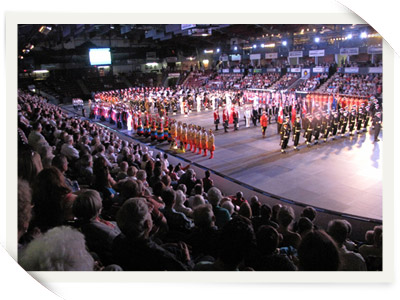
Image of the Pacific Tattoo 2013 Finale

Military bands set to play at this year’s Pacific Tattoo

Pacific Tattoo 2014 features performers from across North America in recognition of the anniversaries of World Wars One and Two. The 3rd Annual Pacific Tattoo, held July 12 and 13 at the Save-on-Foods Memorial Centre, features military and civilian performers from across Canada and the U.S.A, in a theatrical production that honours veterans and recognizes the centenary of the First World War, and the  70th anniversary of D-Day. “We have the familiar tattoo ingredients: military bands, precision marching, pageantry, uniforms, historical recognition, nostalgic music and of course pipes and drums and highland dancers,” says Roger McGuire, producer of the Pacific Tattoo. “Each year the Tattoo incorporates a central theme. This year we recognize anniversaries associated with both World Wars, and we’ll honour veterans who will be in attendance.” New to this year’s event are the New Guard America, Princess Patricia’s Light Infantry Drum Corps, and the Band of the 15th Field Artillery Regiment. New Guard America, holder of 13 Guinness World Records and 11 world championship competition titles, is the world’s only internationally touring professional civilian fixed bayonet rifle exhibition drill team.  Widely regarded as the best in the world, New Guard America features six rifle sequences of such extreme risk and difficulty; they are the only drill team in the world to perform them. The non-firing weapons used during their performances are the M1903-03 rifle. These weapons were used by U.S. military during both World Wars. Returning performers include The Naden Band of the Royal Canadian Navy; the Tattoo Pipes and Drums including members of the Canadian Scottish Regiment and Seaforth Highlanders of Canada; and the “E” Division RCMP Ceremonial Troop. Pacific Tattoo organizers are scheduling free daytime performances around Victoria July 9 through 11.  Watch for impromptu “10-minute Tattoo teases” in the Inner Harbour and in Centennial Square....

Explore More

Categories

Top News

E-Editions Archive

News Stories Archive

Proud Supporters

Joshua Buck, Lookout Newspaper