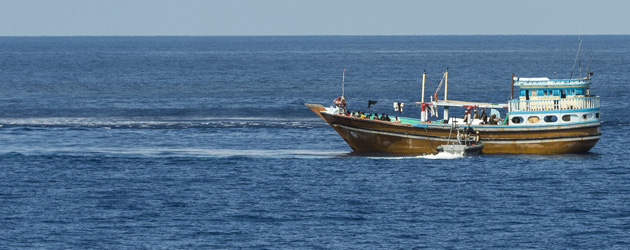
HMCS Regina on guard
HMCS REGINA’s naval boarding party conducts a boarding of a suspect dhow during Operation ARTEMIS off the coast of Africa on March 1, 2014.
HMCS REGINA’s naval boarding party conducts a boarding of a suspect dhow during Operation ARTEMIS off the coast of Africa on March 1, 2014.
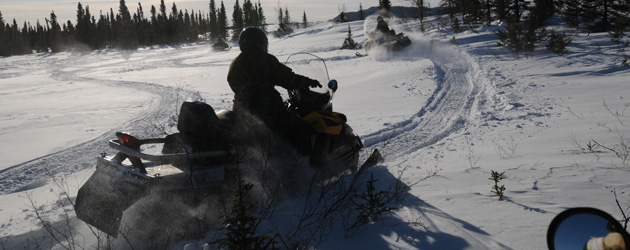
The Joint Task Force Support Element staff participate in a Light Over Snow Vehicle course on February 18, 2014 in the training area of 5 Wing Goose Bay in Happy Valley-Goose Bay, Newfoundland and Labrador.
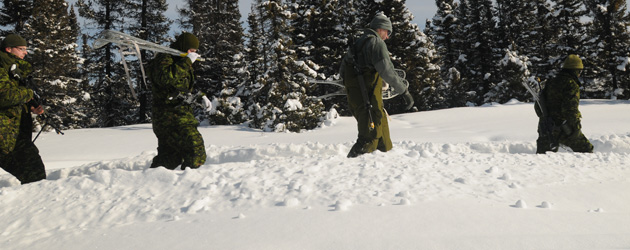
37 Canadian Brigade soldiers conducting winter survival skills training make their way back to their tent area to prepare lunch in the training area of 5 Wing Goose Bay, Newfoundland and Labrador.
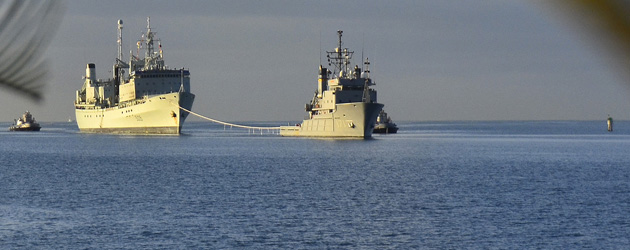
HMCS Protecteur experienced an engine fire en route to Canada and returned to Pearl Harbor with the assistance of U.S. Navy ships.
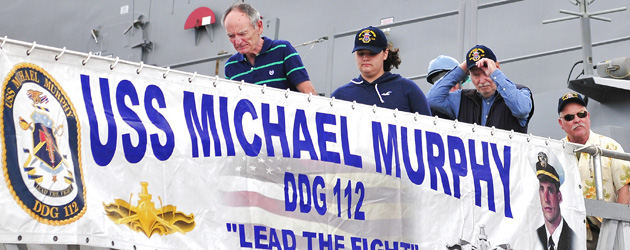
USS Michael Murphy returns to Joint Base Pearl Harbor-Hickam in Hawaii, U.S.A with 17 civilians on board on March 4, 2014 after providing assistance to the Royal Canadian Navy ship HMCS Protecteur.
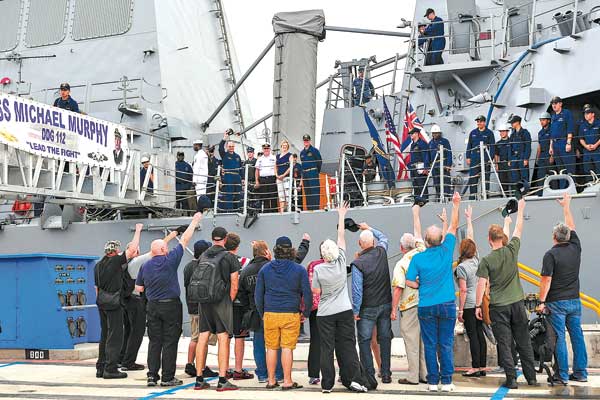
[caption id="attachment_5943" align="alignnone" width="300"] Seventeen civilians wave goodbye to the crew of guided-missile destroyer USS Michael Murphy after being dropped off at Joint Base Pearl Harbor-Hickam in Hawaii. The civilians were on HMCS Protecteur’s Tiger Cruise when a fire broke out.[/caption] When United States Ship (USS) Michael Murphy arrived in Pearl Harbor, Hawaii, on March 4, there were 17 passengers onboard who had been through a once-in-a-lifetime experience.They were all family members of HMCS Protecteur crew members, who had embarked on the ship for the “Tiger Cruise” transit from Pearl Harbor to Esquimalt, B.C. at the end of the ship’s two month Mid-Pacific Oiler deployment. As Mid-Pacific Oiler, Protecteur provided replenishment and re-fueling for allied ships in the Pacific. Having family members on board for the last part of a sail is a common practice with Royal Canadian Navy ships returning from extended operations, and one that family members appreciate.They were expecting to enjoy a leisurely journey, getting a glimpse of life at sea in the Royal Canadian Navy. Instead, they got a first-hand view of their loved ones in action, doing what they are trained to do, respond to a serious fire at sea. At around 10 p.m. on the second day of their journey, the lights suddenly went out, followed by a fire alarm and emergency pipe announcing the fire was in the engine room space. The engine room is the largest compartment inside the ship, and is filled with machinery, fuel lines, and high voltage electric cables.They were 340 nautical miles from land, and with no other vessels close enough to assist, the crew of Protecteur was on their own. They would have to solve this problem together, and their lives depended on it. Wade Keller, father of AB Sam Keller, said, “They mustered us with the...
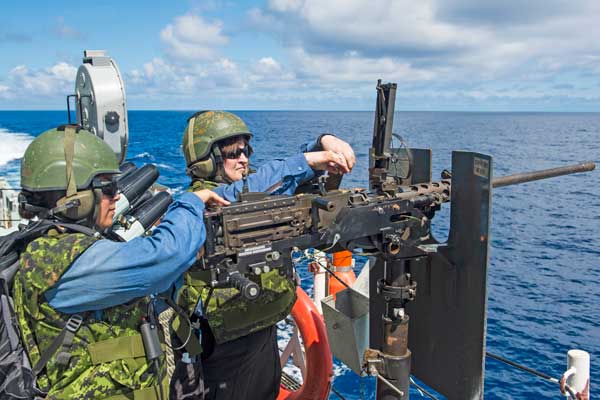
[caption id="attachment_5939" align="alignnone" width="300"] LS Rebecca Charlesworth and Stephanie MacLean reload a .50 cal heavy machine gun during a training exercise to trial the newly installed Herstal mount on the starboard bridge wing.[/caption] HMCS Regina is currently conducting maritime security and counter-terrorism operations at sea off the east coast of Africa as part of Operation Artemis. Op Artemis is Canada’s contribution to Combined Task Force 150 (CTF 150), a multinational maritime task force combating terrorism across the Red Sea, Gulf of Aden, Indian Ocean, and the Gulf of Oman. Regina’s mission is to deter and deny terrorist and transnational criminal organizations from using merchant shipping lanes to smuggle weapons and illicit cargo, while simultaneously enabling the free and fluid movement of goods and services in the region.In general, Regina’s mission is similar to what previous HMC Ships such as Toronto have done in the region, although each ship has been assigned to different areas within the Operation Artemis Joint Operations Area. “We are taking valuable lessons learned from previous rotos and adapting them to the constantly evolving maritime operations picture in the area,” said Cdr Dan Charlebois, Regina’s Commanding Officer. “Our presence also provides the Government of Canada with the flexibility and capability to respond to an emerging crisis in the region on their behalf.”Regina and its CTF 150 coalition partners are working closely to promote security, stability and prosperity in an area that spans over two million square miles in one of the world’s most important shipping routes for transoceanic commerce and trade.The Joint Operations Area includes the main shipping routes from the Far East to Africa, Europe and North America with one third of the world’s oil passing through the area and over 23,000 shipping movements each year.It also contains three narrow waterways, or chokepoints, where ships have...
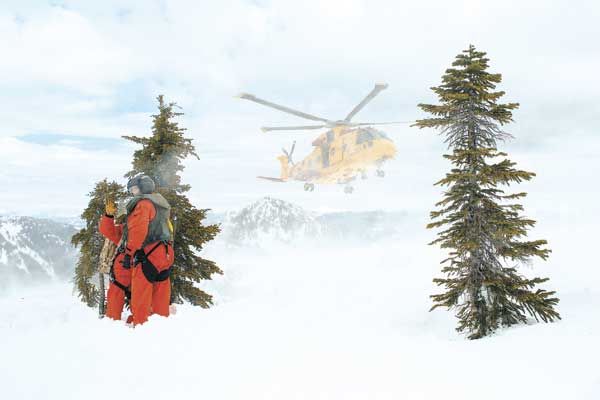
[caption id="attachment_5936" align="alignnone" width="300"] Search and Rescue Technicians from 442 Transport and Rescue Squadron discuss their plan of action on the ground as a Cormorant helicopter comes in to land on top of a mountain near Hope, British Columbia during an annual Search and Rescue Exercise.[/caption] 442 Transport and Rescue Squadron from 19 Wing Comox and local Civil Air Search and Rescue Association (CASARA) members conducted a search and rescue exercise (SAREX) in Abbotsford under the control of Joint Rescue Coordination Centre (JRCC) Victoria from Feb. 25 to 28. The team practiced their collective ability to respond to a plane crash.“This exercise highlights the importance of partnerships and interoperability within the SAR community. Collective search and rescue efforts between the Canadian Armed Forces, other government departments and volunteer organizations help promote education and training, which is fundamental to saving lives,” said RAdm Bill Truelove, Victoria Search and Rescue Region Commander and the commander of Joint Task Force Pacific.The squadron provided CH-149 Cormorant helicopters and CC-115 Buffalo aircraft. More than 70 members from the squadron and 19 Wing Comox participated, along with 35 CASARA members who provided aircraft and assistance in the exercise. Aircrews practiced homing in on emergency locator beacons, parachuting to crash scenes and evacuating patients from remote areas.Search coordinators were located at a command centre in Comox, deployed air and maintenance crews were in Abbotsford, while RCAF Cormorant helicopters, Buffalo airplanes and CASARA aircraft were launched to the Hope and Chilliwack areas of the Lower Mainland to conduct the exercise.Members of the local CASARA provided their own aircraft and local knowledge to assist 442 Squadron personnel. CASARA aircraft are used in a search role and CASARA personnel can be used as spotters onboard military aircraft.“When searching for an aircraft in a remote part of British Columbia, it is...
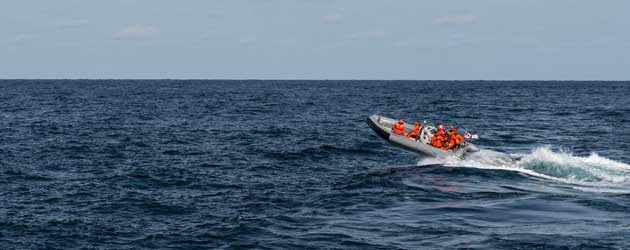
HMCS Iroquois’ rigid hull inflatable boat transfers crew members from the Federal German Ship BONN back to their ship during a multi-national Fleet Exercise on Feb. 26.
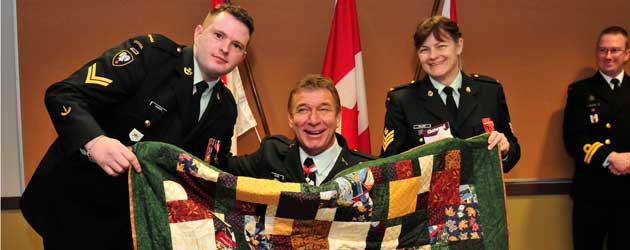
Honorary Colonel Rick Hansen presents a quilt from Quilts of Valor to Cpl Darryl Hansen at Joint Personnel Support Unit Headquarters on Feb. 26.
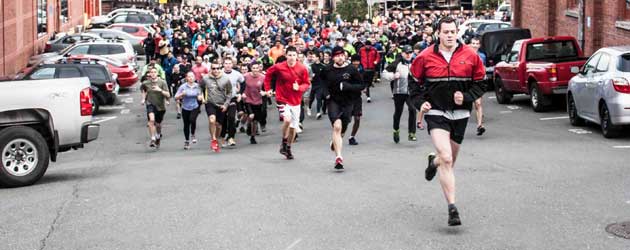
Participants of the February Fleet Run head off on their 5 kilometre run through dockyard and Naden. The Fleet Run is scheduled for the last Thursday of every month and leaves from A jetty.
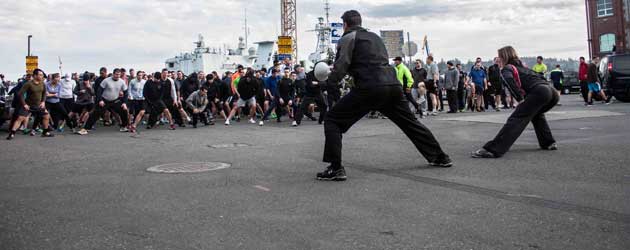
Personnel Support Programs Fitness Instructors Matt Carlson and Kimberly Maine lead the February Fleet Run participants in a brief warm-up before the big event.
HMCS Regina flies its battle ensign sized Canadian Naval Ensign off the east coast of Africa on February 26 during Operation Artemis.
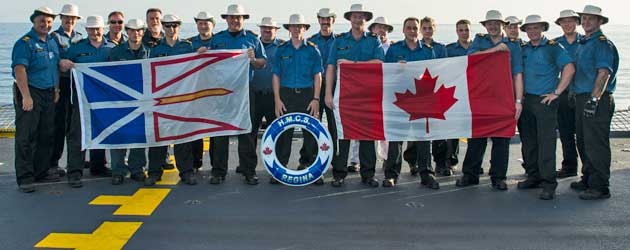
Sailors from Newfoundland and Labrador who are onboard HMCS Regina pose for a photo taken from the flight deck during Operation Artemis.
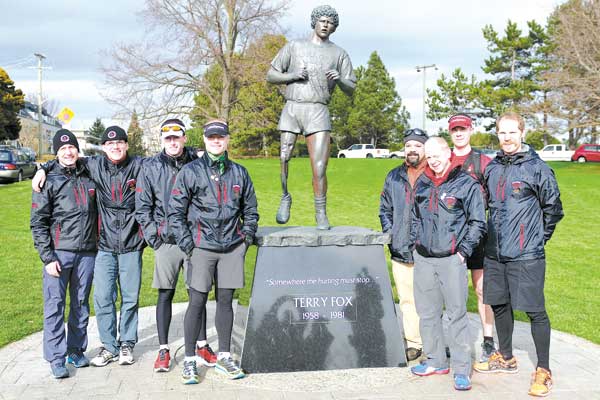
[caption id="attachment_5892" align="alignnone" width="300"] The Wounded Warrior Run B.C. team gathers at the Mile Zero monument in Victoria after running 600 kilometres and raising more than $10,000 for Wounded Warriors Canada.[/caption] After six days on the road and 600 kilometres traversed in running shoes, the Wounded Warriors made it home.The running team, including Wounded Warrior Run B.C. founder PO2 Allan Kobayashi, crossed the finish line Feb. 21 in Colwood.“It was a great experience. There were definitely some challenges but I’m proud of everyone,” says PO2 Kobayashi. “We set out to raise some money for military members, and we surpassed even our expectations. I’m thrilled.”The event raised money for Wounded Warriors Canada, a non-profit organization that provides programs and connections for military personnel suffering from Post-Traumatic Stress Disorder (PTSD) and other work-stress injuries.The run gained public attention as the miles wore on.“We got a phone call from the president of Wounded Warriors Canada, who said he’d been directly receiving phone calls talking about our run,” says PO2 Kobayashi. “We were making waves, and word was getting out. It was huge for us.”The team shattered the fundraising goal of $2,500, raising more than $10,000.“The money just kept rolling in,” says PO2 Kobayashi. “We had schools donating money raised through lunch funds and little kids emptying their piggy banks. It was a very emotional experience.”Setting off from Port Hardy Feb. 15, the team encountered high winds, knee deep snow, and driving rain. PO2 Kobayashi says with the warrior spirit in their hearts nothing could stop them, not even nature.“I was running my leg further up island and nature called. So I ran off to the side of the road and as I was finishing up I heard someone yelling at me from the support vehicle,” says PO2 Kobayashi. “I turned around and there’s...
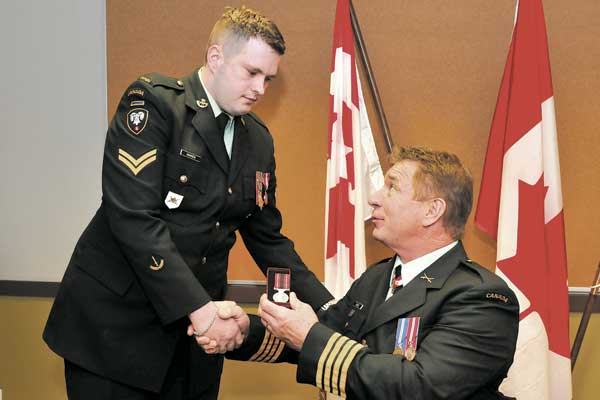
[caption id="attachment_5889" align="alignnone" width="300"] Honorary Colonel Rick Hansen presents the Sacrifice Medal to Cpl Darryl Hansen.[/caption] The room buzzed with excitement, admiration, and inspiration when Canadian legend Rick Hansen entered the Joint Personnel Support Unit (JPSU) Feb. 26.Hansen, an Honorary Colonel for JPSU, stopped by the base during a visit to Victoria and made a few presentations.“It’s an honour to be a part of this unit, and by extension a part of the Canadian Armed Forces,” said Hansen, who inspired the world during his Man in Motion tour, which saw him cross 40,000 kilometres across 38 countries, raising money for spinal cord research and quality of life initiatives. “People like you are what inspired me to become who I am,” he said to the crowd.HCol Hansen presented a medal to Cpl Darryl Hansen (no relation), who received the Sacrifice Medal for a deployment with the 2nd Battalion Princess Patricia’s Canadian Light Infantry (PPCLI) to Afghanistan in 2008. While there he sustained a traumatic brain injury when an Improvised Explosive Device (IED) exploded.“It was a real honour to have HCol Hansen present the medal to me. He’s an inspiration to Canadians everywhere,” said Cpl Hansen. “My time in Afghanistan was life changing in many ways, and it means a lot to have those experiences recognized.”MCpl Brett Trimble was also called forward to receive his Canadian Forces decoration from HCol Hansen for 12 years service to the military.He also presented a quilt from Quilts of Valour, a local organization that provides handmade quilts to military service people and community members going through hard times. One quilt was presented to Cpl Hansen, and another to Victoria local Beverly Hamilton.“When you get down to it, organizations like the CAF are about helping people,” said Hansen. “Whether it’s helping their own recover from the effects...
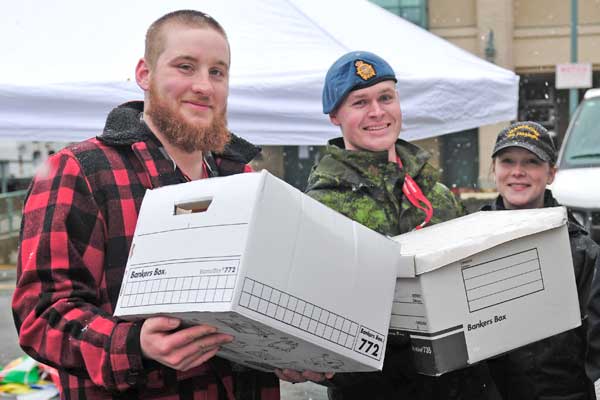
[caption id="attachment_5886" align="alignnone" width="300"] Volunteers Blair Black (left), Cpl Chris Smith (middle) and OS Christina Blaskavitch (right) help pile up documents for the shredder.[/caption] Shredding paper has put $10,000 into caring for the elderly. The cash was raised at the 2nd Annual Shred a Thon for Broadmead Care, through document shredding on Saturday Feb. 22.Volunteers from Maritime Forces Pacific, Sea Cadets and Claremont High School dumped boxes of documents, magazines, old newspapers, and other paper products into a shredder for a donation.“Last year’s event had such a great reaction we wanted to give it another shot,” says Kathy Baan, Director of Development for Broadmead Care, a non-profit organization that provides housing, and social and health service for seniors, veterans, and people with disabilities. Among the facilities run by Broadmead care are Nigel House, Harriet House, and the Lodge at Broadmead, where the event took place.“These are members of our community who have contributed to our country in ways many of us cannot imagine,” says Baan. “We want to do anything we can to get the community involved in giving back to them.”Money raised from the event goes directly to supporting social programs at Broadmead Care’s facilities, such as creative arts. These programs forge connections and create positive moments for residents suffering from cognitive impairments.“A lot of our residents suffer from Alzheimer’s and dementia,” says Baan. “With art programs we’re able to engage them mentally, which can do wonders for the cognitive ability and emotional wellbeing. It really can change their lives, if only for a moment at a time.”Island Document Storage and Shredding was on site, filling ears with the sound of documents falling to the teeth of their churning machine.“People bring all kinds of things,” says Baan. “We’re happy to provide a place to get rid of it all...

HMCS Iroquois gets fired up for Olympic hockey.
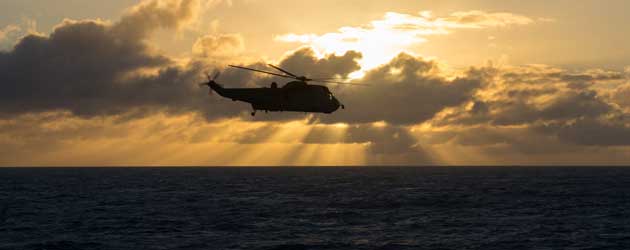
A Sea King from HMCS Protecteur conducts a flight mission of the coast of Hawaii.
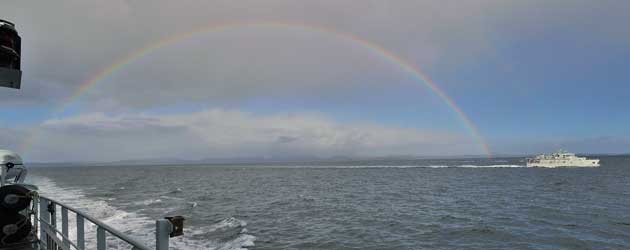
Mother Nature added some extra colour to the scene as Patrol Craft Training boats took part in PCTS PHOTOEX, a joint exercise between seven of the eight West Coast PCTs in the Stait of Juan de Fuca near Victoria on Feb. 14.
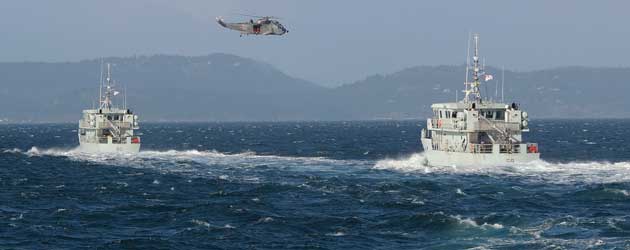
A Sea King flies overhead with a photographer on board as Patrol Craft Training boats take part in PCTS PHOTOEX, a joint exercise between seven of the eight West Coast PCTs in the Stait of Juan de Fuca near Victoria on Feb. 14.
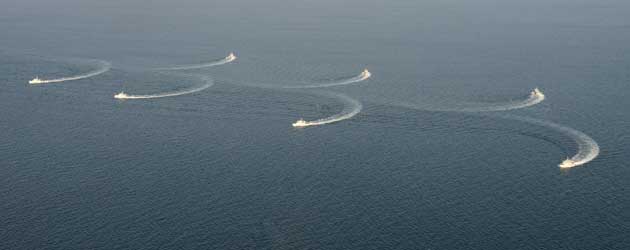
Seven Patrol Craft Training (PCT) vessels conduct formations in the Strait of Juan de Fuca on Feb. 14. The PCT vessels in the formation are; PCT Orca, PCT Raven, PCT Caribou, PCT Renard, PCT Wolf, PCT Grizzly and PCT Cougar.
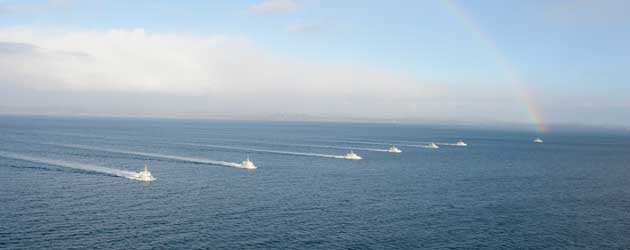
Mother Nature added a little extra colour to the photo as seven Patrol Craft Training (PCT) vessels conducted formations in the Strait of Juan de Fuca on Feb. 14. The vessels in the formation are: PCT Orca, PCT Raven, PCT Caribou, PCT Renard, PCT Wolf, PCT Grizzly and PCT Cougar.
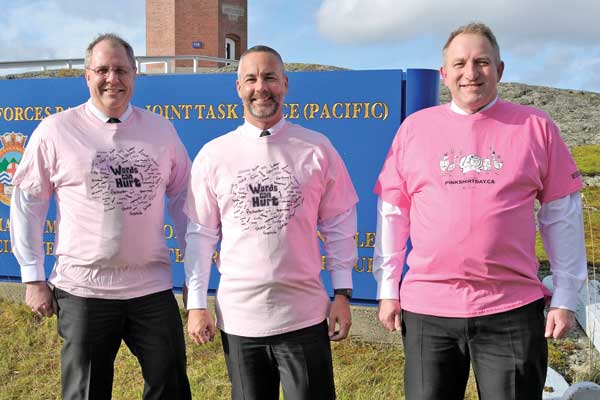
[caption id="attachment_5844" align="alignnone" width="300"] Maritime Forces Pacific (MARPAC) Commanding Officer RAdm Bill Truelove (centre), with Formation Chief CPO1 Paul Helston (left), and MARPAC Chief of Staff Capt(N) Mike Knippel (right) show their support for Pink Shirt Day.[/caption] What is bullying?Bullying is described as an act(s) or verbal comment(s) that could mentally hurt or isolate a person in the workplace.Sometimes, bullying can involve physical contact as well. Bullying can include, but is not limited to, repeated incidents or a pattern of behaviour that is intended to intimidate, offend, degrade or humiliate a particular person or group of people. It has also been described as the assertion of power through aggression.Some examples of bullying are:• Offensive jokes or comments• Insults• Belittling opinions• Withholding necessary information or intentionally giving misinformation• Excluding or isolating the target• Physical abuse or threats of abuseBullying in the workplace is often more subtle, and harmful, than direct verbal and physical abuse. Bullying behaviours are toxic not only to the individual and their family and friends, but also to bystanders and the entire organization. What to do if you feel bulliedThere are a number of steps you can take if you are feeling bullied by someone at work. If you feel safe doing so, talk firmly to the bully about stopping the unwanted behaviour. You may wish to arrange a witness to be present for this conversation. Make sure you keep a factual journal with detailed descriptions of the events- including date, time, witnesses, and outcome. Ensure you keep copies of any written communication from this person.Keep job appraisals and performance reviews.If bullying persists, talk to a trusted supervisor, a union representative, the Good Working Relations Advisors, the Unit Harassment Advisors, General Safety Officers, or the Employee Assistance Program to make a plan of action, but do not retaliate.What...
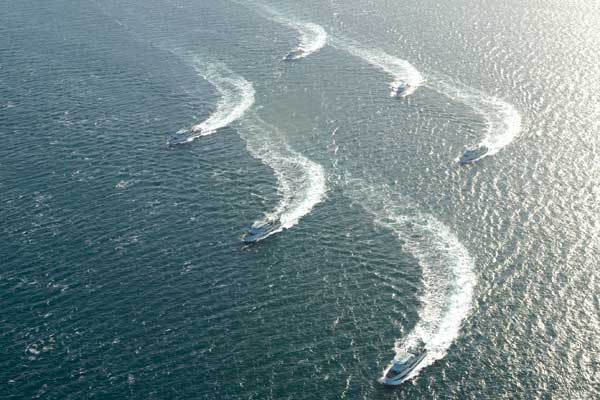
[caption id="attachment_5839" align="alignnone" width="300"] Six Patrol Craft Training (PCT) vessels conduct a starboard turn in formation in the Strait of Juan de Fuca. The PCT vessels in the formation are: PCT Orca, PCT Raven, PCT Renard, PCT Wolf, PCT Grizzly and PCT Cougar.[/caption] The waters off the coast of Victoria were host to a rare sight Feb. 14: seven Orcas sailing in formation.The Orca-class Patrol Craft Trainings (PCT) vessels set out from Esquimalt harbour before separating on different training missions.“It was a great opportunity for a little visibility within the Royal Canadian Navy,” says Capt(N) Bradley Peats, who rode in Orca PCT 55 for the morning. “There haven’t been this many Orcas on the water at one time in quite a while, so we weren’t about the pass this chance up.”Six of the vessels were performing Sea Readiness Inspections in preparation for various training missions, such as MARS III and MARS IV officer training, and the Command Development Course that prepares senior officers for command, and the Orca Class Engineer and Senior Boatswain’s Mate Course that trains Orca crews of the future. “We want to make sure everyone can work as a team and this is how we do it,” says Cdr Malcolm Musgrove, Officer in Charge of minor war vessel Sea Training. “Everyone is certified, everyone has taken their courses and has their tasks, but we want to make sure they can take their training and use it to help each other.”The Sea Readiness Inspection ensure crews are prepared and able to respond to emergency situations through simulated fires, floods, and medical emergencies.“It’s a valuable tool, and gives crew the realism needed to drive a message home,” says Cdr Musgrove. “Though each individual has their specific training, with this they are able to work towards the whole.”During the morning,...
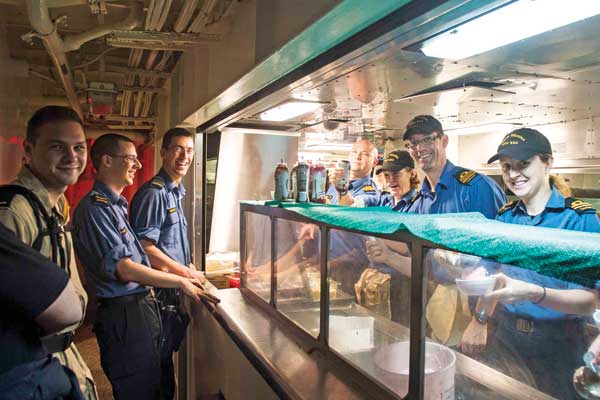
[caption id="attachment_5836" align="alignnone" width="300"] The Command Team of HMCS Regina serves sundaes to the ship’s company from the main steam line during weekly Operation Artemis Sunday’s Sundaes off the coast of India on Feb. 16.[/caption] The weekends just became a little sweeter for HMCS Regina as the ship has now started Sundae Sundays during the overseas deployment for Operation Artemis. Each Sunday evening, Regina’s Command Team serves sundaes with all the fixings to the entire ship’s company from the steam line. “Sundae Sundays provide a little taste of home for the ship’s company and it gives them something to look forward to every week,” said CPO1 Janet Graham-Smith, Regina’s Coxswain. “Sometimes it is small things that help make a huge difference in the ship’s morale during a long deployment such as Operation Artemis.”The importance of quality food services cannot be overstated in a Canadian warship at sea. Regina’s galley produces a diverse menu that contains a selection of healthy choices, as well as some “comfort food” to keep sailors both healthy and happy, especially on a long deployment. “Our cooks are doing a fantastic job of keeping everyone well fed and there is always delicious duff (desserts) available in all of the messes for those sailors who like to indulge their sweet tooth,” said LCdr Gordon Roy, Regina’s Executive Officer. “Well fed sailors are happy sailors and it is the least we can do considering how hard the crew has worked over these many months preparing for Op Artemis.” -Lt(N) Mark Fifield, Op ARTEMIS Roto 4 PAO
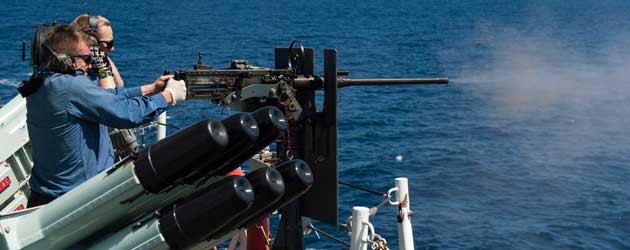
LS Lee Mihalcheon fires a .50 cal heavy machine gun during a surface fire training exercise on board HMCS Regina in the waters east of India during Operation Artemis.