[wpml_language_selector_widget]
[searchwp_form id="1"]
Urban Search and Rescue course students

Base employees train for catastrophe

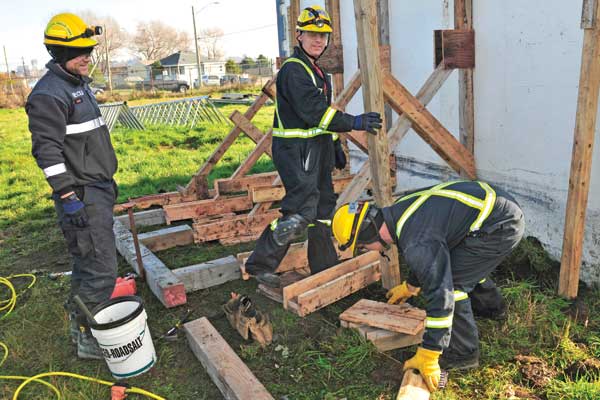
[caption id="attachment_5329" align="alignnone" width="300"] Urban Search and Rescue (USAR) trainees Nolan Miles, Gerry Jomphe, and PO1 Dan Moeller erect a temporary shore to stabilize a simulated collapsing building during training Nov. 28.[/caption] On top of a pile of a rubble, amidst the clanging of sledgehammers and the pounding of nails, 25 people train for the worst.They’re a part of the CFB Esquimalts Urban Search and Rescue (USAR) annual training, and right now they’re stabilizing a “collapsing” building.“Simulations and scenarios help give the training a more practical edge,” says Glenn Cooper, USAR Team Commander. “When they have a clear goal ahead of them it’s easier to put their training and techniques to the test.”Standing in for the collapsing building is an old concrete shed at the USAR facility near Work Point. Temporary shoring materials are being erected using wooden beams, steel pegs, nails, nail guns, sledgehammers, and saws. “This is a very basic skill for USAR. Obviously, it’s not safe trying to get people out of a building about to fall on your head, so you have to make it safer,” says Cooper, who has been with USAR since 1999. Building stabilization is just one part of the two-week long program. Trainees also learn the basics on breaching, the use of heavy tools to break through wooden, concrete, and even metal walls in the event someone is trapped inside a structure. “There are myriad skills needed in an USAR situation,” says Cooper. “With this team training we hope to lay the groundwork so they are better prepared when we send them for certification training.”The training draws personnel from across DND, civilian and military. For PO1 Dan Moeller the training is a way of ensuring his skills are up to snuff should the real thing ever happen.“We’re taught if anything does actually...

health graphic

Maintaining health through the holidays

The Christmas and New Year holiday season is an opportunity to spend well-deserved time with friends and family and to recharge for the new year. While the majority look forward to the holiday period, there are some that find it challenging. As a defence community, we have a responsibility to look out for those around us especially those who may be away from home or experiencing difficulties during this holiday season.To decrease stress and ensure your holiday season is enjoyable the following helpful tips will prove invaluable:•    Practice moderation.  Alcohol should be used responsibly as excessive use can impair mood, thinking, behaviour, and judgement. If you plan to drink, do so responsibly and plan ahead to get home safely.•    Maintain a routine.  Adequate sleep, regular exercise, healthy eating and setting healthy boundaries are the key to maintaining a Sense of well-being. Having a routine will help you cope with the potential stressors of the holiday season as well as effectively balance your needs with the needs and expectations of others.The military and civilian community are fortunate to have a tremendous number of resources for those that may encounter difficulties during the holiday period. CFHSvcsC (P) will maintain services throughout the majority of the holiday season and will post their hours of operation on the marpac webpage. The website will also include a list of other military and civilian community resources that are available during off-hours.  In case of emergency or after hours need for urgent medical treatment, members should call 911 and attend the closest hospital.If you, a family member, friend, shipmate, or co-worker are experiencing feelings of stress, anxiety, sadness, anger, etc., please refer yourself or others to the many health professionals that are available to support and assist. The following is a list of available resources:•    Urgent Care...

HMCS Chicoutimi

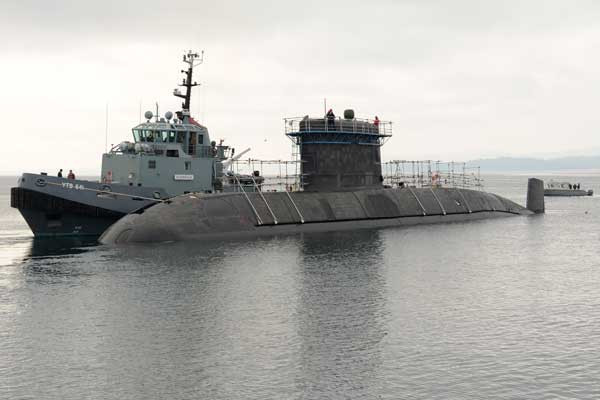
HMCS Chicoutimi on the move

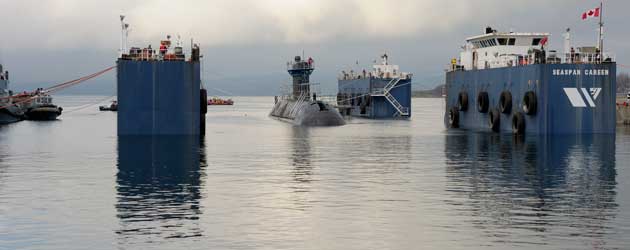
[caption id="attachment_5290" align="alignnone" width="300"] HMCS Chicoutimi undocks from the Seaspan careen at Ogden Point on Nov. 26.[/caption] After a lengthy time ashore, HMCS Chicoutimi is finally back in the water.The Victoria-class submarine was undocked Nov. 26 from Victoria shipyard and will continue system testing through Babcock Canada, and crew training for its 2014 return to operational readiness.“We’re very excited to take the next step in Chicoutimi’s preparation,” says LCdr Tim Markusson, Commanding Officer of Chicoutimi. “It’s been a long time coming and we’re thrilled to be moving forward.”Chicoutimi was docked in 2004 following a fire that claimed the life of Lt(N) Chris Saunders. The fire also gutted portions of the boat. In the nine years that followed the fire, the submarine has undergone extensive repairs, upgrades, and refits.“I head down to see Chicoutimi once a week, and now just walking around it looks like a submarine again,” he says. “The work has been completed skillfully and beautifully. I couldn’t be happier with it.”With the 2014 operations date approaching, LCdr Markusson says the crew of Chicoutimi is getting in sailing shape. “We’ve had several trips to Halifax to work on the trainers and while alongside we’ve been discussing the aspects and procedures of our operation,” says LCdr Markusson.Over the Christmas period Babcock Canada will continue systems testing and then turn over the submarine in early 2014. Before then, there are many small details that need to be attended to by LCdr Markusson and his team.“It’s the bits and pieces which need to be handled,” he says. “Things like outfitting the bunks with mattresses, and installing televisions in each mess. This takes an operational submarine and turns it into a home away from home for the crew.”With the future of Chicoutimi laid out before him, LCdr Markusson is excited to see what’s...

Cadet CPO1 Dennis Roberts

Trip of a lifetime for cadets

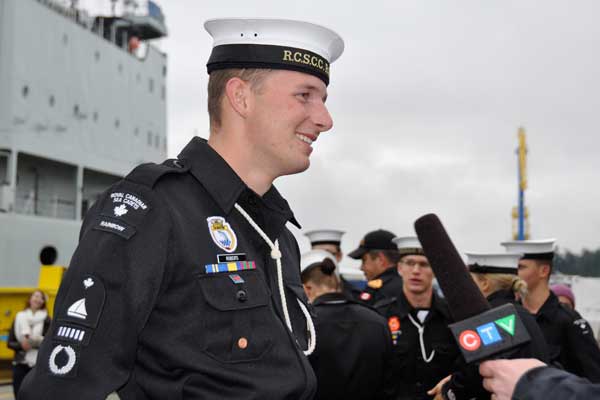
[caption id="attachment_5287" align="alignnone" width="300"] Cadet CPO1 Dennis Roberts, Coxswain of HMCS Rainbow, was in the media spotlight upon disembarking from HMCS Protecteur after six weeks at sea.[/caption] HMCS Protecteur sailed back into Esquimalt Harbour Nov. 18, returning nine Sea Cadets from a once-in-a-lifetime training opportunity.“It was quite unique and really cool,” says CPO1 Dennis Roberts, 18, Coxswain of HMCS Rainbow.Sea cadets from British Columbia and Alberta joined Protecteur’s crew on Oct. 12 for a six-week trip to see the work of sailors in a Royal Canadian Navy ship.Senior sea cadets, aged 16 to 18, were integrated into all crew responsibilities, from deck, air detachment, logistics, marine systems engineering, combat systems engineering and combat.The group also conducted cleaning stations, painted the ship and participated in the Remembrance Day ceremony. They toured the retired USS Midway and the USS Kidd.While in the port of San Diego, the sea cadets explored some of California’s attractions, such as the San Diego Zoo, Sea World, Disneyland and Universal Studios, and even got to spend a couple days on the beach.But even better than basking in the sun was taking a tour of California’s coastline in a Sea King helicopter.“That was the highlight of the trip,” says CPO1 Roberts, who is in his last year of cadets. He joined when he was 12 years old.The sea cadets who joined Protecteur were selected based on recommendations from their commanding officer.“Dennis is a cadet that I would have had no hesitation in recommending for a deployment such as the recent Protecteur one, as he is always willing to learn,” said Lt(N) Jean Ann Cyr, Staff Officer 3 Sea for Regional Cadet Support Unit (Pacific). “I knew he would make the most of the opportunity.” -Larissa Johnston, Navy Public Affairs

RRMC drummer from archives

Royal Roads digitizes cadet photo albums

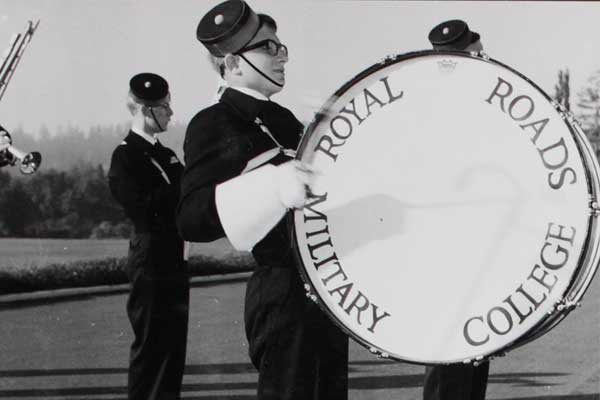
[caption id="attachment_5284" align="alignnone" width="300"] Royal Roads Military College drummer from 1971-72.[/caption] Shaggy-haired 1970s recruits getting their first military haircuts. Muddy runners completing the obstacle course. Uniformed cadets at the formal dance. These were some of the people photographed each year at the former Royal Roads Military College.  Until now, most of these exceptional images were accessible only in photo albums, preserved in the Royal Roads University archives. This month the archives completed digitizing over 1,200 pages from these albums covering 1963 to 1988. Now the photos are searchable by year and fully accessible online through the library webpage: http://library.royalroads.ca/archives/annual-photograph-albums-royal-roads-military-college-1963-1988.  These digitized photo albums offer a chance to reflect on the discipline, teamwork and commitment of Royal Roads cadets, and leadership traits encouraged and admired today at RRU as part of a growing educational legacy, said Paul Corns, associate vice president of Community Relations and Advancement at Royal Roads University.   The majority of the photos in the digitization project were taken by RRMC staff photographer Len Watling, who first spent nine years with the Royal Canadian Navy at HMCS Naden as a darkroom technician before joining the staff of Royal Roads in 1964. Watling was an exacting artist who started his photographic business in 1941 while still a teenager. He routinely ran obstacle courses and hung out of helicopters to get the right shots of cadets.  These unique albums are the most requested items in the RRU archives, often displayed during events such as homecoming, said RRU archivist Caroline Posynick. Now that they are digitized, the albums are much more accessible, and the public can flip through them at home on their computers. This will bring the experiences of cadet life into sharper focus for anyone interested in military heritage.The $16,000 project was partially financed by a B.C. History Digitization Program...

DART combat engineers clean up typhoon debris

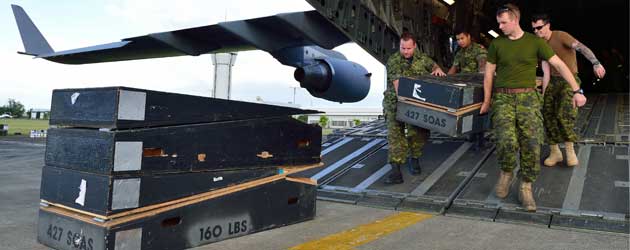
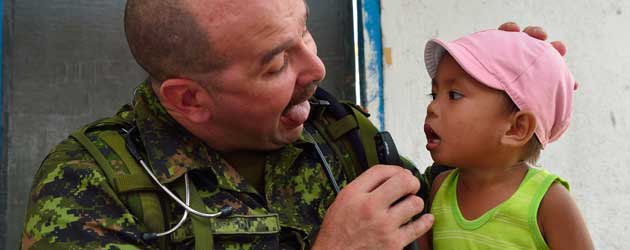
Canada deploys to Philippines for Typhoon Haiyan clean up

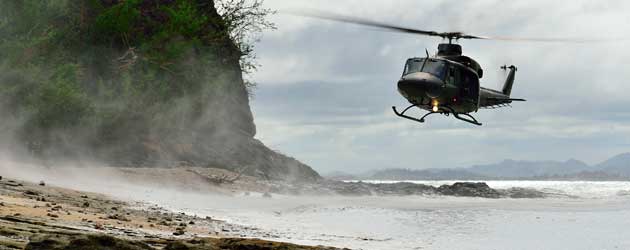
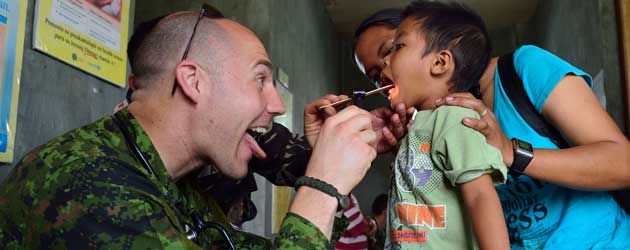
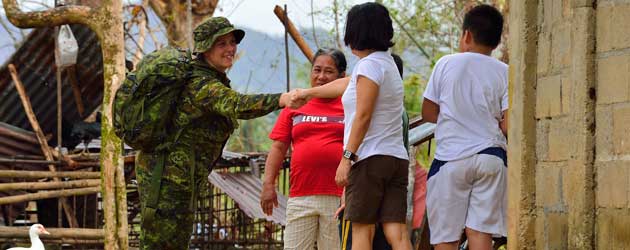
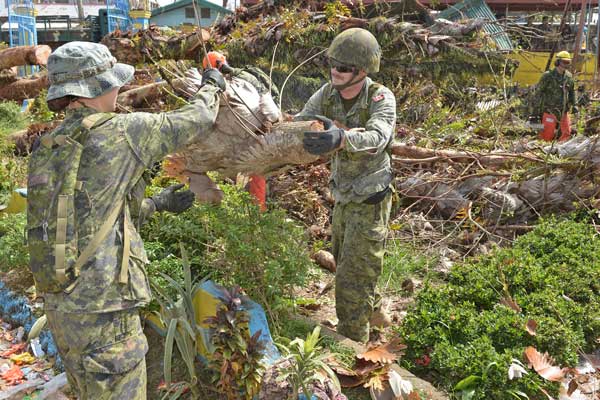
[caption id="attachment_5248" align="alignnone" width="300"] Cpl Brown and a colleague, both DART combat engineers, conduct road tree removal to provide access to Dona Victoria Cortes Dais Memorial School in Pontevedra, Philippines.[/caption] With gusts reaching 380 kilometres per hour, Typhoon Haiyan was one of the strongest typhoons ever recorded. Setting off landslides, knocking out power in several provinces and cutting communications in the country’s central region of island provinces, the tropical super storm has affected an estimated 11.3 million people across the Philippines.It has caused significant loss of life, a large number of injuries and damage to many homes and infrastructure. In response to the humanitarian situation, Canadian Joint Operations Command implemented Op Renaissance 13-1, deploying more than 300 CAF personnel to provide primary medical care, engineering assistance and safe drinking water.  “One of our primary tasks is to open roads that have been blocked by the effects of the typhoon,” said Task Force Commander, Lieutenant-Colonel Walter Taylor. “We have engineers that are operating heavy equipment as well as chainsaws and electrical experts who will be removing a lot of the rubble that’s blocking the roads and permitting the humanitarian actors, the non-government organizations and the UN agencies, access to those villages to distribute relief supplies.”  The production of potable water is one of the most important contributions of the Disaster Assistance Response Team (DART). The Reverse Osmosis Water Purification Unit is set up and maintained by the Water Production Detachment of the DART Engineer Troop and, under ideal conditions, can purify up to 50,000 litres of safe drinking water a day. “Agricultural fields, crops have been blown away; storm surge has flooded the fields with sea water; and fishing boats have been destroyed,” said LCol Taylor. “So the people are really at a loss not only for their homes, but for...

photo contest people's choice award

Father and daughter share the spotlight

[caption id="attachment_5245" align="alignnone" width="300"] A People’s Choice Award winner during last year’s Canadian Armed Forces Photography Contest, “Eskimo Girl” is Able Seaman Rommel Billanes’ first submission to the annual contest.[/caption] Able Seaman Rommel Billanes has, for the second time, been recognized during the Canadian Armed Forces’ Annual Photography Contest for being one of the major award winners in Best in Show (Advanced Category), with his photograph entitled “War Child.”This year he won first place in Portrait, third place in Special Effects, and an Honorable Mention in Environment, all in the Advanced Category. Last year he took home several awards in the Amateur Category, including Photographer of the Year (Novice Level), second place in Portrait, second place in Animal, third place in Open Theme, and the People’s Choice Award for his photograph “Eskimo Girl.”AB Billanes uses his self-taught photographic proficiency to take photos alongside the Image Technician during events such as Family Days, Fleet Mess Dinners and Remembrance Day ceremonies onboard HMCS Protecteur. He has been interested in photography since he was in college, but, he says, “The turning point was in 2011, when I got posted to CFB Esquimalt after my BMQ. I was away from my family in Ontario, so I decided to buy a Digital Single Lens Reflex camera to make myself busy and express my creative skill.”It was at that time he read a notice in The Lookout that the Department of National Defence holds an annual contest for both amateurs and professionals. “I decided to try my luck by submitting various images of different themes,” he said. “I won second prize in the Amateur category in Portraits, entitled ‘Little Miss Sunshine,’ and I also bagged the People’s Choice Award out of 48 entries.”Like last year, AB Billanes had the opportunity to include his daughter in the...

bridge simulator

Former commanding officers take the bridge to train new generation of sailors

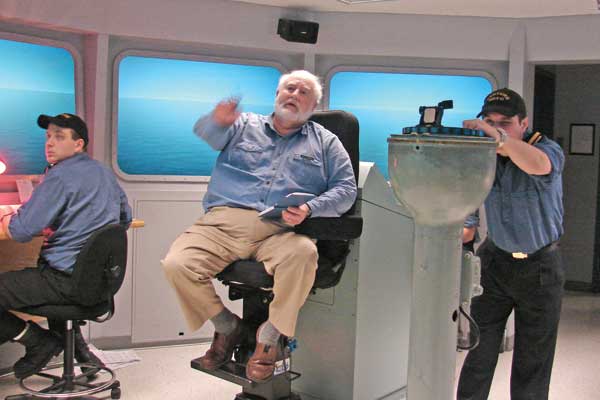
[caption id="attachment_5242" align="alignnone" width="300"] Cdr (Ret’d) Dan Fitzgerald takes the captain’s seat as Commanding Officer during training in the Navigation Bridge Simulator.[/caption] In a small room in Work Point’s Collier building, Cdr (Ret’d)  Dan Fitzgerald directs his bridge crew from his captain’s chair to bring a Halifax-class frigate into port.Before them is a 330-degree realistic computer-generated field of view. So real, virtual ships can even roll and pitch to feel like it’s moving. A total of eight bridges, six visual and two radar used for navigation exercises, reside in the Naval Officer Training Centre’s Navigation and Bridge Simulator (NABS).The simulator was required after the disbanding of the destroyer training squadron. It was integrated into NOTC in 1997 as a way to train bridge officers without the expense of using a real ship. The simulator offers training programs for all levels of bridge officers, from those who have never set foot on a bridge to the most experienced naval officers.  To keep it real beyond the virtual ship, NOTC has hired retired Commanding Officers to aid in the training. “Every real ship has a CO, and when we train we treat NABS as a real ship,” says Capt(N) (Ret’d) Ken Watson, manager of NOTC’s simulation department.The NABS Mentor program was developed as a way to fill crucial leadership roles during training that were previously filled by less experienced training staff.“We had training officers who lacked experience as a CO making decisions a CO wouldn’t make,” says Watson. “We thought there must be a way to have the leadership in place to make the training more realistic, and the NABS Mentor Program was born.”The program places experienced retired Royal Canadian Navy Commanding Officers in the simulator with trainees.Mentors are casual employees of NOTC Venture. Watson himself was Commanding Officer of HMCS Yukon...

19 Wing Buffalo plane pull

Fundraiser pulls out the braun

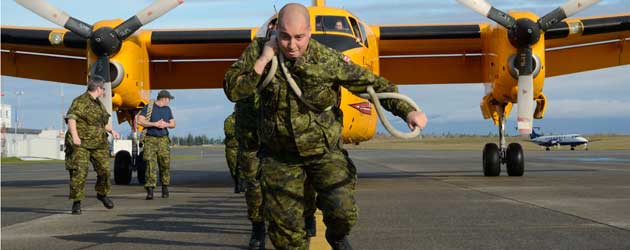
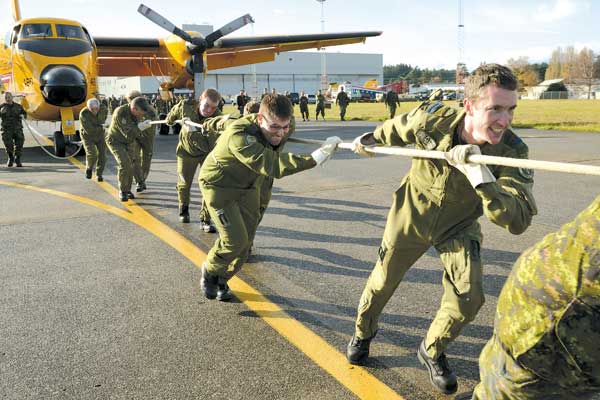
[caption id="attachment_5197" align="alignnone" width="300"] The 19 Wing Operation Team takes a turn in the 30 second challenge, hauling a 35 tonne aircraft down the tarmac.[/caption] Cheers echoed across the airfield as 12 teams at 19 Wing Comox competed to pull a 35-tonne CC-115 Buffalo search and rescue airplane across the tarmac during a GCWCC event on Wednesday, Nov. 13.“We had approximately 120 military and civilian participants involved in the Buffalo Pull,” said event co-organizer, Captain Jeremy Maltais, chair for the Government of Canada’s Workplace Charitable Campaign (GCWCC) at 19 Wing Comox. “It was a great team-building event that promoted physical fitness, while raising $1,350 towards our $45,000 goal for the GCWCC.”Following a group warm-up led by Personnel Support Program fitness staff, the competition began with the goal of seeing which 10-member team could pull the aircraft farthest in 30 seconds.“Teams found that once the airplane’s wheels started to turn, momentum was easy to sustain, but getting a 35-ton airplane to roll from a dead stop was difficult,” said Sergeant Cesar Esteban, co-chair of the 19 Wing GCWCC. Following the competition, the Combined Aircraft Servicing team, made up of technicians from 19 Air Maintenance, 407 and 442 Squadrons was named the winner, pulling the aircraft 100 feet. A celebratory fundraising lunchtime barbeque was also held following the event.  “This type of activity generates a lot of friendly competition among the units and squadrons on base, and is also a lot of fun,” said Capt Maltais.While 19 Wing members are committed to helping their communities throughout the year through volunteering, the importance of the Workplace Charitable Campaign cannot be understated given that many people in the Comox Valley are touched by at least one of the several organizations supported by the Comox Valley United Way.  The Buffalo Pull was just one of...

Explore More

Categories

Top News

E-Editions Archive

News Stories Archive

Proud Supporters

Joshua Buck, Lookout Newspaper