Sailors help mark historic battle
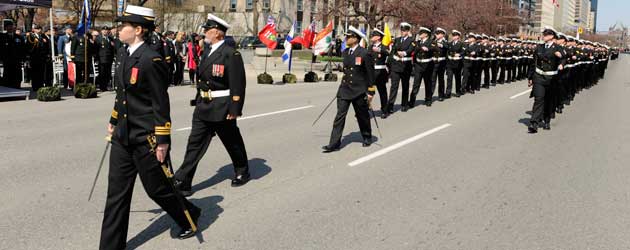
Sailors of the Royal Canadian Navy march past reviewing officer, Lieutenant Governor of Ontario David Onley, during a parade to commemorate the 200th anniversary of the Battle of York in Toronto.
Sailors of the Royal Canadian Navy march past reviewing officer, Lieutenant Governor of Ontario David Onley, during a parade to commemorate the 200th anniversary of the Battle of York in Toronto.
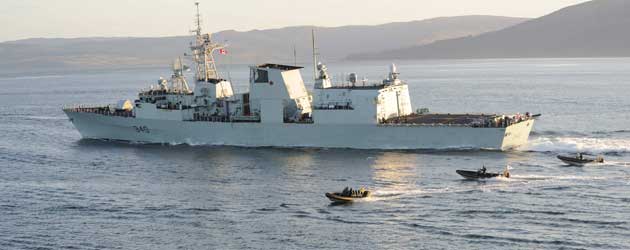
HMCS St. John's is on the offensive during a fast inshore attack craft exercise during Exercise Joint Warrior in the North Sea.
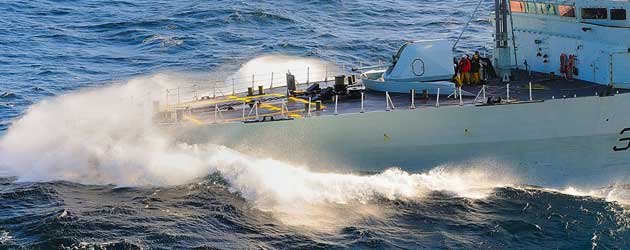
HMCS St. John's noses into the waves of the North Sea during Exercise Joint Warrior.
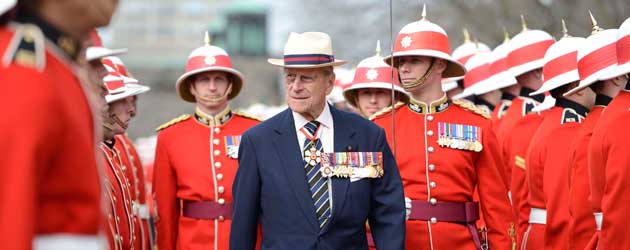
Prince Philip and LCol David Quick, Commanding Officer of the 3rd Battalion, The Royal Canadian Regiment, inspect the Battalion members at Queens Park in Toronto.
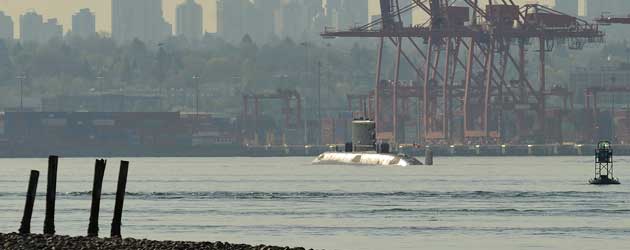
HMCS Victoria transits Burrard Inlet on the way to Canada Place in downtown Vancouver. Ships from Canada's West Coast Navy anchored alongside Canada Place and Burrard Pier for a four day port visit.
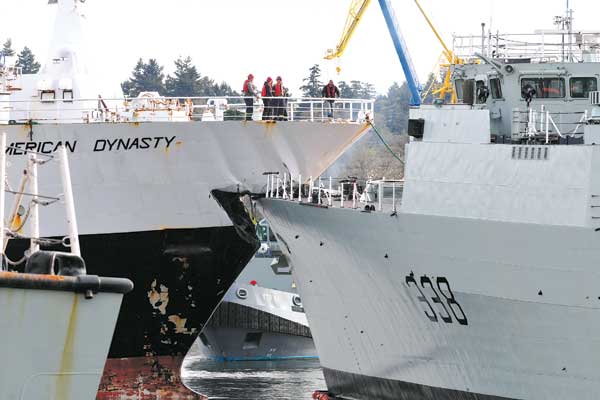
[caption id="attachment_3825" align="alignnone" width="300"] Seattle-based fishing trawler American Dynasty took a bite out of HMCS Winnipeg last week.[/caption] Last Tuesday, just after 8 a.m. Colours, HMC Dockyard’s normally calm environment was turned into one of tension when the Seattle-based fishing trawler American Dynasty slammed into the docked bow of HMCS Winnipeg.The sound of the collision echoed throughout C jetty and a large spray went over the bow of Winnipeg. The force of the impact pushed her stern into the jetty. Minutes later the area was transformed into an emergency response scene with the military police and firefighters managing the location.Several people were sent to hospital, but no serious injuries were reported.Dockyard workers stood behind the military police barricade wondering what had happened to create this bizarre mishap.“Nobody knows exactly what happened,” said Brian Carter, president of Seaspan Shipyards. “The fishing trawler American Dynasty was being moved into the Esquimalt Graving Dock for normal maintenance, and two tug boats operated by Seaspan Marine were manoeuvring the ship when it collided. Details will surface after an investigation is complete,” he said.“Safety and care of our employees are core values at Seaspan and we are committed to understanding what happened in this incident so we can make sure it never happens again,” he added.Winnipeg is in the final stages of the Halifax Class Modernization (HCM) Frigate Life Extension (FELEX). Before the collision there were 65 Victoria Shipyard employees on board Winnipeg working alongside some of the ship’s crew. It took the majority of the day to investigate and formulate a plan to dislodge the embedded trawler from Winnipeg’s bow. The ships were finally separated at 5:30 p.m.An investigation from the Transportation Safety Board is currently being conducted.“At any Transportation Safety Board (TSB) investigation there are three phases,” explains TSB spokesperson Chris Krepski. “Right...
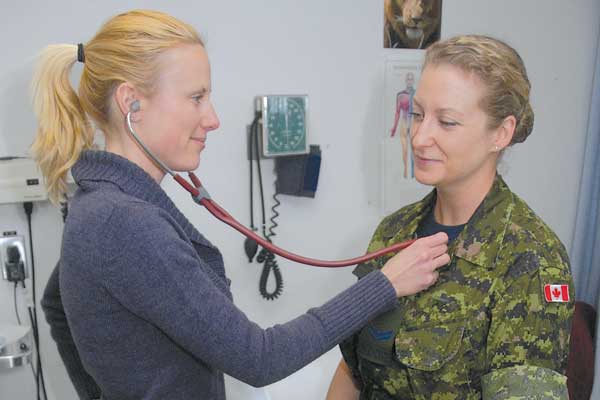
[caption id="attachment_3821" align="alignnone" width="300"] Military doctor Lt(N) Jodylynn Dans gives Cpl Rhonda Tiekenheinrich a check up at the Base Clinic.[/caption] The lack of family doctors in Canada has had a direct impact on Canadian Forces families across the country.The shortage has become such a concern for military leadership that finding a solution has been made a priority.“We have a lot of families, many of whom are in the point in their life when they’re having children, or are raising young kids that have health care requirements,” says LCol Nick Withers, Pacific Formation Surgeon. “We want them to have the care they need.”A 2011 study called “An Examination of Canadian Forces Spouses’ Access to a Family Physician” determined that 27 percent of Canadian Forces families do not have a primary care physician compared to the national average of 16 percent (StatsCan 2010). LCol Withers says this is because of the transient lifestyle inherent to CF families.“Many CF families will move every few years to another posting,” he says. “Because of this it’s all but impossible for many to get to the top of a family doctor waitlist, and it’s a concern that their health will suffer as a result.”To combat the shortage, Health Services and the National Defence have been working with the national medical community to find a solution.“We want to work out a way to expedite the process for CF families, since the shortage affects a much higher percentage than the average population,” says LCol Withers. “We’ve had some good feedback so far from medical professionals. Hopefully we can come to an agreement.”LCol Withers says one proposed solution would be a “save-the-space” type of plan, wherein if a CF family on a waiting list were deployed another CF family could take their place on the list.“It would help get...
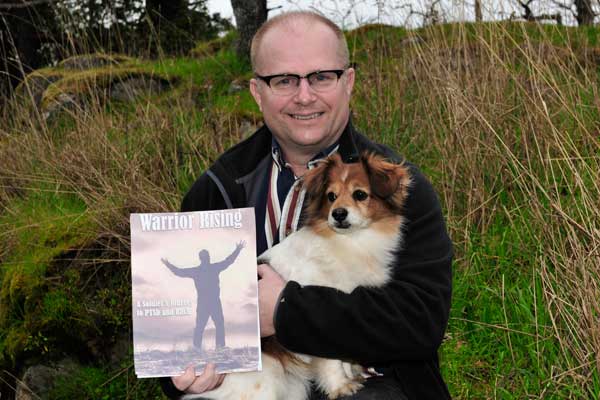
[caption id="attachment_3817" align="alignnone" width="300"] LCol Chris Linford wrote a book about his journey with Post Traumatic Stress Disorder (PTSD). This book called Warrior Rising - A Soldier's Journey to PTSD and Back will be launching this spring. Seen here he holds the book cover and his dog Murphy, who served as a comfort dog during his illness.[/caption] LCol Chris Linford is using his experiences with Post Traumatic Stress Disorder (PTSD) to help others fight this illness through a book he penned.Warrior Rising – A Soldiers’ Journey to PTSD and Back is his way of passing on the information and tools used during his healing process.“I wrote this book to help other veterans recover from this injury. I wrote it for their families and also for the clinicians who treat the injured veterans,” he says. “My book touches on my deployments and recovery. It chronicles my traumas, how they made me feel and how they impacted my personality and my family.”His PTSD stemmed from two deployments: Rwanda and Afghanistan.First, in 1994 as a nursing officer, he was deployed to Rwanda to help manage a cholera epidemic. “Our personnel were not prepared to witness the amount of deaths and severe injuries we observed, and it was extremely difficult as most of the deaths were children under the age of five,” he said. After the deployment, and for the next 10 years, he suffered from PTSD. He knew he had it, but he was at a loss for what to do. He fought the stigma. Eventually the illness led him to insomnia. Finally, he sought medical care. He was put on medication while receiving treatment with the Canadian Forces for PTSD and depression. After a year and a half he thought he had beaten it. Then his illness returned in 2009 during a...
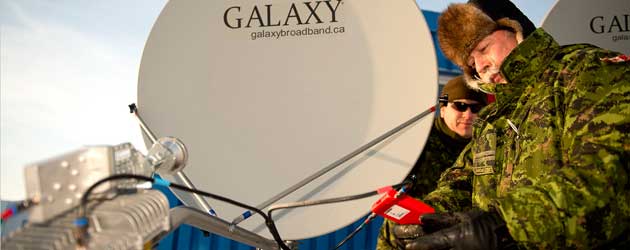
Cpl Michael Melanson (left) a member of ASG Signals Squadron from Gagetown, NB, realigns a satellite dish in Resolute Bay, Nunavut during Operation Nunalivut. Signals dwindle in the far north, so satellite alignment must be precise.
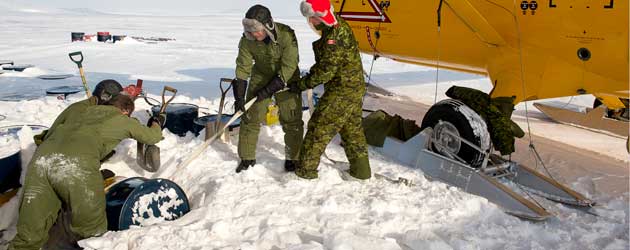
Capt Bryan Sullivan, Capt Lee Burrows (left), Cpl Brian Peers (second from right), and Lt(N) Joel MacDonald (right), dig out fuel barrels from a snow-covered fuel cache located at Mould Bay, NWT during Operation Nunalivut.
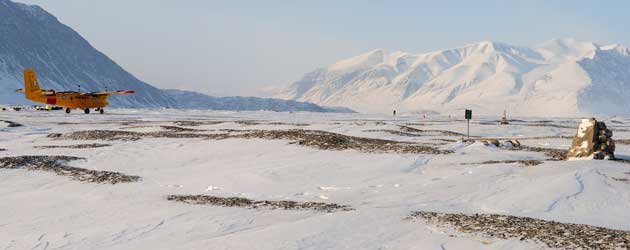
A Royal Canadian Air Force CC-138 Twin Otter from 440 (Transport) Squadron stops at the Parks Canada warden station at Tanquary Fiord, Nunavut during Operation Nunalivut.
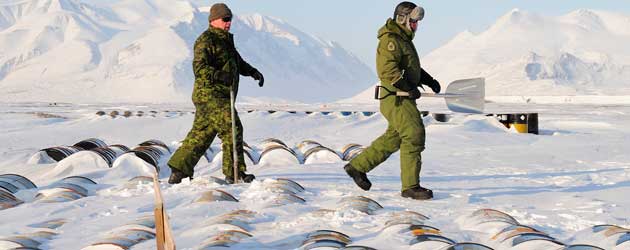
MWO Robert Winton (left) and Cpl Brian Peers search for degradations or spills from the fuel cache at the Parks Canada warden station at Tanquary Fiord, Nunavut, during Operation Nunalivut.
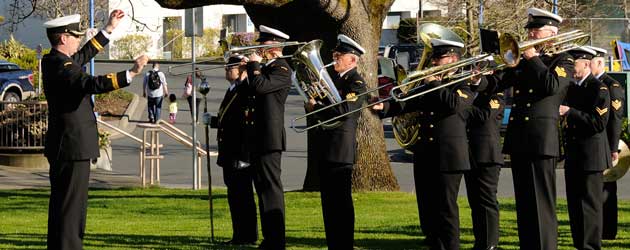
The Naden Band of the Royal Canadian Navy performs The Naval Hymn during the HMCS Esquimalt Memorial held on April 16 at the HMCS Esquimalt Cairn.
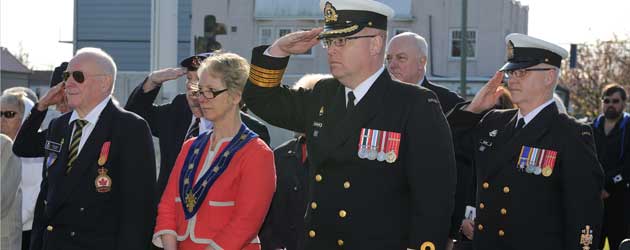
Royal Canadian Legion Branch 172 (Esquimalt) President Don Barr, Esquimalt Mayor Barb Desjardins, Base Commander Capt(N) Bob Auchterlonie, and Base Chief Petty Officer CPO1 Shawn Taylor salute during Last Post at the HMCS Esquimalt Memorial.
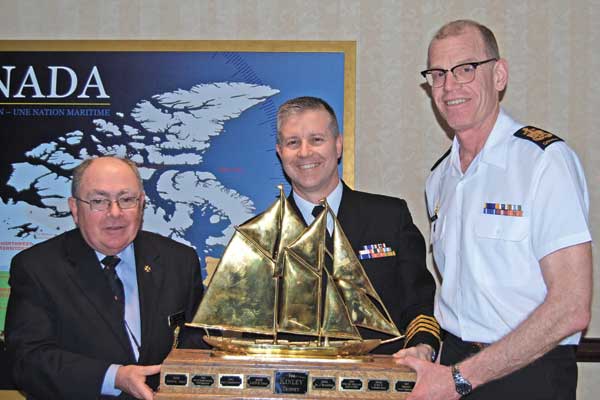
[caption id="attachment_3777" align="alignnone" width="300"] Capt(N) Art McDonald and RCN Command Chief CPO1 Tom Riefesel accept the J.J. Kinley Award from VAdm Ron Buck (Ret’d), National President of the Navy League of Canada, on behalf of HMCS Ottawa.[/caption] The crew of HMCS Ottawa received a prestigious commendation last week when the commanding officer, Cdr Scott Van Will and his crew were honoured with the J.J. Kinley Award. Capt(N) Art MacDonald and RCN Command Chief CPO1 Tom Riefesel accepted the award from the National Board of Directors of the Navy League of Canada (NLC) on behalf of Ottawa.“Ottawa was chosen largely due to the recent work off the coast of Coast Rica as part of Operation Carribe, and in seizing over $26 million worth of cocaine,” says Louise Mercer, Vice President of Maritime Affairs. “Cdr Van Will and his crew demonstrated their commitment to Canadian and North American security, and solidified the many opportunities Canada leverages to partner with other nations and organizations to suppress criminal activity at sea, and keep illegal drugs off our streets.”The J.J. Kinley Award is presented each year by the NLC to members, employees or units of the Canadian Coast Guard, Department of Fisheries and Oceans or the Canadian Forces who have made contributions to support naval and maritime interests.The nomination process for the award is handled exclusively by Navy League Executives, past presidents and the Royal Canadian Navy.According to Mercer the choice was not hard.“Ottawa played a major role in suppressing trafficking in international waters and airspace,” she says. “It’s easy to reward and recognize heroism. It’s only difficult because other ships are also engaged in equally valuable work with strong crews.”CPO1 Sid Tobias, Coxswain in Ottawa, says the award came as a surprise to the crew.“The crew was more than happy to receive the award....
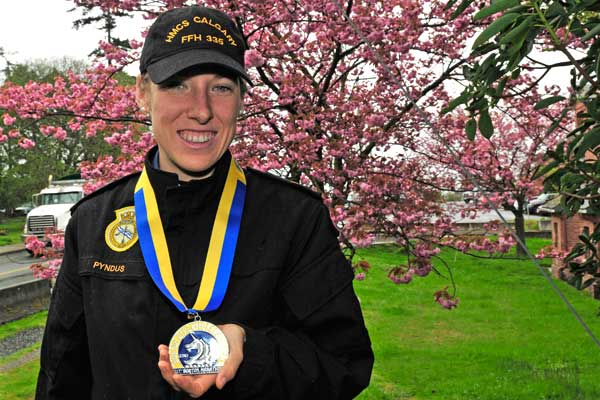
[caption id="attachment_3774" align="alignnone" width="300"] AB Sarah-Mae Pyndus shows off her 2013 Boston Marathon medal. She crossed the finish line with a personal best time.[/caption] Before the turmoil and ensuing tragedy from the bombings overshadowed the Boston Marathon, AB Sarah-Mae Pyndus was enjoying a moment of triumph. As she crossed the finish line on Boylston Street, she glanced at the clock: 3:22:32; it was a personal best. She had beat her previous record by more than 35 minutes. This was her third time tackling the long-distance running event.She placed 6,428 out of 23,336 participants, and placed in the top 11 percentage for her division – female 18-40. “I don’t run for myself,” said the 25-year-old who works as a naval communicator in HMCS Calgary. “When I run, I think about my family, my boyfriend and my ship. I’m really running for them. Every time I cross a mile marker I think of everyone who is watching me and I want to make them proud.”The marathon started 42.195 kilometres outside Boston at the town of Hopkinton. Runners were bussed to the start line. AB Pyndus describes running as both a physical and mental battle. “I knew my race was going well. Usually, by mile 20, I go through a point when I want to stop, walk, or give up and that is the mental wall you hit, but in this race I didn’t have that wall. I was really enjoying myself. I was in pain, my body screamed at me, and my knees, shoulders, and ankles were so sore, but then it went away,” she says.Upon completing the run, she grabbed a tin foil race blanket to keep warm, ate some energy food and walked to the John Hancock tower several blocks away for a post race massage.“About five minutes into the...
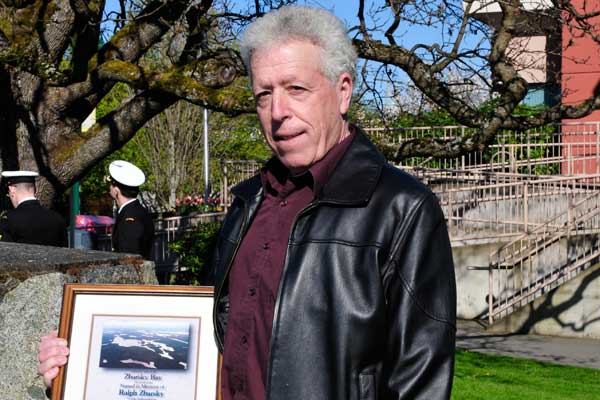
[caption id="attachment_3771" align="alignnone" width="300"] Ralph Zbarsky brought a picture of his uncle Ralph Zbarsky to the memorial ceremony. Zbarsky was one of the survivors awaiting rescue on a Carley float, but because help took so long to arrive, like many sailors, he died from hypothermia.[/caption] Veterans, serving military members, dignitaries and family of the crew of HMCS Esquimalt gathered outside Esquimalt City Hall April 16 to commemorate the sinking of the last Canadian warship lost to enemy action during the Second World War, and to honour the lives of the men who died.“On April 16, 1945, HMCS Esquimalt was torpedoed at Chebucto Head, Nova Scotia. From where we are in Esquimalt this would be about the distance of Race Rocks. She was sunk within sight of home,” said Base Commander, Capt(N) Bob Auchterlonie to the crowd. “For those individuals who were there, the sinking was an experience they will never forget, and neither should we forget their sacrifice.”The Bangor-class minesweeper operated on the Atlantic coast conducting anti-submarine patrols in the approaches to Halifax Harbour. In the early morning of April 16 it was torpedoed and sunk by U-190. The explosion knocked the power out making it impossible for the crew to send out a distress signal. It listed heavily to the starboard pushing the lifeboat underwater, but the crew managed to get four Carley floats away from the sinking ship. Within five minutes it was gone, sinking into the harbour and taking with it 28 sailors. With no distress signal to alert the mainland of their situation, the survivors spent six hours adrift in the frigid waters. Sixteen more died from exposure leaving only 27 men when help arrived. “The last of the 27 surviving members passed away last year. Today we remember the 44 sailors who perished and celebrate...
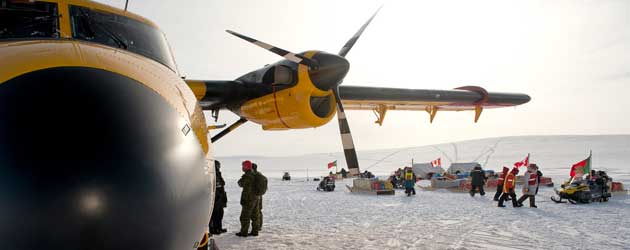
A Royal Canadian Air Force CC-138 Twin Otter delivers supplies to a Canadian Ranger patrol on Sherard Osborn Island, Nunavut, during Operation Nunalivut. The sovereignty operation is conducted every year by the Canadian Armed Forces.
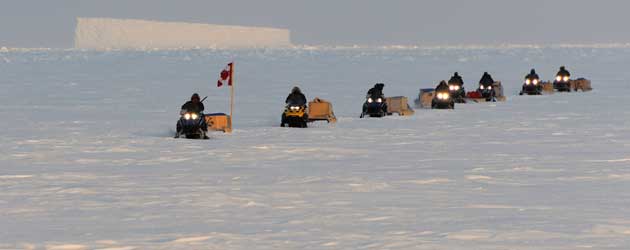
A Canadian Ranger patrol returns to Resolute Bay, Nunavut, from an Arctic patrol during Operation Nunalivut, one of the major sovereignty operations conducted every year by the Canadian Armed Forces in Canada’s North.
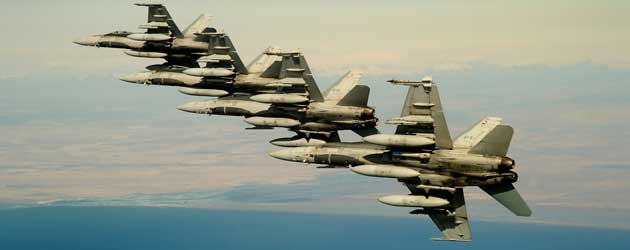
CF-18 jets fly over Iceland on during Operation Ignition, Canada’s participation in the North Atlantic Treaty Organization (NATO) Airborne Surveillance and Interception Capabilities to meet Iceland's Peacetime Preparedness Needs.
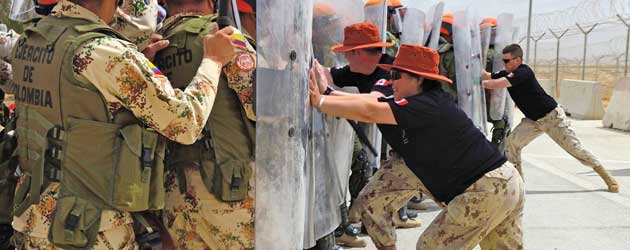
MCpl Bonnie Leung and other members of the Canadian Multinational Force and Observers act as a protesters during crowd control exercises at North Camp in Sinai, Egypt, during Operation Calumet.
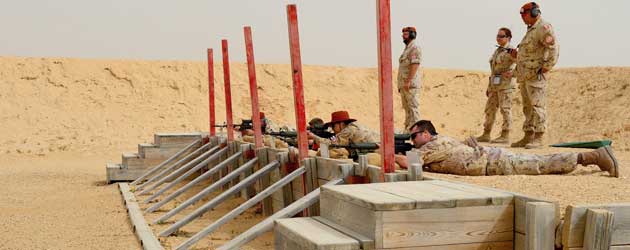
Canadian Multinational Force and Observers (MFO) fire their rifles on a range at North Camp in Sinai, Egypt. Twenty eight Canadian Armed Forces members from across Canada are providing critical expertise as members of Operation Calumet.
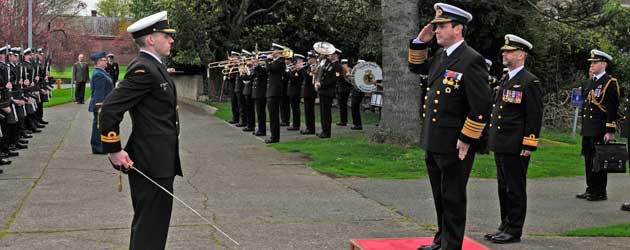
Chilean Admiral Edmundo Gonzales visited CFB Esquimalt for three days last week to foster relations with the Canadian Navy. Upon arrival to the base he was greeted by a Guard of Honour at Duntze Head.
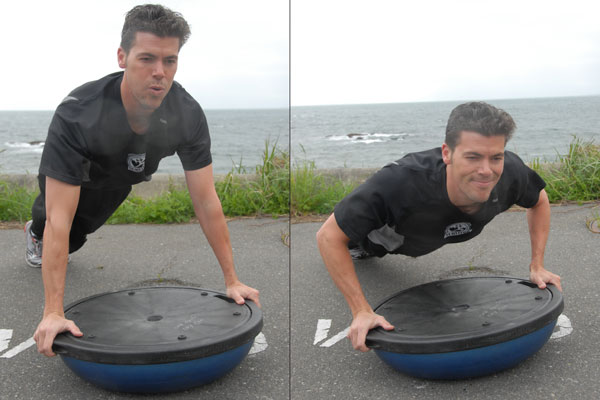
[caption id="attachment_3729" align="alignnone" width="300"] Personnel Support Programs fitness and sports coordinator Matt Carlson leads Operation Powerfit, an inclusive and extensive workout regimen. Here, he uses a Bosu ball to augment the traditional push-up.[/caption] In the Canadian Forces maintaining fitness is part of the job, but for some it’s hard to find fun, inclusive ways to work out. For those wanting a full body workout, there’s Operation Powerfit. “I wanted to create a new fitness experience for people to get excited about,” says Matt Carlson, Operation Powerfit instructor and certified personal trainer. No two classes are the same in Operation Powerfit. What’s important is to encourage your body to break out of its usual routine, says Carlson.This variety is key to what makes Operation Powerfit so effective. “Doing the same workouts all the time can cause your energy to level off and stagnate,” he says. “With Powerfit I like to keep the workouts both enjoyable and challenging so my participants are constantly engaged and always looking forward to the next session.”The gear used in Powerfit is as diverse as the workouts, and includes bodyweight resistance, free weights, kettle bells, and Bosu balls. “Great things can be achieved in a workout so long as you have great technique,” says Carlson. “Keeping your equipment varied as well as your workouts adds an extra layer of adaptation for your body that can produce very positive results.”This round of classes takes place from May 7-30. Classes are Tuesdays and Thursday from 4:15-5:15 p.m. in the NAC upper gym. Any one is welcome: Canadian Forces, DND employees, and civilian. Classes are $80 for eight classes for CF and DND members, and $90 for eight classes for civilians. For those who can’t commit to the full month but would still like to participate, drop in sessions are...
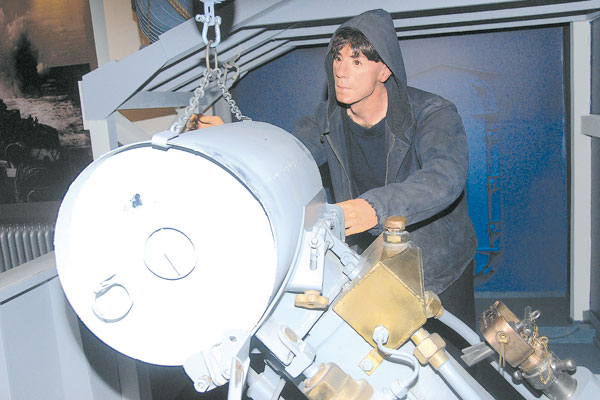
[caption id="attachment_3726" align="alignnone" width="300"] A restored depth charge thrower is just one of many artefacts on display at the museum’s Battle of the Atlantic Gallery.[/caption] Visitors to the CFB Esquimalt Naval and Military Museum can now learn about the Battle of the Atlantic and life on board a Corvette class warship. A section of the museum has been re-designed with new exhibits and artefacts from the museum’s own collection that reflect many aspects of nautical life during the Second World War. “The museum’s new galley provides visual and documentary insight in the long-running sea battle that definitively shaped Canada’s navy,” says Claire Sharpe, exhibit designer. She researched and wrote the gallery’s text panels, selected the images, and worked with graphic designers and local signage companies to bring her vision to life. A realistic cutaway of a warship deck is the most visually compelling exhibit, complete with crew mannequins, rust and railings. Plus people can see a restored depth charge thrower used to thwart German submarines, Carley float, life raft, rations and authentic uniforms. An important component of the gallery is the award-winning film series “Convoy” that tells the epic story of the Battle of the Atlantic within an international context. “It’s an important part of the Canada’s naval history and we wanted to show it the proper respect,” says Sharpe.The gallery was a two-year project with many hands bringing it to fruition, including hull technicians from Fleet School, Integrated Personnel Support Services Centre personnel, Construction Engineering, and Sharpe’s husband Greg. A local engineering company manufactured fake depth charges and a davit for the life-scale corvette display that anchors the gallery. It’s the details that have made all difference, such as painting the room in the disruption pattern colours – western approaches blue, green and white - used to mislead wartime...
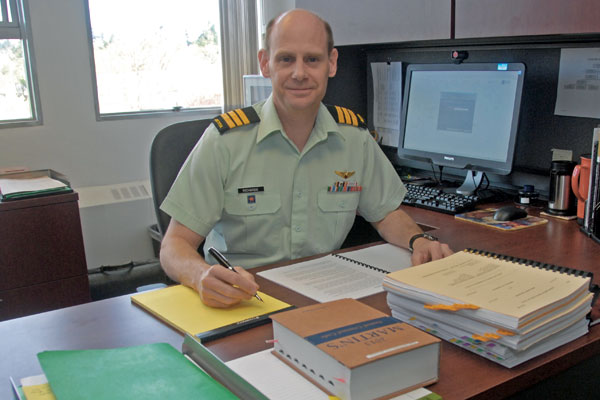
[caption id="attachment_3723" align="alignnone" width="300"] LCol Steven Richards, Deputy Director of Military Prosecutions (West), is hard at work in his brand new office in Naden Building N30.[/caption] The opening of the Regional Military Prosecutor (RMP) office at CFB Esquimalt last summer was a clear sign this resource was much-needed locally. But finding a place to house the RMP (Pacific) office and the Deputy Director of Military Prosecutions for Western Canada, LCol Steven Richards, has taken a little time. Good news, he’ll no longer be rooming with the Assistant Judge Advocate General (AJAG) staff. The finishing touches are complete in his new three office space in building N30, and with it will come more staff to help him prosecute cases. “I’m the only one here right now, so it’s been a busy year,” says LCol Richards. “We’ve prosecuted around a dozen cases in the Pacific Region so far and advised on many more, and that’s just this year. So I’m excited for the new staff to arrive.”He’s expecting a Regional Military Prosecutor in July, and a civilian legal assistant to compliment his roster. The RMP is a branch of the Judge Advocate General (JAG) that, much like AJAG, provides legal counsel and services to the Formation. While AJAG deals with a wide range of legal subject areas, including laws pertaining to the conduct of military operations, the RMP is focussed specifically on military justice, including prosecution of court martial cases.“When the Commander MARPAC reviews a case and thinks it may require a court martial, he sends it to our office,” explains LCol Richards. “Once we take a look at the evidence and the circumstances of the offense, we decide whether or not charges should be laid to be tried by court martial, and if so what those charges should be.” The branch...
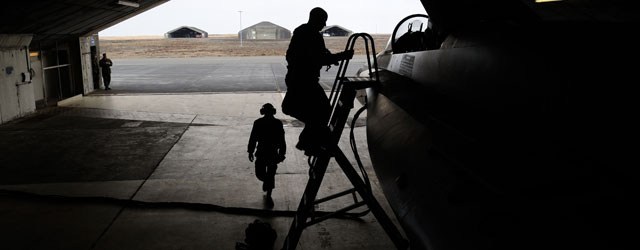
A CF-18 aircraft pilot prepares to fly his jet during Operation Ignition. The operation is Canada’s participation in the NATO Airborne Surveillance and Interception Capabilities to meet Iceland's Peacetime Preparedness Needs.