
Iceland’s eye in the sky
CF-18 jets fly over Iceland during Operation Ignition. The operation is Canada’s participation in the NATO Airborne Surveillance and Interception Capabilities to meet Iceland's Peacetime Preparedness Needs.
CF-18 jets fly over Iceland during Operation Ignition. The operation is Canada’s participation in the NATO Airborne Surveillance and Interception Capabilities to meet Iceland's Peacetime Preparedness Needs.

Canadian troops attend a ceremony at Fossvogur Cemetery to remember fallen Canadian soldiers from the Second World War during Operation Ignition2013.
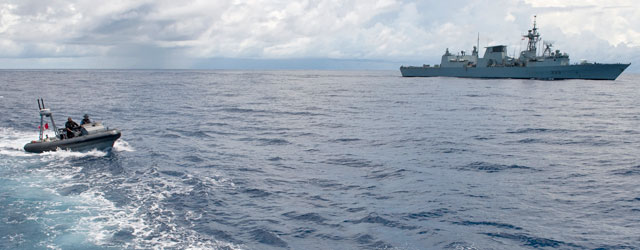
HMCS Toronto stands guard during a narcotics seizure in the Indian Ocean during Operation Artemis. The ship's boarding party found narcotics with an estimated street value of $100 million.
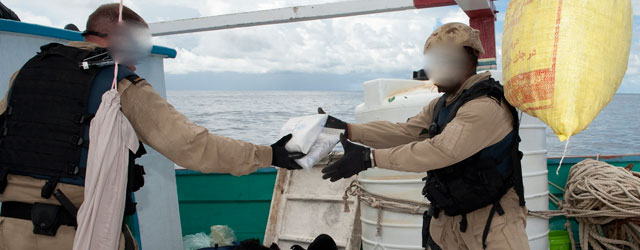
Narcotics are piled awaiting transport to HMCS Toronto. Toronto’s naval boarding party found narcotics with an estimated street value of over $100 million while searching a suspect vessel in the Indian Ocean.
It’s been decades in the making, but has finally come to fruition. Safety and security-oriented access rules have been defined around Fleet Maintenance Facility Cape Breton (FMF CB) buildings in what is now called the ship repair zone (SRZ). It’s the latest advancement in the massive facility consolidation project that began more than a decade ago. To improve safety and security of the area, the zone is now only accessible to FMF CB employees and those conducting business with the unit. The zone includes the main structure - D250, D252, D190A, D215, D149 and smaller outlying buildings. “I have seen too often people wearing flip flops while using the FMF CB buildings as a shortcut to transit the yard - this is a safety issue, plain and simple,” says Capt(N) Don Smith, Commanding Officer of the FMF CB. “Our number one concern is ensuring no one gets hurt, and to do that everyone needs to keep up with some simple safety regulations. Also we must control access to the weapons systems and classified information needed to support the operational capabilities of the Fleet.” People needing to enter the area must report to the commissionaires’ desk in D250 with valid ID. They’ll be given a visitor pass if they are not in possession of an access badge. Visitors with less than level two security, or without DND ID, will be escorted.They will be required to don CSA approved hardhats, work boots, and safety glasses if entering any of the production work centres. FMF CB employees working in or visiting the Ship Repair Zone will be required to carry their ID badge and have it displayed when in office areas. These double as electronic swipe cards to pass electronic check points at the various entry points of the building and other areas within the SRZ. “This is a military industrial zone, and there are things here that need to be more regulated than they have been in the past,” says Capt(N) Smith....

[caption id="attachment_3676" align="alignnone" width="300"] Personnel Support Programs' administrative assistant to the manager, 25-year-old Fawnia Robitaille, hopes to be the next Miss Universe Canada.[/caption] The next Miss Universe Canada could be CFB Esquimalt’s Fawnia Robitaille.The 25-year-old works at Personnel Support Programs as administrative assistant to the manager. Strutting down the runway in Canada’s top pageant is familiar terrain for the brown-haired, brown-eyed beauty. She put herself under judge’s scrutiny in 2010 in the same competition. While she didn’t win, it didn’t deter her from slipping on a gown again in hopes of a tiara, and a chance at the world title. “Doing pageants builds character,” she says. “It keeps me motivated to achieve a goal, whether it’s to improve my fitness, to look good in a bathing suit, or to improve my public speaking during the interview with the judges.”The road to the May 25 competition has been a testament to self control. Most after-work hours are spent at the gym – almost three hours, and every day she considers her meals, choosing small healthy choices to boost her metabolism over alcohol and fast food.She’ll know April 15 if it paid off when she gets fitted for her gown. “The gown is sponsored by Victoria Bridal Boutique and after a meeting with them we mutually decided on a few dresses. I won’t go into detail about the dresses so as not to spoil it, but they are gorgeous dresses and I am very excited to wear one of them during the Miss Universe Canada pageant. The bathing suit is the same for all delegates, and we receive those once we arrive in Toronto.”And which does she prefer – gown or bathing suit?“Both. The gown is what identifies me and my flavour for fashion. Being in a bathing suit shows off the...
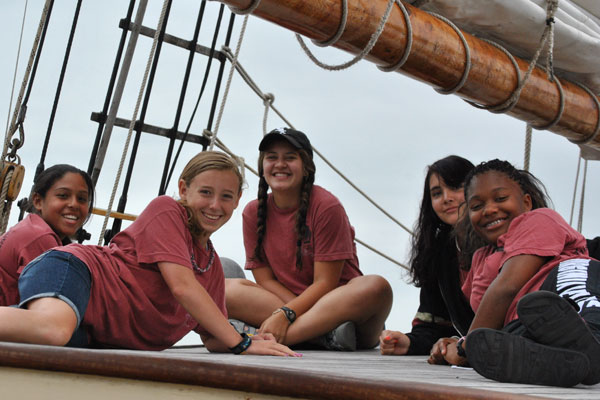
[caption id="attachment_3673" align="alignnone" width="300"] Girls from the 2012 Sisters Under Sail program relax on the deck of Unicorn during some downtime.[/caption] On the worn wooden deck of a tall ship named Unicorn, 12 young women will learn about sisterhood this summer in a program called Sisters Under Sail.The program empowers young women ages 13 to 18 with confidence, independence, and identity through nautical adventures.A dozen young women are chosen to take part in the two-week voyage across the Great Lakes.This year’s program focuses on girls from military families from both the U.S. and Canada. Dawn Santamaria, owner of the 110-foot Schooner Unicorn with husband Jay, says military children are rarely acknowledged for the lives they lead on behalf of their parents.“So often they’re uprooted and moved to other parts of the world, or have their parents deployed to dangerous places. That can be very difficult,” she says. “I wanted to honour these girls and everything they go through, and give them the tools they need to make it through what can be a very challenging life.”Applications from children of fallen or active status/active duty members in any branch of the military, including National Guard, Reservists, or Coast Guard will be accepted until April 15. Applicants must fill out an application downloaded from the Sisters Under Sail website at www.sistersundersail.org, write a 300 to 600 word essay on overcoming obstacles, and submit a letter of reference from a non-family member that speaks to the girl’s strength of character. Applications are reviewed by the Sisters Under Sail Board of Trustees, who then choose the 12 sailors - six girls from Canada and six from the United States.The program began eight years ago when the Santamarias saw the effects a life of sailing had on their four daughters.“They became so confident, and strong...
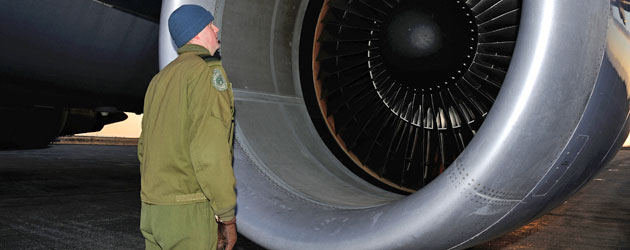
A crew member from 437 Squadron inspects the CC-150 Polaris aircraft before a flight during Operation Ignition, Canada’s participation in the NATO Airborne Surveillance and Interception Capabilities to meet Iceland's Peacetime Preparedness Needs.
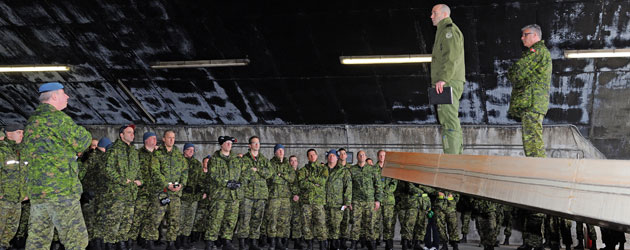
Task Force Commander, LCol Darcy Molstad, addresses the troops during Operation Ignition 2013. The operation is Canada’s participation in the NATO Airborne Surveillance and Interception Capabilities to meet Iceland's Peacetime Preparedness Needs.
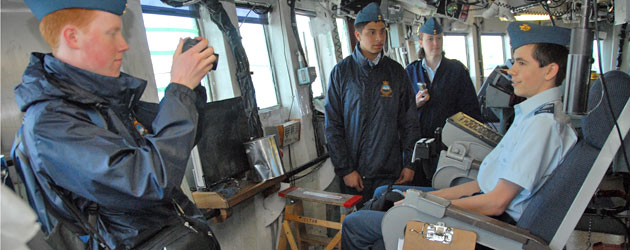
Air Cadet FSgt Braden Scriven (left) snaps a photo of brother FSgt Graham Scriven in the Captain's Chair on HMCS Algonquin. The cadets were visiting from Canmore, Alberta, to get a peak at naval life.

Fleet Maintenance Facility Cape Breton Riggers Al Scherer (right) and Barrie Brillinger (left) move test weights to aid in crane certification.
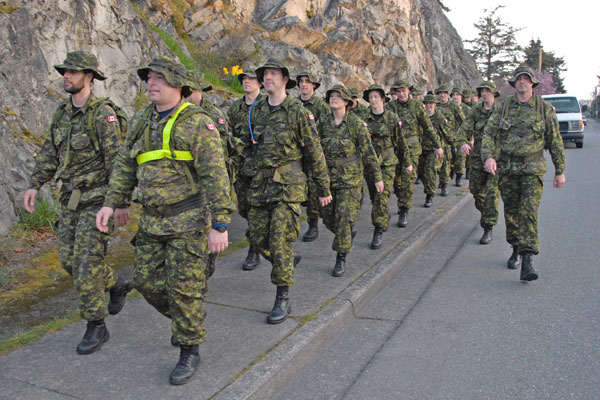
[caption id="attachment_3643" align="alignnone" width="300"] The recruits for CFB Esquimalt’s 2013 Nijmegen March take an early morning stroll in preparation for the annual march through the Dutch countryside.[/caption] Early risers in Esquimalt can expect to see a sea of green trudging down Lampson Street. The morning military marchers are in training for the annual Nijmegen March in the Netherlands.“It’s a physically demanding training process,” says CPO1 Chris Koblun, team leader for the CFB Esquimalt Nijmegen team. “By the time we head to the march in July we’ll have walked the distance of 30 marathons. It may be tough, but the results are worth it.”Nijmegen March is gruelling four day trek through 160 kilometres of Dutch countryside, which participants cover in full combat uniform carrying a 10kg rucksack.“It’s an absolutely career changing experience,” says CPO1 Koblun. “It’s very physically and emotionally demanding, but it gives you a new perception on what it means to be in the military.”CPO1 Koblun says the experience of the Nijmegen March is one all Canadian Forces members should experience.“Canadians are really the guests of honour there,” he says. “Civilians are excited to see the teams from other countries but when they see the Canadian flag they really go crazy.”The Dutch adoration of the Canadian Forces stems from the final days of the Second World War when the Canadian military liberated Holland and provided citizens with food and protection.“During the march you hear stories from the older civilians saying they wouldn’t be alive if the Canadians hadn’t saved their parents,” says CPO1 Koblun. “It can be very emotional, and very humbling. Even after all this time they’re still grateful.”Training for the march, which began Feb. 25, is as gruelling as the event itself, and it’s not a certainty all marchers will go. Out of the 24 people that...

[caption id="attachment_3639" align="alignnone" width="300"] Construction on sections of Hospital Road at CFB Esquimalt have caused many closures and re-routes along Dockyard’s central road.[/caption] CFB Esquimalt has gone through enormous changes during the past few years and there are several more years to come. Over the next year, employees will see several major construction projects take place, many continuing through 2014 and beyond. Although the focus tends to be in Dockyard, there are also major construction projects underway at several other sites. The objective is sustainable infrastructure to support a modern navy. As evident by the time line, there are many projects either underway or about to start. The Royal Canadian Navy has the lion’s share of the Department’s construction allocation over the next 10 years.There are even more projects in the budding stages. Below are the projects that are underway or coming soon. Base Fire Hall and Command PostThis brand new facility is in final stages with occupancy slated for May 2013. Its street appeal is achieved by radical use of color and innovative architectural style. Inside it’s fitted with the most current fire-fighting equipment and comfortable accommodation facilities including theatre classroom and kitchen.Utility CorridorThis project started in June 2012 and will continue until October 2013. This three meter by three metre tunnel will form the backbone for municipal infrastructure within Dockyard (water, sanitary sewer, steam, power and communications) ready for future development. The contractor is working both ends towards the middle to reduce construction time. There will be, however, ongoing traffic detours as the contractor excavates and builds the tunnel. In the end, there will be a wide corridor with bicycle lanes and sidewalks all the way from the Gate House to B-Jetty.Fleet Maintenance Facility (Cape Breton) This multi-phased project will enhance FMF (CB)’s ability to deliver ship repair...

[caption id="attachment_3636" align="alignnone" width="300"] Your internet activity could impact workplace security.[/caption] Ever consider that by “liking” an ad, picture, or video on Facebook you may have invited a computer worm to sift through your personal information? According to Infosecurity magazine, cyber security, cyber espionage and cyber terrorism top the 2013 list of information security threats. Individuals, industry and governments are clamouring to proactively manage the inherent security demands. Your personal computing habits - the way you browse the internet, use social media, and save and transfer files - can also be a hazard to work place security. Sharing the details of your daily activity is common place in social media. Minute-by-minute updates of your personal life are not harmful unless sensitive information is included in your posts. For example, Tweeting, “Glad the ship broke down and we get to stop in Crete for parts…who know how long the repairs will take,” discloses Essential Elements of Friendly Information (EEFI) that are useful to anyone who wants to cause harm. In general, EEFIs include information about personnel, equipment, capabilities, position, and operations. This Tweet has just told the “bad guys” where the ship is headed (position), that she is broken (capabilities), her operational capability is limited and that the ship’s company will likely be exploring the sights and sounds of downtown Crete. This is valuable information for anyone with the will and means to derail the ship’s mission. Private computing behaviours seldom adhere to principles of acceptable workplace computing and are rarely conducive to operational security (OpSec). The recently promulgated VCDS OpSec directive (CANFORGEN 032/13) serves as a reminder and a warning to Canadian Armed Forces (CAF) personnel that sensitive information must be handled with care, exercising due consideration for public safety and national security. With access to privileged information comes the...

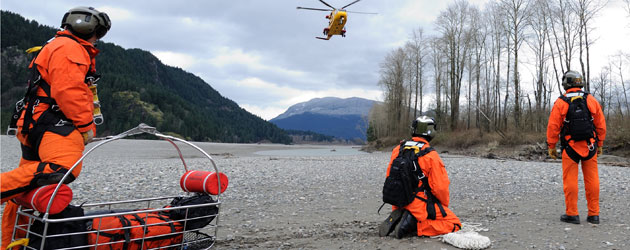
Search and Rescue Technicians MCpl Nick Nissen (left), Sgt Chris Lamothe (centre) and MWO Gavin Lee (right) wait to be hoisted into a Cormorant helicopter during a search and rescue exercise held in Kelowna, B.C. from March 18-22, 2013.

MWO Gavin Lee, a Search and Rescue Technician with 442 Transport and Rescue Squadron, spots for a simulated downed aircraft from a Cormorant helicopter during a search and rescue exercise held in Kelowna, B.C. from March 18-22, 2013.
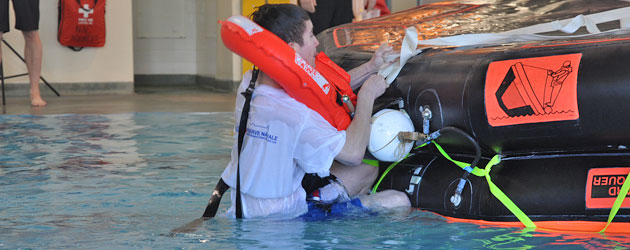
Cody Bauml of Edward Milne Secondary practices the proper procedure for flipping a capsized life raft during HMCS Malahat’s Sailor for a Week exercises last week at Naden Athletic Centre.
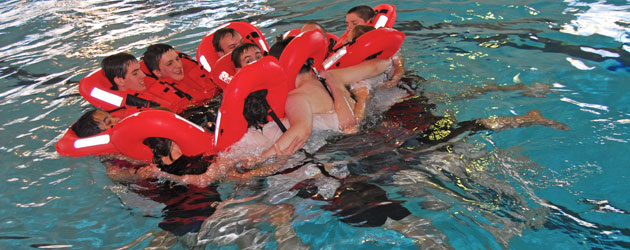
Students participating in HMCS Malahat's Sailor for a Week practice sea survival techniques by forming a ring to conserve body heat at the Naden Athletic Centre Pool.
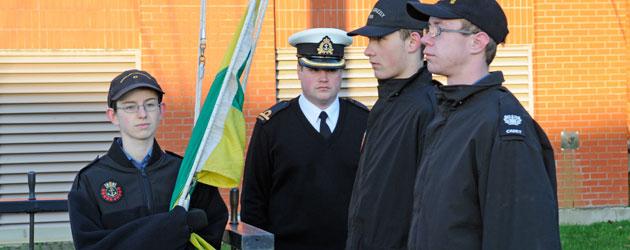
Cadets from across B.C. kicked off their March Break at CFB Esquimalt with a colours ceremony held at Work Point. Seen here PO1 Susannah Weber, A/Slt Kent MacLeod, PO2 Drew Meyer and CPO2 Christopher Amundson.
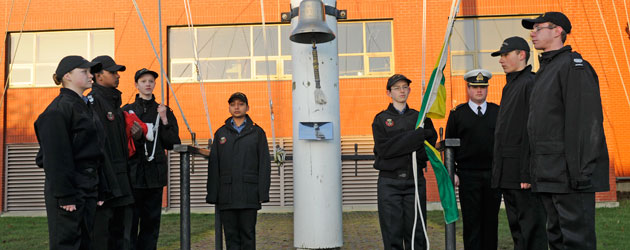
Cadets kick off March Break with a colours ceremony: PO1 Deryn Hotel, PO2 Kevin Daniel, PO2 Lyndsay Bodgener, PO2 Nancy Andrews, PO1 Susannah Weber, A/Slt Kent MacLeod, PO2 Drew Meyer and CPO2 Christopher Amundson.
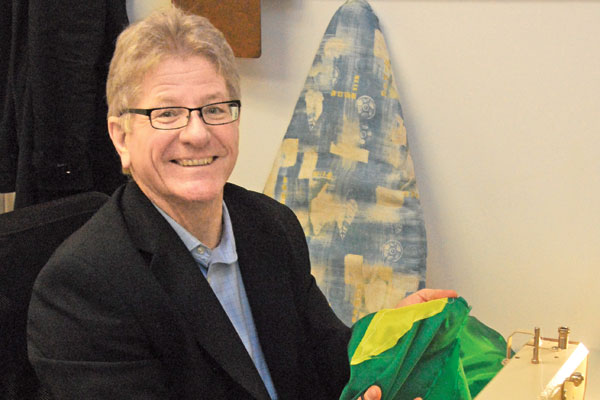
[caption id="attachment_3598" align="alignnone" width="300"] Paul Servos, co-owner of the Flag Shop, practices a technique called applique-sewing, in which an image is sewn onto both sides of a flag to give the impression of a flat image.[/caption] The flag-lined store front on Fort Street is suggestive of what is offered beyond its doors. Inside the newly re-opened Flag Shop is a vast inventory of international flags, ensigns and anything flag related. Owners Paul and Maggie Servos opened the Flag Shop, with the help of Mayor Dean Fortin, Feb. 15, National Flag Day. It’s one of 13 Flag Shops across Canada, a franchise owned by Vancouver-based Textile Image Inc. “I’d been looking for a small business and a friend of mine suggested I look into the Flag Shop,” says Servos. “I’ve always had a strong connection to nautical life, so it seemed like a perfect fit.” Servos has come out of early retirement to run the shop. In 2010 he stepped down as CEO of the Greater Victoria Harbour Authority and spent more than a year travelling the world. While he says the break was nice, it wasn’t long before he got restless. “When you spend most of your life working it’s hard to just give it up,” he says. The shop was owned by Jamie and Chantal Webb for 14 years. They sold it in 2009, but it closed shortly afterwards. Under the encouragement of Webb, Servos seized the opportunity to bring a full service flag shop back to Victoria. “Especially in a navy town like Victoria there is a huge market for flags,” says Servos. “We hope that if the military needs flags made they’ll come here.” Most businesses that sell flags are what Servos calls “catalogue shops”; the inventory is ordered in only when the customer needs it, which...
[caption id="attachment_3595" align="alignnone" width="300"] MS Shianne Auger of 158 Grizzly Cadet Corps is instructed in striking techniques by James Tosoff.[/caption] Lined up on the hardwood floor of the Naden Athletic Centre gym last week, the row of cadets more closely resembled the ranks of disciplined Royal Canadian Navy sailors. The group of 30 youth, under the tutelage of James Tosoff, were being given an overview on the basic rules of taekwondo, kickboxing, and jujitsu. “I’ve trained a few military personnel in my time, so I wanted to work with the kids who could be the future of our military,” says Tosoff, owner and Chief Instructor at Westcoast Taekwon-Do. “This is a prime time in their lives, where the discipline and physical fitness learned through martial arts can impact their future.” Tosoff and his instructors gave the cadets demonstrations and theory lessons on the basic strikes, kicks, blocks, fighting stances and warm up exercise. They were also shown basic juijitsu grapples and kickboxing strikes. “These techniques are building blocks for fitness and discipline,” says Tosoff. “It’s the lessons at the core of the techniques that are really important: patience, confidence, and leadership.” The cadets were part of the 2013 Regional Inter-Divisional Seamanship Competition. The week-long event took place over spring break and tested the naval skills of select sea cadets from across British Columbia. Part of the event included teambuilding exercises, such as the martial arts lesson, to strengthen leadership and cooperation. “It was a lot of fun, and it was very enlightening,” says PO1 Emily Roberts of Sea Cadet Corps 137 Kamloops. “We get to do a lot of things in cadets but this was a new experience for me.” She has been training in karate for 10 years, but says the opportunity to try a new style of martial arts was exciting.“Even if it’s just the basics it’s still a new experience,” she says. PO1 Roberts says her time in martial arts has greatly benefited her time as a cadet,...
[caption id="attachment_3593" align="alignnone" width="300"] LS Kotelko, an RMS clerk from HMCS Unicorn stands duty as a lookout on HMCS Yellowknife.[/caption] What better way to spend spring break than leaving the shovel behind and bidding “adieu” to Saskatoon’s knee-deep snow for plus temperatures and liquid water? This was the experience for members of the naval reserve division HMCS Unicorn who were in Victoria sailing in HMCS Yellowknife and conducting tours from Feb. 16-24. This is the second year Unicorn took out a contingent of its ship’s company to sail as part of a combined ship’s crew on a Kingston class vessel. Unicorn sailed in Yellowknife just days after LCdr Corey Gleason assumed command of the ship. The two crews from Yellowknife and Unicorn went right into the week’s program with a man overboard drill shortly after slipping. They continued the day with manning checks and drills, followed by .50 caliber machine gun shoot for the Deck Department, and message processing and modem configuration for naval communicators. This sail supported Unicorn sailors in several ways: for working on on-the-job performance record, maintaining skills, giving sailors in support trades the opportunity to sail on a MCDV and to see what could be achieved in a week on board ship. “What wasn’t a success?” said LCdr Karen Wallace, Commanding Officer of Unicorn. “From the non-qualified naval environmental training program, ordinary seaman to the bridge watch keeper qualified, maritime surface and sub-surface officer, each learned or honed skill sets.” Exercises continued through the week with boatswains conducting a timed deliberate firing on the .50 caliber machine gun - which had everyone in good spirits as their final times were announced; a pyrotechnics lecture and demonstration; light line approaches and transfer with HMCS Saskatoon; and preparing for a Cormorant helicopter with flying stations. It turned out the Cormorant was not able to participate, but after the evolution was cancelled Yellowknife was tasked with a “no duff” search and rescue (SAR), with Yellowknife and Unicorn working...
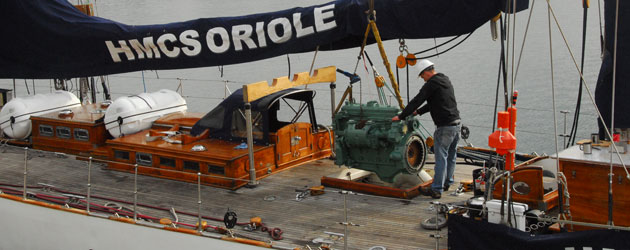
Colin Spivey of Intercon Marine works to lower HMCS Oriole's newly refurbished engine into the ship's engine room.
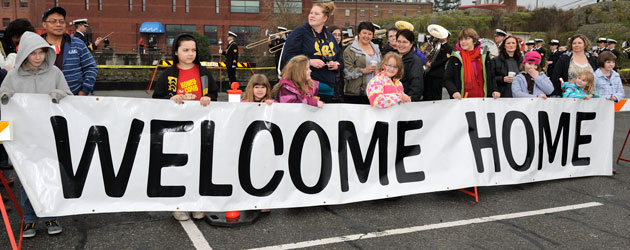
Family and friends welcome HMCS Regina home alongside "A" Jetty on March 14. During its eight-months in the Arabian Sea, the ship was primarily employed in maritime surveillance, a task that involved monitoring, hailing and investigating vessels.
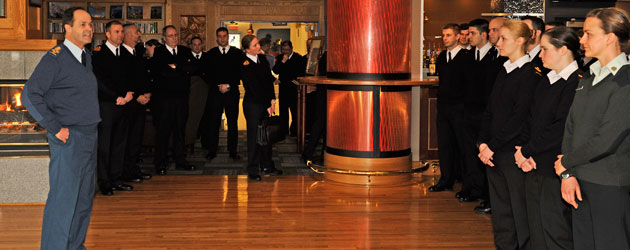
Chief of the Defence Staff, Gen Tom Lawson chats with students and staff at Venture, The Naval Officer Training Centre Gun Room.
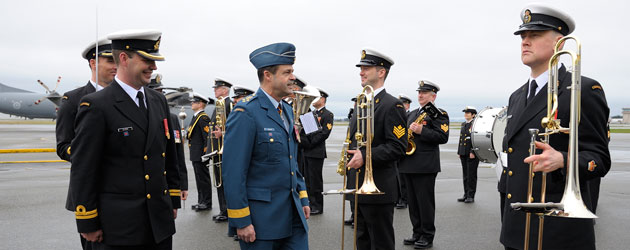
Lt(N) Matthew Clark, Director of Music, accompanies Chief of the Defence Staff, Gen Tom Lawson, as he inspects the Naden Band of the Royal Canadian Navy on his arrival at 443 Maritime Helicopter Squadron.