Checking out the goods
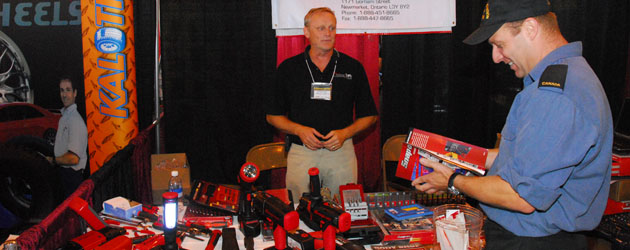
A Canadian Forces member checks out one of the many booths at the Lookout Industrial Tradeshow on Sept. 22.
A Canadian Forces member checks out one of the many booths at the Lookout Industrial Tradeshow on Sept. 22.
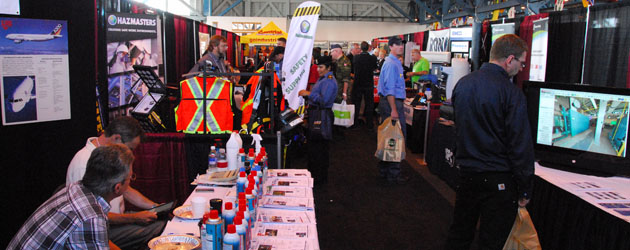
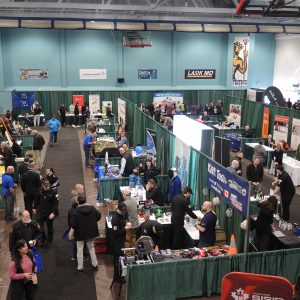
CF members browse the many products on hand at the Lookout Industrial Tradeshow at CFB Esquimalt.
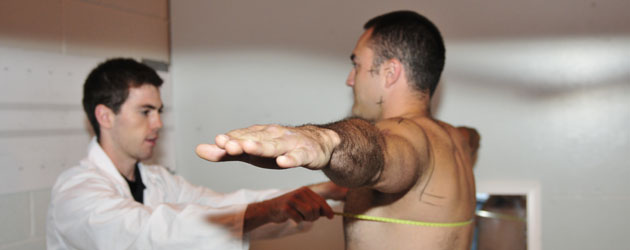
OS Scott Hickey, marine systems engineer student from Fleet School volunteered to take part in the 2012 Canadian Forces Anthropometric Survey.
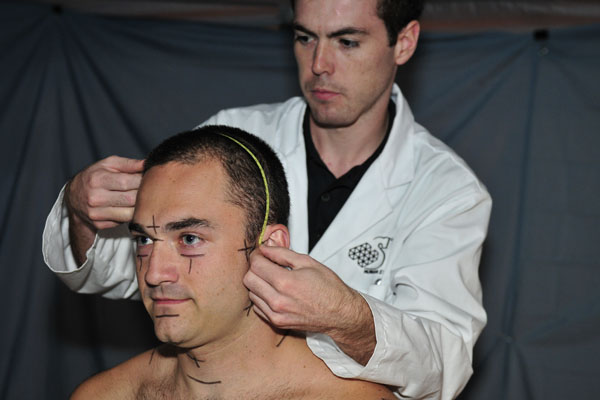
[caption id="attachment_2342" align="alignnone" width="300"] OS Scott Hickey, marine systems engineer student from Fleet School volunteered to take part in the 2012 Canadian Forces Anthropometric Survey. This is the first time a survey has ever been conducted across the Canadian Forces to establish data on the size and form of a range of military members.[/caption] Last week, the upper level of the Naden Gym took on the look and feel of a scientific research lab. Dressed in blue robes, 180 CFB Esquimalt members had lines and x’s drawn on them before they were measured and guided behind curtains where three-dimensional lasers mapped out images of their bodies. It looked like a scene from a sci-fi movie. This was part of the 2012 Canadian Forces Anthropometric Survey, a Canadian Forces wide study involving 15 bases and wings. The study is being conducted for the Canadian Forces by Defence Research and Development Canada, an agency that provides DND, other government departments and the public safety and national security communities with the knowledge and technologies needed to defend and protect Canada’s interests at home and abroad. “This is the first time the Canadian Forces have done a study like this involving navy, army and air force,” said Allan Keefe, project lead from Defence Research and Development Canada (DRDC). Current clothing and workspace standards are based on an army survey conducted in 1997, and there was evidence to suggest the survey needed to be updated, he says. “Knowledge of the size and form of the body of Canadian Forces personnel is crucial to properly specify, evaluate, and develop military equipment and individual clothing,” said Keefe. “We are taking a proportionate sampling approach to ensure we have proper representation of gender, occupation, age and language. This allows us to get a non-bias snapshot of the body...
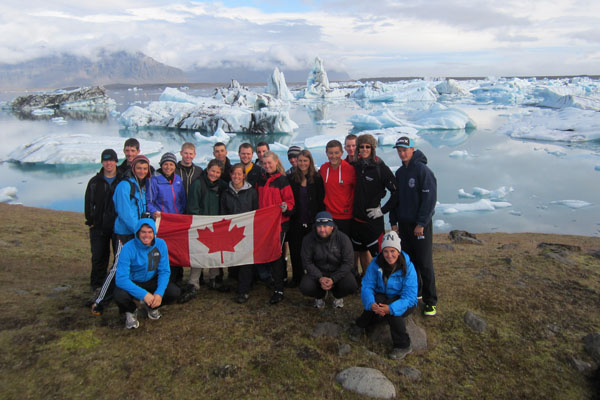
[caption id="attachment_2339" align="alignnone" width="300"] Seventeen Royal Canadian Army Cadets and three Cadet Instructor Cadre Officers from across Canada participated in a rigorous international expedition in Iceland from Aug. 24 - Sept. 6.[/caption] Seventeen Royal Canadian Army Cadets and three Cadet Instructor Cadre Officers from across Canada participated in a rigorous International Expedition in Iceland from Aug. 24 to Sept. 6, which tested their physical and mental limitations. The itinerary included a self-sufficient and gruelling 10-day hiking and mountain climbing expedition through Iceland’s south-western region, followed by three days of equally challenging mountain biking. Participants ascended 1,000 metres of altitude and higher, through technical terrain, rivers, and mountains, each one carrying a rucksack of 50 lbs. “The itinerary was very challenging, even for an experienced adventure enthusiast to attempt,” said mountain guide Vidar. “When I first heard that I was to do this with a group of teenagers, I thought this is crazy.” On day seven of the expedition, the group’s mountain guides were alerted to an approaching storm that could bring dangerously high winds and subzero temperatures. “It was really tough,” recalls cadet Matthew Wickwire, 18, from Halifax, N.S., a member of 2501 1st Halifax-Dartmouth Field Regiment Army Cadet Corps. “After seven days of hiking and climbing through all types of weather and nearing the end of the expedition, the guides told us that we were going to have a long day tomorrow, a really long day.” Due to the potential of a heavy storm, they couldn’t take the chance of being caught in high altitude, so they had no choice but to get out of there fast. On day eight of their expedition, cadets, staff, and guides woke at 4 a.m. to the daunting task of crossing the Skeioararjokull glacier, the third largest glacier in the world, which would...
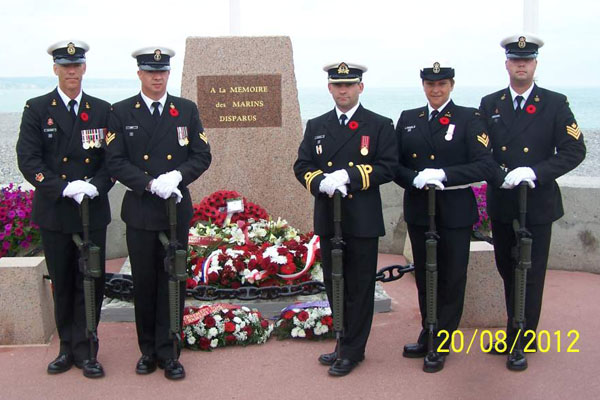
[caption id="attachment_2336" align="alignnone" width="300"] Representatives from the Royal Canadian Navy at the 70th Anniversary of the raid in Dieppe, France. From left to right: PO1 Yvan Vallières, MS Ryan Hart, Lt(N) Jason Delaney, MS Kimberly Sampson, and PO2 Mickael Pinault-Lepage.[/caption] MS Hart and I were both selected to represent Maritime Forces Pacific (MARPAC) at the 70th Anniversary of the raid in Dieppe, France. We flew into Trenton and had two full days of parade practice before departing for France. One the first day we practiced individual drill movements. The second day we trained with the contingent of 107 individuals from all three elements on the five different parade scenarios. A military airbus took us from Trenton to Ottawa where we picked up veterans who participated in the raid. Those veterans were 92 to 95 years young and came from Montreal to Vancouver. Then we flew to Lille, in northern France, where two buses drove us the three hours to Dieppe. Once in Dieppe, we were given our hotel room, which we shared with two or three roommates. The next morning, the contingent was driven to the three beaches where the raid took place. A Canadian historian talked to us a length about what went on that day. I visualized what the soldiers saw once they landed on the beach. We were also driven to the furthest point inland where the Allies marched to. Following this tour, we went to a theatre and saw the world premiere of “Dieppe Uncovered". The declassification of documents led to this documentary, after 15 years of research by military historian David O'Keefe. One of the main British spies featured in the documentary was present in the audience. That night, we went to Les Vertus Canadian Cemetery where we had a chance to browse for an...
Title: 84, Charing Cross RoadLocation: Langham Court Theatre, 805 Langham Court, Victoria, B.C. V8V 4J3 CanadaLink out: Click hereDescription: Langham Court Theatre presents 84, Charing Cross Road - a comedy by Helene Hanff, adapted by James Roose-Evans and directed by Sylvia Rhodes. Set in the tumultuous decades between 1950 and 1970, this is a story of love for great literature, and a long-distance love between two people. Suitable for all audiences. Previews Wednesday, October 3rd, Opens Thursday, October 4th and runs through to Saturday, October 20th, 2012. Preview Night (October 3) all tickets are 2 for $20. October 9th & October 16th all tickets are 2 for $30. Single tickets are $21 and $19. To book tickets and for more information, please call 250-384-2142 or visit www.langhamtheatre.caStart Date: 2012-10-03End Date: 2012-10-20
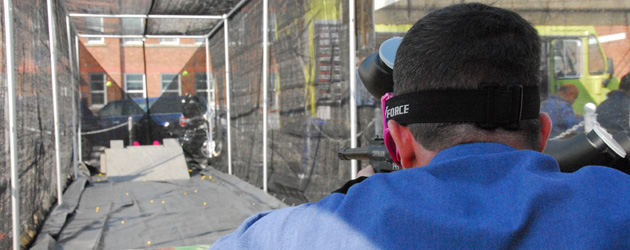
LS David Murray-Trottier sights up a shot at the TNT Paintball booth at the Lookout Industrial Trade Show.
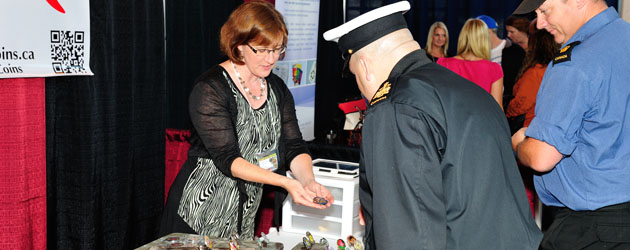
Helen Edley of Landsharkzcoins, one of 115 booths at the CFB Esquimalt Industrial Supplier Trade Show, displays several samples of their products.
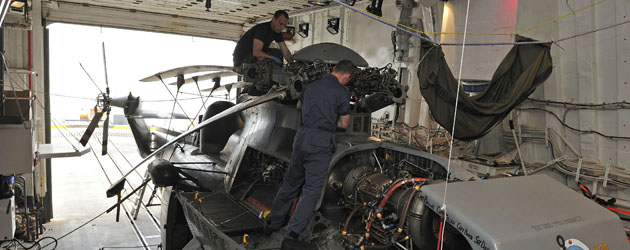
Cpl Christopher Smith (foreground) and Cpl Guillaume Trembly perform general maintenance on a CH-124 Sea King helicopter while deployed on HMCS Regina in the Arabian Sea during Operation Artemis.
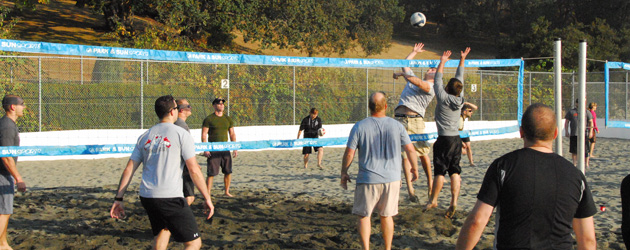
A few friendly morning games of beach volleyball during Fleet School Sports Day.
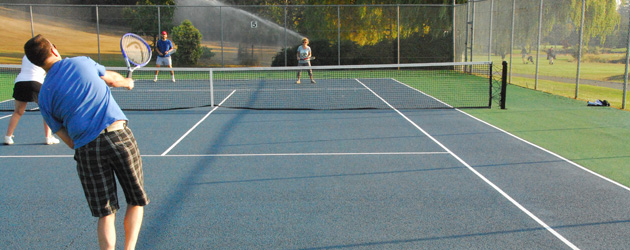
PO1 Lorne Ferguson takes part on the tennis court during Fleet School Sports Day.
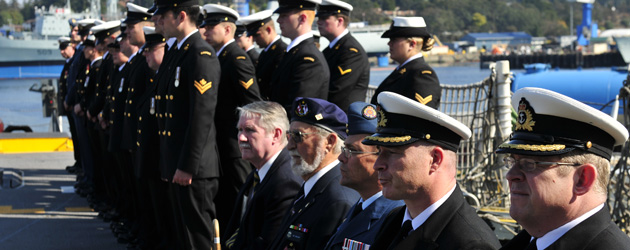
Last Friday the crew of HMCS Ottawa honored the 70th anniversay of the sinking of Ottawa I with a memorial service held on the ship at 11 a.m.
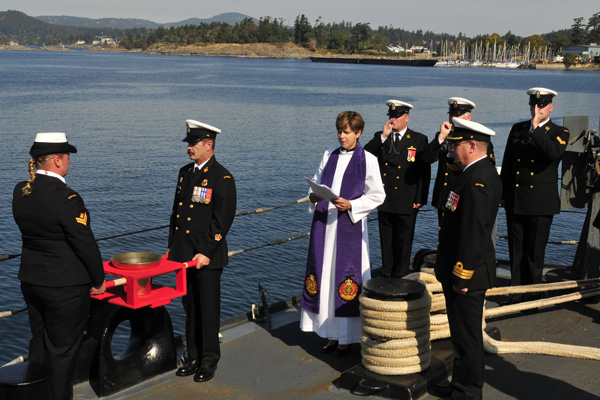
[caption id="attachment_2283" align="alignnone" width="300"] HMCS Ottawa I honored. The water casting party, PO1 Keith Fairman and MS Ley Ireland, commit the blessed water to the sea to commemorate the 70th Anniversary of the sinking.[/caption] The crew of HMCS Ottawa were joined by past commanding officers and veterans on Sept. 14 to commemorate the 70th anniversary of the sinking of the original destroyer HMCS Ottawa and crew. Once the ship’s company had fallen into divisions on the flight deck the ceremony began. “Let us think reverently of those comrades who laid down their lives for sovereign and country,” said Commanding Officer Cdr Scott VanWill to his crew. “Let us be mindful of the cost of freedom and peace. May our country and its people be worthy of their sacrifice.” Then, the ship’s flag was lowered to half mast. Padre Lt(N) Jeannine Friesen led a naval prayer and blessed the water in Ottawa II’s ship bell and MS Ley Ireland and PO1 Keith Fairman committed the water over the side of the ship. The ship’s bell rang once in memory of Ottawa I and two minutes of silence followed. Amazing Grace was piped on the bagpipes. “We commemorate the sinking every year, but this is the first year we have reached out to veterans and past commanding officers,” said Ottawa’s coxswain, CPO1 Sid Tobias. “It gives the sailors a direct reference point to think about and brings them closer to the sacrifice of service. It is our responsibility to mark this each year,” he said. Veteran Ed Dallin attended the ceremony. His brother was a stoker on the original Ottawa from 1938 to 1941. “This brings back a lot of memories for me,” said Dallin. “My brother got off the ship before it sank the following year. He was glad he wasn’t...
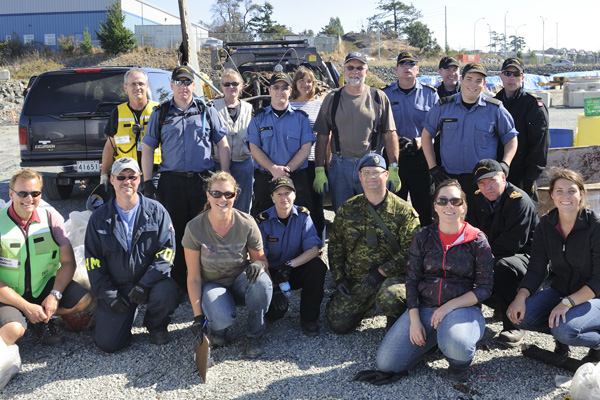
[caption id="attachment_2279" align="alignnone" width="300"] Group shot of the Military and DND civilians who volunteered in the annual Great Canadian Shoreline Cleanup at Yarrows boat ramp.[/caption] More than 40 military and civilian volunteers rolled up their sleeves last Wednesday for the Great Canadian Shore Cleanup. This year marked the first official CFB Esquimalt crew, headed by the office of the Queen’s Harbour Master, the Canadian Forces Auxiliary Vessels and the Port Operations and Emergency Services Branch. “It’s our responsibility to keep this harbour clean,” says Branch Environmental Officer Lyle Fairley. “We wanted to do our part, and we’ve had a really great response from the base.” The team targeted the area around Dockyard and Naden, as well as across the water in View Royal. They combed the waters and beaches for refuse of any kind, even hauling an old wooden boat out of the seabed near Fleet Dive Unit. “I can’t believe how much stuff we recovered,” says Fairley. “Everyone did a really great job.” All in all, around 3,000 lbs of material was recovered. This included 1,937 lbs of scrap metal, 176 lbs of rope, and 59 lbs in plastic bags. “There’s still more out there, and it’s going to take a lot more work, but we’re off too a good start,” says Fairley. “All of the stuff that we collected can have a serious impact on marine wildlife and the ecosystem. This is an important job, and I’m glad that we can help.” Shawn O’Hara, Staff Writer
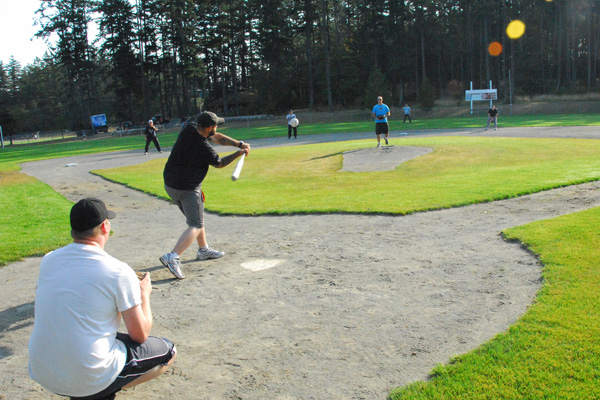
[caption id="attachment_2275" align="alignnone" width="300"] LS Darren Hann takes his turn at bat during Fleet School Sports Day.[/caption] Staff and students from CF Fleet School took a break from classroom learning for some sports competition Sept. 14 at the annual Fleet School Sports Day. More than 700 students and teachers took to the fields at the Juan de Fuca Recreation Centre for a little physical exertion, to stay fit and clear their minds. “They spend a lot of time cooped up in classrooms, watching presentations,” says PO1 Judith Hales, Fleet School Sports Officer. “Here they can get some exercise, get to know more about each other and how they work together.” Competition isn’t the focus of the day, though there are winners for each sport. Skills utilized during team sports are closely related to the skills needed to be successful in the military. “Playing a sport is all about leadership, teamwork, and knowing your role,” says PO1 Hales. “It’s important to instil that understanding of teamwork and community early on. It’s a huge advantage later in your career.” The day’s competition was conducted round robin style. The Marine Systems Engineer team placed first in floor hockey; the Blue Team, made up of a mixture of students from all sections, took first in soccer; OS Oswald Lindsay had the top score on the golf course; Cdr Daniel Riis and civilian Sylvie Rochette won doubles tennis; the Naval Combat Information Operators came first in softball; and finally, the beach volleyball champions were the Sonar Operators. Shawn O’Hara, Staff Writer

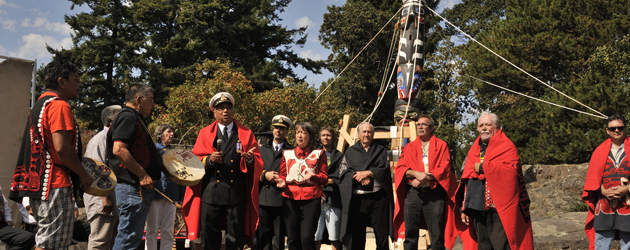
The Honorable Steven Point, Lieutenant Governor of British Columbia thanks all the individuals and groups for their support and participation in the Hosaqami during the Pole Raising Ceremony at the front of the Government House.
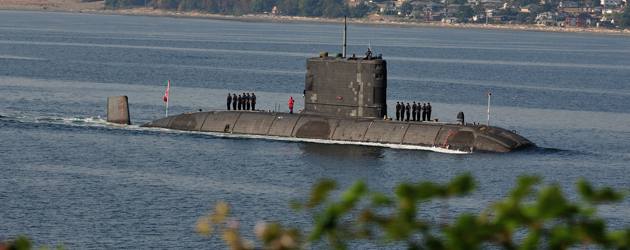
HMCS Victoria enters Esquimalt Harbour as she and her crew return from participating in the world’s largest multinational, maritime exercise, Rim of the Pacific (RIMPAC).
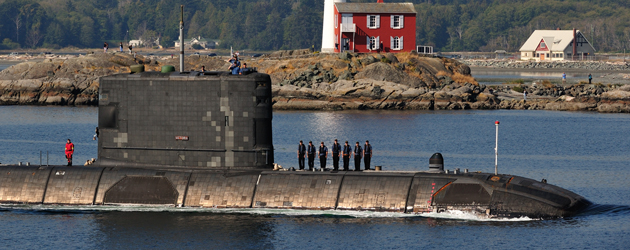
Family, friends, and community members gathered at CFB Esquimalt September 14, 2012 to welcome home HMCS Victoria as she and her crew return home.
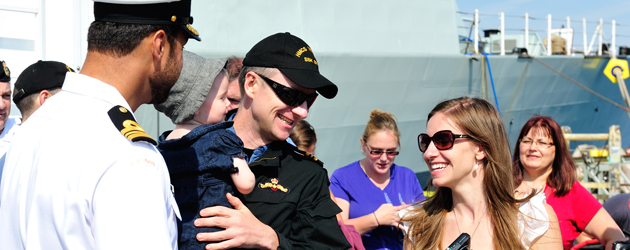
Executive Officer of HMCS Victoria, LCdr Christopher Holland is with his wife Lindsey and their daughter.
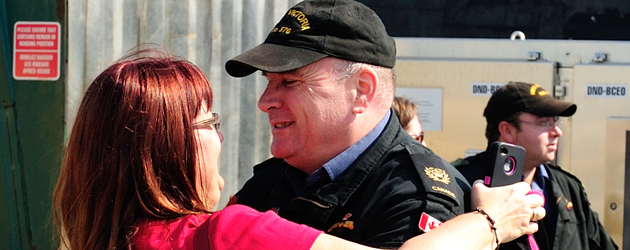
CPO2 Christopher Robinson of HMCS Victoria and his wife Sue hug after the return of Victoria to CFB Esquimalt.
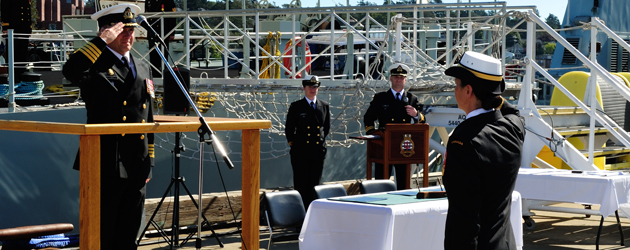
Capt(N) M.W. Teft returns Salute to LCdr L.J. Zezza at the opening of the HMCS Saskatoon Change of Command ceremony Sept 6, 2012.
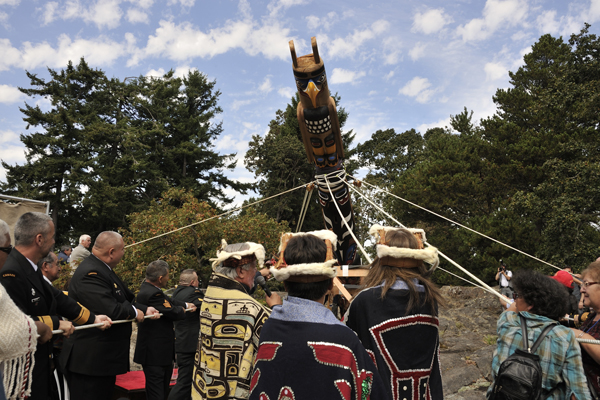
[caption id="attachment_2206" align="alignnone" width="300"] Rear-Admiral William Truelove Commander, Maritime Forces Pacific and guests assist with the Raising of the Pole Hosaqami at the front of the Government House.[/caption] Naval history from 1959 was rekindled and celebrated on Sept 8 during a replica Hosaqami totem pole raising at Government House. Approximately 1,500 people packed the front lawn awaiting the arrival of the Honourable LGov Stephen Point, First Nations Elders and Chiefs, MARPAC Commander RAdm Bill Truelove, veterans, and dignitaries. This occasion was the result of an initiative of LGov Point and the Government House Foundation to honour the Queen’s Diamond Jubilee. “You are the witnesses to this beginning,” said LGov Point to the crowd. “This pole belongs to all of us. To me it represents a new time for us all to stand in the same circle. We have to find, in this time and age, a way to paddle in one canoe.” First Nations carver Chief Tony Hunt, the grandson of Chief Mungo Martin, who carved the original pole, was commissioned by LGov Point to carve the red cedar log into the 7.3 metre pole. With help from his son, Tony Hunt Junior, this process took two and a half months of skilful carving behind Government House. A 17-year-old Hunt Sr helped his 87-year-old grandfather Martin carve the original pole in Thunderbird Park Victoria. The pole was then gifted to the Royal Navy from the Royal Canadian Navy as a 50th anniversary event. It spent many years on Whale Island, in Portsmouth England, where it stood until the late 80s. Badly damaged by weather, it was returned to CFB Esquimalt where it sat outside the Chief and Petty Officer’s mess for years. In collaboration with LGov Point, Chief Hunt decided it was too badly damaged and a new pole should...
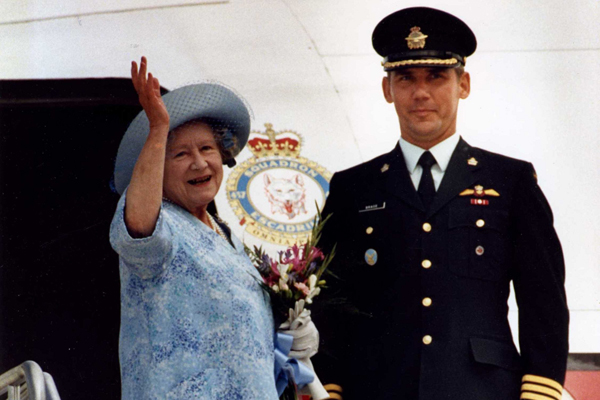
[caption id="attachment_2202" align="alignnone" width="300"] Brigadier-General (Ret’d) Jeffrey Brace was pilot to the Royal Family during his career.[/caption] He’s flown the Royal Family, a pope and the late Prime Minister Pierre Elliott Trudeau, but for Brigadier-General (Ret’d) Jeffrey Brace, his time spent with people facing cancer is one of the most rewarding experiences of his life. A distinguished member of Canada’s Air Force, Brace had a long and exciting career before being diagnosed with prostate cancer 10 years ago. “Bitten by the flying bug” as a young air cadet in Montreal, Brace rose through the ranks quickly. He served as a crew member on the 1973 Trudeau mission to China, commanded 437 Transport Squadron where he flew members of the Royal Family and Pope John Paul II, and served not only as base commander at Canadian Forces Base Trenton, but also as commander of Canada’s military air transport and search and rescue forces. He took early retirement from the Canadian Forces in 1996 to become executive director of the National Air Force Museum of Canada in Trenton, a position he held until 2002. That year, he opted to take part in a clinical trial for the early detection of prostate cancer. The doctors found something. Brace admits it was “jaw-dropping” to discover he had cancer, but he quickly realized he needed a plan. “When you face something like this you don’t run around in circles, you sit down and you lay out a plan and you follow it,” Brace says. “I know the military and its regimented ways gave me the planning skills I needed to deal with something that, at the time, was a crisis in our family’s lives.” After assessing the risks with the help of his wife June, and on the advice of his doctors, Brace underwent surgery....
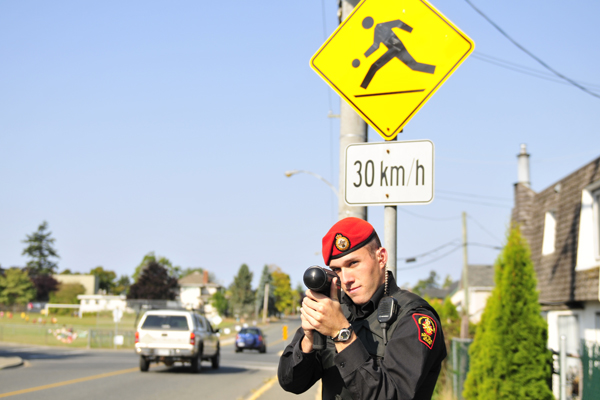
[caption id="attachment_2198" align="alignnone" width="300"] Cpl Grant Mackay holds up a radar gun assessing speeds of motorists near Macaulay Elementary School. Motorists are reminded to slow down and respect playground zones and school zones now that school is back after summer holidays.[/caption] It’s that time of year again, when students of all ages head back to school. With this comes heavier traffic on our streets and highways, and an increase in small children walking independently to their school or bus stop. Children by nature are very impulsive and often do things before they have a chance to think about it, which puts them at a greater risk of being involved in a serious accident. Motorists need to be aware of the increased risks and adjust their driving habits accordingly. As a reminder, the posted speed limit in most school zones is 30 km/h between the hours of 8 a.m. and 5 p.m. when students are in school and 30 km/h in playground zones from dawn to dusk. It is the driver’s responsibility to use extra caution in these areas to prevent a tragedy from occurring. Safety Tips for Drivers• Always come to a complete stop at posted stop signs; this will enable you to see more potential hazards.• Pay extra attention to children walking on medians, streets and curbs.• Refrain from using cellular phones or handheld devices while driving.• Obey the posted speed limit. It’s there for everyone’s safety.• Always stop for school buses when their flashing lights are activated. Safety Tips for Students• Refrain from using headphones while walking to school. It reduces the ability to hear approaching dangers.• Do not use your cellular or mobile phone while crossing intersections, it distracts from potential dangers.• Always cross at posted crosswalks and activate the crosswalk lights when available.• Even though the...
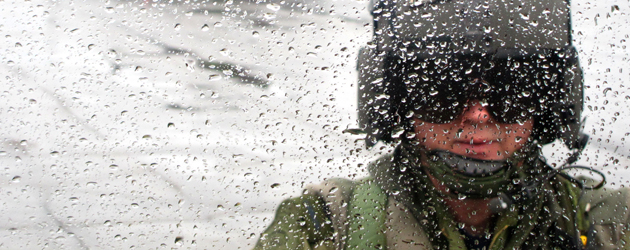
MCpl Tim Patterson, a Flight Engineer with 400 Tactical Helicopter Squadron, Borden, ON is seen through the rainy windscreen of a CH-146 Griffon helicopter at Mike Zubko Airport, Inuvik, NT during Operation Nanook 2012.