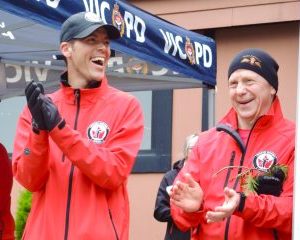

Blood donation contribution ceremony
Blood donation contribution ceremony. from Lookout on Vimeo.
Blood donation contribution ceremony. from Lookout on Vimeo.


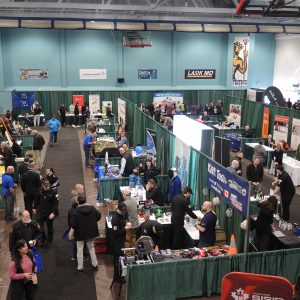
The MARPAC EXPO Maritime Forces Pacific Expo CFB Esquimalt - Education & wellness trade show MARPAC EXPO from Lookout on Vimeo.
The product launch of the Roger's Chocolate bar with the Navy wrapper.

Training prerequisite for those who will serve on a ship or seagoing unit. Members learn how to potentially save the ship.
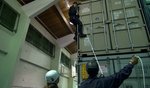
This is a quick introduction to what the Naval Boarding Party Course includes. Some of the tasks that are more popular include container searches and range practice. This 5 week course for up to 20 people per course runs five or six times in a year.
Face to face opportunities to market your business directly to this niche market. MARPAC Expo Feb 6, 2014 Industrial Supplies Tradeshow Sept 18, 2014 Email for more info or to secure your vendor placement. melissa.atkinson@forces.gc.ca Maritime Forces Pacific Expo Education & Wellness TradeshowFebruary 5, 2015 Download the booking form.Email for more info or to secure your vendor placement.melissa.atkinson@forces.gc.ca See video of our 2012 show. Industrial Tradeshow Supplier Trade Show September 18, 2014 Download the booking form. Email for more info or to secure your vendor placement.melissa.atkinson@forces.gc.ca Watch the video about our 2012 show.

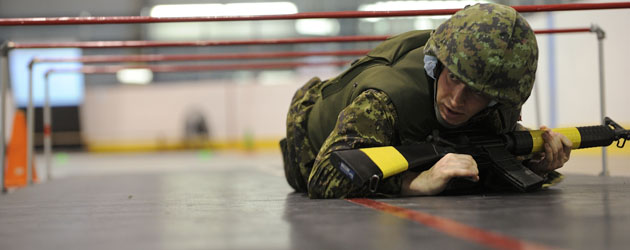
Escape to cover, one of the new 6 new tasks in the CF fitness test.
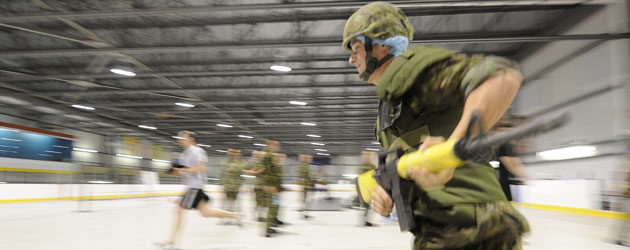
Changes in military fitness standards coming soon. The new tasks are a picket and wire carry, escape to cover, sandbag fortification, causality extraction, a stretcher carry, and a latrine dig.
Team MARPAC, lead by Lieutenant Pamela Harris, arrives to the entrance of Charlemagne field, the finishing mark of the Nijmegen Marches for military teams.
Kaitlyn Gear takes a refreshing ride on a slip-and-slide at the Colwood Pacific Activity Centre (CPAC) Summer Camp.
Group shot of participants in the CPAC summer camp program. Every summer from June to August the CPAC hosts summer camp programs for the children of CF personnel and children in the surrounding regions.
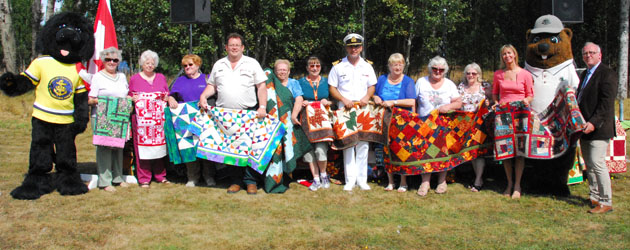
Cdr Bradley Peats of NOTC accepts a donation of 50 hand made quilts from Marilyn Fuller, the Vancouver Island Representative for Quilts of Valour.
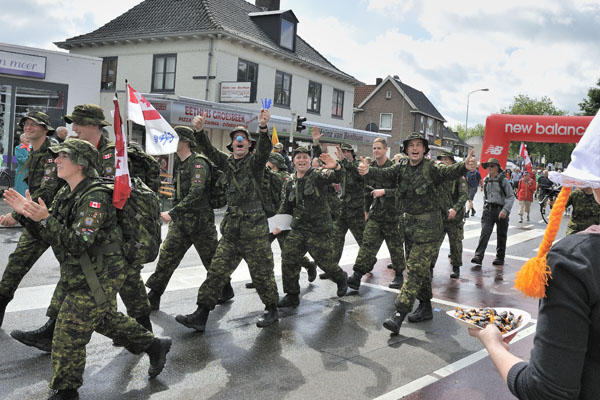
[caption id="attachment_1896" align="alignnone" width="300"] Team MARPAC during the 2012 Nijmegen Marches cheers with the crowd as they march through the streets of Groesbeek, Netherlands, during day three of the four-day marches.[/caption] It was blisters and bliss for the Maritime Forces Pacific (MARPAC) contingent when they marched in one of the world’s largest annual pilgrimages. From July 17 – 20, MARPAC’s team joined more than 45,000 military marchers from around the world for the 96th annual Nijmegen March held in The Netherlands. “It was definitely physically challenging for everyone,” said Lt Pam Harris, MARPAC Nijmegen 2012 team leader. “Even with all the training we did it really took a toll on my body doing four days marching that pace.” Each day marchers strapped on a rucksack loaded with 10 kilograms of sand, laced up their combat boots, formed up, and marched, while singing songs to take their minds off the aches and pains. The route was different each day, but always led back to the small village of Nijmegen where the march began in 1916. “It was initially a military incentive to keep military members in shape and was started by the Dutch, but it is now more geared to honour military members who helped liberate that area of Holland during the war,” said Lt Harris. Each night back at the camp marchers soaked their feet, tended to their blisters and prepared for the next day. “We would march for about eight hours a day,” said Lt Harris. “No one complained and everyone interacted with the kids and civilians we met along the way. The team spirit and morale was great. I was very proud of our team. They were amazing.” Nijmegan veterans CPO2 Chris Koblun and Sgt Kim Arnold went as sweepers, supporting the Canadian and British teams when they...
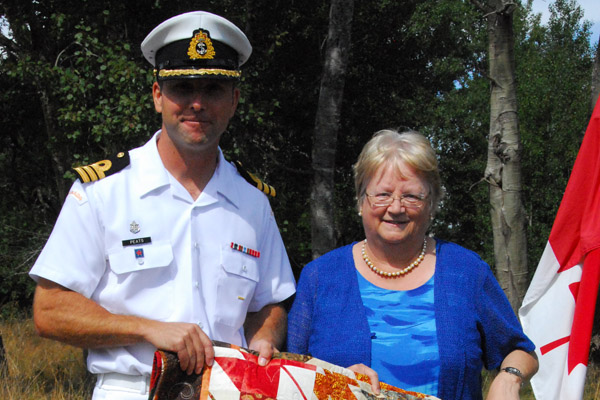
[caption id="attachment_1888" align="alignnone" width="300"] Cdr Bradley Peats of NOTC accepts a donation of 50 hand made quilts from Marilyn Fuller, the Vancouver Island Representative for Quilts of Valour.[/caption] History and valour melded last Saturday at Fort Rodd Hill during Fab Fort, a celebration of Canada’s military. Amidst the howitzers, medieval re-enactors, vintage military vehicles and thousands of visitors, two dozen local quilters delivered 50 hand-made quilts for injured veterans and service members. Accepting the quilts on behalf of the Canadian Forces was Cdr Bradley Peats of the Naval Officer Training Centre. “The CF is like a family. That family isn’t just its active service members,” said Cdr Peats. “It’s our families, civilian organizations, and grassroots organization like Quilts of Valour that do such remarkable things for service men and women.” The women of Quilts of Valour have been stitching these hand-made coverlets since 2006, when the organization was founded by Lezley Zwaal of Edmonton, Alberta. Since then, chapters have sprung up all over Canada and delivered more than 1,500 quilts. The Vancouver Island chapter is headed by Marilyn Fuller, who was on hand to make the Aug. 19 presentation. “We wouldn’t have what we have if the military didn’t do what they do,” said Fuller, who’s had the opportunity to personally deliver quilts to a number of veterans. She says the meetings often ended in tears of happiness. “They just didn’t understand that so many people are appreciative of what they do.” The quilts are created from donated fabric and materials, including two huge boxes of scrap fabric given to Quilts of Valour by Parks Canada. The scrap fabric began as 19th century-style clothing for historic displays and will find new life warming and comforting injured veterans. “Quilts of Valour is very close to what we do at Fort Rodd...
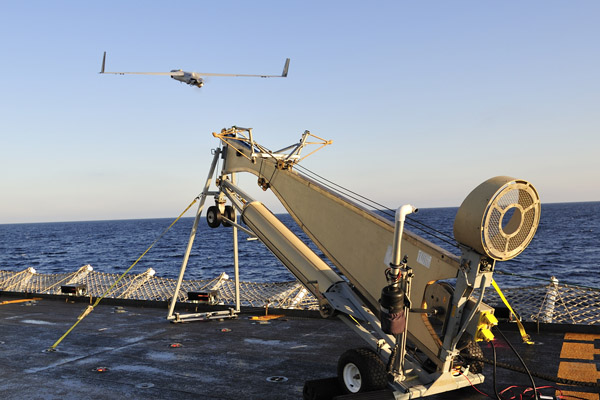
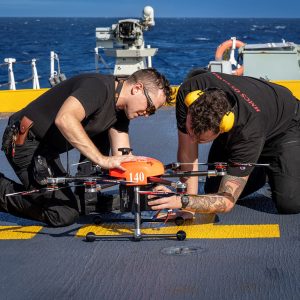
[caption id="attachment_1883" align="alignnone" width="300"] Scan Eagle Unmanned Aerial Vehicle launches from the flight deck of HMCS Charlottetown during Operation Active Endeavour with Standing NATO maritime Group 1 in the Mediterranean Sea.[/caption] In late August, HMCS Charlottetown wrapped up a seven-month deployment and bade farewell to the ScanEagle unmanned aerial vehicle (UAV) detachment that shared the flight deck with Osprey, the Halifax-class frigate’s CH-124 Sea King helicopter. Charlottetown is the first Canadian warship to carry a UAV detachment throughout an expeditionary deployment. UAVs are new to the Canadian Forces — the first was the CU-161 Sperwer, which entered service in Afghanistan in February 2006 — so the skills required to launch, fly, recover and maintain them are still sourced from a variety of military occupations in the Canadian Army, the Royal Canadian Navy and the Royal Canadian Air Force. Because the ScanEagle is still under trial, the Charlottetown UAV detachment included civilian technicians as well as soldiers, sailors and airmen. Integrating and synchronizing all their capabilities required a high degree of collaboration among the UAV detachment’s members. This teamwork produced an exceptional synergy. “Coming from the army, there were certain things that my team and I had to adjust to when operating in a marine environment,” said Sgt Michael Jenkins of the Royal Canadian Artillery, the senior UAV operator and controller in HMCS Charlottetown. “The constant movement of the ship made launch and recovery different from on land, and there was naval lingo and acronyms that we had to learn to be able to operate smoothly with the sailors in the Ops Room.” The Operations Room is the nerve centre of this collaborative effort. Typically, the ship detects a vessel on radar or receives an intelligence report about a “vessel of interest.” Traditionally, a ship reacts in one of two ways:...
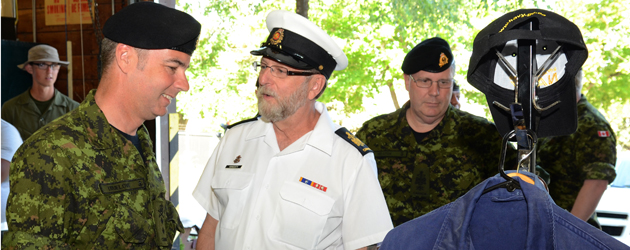
During a visit to Vernon Army Cadet Camp, Admiral Bill Truelove shared stories with Chief Ronneseth.
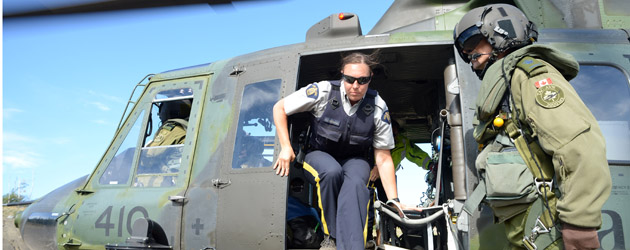
RCMP Constables Amanda McGillvray disembarks a CH-146 Griffon helicopter during a CF assistance to law enforcement scenario on Operation NANOOK.
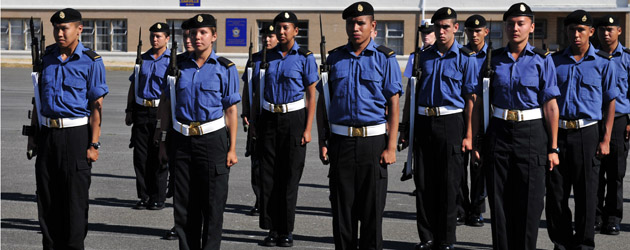
Fifty five graduates from the Raven Aboriginal Youth Program celebrated the end of their five week program with a graduation and awards ceremony last Thursday.
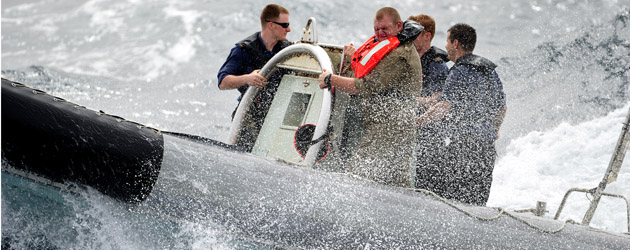
HMCS Charlottetown conducting rigid hull inflatable boat training in the Arabian Sea.
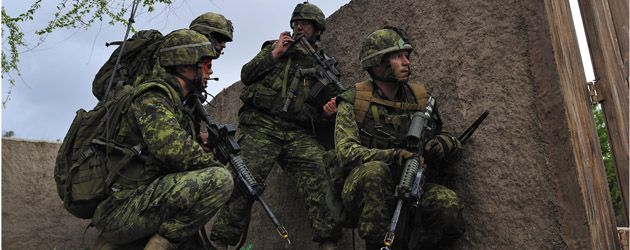
Last month during RIMPAC, Canadian soldiers conducted Military Operations in Urban Terrain at the Marine Corps Training Area Bellows, Waimanalo, Hawaii.
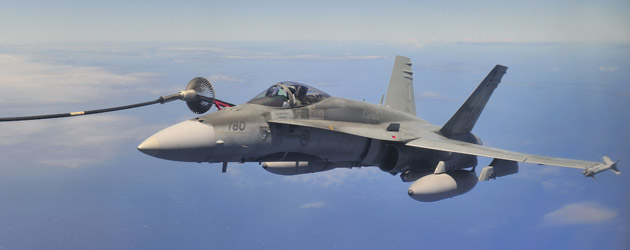
A CF-18 hornet from 425 Tactical Fighter Squadron in Bagotville, Quebec, gets refueled by a Hercules (Out of frame).
DND is stepping up their authority to keep civilians out of the rifle range in Nanaimo. Despite well placed “No Trespassing” signage, people continue to use the DND property as recreation land. The threat of fines and court appearances has garnered the attention of local media and vocal opposition from mountain biking, running and hiking groups who trespass on the federal property along the Westwood Ridge. With safety in mind, DND has placed additional barbed wire fences to keep the public out, and increased patrols. The range has been used by the military, RCMP, the B.C. Rifle Association and other private groups since the 1920s. Two weeks ago, Base Public Affairs officer, Lt(N) Michael McWhinnie met with CTV Vancouver Island at the range to inform the public on this safety issue. “We are asking for a change in the behaviour of specific groups that knowingly trespass upon DND property,” said Lt(N) McWhinnie. “The Nanaimo Range is a restricted access military training area where live ammunition is used, which is clearly identified on regional maps. Any unauthorized access to the property constitutes an illegal act, and it is unsafe.” The military needs to conduct necessary training in an environment that is free of public risk, due to the inherent danger of weapons firing. This eight-kilometre range is licensed to fire up to 7.62 millimetre ammunition from weapons ranging from pistols to machine guns. “Bullets have the ability to travel anywhere in this danger template,” explains MWO Bill Murphy, range control officer for CFB Esquimalt. Situated near the Morrell Nature Sanctuary and Westwood Lake, the Nanaimo Range is a geographically remote area and has been used by civilians as a short cut to the Mount Benson lookout station. “About five or six years ago there was a (one-time only) non-military use agreement signed to have the Nanaimo Mountain Bike Club traverse through our property for a race,” said MWO Murphy. “Since then, it’s become popular to hikers and bikers and they have established...
LS Stephon Mullet of HMCS Vancouver might feel a little chafed when he competes in the Aug. 26 Iron Man Canada Triathlon. The layers of green nylon that form the tutu he’ll be wearing may rub in the wrong places. Triathlons are hard work on the best of days, and a tutu isn’t exactly standard endurance gear. But if LS Mullet meets his fundraising goal of $10,000, he’s pledged to compete in the running and cycling portions of the triathlon in a tutu. It isn’t the first time he’s donned the costume. He wore it for this year’s Times Colonist 10K, as well as the Victoria Triathlon. Why? In support of his charity “Fighting Cancer Below the Belt”, a organization that raises funds and brings awareness to the various forms of gynaecological cancer that affect approximately 80, 000 women world-wide. “My friend’s mom is battling cancer, so I figured I’d wear the tutu for her,” he says. “I’ve lost a friend to cancer in the past, so I want to do what I can to help.” LS Mullet isn’t a stranger to endurance sports. He competed in Iron Man Canada last year, sans tutu. To prepare for this year’s event, LS Mullet trains six days a week for between three and five hours a day. “I’m swimming three days a week, running four days a week and I cycle every day.I’m ready,” he says. Fitness is a priority for LS Mullet, who believes all Canadian Forces members should stay fit. “If I don’t stay fit, I can’t do the job. It helps me keep in fighting shape, and I can help support a great cause.” To donate to LS Mullet’s cause, a donation page can be found on www.uncoverthecure.com Shawn O’Hara, Staff Writer
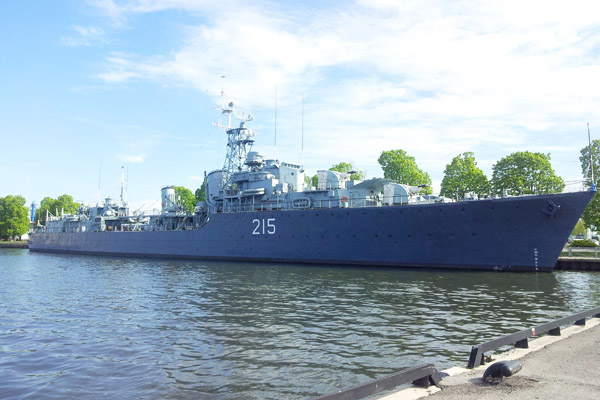
[caption id="attachment_1828" align="alignnone" width="300"] HMCS Haida, a Tribal-class destroyer built in England, was commissioned into the RCN in 1943, serving in many theatres of operation through the Second World War. After a post-war refit, Haida continued in service through Korean War and Cold War until she was decommissioned in 1963.[/caption] For those who know little or nothing about the Royal Canadian Navy (RCN), stumbling across a vintage warship on the waterfront in Hamilton, Ont., can be a revelation. HMCS Haida, a Tribal-class destroyer built in England, was commissioned into the RCN in 1943, serving in many theatres of operation through the Second World War. After a post-war refit, Haida continued in service through Korean War and Cold War until she was decommissioned in 1963. That year a group of Toronto businessmen formed an organization called Haida Inc and saved her from the scrap yard. The ship was later acquired by the Province of Ontario and moved to Ontario Place in Toronto in 1971. She was designated as a national historic site in 1984 and ownership was transferred to Parks Canada in 2002. Haida was moved to Pier 9 in Hamilton on August 30, 2003, the 60th anniversary of her commissioning. “In our experience, many people who visit the ship have minimal to zero knowledge of Haida or the navy,” says Darryl Jones, past president of Friends of Haida, an organization partnered with Parks Canada and devoted to the preservation of the ship. “When our volunteers inform the public about the history of the ship, her accomplishments and the living conditions aboard, they come away amazed and carry an appreciation of the ship and our navy that they never realized previously.” Haida is now an “irreplaceable historic artifact” managed and presented as a living, operating ship, according to Mr. Jones. Visitors...

LS Joel Lalonde and MCpl Chris Kotrba demonstrate a combat crawl for Aboriginal youth taking part in the summer Raven program. This training involved overcoming barriers in the confidence course held at Albert Head.