Greening the MSE Fleet
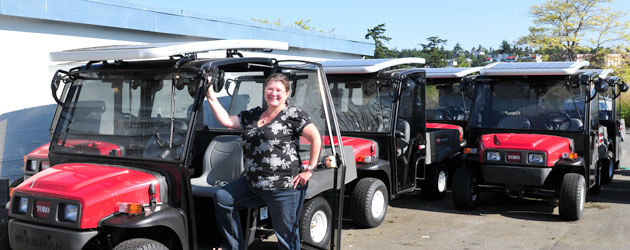
Ivy Burkhart, assistant vehicle fleet manager shows the new Toro fleet.
Ivy Burkhart, assistant vehicle fleet manager shows the new Toro fleet.
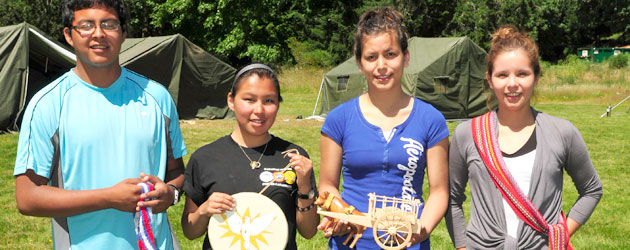
Nick Gardiner, Laryssa Sutherland, Joelle Corrigal and Sherilyn Sewoee show drums, Metis sashes and Red River carts they made at the culture camp.
The Honourable Peter MacKay, Minister of National Defence, addresses local business leaders, members of the Defence team and invited media at the Wardroom during an announcement of significant infrastructure investment last Thursday.
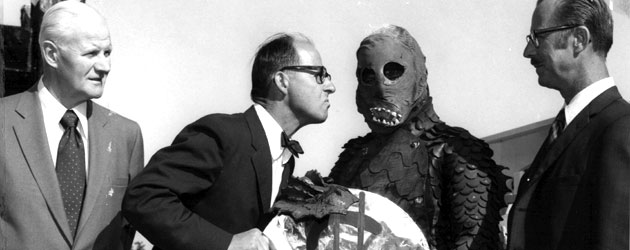
DND has been recognized with a United Way Honorary Life Membership in celebration of the United Way of Greater Victoria's 75th anniversary in 2012.

On July 19 during his visit to CFB Esquimalt, The Honourable Peter MacKay, Minister of National Defence unveiled the War of 1812 Commemorative pins which will be worn by all Canadian Forces members for the next three years to mark the sacrifice and commitment of those who fought in this war from 1812-1815. He pinned the first one on Sailor of the Quarter LS Mathieu Blais during a ceremony held on the Wardroom patio. The 1812 Commemorative banner was also unveiled which will be flown by Canadian Forces units, formations and establishments across the country. “This tribute will be a daily reminder of a key chapter in Canada’s history, and of the courageous efforts made by the regular and militia soldiers, provincial marine and the aboriginal allies who helped define who we are today,” said Minister MacKay. “Alongside our Government’s commitment to support the men and women of the Canadian Forces for the challenges of the future, we have made important progress in preserving and promoting the history of those who served in years past.” The War of 1812 was instrumental in the development of Canada’s military and tells the story of the Canada we know today – an independent and free country in a constitutional monarchy with its own parliamentary system. French and English speaking Canadians fought and defended Canada alongside First Nations members during the War of 1812. “Canadian Forces members across the world can proudly wear their pin and fly their banners as, much like their ancestors, they proudly serve Canada by defending its values, interests and sovereignty.” As part of its initiative to commemorate the 200th anniversary of the War of 1812, DND created the CF War of 1812 Commemorative Banner which will be presented to CF units, formations, and establishments whose heritage embraces service in the defence of Canada during 1812-1815. The banner will be carried, flown, or displayed throughout the 2012-2015 commemorative period and paraded thereafter by units, formations, and establishments on anniversaries of...
The majority of boxes have been unpacked in the Admiral’s house and RAdm Bill Truelove is settling into his corner office at D100 with a view of Esquimalt Harbour and the task at hand – commanding Maritime Forces Pacific (MARPAC) and Joint Task Force Pacific (JTFP). “It’s incredible to be back here,” he said staring out his window. “It’s been five years since we were on this coast and we are thrilled to be back among these folks and this exciting team.” Late last year from his post in Kabul, Afghanistan, RAdm Truelove learned his next post would be in Victoria where he would assume the responsibilities of Commander of MARPAC and JTFP. “Getting this appointment was a thrill for me. It is both exciting and daunting to a degree as it is a significant posting. When I received official word I was incredibly honoured and humbled by the announcement,” he said. RAdm Truelove began his career at Royal Roads military college and he met his wife Brenda on a blind date in Victoria. “We got married in front of the castle at Royal Roads and Victoria is home for Brenda, so she is very happy to be back,” he said. “We both have a lot of history here and it’s nice to see familiar faces.” RAdm Truelove grew up a “navy brat”. His father served 36 years and attained the rank of Chief Petty Officer. “My dad has always taught me the critical role that our chiefs, petty officers and leaders play in the navy. I grew up seeing him go away a lot and we moved every few years and now I have done that with my children. My daughter reminded me once that it was 12 schools in 13 years and it struck home with me that we can never thank our families enough for what they do to support us,” he said. RAdm Truelove’s daughter Ashley is a nanny in Switzerland, while his son Anthony is...
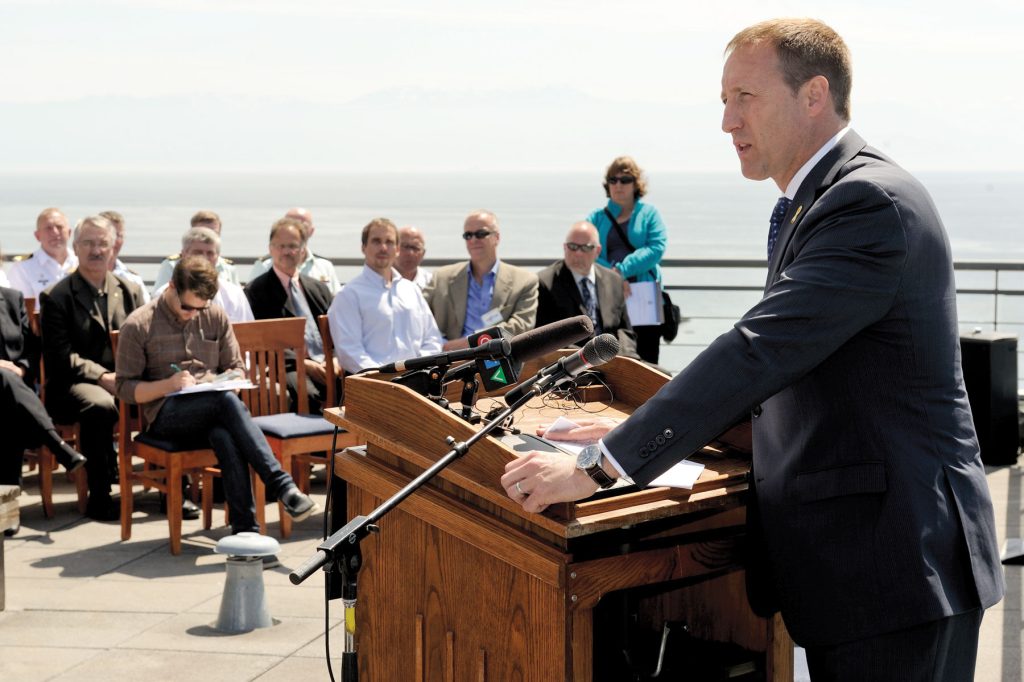
Four contract awards for Department of National Defence and Canadian Forces related infrastructure projects which total $10.9 million were announced last Thursday by Minister MacKay during his visit to CFB Esquimalt. The four projects including replacing obsolete electrical equipment at Canadian Forces Ammunition Depot Rocky Point, outfitting the Canadian Towed Array Sonar System block, repairs to A-Jetty, and the replacement of transformers at the Canadian Forces Fleet School. “The Government of Canada is determined to provide modern, efficient and effective infrastructure for our Canadian Forces personnel. I am pleased to show continued progress on these goals, which is in line with our commitment to give our men and women in uniform the support they need so they are fully prepared when the call to action comes,” said Minister MacKay. “These projects also provide the economy with important local jobs,” he said. Rocky Point’s Ammunition Depot upgrade to their electrical and communications systems includes the installation of a new electrical grid including feeder lines, distribution panels and transformers to magazines and improved lighting. G&E Contracting was awarded the $5.8 million contract. The Canadian Towed Array Sonar System block is a 1,600 square meter extension to Fleet Maintenance Facility’s Dockyard 250 which houses the new combat/electronic work centre. This work centre will include the units responsible for the maintenance and repair efforts conducted on all electronic ship systems, such as communications, radar and electronic warfare sensor equipment. The contract involves outfitting this facility with the electrical, mechanical architectural and industrial shop support features required for the functions that will be found within the building. Ledcor Construction has been awarded the $2.9 million contract. A-jetty’s structural repair involves the replacement deteriorated piles, bracing, timbers and other key structural members. RUSKIN Construction won this $1.1 million contract for services. Canadian Forces Fleet School’s transformer...
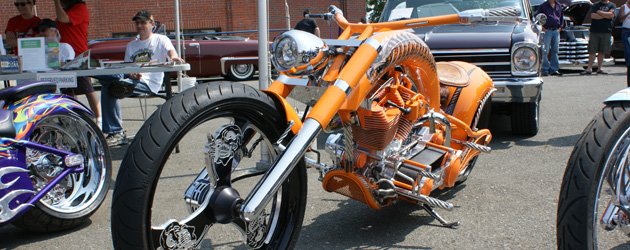
A 2009 U-Built Chopper Pro Street owned by Gary Miller, Winner Best in Show.
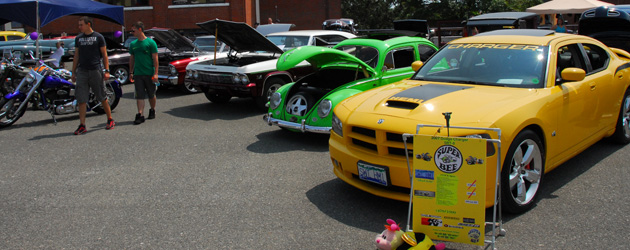
Several of the many cars and bikes at the Chrome n’ Wheels show during Formation Fun Day.
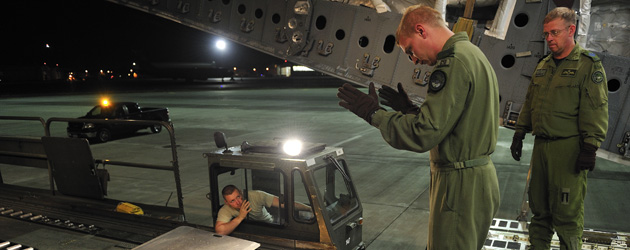
MCpl Chase (left) and Sgt Kingston (right), Traffic Technicians from 429 Transport Squadron of the Royal Canadian Air Force in Trenton, Ontario, help unload a Canadian Forces CC-177 Globemaster III aircraft at Joint Base Pearl Harbor-Hickam in Honolulu.
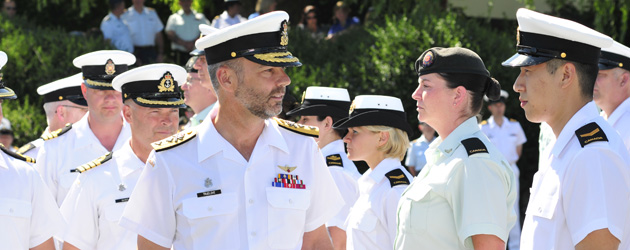
RAdm Bill Truelove reviewing the parade at the Base Commander Change of Command Ceremony held in Naden's Parade Square.
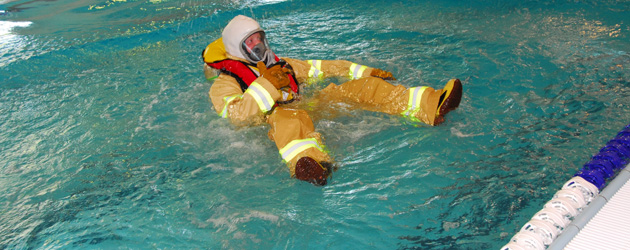
CFB Esquimalt Fire Fighter Adam Glazier takes the plunge in full gear to test buoyancy, while Jon MacDonald swims alongside.
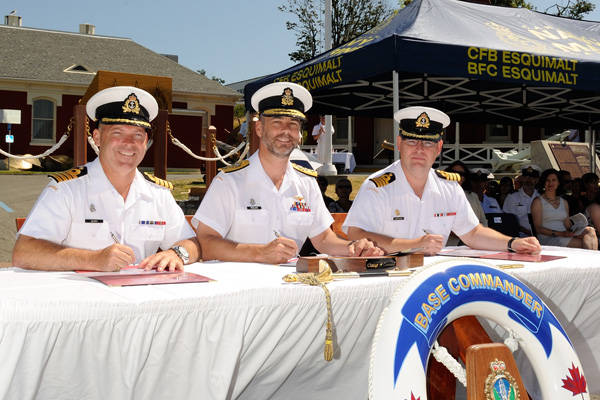
[caption id="attachment_1510" align="alignnone" width="300"] Base Commander Capt(N) Bob Auchterlonie assumed command from Capt(N) Craig Baines during the Change of Command Ceremony held in Naden’s Parade Square. The change of command cermony was administered by RAdm Bill Truelove (centre).[/caption] Friends, family, and colleagues gathered last Thursday to bid farewell to a great leader – Capt(N) Craig Baines - and warmly welcome the new head of CFB Esquimalt. In a Change of Command ceremony held on Museum Square, Capt(N) Baines passed on the responsibilities of Base Commander to Capt(N) Bob Auchterlonie. The ceremony was attended by dignitaries from surrounding municipalities and communities, including Esquimalt mayor Barbara Desjardins and representatives of the Esquimalt and Salish First Nations, Chief Andy Thomas, Elder Mary Anne Thomas and Elder Elmer George. “While I am happy to pass on the reasonability of command, this day is also bittersweet,” said Capt(N) Baines. “Having command is a bit like playing poker, with the mission as the pot. Luckily for me I was dealt a hand of aces. One of those aces is every man and woman, civilian and military, of CFB Esquimalt. For all that you’ve done in these past few years, I would like to personally thank you.” Capt(N) Baines expressed in excitement and respect for Capt(N) Auchterlonie, and the comfort with which he turns over command. “He is a man of tremendous experience and professionalism, and I’m excited to see where we’re going, and how we’re going to get there,” he said before the turnover. “I can’t tell you what a pleasure it is to turn command over to such a great friend and know that all the great work the men and women of CFB Esquimalt do will continue under his watch.” Following his speech, he joined Capt(N) Auchterlonie and RAdm Truelove in signing over command....
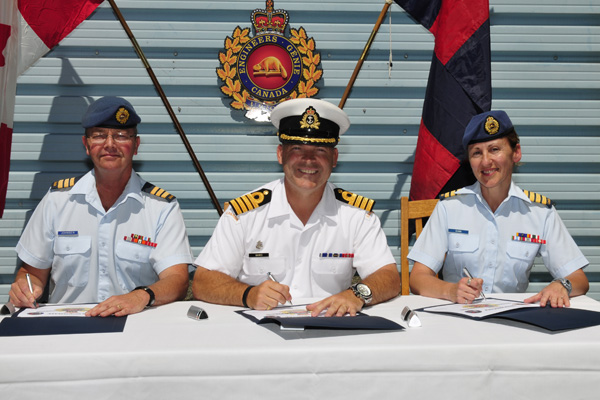
[caption id="attachment_1504" align="alignnone" width="300"] Command of the Base Construction Engineering (BCE) branch changed hands July 11 when outgoing Commanding Officer Col Darlene Quinn said goodbye to colleagues and friends and LCol Matthew Johnsen took the reign.[/caption] After two years as Commanding Officer of Base Construction Engineering (BCE), Col Darlene Quinn stepped down July 11. Taking her place is LCol Matt Johnsen. Below, Col Quinn reflects on her service at CE. Describe the highlights of your time in this position. I became Commanding Officer (CO) of the Base Construction Engineering Branch in July 2010. On the technical side, some of the highlights have been growing our infrastructure maintenance program to a level that will make tangible inroads in improving the condition of our infrastructure, as well as seeing the progress of the major capital program. On the leadership side, without doubt my highlight has been watching the individual people in the Branch stretch themselves to new levels, take on new skills and responsibilities and fulfill every major challenge thrown their way. On a professional level, I have enjoyed broadening my infrastructure knowledge to include navy-specific infrastructure such as the jetties, the dry dock, and the oily waste water treatment plant. In the past, I have served as BCEO for both the army and for the air force. This has been my first experience with the navy and I have thoroughly enjoyed it. What will you miss most about this post? I will miss the pace of activity. Engineering at this level is exhilarating because it is such a fast paced and rapidly changing environment. What is next for you? I will be moving to Ottawa to take up the post of Director General Military Engineering (DGME). DGME is Associate Deputy Minister Infrastructure and Environment’s (ADM(IE) lead for capital construction,...
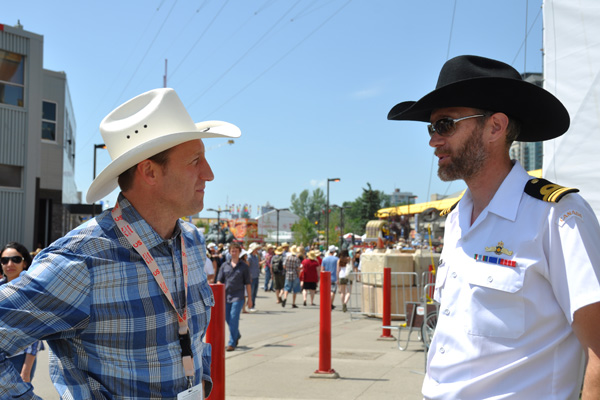
[caption id="attachment_1500" align="alignnone" width="300"] The Honourable Peter Mackay, Minister of National Defence (left), discusses the submarine HMCS Chicoutimi with its Commanding Officer, LCdr Andy Cooper.[/caption] Sailors from HMCS Calgary and the submarine HMCS Chicoutimi saddled up this past weekend to join soldiers and airmen and women participating in the 100th Anniversary of the Calgary Stampede. Calgary sailors make an appearance every year to coincide with their annual Namesake City visit. The “Greatest Outdoor Show on Earth” kicked off at 9 a.m. Friday, July 6 with the Stampede parade, where fireworks and a Snowbirds flypast signalled the beginning. More than 300,000 people lined the streets to watch the parade, which included the colourful heraldry of marching bands from all over the world, over one hundred floats, horse teams, cultural displays, and military contingents. All three elements were represented in the parade. The Naden Band of Maritime Forces Pacific led sailors from Calgary, Chicoutimi, and Tecumseh, Calgary’s naval reserve unit. They were followed by members of 1 Canadian Mechanized Brigade Group (1 CMBG), a Leopard tank, and Coyote with crew. The Royal Canadian Air Force (RCAF) banner flew before a marching contingent of airmen and women and the Cold Lake Band. Each contingent took up the length of an entire city block, drawing applause and standing ovations as they passed. At the Stampede Grounds, static displays from all three elements are set up to encourage interest and curiosity from the general public. Children play in the Rigid-hulled inflatable boat (RHIB) supplied by HMCS Tecumseh, clamour into a G-Wagon, sit in an F-18 cockpit and straddle the saddle on Chicoutimi’s MK 48 torpedo. The displays are very popular and well attended, but none so much as the Explosive Ordnance Disposal robot, which draws many smiles and nervous laughter when it unexpectedly follows people...
Ammo tech among first four civilians deployed to Afghanistan.
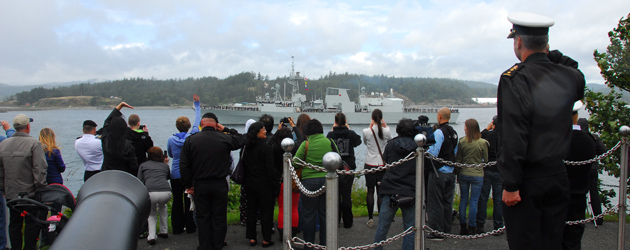
Assembled well wishers wave as the HMCS Regina leaves CFB Esquimalt for the Arabian Gulf on Operation Artemis.
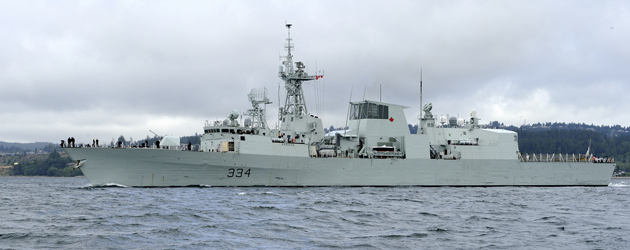
HMCS Regina sails past Fisgard lighthouse on her way out of Esquimalt harbour to join Operation Artemis.
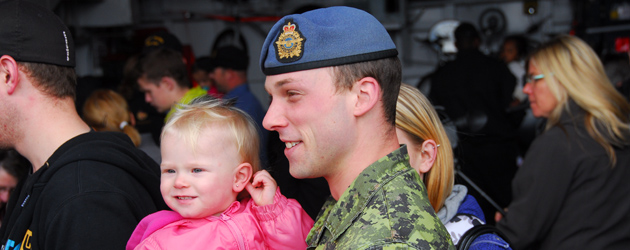
Cpl Guillaume Tremblay holds daughter Sophie during deployment ceremony of HMCS Regina.
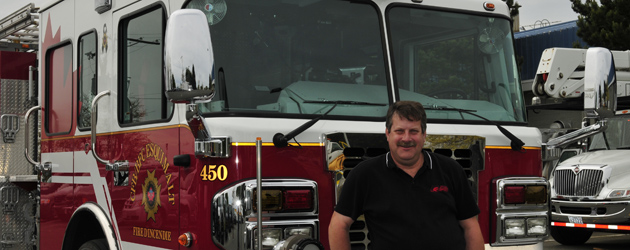
Tom Mehmel of manufacturer Fort Garry Firetrucks showed TEME mechanics several features of the new firetruck which they will maintain in future.
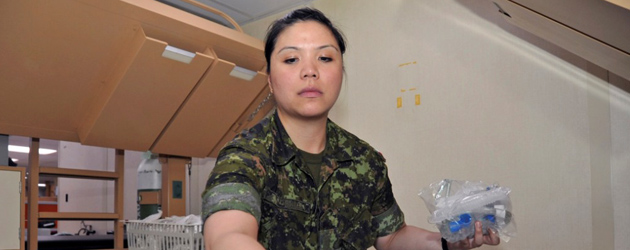
Canadian Nursing Officer, Lt. Iphigenia Morales inventories and puts together medical supply trays in ward one aboard the Hospital Ship USNS Mercy (T-AH 19) which is currently underway for Pacific Partnership 2012.
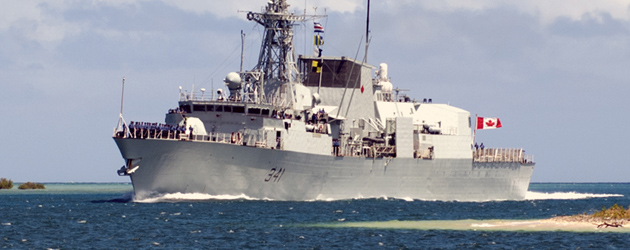
HMCS Ottawa pulls into Joint Base Pearl Harbor-Hickam to support the Rim of the Pacific (RIMPAC) 2012 exercise.
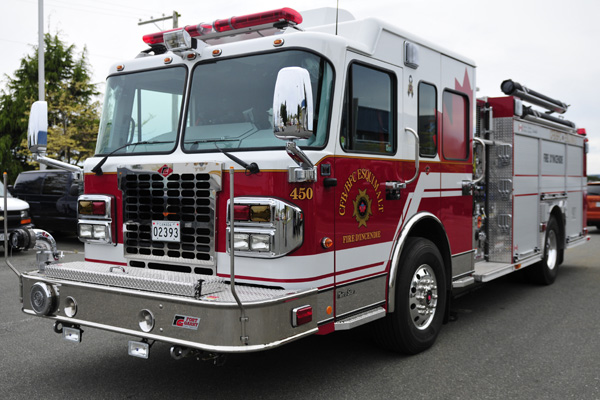
[caption id="attachment_1398" align="alignnone" width="300"] CFB Esquimalt received the first of three new firetrucks designed and engineered to last the next 25 years.[/caption] CFB Esquimalt Fire Department recently received a custom-built 2012 Class A Pump Fire Truck, one of three trucks being purchased over the next two years to replace CFB Esquimalt’s aging fleet of fire fighting apparatus. The truck was designed specifically for CFB Esquimalt firefighters, with the unique situations found in fighting fires on a naval base in mind. The truck sports a smaller water tank and a side-mounted control panel that makes the vehicle lighter and shorter over all, and allows it to travel across jetties safely. Increased hose storage and a pumping volume of 2,000 gallons a minute enhances the mobility and power needed to respond to fires aboard ships and the large buildings found within CFB Esquimalt. Safety was also a focus in the design. The cab of the truck can withstand a roll over, protecting the controls as well as fire fighters. There are also systems in place that ensure seatbelts are fastened and doors closed. Tom Mehmel of Fort Garry Fire Trucks says the design specifications are intended to make the jobs of CFB Esquimalt’s Fire Department easier and most importantly safer. “The most important thing is protecting the fire fighters,” says Mehmel. “This isn’t a backyard creation. The safety systems that are in place are there to protect the lives of the fire fighters and the general public on the way to a call.” Rick LeQuesne, Deputy Fire Chief at the CFB Esquimalt Fire Department, reviewed the truck design, and offered suggestions based on what CFB Esquimalt’s fire fighters need to do their jobs. He says one of the main strengths of the vehicle is its versatility and adaptability. “The vehicle has a...
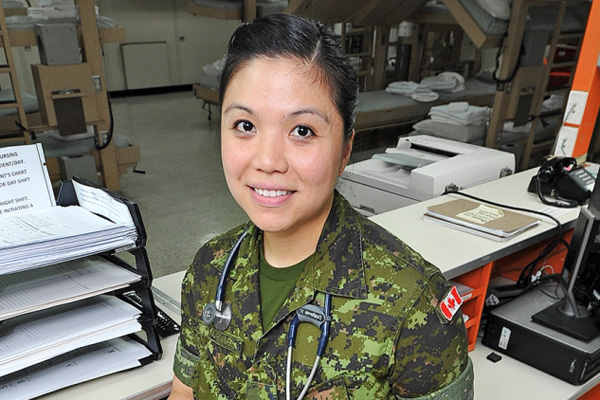
[caption id="attachment_1392" align="alignnone" width="300"] Lt Iphigenia Morales on board the American naval hospital ship USNS Mercy working as a staff nurse.[/caption] Canadian Forces nurse Lt Iphigenia Morales is getting the training opportunity of a lifetime. She’s currently on board the Amercian naval hospital ship USNS Mercy working as a staff nurse. The noncombatant ship is part of the UN Pacific Partnership 12, a humanitarian and civic assistance mission to Indonesia, the Philippines, Vietnam and Cambodia. It left on a four-and-a-half month humanitarian journey May 3 from San Diego, and is crewed by 70 civil service mariners working for Military Sealift Command, who operate and navigate the ship while navy planners and medical personnel plan and execute the mission. Japanese landing ship tank Oosumi, carrying a complete medical team, helicopters and representatives from Japanese volunteer organizations, will join Mercy during its stops in the Philippines and Vietnam. The 28-year-old nurse from Canadian Forces Health Services (Pacific) has joined the Medical Surgery Ward, helping prepare and assist pre- and post-surgery patients. Upon hearing of the ship’s arrival, people begin lining up on the jetty in the wee hours of the morning waiting to be ferried to the ship. The civil service mariners operate two 33-foot utility boats to transport patients and mission personnel between ship’s anchorage and shore. Mercy is too large to pull pier side at any of the mission stops. The operation of these small boats, which carry more than twice as many passengers as Mercy’s two embarked helicopters, greatly increase the number of people who will benefit from the mission. “Lines of more than 500 patients begin forming at three in the morning, waiting for the clinic to open, and yet the people remain positive and excited to interact with us,” says Lt Morales. In Sangihe, Indonesia, she...
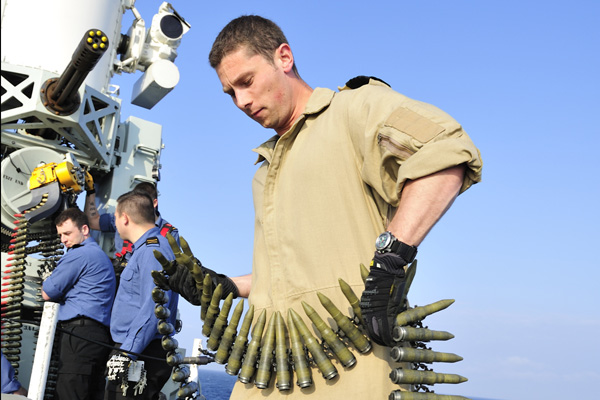
[caption id="attachment_1386" align="alignnone" width="300"] LS Sean Hemeon, with MS Ryan Russell (inset), both weapons technicians, help unload the Close In Weapons System on board HMCS Charlottetown.[/caption] Weapons for fighting, radar for detection and navigation, the horizon-reference system that helps the Sea King helicopter land safely — all these systems are under the care of the Combat Systems Engineering (CSE) Department, which handles much of the crucial maintenance involved in keeping a ship combat-ready at sea. One piece of kit aboard HMCS Charlottetown is all too familiar to the members of the CSE Department: the Mk 15 PHALANX 20-mm Close-In Weapon System, abbreviated “CIWS”, known to most as the Sea Whiz. The ship’s last ditch defence mechanism, the CIWS is a radar-guided six-barrelled Gatling-type gun system that fires bursts or continuously at either 3,000 or 4,500 rounds per minute. It is located on top of the ship’s hangar to engage fast-moving close-range targets such as diving missiles and aircraft, and attacking gun-boats. If this powerful machine is to be ready to defend the ship, the CSE Department members must perform “the upload.” “Whether it’s five degrees in the middle of the Atlantic Ocean in winter, or a scorching 35 degrees in the Mediterranean, this thing’s got to be ready to go at all times,” says LS Matthew Martin, a weapons technician serving in Charlottetown. The call comes across the CSE “meet-me” net: “All on-watch CSE personnel muster CSE flats, CIWS upload.” It takes two minutes for the required personnel to get into their jackets and leather-palmed gloves. Within 10 minutes, everyone is already beginning the task, with MS Kelly Spicer and LS Timothy Tyler preparing the ammunition in a compartment immediately under the gun mount, and the rest of the group at work on the hangar roof. To ensure its complex...


The crew of NOTC Venture rides the Big Bike for charity.