[wpml_language_selector_widget]
[searchwp_form id="1"]
Denne / Den

Wartime family treasures recovered in local antique shop

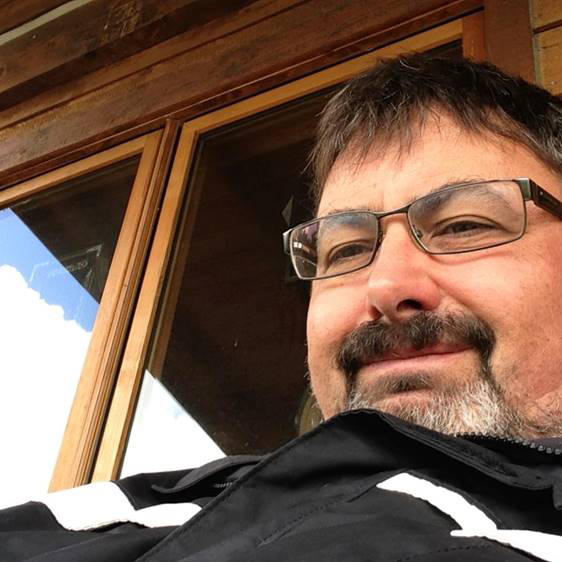
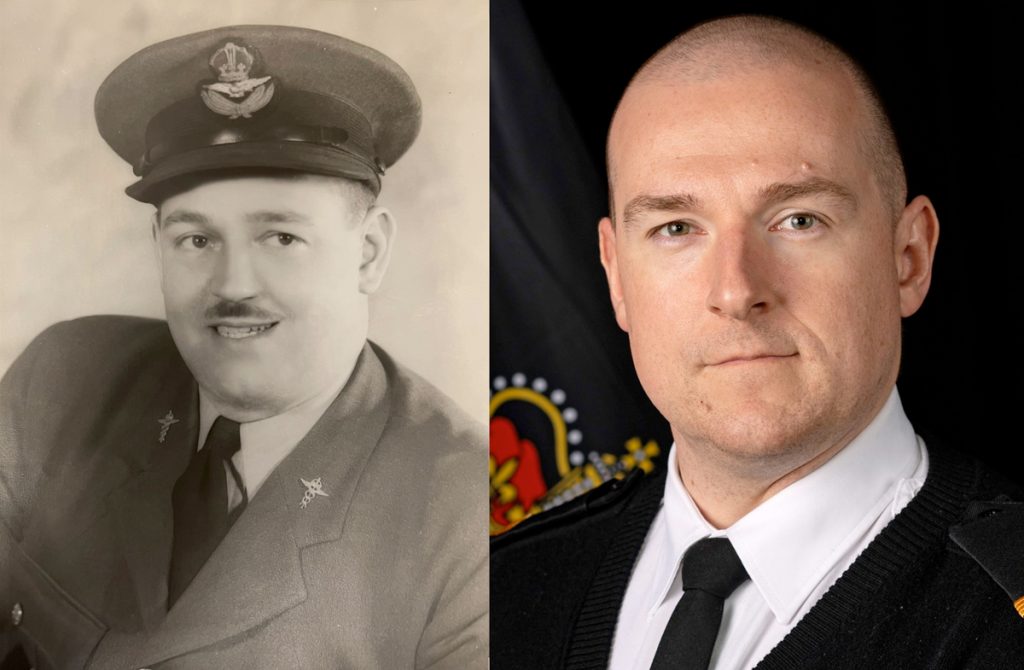
[caption id="attachment_30410" align="aligncenter" width="595"] Left: Captain Ambrose (Jack) Denne, Royal Canadian Air Force.Right: Lieutenant (Navy) Donald Den. Photos supplied.[/caption] Lt(N) Donald Den, HMCS Malahat Public Affairs Officer — I have been fascinated with my family history for as long as I can remember, and I have always treasured pieces of my family’s past that have been passed down to me. However, a recent coincidental family discovery made me believe in the unbelievable. As a recent Navy-oriented hobby, I have amassed a decent coin collection, including several HMCS coins from different eras. For this reason, I found myself at the local military antique shop downtown Victoria, Command Post Militaria and Antique. As I am, by no means, the only Royal Canadian Navy (RCN) member in Victoria who collects them, it was unsurprising that they did not have any coins available. I passed dozens of boxes holding thousands of old and new military photos on the way out. “We get photos all the time, from legions, people drop off boxes, it’s quite extensive,” noted the shop owner, Brent Fletcher. While glancing at one of the boxes, I noticed a black-and-white photo of a man in a Royal Canadian Air Force (RCAF) uniform and had to do a double take. This could be my grandfather, I thought. It didn’t seem possible, but I began noticing tell-tale signs. The lapel pins marking his status as a Medical Officer, the ‘RCAF’ crest on his peak cap that I kept in my office, and the familiarity in the face of the man I had called ‘Papa’ in my youth. When I joined the RCN in April 2016 as a Public Affairs Officer with Victoria’s Naval Reserve Division, HMCS Malahat, I was not the first member of my family to serve in the Canadian Armed Forces (CAF). My...
Canada: A ‘Capable, Adaptive, Partner’ at RIMPAC 2022

[caption id="attachment_30406" align="aligncenter" width="595"] U.S. Navy Vice Admiral Michael Boyle, Commander Combined Task Force, presents Commander Kevin Whiteside, Commander HMCS Vancouver, with a plaque commemorating the ship’s participation in Rim of the Pacific (RIMPAC) 2022 at Pearl Harbor, July 6. Photo: Sergeant Ghislain Cotton, Canadian Armed Forces.[/caption] Lt(N) Michelle Scott, HMCS Vancouver Public Affairs Officer, Capt Jennie Derenzis, Combined Information Bureau, RIMPAC 2022 — Part 3 - The Royal Canadian Navy optimizes opportunities to work with allies This year’s multi-nation Exercise Rim of the Pacific (RIMPAC) is hosted by the Commander of the United States Pacific Fleet and led by the Commander of U.S. 3rd Fleet biennially. RIMPAC 2022, taking place June 29 to August 4, has returned to a full-scale implementation of the world’s largest maritime exercise. It follows a scaled-back RIMPAC 2020 during the early months of the Covid-19 pandemic. The initial shore-phase of the multi-nation Exercise Rim of the Pacific (RIMPAC) provided Canadian Armed Forces (CAF) participants with unique opportunities to exchange ideas and carry out operations-focused training with international partners and allies. As RIMPAC 2022 transitioned into the sea phase, Commander (Cdr) Kevin Whiteside, HMCS Vancouver’s Commanding Officer, said the first two weeks of shore phase helped the ships crews to prepare for operations at sea. “Once we get out to sea, there’s no exact starting point for us – we can continue with the basics we discussed alongside or we can expand on those facets to challenge ourselves and our interoperability,” he said. “Vancouver is a great team of 250 awesome Canadians, and RIMPAC brings us all together as an even bigger team.” During RIMPAC’s alongside phase, HMCS Vancouver spent time exchanging ideas and practices with partner nations the crew will be working with during Operations Projection and Neon following RIMPAC. The ship hosted members from Australian supply ship HMAS Supply to discuss the Vancouver’s experience and familiarity with the Close-In Weapons System, a relatively new system for the Australian ship. Divers from the French frigate FS Prairial...

Major (Retired) Mark Campbell

Wounded veteran gets rare opportunity to jump with the SkyHawks

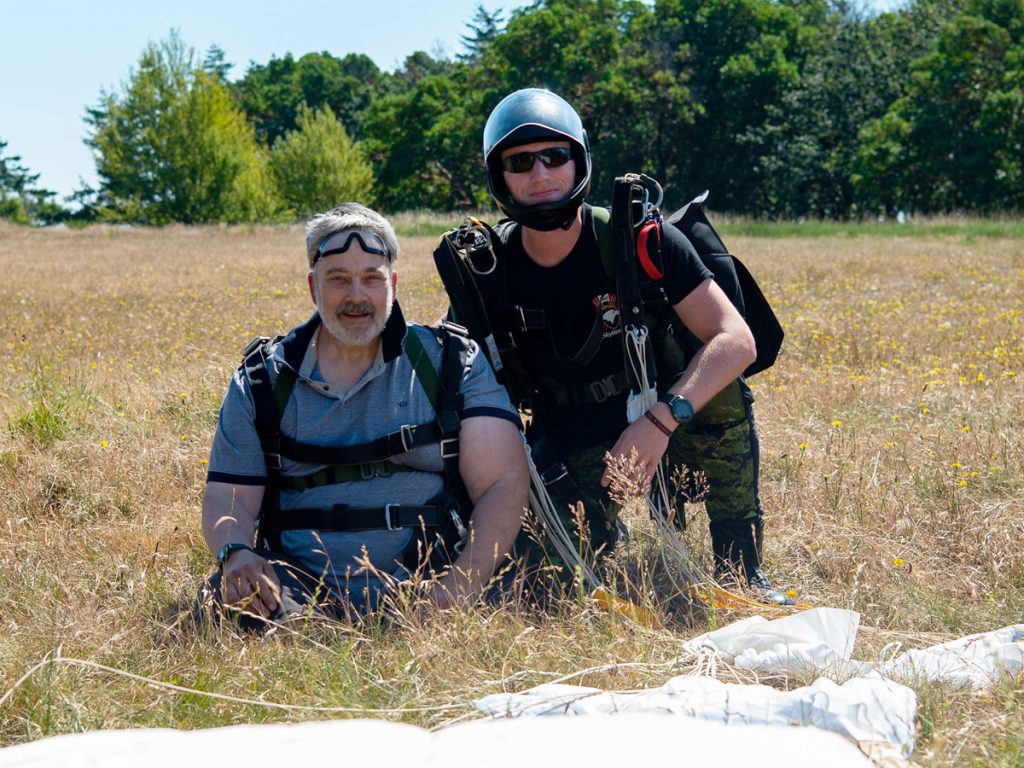
[caption id="attachment_30404" align="aligncenter" width="595"] Wounded veteran Major (Retired) Mark Campbell (left) was given the rare opportunity of performing a tandem jump with the SkyHawks at CFB Esquimalt on July 26. Photo: Corporal Jessey Gagné.[/caption] A/SLt Charlie Galley, CFB Esquimalt Public Affairs — A Canadian Army war veteran who lost both legs in combat in Afghanistan took a rare opportunity to jump with the Canadian Armed Forces (CAF) Parachute Team, the SkyHawks, at CFB Esquimalt. On July 26, the SkyHawks took Major (Retired) (Maj (Ret’d)) Mark Campbell 12,500 feet above Albert Head before strapping him to one of the team members for a ‘tandem jump’, a jump where two people connected by a harness jump together. “Intense, fantastic, incredible – just the jump itself was exciting, but also the opportunity to see the SkyHawks behind the scenes, in action, in rehearsal, and being welcomed into the team, made me feel very warm and welcomed. They are a truly spectacular jumping team,” Maj (Ret’d) Campbell said. The rare opportunity came when his former SkyHawks friends contacted the team and set it up without him knowing. It was also a chance for Maj (Ret’d) Campbell to leave Edmonton and reconnect with family and friends in his hometown of Nanaimo. Maj (Ret’d) Campbell was harnessed with Tandem Master Sergeant Antoine Collette. Once the parachute was deployed, he was given control of the steering until they came in for a landing. He has previous experience jumping as a paratrooper. However, this was his first time experiencing free fall. Maj (Ret’d) Campbell was an Infantry Officer and part of the Operational Mentoring and Liaison Team in Afghanistan on Operation Athena in 2008 when he lost both his legs in an explosion. He retired from the CAF in 2017 after 34 years of service, the first six of...

HMCS Vancouver supports TAPA during RIMPAC 2022

[caption id="attachment_30397" align="aligncenter" width="595"] HMCS Vancouver (FFH 331) fires the muti ammunition soft-kill system (MASS) from the bridge during Rim pf the Pacific (RIMPAC) 2022 Photos: Sergeant Ghislain Cotton.[/caption]   Lt(N) Michelle Scott, HMCS Vancouver Public Affairs Officer — HMCS Vancouver became the first Royal Canadian Navy (RCN) vessel to tactically launch a surface off-board passive decoy (SOPD) as part of electronic warfare (EW) tactics training during the Rim of the Pacific (RIMPAC) 2022 exercise. “Electronic Warfare is, by far, the most effective defensive method against Anti-Ship Missiles,” said Lieutenant (Navy) Adelaide Hawco, a member of the trail staff on board HMCS Vancouver from Canadian Forces Maritime Warfare Centre (CFMWC). Over eight days, subject-matter experts from the CFMWC led the ship’s crew through various tactics trials as part of the Technical Cooperation Program Anti-Ship Threat Project Arrangement (TAPA). TAPA is a Five Eyes cooperative series of EW exercises that test current and future non-kinetic defensive tactics and procedures. RCN ships test theoretical tactics in real time using real missiles and ammunition to prove their viability. TAPA trials have been a regular RIMPAC component since 2006. The SOPD is one component of the Halifax-class Anti-Ship Missile (ASM) Defence suite. It is a spherical inflatable decoy launched from the ship to attract Radio Frequency Missiles. “TAPA22 with HMCS Vancouver was extremely successful and a huge step forward for RCN Electronic Warfare tactics and procedures,” Lt(N) Hawco said. “There were some significant milestones during the week: an effective hard-kill/soft-kill combination solution was identified and confirmed for specific current threat Anti-Ship Missiles, and sophisticated jamming techniques were refined.” EW differs from traditional kinetic warfare and hard-kill tactics as it does not employ munitions to destroy a target. Soft-kill tactics are used to disable an enemy without destructive force; this is done through distraction and seduction to divert an attack. Launching the SOPD was just one of the many sophisticated EW tactics trialled while Vancouver supported TAPA22. Over the week, the ship tested and fine-tuned its...

CFB Esquimalt museum highlights hand-made flag for National Peacekeepers’ Day

[caption id="attachment_30400" align="aligncenter" width="595"] For National Peacekeepers’ Day, CFB Esquimalt Naval and Military Museum is highlighting a unique handmade Korean War-era United Nations flag used by HMCS Sioux. Photo by Rodney Venis, CFB Esquimalt Public Affairs.[/caption] CFB Esquimalt Public Affairs — In celebration of National Peacekeepers’ Day on August 9, the CFB Esquimalt Naval and Military Museum is highlighting a unique handmade Korean War-era United Nations (UN) flag. The flag was donated by George Mannix, who handmade it in 1950 while serving as the Chief Yeoman of Signals in HMCS Sioux. “The United Nations was so new there was no readily useable flag for a ship participating on such a mission,” said Clare Sharpe, the exhibit designer at the museum. “The improvised flag also speaks to the tremendous resilience and adaptability of the Royal Canadian Navy and its personnel in times of great uncertainty.” The flag’s look is quite different from the modern, mass-produced flag. The white map and olive branches still show the black marker cut lines, and the flag is made of blue bunting and material cut from a regulation-issue kit bag to form the outline of the UN logo. At the time of the flag’s construction, HMCS Sioux left its Esquimalt home base to support UN efforts to defend the Republic of Korea (ROK) from invasion by North Korea. The flag was first flown in the summer of 1950 while entering Kwajalein, an atoll in the Marshall Islands that served as a US Navy communications, supply, and refuelling station. Sioux’s first task was to escort ships between Sasebo, Japan, and Pusan in South Korea, witnessing a veritable ‘last stand’ of ROK and UN troops against the North Koreans. Sioux then transferred to Korea’s west coast to support the Inchon landings that relieved Pusan and allowed UN forces to push north. HMCS Sioux departed in January of 1951, served two more tours around the Korean Peninsula, and was the last Canadian vessel to depart those waters after hostilities...

New trade specialty badge arrives at Naval Fleet School (Pacific)

[caption id="attachment_30393" align="aligncenter" width="595"] Recipents of the new SAC Pin.[/caption] Peter Mallett, Staff Writer — Sailors qualified to control aircraft onboard Navy ships will now be awarded the Royal Canadian Navy’s new Shipborne Air Controller (SAC) specialty skill badge. A helicopter on a web surrounded with crimson laurels – that’s the visual cue of not only the demanding qualifications and added workload, but also the NATO standard, said the Coxswain of Naval Fleet School Pacific (NFS(P)). “The SAC qualification is one of the few qualifications across the CAF that is a NATO qualification,” CPO2 Warren Beatie Canadian Fleet Pacific Chief Air Controller said. “This badge indicates to other nations and navies that we have the same qualifications and training as them.” Seven Shipborne Air Controllers (SACs) were awarded with this new badge in a July 28 ceremony in Dockyard at CFB Esquimalt, including CPO1 Ferguson, who completed his first SAC training in 1995. Other eligible sailors will continue to receive these badges during ceremonies in the weeks to come including those currently deployed on operations.  Newly qualified Shipborne Air Controllers will be awarded their pin on successful completion of the grueling course at Naval Fleet School Pacific or Atlantic. SACs are responsible for the safe and effective tactical control of helicopters and fixed wing maritime aircraft. The job title is granted to combat operators from naval trades, including Naval Combat Information Officer (NCIOP), Naval Electronics Sensor Operator (NESOP), and Sonar Operator. To qualify for the SAC specialty badge, a sailor must be currently serving as a regular or reserve force Royal Canadian Navy (RCN) member, and must have successfully completed the NFS NATO-grade Delta Course. The course combines classroom instruction and time in the simulator, culminating with live control of aircraft at sea. The badges were presented by Commadore (Cmdre) David Mazur, Commander Canadian Fleet Pacific at Duntze Head. Cmdre Mazur said the new specialty badge recognizes a sailor’s diligence in completing training to become a SAC. “They stepped forward and...

New military book series underway

[caption id="attachment_30356" align="aligncenter" width="595"] Petty Officer Second Class (Retired) Tina Renaud and Lieutenant-Commander (Retired) David R. Lewis[/caption] Peter Mallett, Staff Writer — A pair of military veterans has launched a publishing company to share the stories of the military community, first responders, and their families. “Battle Rattle Press wants to celebrate the service, the sacrifice and the diversity of the Canadian Armed Forces (CAF) and first responder community, and how each author incorporates a connection into a larger mission,” said Lieutenant-Commander (Retired) David R. Lewis, co-owner of Battle Rattle Press. A former Canadian Armed Forces (CAF) Public Affairs Officer, Lewis formed Battle Rattle Press in May together with Petty Officer Second Class (Retired) Tina Renaud, his long-time friend-turned-business partner. The pair is currently working on a series of 12 books containing short stories of people who have experiences within the CAF, first responder, and military family communities. “This series intends to spotlight the uniqueness of each individual within the commonality of a desire for service,” Lewis said. Lewis expects most of the contributors have found ways to integrate their identities into their careers. This, he says, is something Battle Rattle Press wants to celebrate. Passion through experience Lewis served 13 years as a Public Affairs Officer at CFB Esquimalt, the Tomb of the Unknown Soldier, and Ceremonial Guard on Parliament Hill, and was also deployed to Afghanistan. Tina Renaud served eight years in the regular force as a Finance Clerk, and then 14 years as a full-time Class B Reservist, working in human resources, before her medical release. “Tina and I have both worked with every race, faith, gender, and sexual orientation, and people of all walks of life in the military during our service,” Lewis said. “We really want to convey the message of what an honour it is to work with, share, and learn from a diverse spectrum of people.” A tool for healing Renaud thinks writing will help some of Battle Rattle’s contributors in healing and recovery. “Telling...

Mark Nelson

Fill Yer Boots with the colourful language of the Royal Canadian Navy

Mark Nelson — I was introduced to Jackspeak when I began my 26-year naval career in HMCS Chippawa on July 1, 1980. I quickly learned my training base was a Stone Frigate, floors were decks, the ceiling was a deckhead, walls were bulkheads, and the upper ridge of my boot soles were catwalks. Unfortunately, my catwalks were dirty, so I had to turn to at birds, which was a quaint way to say I had to stay late and polish brass. From that day forward, aside from having perfectly clean catwalks, I became engrossed with the language of the Navy. To a newcomer, the jargon can be a gateway to a fascinating world. However, it can also be confusing. For example, there is more than one way to refer to a lazy person, as they can be a skiver, skate, or be described as swinging the lead. The same goes for sleeping arrangements, as a sailor might sleep in a pit, cart, or rack, but only occasionally in a bunk. Nuances must be learned. The term mess carries no less than three meanings in a Canadian warship. Whistling is frowned upon unless you’re a cook, then you are allowed, just as long as you don’t whistle up a wind. Every ship is represented by a uniquely designed badge and never referred to as a ‘crest’ unless you are willing to face admonishment. Similarly, if you want to live on the edge, just say you served ‘on a ship’. You will be quickly told that sailors always serve in a ship. If you made this mistake more than once, your keelhauling would likely take place in half a dog watch. The ship’s engineers are far more commonly referred to as stokers, even though no ship’s engineer has stoked a coal-fired furnace...

Esquimalt Naval and Military Museum receives new items

[caption id="attachment_30341" align="aligncenter" width="595"] Tatiana Robinson, Curator of the CFB Esquimalt Naval and Military Museum, displays a solid brass wheel from HMCS Columbia. Howard Robins, President of the Artificial Reef Society of British Columbia, displays a sculptor’s maquette of a Second World War-era merchant mariner that was to be placed on the flight deck of HMCS Cape Breton. They were some of the many items presented by the ARSBC to the museum in a presentation made on July 25 in Esquimalt.[/caption] Peter Mallett, Lookout staff writer — A collection of naval artifacts from five former Royal Canadian Navy (RCN) warships made its way to the CFB Esquimalt Naval and Military Museum. The artifacts were delivered and presented to museum staff on July 25 by Howard Robins, President of the Artificial Reef Society of British Columbia (ARSBC). “Everything I brought with me to the museum was either one or two of a kind on a ship we were working,” Robins said. “I looked for things that were memorable or personalized, or can in some way relate to the ship as a souvenir.” The items range from a brass statue to firing triggers, alarm bells, and ammunition magazine clips. Robins’ non-profit foundation was formed over 30 years ago and has sunk six former HMCS vessels to form nine of its artificial reefs in the coastal waters of B.C. The ARSBC was displaying the items at trade shows or using them for educational purposes for students and other dive community members but deemed they were no longer needed. New partnership CFB Esquimalt Naval and Military Museum curator Tatiana Robinson said she was excited to receive the delivery. She also confirmed it was the first time the museum and the ARSBC had worked together. “We are delighted to receive these materials and to be working with the Artificial Reef Society of British Columbia in our first partnership,” Robinson said. “We are so happy to receive these naval artifacts and become their custodians for future generations...

Steam-powered crane barge receives a sunny work-up

[caption id="attachment_30327" align="aligncenter" width="595"] Workforce members work on the kingpost turntable at the 250 steam-powered Crane Barge at CZ Jetty outside FMF Cape Breton.[/caption] Ashley Evans, Public Affairs Officer, Fleet Maintenance Facility Cape Breton and Cape Scott — You may notice C2 jetty at CFB Esquimalt is slightly different nowadays. The spot usually occupied by a Halifax-class frigate, Kingston-class coastal defence vessel, or Orca-class maritime patrol craft (training), is now taken by the 250 Steam-Powered Crane Barge with its boom detached and workforce members bustling methodically around the turntable’s base. The barge goes in for a refit every five years to Point Hope. The crane certification, required every four years, is done simultaneously. Since this certification is needed for the barge to be operational, Fleet Maintenance Facility Cape Breton (FMFCB) is currently working on the crane. This is the first work to be done in 17 years on the 250 Steam-Powered Crane Barge at Esquimalt’s Dockyard. Pulling this work together has been at the hands of the crane riggers, shipwrights, boilermakers, mechanical fitters, rigging loft, and electricians, with ten workforce members working on the Crane Barge at any given time. The shipwrights began by building the scaffolding for the project – one set for the boom and one for the kingpost. The boom was then laid down, stripped of all wires, and all hardware was removed. Then, using the crane, the team rigged off the kingpost turntable and laid it on the deck. Four extra wood-decked barges were brought in to support the work on the boom. Non-destructive testing and inspections for damage and wear will be the next part of this evolution for crane re-certification. This substantial project has included the removal of the crane boom and the turntable for routine maintenance and completing any needed repairs required for re-certification. Involved in this evolution has been the inspection of all moving parts – anything that moves or could receive wear – and removing and inspecting bearings, shives, ware-pads, and spools....

Junior Canadian Rangers conduct summer training on Vancouver Island

[caption id="attachment_30319" align="aligncenter" width="595"] Over 70 Junior Canadian Rangers from across Western Canada took part in this year’s Enhanced Training Sessions (ETS) hosted by 4th Canadian Ranger Patrol Group’s a Junior Canadian Ranger Company on Vancouver Island, held July 5 to 20. The participants took part in variety of outdoor adventure activities where they worked on their leadership, communication, and teamwork skills. Photo submitted.[/caption] Captain Natasha Tersigni, 4th Canadian Ranger Patrol Group — Seventy-eight Junior Canadian Rangers (JCRs) from Western Canada travelled to Vancouver Island to participate in this year’s Enhanced Training Sessions (ETS), held July 5–20 in Victoria and Strathcona Provincial Park. “While it is an opportunity for youth to come to beautiful Vancouver Island and take part in outdoor adventure activities they normally may not have had the chance to do, it is really about building those soft skills that we are focused on,” said Captain (Capt) Brandon McAuley, JCR Coy Training and Development Officer for 4 CRPG. The JCR program is a community-based program offered in remote, isolated, and coastal communities to youth aged 12-18. It is supported by local Canadian Rangers, JCR leaders, and program volunteers. The youth program promotes traditional cultures and lifestyles in the communities and teaches life, traditional, and Canadian Ranger skills. Capt McAuley said JCRs are tested regarding interpersonal and life skills. “They must work in small groups, take part in activities outside of their comfort zone and really push their physical and mental limits,” he said. ETS had been on hiatus for the past two years due to the COVID-19 pandemic. Usually, it is held annually in the summer as an opportunity for the JCRs to come together, meet new people, participate in new activities, and learn valuable life skills. This year, most ETS was held at the Strathcona Park Lodge near Campbell River. The JCRs participated in physical activities such as rock climbing, canoeing, kayaking, hiking, swimming, and camping. At the same time, the youth worked on their communication, teamwork, leadership,...

Le GPIM accueille le commandant du nouveau NCSM Venture

Anna Muselius Conseiller en communication, GPIM — Le vendredi 15 juillet, lors d’une cérémonie de signature tenue au Work Point de la BFC Esquimalt, le capitaine de frégate Mike Stefanson a été officiellement nommé le tout premier commandant du NCSM VENTURE (le centre d'entraînement du commandement de la marine de la Marine royale canadienne). La cérémonie a été présidée par le commodore David Mazur, qui occupe par intérim le poste de Chef d’état-major adjoint de la Marine – Personnel et Instruction. Le NCSM VENTURE est le nom de la nouvelle unité qui exercera ses activités dans le bâtiment Collier sous le commandement du Groupe du personnel et de l’instruction de la Marine (GPIM). Le nom du NCSM Venture et son lien avec le domaine de l’instruction en leadership, qui remonte à l’année 1910, est conservés dans le nom de l’unité. Le NCSM VENTURE sera responsable de concevoir et de donner les cours d’éducation en matière de leadership de la MRC, depuis les cours de base jusqu’à l’entraînement-cadre pour les officiers et les militaires du rang (MR) dans le contexte de l’évolution continue du GPIM et du remaniement de sa structure. Le Centre d’entraînement des officiers de la marine (CEOM), qui est davantage connu et qui est une ancienne division de l’École navale (Pacifique) [EN (P)], sera transféré au HMCS VENTURE sans perturbation majeure. Cette division se concentrera principalement sur la gestion et l’instruction des officiers de guerre navale (OGN), depuis l’instruction qui suit la Qualification militaire de base des officiers jusqu’au niveau de qualification élémentaire des OGN. Elle se concentrera également sur l’instruction et la gestion des officiers de navigation de la flotte (ONF). « Comme tous les officiers de guerre navale, j’ai commencé ma carrière navale à VENTURE », a déclaré le capitaine de frégate Stefanson après la cérémonie. « Aujourd’hui je reviens à NCSM VENTURE en qualité de commandant du nouveau centre d'entraînement de commandement...

NPTG welcomes commander of new HMCS Venture

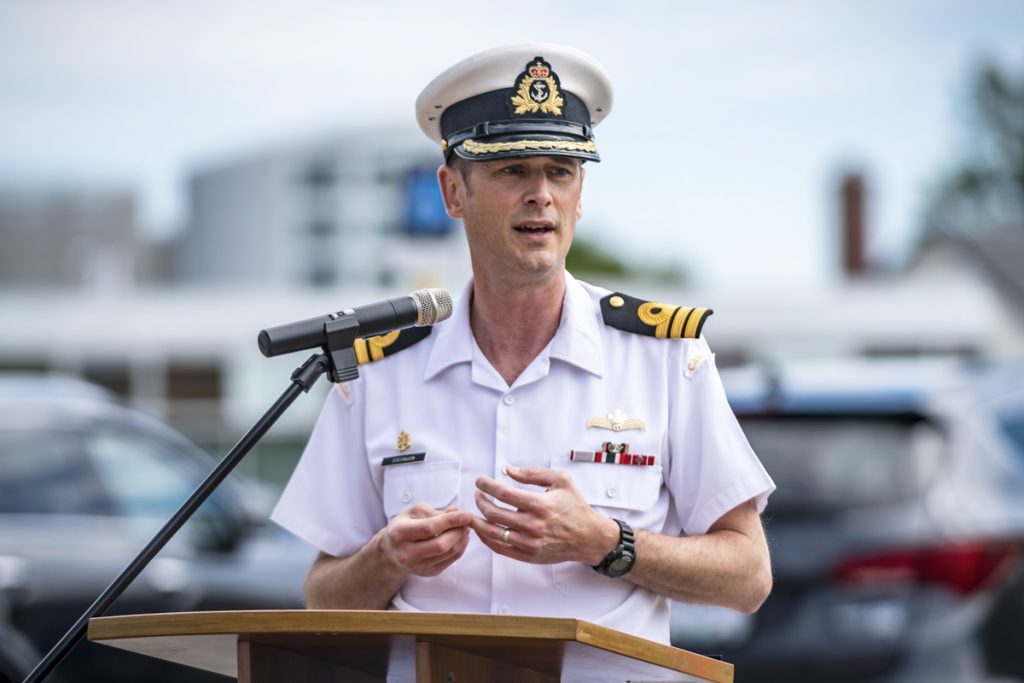
Anna Muselius Communications Advisor, NPTG — On July 15, in a signing ceremony held at Work Point at CFB Esquimalt, Commander (Cdr) Mike Stefanson was officially appointed as the inaugural Commanding Officer of HMCS Venture, the Royal Canadian Navy’s (RCN) naval leadership training centre. The ceremony was presided over by Commodore David Mazur, Acting Assistant Chief of Naval Staff, Personnel and Training. HMCS Venture is the name of the new unit that will operate out of the Collier Building under the command of Naval Personnel and Training Group (NPTG). HMCS Venture, and its link to leadership training, dates back to 1910. The unit will develop and deliver RCN leadership education, from foundational courses to capstone training for both officers and non-commissioned members (NCMs) as part of NPTG’s continued evolution and realignment of the Group’s structure. The more familiar Naval Officer Training Centre (NOTC), a former division within Naval Fleet School (Pacific), will move to HMCS Venture with minimal disruption. This division will focus primarily on Naval Warfare Officer (NWO) management and training, from post-Basic Military Officer Qualification (BMOQ) to the NWO Primary Qualification level, as well as Fleet Navigating Officer (FNO) training and management. “Like all Naval Warfare Officers, I started my naval career at Venture,” Cdr Stefanson said after the ceremony. “Now, returning to HMCS Venture, this time as the Commanding Officer of the new naval leadership training centre, what has inspired me most, is seeing the instructors and staff are still deeply committed and passionate about developing future RCN leaders. Similarly, the students are still keen to learn, to serve, and to lead.” Two other divisions will fall under the command of HMCS Venture. These include a Naval Technical Officer (NTO) Division which will focus on training from post-BMOQ up to Head of Department, and a Leadership Division which has responsibility for both RCN officer and NCM leadership training initiatives. Discussion is ongoing concerning a possible fourth division, which would be responsible for Patrol Craft Training (PCT). “With the...

Commander Coates

HMCS Regina welcomes new Commanding Officer

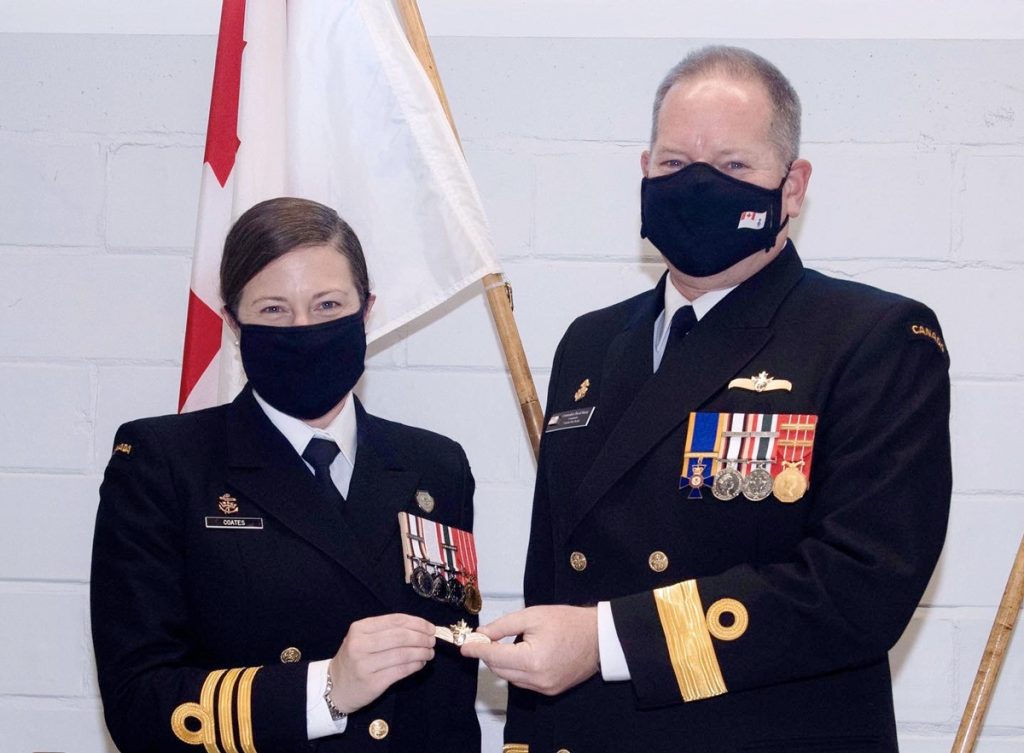
[caption id="attachment_30276" align="aligncenter" width="595"] On June 30, HMCS Regina held a Change of Command ceremony, which saw Commander Meghan Coates take over as Commanding Officer of HMCS Regina. This ceremony was presided over by Commodore Dave Mazur, Commander Canadian Fleet Pacific.[/caption] Peter Mallett, Staff Writer — HMCS Regina has a new captain. Commander (Cdr) Meghan Coates was appointed Commanding Officer (CO), HMCS Regina, in a Change of Command ceremony at the ship’s office in Dockyard at CFB Esquimalt on June 30. “I am very excited and grateful to be appointed CO of HMCS Regina,” Cdr Coates said. As a woman, Cdr Coates’ appointment follows the milestone appointment of Cdr Annick Fortin as Commanding Officer of HMCS Winnipeg in March 2022, which is Cdr Fortin’s second appointment as a female CO of a Halifax-class ship on the West Coast, following taking command of HMCS Regina (June 2021 – Mar. 2022). The importance and gravity of being the second female CO of a frigate was not lost on Cdr Coates. “I am extremely grateful to all the NWO (Naval Warfare Officer) females who have been COs on any of our ships, as they have helped break the glass ceiling and demonstrate women are more than capable of these demanding and responsible positions,” she said. Cdr Coates said she is not one to keep track of women in essential posts in the RCN because there are numerous posts, but is glad to see the list of female commanders growing. “It is extremely important for other women to have role models to look up to and it is wonderful to see my peers and friends in command roles, whether they are in positions at sea or ashore,” she said. A sailor’s life Originally from St. Stephen, N.B., Cdr Coates’ path to commanding Regina was 23...

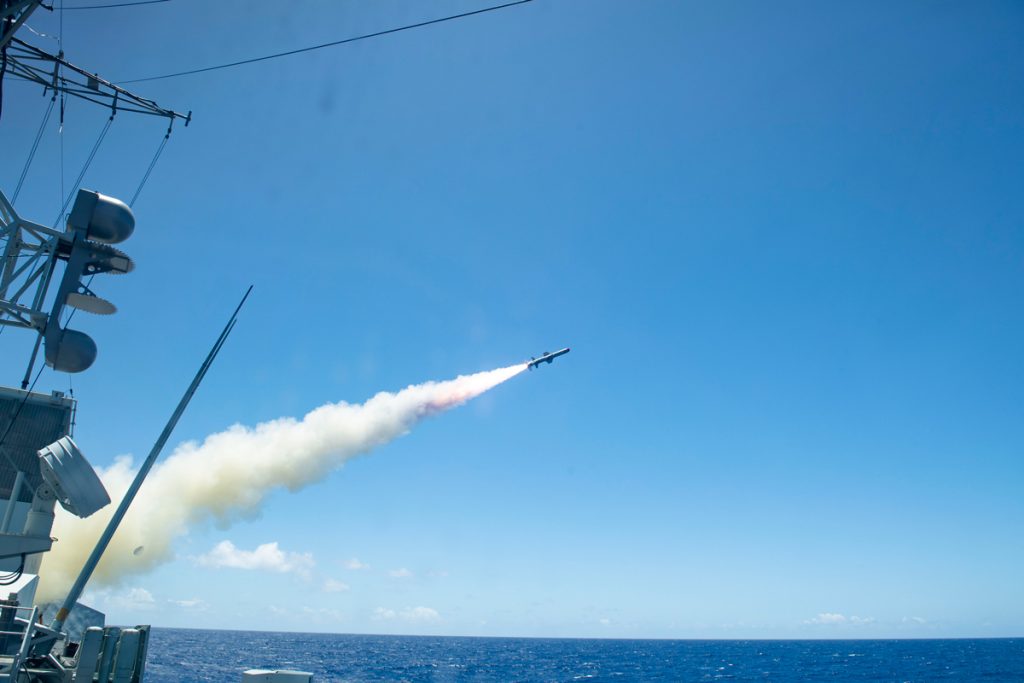
HMCS Winnipeg fires harpoon missiles during RIMPAC 2022

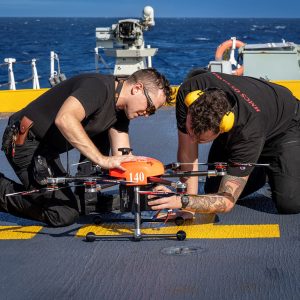
Captain Christine MacNeil, Public Affairs Officer, HMCS Winnipeg — HMCS Winnipeg successfully deployed drones and an embarked helicopter for the first time while utilizing its anti-ship missile system during a sinking exercise (SINKEX) off the coast of Hawaii on July 12. The SINKEX was part of Exercise Rim of the Pacific (RIMPAC) 2022. The ship fired its RGM-84 Harpoon Surface-to-Surface Missile (SSM) in coordination with MQ-9 Reaper drones and its embarked CH-148 Cyclone helicopter. “Winnipeg spent countless hours training to safely and efficiently execute this firing event,” said Lieutenant (Navy) Bucky Branscombe, Winnipeg’s Operations Officer. “It was a great opportunity to showcase what the team has accomplished during our pre-deployment readiness training this year, and to prove we are fully prepared to represent the Government of Canada anywhere in the world.” During a SINKEX, an environmentally clean and decommissioned hulk, in this case, the ex-USS Rodney M. Davis, is purposefully sunk, improving the partner’s readiness and creating an opportunity for cooperation with other nations. The RGM-84 Harpoon SSM is an all-weather, over-the-horizon, anti-ship missile utilized by many NATO member states. This system allows the ship’s Commanding Officer to address threats from over the horizon while maintaining a safe distance. With two Harpoon missiles striking the target, this SINKEX proved the capability of both the ship and the crew, said Petty Officer First Class (PO1) Kevin Granger, Above Water Warfare Director onboard HMCS Winnipeg. “As the Surface Action Group Commander for this evolution, Winnipeg and the Canadian Armed Forces proved we could integrate effectively with partner nations to conduct coordinated strike engagements, scoring a mission kill on the target,” PO1 Granger said. Twenty-six nations, 38 ships, four submarines, more than 170 aircraft, and 25,000 personnel are participating in RIMPAC from June 29-Aug. 4 in and around the Hawaiian Islands and Southern California....

The Close-in Weapon System

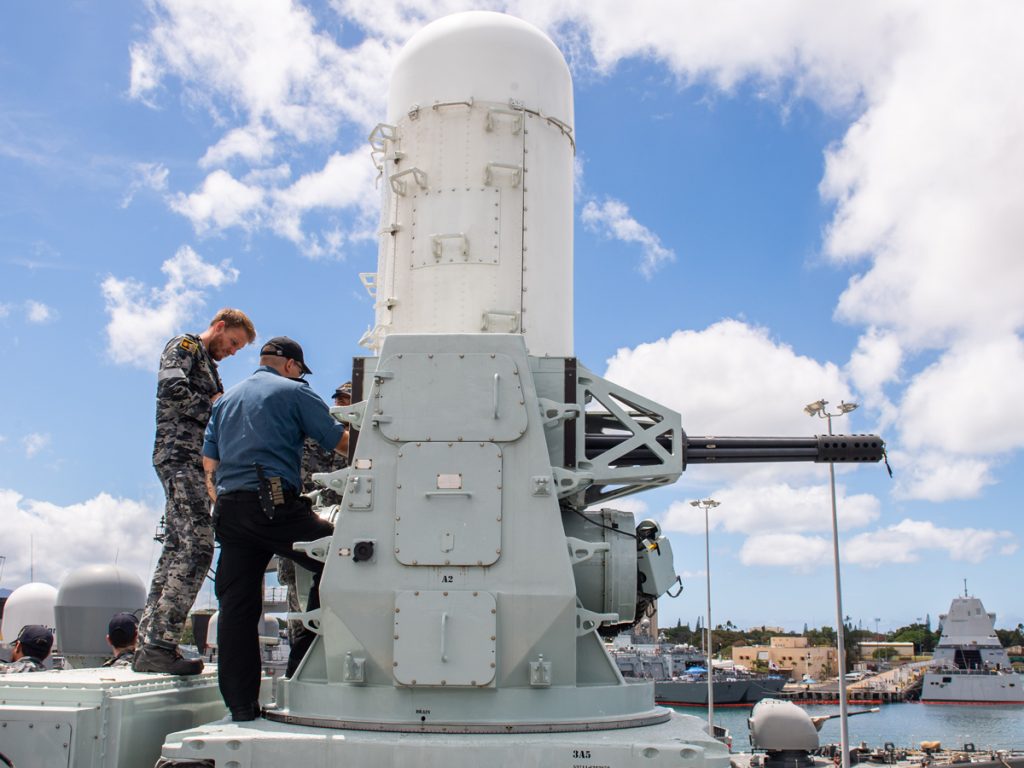
The Close-In Weapon System  

Sub-Lieutenant Cael Halvorsen Combat Systems Engineering Officer, HMCS Winnipeg — The Close-In Weapon System (CIWS) is a hard-kill weapon system onboard HMCS Winnipeg. It is the last line of defense in the ship’s layered defense against missiles and surface threats. As the final defense system, CIWS protects the sailors when other anti-air or anti-surface capabilities cannot. CIWS employs its Search and Track RADAR suite to acquire and track a target, then destroys it by firing 20mm tungsten rounds out of its six barrels at a rate of up to 4,500 RPM. CIWS is a self-contained system that can operate without operator; as long as it has power, it can protect the sailors. The first models of CIWS were made in 1977. The system is time-tested and still carries its weight as a reliable, semi-automatic hard-kill system. It also provides great capability to modern navies of more than 20 nations around the world.

Former shipmates work together again at RIMPAC22

[caption id="attachment_30256" align="aligncenter" width="595"] Sailors from HMAS Supply pose with Vancouver’s kisby ring on board the ship during a visit to discuss Close-In Weapons System 1B, a relatively new piece of kit for the Australian ships. Photo by Sergeant Ghislain Cotton.[/caption] Lieutenant(N) Michelle Scott HMCS Vancouver PAO — The Alistair MacDonald song ‘Heading for Halifax’ famously notes that for those born in Cape Breton ‘Wherever they go, there’s bound to be friends from back home.’ Arriving in Pearl Harbor, Hawaii, for Rim of the Pacific (RIMPAC) 2022, Lieutenant-Commander (LCdr) Stephen Wall, Operations Officer in Her Majesty’s Australian Ship (HMAS) Supply, found that particularly true. LCdr Wall was born and raised on Cape Breton Island, N.S., and served in Esquimalt-based ships as a Naval Warfare Officer for 16 years before joining the Royal Australian Navy (RAN). The exercise gave him an opportunity to re-connect with many former shipmates on the Canadian frigates, also alongside in Pearl Harbor for RIMPAC, including his former shipmate Commander Kevin Whiteside on Her Majesty’s Canadian Ship (HMCS) Calgary, now HMCS Vancouver’s Commanding Officer. “It was a great opportunity to leverage the deep technical knowledge of the system that RCN operators are known for,” said LCdr Wall. “We shared technical and training ideas and practices to improve both of our teams.” LCdr Wall reached out to schedule a visit for his RAN team to discuss Close-In Weapons System (CIWS) 1B training and maintenance on HMAS Supply. The CIWS 1B is less widely employed on Australian ships, but his Canadian counterparts are well-versed in the weapon system located on the hangar top of each Halifax-class ship. The cross-deck evolution helped the Australian sailors develop their understanding of the weapons system and obtain helpful tips and tricks from seasoned CIWS operators and maintainers. “We discussed a wide variety of topics, both procedure-based and concept-based,” explained Sailor First Class (S1) Joop Koerten, Weapons Engineering Technician and Vancouver’s CIWS subject-matter-expert. “I shared knowledge with the maintainers, including techniques for maintenance procedures, products...

Balihar Dhah of Commercial Building Cleaning

Bravo Zulu: clean sweep congrats

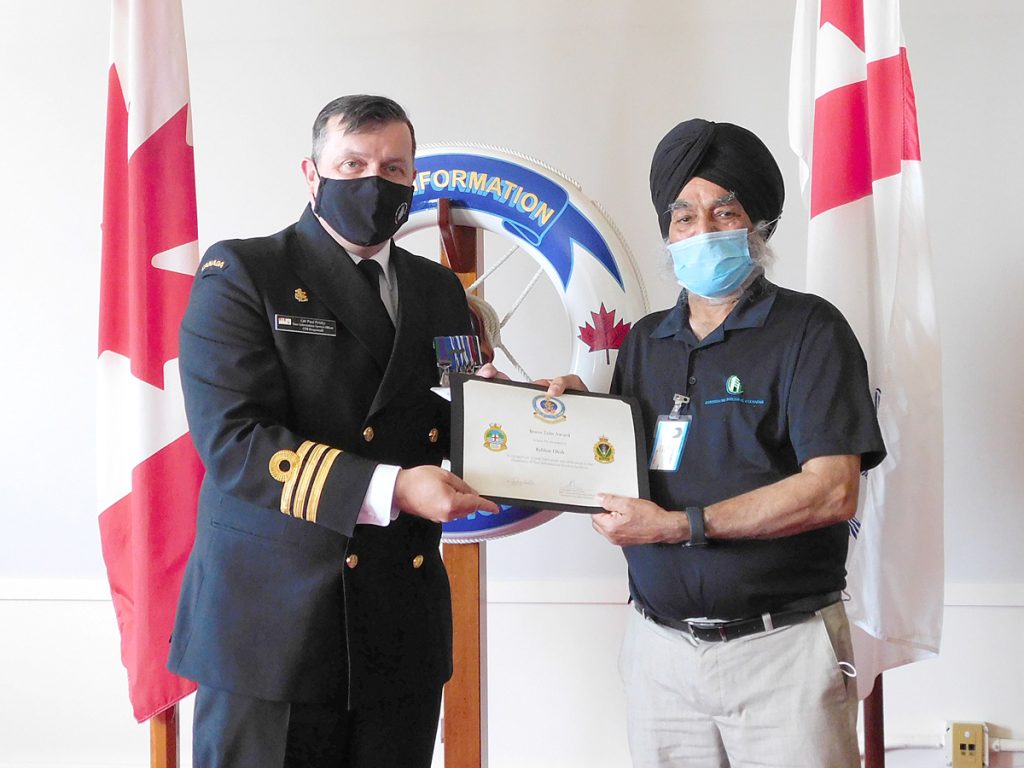
[caption id="attachment_30252" align="aligncenter" width="595"] Commander Paul Frisby, Commanding Officer BIS, presents his unit’s ‘Well Done Coin’ to Balihar Dhah of Commercial Building Cleaning on July 13 at BIS headquarters in Dockyard. Photo: Elizabeth Lutz, BIS.[/caption] Peter Mallett Staff Writer — A civilian contractor has received special recognition for his extraordinary efforts at improving the cleanliness of Base Information Services (BIS). Balihar Dhah, an employee of Commercial Building Cleaning, received a BIS ‘Well Done Coin’ and Bravo Zulu Award on July 13 during a presentation at BIS Headquarters in Dockyard. “Being the cleaner is not an easy job and to do it with a pleasant disposition is most welcome,” said Commander (Cdr) Paul Frisby, BIS Commanding Officer. “Balihar is a valued member of our team.” In making the award presentation, Cdr Frisby noted the job of the cleaning staff had been made more stringent during the COVID-19 pandemic than in the past. “Balihar has been keeping the building in a high state of cleanliness, which makes for a much more pleasant environment to work in,” Cdr Frisby said. “He is cheerful while he cleans and this also makes BIS a better place to be.” Balihar Dhah, 77, has been working at CFB Esquimalt since 2017. He was born in Punjab, India, and immigrated to Canada in 2008. He had previously worked as a farmer and at another cleaning company before beginning his job in Esquimalt. He speaks English but was able to respond better to interview questions in Punjabi through Sailor First Class Ryan Chouhan, who acted as a translator. Dhah said he was delighted to receive the award. “I found out about five months ago I was going to receive this award, and I was very happy,” Dhah said. He also noted how he loves working at CFB Esquimalt and supporting...

Chief Petty Officer Second Class Benito Beaudoin

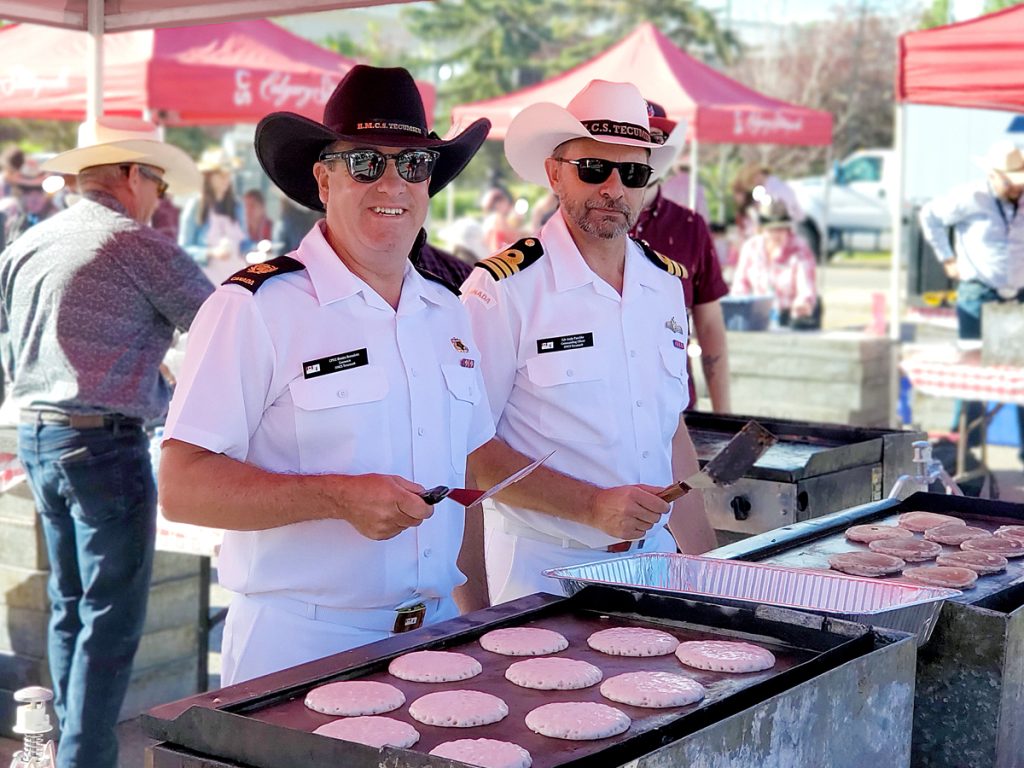
Batter Up! Stampede flips out for sailors’ sweet stacks

[caption id="attachment_30249" align="aligncenter" width="595"] Chief Petty Officer Second Class Benito Beaudoin, Coxwain HMCS Tecumseth, and Commander Andy Paschke, Commanding Officer HMCS Tecumseth, prepare pink pancakes during the Pink Pancake Stampede Breakfast on July 13. Photo supplied.[/caption] Kateryna Bandura Editor — White-uniformed sailors fed hundreds of people at the annual Pink Pancake Stampede Breakfast on July 13 in Calgary, Alta. “Many folks were asking questions about us cooking in our white uniforms, but we kept them clean, for the most part,” said Lieutenant (Navy) John Foster, Public Affairs Officer at Western Region Naval Reserves. The crews of HMCS Tecumseth and HMCS Calgary delighted Calgarians with a traditional pancake breakfast to raise awareness of the Canadian Cancer Society and encourage participation in the CIBC Run for the Cure. Four sailors from Calgary and Tecumseth cooked and served pink pancakes, along with Commander (Cdr) Andy Paschke, Commanding Officer (CO) of HMCS Tecumseh; Chief Petty Officer Second Class (CPO2) Benito Beaudoin, Coxswain of HMCS Tecumseh; Cdr Adriano Lozer, CO of HMCS Calgary; and Chief Petty Officer First Class Armand Reelick, Coxswain of HMCS Calgary. CPO2 Beaudoin said his unit did not have the opportunity to connect with Calgarians since the pandemic. “As the local unit Coxswain, it was a great pleasure to put on my cowboy hat and my full white to serve pancakes at an official Stampede Breakfast event this year,” CPO2 Beaudoin said. “HMCS Tecumseh sailors want to help and participate in various events around Calgary. That is who we are.” The event provided an opportunity for community outreach, Lt(N) Foster said. The Royal Canadian Navy’s mascot, Sonar, entertained families with young kids, who could try on firefighting gear and have their photos taken. “We attended to serve and interact with the public and raise awareness of the navy in Alberta, and connect...

Master Sailor (MS) Scott Van Maurik

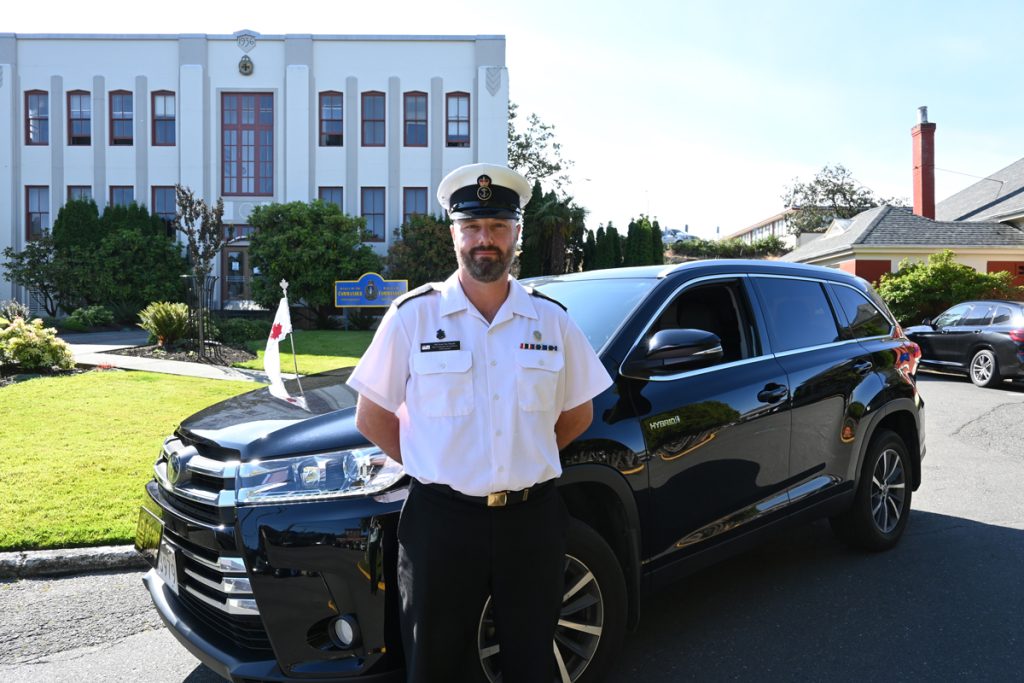
5 Questions with the Base Commander’s Driver

[caption id="attachment_30246" align="aligncenter" width="595"] Master Sailor (MS) Scott Van Maurik currently works at the Base Executive Branch of CFB Esquimalt as the Base Commander’s Driver.[/caption] CFB Esquimalt Public Affairs — Master Sailor (MS) Scott Van Maurik currently works at the Base Executive Branch of CFB Esquimalt as the Base Commander’s Driver. What’s an average day on the job like? The bulk of what I do is what you likely expect – I just drive, but the road conditions, traffic, construction, and things like that make each day different. Although I spend most of my time driving the Base Commander to meetings, there is variety in when and where I’m driving – a lot of the meetings happen outside of the Base. I get to meet a lot of people. I’ve met most of the local mayors, for example, and I think having that opportunity has given me a better understanding of how the different municipalities work. What’s the most interesting thing that’s happened recently while on the job? Recently, I got to watch one of the controlled burns at Rocky Point that help maintain the ecosystem and prevent wildfires from getting out of hand. The Base Commander had been invited to see what the controlled burns entail, and I followed along with the car in case things got too smoky and we needed to move quickly to a different location. What’s something about your job that nobody realizes? When the Base Commander drives around, people salute the vehicle, but they can’t see inside. The thing most people don’t realize is he is often saluting back. What’s something interesting about yourself? I was once posted to the Canadian Forces Station (CFS) Alert in Nunavut, and I ran the trading post. One day I caught 14 fish, and the president of the...

A Little Library is now open at the Lookout

[caption id="attachment_30240" align="aligncenter" width="595"] The Lookout’s Little Free Library, located in front of its building at 1522 Esquimalt Road.[/caption] If you have come by the Lookout’s office at 1522 Esquimalt Road in the past week, you may have noticed a new structure just outside our door. The tall grey box is one of  hundreds Little Free Libraries (LFL) around Victoria. This library was organized by Leslie Eaton, a graphic designer at the Lookout. “Everyone at the Lookout felt a little library was a good fit for our organization,” Eaton said. “We want to provide books for anyone who wants something to read, and now they can come by any time to get one.” The LFL program, in partnership with Idea Tree Consulting, offers homemade book exchange boxes in front of homes, schools, and businesses. “The local LFL program has campaigns that align with Lookout staff’s values, such as Indigenous awareness, pride, diversity, and equity,” Eaton said. “I have put out a request for books in different languages; hopefully, soon we can have a stock of them in there as well.” The LFL’s location outside the Lookout worked well, Eaton said, as there was a cement block embedded into the ground to give it some more stability. The LFL is also beside, but not blocking, a path military members take on their way to and from the parking lots. There are no rules to the library, Eaton said. Once a book is taken out, it does not need to be brought back or replaced with another. However, if someone wants to do that, that’s okay too, she said. For more information, please visit:www.theideatree.ca/past-projects/mapping-victorias-little-librariesand victoriaplacemaking.ca/little-free-libraries

MFRC recruiting new board members

[caption id="attachment_30226" align="aligncenter" width="595"] Board members conduct a strategic planning meeting with the MFRC management team on June 1 at Laurel Point Inn in Victoria. Photo supplied.[/caption] Peter Mallett Staff Writer — The search is underway to fill vacancies on the Esquimalt Military Family Resource Centre (MFRC) board of directors. Master Sailor (Retired) Samantha Krzywonos, MFRC Board Chair, says the board is looking to fill one or two vacancies in time for its Annual General Meeting in September.  “We are seeking volunteers interested in non-profit governance, who can contribute or learn in areas of finance, communications, fundraising, and risk management,” Krzywonos said. The MFRC is an independent, non-profit charitable organization that addresses the needs of Canada’s military families. Its board of directors is a 12-member governance body that supports the MFRC through establishing policy and setting long-term goals. The board is guided by the Societies Act of British Columbia and is responsible to the Military family community. Board members must commit to six to ten hours per month, said Krzywonos. They are also required to attend monthly board meetings on the last Wednesday of each month. All MFRC volunteers are required to undergo a police background check. Elected candidates will be provided with support, orientation, and training, she said. Krzywonos began volunteering for the MFRC 20 years ago, when she was transitioning out of the military. After serving ten years as a reservist and regular force member, and completing her military career as a Naval Combat Information Operator (NCIOP), Krzywonos worked locally with several non-profits, including the Victoria Hospitals Foundation. Her husband, Jason, currently serves with 443 Squadron as a Warrant Officer AESOP (Airborne Electric Sensor Operator). Krzywonos became the MFRC chair in 2016. She hopes the same reasons that drew her to volunteer with the MFRC may also be appealing to others. She encourages anyone interested to apply for a spot on the board of directors or some of the other volunteer positions within the organization. For a full list...

HMCS Edmonton

MCDVs set sail to support Naval Warfare Officers’ training

[caption id="attachment_30223" align="aligncenter" width="595"] HMCS Edmonton’s crew visits Alaska during a recent Naval Warfare Officer II training sail. Top row (L-R): Petty Officer Second Class (PO2) Mellis, PO2 Hunter, Lieutenant (Navy) Hembruff, Sailor Third Class Finch, Lieutenant (Navy) Hwang, Sub-Lieutenant Yen. Bottom row (L-R): Sailor First Class Tse, Lieutenant (Navy) Negm XO, Petty Officer First Class Robichaud (Coxswain), Aviator Brittain.[/caption] Kateryna Bandura Editor — Two Maritime Coastal Defence Vessels (MCDVs) have been tasked with helping out with Naval Warfare Officer (NWO) II course delivery to relieve high summer demand on the training system. “HMCS Brandon and HMCS Edmonton are pushing through a backlog of trainees needing to complete the sea phase of NWO II before continuing their trade training,” said Petty Officer First Class (PO1) Nicolas Robichaud, HMCS Edmonton’s Coxswain. The NWO II course is one course in the many stages of NWO training. Over the last decade, the course’s sea phase has been conducted on the ORCA class, however, this summer it will consist of three waves of 20 students crewing HMCSs Brandon and Edmonton over a total of six weeks. Lieutenant-Commander (LCdr) Louis-Phillippe Trudel, a trained NWO with HMCS Brandon, said the students require time at sea to learn the basic seamanship skills expected of all sailors. “Generally speaking, they are being oriented to life at sea,” LCdr Trudel said. The NWO trainees are learning to be effective lookouts and helm people. They practice working ship lines and participate in all ship evolutions and emergencies, such as spill response, damage control, and person overboard. The ships also support the training of NWOs working on bridge watchkeeping tickets and Marine Technicians working towards their engineering watchkeeper certification. The ships’ route lies along the Inside Passage through the islands on the Pacific Northwest coast, which has been beneficial for navigation and...

Explore More

Categories

Top News

E-Editions Archive

News Stories Archive

Proud Supporters

Joshua Buck, Lookout Newspaper