[wpml_language_selector_widget]
[searchwp_form id="1"]

Meet CFB Esquimalt’s Senior Fleet Chaplain

[caption id="attachment_29841" align="alignnone" width="595"] Major Daniel Walton, Senior Fleet Chaplain at CFB Esquimalt.[/caption] Kateryna Bandura Editor — Military members often seek spiritual guidance from their chaplains, yet the specifics of a chaplain’s work are often shrouded in mystery. Major Daniel Walton, Senior Fleet Chaplain at CFB Esquimalt, says the job of a chaplain is not a typical nine to five job. “You look after the spiritual well-being of your unit or your ship. It's our responsibility to go out to where people are. This helps us be seen and they feel more confident to come see us when they need,” he says. Chaplains belong to a purple trade, meaning they can do their jobs in any element. Since being sworn into the military in 2014, Maj Walton has travelled across Canada and around the world, and worked with all three military elements. Now, he leads a team of four chaplains, including himself, at CFB Esquimalt. The secret to being a great chaplain, he says, is dedication. “I try to not just fix the problem and move on, but to walk somebody through their experiences. Then we can find a way to deal with it,” he says, adding that it helps to always have a pocket full of candy. Maj Daniel Walton’s path offered him many opportunities to fulfil his mission to do greater good. Dehydrated jerky and toy trucks Maj Walton changed a family’s life while he was deployed to Iceland for Operation Reassurance in May-June 2017. While on the mission, he raised funds for a charity that helped families with terminally ill children. “One guy had a dehydrator and he made jerky just for fun. People would kick in 10 bucks just to pay for the meat he used and that money would go into the box. Somebody had clippers, so people started cutting each other's hair and donating after they were done. The CO was a runner, so he ran a marathon from Reykjavik to Keflavik, and people sponsored...
Anticipation mounts for Bernays family 

[caption id="attachment_29856" align="aligncenter" width="595"] Shannon Bernays[/caption] Peter Mallett Staff Writer — Shannon Bernays is brimming with pride about her recent selection as Ship’s Sponsor of the Royal Canadian Navy’s (RCN) third Arctic and Offshore Patrol Ship. “I was pleasantly shocked and just felt so honoured to be named the sponsor, but with this honour comes great responsibility,” Bernays says. “The whole family is so excited the ship will be stationed in Victoria, so we can continue to build a strong relationship with the Max Bernays and her crew for years to come.” The 54-year-old Colwood resident and mother of two says she was beyond excited to learn that she would be the sponsor of the ship named after her grandfather. She found out about her appointment in March through a Zoom call from Vice-Admiral Craig Baines and Commander Collin Forsberg, Max Bernays’ Commanding Officer. The appointment of a ship’s sponsor is a long naval tradition. The sponsor plays a key role in the ship’s naming ceremony and most sponsors continue their relationship with their ship for many years. The future HMCS Max Bernays is named after her grandfather Chief Petty Officer Max Bernays, who served as the Coxswain of HMCS Assiniboine during the Second World War’s Battle of the Atlantic. The ship is in its final stages of construction at Irving Shipbuilding in Halifax. It is set to launch at a naming ceremony on May 29. Shannon Bernays will attend the ceremony along with her husband Scott Thompson and children Max and Tessa. Shannon says they have been looking forward to the event for weeks since learning about her appointment. She will christen the ship by breaking a bottle of champagne across the ship’s bow. “Just thinking about it gives me goose bumps and brings tears to my eyes because I am so proud of my grandfather and everything he has done,” she says. “I know this moment would make my grandfather so proud if he were here, and he may be with...

The big chill – sailor credits cold-water swimming for help with injury recovery

[caption id="attachment_29852" align="aligncenter" width="595"] Sailor First Class Marie-Neige Dupuis-Carbonneau, a member of the Stadacona Band, has been recovering both physically and mentally after being struck by a vehicle while on her bicycle last year.[/caption] Joanie Veitch Trident Staff — Last June, Sailor First Class Marie-Neige Dupuis-Carbonneau, a clarinetist with the Stadacona Band, was hit by a pick-up truck while riding her bike home from work. As captain of her unit’s Navy Bike Ride team, she would ride about 300 kilometres most weeks. The accident changed everything. Just minutes away from her home in Halifax, S1 Dupuis-Carbonneau was cycling alongside Lake Banook when the construction truck struck her. “He had no clue I was on his bumper,” she says. She spent four days in a hospital. Among many injuries, she had torn ligaments and damaged cartilage in her chest. Later, she learned she had a significant shoulder injury that may require surgery. Before the accident, S1 Dupuis-Carbonneau was fit and active. She cycled to the band office at Windsor Park most days, often adding an extra 50 to 60 kilometres to her commute. A runner too, she’d qualified for Canadian Armed Forces nationals in both swimming and triathlon. After the accident, S1 Dupuis-Carbonneau could barely move. Her parents slowly nursed her back and in mid-July, she was able to walk with crutches and an articulated leg brace. Knowing her love of the water, her father promised to take her to the beach. “I couldn’t do much but it was enough just to be able to sit on the beach and be outside. That was the first time I had a sense that I was going to heal,” she said. By the end of August, S1 Dupuis-Carbonneau was meeting up with some members of the Navy Tridents Triathlon Club during their training swims. She could feel she was beginning to build up her strength. When summer turned to fall and the lake got colder, she continued her outdoor training with an inflatable swim...

Sailor First Class Austen Webb

Underwater drone ‘no small thing’ for Patrol Craft Training Unit

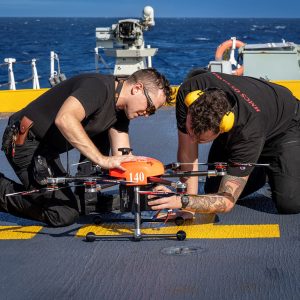
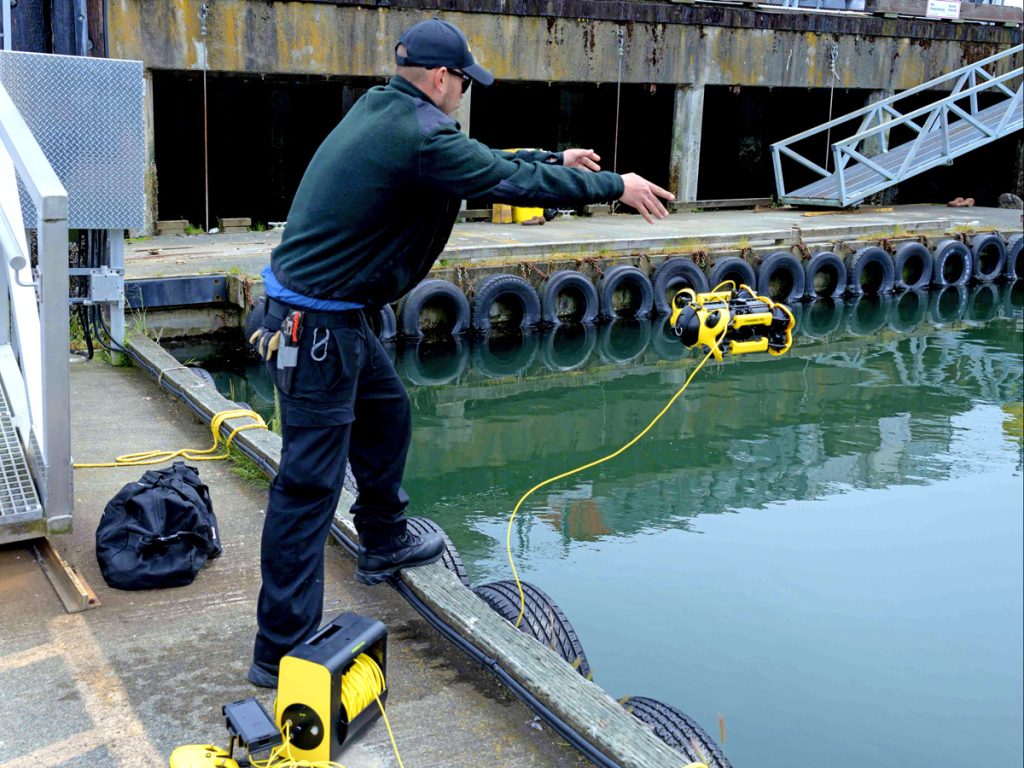
[caption id="attachment_29849" align="aligncenter" width="595"] Sailor First Class Austen Webb of Patrol Craft Training Unit puts the Chasing M2 remotely operated vehicle at D Jetty. Photo: Aviator Bastien Beaucage, Canadian Armed Forces.[/caption] Peter Mallett Staff Writer — An underwater drone is speeding up inspections of navy training vessels. CFB Esquimalt’s Patrol Craft Training Unit (PCTU) is using a remotely operated underwater vehicle (ROV) to regularly monitor the subsurface conditions of eight Orca-class training vessels. The technology, which arrived in January, helps to determine any necessary repairs or preventative maintenance as an alternative to deploying a team of divers from Fleet Diving Unit (Pacific). The technology’s benefits and its positive impact on day-to-day operations were noticed immediately, says Sailor First Class (S1) Austen Webb, Senior Boatswain Mate at PCTU. S1 Webb says the ROV will make inspecting Orca-class vessels easier, save money and transportation costs, and reduce lost training time caused by lengthy inspections during deployments. “Previously, Orcas would either be required to return to port in Esquimalt or have divers sent to locations to check for damage,” he said. “Quite often no damage was found.” The ROV will improve the unit's efficiency by deploying divers only when necessary, allowing deployed Orcas to remain on training missions longer. Practical Uses S1 Webb says the Chasing M2 ROV will be used primarily for surveying hulls of vessels alongside in Esquimalt. While in the open water, the drone can be used when the ship comes in contact with debris. “These can include log strikes or when ropes or fishing lines wrap around the props or shaft line of a vessel,” he says. “During one recent log strike, a tree trunk was caught in the shafts of an Orca. After the removal of wooden object, the drone was deployed to check for damage. Miraculously, no damage...

Base firefighter rides for Tour de Rock

[caption id="attachment_29839" align="aligncenter" width="595"] Lt Josh Peterson is one of 21 Tour de Rock participants in this year's Tour de Rock.[/caption] Kateryna Bandura Editor — A local firefighter plans to raise $10,000 for children battling cancer. Josh Peterson, a lieutenant with CFB Esquimalt Fire Rescue, is one of 21 law enforcement and emergency personnel taking part in the 25th Canadian Cancer Society’s cycling event Cops For Cancer Tour de Rock. The ride runs over two weeks in September, with participants travelling 1,200 kilometers from Port Alice to Esquimalt, raising funds to support pediatric cancer research. “It is a way to connect with children battling cancer, to help them know they are not alone in their battle - that we care, and so does the community,” he says. So far Lt Peterson has raised $5,852. He received support from his fire chief, coworkers, and family. Now he is looking for support from the base community. Lt Peterson’s team trains three days a week. Tuesdays are hill nights, when the team rides at the Observatory in Saanich. Thursdays are speed nights, where they ride all over town, including Ring Road at UVIC. Sundays are the long ride days, during which they work towards 100 kilometres per day. He says they will reach over 130 kilometres a day by the time the Tour kicks off. All riders are paired up with a junior rider battling cancer. The pairings will be announced soon, and Peterson says he is nervous to meet his honorary rider. “Their spirit and excitement is what will inspire us to continue riding on the hard days. I look forward to hearing the stories on their battles with cancer. These children will fill us with hope and inspiration,” he says. The fire hall at 1350 Esquimalt Road has supported the ride for years, with past riders including Chris Day, Alex Marshall, and Matt Arnsdorf. This is Lt Peterson’s first time participating. “Being part of the Tour is a massive responsibility and takes a...

CFB Esquimalt marks Indigenous Awareness Week with a ceremonial canoe trip

[caption id="attachment_29836" align="aligncenter" width="595"] Members of the Defence team paddle in the RCN canoe from Work Point to Behrens Island, May 24. The short canoe trip kicked off Indigenous Awareness Week at CFB Esquimalt and a celebration of its theme “We are all in the same canoe, under the same sun.” Photo: Peter Mallett, Lookout Newspaper.[/caption] Peter Mallett Staff Writer — “We are all in the same canoe, under the same sun” was the theme for Canadian Armed Forces Indigenous Awareness Week celebrations at CFB Esquimalt last week. The calm waters of Victoria harbour welcomed 15 paddlers from all walks of life on the sunny morning of May 24 as they made their way around Berens Island in a canoe designed for the Royal Canadian Navy (RCN). Topping the list of VIP paddlers was Capt(N) Jeff Hutchinson, Base Commander, and Major General Michel-Henry St. Louis, Acting Commander of the Canadian Army. The Defence Aboriginal Advisory Group (DAAG) co-chair Shae Clutesi says the event built a special bond between participants. “Everyone in a canoe works as a team, so you need to build that trust and camaraderie with each other to get the canoe to perform properly. Building this trust makes for a very significant impact in the way the group can feel as one,” she says. Clutesi, who works as a Client Service Provider for the Base Executive Branch, says the DAAG plans to host more events that feature the RCN canoe. After its visit to Work Point, the canoe was put on display at the Fleet Maintenance Facility Cape Breton and the Naden Athletic Centre. The ceremony at Work Point this week featured a drumming ceremony performed by paddler and DAAG member Petty Officer First Class Marielle Audet of the Naden Band. Chief Petty Officer Second Class Patrick Stephens, the Indigenous Advisor to the Chaplain General, brought the Canadian Armed Forces Eagle Staff, which was displayed prominently at the canoe’s bow for the entire trip. This is not the first...

Vice Admiral Angus Topshee: Farewell Message

[caption id="attachment_29812" align="aligncenter" width="595"] VAdm Angus Topshee, outgoing commander Maritime Forces Pacific (MARPAC) and Joint Task Force Pacific (JTF(P)), addresses the crowd during the Change of Command ceremony at Duntze Head on May 16. Photo: Sailor First Class Kendric Grasby, Maritime Forces Pacific Imagery Services[/caption] To the thousands of great Canadians, sailors, soldiers, aviators, and operators in uniform, as well as the civilian public servants and contractors who enable and support them within Maritime Forces Pacific (MARPAC) and Joint Task Force Pacific (JTF(P)): I want to start by acknowledging that much of what MARPAC does takes place on the traditional lands of the lək̓ʷəŋən-speaking people and specifically the Esquimalt and Songhees nations. As I prepare to leave these lands to head to Ottawa, I want to thank all of the indigenous people I’ve met in the course of my duties for sharing their lands and knowledge with me. I promise to continue to work on the difficult, but essential task of reconciliation in my next assignment. When I took command last May, I asked all of the military personnel in MARPAC and JTF(P) to commit to duty. To serve Canada and Canadians loyally, to put that service before ourselves and to be ready to help, ready to lead, and ready to fight while respecting the rights and dignity of every person. I asked all of the public servants to commit to stewardship and innovation to make best use of the resources assigned to us. I also asked all of us, military and civilian alike, to serve with integrity and empathy. The task I set was to understand and acknowledge the needs, goals, and desires of every person we work with inside or outside of the defence team. To respect their dignity and strive to build an inclusive and welcoming workplace that maximizes the potential of every individual. While we still have work to do, we have made progress thanks to initiatives like CODE training, critical conversations with affected persons, trauma...

New Royal Canadian Navy pin marks steps toward command

[caption id="attachment_29805" align="alignnone" width="594"] Vice-Admiral Craig Baines, outgoing Commander of the Royal Canadian Navy, presents Commander Éric Isabelle with the gold level of the new naval warfare officers’ pin. Photo: Ed Dixon, MARPAC Imaging Services[/caption] SLt Wilson Ho MARPAC Public Affairs — Royal Canadian Navy (RCN) naval warfare officers are now eligible for a new pin that marks their progress toward command of a warship. The new pins were officially unveiled on May 16 at Maritime Forces Pacific. This initiative builds upon similar RCN specialty skill badges that recognize unique qualifications. As an occupation, RCN naval warfare officers train to one day command a warship or submarine. “This new naval warfare officer badge recognizes the significant effort required to reach key career milestones within this occupation,” says Commander Amber Comisso, Director Personnel Policy 2 at RCN. “Naval Warfare Officers are encouraged to apply for their pins and to wear them with pride, as they are visual indicators of their progression towards command.” The badge recognizes sea-going service and progression towards command based upon successful completion of specific qualifications and positions held within Her Majesty’s Canadian ships and submarines. During the unveiling ceremony on the West Coast, 30 recipients received the bronze level, 14 recipients received the silver level, and six recipients received the gold level pins. Maritime Forces Atlantic in Halifax and the naval staff in Ottawa also presented badges to their first recipients the same day. In order to qualify for the badge, a candidate must be a currently serving RCN member who is either a current or former naval warfare officer. Personnel can apply for the badges through their divisional system.   Three tiers of the badge Bronze: Given when a candidate receives a bridge watch keeping certificate on board a commissioned warship Silver: Given to Regular Force members who are operations room officer qualified (with command development course completion), to submariners who have received their equivalent operations room officer qualification, or to Primary Reservists who are Orca-class officer-in-charge...

Pegasus

Healing injured members at 10,000 feet

Peter Mallett Staff Writer — Operation Pegasus Jump is not a typical military mission, but a skydiving camp designed to help injured military members heal by letting go of their fears. This summer on Vancouver Island, groups of veterans, current serving military members, and first responders will make their jumps from a Cessna 182 Jump plane at heights ranging between 3,500 and 10,000 feet. Operation Pegasus Jump is organized by Campbell River Skydive Centre owners, former Canadian Airborne Regiment member Sergeant (Retired) Rob McNeill and former Search and Rescue Technician Master Warrant Officer (Retired) Bob Verret. The two men are the operators of the only veteran-owned drop zone in Canada. The skydiving camp is a therapeutic team-building exercise for men and women living with PTSD and other occupational mental illnesses, says McNeill. “I know from personal experience parachuting is the best therapy for injured airborne members,” he says. “It’s all about taking service members and first responders out of their comfort zone and presenting them with a challenge.” The camp is an extension of McNeill and Verret’s company Us For Each Other (U4EO). The pair operates five parachuting businesses and education programs in Campbell River. Finding bliss After completing a First Jump Course, which offers four to five hours of instruction, participants will make their first jump from 3,500 feet. They will then have the option to continue to make jumps or make a tandem skydive from 10,000 feet while attached to an experienced instructor. Other activities at the camp include a first-day meet-and-greet barbeque, golf day, flyboarding, and helicopter tours. Master Sailor Jennifer MacKinnon, a skydiving volunteer coach and instructor with the Campbell River Skydiving Centre, says she thoroughly enjoys the experience of instructing first-timers who have never jumped before. “I love the passion people bring to this sport and...

Royal Canadian Navy launches Mentorship Program

  Royal Canadian Navy (RCN) sailors at all ranks and civilian employees at all levels have a mentorship program to call their own. Personnel are invited to attend the program’s first session, which will take place on May 26 from noon to 1:15 p.m. EST (sign-in begins at 11:30), and will be available Canada-wide on Microsoft Teams, or dial in at 343-803-5382, phone conference ID: 692 197 804#. In the first session, titled “Why Mentorship?”, RCN members will share their thoughts on why mentorship is important. The session will feature the following speakers: Chief Petty Officer First Class (CPO1) Alena Mondelli, Halifax Base Chief Petty Officer; Formation Master Sailor Kevin Dave from Maritime Forces Atlantic; Command Master Sailor Maude Lauzon; Formation Master Sailor Stephanie MacAndrew from the Naval Reserve; Lieutenant-Commander Calley Gray; Sailor First Class Ella York; and Rear-Admiral Casper Donovan, Acting Deputy Commander RCN. “The program is designed to create a space where individuals, regardless of their rank or experience, can share their knowledge and expertise with others who want to learn and grow in a personal and professional capacity,” says program director Dennis Witzke. The program will consist of group sessions led by a subject matter expert. These sessions will be available to all on MS Teams. The group sessions will be held monthly and everyone is encouraged to actively participate, share their insights, and ask questions. Although this program was developed with RCN military and civilian personnel in mind, it is open to all Canadian Armed Forces members and Department of National Defence employees at all ranks and levels. “It is important to facilitate the transfer of knowledge between Defence Team members to prepare them for the complex roles they’ll be expected to perform as their careers progress,” says CPO1 Tara White, the navy’s occupation manager for boatswains and clearance divers, and member of the program development team. “This way we can ensure important lessons and skills that have been learned are passed on and support the...

New leader at the helm of HMCS Saskatoon

[caption id="attachment_29791" align="aligncenter" width="595"] HMCS Saskatoon sails in formation with United States Coast Guard Cutter (USCGC) Blueshark during a PhotoEX with HMCS Yellowknife and USCGC Osprey as the formation prepares for their upcoming deployment to Operation Caribbe on February 17, 2022. Photo: MARPAC Imaging Services[/caption] Capt(N) Timothy Blois Operation Caribbe Public Affairs Officer — A change of command ceremony for HMCS Saskatoon took place Friday, May 20 at Y jetty between out-going ship commander Lieutenant-Commander (LCdr) Nadia Shields and in-coming commander LCdr Michael Vanderveer. Overseeing the ceremony was Commander S. G. Kelly, Commander Coastal Division (Pacific). The ceremony marked two years since LCdr Shields took command of Saskatoon. During her command, she deployed twice on Operation Caribbe, contributing to the seizure and destruction of over 5,000 kilograms of cocaine and preventing them from potentially hitting the streets of Canada. Highlights of her time in command also included circumnavigating Vancouver Island and being the first Commanding Officer of a Kingston-class vessel to use demolitions in a theatre of operations. LCdr Shields will now become the Officer-In-Charge of Patrol Vessels Sea Training (Pacific). “I went through the achievements of Saskatoon and I realized it wasn’t the miles steamed, time away from family, or our mission accomplishments that made this an amazing time for me as a Commanding Officer. It was that if I was given the opportunity to take command again, I would choose this crew every single time,” she says. LCdr Michael Vanderveer has a wealth of experience, including operational tours with HMCS Regina on Operations Artemis and Reassurance. He has been a bridge watchkeeper, instructor for the Fleet Navigation Course, Operations Officer, Weapons Officer, and Executive Assistant to the Commander Maritime Forces Pacific. In looking forward to his command, LCdr Vanderveer remarks he is excited to have this opportunity. “Coming down to Y jetty and working with a small but capable team is one of the greatest experiences to have in the navy,” he says. “At all ranks and in all...

Two warships come home from Operation Caribbe

[caption id="attachment_29786" align="aligncenter" width="595"] A long exposure of HMCS Yellowknife while the ship is deployed on Operation Caribbe, March 19, 2022. Photo: MARPAC Imaging Services, Canadian Armed Forces photo[/caption] Capt(N) Timothy Blois Operation Caribbe Public Affairs Officer — After travelling 33,874 nautical miles, HMC Ships Saskatoon and Yellowknife returned to their home port in Esquimalt last Thursday after a combined 147 days at sea. Both ships participated in Operation Caribbe, a U.S.-led enhanced counternarcotic operation in the Eastern Pacific Ocean. Their arrival home was marked with the hallmarks of naval tradition: the Naden Band of the Royal Canadian Navy performing while sailors’ loved ones waited on Y jetty. While away, each ship worked different areas of the Eastern Pacific Ocean. Their efforts saw them seize and destroy about 872 kilograms of cocaine, and obtain valuable intelligence into smuggling networks. The ships went as far south as Ecuador, stopping in the USA, Mexico, and Panama for fuel and provisions. Canada has been contributing to Operation Caribbe since 2006, which led to the seizure of more than 112 tons of cocaine.

MARPAC Change of Command

Maritime Forces Pacific Leadership Command Change

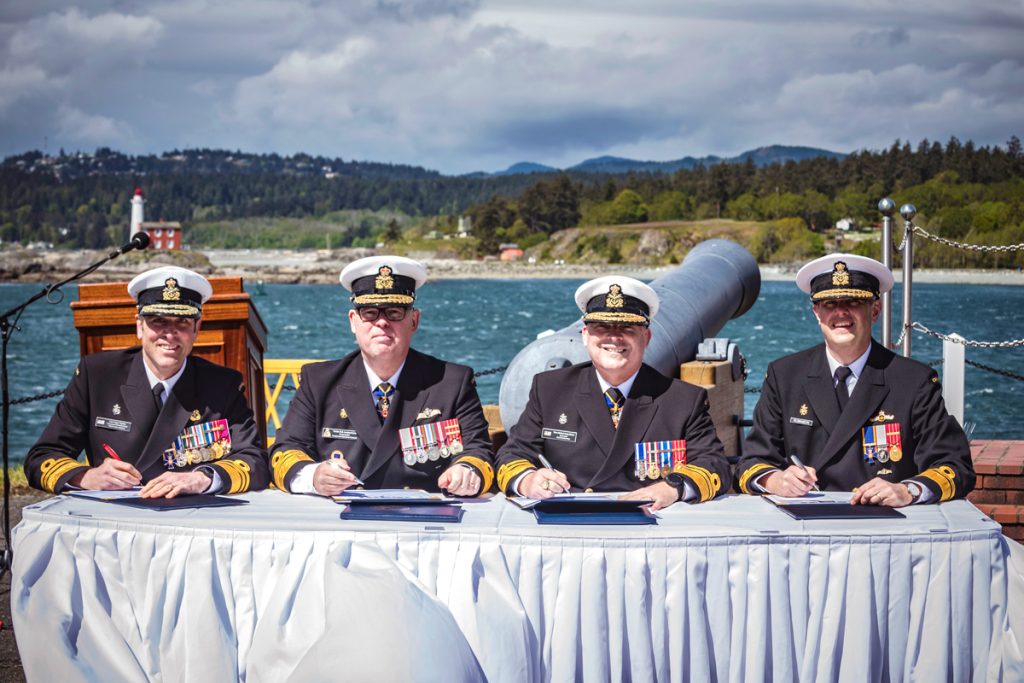
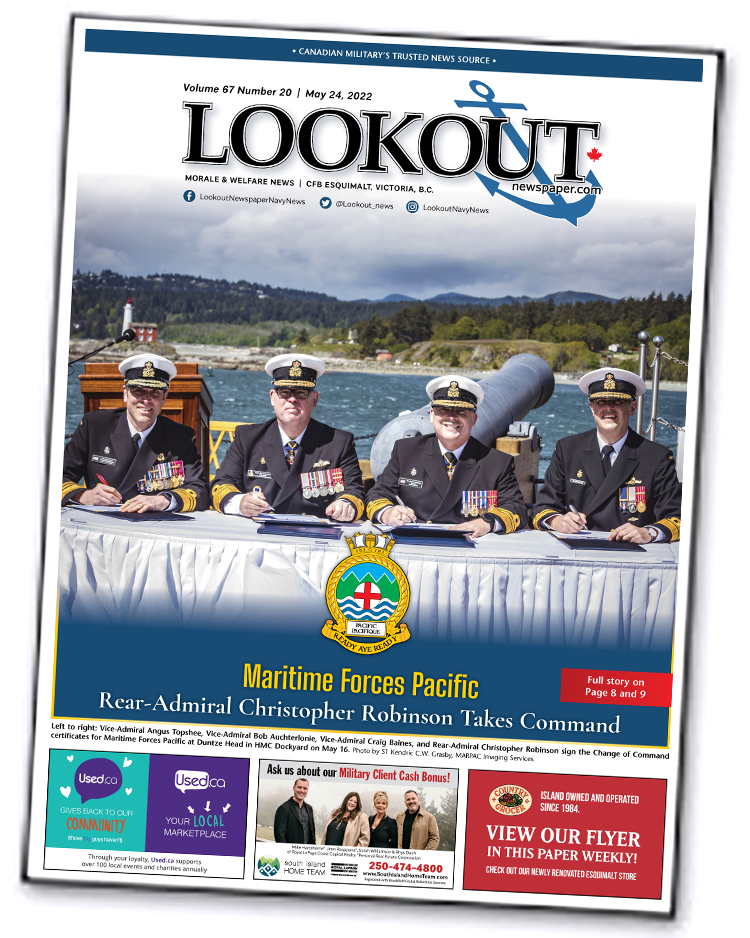
[caption id="attachment_29782" align="aligncenter" width="596"] Left to right: Vice-Admiral Angus Topshee, Vice-Admiral Bob Auchterlonie, Vice-Admiral Craig Baines, and Rear-Admiral Christopher Robinson sign the Change of Command certificates for Maritime Forces Pacific at Duntze Head in HMC Dockyard on May 16. Photo by S1 Kendric C.W. Grasby, MARPAC Imaging Services.[/caption] Peter Mallett Staff Writer — The winds of change swept through Esquimalt’s dockyard last week as the reins of command for the Maritime Forces Pacific (MARPAC) passed from one leader to the next. Newly promoted Vice-Admiral (VAdm) Angus Topshee handed over command of MARPAC and Joint Task Force Pacific (JTF(P)) to Rear-Admiral (RAdm) Christopher Robinson at Duntze Head on May 16. Holding the in-person event was a major change from the past two years. Last year’s MARPAC Change of Command Ceremony, which saw RAdm Topshee replace VAdm Bob Auchterlonie, was held virtually due to health and safety regulations surrounding COVID-19. This year’s event saw the return of the traditional naval pageantry, usually reserved for such ceremonies. VAdm Topshee saluted HMCS Brandon and three Patrol Craft Training Vessels during the ceremonial sail past, as well as a fly-past from a CH-148 Cyclone helicopter. Florence Dick and Christine Sam from the Songhees Nation conducted a First Nations blessing, and the Lieutenant Governor of British Columbia, the Honourable Janet Austin attended the event. Saying Goodbye After a little more than one year in command of MARPAC, Vice-Admiral (VAdm) Topshee moves on to Ottawa to his new job as Commander of the Royal Canadian Navy. He, along with other speakers, noted many challenges the formation has dealt with over the past year, including a global pandemic and the ongoing climate change. More locally, MARPAC dealt with environmental disasters such as forest fires, floods, and personnel shortages. Despite all the pressing issues, VAdm Topshee said the fleet and...

When Assiniboine brought word processing to the RCN

Don Sheridan, with CPO1(Ret’d) Bruce Cake, and CPO1 (Ret’d) John Arsenault Contributors — In this article we celebrate an innovation in the Royal Canadian Navy that started specifically in HMCS Assiniboine – when the ship’s office trialed a Canadian word processing system that was, at the time, a world leader in this new technology. Flashback to 1979 When CPO2 Bruce Cake became the Chief Clerk of HMCS Assiniboine, he started with one manual typewriter, then an electric typewriter, and later a Gestetner to produce copies of routine orders. Operating a Gestetner involved typing on a skin - foolscap-sized, thin membrane. The skin was placed on a drum and ink seeped into cuts made by typed characters. There were no erasers, so fixing a mistake meant using correction fluid or starting over. Assiniboine was in refit when Chief Cake replaced the typewriters with modern electric typewriters, and the Gestetner with a Xerox photocopier. Although the photocopier seemed like a good idea, it broke down on the first day at sea because the top of the machine moved back and forth to produce a single copy. It was unable to function for long in a warship at sea. However, a more impressive innovation was to come The AES word processors were revolutionizing office management. They allowed users to create, store, and revise text electronically before printing. They had a monitor to enter, edit, and format the text, making the AES known as the world’s first programmable video screen word processor. CPO2 Cake first learned of the AES during Assiniboine’s Joint Naval Force Atlantic deployment in Chatham, England, from a demonstration at an office supplies shop. He asked if he could input a paragraph on the device, and was able to immediately see the text on a monitor. It was a “eureka” moment for...

Belmont Park chapel collects funds for Ukraine

[caption id="attachment_29762" align="aligncenter" width="595"] Interior of Chapel of Our Lady Star of the Sea.[/caption] Kateryna Bandura Lookout Editor — Parishioners at the Chapel of Our Lady Star of the Sea Roman Catholic Military Chapel in Belmont Park performed a seven-day miracle. They collected $780.52 in one week to aid the citizens of Ukraine. Captain (Padre) Justin Peter, Faith Community Co-ordinator, says the money will be sent to the Roman Catholic Military Ordinariate of Canada, who will transfer the money to a local Catholic humanitarian organization in Ukraine. “This particular issue seems to have really touched our congregation in a very deep way,” he says. The congregation has been at less than half strength since COVID, reducing from about 100 people to 40 on a good day. When the chapel put out the call for funds, everyone pitched in, from parishioners to their neighbours and co-workers. Over the week, Capt Peter talked to people about the Ukraine humanitarian crisis. “I’m envisioning one person in particular, who was telling me about the horrible things she was reading, and you could see tears in her eyes. She doesn’t know anybody who’s from Ukraine, but there she is coming to pray every day,” he adds. To help parishioners remain mindful of fellow Catholics in Ukraine, the chapel acquired a golden tapestry. The $90 tapestry was made in Ukraine by a local mom-and-pop shop. “It was just [an] Easter gift to the chapel,” he says. The tapestry was met with excited gasps during the unveiling at the Easter Vigil. Capt Peter says the tapestry is now part of their history. “If 10 to 20 years down the line new people take over the chapel, that tapestry tells of when the chapel answered the call to be generous.”

Engineering students explore career path

Nineteen engineering students from the University of British Columbia (UBC) travelled from Vancouver to Esquimalt in HMCS Vancouver on May 2, for a unique Navy experience. UBC students took part in the Canadian Students at Sea (CSaS) program, which is an opportunity for post-secondary students to gain a deeper understanding of the Royal Canadian Navy (RCN) through hands-on and immersive experiences, both at sea and ashore. During the sail to Esquimalt, students had experiences and interactions primarily with engineering aspects of the warship. They toured various departments and learned about marine systems engineering, naval combat systems engineering, damage control, and emergency responses onboard ship. On completion of the at-sea portion, while HMCS Vancouver remained at sea to continue on their program, students were transferred ashore at CFB Esquimalt via a Rigid Hull Inflatable Boat (RHIB) ride. Over calm seas and sunny skies, the boat ride ashore was another highlight of the students’ experience during the CSaS program. The following day, students visited various units at CFB Esquimalt, such as the Fleet Maintenance Facility Cape Breton (FMFCB), HMCS Whitehorse, the Naval Officer Training Centre’s Navigation and Bridge Simulator (NABS), and briefs from the Regional Operation Centre (Pacific) and the Marine Security Operation Centre (West). The Naval Personnel and Training Group (NPTG) also provided briefs and showcased interactive displays of new technologies used to enhance sailor training and exposure to their navy. Davin Birdi, a fifth-year electrical engineering student, says the program gave him an opportunity to see things he would not normally get a chance to see. “They built this tracking software, which is a very complete in-house solution to a problem. I thought that was a very interesting application, as well as seeing the machine shops,” he says. “It was really cool to see the scale at which things can be produced, like when they were cutting that really thick steel piece [at FMFCB]. That was really amazing.” Hillary Oldford, a fourth-year ocean and naval architectural engineering student, says the...

HMCS Nanaimo

HMCS Nanaimo celebrates 25 years

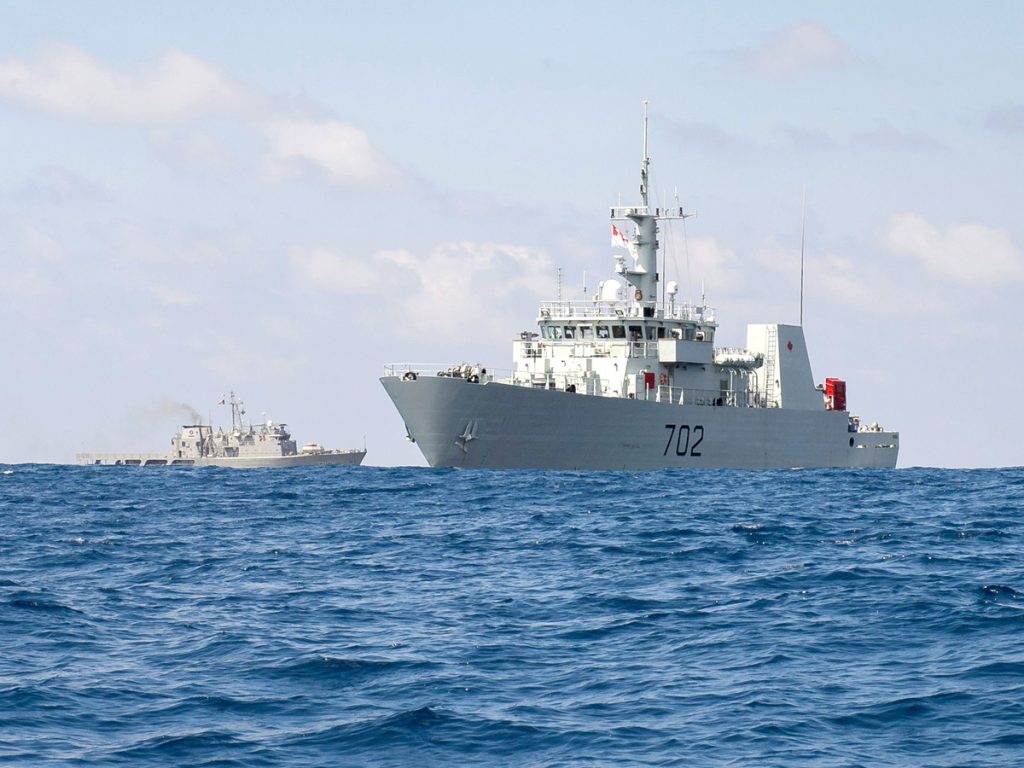
[caption id="attachment_29754" align="aligncenter" width="595"] HMCS Nanaimo celebrates 25 years. The Kingston-class vessel went into service in 1997.[/caption] Nanaimo News Staff  — A navy ship bearing the name of the Harbour City is celebrating 25 years since it was commissioned. HMCS Nanaimo, designed for coastal patrols, mine sweeping, law enforcement and pollution surveillance, and response, celebrated its silver jubilee May 10. “This maritime coastal defence vessel (MCDV) has accomplished much in a quarter century of service,” noted the Royal Canadian Navy in a social media post. The first vessel of its class based on the west coast was commissioned in 1997 and its first crew was comprised mainly of reservists. Over the past 25 years, the ship has supported the Royal Canadian Mounted Police  (RCMP), Canada Border Services Agency, and Canadian Coast Guard, and has been involved in search-and-rescue operations and environmental disaster response. The ship is also used for training and survey missions. HMCS Nanaimo was one of 12 Kingston-class MCDVs constructed as part of a 1992 contract with Halifax Shipyards Ltd. in Nova Scotia. Nanaimo left leaving Halifax in November 1996 and arrived at Esquimalt a month later. HMCS Nanaimo is dry-docked for maintenance at Point Hope Shipyards in Victoria Harbour until the spring.

Final goodbyes aboard HMCS Sackville

[caption id="attachment_29747" align="aligncenter" width="595"] CFAV Glenevis prepares to move HMCS Sackville from HMC Dockyard to the waters off Point Pleasant Park on the morning of May 1, Battle of the Atlantic Sunday. Photo by Joanie Vietch, Trident staff.[/caption] Joanie Veitch Trident Newspaper — As the crew of HMCS Sackville readied the ship for sea, a small group of people gathered on the jetty at HMC Dockyard Halifax on the morning of Sunday, May 1. Many of them were family members preparing to say a final goodbye to their loved ones at a committal of ashes ceremony held aboard the ship.  “Today is Battle of the Atlantic Sunday. It’s an honour and a privilege to take your loved ones to their final resting place,” said Commander (retired) Gary Reddy, Sackville’s Commanding Officer with the Canadian Naval Memorial Trust, a non-profit that operates the ship. Aided by two tugboats, Sackville sailed to a point off Point Pleasant Park to serve as the backdrop for the Battle of the Atlantic ceremony held at the Sailors’ Memorial. At 11 a.m., both at the memorial and on board the ship, a service was held to commemorate the devastating losses during the Battle of the Atlantic, the longest campaign of the Second World War. “The elements were often more violent than the enemy. Raging storms, ice, cold, fog, and dense blackness confronted navy and merchant sailors alike. Ships collided, ran aground, or were lost to enemy action,” said Cdr (Ret’d) Reddy. The number of service members who died during maritime operations were staggering: 1,797 Royal Canadian Navy (RCN) men and women, 1,578 Canadian merchant marines and 752 personnel from the Royal Canadian Air Force (RCAF). The Canadian Army and RCAF lost another 380 men at sea when the ships carrying them were sunk. Following the service, family members gathered in small groupings for the committal of ashes ceremony. With CNMT Chaplain, Padre Andrew Cooke officiating, 20 families took part in the ceremony. As each family group came forward,...

HMCS Harry DeWolf’s drug busts add to smuggler blues

    [caption id="attachment_29741" align="aligncenter" width="595"] Members of the Royal Canadian Navy and the United States Coast Guard’s Law Enforcement Detachment recover bails of cocaine that were thrown overboard during a counter-narcotics operation. Canadian Armed Forces Imagery Technician photo.[/caption] Peter Mallett Staff Writer — HMCS Harry DeWolf and its crew continue to protect North America from illegal narcotics in the high seas. The Arctic and Offshore Patrol Ship participated in two interdictions and seized a combined 386 kilograms of cocaine with an estimated street value of USD $15 million. The busts were made as part of Operation Caribbe 2022. The multinational campaign targets transnational criminal organizations and illegal narcotics shipments in the Caribbean Sea and Eastern Pacific. The first drug bust took place on April 19 when Harry DeWolf intercepted two vessels containing 231 kilograms of cocaine, with the help of U.S. Coast Guard (USCG) Law Enforcement Detachment (LEDET) and United States Navy vessel USS Wichita. Then, in the early morning hours of May 1, the ship noticed a suspicious vessel and conducted an interjection using involving the ship’s two multi-role rescue boats. This time Harry DeWolf’s crew recovered 165 kilograms of cocaine. Arrested suspects were processed by the U.S. Law Enforcement system. Seized drugs were collected as evidence for court proceedings and will then be destroyed at a facility in the U.S. This is Harry DeWolf’s second Op Caribbe deployment in six months. In December, while operating in the Eastern Pacific, Harry DeWolf worked alongside USCG staff in two drug interdictions, seizing a combined 2,589 kilograms of cocaine. The ship began operating on its second Op Caribbe deployment on April 4, making its third and fourth seizures of illegal narcotics. Harry DeWolf’s Executive Officer, Lieutenant-Commander Ryan Bell, says the ship’s crew worked diligently before interdicting the vessels. “The successful interdiction is a tangible way of demonstrating we are protecting and safeguarding North America and society from illegal narcotics,” he said. “Achieving this success in combined operations proves allied navies can...

Asian Heritage Month – meet the Li brothers

[caption id="attachment_29732" align="aligncenter" width="595"] Cpl Jeff Li carries out his duties with the CAF. Photos: Canadian Armed Forces[/caption] Marie-Christine De Tilly Contributor — To mark Asian Heritage Month, the Strategic Partners Engagement Office invited two military members of Asian descent to share their stories and provide advice to new members in the Canadian Armed Forces (CAF). Asian Heritage Month, celebrated in May, aims to highlight the culture and history of Asian Canadians. Sergeant Mingxin Li was born in Nanjing in the Republic of China and arrived in Montreal with his parents at the age of one. The birth of his younger brother Jeff completed the family. The brothers grew up in Mont-Royal. Both Li brothers enlisted in the CAF within a year of each other (2013 and 2014) and have since contributed to several domestic and overseas operations. These include Kuwait in 2015 and Iraq in 2018. Their desire to learn new skills, combined with the opportunity to help their community, convinced them to answer the call and join the Primary Reserve. “As a university student, employment in the Primary Reserve of the Canadian Armed Forces offered an interesting challenge and provides significant flexibility to successfully complete one’s education,” Cpl Li says. During their last few years in the Forces, the two brothers were able to assist their community by responding to the several spring flooding incidents as part of Operation Lentus. “Canada is where I was born and raised. I am very proud to serve my country and grateful for all the opportunities the Canadian Armed Forces have given me,” says Cpl Li. When he is not in uniform, he practices as a business lawyer with Stikeman Elliott. Sgt Li enlisted as a military intelligence specialist with 4th Intelligence Company after completing his bachelor’s degree in political science and economics. “I came to Montreal at a young age and was able to discover and keep my roots while being exposed to many other cultures. I owe part of my success...

Jacob McFarlane

Pipefitter apprentice wins gold at Skills BC competition

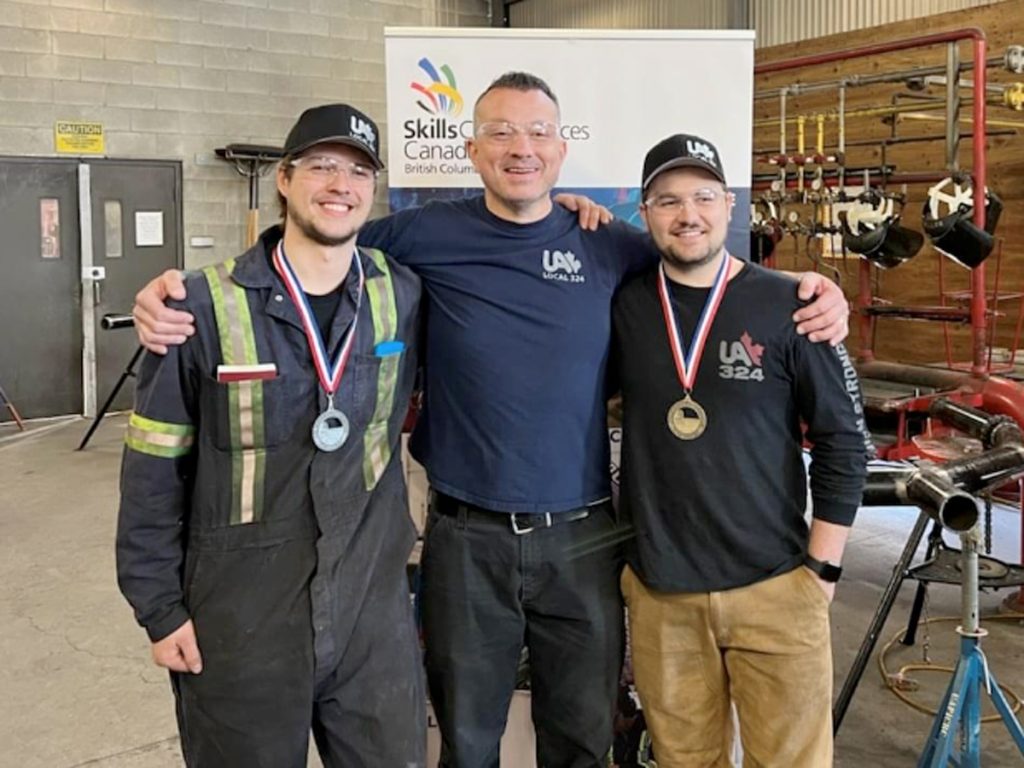
  [caption id="attachment_29728" align="aligncenter" width="595"] Jacob McFarlane (right) receives a gold medal at the BC Skills competition. Photo supplied.[/caption] Ashley Evans FMFCB/CS — The Pipefitter Shop at Fleet Maintenance Facility Cape Breton (FMFCB) has cause for celebration this month. Their apprentice Jacob McFarlane won a gold medal in the Steam/Pipefitter challenge at the Skills BC competition, held in United Association (UA) 170 Hall/ Training Facility. McFarlane, a third year steam/pipefitter apprentice, attended the competition on April 9 after getting scouted with another member of his class by the Training Director at Vancouver Island Piping Industry Joint Training Committee at Camosun College and a union representative from UA 324. Contestants went into the competition not knowing what tasks they would have to tackle, making preparation somewhat challenging. “I wasn’t sure what we would be making; so, I didn’t know what I should practice,” says McFarlane. “So I practiced a bit of everything.” Contestants arrived to a workstation with a tool cart and an envelope that held directions to what they were to fabricate within the allotted time of seven hours, with a 45-minute break. McFarlane says the project included making a three-piece mitered 90-degree bend with an equal offset Y on the end. He had to ensure his measurements were correct and that his math had been done accurately to achieve the right angles and to make the cuts. He also had to put a 37-degree bevel on the ends of each pipe, with a 1/8th weld gap. He then had to ensure the structure was all level with correct gaps before tacking it together, which he said took a couple of tries. The most challenging aspect of this project was cutting the pipe with an oxy-acetylene torch, which is something he had not done much other than in school. Additionally, it...

Chaplain-in-training nominated for literary award

Peter MallettStaff Writer — SLt Katherine Walker was brimming with pride when her crime novel All is Well was published by Thistledown Press last year. She didn’t think it could get much better than holding a hard copy filled with her writing. However, on April 20 All is Well earned her a nomination for Best Crime First Novel in 2022 by Crime Writers of Canada. She joins four other first-time Canadian authors, all vying for the win. “It feels so good and affirming on so many levels to be recognized,” she says. “To be able to craft a good crime novel and then have all the pieces fall into place was wonderful, but then to be included in an awards presentation with so many great writers is simply magical.” The central character in her novel is Christine Wright, a former Special Forces soldier transitioning into her role as a minister at a church set in downtown Victoria. SLt Walker is in the final stages of her training to become a chaplain, and says writing about a former military member turned chaplain was slightly surreal. The plot follows the protagonist after she murders her attacker with a candlestick in the book’s opening chapter. After which the dark comedy unfolds as Wright’s poorly planned cover-up slowly unravels. “Writing is the way I can share myself and my stories with the rest of the world,” she says. Award winners will be announced later this month in a ceremony streamed live on YouTube. Crime Writers of Canada was established in 1982 by Globe and Mail crime and fiction reviewer Derrick Murdoch. It is a national non-profit organization for Canadian mystery and crime writers, associated professionals, and others with a serious interest in Canadian crime writing. For more information and for a complete list of nominees for its annual awards visit www.crimewriterscanada.com  

CFB Halifax Archery Club

On the mark: CFB Halifax Archery Club restarts

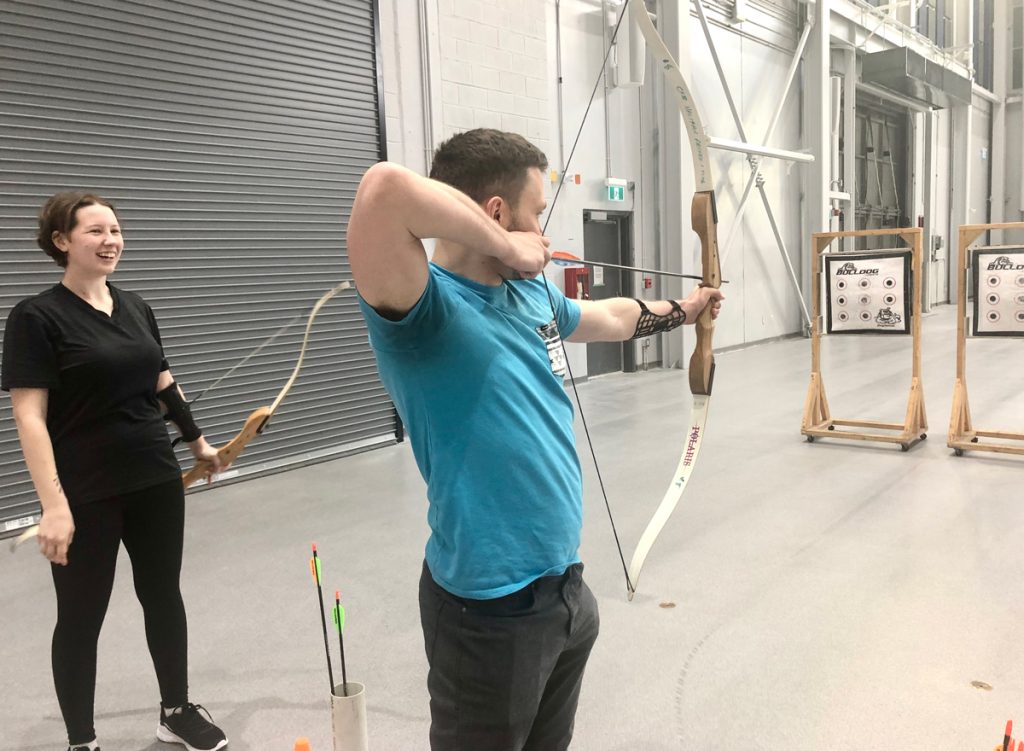
[caption id="attachment_29701" align="aligncenter" width="595"] S3 Kate Briand (left) looks on as S3 Noah Locke gets ready to fire his arrow during a trial shoot night for the newly re-formed CFB Halifax Archery Club. Photo: Joanie Veitch, Trident Staff.[/caption] Joanie VeitchTrident Newspaper — After a hiatus of more than eight years, the CFB Halifax Archery Club is back on the shooting range. Officially starting up again on April 1, the recently re-formed club has been running trial shoots over the last few months in the drill hall at S-120, the Consolidated Seamanship Training Facility at Stadacona, with new and returning members from the former club participating. Judging by the amount of traffic on the club’s Facebook page — Front Line Archers — the resurrection of the club has generated a lot of interest, says CPO2 Ian Smith, one of the organizers and a member of the club’s executive board. “We currently have 66 members on Front Line Archers. Many have been keenly following the club’s progression over the past two years. Many of those members have been out for our trial shoots and the feedback has been positive.”  From the early 1990s until 2014, when the former drill hall was demolished, the CFB Halifax Archery Club was a popular and competitive club.  The club was originally formed to give military families an activity they could do together on base. Some members of the club went on to compete at an elite level. Despite the years of resounding success, as some of the key organizing members got posted away from Halifax, the original CFB Halifax Archery Club began to lose some momentum. Then the club’s home, the old drill shed, was deemed unsafe to use and that became the final arrow in the club. Equipment was stored in a shed beside the...

Sailor staying sharp with fencing nationals

[caption id="attachment_29695" align="aligncenter" width="595"] S1 Kevin Leung shows off his fencing gear and Épée (sword). The 29-year-old has been training several hours per week in preparation for fencing’s Canadian National Championships in Toronto, May 20 to 23. Photo by Peter Mallett, Lookout.[/caption] Peter Mallett Staff Writer — He may be a late bloomer to the sport of fencing, but S1 Kevin Leung is ready-aye-ready to put his sword skills to the test against Canada’s best. It was only three years ago that the 29-year-old Naval Communicator first discovered the historic art of fencing and the subtle differences between the three swords: the foil, sabre, and Épée. Later this month he will put his best foot forward at the 2022 Canadian National Championships in Toronto. The tournament, May 20 to 23 at the University of Toronto, is his second national competition and 10th tournament. He sees gradual improvement in his performance with each competition. To prepare, he practices his moves and footwork four times a week at local club OSM Fencing, takes private lessons, and participates in a highly demanding workout program that involves intense exercise. All about strategy S1 Leung’s introduction to fencing came in 2019 during a port visit to Hawaii while in HMCS Ottawa. He watched videos of elite fencers Eli Schenkel, Georgina Usher, Max Heinzer, and Áron Szilágyi compete at the Olympics. “These Olympians were all lightning fast and precise, it was inspiring. Then it hit me, I have always liked swords and there was a sport that allows for sword play, so I thought this might be fun.” The appeal of fencing, he says, is because it’s added more of a mental game than a test of physical prowess. “On the surface fencing looks like a bunch of people hopping around and trying to stab each other, but in reality it’s all about strategy, tactics, and exploiting the gaps your opponent makes. You plan your next move and read your opponent’s next move.” Impressive start  His first...

Explore More

Categories

Top News

E-Editions Archive

News Stories Archive

Proud Supporters

Joshua Buck, Lookout Newspaper