[wpml_language_selector_widget]
[searchwp_form id="1"]

HMCS Calgary sailors learn Vietnamese while deployed in Asia

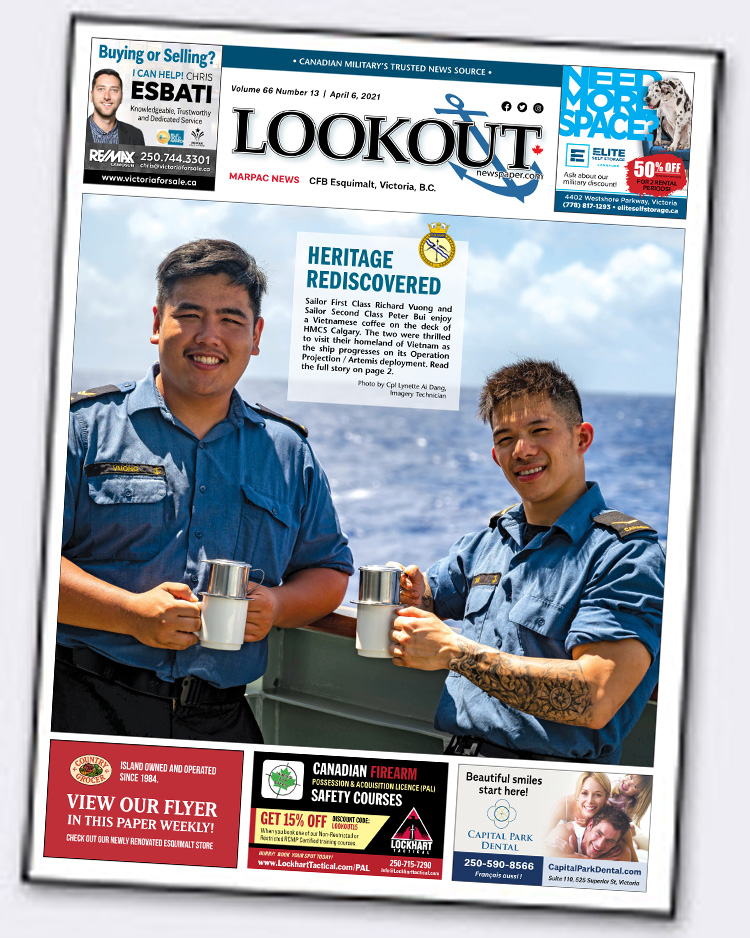
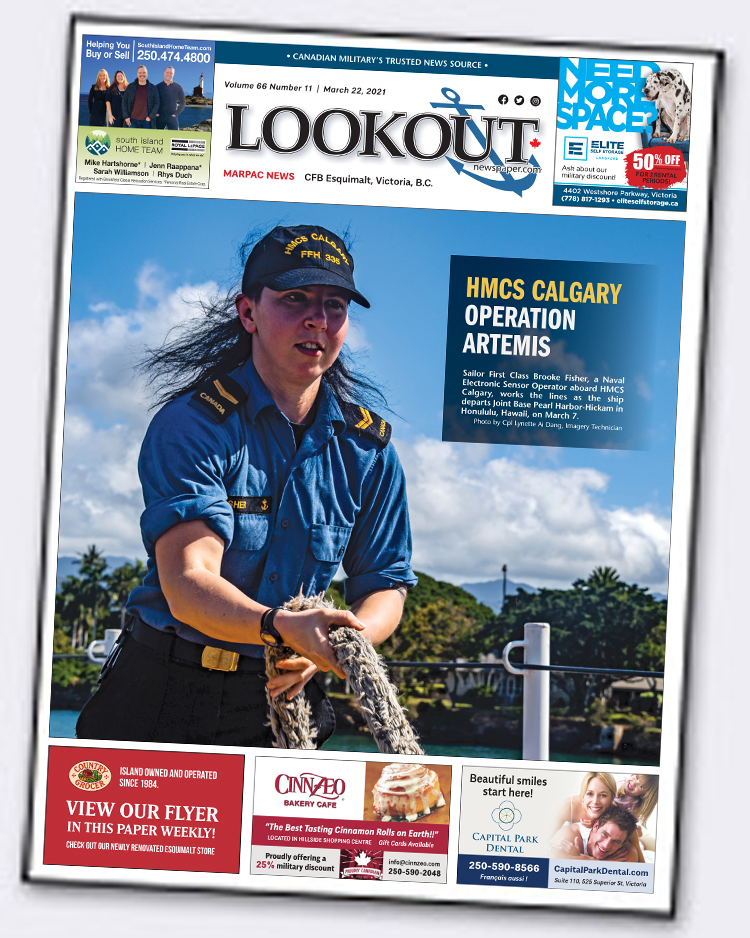
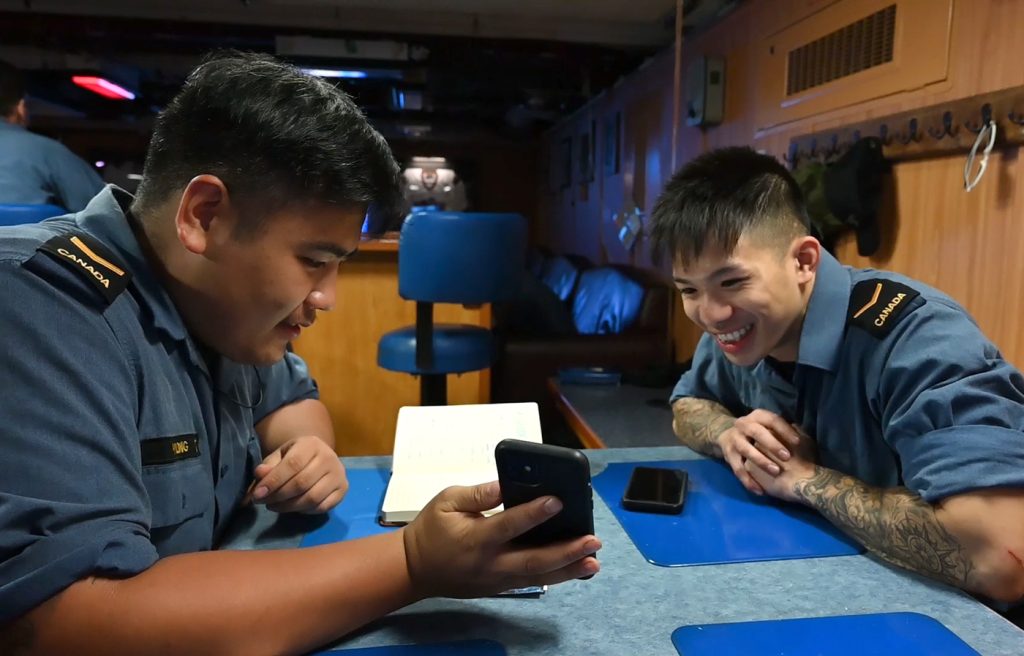
[caption id="attachment_25628" align="aligncenter" width="595"] Sailor First Class Richard Vuong (left) and Sailor Second Class Peter Bui were thrilled to visit their homeland of Vietnam as the ship progresses on its Operation Projection / Artemis deployment. Photo by Cpl Lynette Ai Dang, Imagery Technician[/caption]Capt Jeff KlassenHMCS Calgary PAO––Two HMCS Calgary sailors, both with Vietnamese heritage, have remarkably similar stories and were excited for the fuel stop in Cam Ranh International Port, Vietnam, even though they couldn’t step foot on land because of COVID-19.Marine Technician’s Sailor First Class (S1) Richard Vuong and Sailor Second Class (S2) Peter Bui are natural-born Canadians brought up in families that follow traditional Vietnamese customs; both parents were born and raised in Vietnam.Despite not being able to go ashore in Vietnam as part of Operation Projection, both sailors are studying Vietnamese during the deployment, an affirmation of their heritage.S1 Vuong’s Vietnamese girlfriend has been teaching him the language. He hired her as a tutor before going on deployment. They hit it off, he says. They frequently video call and she helps him with his pronunciation.He started learning Vietnamese just in case he could go to Ho Chi Minh City in the South and Haiphong and Hong Gai, near Ha Long Bay in the North to meet his ancestors. “I wasn’t able to go to a Vietnamese coffee shop on this deployment, but I was still excited to actually see the country with my own eyes, even if it was just from the ship,” he says.S2 Bui worked on a small northern Vietnamese farm as a teen.“When I found out we were going to Vietnam, even though we couldn’t get off the jetty, I was really happy. I was so excited to see my home country again.”S2 Bui’s parents moved to Canada when he was young and for years his knowledge...
Naden Band gets ‘In the Groove’ for World Health Day

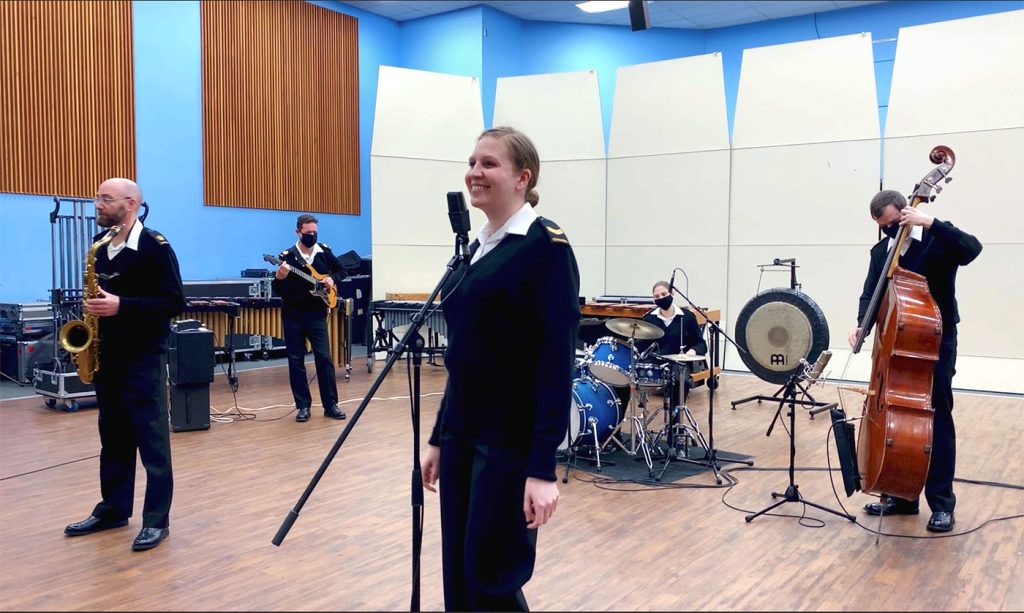
[caption id="attachment_25625" align="aligncenter" width="595"] Members of the Naden Band perform the song Hang In There at the Naden Band headquarters.[/caption]Peter MallettStaff Writer––A new music video produced by the Naden Band encourages people to stay the course in the fight against COVID-19 with messages of support from the base community. The song entitled Hang in There was written by band member PO1 Jeff Cooper with PO 2 Stephen MacDonald helping with the harmony. It’s in celebration of World Health Day on April 7. “The world has faced some incredible challenges in the last year and I think we all need some encouragement to keep doing the right things,” says PO1 Cooper. “There are so many people out there who are putting themselves on the line to serve the greater good and this is a big thank you to all of them. Living through the pandemic for the past year has made us look at everything through the lens of how it impacts our health and how our actions affect others.” The music video is available through the band’s official Facebook account. It features a five member band performing the song as well as footage of base personnel sending shout outs of support.The song is written in a standard jazz format with S1 Laura Andrew on vocals, and solos performed by PO1 Jeff Cooper on saxophone, PO2 Stephan MacDonald on guitar, PO2 Ross Macdonald on stand-up bass, and S1 Sandra Veilleux holds it all together on drums. “I enjoyed everyone’s playing, we’ve got a good groove and it feels right,” said PO1 Cooper. “I also really enjoyed the contributions of people around the base, everyone we contacted was happy to participate and it really helped fill out the supportive community vibe we were going for.” Video production was completed by an in-house team of technicians...

Life at sea – Soup and unique navy words

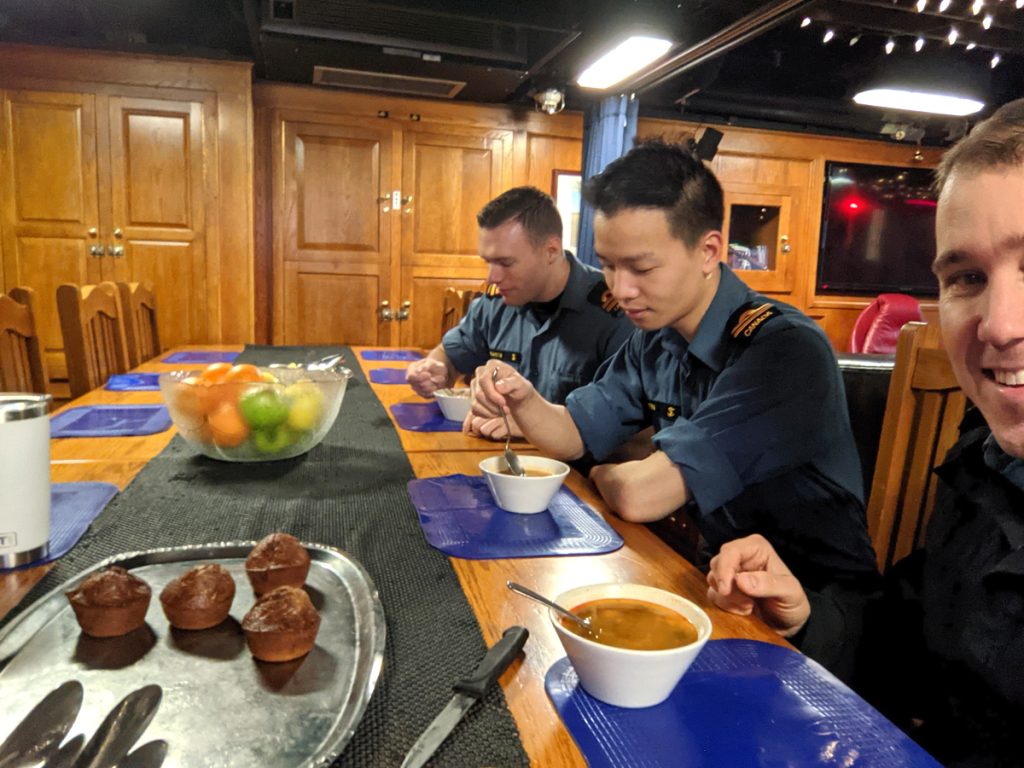
Lt Jeff Klassen Public Affairs Officer––I sailed in HMCS Regina earlier this year. While there, I wrote about my experiences in a BLOG and this is a continuation of that.Navy culture is really quite different to the other environments. They do all sorts of unique things, some of them dating back hundreds of years. One tradition is “Soup”.Now you might think soup is a lunch-evening type of thing. But in the navy it’s a morning thing.Every day at 10 a.m. navy cooks serve soup; in fact, it’s called “10 o’clock soup”.  At that time, a significant portion of the crew stops what they are doing and eats soup. I’ve heard it might be to help counter sea sickness, but I’m not sure.  It seems to just be a thing.Another thing about the navy is it has all sorts of special words and navy people love telling you about them.Here’s some of the ones I’ve discovered.Rack = BedDeck = FloorDeck head = CeilingBulk head = WallHatch =  DoorShip = Boat Most naval vessels are called ships and you shouldn’t call them boats. For example, a frigate is a ship not a boat, but the small inflatable boarding vessels - called “RHIBs” – are boats.Life Preserver = Personal flotation deviceGalley = KitchenMess or cabin = BedroomGash = GarbageHeads = Toilets and WashroomsDuff = DessertNo Duff = You say this to mean that something is not a training exercise.Port and Starboard – If you’re looking in the direction of the front of the ship, port is left and starboard is right. I remember it by saying “p.s.”.Jack = A type of flag.Boatswain = Pronounced something like “Bo-sun’. This is a tradesperson who is sort of a boating jack-of-all-trades.Ping boatswain = Slang for sonar operator.Sin boatswain = Slang for a padre/chaplain.Baby doc = Medical...

New barges to bolster harbour ops

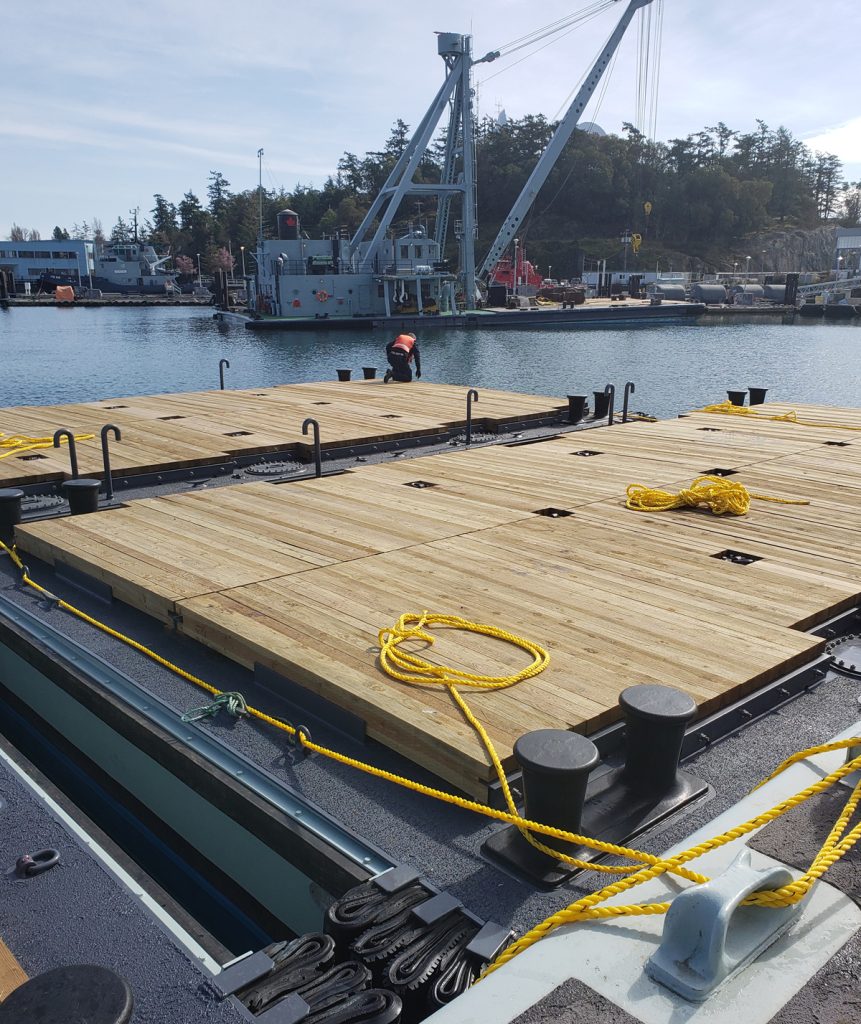
Peter MallettStaff Writer––A quartet of barges are set to make water-side ship maintenance a little easier.Four Stevedoring barges, constructed by Canadian Maritime Engineering of Port Alberni, were towed to the base by tugboat, and became crown assets on March 12. After the final certifying documentation is received from the contractor, there will be an official transfer of ownership from crown assets to Port Operations and Emergency Services Branch. Then, they will be put into use by Auxiliary Fleet crews. “The new equipment will make our work easier as temporary work platforms currently being used are much larger and cumbersome,” says George Morris, QHM Assistant Engineering Superintendent. “These new Stevedoring barges have the same purpose but are easier to manoeuvre in tight spaces near the jetties.” Each barge measures approximately 6 x 12 metres and features replaceable wooden deck tops. They are the replacement for the YC50 Series scows that have been out of service since 2016. The much larger 250 series barges have been used by work crews as a temporary fix since YC50 Series scows were phased out. The new barges will be a platform for personnel working on a ship’s hull; painting of anchors; repairs to the Cantass and Nixie equipment and the sonar and torpedo decoys towed by warships; transporting equipment across the harbour, including submarine casings, brows, stands, berthing equipment and other items; and used as fenders for visiting ships. Their wooden deck tops are 20 centimetre thick and built to withstand the rigours of every Queen’s Harbour Master and fleet evolution, says Morris. “Should one of the beams be damaged to the point of needing replacement, the process of making repairs is much easier.” The newly acquired Stevedoring are currently tied up alongside C4 jetty in Dockyard until the completion of the Small Boat Floats project in 2022.––––

HMCS Malahat holds first-ever Virtual Training Mess Dinner

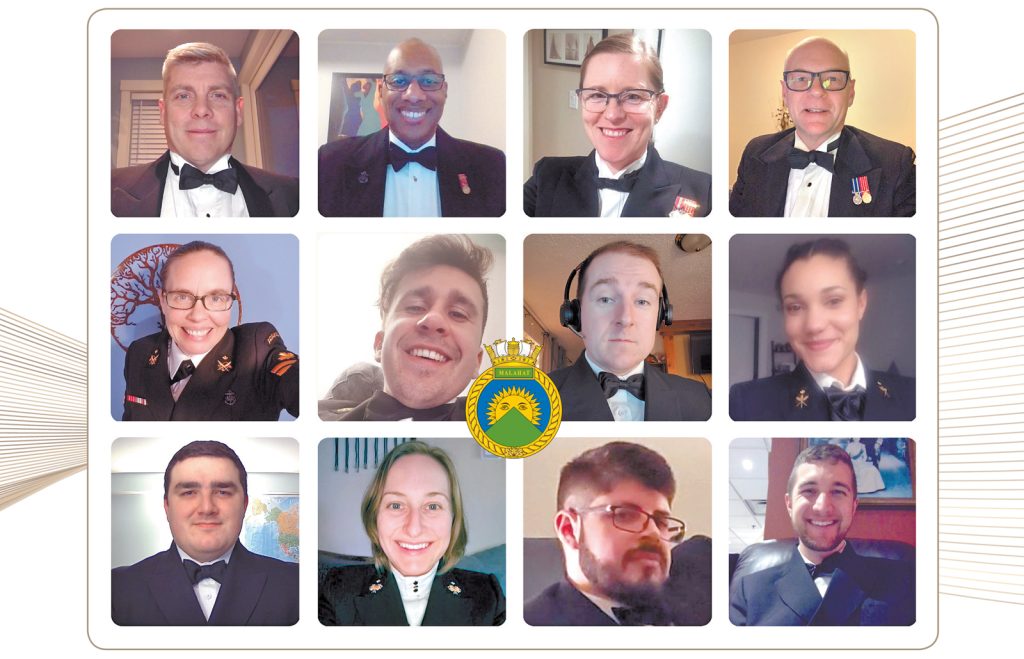
SLt Donald DenHMCS Malahat PAO––Since the onset of COVID-19, Victoria’s Naval Reserve Division HMCS Malahat has “cracked the code” when it comes to conducting regular training.Malahat has gotten members in boats, divers in the water, and held regular training nights since the pandemic began. When it comes to personnel readiness, Malahat and the Royal Canadian Naval Reserve are doing well.However, people also join the Naval Reserve for the camaraderie, and maintaining that social aspect during a pandemic has proved to be difficult to nurture. Social events and fairs have been put on hold and all the messes at Malahat remain closed under provincial health and safety regulations.For the 2020 holiday season, Malahat conducted a small, virtual departmental Zoom session in place of a larger event, which is where the idea started for a ‘Virtual’ Training Mess Dinner.It is one of the Royal Canadian Navy’s most storied social events where members dress in their best formal wear and enjoy a meal together – all while observing a multitude of naval traditions.“A Mess Dinner is full of pomp and circumstance, but it also comes with strict protocols and ceremonial proceedings,” says Lt(N) Roland Young. “It seemed daunting, but we wanted to see if we could do it.”Over several weeks, with members meeting safely in-unit at Malahat and virtually via Zoom, the event gradually began to take shape. It involved specified traditional roles that come with the Mess Dinner, such as President, Vice-President, and Secretary. It also required a full script, several walkthroughs, and even storyboarding to put it together in a virtual environment.“We knew from experience that we had to be prepared for every eventuality, such as glitches or dropped calls. All plans work until they meet reality,” said Lt(N) Young, who coordinated the Mess Dinner and eventually took on the role...

Cadets chose their own adventure during virtual spring break

FSgt Jaskirat Singh888 Avenger RCACS, Vancouver WO2 Myranda Middleton 848 Royal Roads RCACS, VictoriaWO Harmannat Pabla 3300 British Columbia Regiment Bhai Kanhaiya, RCACC, Surrey––Cadets in B.C. haven’t been able to train in person since November 2020, but that hasn’t stopped them from having unique experiences and opportunities.Spring Break was no exception.Throughout the two-week break,  225 sea, army, and air cadets logged onto WebEx each day to advance their skills, make new friends, and have fun virtually with through the Spring Break Cadet Activities Program.Cadets had access to drop-in workshops ranging from boat and buoyancy basics, building shelters, human synergistics, photography, and music. Forty cadets also earned their Pleasure Craft Operator’s Card by completing Module 1 of the Small Craft Operator Permit course.A major highlight of the weekly program included a virtual CAF Familiarization tour of Operation Palaci with Lt McGall, First Regiment Canadian Horse Artillary Shilo, Manitoba, and WO Ubbing from the 20th Field Regiment in Red Deer, Alberta.They discussed how Op Palaci helps control avalanches in Rogers Pass and answered questions from cadets.More than 70 cadets also participated in a virtual tour of 442 Transport and Rescue Squadron located at 19 Wing Comox led by Major Ryan Port, CC-115 Buffalo Flight Commander. Cadets were shown around a CC-115 Buffalo, and the systems that support it, and then talked to Maj Port about flying, search and rescue, and life at 19 Wing. Citizenship is another aspect of the Cadet Program; cadets were treated to a tour of the British Columbia legislature, led by MLA Dan Davies, who is also a Cadet Instructor’s Cadre Officer. Cadets learned history of the Legislature and how bills are reviewed and voted upon. In addition, cadets asked Davies about aspects of his job and the government process.Spring Break offered Year 5 workshops to senior cadets. In their...

Firefighter’s effort results in better health protection

[caption id="attachment_25585" align="aligncenter" width="594"] Capt(N) Sam Sader, Base Commander, presents base firefighter Curt Morwick with a Bravo Zulu for his work to improve the occupational health and safety of his co-workers. Photo by: Sailor First Class (S1) Sisi Xu, MARPAC Imaging Services, Esquimalt[/caption]Peter MallettStaff Writer––Sometimes all it takes is a little ingenuity and a desire to effect positive change to make a workplace better. A year ago, firefighter Curt Morwick set about to improve the balaclava-style hood used by himself and other firefighters at CFB Esquimalt Fire and Rescue. His team used disposable, single-use hoods to protect them when fighting a fire, or just out on an emergency. It is fitted between the firefighter’s helmet, protective gear, and tucked into their clothing. Wearing it helps prevent harmful amounts of microscopic carcinogenic particles generated by burning materials from being absorbed by their skin. These particles can travel through traditional knitted hoods and accumulate on absorptive areas of the neck, jaw, and throat. He knew, through a 2002 study by the United States Firefighter Cancer Support Network, that firefighters have a 61 percent greater likelihood of dying from cancer than the regular population. For every five degree Fahrenheit increase in body temperature, the skin contamination rate increases by 400 percent.He and another firefighter bought and tested a Gray Particulate Blocking Hood from manufacturer Innotex. Their product offers two layers of protection, are thicker and larger than traditional hoods covering more of the firefighters face and upper body. It features an elastic sewn face opening that provides a better protective seal and has a longer drop to cover more of the chest, shoulder, and neck. The hoods are also machine-washable and can be reused up to 100 times. Morwick, also on the unit’s health and safety team, had them added to their standard kit of protective safety gear. “I am glad we now have more protection,” he says. “The members of our team all have families and children to go home to at...

HMS Montrose seizes third drug haul in five weeks

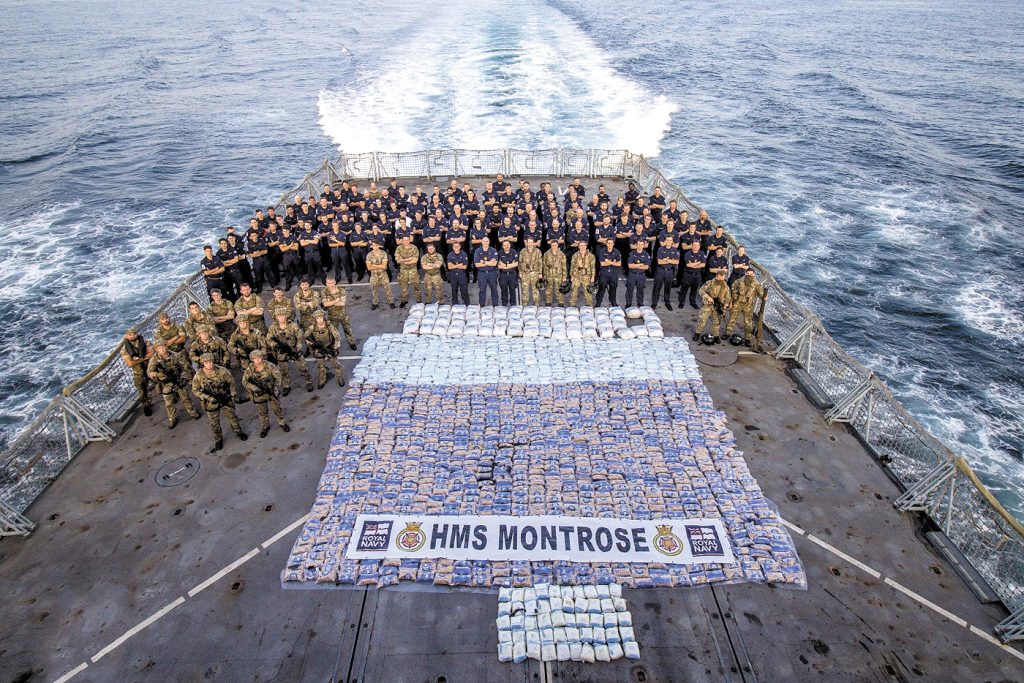
[caption id="attachment_25582" align="aligncenter" width="594"] Royal Navy and Royal Marines from HMS Montrose stand with more than 2,800 kilograms of narcotics seized from a vessel in the Arabian Sea on March 12. Photo: AET Josh Edwards RN[/caption]Combined Maritime Forces––Royal Navy frigate HMS Montrose has struck success for a third time in less than five weeks. In an operation lasting 10 hours, Montrose intercepted over 2,800 kilograms (6,100 lbs) of hashish and 50 kg (110 lbs) of heroin in the Arabian Sea, March 12.The boarding team from the ship, operating in direct support of Combined Maritime Forces’ Combined Task Force 150, seized the drugs – with an estimated wholesale value of over $4.5 million – following searches of suspicious vessels whilst undertaking a counter-narcotics patrol. This latest successful interdiction has further deprived criminal and terrorist networks of their ability to finance their operations through the transport and sale of illicit cargo. “It is purely coincidental that this operational success falls on my last day at sea in Command,” said Commander Ollie Hucker, HMS Montrose Commanding Officer. “Be it the first day or the last day, these results only happen because of the collective effort and skill of the incredibly professional, highly trained and dedicated people that the Royal Navy employs, and that I have the privilege to command.”This is the latest in a string of successful counter-narcotics operations since the Royal Canadian Navy assumed command of CTF-150 in late January 2021. CTF-150, one of three Combined Maritime Forces task forces, is operating in the region to disrupt criminal and terrorist organizations and to prevent the illegal trade of drugs and weapons. As part of this, Montrose alone has intercepted a combined haul of more than 5,220 kg (11,510 lbs) over the ship’s last three interdictions, striking a tangible blow in the war...

Chilly training for clearance divers during ICEDIVEX 21

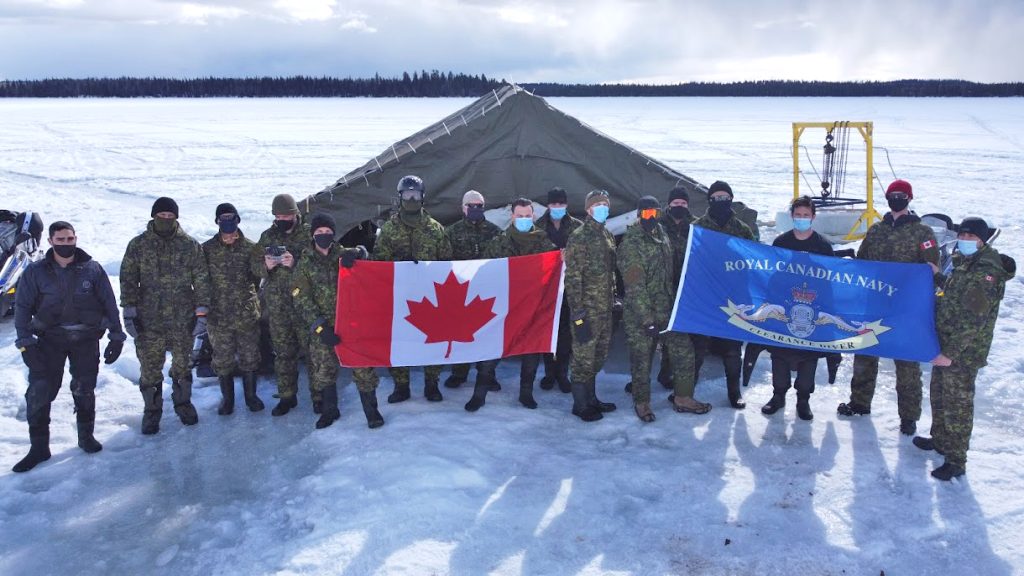
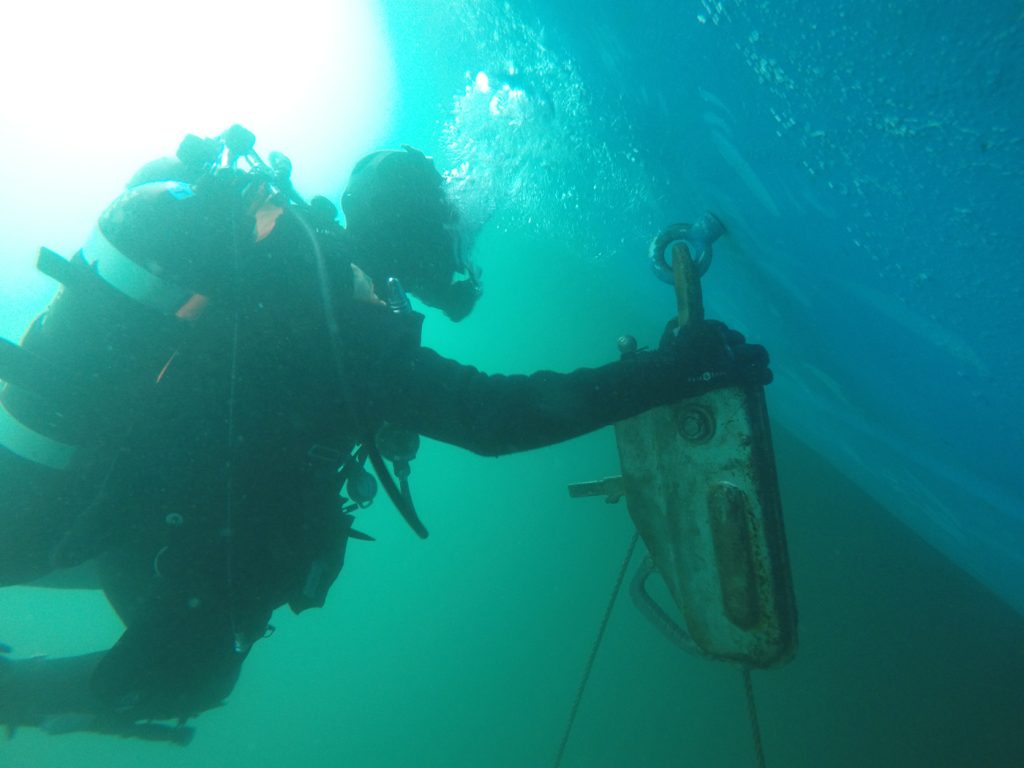
[caption id="attachment_25576" align="aligncenter" width="594"] Members of the ICEDIVEX 21 team pose for a group photograph at their dive site out on the lake. Photo by FDU(P)[/caption]Peter MallettStaff Writer––Diving in icy waters might not appeal to most civilian divers but for the navy’s Clearance Divers it is a must. To maintain operational diving expertise in extreme cold and under-ice environments, they must train to operate in these harsh conditions and ensure their equipment works well. This was tested the first week of March when nine Fleet Diving Unit (Pacific) Clearance Divers, four Port Inspection Divers, two Marine Technicians and one Physician Assistant deployed to Sheridan Lake, B.C., for ICEDIVEX 21. Divers, dressed head-to-toe in Ultra-Light Weight Surface Supplied diving equipment and sheltered underneath a modular tent situated on the lake, slipped into a carved-out hole in the ice to exercise in the frigid waters below.Divers deployed in teams of two, with a third ‘Standby Diver’ remaining on the surface ready to respond in case of emergency. There is the potential for the umbilical, which provides communications and air between the surface and divers, to become severed and for the diver to then become lost in the cold and murky water. As such, the divers all practiced anchoring themselves to the underside of the ice with an ice screw; the normal response to such a situation. This rescue procedure was practiced with the “lost” diver attaching themselves to the ice while the Standby Diver searched for them in the near-dark water. On the surface, another member remained in constant communication with the entire team. “The water was quite cold and visibility was poor given our depth and the darkness under the ice,” said Lt(N) Jesse Deason, an FDU(P) Clearance Diving Officer. Before travelling on the lake, the team underwent two days of...

Raising the flag for transgender pride

[caption id="attachment_25568" align="aligncenter" width="595"] Positive Space Ambassador S1 Danielle Dewitt says it is an honour to raise one of the first-ever transgender pride flags at the base this week.[/caption]Maritime Forces Pacific will make history Wednesday when it raises the Transgender Pride Flag in Dockyard, Work Point, and at Naden at 8 a.m. The ceremony corresponds with International Transgender Day of Visibility that was founded by transgender activist Rachel Crandall in 2009 in reaction to the lack of recognition of transgender people. The annual event, held on March 31, is dedicated to celebrating the resilience and success of transgender people, and to raise awareness of discrimination faced by transgender people worldwide.The flag-raising ceremonies demonstrate the West Coast formation’s commitment to an inclusive workplace and this is an important step in showing that the CAF is not just accepting of the LGBTQ2+ community, but is proud to welcome members of all gender identities, expressions, and sexual orientations.All provincial health and safety protocols will be in place for those wanting to attend and include physical distancing and the wearing of non-medical facemasks.The flag-raising is an important step towards inclusiveness, says S1 Danielle Dewitt and CPO2 Lyne Edmondson, who both identify as transgender. S1 Dewitt, 38, works as a Senior Boatswain in the Patrol Craft Training Unit and identifies as a woman. She was the first person to raise the Pride flag at CFB Halifax in 2017, and will take part in the first hoisting of the transgender flag at Duntze Head.“I am incredibly honoured to be chosen to raise the flag and can’t wait for this,” says S1 Dewitt.The feeling is mutual for CPO2 Edmondson who will also be involved in this week’s watershed moment. A Weapons Engineering Technician by trade, she now works as the Staff Officer New Capability Integration, Detachment West....

Life at sea – It’s a mess (where you sleep)

[caption id="attachment_25556" align="aligncenter" width="595"] Lt Jeff Klassen, outside his mess room door.[/caption]By Lt Jeff KlassenPublic Affairs Officer––This is the third in a series of blog posts about my experiences while sailing with HMCS Regina, a Canadian Halifax-class warship.Blog Post THREE: It’s a mess (where you sleep).In a ship you don’t sleep in a bedroom; you sleep either in a ‘cabin’ or a ‘mess’ (or sometimes at your workstation, but you shouldn’t). The difference between the two is that cabins typically have less beds in them than messes and contain desks and a sink, while messes are more just bunk beds and lockers (bunks are actually called “racks” on ship, just so you know). Typically. officers have cabins so they can double as computer workspaces, while non-commissioned members usually make up the messes. The only people that sleep alone are the ship’s Commanding Officer, the Coxswain (the ship’s Chief in charge of the well-being and order of the crew), the Executive Officer (the right hand of the Captain), and, in Regina, the Physician Assistant (this is not the case on all Halifax-class ships at all times).I’m in a mess with five other people and it’s been interesting trying to figure out what makes good mess etiquette, and my mess mates have been pretty cool about my whole “learning process”. The particular challenge is due to some crew members being “night workers”; at almost all times of the day there is someone sleeping in your mess so you don’t want to disturb them. For this blog post, I’m going to give you the do’s and don’ts of living in mess.Don't:turn the light on, as there is almost always someone sleeping.leave your curtains closed when you’re not sleeping. Curtains cover your bed when you are sleeping so you have some privacy. If you...

Veteran celebrates 106th birthday with a new-fashioned party

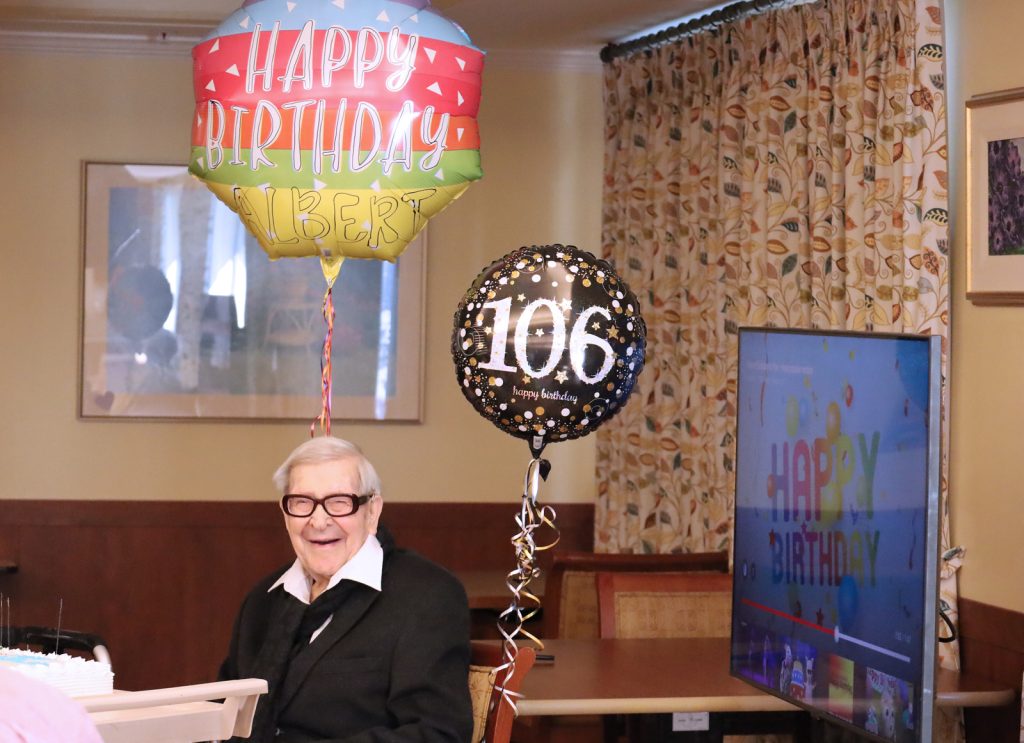
[caption id="attachment_25553" align="aligncenter" width="594"] Albert Middleton celebrated his 106th birthday on March 11.[/caption]Peter MallettStaff Writer––There were smiles, toasts to good health, and plenty of cheer when one of Canada’s oldest veterans celebrated his 106th birthday milestone.The small gathering of in-person and virtual well-wishers came together in the dining room at Veterans Memorial Lodge on March 11 to honour Albert Middleton. “I really enjoyed the party and it was so good to see all of the wonderful people who came out to help me celebrate,” said Middleton. “My favourite part was having a good old-fashioned party complete with champagne, cake, and some big band music.”As a centenarian-plus, he has survived two world wars and lived through two pandemics. When Middleton was born in London, England, in 1915, the Panama Canal had just been built, Sir Robert Borden was Prime Minister of Canada, and a new technology called “radio” was still in its infancy. He was sent to Canada as a First World War orphan, arriving in Toronto in 1929 when he was 14. In 1943, at the height of the Second World War, he signed up for the Air Force and served as a Leading Aircraft Man. During his military career, Middleton worked as a mechanic and maintenance worker servicing RCAF and RAF aircraft in London. “I didn’t want to get drafted, so I thought I would join up and be done with it,” said Middleton. For most of the war he worked in airplane hangars servicing and repairing warplanes. “Thankfully, I wasn’t a pilot as that was a really dangerous job; I stayed on the ground during the war,” he said. “Nevertheless, it was hard work keeping all the planes up and running. We really didn’t know too much about what was going on in the war itself, so we just...

Boot camps get reboot at Albert Head

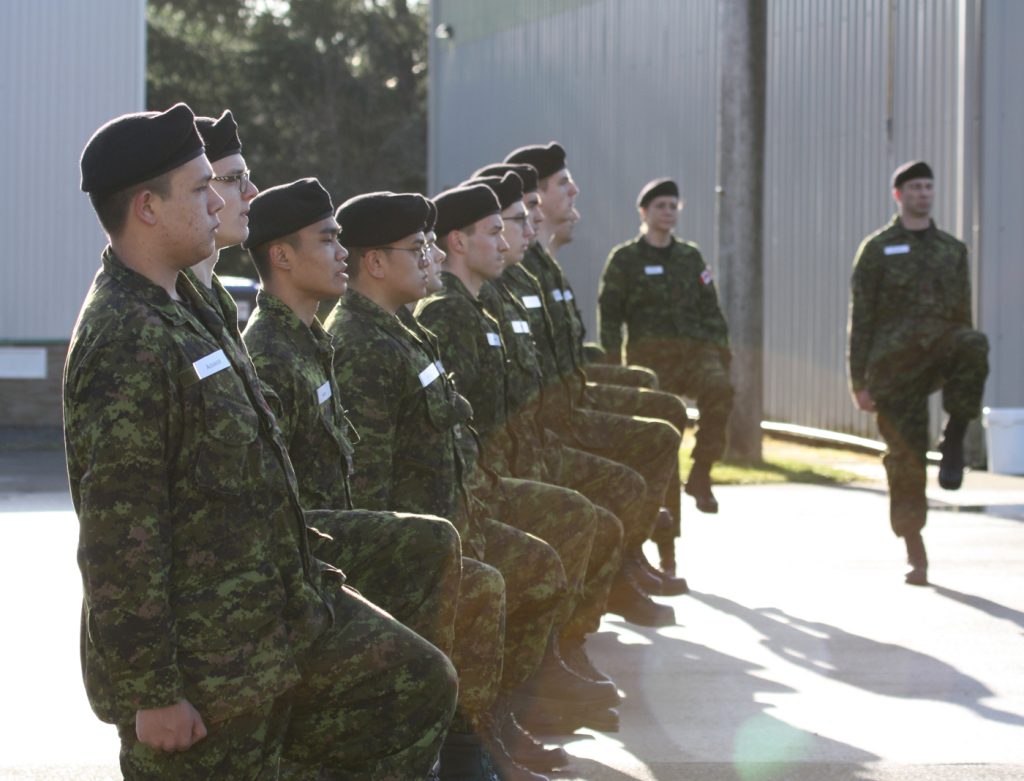
Peter MallettStaff Writer––Albert Head Training Centre is now the location for the Decentralized Basic Military Qualification (DBMQ) on the West Coast. Naval Fleet School Pacific moved its basic training operations for naval recruits from Work Point and is currently conducting the first of five DBMQ serials in Metchosin. This year’s training will run from March to November 2021. The goal is to continue safely training the navy’s newest sailors through a COVID-19 persistent environment. Each of the five serials consists of 55 mostly Regular Force naval recruits who will learn inside a training bubble and be confined to the base for a period of 10 weeks. “Last year, the first serial we ran with an eye to seeing if we could do it and make it work,” said LCdr Mike Erwin, NFS(P) Seamanship Division Commander. “Now we are running our Basic Military Qualifications with an eye to sustained operations and turning Albert Head into a centre of excellence.” Work Point was a great starting point to train the first group of recruits last year, he says, but adds a more permanent solution was needed to accommodate this year’s greatly expanded list of 275 naval recruits. Recruits enter a two-week isolation period at the Wardroom before their transfer by bus to Albert Head. Training is then delivered by Naval Fleet School Pacific under the leadership of the Naval Personnel Training Group. Recruits are closely monitored by Canadian Forces Health Services (Pacific) staff throughout their arrival in Victoria to mitigate any potential COVID-19 exposures. Both Fleet Schools on either coast are training for Regular Force recruits, while Naval Fleet School (Quebec) is supporting training for the Naval Reserve recruits at Camp Vimy, CFB Valcartier.Up until last year, Basic Military Qualification for all recruits was centralized at Canadian Forces Leadership and Recruit School...

Sailor Profile: Lt(N) Wilson Gonese

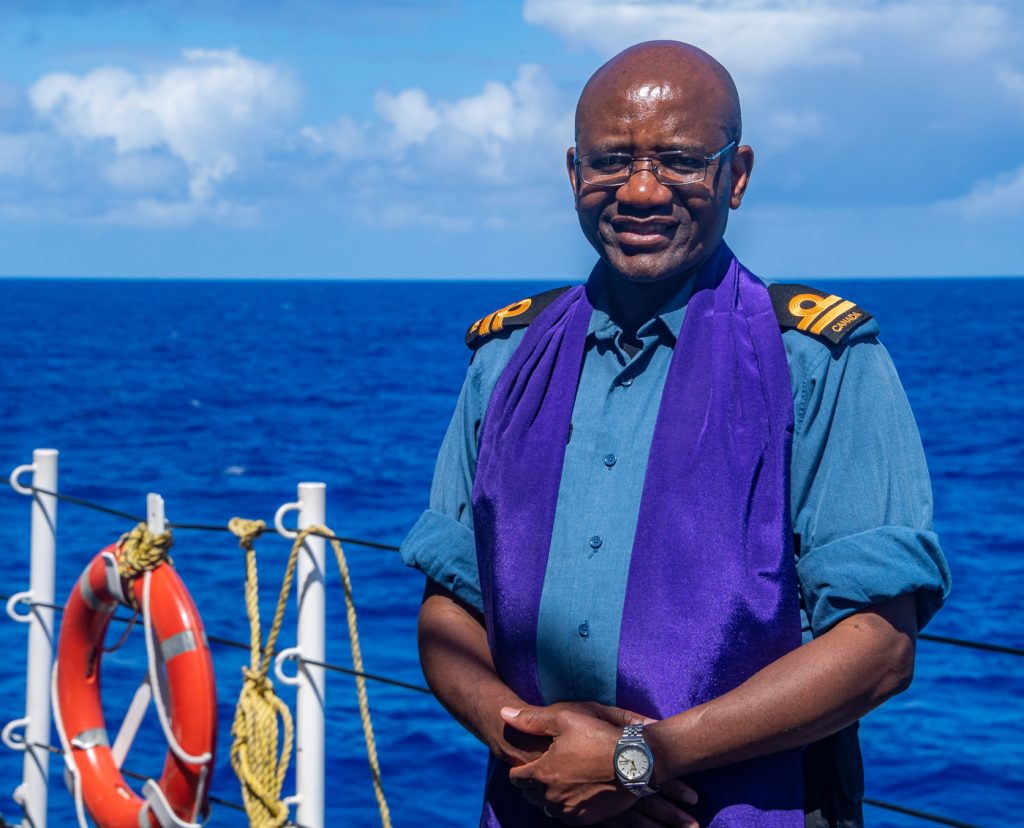
Captain Jeff KlassenHMCS Calgary PAO––From a farm in Africa, to communities in Newfoundland, and then to Asia and the Middle East on a warship – the adventure of HMCS Calgary’s chaplain continues.Lieutenant (Navy) Wilson Gonese grew up on a farm in Gutu, Zimbabwe. He received a calling from God and after high school told his parents he wanted to be a minister. “At first it was not accepted because ministers were not paid well. My family wanted me to go into nursing or teaching, anything more secure. But I was convinced God was calling.” For 13 years, Lt(N) Gonese served as a minister in the Reform Church in several communities in Zimbabwe and Botswana. In 2007, with hopes of a better life, he and his wife and their two children took a one-way flight to Canada where he continued to work as a United Church Minister in Newfoundland in the communities of Burgeo, Springdale, and Carbonear.“Moving to Canada from Africa was a huge transition. The cold weather, cultural shock, not knowing whether we would succeed or not. Still, the people of Newfoundland are very friendly and welcoming, so I had a very good time there.”In 2018, he had another calling - to join the Canadian Armed Forces as a Chaplain. “I wanted to serve the country alongside serving members. I looked at the men and women in uniform and I wanted to give them the support they need, to be there for them.”In 2020, he began the biggest adventure of his military career thus far - serving in HMCS Calgary by providing morale and spiritual support for those on board. He is currently embarked with the ship on its deployment to the Indo-Asia Pacific and Middle East regions on Operations Artemis and Projection. During this deployment, while the ship was...

Sailor profile: S2 Samantha-Lee Epstein

[caption id="attachment_25521" align="aligncenter" width="595"] S2 Samantha-Lee Epstein[/caption]Lt(N) C.E. GrantHMCS Moncton UPAR––Before joining HMCS Moncton for Operation Caribbe, boatswain Sailor Second Class (S2) Samantha-Lee Epstein had only one day at sea gained from a day sail aboard HMCS Oriole. She volunteered to sail in Moncton and headed south for the Caribbean in January to participate in U.S.-led enhanced counter-narcotics operations. It was her first time in a Maritime Coastal Defence Vessel.The Naval Reservist dove feet-first into Mission-Specific Readiness Training, and while this alone posed a significant challenge for the junior sailor, the story leading up to that moment speaks volumes about her perseverance and character.In August 2020, her mother passed away suddenly of a heart attack. In the wake of her loss, S2 Epstein travelled to Toronto to be with her father and spent a month tending to family matters, which was made all the more difficult due to COVID-19 restrictions and isolation requirements. “Coming back from Toronto and having to quarantine alone was difficult, but getting back to work with the support of my crewmates on Oriole was a tremendous help.”It was not long after her return that she was offered to join a new ship going on deployment. “Having the opportunity to come on Op Caribbe with HMCS Moncton felt like something I needed - a change of pace, different scenery, and a new challenge to keep me going. But it was also terrifying and challenging. I was extremely anxious before going on this sail that I wouldn’t be mentally capable of doing this yet. Also, doing something completely different from anything I had done before left me unsure of what to expect.”She overcame her pre-deployment uncertainty through a process leading up to the deployment.“My therapist, social worker, and the Canadian Armed Forces (CAF) medical team contacted me regularly...

Carol Hendrie – A Tribute

Roy Preyser and Douglas McCarthyFormation Review Staff (formerly BCompt Staff)––It was with great sadness that we learned of the passing of Carol Hendrie in December 2020, a cherished retiree from the Base Comptroller (BCompt) branch.  Although we aren’t fully aware of all the positions she held over the years, we know for certain that she worked at CFB Shilo prior to her arrival at CFB Esquimalt.Carol was a central member of the BCompt branch staff and known throughout the Formation as a diligent, knowledgeable, and proficient member of the finance community. For years, the BCompt branch was assigned the Regional Departmental Accounting Office responsibility of providing guidance and oversight for financial policy and processes within the Formation.  As the Base Financial Management Supervisor, she provided training for countless users in the old FIS finance system, and then subsequently the replacement FMAS system (now known as DRMIS).  Her knowledge of government financial policy and procedures was unmatched, and she gladly shared her expertise with everyone.Carol was a key player in implementing new policies and procedures in the Formation. When new policies were issued, she would carefully consider how these would impact Formation staff and provide input on the best ways forward to ensure people throughout the Formation would be able to function at their assigned tasks. Carol was instrumental in the development and delivery of the Acquisition Credit Card and RC Managers courses that were offered for years in a classroom training environment.  For years she also provided annual Fiscal Year-End Briefs to Formation staff, and single-handedly entered all the Payable-At-Year-End transactions for the entire Formation.Carol took great pride in her work and mentored many personnel over the years - both military and civilian. As a mentor, she was invaluable to both authors of this article. We were blessed to work directly...

Life at sea – Sea Sickness

By Lt Jeff Klassen, Public Affairs Officer––Welcome to my continued blog post series about what it’s like to be on the Canadian warship. Here we go:Blog Post TWO: Sea SicknessSea sickness is a real issue. At the beginning of my sail in HMCS Regina during TGEX 1-21, the ship stayed in the relatively calm waters just south of Vancouver Island and everyone was happy and fresh faced looking forward to the exercise ahead. However, between my second and third night, the ship met some choppier waters and throughout the night the boat swayed back and forth (from “port” to “starboard”, as they say) making it difficult to sleep. The next morning everyone’s demeanour had completely changed. For those not sitting in front of the medic’s office staring blankly into space with bags under their eyes, the conversation topic of the day was how everyone was coping with sea sickness.From what I can tell, getting sea sick is in no way a gauge of how good or tough of a sailor you are. I heard a senior officer, with years of experience in ships like Regina, complain about how they get sea sick from the beginning to the end of every sail they do. A colleague of mine who had sailed for years threw up in the hallway, thankfully into a sea sickness bag (I know you’re reading this - don’t worry I’m not using your name!). Fortunately, when you do get sea sick, it seems that, with a mix of medication and your body adapting, you “get your sea legs”, as they call it, and are able to sort of manage working, even if you aren’t at one hundred per cent capacity.In a weird way sea sickness shows how much the crew care and look out for each other. It...

A joint effort during Exercise Scottish Cossaint

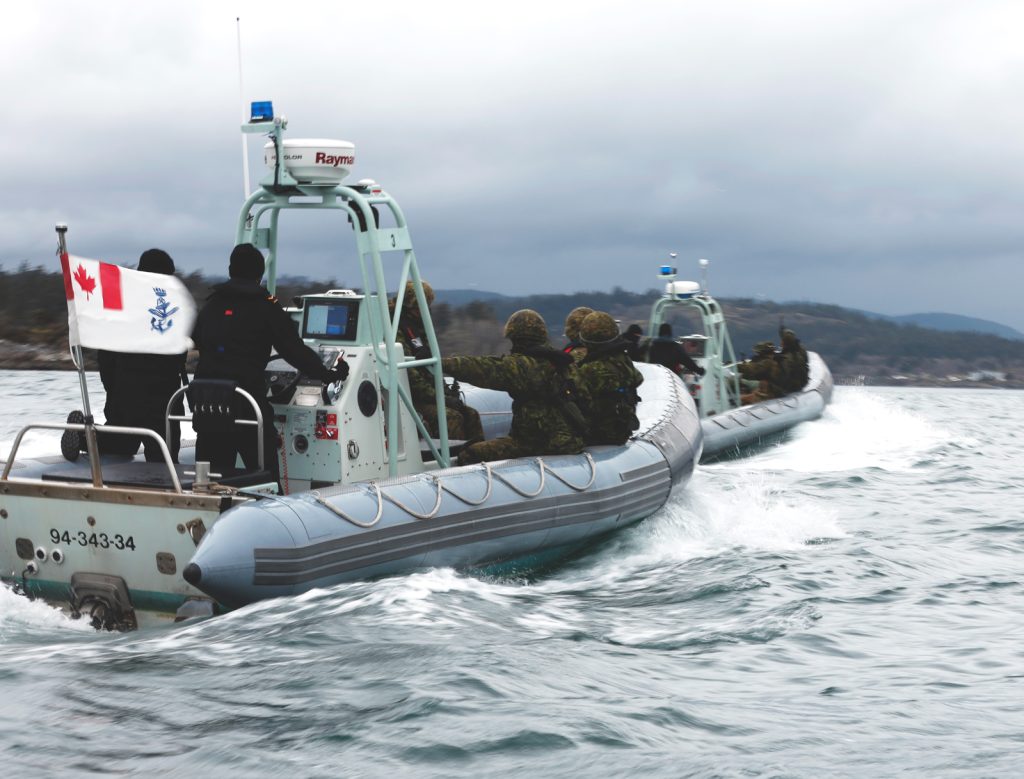
[caption id="attachment_25510" align="aligncenter" width="595"] With the actions of a raid complete, soldiers of The Canadian Scottish Regiment are moved from the objective at high speed by sailors of HMCS Malahat using rigid hulled inflatable boats.[/caption]SLt Donald Den / Capt Cameron ParkHMCS Malahat PAO / Canadian Scottish Regiment (Princess Mary’s) PAO––––Soldiers of The Canadian Scottish Regiment (Princess Mary’s) alongside sailors from HMCS Malahat participated in Exercise Scottish Cossaint between Feb. 19 to 21. Soldiers conducted patrols and raids in the training area and waters at Canadian Forces Ammunition Depot (CFAD) Rocky Point near Victoria, B.C. Sailors from Malahat supported the exercise with three rigid hulled inflatable boats (RHIBs) and one Defender-class boat on loan from the Naval Security Team in Esquimalt. Deploying to the training area Friday evening, the soldiers were immediately immersed into a training scenario in which a hostile enemy force was present in the area, including a possible mortar position on Bentink Island. Reconnaissance patrols deployed under cover of darkness to locate and observe likely enemy positions, while the remaining platoons readied themselves to conduct raids and ambushes using the information gathered. The added mobility provided to the Canadian Scottish Regiment by Malahat would be a key element of the exercise. Before using their boats to transport soldiers, sailors from Malahat briefed the infantry platoons on the use of RHIBs, including actions on what to do in emergency circumstances such as falling overboard.“For the soldiers, it’s a great opportunity. It’s another valuable experience that adds to their soldier skills,” said LCol Scott Cessford, Canadian Scottish Regiment Commanding Officer. “It’s an exciting experience being in the boats moving at high speed across the water, and it makes the commitment and effort each of them puts into the training all the more rewarding.” While the soldiers were working on land, sailors from Malahat...

Base Administration’s PO2 Israel Wong – Nelles Kitchen 2IC

[caption id="attachment_25507" align="aligncenter" width="593"] PO2 Israel Wong[/caption]2Lt Jamie BoparaiBase Administration––When Petty Officer Second Class Israel Wong joined the Naval Reserves in 2001, he never realized his part-time job would be a recipe for a long and fruitful career. Attending George Brown College as a culinary arts student, PO2 Wong decided that taking a summer job as a naval cook was an exciting idea. “It was a bit of an adventure,” he says. “I wanted to take my cooking out of the classroom and into the world, so I did and never looked back.” Shortly after joining, the world drastically changed on Sept. 11, 2001. By Dec. 4, he was posted to HMCS Toronto and deployed to the Persian Gulf to join the US-led coalition against terrorism in Afghanistan. “There were lots of unknowns at the time,” PO2 Wong recalls. “We were uncertain if we would be directly involved in conflict or not, but it was very exciting at the same time. It was also my first deployment, so I was learning how to perform my duties in an environment I had never been exposed too.”While PO2 Wong prides himself in his craft of choice, he had never cooked at night before and found the Atlantic ocean to be rougher than expected. “I was a little seasick at the beginning of that first trip, but I eventually overcame it, and I even began to enjoy the rougher sea states. In the end, thankfully, we all return safely to our friends and families.” After returning to Canada, he continued honing his craft with passion and success. He moved up the ladder to his current rank by showcasing his abilities during many special events. “I always loved mess dinners and cocktail parties, especially in foreign ports. Sometimes people are not aware of the talent required of a military cook and being able to showcase our abilities in a formal setting gives me an amazing feeling of pride and accomplishment.”Now the second-in-charge of Nelles...

HMCS Malahat Divers back in the water

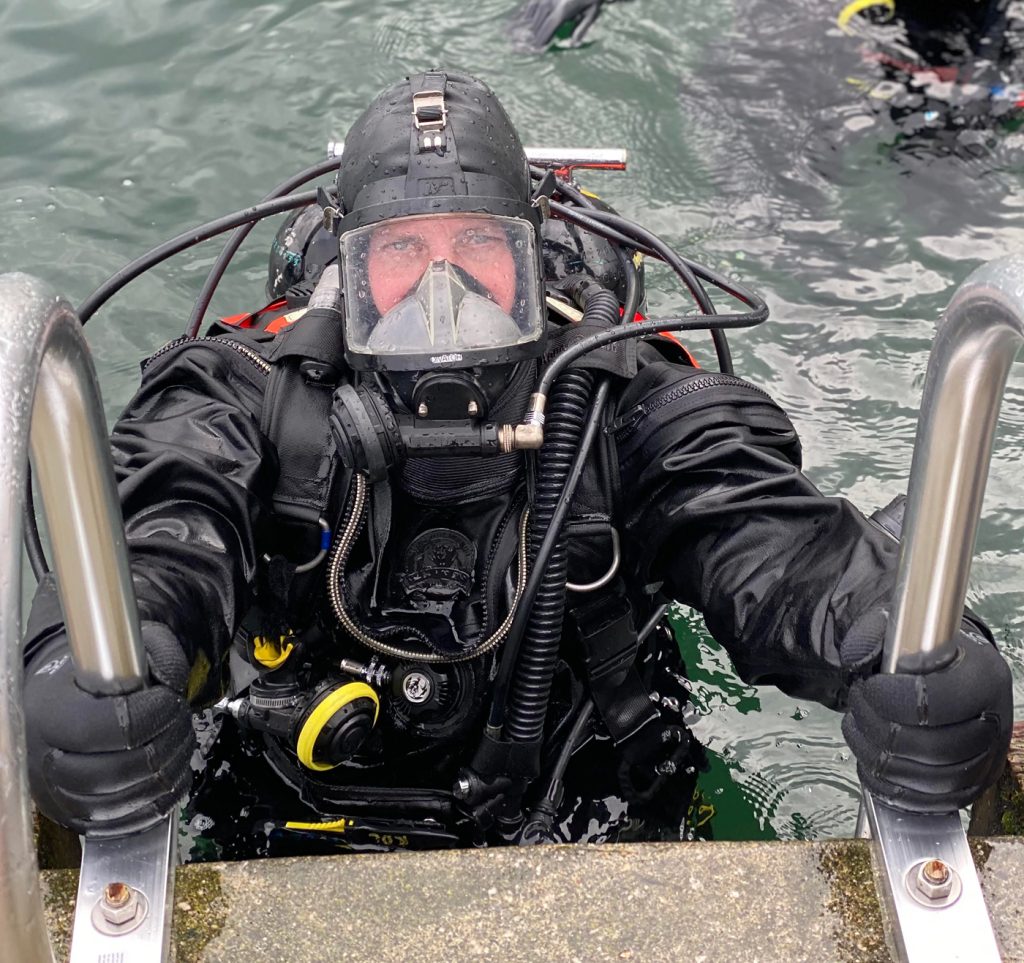
[caption id="attachment_25501" align="aligncenter" width="595"] Photo by S1 Angel Ruis[/caption]SLt Donald DenHMCS Malahat PAO––Three weekends ago marked the sixth time divers from Victoria’s naval reserve division HMCS Malahat were able to conduct a training dive since the outbreak of COVID-19.Malahat Port Inspection Divers dove off their jetty on Victoria’s Inner Harbour Saturday, Feb. 20 for most of the morning, with divers staying under the water for up to 30 minutes at a time.Divers in the Canadian Armed Forces are required to dive at least once every 90 days to maintain their proficiency, otherwise there is significant additional training required to re-qualify. In addition, Malahat was also able to dive a member from HMCS Discovery, Vancouver’s naval reserve division. Discovery, at present, does not have enough divers to conduct their own dives, so they come over to the Island at least once every 90 days. COVID-19 originally presented barriers in Spring 2020, which delayed some of their training, but Malahat divers have adapted and become familiar with the additional health and safety precautions now required. “It has really become normal to us now at this point,” says CPO2 Sean Ratz, Malahat’s Dive Officer. “Our divers are wearing non-medical masks up to the point they put their actual diving mask on, and anyone on the dive site is wearing a mask at all times – whether it’s a dive mask or a non-medical mask.” Not only has Malahat been able to conduct six proficiency dives since the onset of COVID-19, many of its divers have gone on to a few larger dive exercises.“I am very pleased with the way Malahat divers have adapted and led the way for modified diving during COVID-19,” says Cdr Cameron Miller, Malahat’s Commanding Officer, who attended the dive as an observer. “We ensure all precautions are in place...

RCN divers ready for Ukraine training mission

Peter MallettStaff Writer––A team of Clearance Divers are heading to Ukraine for a month to share their expertise in diving. Two divers from each coast’s dive unit, led by Lt(N) Kevin Darling, will travel March 28 to the Black Sea port of Odessa to deliver a ships dive course training program to the Diving School of the Armed Forces of Ukraine.   Lt(N) Darling says Royal Canadian Navy (RCN) divers were selected for the job because they have the knowledge and expertise to help develop and mentor partner nations.“The RCN is constantly engaged in instruction and the force generation training of all Canadian divers, and this is a great opportunity to collaborate with our Ukrainian partners and share our experience and knowledge in diving. It’s important for the Canadian Armed Forces to provide this training to other NATO [North Atlantic Treaty Organization] partners and help bolster their capabilities and strengthen international partnerships,” he says.Divers will quarantine for eight days prior to their departure from CFB Trenton. Lt(N) Darling emphasized all divers will adhere strictly to public health guidelines before and during transit to Ukraine, and while on the ground with the goal to keep things safe for everyone involved.The Ukrainian Naval Forces recently introduced a basic diver training course, which was developed with help from the United States Navy, Royal Navy and Danish Armed Forces. The RCN Ships Dive Course will build on that program with a combination of in-class and at-sea instruction. The in-water portion will be delivered in swimming pools and at sea.Training will provide Ukraine divers with the knowledge and expertise necessary to conduct underwater searches of a ship’s hull, and to locate, identify, and neutralize clandestinely placed sabotage devices and limpet mines. The course also prepares divers to conduct jetty and seabed searches prior to a ship’s arrival...

HMCS Calgary discusses gender for International Women’s Day 2021

[caption id="attachment_25493" align="aligncenter" width="594"] Members of HMCS Calgary stand together in support of International Women’s Day Feb. 27 on the flight deck. Photos by Cpl Lynette Ai Dang, CAF Imagery Technician[/caption]Captain Jeff KlassenPublic Affairs Officer––International Women’s Day 2021 did not go unnoticed by the crew of HMCS Calgary.As the ship sailed toward its theatre of operations for Operations Artemis and Projection, Lieutenant (Navy) Anne Day led guided conversations with the crew about gender issues. On both March 7 and 8, sailors of all ranks, including the commanding officer, gathered in the wardroom to watch video lectures and participate in guided discussions. People talked about the new ‘Sailor’ ranks, implicit bias, on being one of a few women in a mess or wardroom, gendered uniforms, gendered perceptions on child care and parental leave, common gendered language heard in the navy such as saying “the guys” or “man overboard”, representation of women in the Canadian Armed Forces, recruiting, and more. “We wanted to engage participants with these ideas, to challenge their own assumptions and biases. Women still face a ton of obstacles, not just in the military but in society in general. As leaders and Canadians we must continually strive to break down barricades,” said Lt(N) Day. “Having people from across all ranks was really important to me because the cultural change we need to achieve requires diverse voices.”To direct and stimulate conversations she used prompts, such as a study that looked at the bias of how men are more likely to be perceived as “firm” or “leaders” and women are looked at as “argumentative”, “bossy”, or “abrasive” for the same actions. She brought up results of another study that showed men interrupt women three times as much as they interrupt other men. “I think we had some great discussions that captured a range of opinions. The act of having the conversation and being able to engage in that type of open dialogue with a broad spectrum of the crew will have...

Riding around the clock for Wounded Warriors Canada

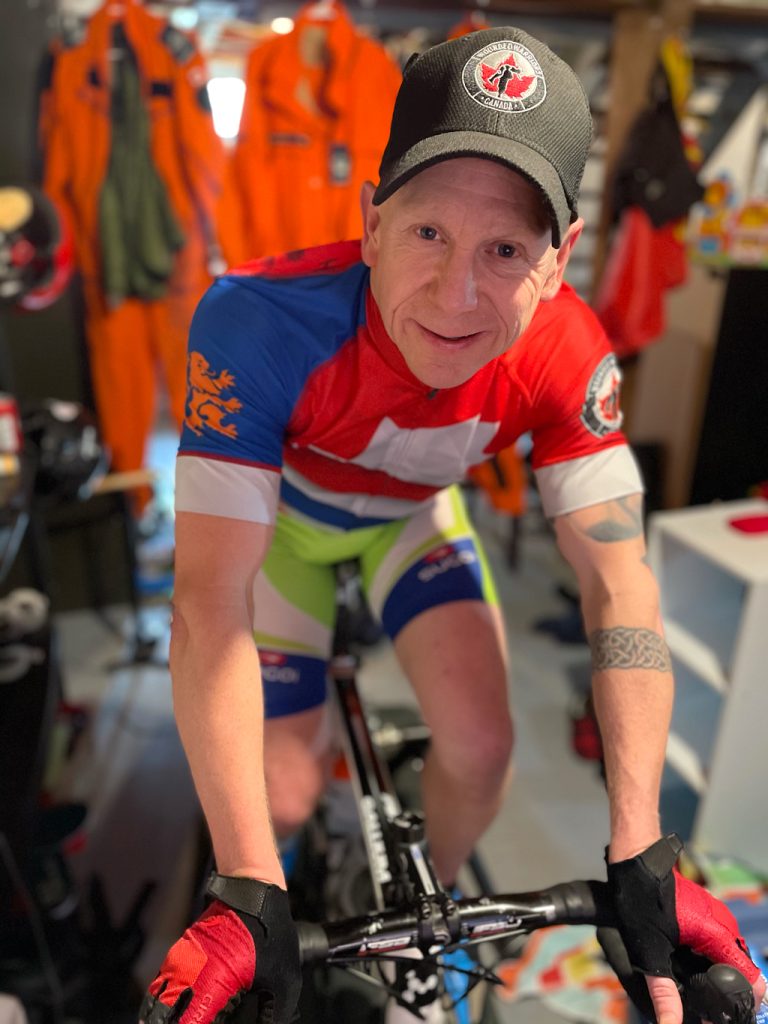
[caption id="attachment_25474" align="aligncenter" width="595"] WO Dan Bodden of the base’s Transition Centre rides his stationary bicycle during a fundraiser for Wounded Warriors Canada on Feb. 24. WO Bodden and Sgt. Mike Kotuk of CFB Trenton peddled their bikes for 24 consecutive hours, logging 1,409 kilometres and raising close to $5,000 for mental health treatment and support programs for veterans and currently-serving members. Credit: Wounded Warriors Canada[/caption]Peter MallettStaff Writer––Sgt Mike Kotuk of CFB Trenton, ON, and WO Dan Bodden, CFB Esquimalt, cycled for 24 consecutive hours on Feb. 24 without getting anywhere, sort of. The cycling duo spun their wheels on a stationary bike to raise funds and awareness for The Wounded Warrior Run BC, since the yearly relay-style run was cancelled due to COVID-19. It has been tentatively rescheduled for April 11 to 18. WO Bodden and Sgt Kotuk’s alternate fundraiser, entitled 24 on the 24th for Wounded Warriors Canada, had them cycling 1,409 kilometres, raising $5,800. “I felt a sense of deep satisfaction when the clock finally hit 7 a.m. the next morning. We were both utterly delighted with the results,” says WO Bodden. “I couldn’t believe the generosity and support of people from everywhere.”WO Bodden is the co-founder of Wounded Warrior Run BC. The Search and Rescue Technician works as a Platoon Warrant Officer at the Transition Centre on base.During their ride, both men kept track of their distance, speed, and time on the popular cycling game platform Zwift. They were permitted to take occasional meal, bathroom, and rest breaks. While cycling they also made regular updates to their followers on Facebook. As time wore on, WO Bodden says the pain and fatigue in his body mounted. “Even with a plan of execution for fluid and nutrition, in an activity like this your hands, feet, knees, and your rear end...

New helicopter trainer ready for action at DCTF Kootenay

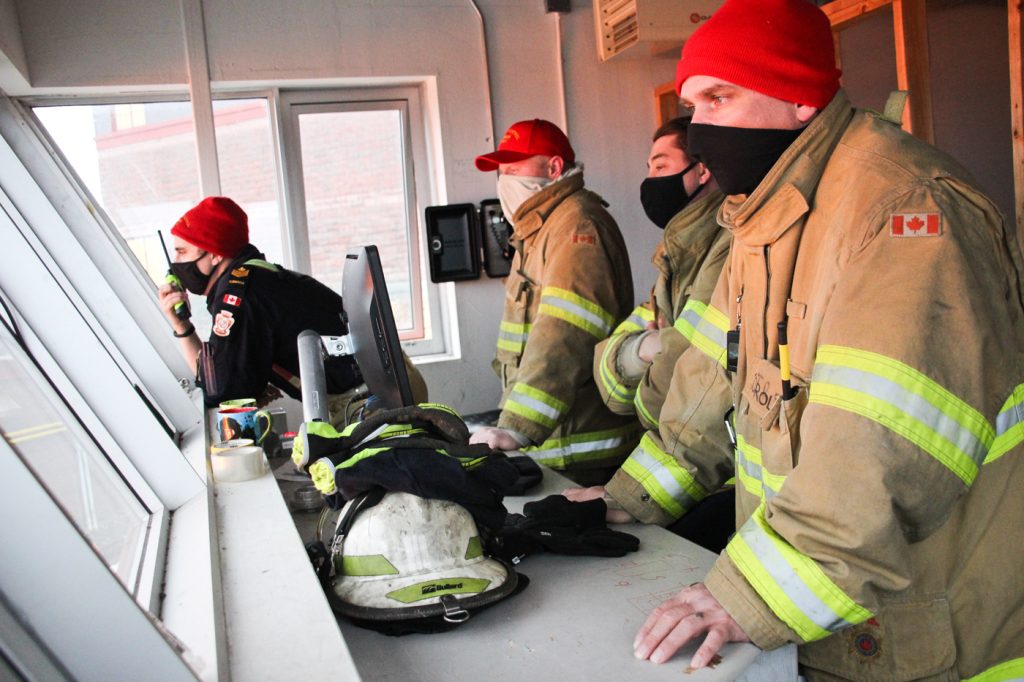
[caption id="attachment_25471" align="aligncenter" width="595"] Naval Fleet School (Atlantic) staff look on from the control tower as their colleagues exercise the new helicopter simulator. Photo by Ryan Melanson, Trident Newspaper[/caption]Joanie VeitchTrident Newspaper––After months of anticipation, control operators and instructors fired up the new helicopter trainer at Naval Fleet School (Atlantic) Damage Control School in Purcell’s Cove, Halifax, on March 1. It’s in preparation for an individual helicopter crash rescue training course to go live later this month — the first at the school since November 2019.The new model is a huge improvement over the previous trainer, says LCdr Andrew Cumming, Commanding Officer at DCTF Kootenay, adding the old trainer was “rusted like an outdoor barbecue” after being heated and cooled during training exercises for nearly 20 years.Cyclone Trainers The new trainer simulates the navy’s CF-148 Cyclone, giving it new entry and exit points and different locations for potential fires than the previous helicopter frame, which was installed when DCTF Kootenay was built in 2002 and modelled on the CH-124 Sea King.Design for the new trainer frame began in 2015 with DCTF managers on both coasts offering feedback on their experience with the original frame. “The biggest change is the look and feel of the trainer to be a realistic rendition,” says LCdr Cumming. “In any fire, the sooner you can combat it, the more likely it won’t get out of control. You will lower the temperature to increase the survivability of anyone inside. That’s why this training is critical, so that teams advance as quickly and safely as possible to prevent loss of life.”Systems within the helicopter will extend its service life, such as improved steel and a water system that ensure it doesn’t get as hot as the previous frame, preventing thermal expansion.The new helicopter trainer was built and installed...

Life at sea

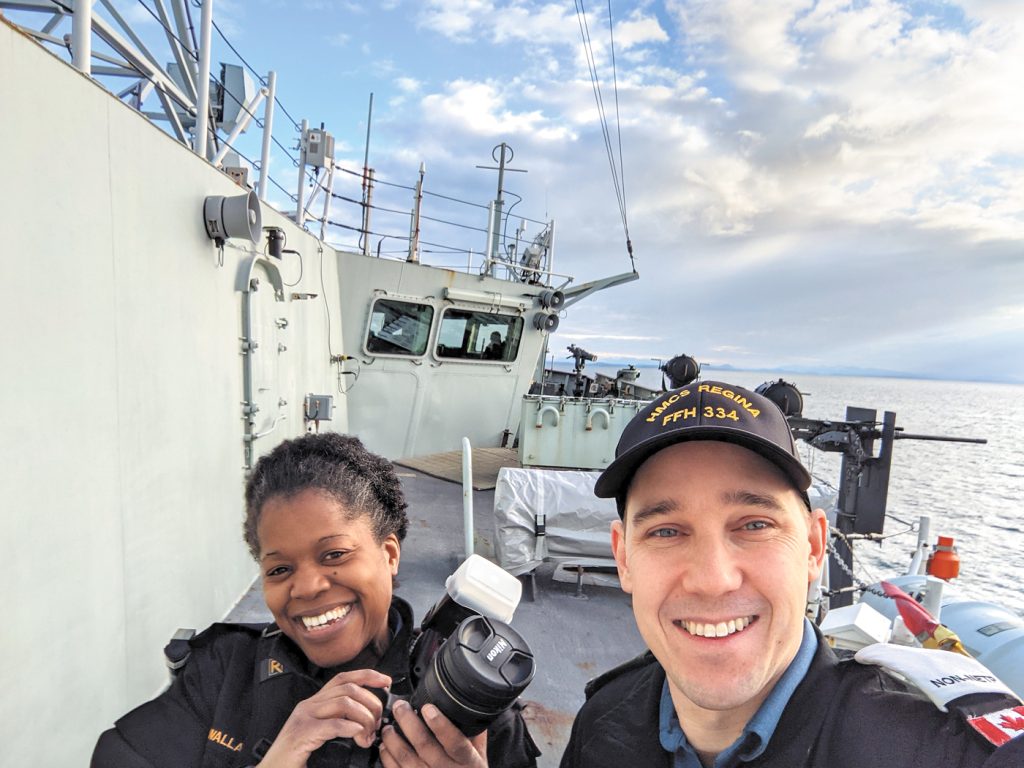
CAPT Jeff KlassenPublic Affairs officer––I’m no sailor. If I were a pirate in a children’s cartoon you’d call me a “land lubber”. In fact, most of what I’ve done in my military career (sure, it’s just a short three years) has been in a chair staring at a computer screen. Actually, it’s worse than that – sitting in a chair, staring at a computer screen… in Ottawa! (I jest.)  I was recently given the opportunity to go on a task group exercise with one of our Halifax-class warships, HMCS Regina. I couldn’t have been more thrilled. Doing exciting things like this is exactly why I joined the military!So, what’s life like on a warship Jeff? I’m glad you asked. I am going to tell you, but it’s going to be over a series of blog posts made throughout my time in Regina.Blog Post One: An overview of the ship (an organism that never sleeps)I’m writing this about six days into my voyage with HMCS Regina, and what I’m saying is really about this ship, but I feel that I could probably generalize a bit.Warships are really cool. They are cool in the sense that they are giant, floating, autonomous, powerful, multi-purpose, self-sustaining systems that never sleep. This system operates something like an organism; it is not just made up of hardware and equipment but also hundreds of differently trained people, all necessary for the overall functionality and effectiveness of the ship. There’s almost no spare room for the non-essential.The cool thing about living on the ship is you are in the middle of all this. All these integrated yet separate people and parts of the system move around and interact in a dance whose continual performance is needed for the good functioning of the whole.Let’s look at the ship from the...

Navy brothers lean on each other through tough times

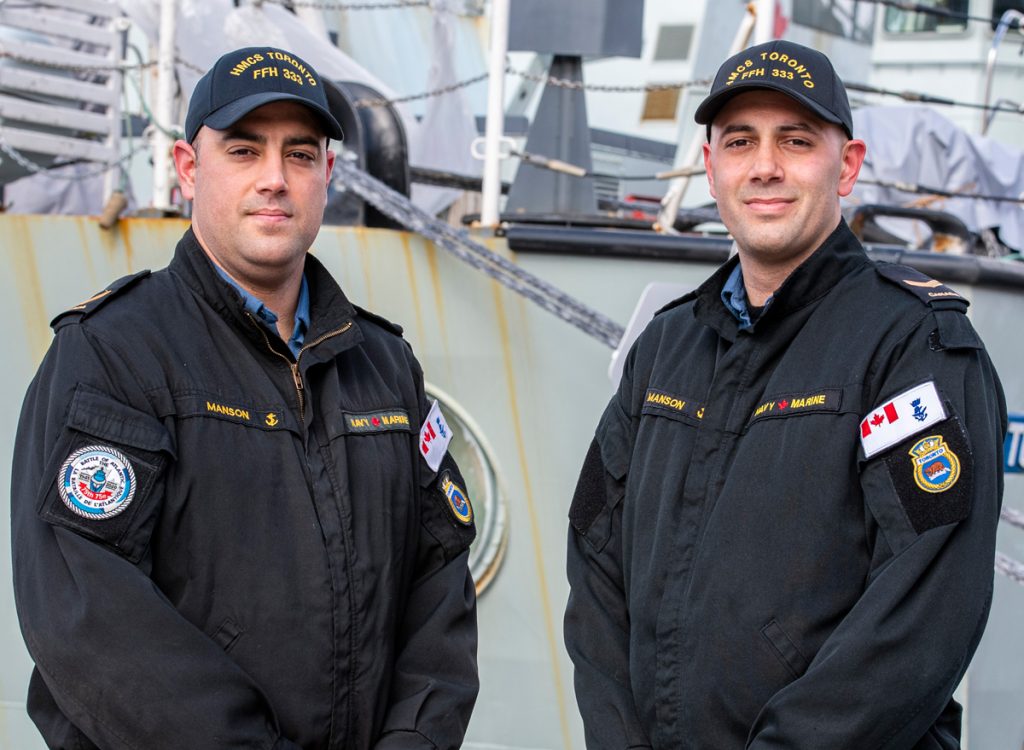
[caption id="attachment_25462" align="aligncenter" width="595"] Sailors First Class Triston (left) and Anton Manson have followed similar paths in life, and the brothers are currently posted to HMCS Toronto. Photo by Mona Ghiz, MARLANT PA[/caption]Ryan MelansonTrident Newspaper––For HMCS Toronto, the 2020 Operation Reassurance deployment was anything but routine. While still reeling from the tragic crash of HMCS Fredericton’s Cyclone helicopter last spring, the ship left Halifax in July, joining NATO allies in the Mediterranean under tight COVID-19 restrictions.For Sailors First Class Anton and Triston Manson, two brothers posted to Toronto, the sail presented several challenges, with pre-deployment preparations complicated by health restrictions, and the extra stress of being overseas during a pandemic. Being in the unique position of having a close family member on board was a blessing.“I got lucky this time; I had that little piece of home with me, so my brother and I were able to lean on each other,” said Triston. “We don’t always see each other during the workday, but we’ll always eat together, and we hang out every day if we’re in port. We’re also good friends, which helps.”It’s not the first time the pair has sailed as part of the same crew. They’ve been able to share a good portion of their naval experiences with each other, and even prior to beginning their Forces careers, the brothers followed similar paths. Both were standout hockey players at a young age, playing at different times at the Major Junior level for the Shawinigan Cataractes, and both had a taste of working odd jobs in the private sector before deciding on the navy route.They were inspired by their grandfather, a Royal Canadian Navy veteran, and their father, who encouraged them to consider military service.“My job is extremely important to me. I’m able to provide a good life for...

Explore More

Categories

Top News

E-Editions Archive

News Stories Archive

Proud Supporters

Joshua Buck, Lookout Newspaper