[wpml_language_selector_widget]
[searchwp_form id="1"]
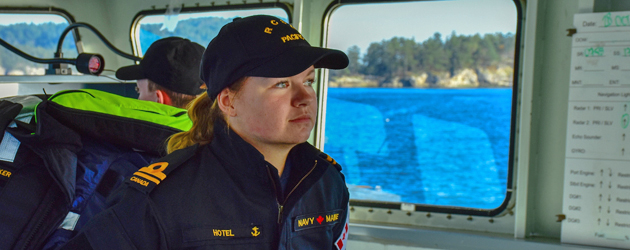
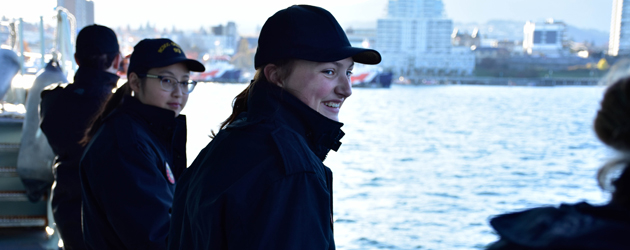
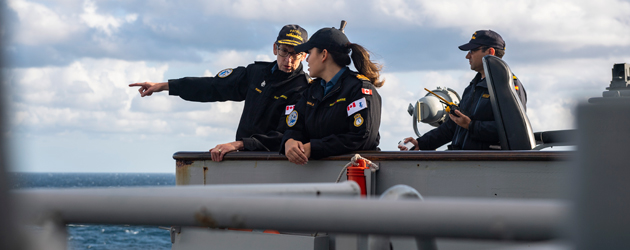
Cadet Hannah Tiemer from 100 RCSCC in Duncan charts a course aboard PCT Raven during the biannual Cadet Seamanship Deployments. Photo by Capt Jordan Holmes

Cadets at sea

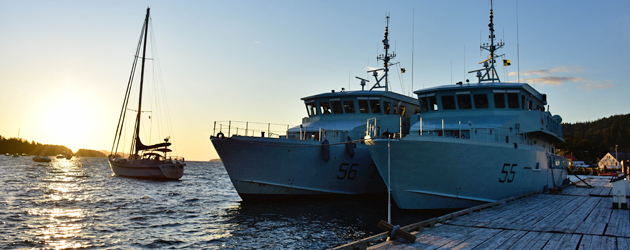
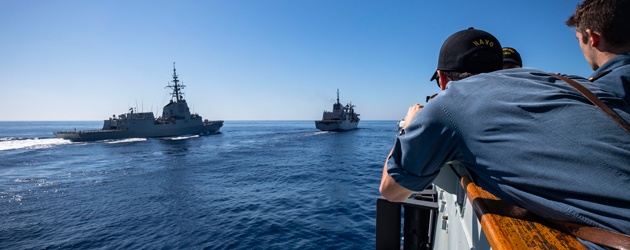
[caption id="attachment_21985" align="alignnone" width="593"] Cadet Hannah Tiemer from 100 RCSCC in Duncan charts a course aboard PCT Raven during the biannual Cadet Seamanship Deployments. Photo by Capt Jordan Holmes[/caption]Capt Jordan Holmes, RCSU(P) ~Sixty-four cadets from across Canada spent a week sailing in Patrol Craft Training vessels Orca and Raven.Cadets filled a variety of roles including navigator, helmsmen, boatswain, and cook, all while learning general seamanship and small boat handling skills.The two vessels were staffed by eight Cadet Instructors Cadre (CIC) Reserve officers and nine Regular Force members from the Patrol Craft Training Unit (PCTU). Among the staff in Orca was SLt Deryn Hotel, from Victoria. This was her third round instructing the biannual seamanship deployments. “I was a cadet my first time on a PCT; there was so much to learn every day. I really thrived in the consistency and rhythm. It’s an opportunity unique to the Cadet Program for youth, and it’s so empowering. How many other teenagers get to experience a taste of life in the Royal Canadian Navy?” said SLt Hotel.She has been a CIC officer for three years and fills a variety of roles in the Cadet Program. She is an instructor with 100 Royal Canadian Sea Cadet Corps Admiral Mainguy in Duncan and teaches at the South Island Sailing Centre, where hundreds of cadets learn the basics of sailing every year. “Much of what happens at the Corps is in a classroom, whereas the seamanship deployments are practical and hands-on. I think it pushes cadets out of their comfort zone. They have to spend a lot of time building the trust of the Regular Force officers and NCMs (non commissioned members) on the ship, to show they are capable of running each exercise or performing a role, and they do. By the end of the week...
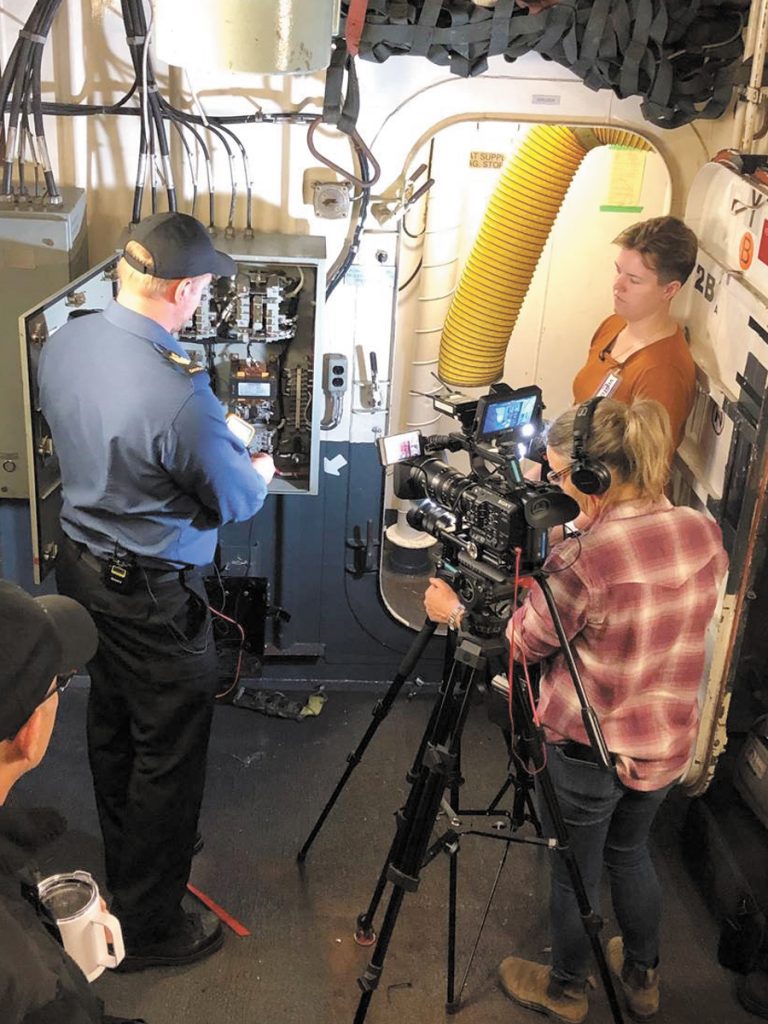
PO2 Gillies from Naval Personnel Training Group assists in the filming of a training video with a film crew from Race Rocks 3D. Photo by PO1 Beaulieu

Naval Fleet School training tool box modernized

[caption id="attachment_21982" align="alignnone" width="593"] PO2 Gillies from Naval Personnel Training Group assists in the filming of a training video with a film crew from Race Rocks 3D. Photo by PO1 Beaulieu[/caption]Peter Mallett, Staff writer ~A new tool in the training box of Naval Fleet School is currently being developed. Contracted by Naval Training Development Center Pacific (NTDC (P)), Race Rocks 3D is creating a fully functioning virtual reality version of the ship’s power generation and distribution system. It will include a series of instructional videos to be used in tandem with the virtual task trainer. By utilizing this technology, NTDC(P) hopes to enable naval trainees to hone their practical skills before placing them in real-world scenarios. This will also help propel current naval training into the future, and fulfill the vision of the Future Naval Training Strategy – to produce a world-class training system that fosters excellence at sea. Currently, phase two of the development shows trainees how to:Sync a generator at the switchboard;Parallel a generator with shore power at the switchboard; andReset a load shed con­di­tion. Created by the Program Support Services section of the Learning Support Center division of the NTDC(P), and Race Rocks 3D, this technology can be facilitated in-class or remotely, allowing trainees to learn at their own pace at any time via the Defence Learning Network (DLN). The program can be accessed at the convenience of the trainees via a tablet or computer onboard the ship, or remotely from their own devices.In the program, trainees or current sailors who need a refresher can decide what level of instruction they need while looking at an interactive, exact replica of a Halifax-class frigate switchboard. Trainees can watch videos that walk them through tasks step-by-step; they can choose to be walked through each step via a series of on-screen instructions;...

Honouring the traditions of Indigenous sailors

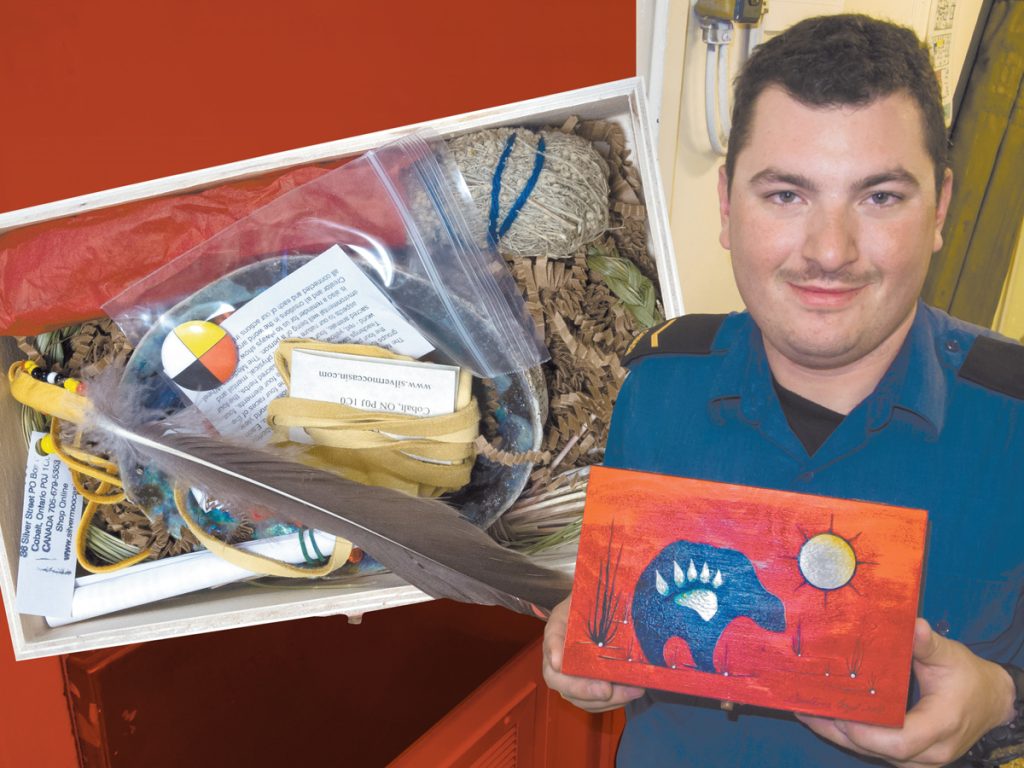
[caption id="attachment_21979" align="alignnone" width="593"] AB Kyle Edwards[/caption]Capt Jenn Jackson, HMCS Ottawa PAO ~In the spirit of Remembrance Day, HMCS Ottawa’s commemorations consisted of three separate ceremonies – a traditional Remembrance Day ceremony held at sea on the flight deck, a Committal of Ashes to Sea presided over by Padre Andrew Klinger, and a smudging performed by Able Seaman Kyle Edwards, a member of the Algonquin Nation and a boatswain. The ceremony was made possible through the provision of a Smudge Kit provided by the Defence Aboriginal Advisory Group (DAAG), who also assist with maintaining the kits with replenishment of supplies through the Padre’s office. Ships have been provided kits and they are generally held in the Coxswain’s office. Where possible, an Indigenous member of the crew is appointed custodian of the kit.“When I was first approached at the beginning of the sail about performing a smudging, I felt extremely honoured,” said AB Edwards. “This ceremony recognized the traditions and beliefs of Indigenous sailors aboard Ottawa, and recognized the sacrifice made by of all Indigenous members, veterans, and fallen.” Each smudge kit comes with instructions from the DAAG that includes a list of supplies, how to properly use the kit, and how to maintain it. Any member of the crew may request to use the kit as part of their traditions.

Honouring Mia Larsen

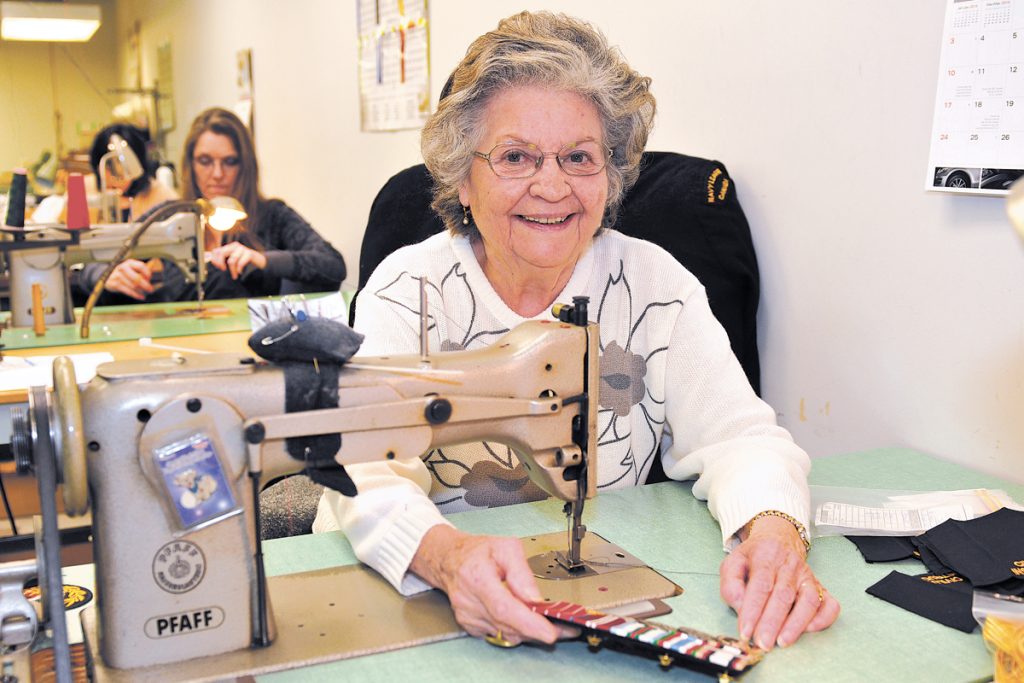
[caption id="attachment_21976" align="alignnone" width="593"] Mia Larsen[/caption]Captain Peter Fuerbringer, Public Affairs Officer, CFB Esquimalt ~Our base family sadly lost a familiar face with the recent passing of Mia Larsen. Known for her friendly demeanor, quick smile, generous heart, and renowned skillset, Mia had been tailoring clothes for nearly six decades. From newly minted sailors to flag officers and retired members, Mia was known, respected and will be missed. Five decades ago, 30-year-old Mia apprenticed with master tailor Margaret West at her shop in Work Point. She bought West’s business 13 years later when her mentor retired. Eventually, the store moved to its current CANEX location, and slowly it grew to fill the demand. In 2013, Mia was presented with the Queen’s Diamond Jubilee Medal from then Premier Christy Clarke as further testament to her character and contribution.“We wanted to nominate Mia because she has been doing this so long and has mounted so many medals,” said Donna Bird, one of three employees who nominated Mia at the time for the award. “We thought wouldn’t it be nice to see her issued one herself.” Mia is survived by her daughter Ivy and step-son Rob. She was a loving Nana to her grandchildren Levi, Justin, Tara, Brianne, Kyle, Talina, and Sebastian and great-grandchildren Sawyer, Mia, Hadley and Hunter.Her legacy will live on in the hearts and minds of everyone she interacted with here at CFB Esquimalt. She was part of our defence community, and we will miss her greatly.

Holiday card contest for children

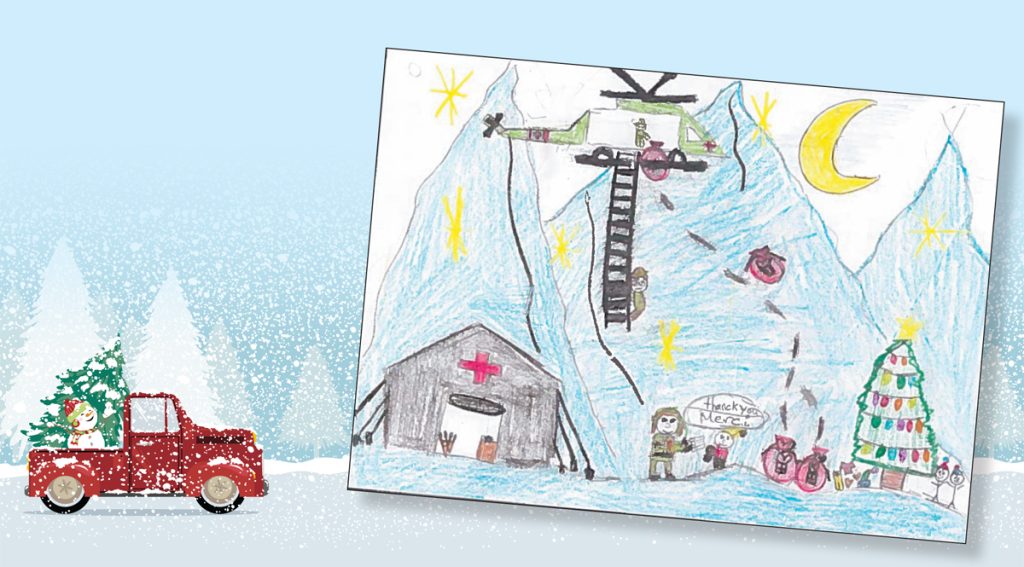
[caption id="attachment_21973" align="alignnone" width="594"] At right: 2018 contest winner - Isabel Broadbent (age 11): Military hospital and personnel spreading Christmas joy to children in Ukraine and delivering gifts. They are also helping decorate a Christmas tree.[/caption]DNDDeputy Minister Jody Thomas and Chief of the Defence Staff General Jonathan Vance are calling upon the children of Defence Team members to design their 2019 holiday greeting card.The contest is open to children of the military and civilian Defence Team members, aged four to 12. The task? Come up with some creative holiday artwork around the chosen theme, and follow the guidelines below to submit to the contest. The contest closes on Nov. 20 and shortly thereafter, the Deputy Minister and Gen Vance will pick and announce a winning design.Submission Guidelines:All artwork must be completed on the template found https://ml-fd.caf-fac.ca/wp-content/uploads/2019/11/dgm-11119-pz7_2019-dm-cds-holiday-card_contest-form.pdf.Artwork should be themed around “How our Defence Team members make a difference”; for example, our military performing search and rescue, or our scientists developing new and innovative ways to keep Canada safe.There should be no text within the picture itself – all text is to be included in the description section of the template.Artwork will need to be submitted by the Defence Team member and include a description of the artwork (in the artist’s words), and include the name and age of the child.Artwork should be scanned at a high resolution and emailed to Internal_Communications_internes@forces.gc.ca.By providing a submission, you are allowing for the reproduction and use of the artwork for the holiday greeting card and for use on the Defence Team intranet, The Maple Leaf, and on various social media platforms.

Quick response saves canoeists

[caption id="attachment_21970" align="alignnone" width="593"] Nanoose Bay, Vancouver Island. Photo credit: Russell McNeil[/caption]Peter Mallett, Staff Writer ~Two canoeists are grateful for the life-saving efforts of three Queen’s Harbour Master Detachment employees attached to Canadian Forces Maritime Experimental Test Range (CFMETR) at Nanoose Bay.The adult male and female had paddled a kilometre offshore on Oct. 29 when they encountered choppy seas and high winds that resulted in their canoe capsizing. The pair were not wearing life jackets. After a few minutes in the cold water, both began to suffer from hypothermia. A witness spotted the pair struggling in the water and called 9-1-1. A mayday call was issued by the Canadian Coast Guard over radio channels monitored by Queen’s Harbour Master at CFMETR. That’s when Petty Officer First Class (Retired) Steve White, Derrick Viggers, and Nathan Reed, all civilian employees of Port Operations and Emergency Services Branch, sprang into action. White and Viggers jumped aboard Sea Truck YFU-101, a landing craft, and raced towards the canoeists, while Reed set up a command post and provided communications between the coast guard and emergency health services.   “We immediately saw the capsized canoe in the water but were uncertain if they had made it to shore safely,” said White. “We raced in their direction and then learned from the coast guard radio and Nathan’s dispatches the pair had made it out of the water and were on a nearby beach.”White, a former Boatswain in the Royal Canadian Navy, says he recognized the signs of hypothermia in the two victims when he arrived onshore, and that both would need immediate medical attention. White said the male was suffering from more severe hypothermia symptoms than his female counterpart, who he had managed to hoist out of the water and on to the top of the canoe; but she was...

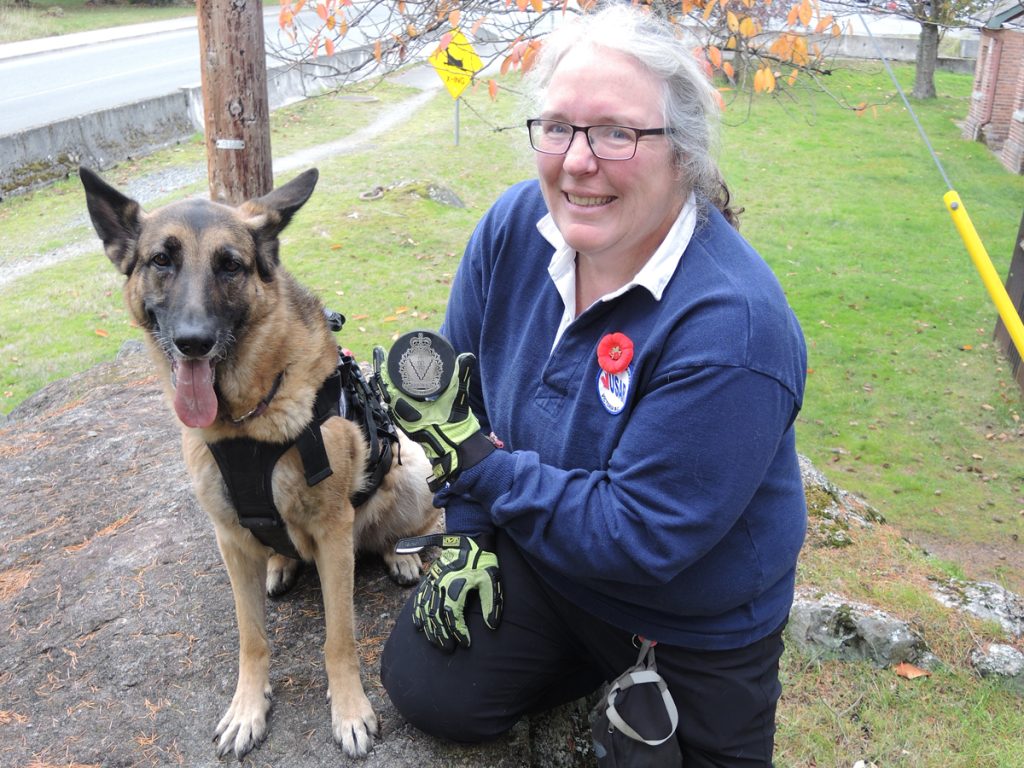
Nine-year-old German Shepard Miss Moxxii and her handler Angela Lavergne show off the special commemorative puck they will use in the ceremonial opening puck drop for the Victoria Royals Defence Appreciation Night at the Save On Foods Memorial Centre on Nov. 15.  Photo by Peter Mallett/Lookout

Victoria Royals roll out red carpet for Miss Moxxii

[caption id="attachment_21967" align="alignnone" width="593"] Nine-year-old German Shepard Miss Moxxii and her handler Angela Lavergne show off the special commemorative puck they will use in the ceremonial opening puck drop for the Victoria Royals Defence Appreciation Night at the Save On Foods Memorial Centre on Nov. 15. Photo by Peter Mallett/Lookout[/caption]Peter Mallett, Staff Writer ~Trotting down the red carpet to centre ice at this year’s Nov. 15 Victoria Royals Defence Appreciation Night hockey game will be nine-year-old German Shepard Miss Moxxii Mayhem.With owner Angela Lavergne by her side, Miss Moxxii will carry the ceremonial puck to centre ice ahead of the Royals’ game against the Lethbridge Hurricanes game.She will give the puck to Capt(N) Sam Sader, Base Commander, who will perform the ceremonial puck drop between the two team captains.“I am certain she will handle her moment in the spotlight on the arena floor in a cool and collected manner as she has had experience in front of large crowds,” said Lavergne, who works at Regional Cadet Support Unit (Pacific). Lavergne and Miss Moxxii, a trained cadaver dog, have been volunteering their services to the base’s Urban Search and Rescue team for the past nine years. She says the ceremonial puck drop is a great way to acknowledge Miss Moxxii’s career with the Canadian Armed Forces (CAF) as she approaches retirement.“We have little doubt Miss Moxxii’s appearance on the ice will create a positive stir amongst the crowd at the game,” said Matt Carlson, Defence Appreciation Event Coordinator with Base Public Affairs. “The game will also be a great way for the public to interact with military members and DND civilian employees manning displays from a variety of Canadian Armed Forces units.”Outside on the arena steps there will be five displays:  an emergency service vehicle from CFB Esquimalt Fire and Rescue;  a...

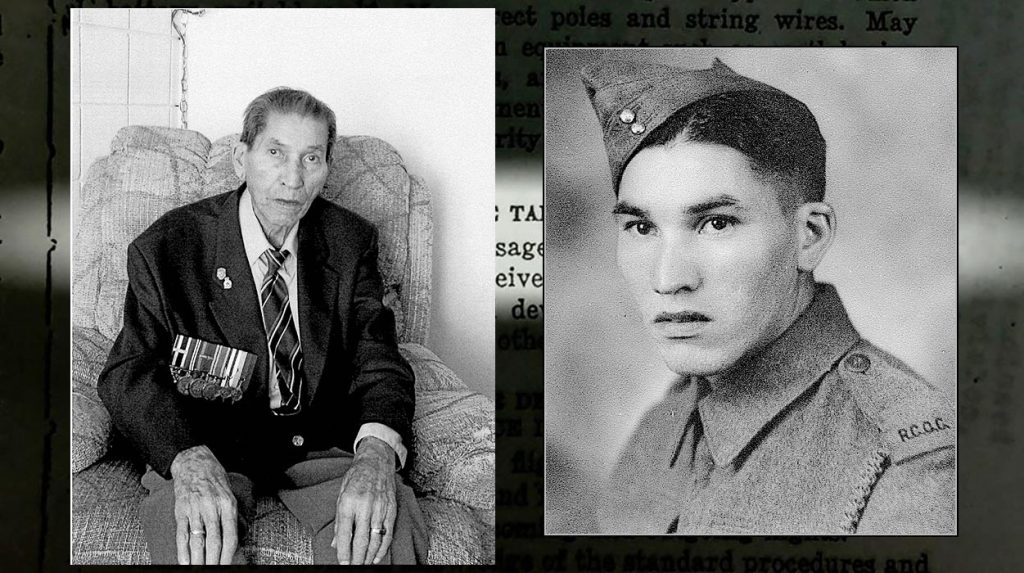
Left: Cpl (Ret’d) Tomkins at age 85 in 2003. He was one of the few known Cree Code Talkers who used the Cree language to create a secret code that may very well have turned the tide of the Second World War in favour of the Allies.  Photo courtesy of Adele Laderoute. Right: Corporal (Retired) Charles (Checker) Tomkins during the Second World War

Indigenous languages used as code in Second World War

[caption id="attachment_21930" align="alignnone" width="595"] Left: Cpl (Ret’d) Tomkins at age 85 in 2003. He was one of the few known Cree Code Talkers who used the Cree language to create a secret code that may very well have turned the tide of the Second World War in favour of the Allies. Photo courtesy of Adele Laderoute. Right: Corporal (Retired) Charles (Checker) Tomkins during the Second World War, circa 1940. He was part of a group of Indigenous Canadian soldiers who created a secret code using their own language that the enemy had no way to break. Photo courtesy Alex Lazarowich[/caption]Lynn Capuano with files from Shannon Morrow, Army Public Affairs ~Secrecy in communication during the Second World War was as important as it was difficult. What better way to create an unbreakable secret code than to use a little-known language as its base?Messages, whether in plain language or in code, were constantly being intercepted, stolen, overheard or deciphered. It was vital that Canada and its Allies find a way to send secret messages the enemy could not decrypt.They finally succeeded towards the end of the war. Termed “Code Talking,” it cleverly used Indigenous languages to create an unbreakable spoken code.The job was simple but ingenious in its application. The Code Talkers would translate a secret message into words from an Indigenous language, speak it over the radio and another Indigenous soldier would translate it back into English at the other end.One of the languages used was that spoken by the Cree First Nation people in Alberta and Saskatchewan. There were many patriotic Cree men and women who served during the Second World War and, since Cree was little-known and only spoken in Canada, its use as a code baffled enemy forces.One of the few known Code TalkersBecause they were sworn to secrecy during...

Photo courtesy Hayley Young

HMCS Regina conducts sensors and weapons testing

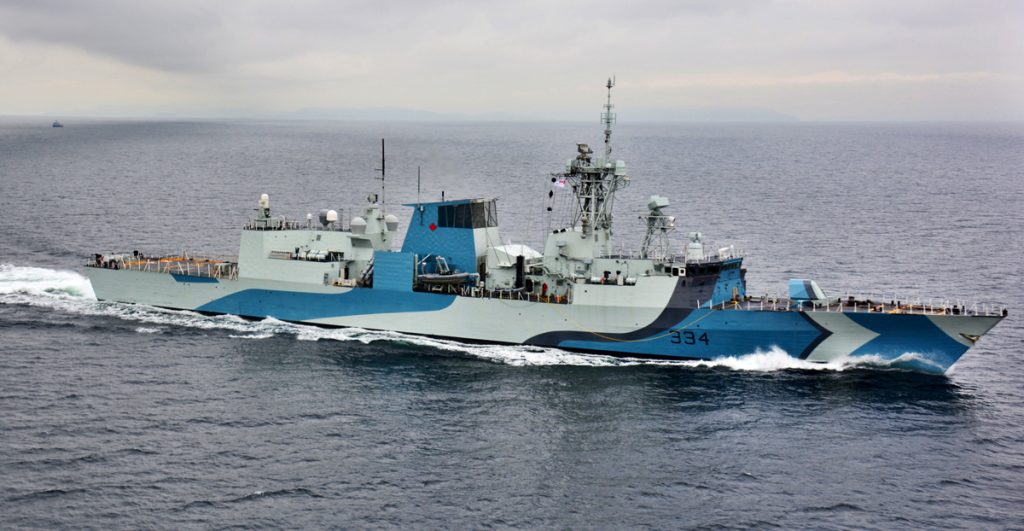
[caption id="attachment_21927" align="alignnone" width="594"] Photo courtesy Hayley Young, CFMETR[/caption]Stephen McCormick, CFMETR Range Engineer ~As part of ongoing ship readiness preparations, HMCS Regina was at the Canadian Forces Maritime Experimental and Test Ranges Oct. 24 to 25 to conduct FORACS testing - FORACS is an acronym that stands for NATO Naval Forces Sensor and Weapons Accuracy Check.  Over the past 22 years Canada has been a regular member of NATO FORACS and relies upon this organization to provide accuracy measurements of key sensors and combat systems equipment for submarines, destroyers and frigates.  The ranges measure the bearing, range, position, and heading accuracy of sensors in surface ships and submarines to satisfy national requirements and to meet NATO material readiness standards, through dynamic combat system performance evaluation.FORACS services are provided at three fixed ranges: the AUTEC Range in the Bahamas, Stavanger Norway, and Souda Bay Greece.  Canada has use FORACS services on an opportunity basis in order to ensure submarines and warships are technically ready for weapons firings and mission obligations. In addition to the three NATO FORACS check sites, a number of ranges have NATO FORACS test equipment available, including CFMETR.To assist in Regina’s testing, staff from AUTEC (Bahamas) and Fleet Maintenance Facility Cape Breton sailed in Regina.  “This is the first time I have conducted FORACS that I can recall, and I have been impressed by the FORACS team in their approach to integrating into the ship,” said Commander Landon Creasy, Regina’s commanding officer. “It’s been very interesting for my operators and technicians to work with some world-class engineers from a variety of backgrounds. It’s given us the opportunity to chase down faults with on-hand experts, optimize sensors, and get a deeper understanding of the equipment we work with on a daily basis.”By using deployable FORACS capabilities and the CFMETR test...

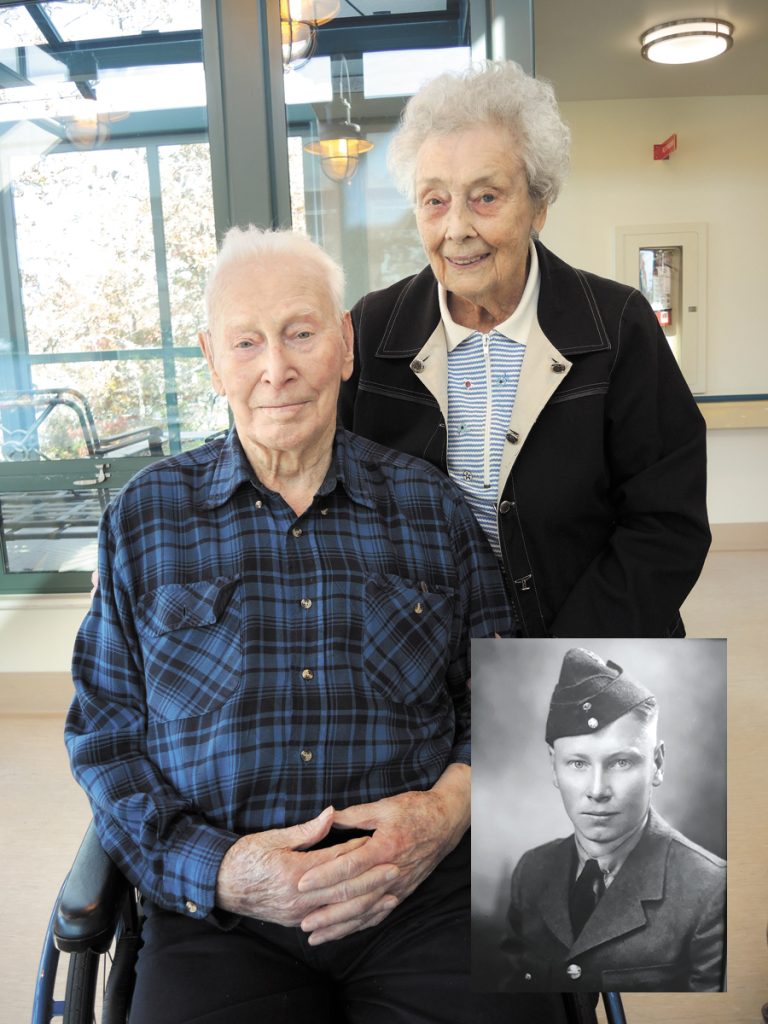
Second World War veteran William ‘Glen’ Ryder poses for a photo with his wife Velma Ryder at Veterans Memorial Lodge at Broadmead on Oct. 28

Japanese submarines brought unease to west coast

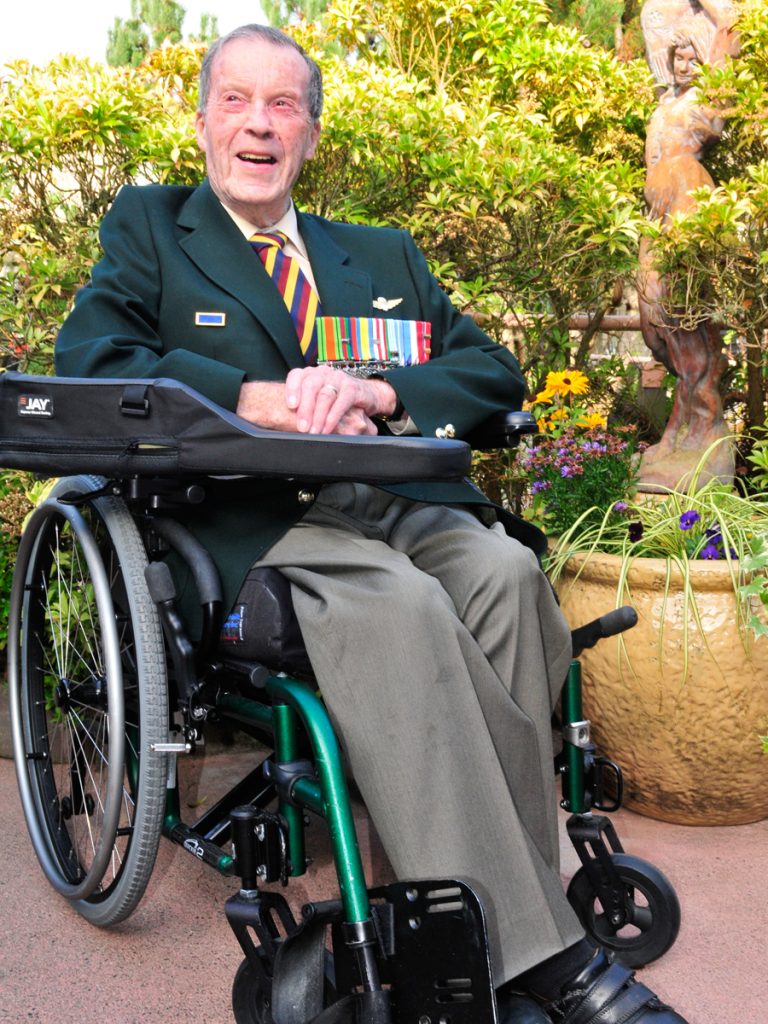
[caption id="attachment_21924" align="alignnone" width="594"] Second World War veteran William ‘Glen’ Ryder poses for a photo with his wife Velma Ryder at Veterans Memorial Lodge at Broadmead on Oct. 28, 2019. During the war, Ryder was part of a six-man crash boat crew that patrolled the west coast of Vancouver Island for the Royal Canadian Air Force (RCAF) Marine Division. Photo by Peter Mallett. Inset: William ‘Glen’ Ryder[/caption]Peter Mallett, Staff Writer ~On a cool, sunny day inside a glassed solarium at Veterans Memorial Lodge at Broadmead Care in Saanich, 97-year-old William ‘Glen’ Ryder reflected on his days as a member of the Royal Canadian Air Force (RCAF) Marine Squadron. During the final three-and-a-half years of the war, Ryder was part of the Marine Squadron’s flying boat squadron of watercraft that patrolled the waters of Canada’s Pacific coast. “There certainly was a good dose of fear and panic in the aftermath of the Japanese attack on Pearl Harbor in December 1941,” said Ryder. “There were multiple reports of Japanese submarines off the west coast.” Ryder grew up in Athabasca, AB, before moving to the west coast, finding work aboard Canadian Pacific vessel Princess Maquinna, a passenger ship that operated on Vancouver Island’s west coast. With the threat of conscription in Canada looming, he decided to enlist at the RCAF Marine Squadron office on Government Street in an effort to avoid becoming a member of Canada’s army. “I didn’t want to be a foot soldier and thought the prospects of getting my call to the army was getting too close for comfort.”Based out of Western Air Command’s headquarters at Jericho Beach in Vancouver, Ryder was one of a six man crew that patrolled the waters of Vancouver Island aboard RCAF boat Malecite. Named for the Algonquin tribe of New Brunswick, Malecite was built in 1941...

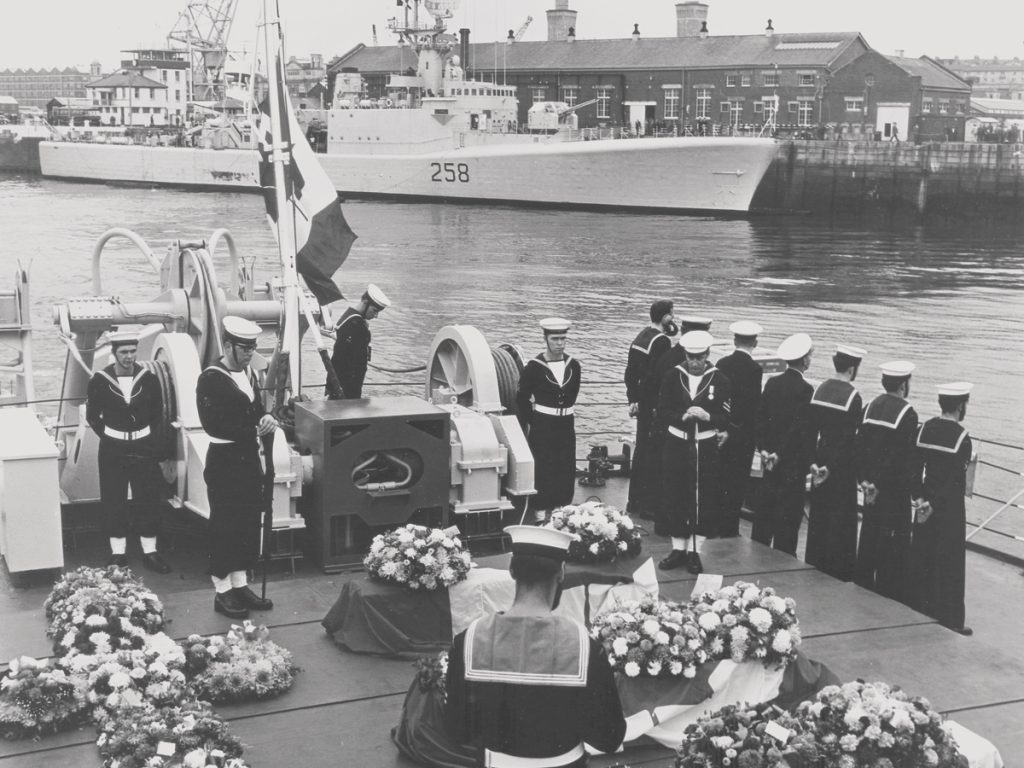
Funeral service for the nine deceased crew members of HMCS Kootenay with the burnt and damaged ship in the background at Devonport

Engineer recalls tragedy of Kootenay explosion

[caption id="attachment_21921" align="alignnone" width="593"] Funeral service for the nine deceased crew members of HMCS Kootenay with the burnt and damaged ship in the background at Devonport, UK, Oct. 27, 1969. The ceremony was held on board HMCS Saguenay, a fellow ship that had served alongside Kootenay in the naval exercise.[/caption]Peter Mallett, Staff Writer ~It’s been 50 years since a deadly explosion and fire ripped through HMCS Kootenay, but the “awful aftermath’ still haunts 71-year-old Englishman Robert Twitchin.The east coast tragedy is still considered the worst peace-time accident in the Royal Canadian Navy (RCN), killing nine sailors. It all went wrong in the engine room of the Restigouche-Class destroyer on the morning of Oct. 23, 1969, as the ship underwent a full-power trial 200 nautical miles off the coast Plymouth, England.The explosion created a blackened bulge in the starboard side of the vessel. Kootenay was towed approximately 200 miles to the Davonport Royal Dockyard in Plymouth.Twitchin was a junior member of a six-man team of civilian engineers that assisted in the investigation and subsequent repairs. He was a mechanical fitter and worked on the removal of the ship propellers, and then on the investigation that involved the dismantling of drive trains and the ship’s problematic gearbox and bearings.Two years previously, on the Royal Navy Aircraft Carrier HMS Eagle, Twitchin had also witnessed the terrible aftermath of a fatal fire in B boiler room, an experience that helped him confront the “devastation” awaiting him and his fellow engineers as they descended into the Kootenay engine room.Truly ShockingPrior to their investigation, the team was briefed by their Technical Supervisor Albert Benson, who advised them to “tread lightly” and sensitively in their investigation. That advice would very soon make sense.“When we first got down into the Kootenay engine room and saw the extensive destruction, including...

Murray Edwards attends a ceremony for his 90th year certificate presented by Princess Patricia’s Canadian Light Infantry at Veterans Memorial Lodge at Broadmead in November 2019.  Credit: Peter Mallett

A forgotten Hero of a forgotten war

[caption id="attachment_21918" align="alignnone" width="594"] Murray Edwards attends a ceremony for his 90th year certificate presented by Princess Patricia’s Canadian Light Infantry at Veterans Memorial Lodge at Broadmead in November 2019. Credit: Peter Mallett[/caption]Peter Mallett, Staff Writer ~A 99-year-old veteran of the Korean War isn’t giving up his life-long quest to see a platoon mate receive proper recognition for his unparalleled heroism at the Battle of Kapyong.Murray Edwards served Canada from 1942 - the height of the Second World War - to the Korean War, Cyprus, and the Six Day War in the Middle East before his retirement from the Canadian Armed Forces in 1969. Edwards, a resident at the Veterans Lodge at Broadmead, turns 100 in January. While his mobility has been hampered by a stroke and he uses a walker to get around, his memory remains crystal clear of his time in Korea and the selflessness of Lt Mike Levy. He says Lt Levy was intentionally excluded from a Military Cross medal for heroism because of the commanding officer’s bigotry towards Jews. Edwards says Levy is truly a forgotten hero of Canada’s ‘Forgotten War’. Levy died in 2007.“I was lucky to know him and we were lucky to have him as the most experienced officer in the entire [PPCLI] battalion,” said Edwards. “We were also lucky to have him in the right place at the right time at Kapyong.”Recalling KapyongIn 1950, when war again broke out in Korea, the Second Battalion Princess Patricia Canadian Light Infantry were deployed to the Korean Peninsula as part of the United Nations Command Forces response to the invasion of South Korea by communist forces from the north. On April 21, 600,000 soldiers from North Korea and of the 60th Chinese Infantry Division began their march south in an ill-fated attempt to break Allied lines and...

Chief Petty Officer First Class (Retired) Melvin Hiles

Korean War Veteran receives special medal

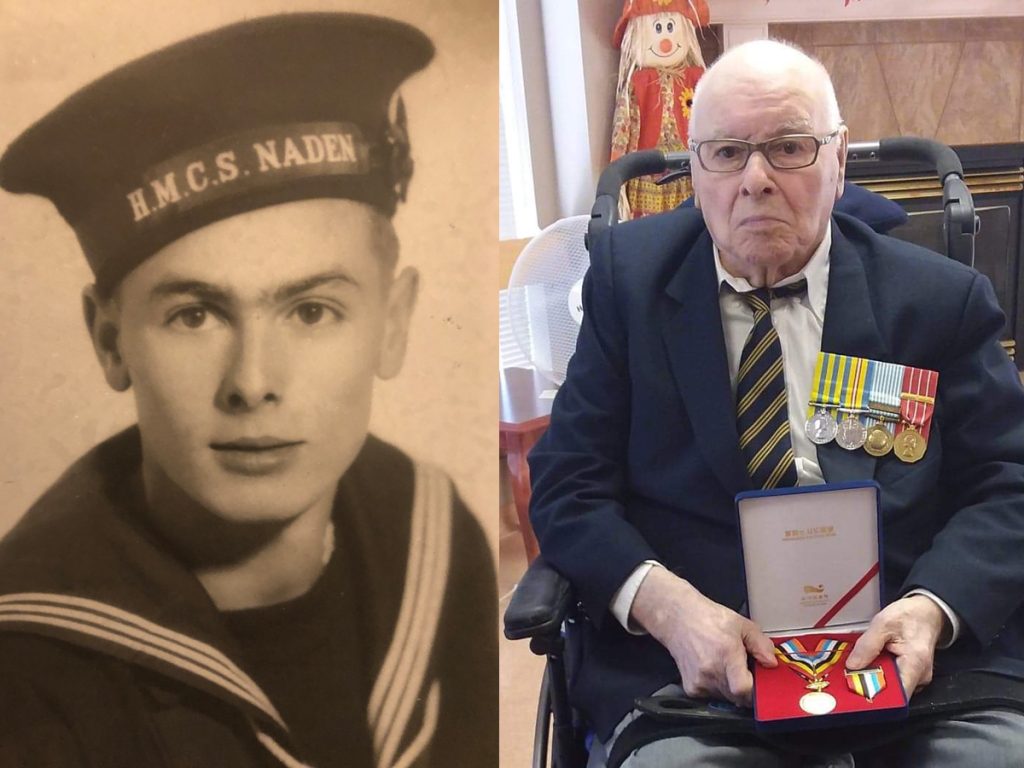
[caption id="attachment_21915" align="alignnone" width="593"] Right: Chief Petty Officer First Class (Retired) Melvin Hiles, 90, is presented with his Ambassador For Peace medal by Korean Consulate Official Kangjun Lee during a private ceremony at the Kiwanis Village seniors home in Nanaimo on Oct. 8. Credit Garth Hiles. Left: An undated file photo of Melvin Hiles from his first days at CFB Esquimalt.[/caption]Peter Mallett, Staff Writer ~There were hugs, cheers and tears for the family of an ailing veteran of the Royal Canadian Navy when he received an Ambassador for Peace medal for his service in the Korean War. Chief Petty Officer First Class (Retired) Melvin Hiles, 90, was presented the commemorative medal by Korean Consulate Official Kangjun Lee during a private ceremony at the Kiwanis Village seniors home in Nanaimo Oct. 8. CPO1 (Ret’d) Hiles served aboard Royal Canadian Navy destroyer HMCS Sioux from June 1950 to March 1951 during his 25-year military career that ended with an honourable discharge in 1973. The ceremony was attended by his children and other family members, including his 98-year-old sister Laura who also resides at Kiwanis Village. She was moved to tears of joy according to her nephew, 58-year-old Garth Hiles. Because of health problems, CPO1 (Ret’d) Hiles was unable to offer an acceptance speech or speak at the ceremony. Garth says his father immediately “perked up” upon receiving the award including an ear-to-ear grin. “Dad has always been a man of few words, but he was touched by receiving any form of recognition of his vast sacrifices in his naval career,” said Garth. “He is proud of his country and all the navy has done for other countries in their fight for freedom.” Garth and his wife Siobhan applied for the medal on behalf of his father. “When I first found out he was going to...

Veteran’s common scents business

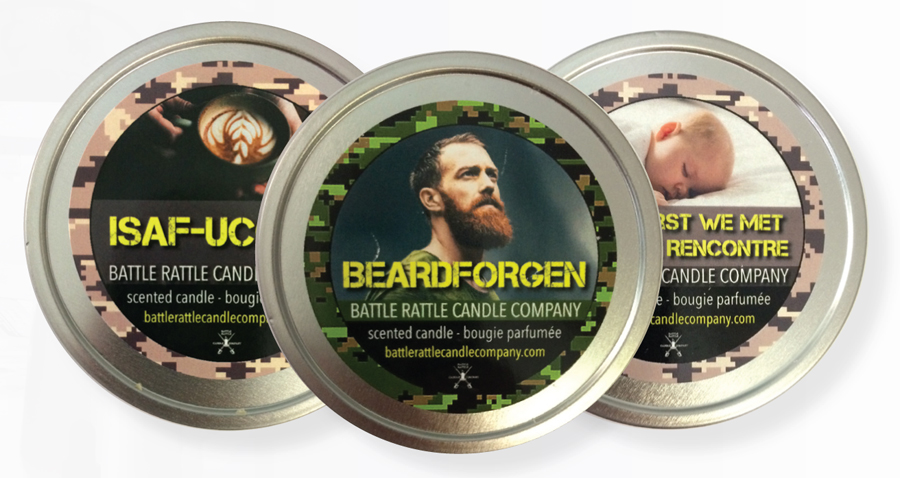
Peter Mallett, Staff Writer ~When Lieutenant-Commander (Retired) David Lewis launched his small business, he had a simple business plan that relied on one premise: The nose knows common scents.Knowing there are about 450 olfactory receptors that communicate between the nose and brain, the 60-year-old veteran created Battle Rattle Candle Company - scented candles with a military twist. Ten per cent of net sales are donated to Canadian veteran charities.All 30 of his candles are military themed. Afghan Tea, Galley Cookies, Kabul Snow, Duff, and the list goes on, “making scents of our time in the military,” he says. He has divided them into two categories: domestic operation scents and deployed scents, with a recent launch of holiday scents such as Ginger-Bloggins Man, and Moosemilk.LCdr Lewis spent 13 years in the military as a public affairs officer. In 2011, he was posted to Camp Eggers in Kabul, Afghanistan, as Deputy Director of Social Media for NATO. Smelling a chai-scented candle a few months ago instantly brought him back to that deployment and the tea he drank. “I began to ask myself, what if I created a line of scented candles for military members and veterans. Ones that would have a unique point of reference for anyone who has ever served in any branch of Canada’s armed forces.” After a bit of research and experimenting, he set about turning his London, Ontario, home into a mini factory. Pots of paraffin wax are heated on the stove top before adding his special scent formulas and colours. Then he pours them into small tins, adding the final touch of a wick in the centre. Each tin is topped with a lid and label. His candle names hold meaning to those who serve and have served. Some will even bring about a chuckle such as the Beardforgen,...

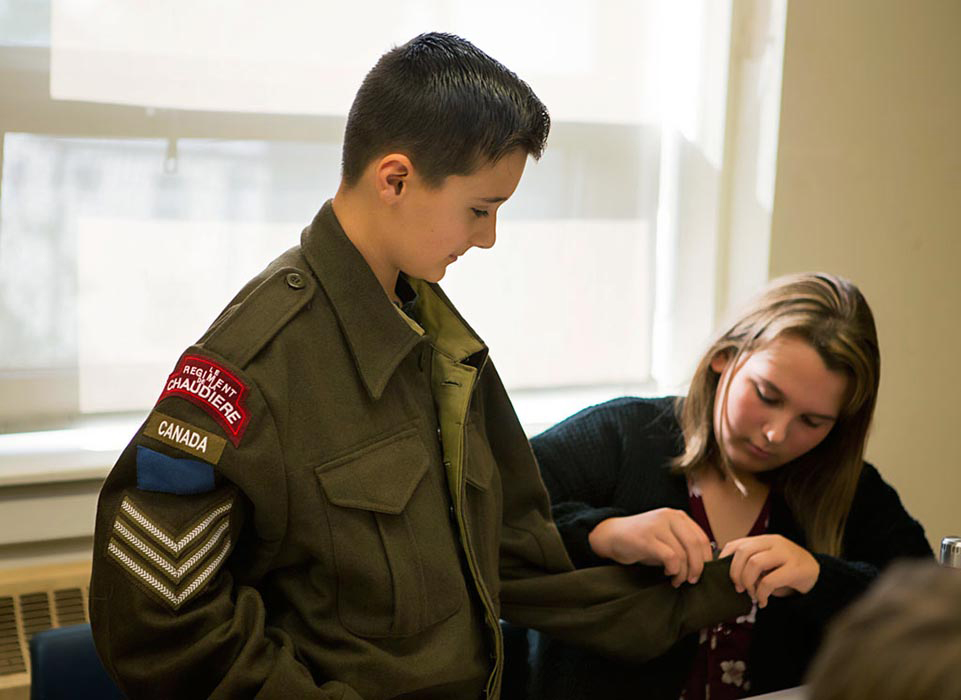
This authentic Second World War-era coat is just one example of the contents of the Canadian War Museum’s Supply Line Second World War Discovery Box. The resource is being made available to schools at no charge and includes other artifacts from the era to enhance classroom instruction. Photos Provided by the Canadian War Museum.

Discovery Box makes history tangible

[caption id="attachment_21909" align="alignnone" width="594"] This authentic Second World War-era coat is just one example of the contents of the Canadian War Museum’s Supply Line Second World War Discovery Box. The resource is being made available to schools at no charge and includes other artifacts from the era to enhance classroom instruction. Photos Provided by the Canadian War Museum.[/caption]Steven Fouchard, Army Public Affairs ~The Canadian War Museum is bringing the Second World War to life for students across the country with a new “Discovery Box” of artifacts designed to stimulate discussion in the classroom.The project is a follow up to the museum’s Supply Line First World War Discovery Box, which has been borrowed more than 1,900 times since the museum launched the initiative in 2014.This year, the museum is circulating 20 Second World War kits and 30 First World War kits, which will be loaned to schools free of charge for two weeks at a time. Both are aimed at students from Grades 4 to 12.Sandra O’Quinn, a learning specialist with the museum, said the Second World War box contains 23 artifacts, some reproductions, others authentic. There are hands-on objects and clothing, photographs and documents. As was the case with the First World War version, she added, they were chosen to spark students’ curiosity.“A big part of the current curriculum in most provinces is teaching historical literacy skills and inquiry-based thinking,” she said. “So, by giving them things that are curious and cause them to ask questions, it opens up a whole line of thinking for the teacher to run with.”Feedback from the first round of Second World War kit loans is still being gathered, but O’Quinn said she suspects students will be fascinated by two artifacts in particular: a lifeboat ration tin and a “sweetheart pin.”“It’s a real ration. We filled it with epoxy...

Historica Canada’s new history teaching tool

Peter Mallett, Staff Writer ~A new teaching tool by non-profit Historica Canada is bringing first-hand accounts of veterans to the classroom just in time for Remembrance Day. Record of Service: Canadian Contributions to International Peace and Security is geared towards middle school and high school students and includes a free education guide and accompanying DVD in both English and French. The DVD was released in November 2018 with 4,000 copies distributed to date, while the education guide was released last month. The new teaching tool encourages ­students to reflect on how international military engagements have shaped both individual experiences and the larger Canadian identity, says Mira Goldberg-Poch, Assistant Manager, Programs and Education at Historica Canada. “The guide brings oral history into the classroom and includes activities that build research, analysis, critical thinking and communications skills. Students are invited to deepen their understanding of how international engagements have shaped both individual experiences and the larger Canadian identity, and to examine the legacies of these conflicts.”The education guide is broken into 15 activities and are focused on the first-hand testimonies and accounts of 15 military veterans who served Canada from the Second World War through to the war in Afghanistan. Activity 4: Women and the Second World War offers a first-hand account from Janet Hester Watt who worked as a member of the Women’s Royal Canadian Naval Service (WRCNs) more commonly known as Wrens. They played vital roles in the First and Second World War efforts in both Canada and Great Britain. Jobs they performed included cooks, clerks, telegraph operators, electricians, coder, signallers, radar plotters and mechanics. “Once a Wren, always a Wren,” declares Watt. “You can go into a place and you meet a total stranger and you find out she’s a Wren, you’ve formed an association right then and there.”Goldberg-Poch says oral...

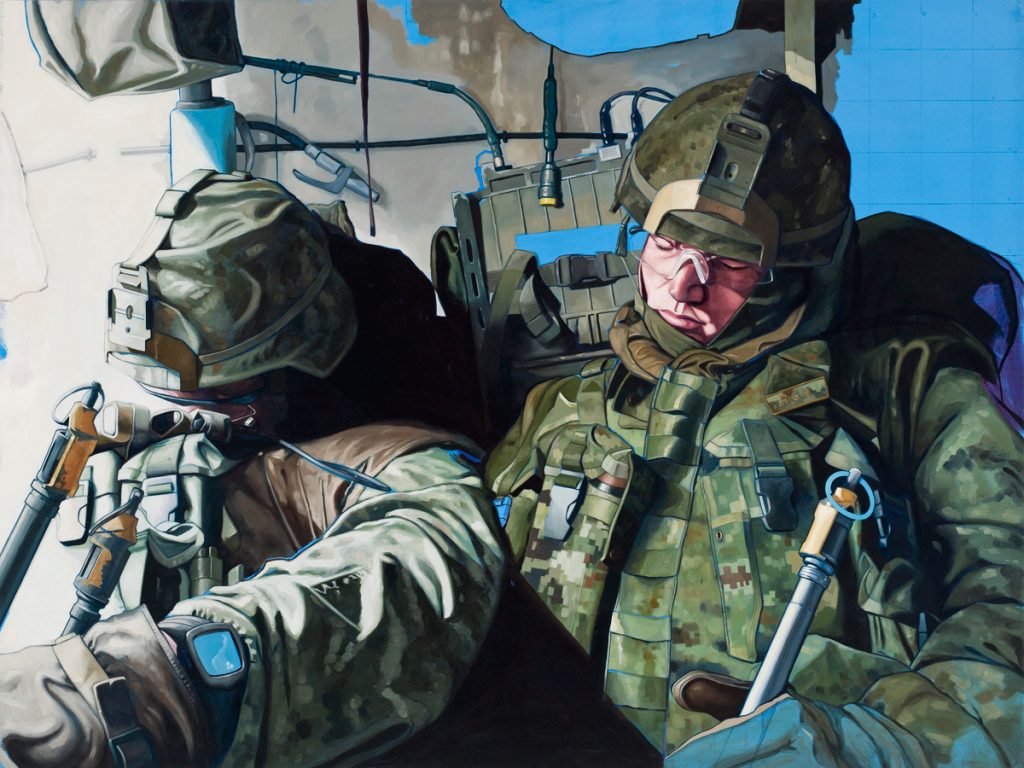
Former Canadian Forces Artist Program volunteer Scott Waters depicts two members of 2RCR (Royal Canadian Regiment) sleeping in their light armoured vehicle during training at CFB Gagetown in 2006.

Artist Scott Waters paints a picture of a soldier’s life

[caption id="attachment_21903" align="alignnone" width="593"] Former Canadian Forces Artist Program volunteer Scott Waters depicts two members of 2RCR (Royal Canadian Regiment) sleeping in their light armoured vehicle during training at CFB Gagetown in 2006.[/caption]Peter Mallett, Staff Writer ~Toronto-based artist Scott Waters’ military experience has framed much of his work.He served with the Princess Patricia’s Canadian Light Infantry between 1989 and 1992, and was stationed at Work Point. He and his platoon mates were preparing for war, hoping to be deployed to Kuwait for The Gulf War. His insights into the reality of being a soldier is what led him to be accepted into the Canadian Forces Artists Program. A reality that doesn’t always match with the public’s perception. Much of a soldier’s work is waiting for action, leading Waters to paint a more human aspect of them.In 2006, he travelled to CFB Gagetown in New Brunswick to get images of soldiers training to deploy to Afghanistan. From that embedded opportunity he created a series of paintings showing soldiers in everyday situations. This point of view is a detour from many other artists who depict soldiers in hardship moments. Waters’ wanted to paint the truth of a soldier’s journey – the boredom from waiting, the humour found in anticipation, the solemn nod to a lost comrade. Sleeping in the LAV (Light-Armoured Vehicle) is among those. It depicts two Second Battalion Royal Canadian Regiment personnel resting in their vehicle during Exercise Royal Archer II in the lead-up to their deployment to Afghanistan.“One of the issues I was interested in painting is how military service sometimes leads to death because that’s the nature of the job,” said Waters. “So, in this painting I have presented a rather quotidian [commonplace] image of two guys napping. But there is also the intended spectre of deployment in a war zone,...

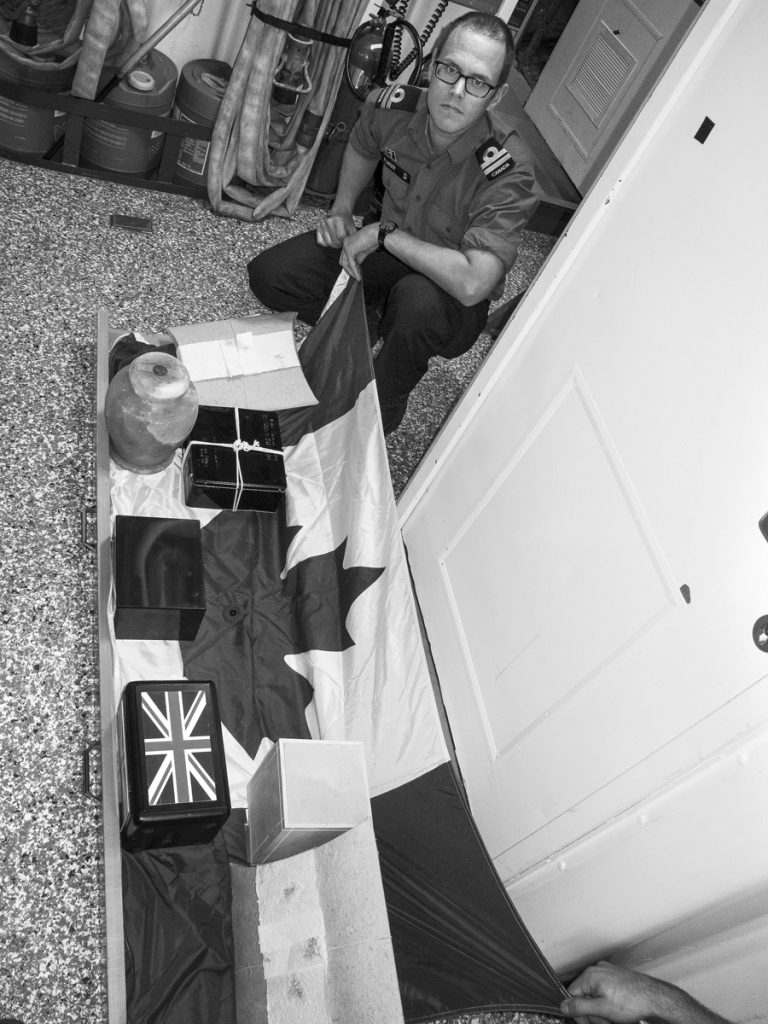
Padre Andrew Klinger prepares the ashes on the sliding board.  Photo by Capt Jenn Jackson

Honouring Those Who Have Served Before

[caption id="attachment_21900" align="alignnone" width="594"] Padre Andrew Klinger prepares the ashes on the sliding board. Photo by Capt Jenn Jackson[/caption]Captain Jenn Jackson, HMCS Ottawa PAO ~When HMCS Ottawa departed Esquimalt harbour for Operations Neon and Projection on Aug. 6, it carried with her the ashes of seven veterans – two who served in the Second World War – which had been entrusted into the care of Ottawa’s crew by their families.“When we departed, along with our own families, present among the crowd were the loved ones of the ashes we carried, saying a final farewell knowing their loved one’s remains would be committed to sea during the deployment,” says Padre Lt(N) Andrew Klinger, Ottawa’s Padre.Committal of Ashes to Sea are coordinated through CFB Esquimalt’s Chaplin Office and are conducted an average of two to three times a year. The ashes are always those of former Canadian Armed Forces members, and families provide the container, as well as a short biography that is read during the ceremony as Words of Remembrance. “I am humbled to be able to honour the wishes of these veterans and their families,” said Padre Klinger.In keeping with the spirit of Remembrance Day, the ceremony will take place on Ottawa next week during a pause in her deployment in the Asia-Pacific region.“I cannot think of a more fitting way to offer a final farewell to deceased navy veterans than to commit their ashes to sea from a vessel conducting operations similar to those that represented a significant and dedicated period in their lives,” says Padre Klinger. “As I read through the Words of Remembrance for each set of ashes, I am struck by the commitment each made to their country through their service – just as I am serving now.”The ashes to be committed to sea are those of...

Message from the Base Commander

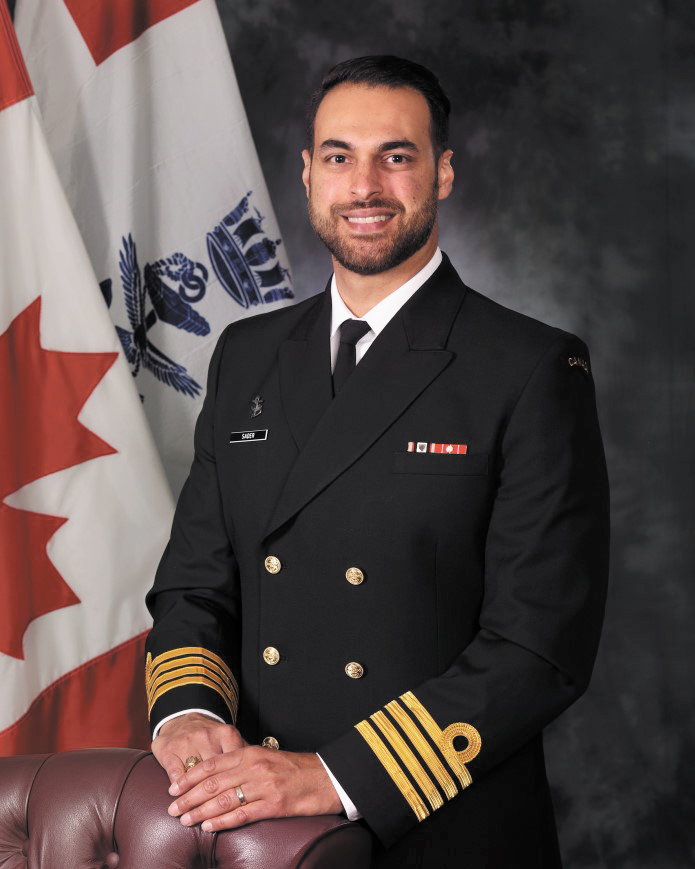
During this time of remembrance, I encourage everyone to think upon the reason why we wear the red flower and hold ceremonies across this great country. The freedom we enjoy here in Canada comes at a cost, paid by brave men and women who selflessly put themselves in harm’s way during times of armed conflict.It is important that we remember the toll, sacrifice, carnage, and causes of these conflicts so that in our solemn gratitude we do not repeat the mistakes of the past.On the 11th hour of the 11th day of the 11th month, when 101 years ago the guns fell silent on the fields of Europe, the world takes time to reflect and pay tribute to those that fought and shall not grow old. Although the lessons of ‘The Great War’ did not stop us from engaging in future armed conflicts, they do give us this moment where each year we wear a poppy, and honour those who gave everything so that we might enjoy a future free from tyranny and persecution. Many Canadians whose names we will never know, but to whom we owe a great debt, shall be remembered. While we are fortunate to have normal lives afforded us by the peace we currently enjoy, it is important the memory of the cost remains as a stark reminder to future generations. As you gather with others at Remembrance Day ceremonies across the country, please remember the sacrifice of those who have served, and those who continue to serve in areas of conflict.Capt(N) Sam Sader---

Explore More

Categories

Top News

E-Editions Archive

News Stories Archive

Proud Supporters

Joshua Buck, Lookout Newspaper