
[wpml_language_selector_widget]
[searchwp_form id="1"]
Dockyard worker Jeremy Chow takes a selfie with his wife Evelyn (left)

Ailing dockyard worker needs stem cell donor

[caption id="attachment_20517" align="alignnone" width="591"] Dockyard worker Jeremy Chow takes a selfie with his wife Evelyn (left), his two daughters Jayla and Maile, and the family cat Piku. Chow is currently battling leukemia and so far has had no luck in his search for a potentially life-saving stem cell donation.[/caption]Peter Mallett, Staff Writer ~The family of a dockyard worker recently diagnosed with leukemia is searching for a potentially life-saving stem cell donation. Jeremy Chow, a 42-year-old shipwright joiner from Fleet Maintenance Facility (FMF) Cape Breton, was diagnosed with acute myeloid leukemia in November 2018. Because Chow is of mixed race - Chinese and English - he and his family have had no luck finding a donor through national and world-wide donor registries. Positive stem cell matches are determined through inherited ancestral tissue types and other genetic markers. But there is a significant race-based unevenness in the donor list worldwide. Approximately 70 per cent are Caucasian, 16 per cent are Asian, and an even smaller percentage are mixed race. “A donor could come from anyone, anywhere. We have been actively searching the registries, but nothing is coming up as a match yet,” said Evelyn Chow, Jeremy’s wife.While Jeremy was wrapping up chemotherapy at a Vancouver hospital last week, Evelyn and Jeremy’s friends and co-workers were busy spreading the word about his situation. “We could never have imagined this was going to happen to Jeremy and that there was such a shortage,” said Evelyn. “The effort now is not only to help Jeremy find a donor, but also to raise alarm bells about the shortage in an effort to help others who are in a similar situation.” Last week, Evelyn attended a stem cell donor clinic at the University of British Columbia in hopes of finding a match. Evelyn along with her family and friends,...

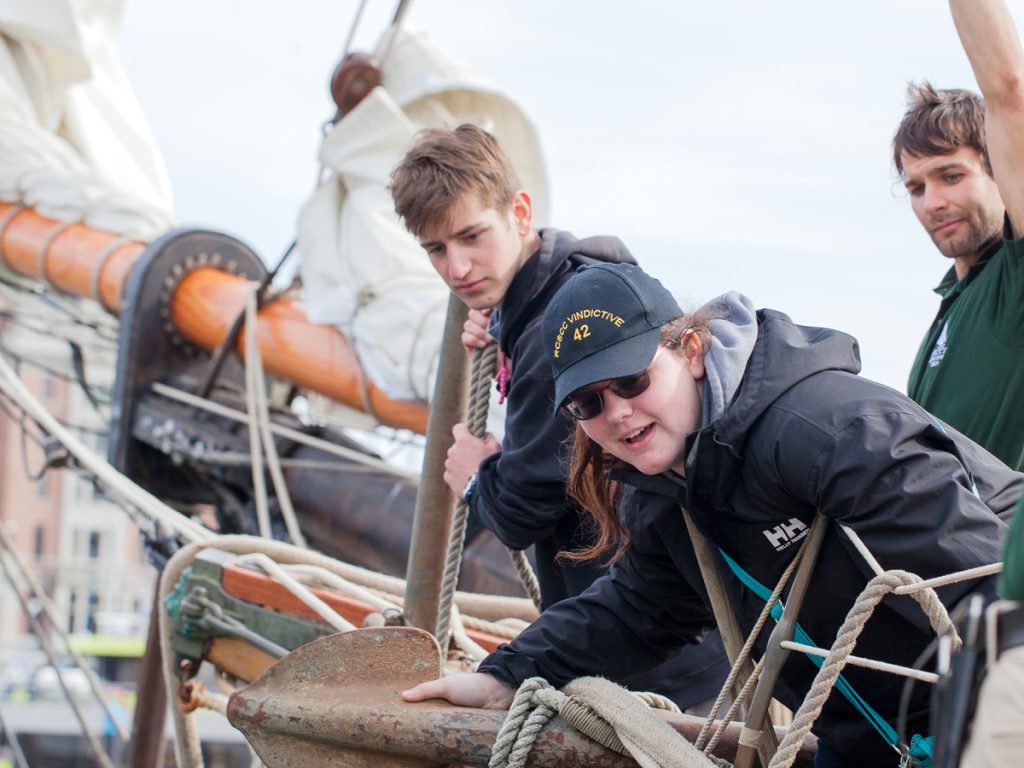
Photo by Christa Brunt

Sea cadets: schooners and a taste of SALT

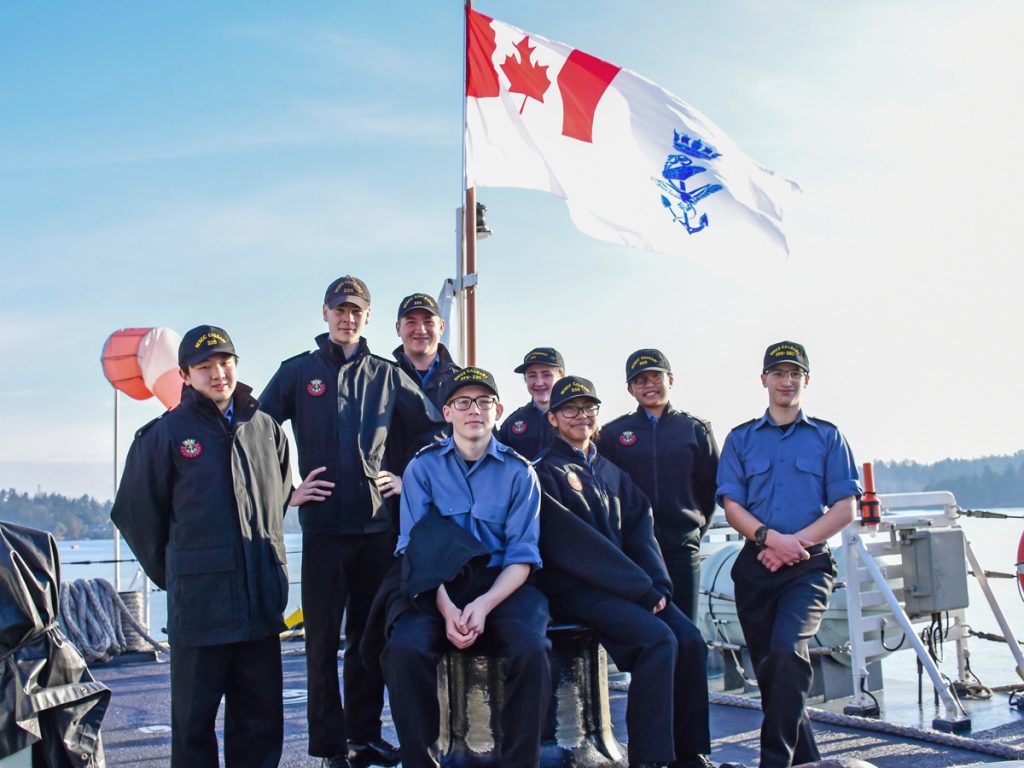
[caption id="attachment_20476" align="alignnone" width="591"] Bosun Brock directs cadets Cassandra and Hunter as they prepare to come alongside in Victoria Harbour on the deck of S.A.L.T.S. schooner Pacific Swift. Photo by Christa Brunt[/caption]Peter Mallett, Staff Writer ~A group of 57 Sea Cadets from across Canada set a course for fun and adventure earlier this month aboard two tall ships. The heritage vessels are built and operated by the Sail and Life Training Society (SALTS) of Victoria. The aspiring mariners, all between the ages of 13 and 25 representing nine of Canada’s 10 provinces, took part in SALTS’s first deployment of 2019. The two schooners, the Pacific Grace and Pacific Swift, returned to Ship Point Pier on March 15 after five days at sea and a voyage that took the cadets through the Gulf Islands and back. As the ship entered Victoria’s Inner harbour under fair skies, Sea Cadets could be heard cheering and singing while several were spotted climbing the rigging one last time.SALTS Executive Director Loren Hagerty says the heritage tall ships provide an ideal platform for youth mentorship at sea, and provide them a confidence boost and sense of wellbeing. “Every young person on board has to fully participate and engage in order for the ship to go anywhere,” said Hagerty. “The result is growth in relational skills, teamwork, work ethic and the satisfaction of accomplishing something significant together.”Each ship normally has a crew compliment of five who are accompanied by up to 31 trainees. While aboard, cadet trainees had the opportunity to handle sails, take the helm, climb the rigging, and take part in night-time anchor watch along with many other activities of shipboard life. Each year 1,700 young people are given an opportunity to learn how to sail, grow relational skills and develop work ethic in five to...

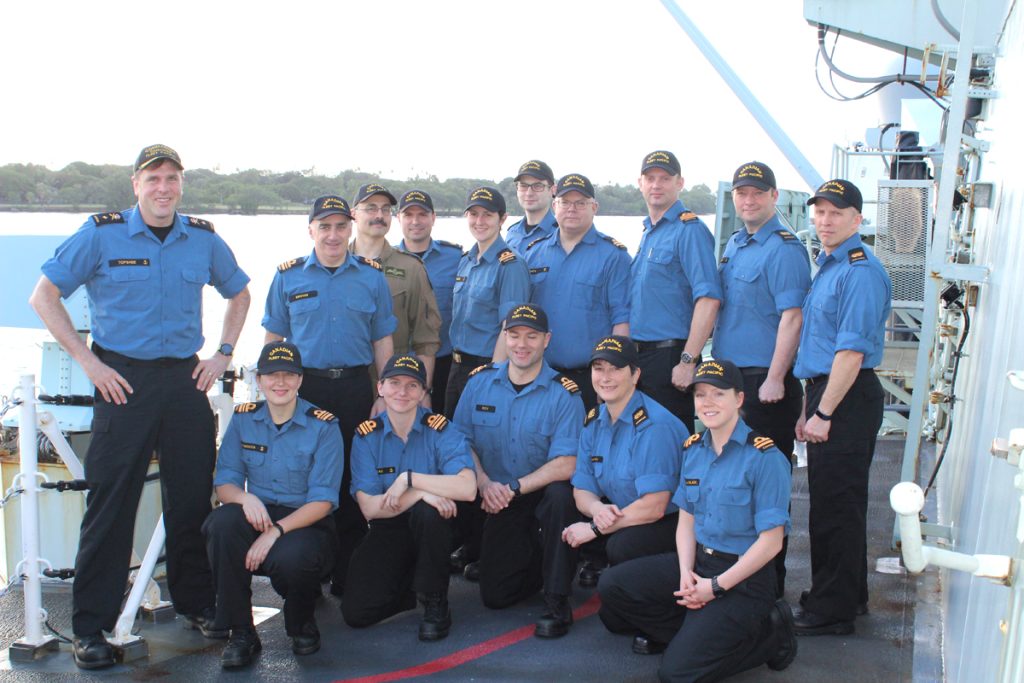
Commodore Topshee and his staff pose as OTTAWA enters Pearl Harbor.

HMCS Ottawa aids USN in submarine course

[caption id="attachment_20473" align="alignnone" width="591"] Commodore Topshee and his staff pose as OTTAWA enters Pearl Harbor.[/caption]Peter Mallett, Staff Writer ~HMCS Ottawa has returned to Esquimalt after successful completion of a training exercise involving torpedo fire with vessels of the United States Navy (USN), and support to the Canadian Navy’s Operation Projection. The Halifax-class frigate and its crew of 220 completed a month-long deployment on March 4 that included participation in a USN Submarine Commander’s Course (SCC), Feb. 20 to 22, off the coast of Hawaii. Ottawa sailed to Hawaii Feb. 6 with HMCS Regina and Naval Replenishment Unit (NRU) Asterix. During their transit to Pearl Harbor, Ottawa served as the command platform for the initial task group under the leadership of Canadian Fleet Pacific Commanding Officer, Commodore Angus Topshee. In Hawaii, they supported Regina’s and Asterix’s Operation Projection mission by working with partner navies and conducting key leadership engagements to enhance military cooperation and partnerships in support of Canada’s diplomatic efforts in the Asia-Pacific region. Before taking part in the Submarine Commander’s Course, Ottawa was required to complete a Torpedo Readiness Inspection under the guidance of Sea Training Pacific (ST(P)). While on board, ST(P) staff helped the ship’s crew fulfil its Assisted Ship Readiness Training that included internal emergency response to fires and floods. Ottawa Executive Officer, Lieutenant Commander Tyson Bergmann said, “With the help of Sea Training Pacific, Ottawa’s crew sharpened their skills and learned critical lessons that will be valuable moving forward, and I am proud of our capable and competent crew.” The USN Submarine Commander’s Course saw Ottawa engaged in exchange of torpedo fire between the ship and USN submarines. The exercise torpedoes fired by Ottawa allowed the ship to conduct real-world training safely with other units as these torpedoes did not contain a payload and were unarmed. “Ottawa was...

Cadets earn sea legs in HMCS Calgary

Cadets earn sea legs in HMCS Calgary

Peter Fuerbringer, Regional Cadet Support Unit Pacific ~Sea Cadets from Alberta and British Columbia took to the high seas aboard HMCS Calgary for a five-day experience off the southern shores of Vancouver Island. The cadets, many of whom hail from HMCS Calgary’s namesake city, earned the experience to become part of the crew thanks to a unique aspect of the Cadet Program that opens up opportunities to interact with active members of the Canadian Armed Forces. Cadets were able to join the ship in Victoria and take part in training exercises such as man overboard, fire suppression, navigation, officer of the watch, high speed maneuvers and onboard landings with the Royal Canadian Navy’s new Cyclone helicopter.“I thought it was super cool to become part of the crew for a little bit and see the ship in action,” said Cadet Tyler Knowless from Sidney, B.C. “There is so much teamwork that happens during the drills, and it was great to be treated like part of the team by so many people we look up to.” According to the ship’s Commanding Officer, Commander Blair Saltel, having cadets on board has been a top priority since he took command in 2016. “HMC ships are busy when we put to sea, but some missions allow for opportunities to show the Canadian public what the RCN does and what life at sea in a warship is like, while allowing my sailors to develop their own skills.”In 2018, his team and the cadet organization managed to bring 89 cadets to sea over a series of five-day periods. “I hope Calgary’s program will allow for something similar, starting with this past sail. Working with the cadet organization showed me how impressive and solution-focused they are to get great kids to experience great things.”

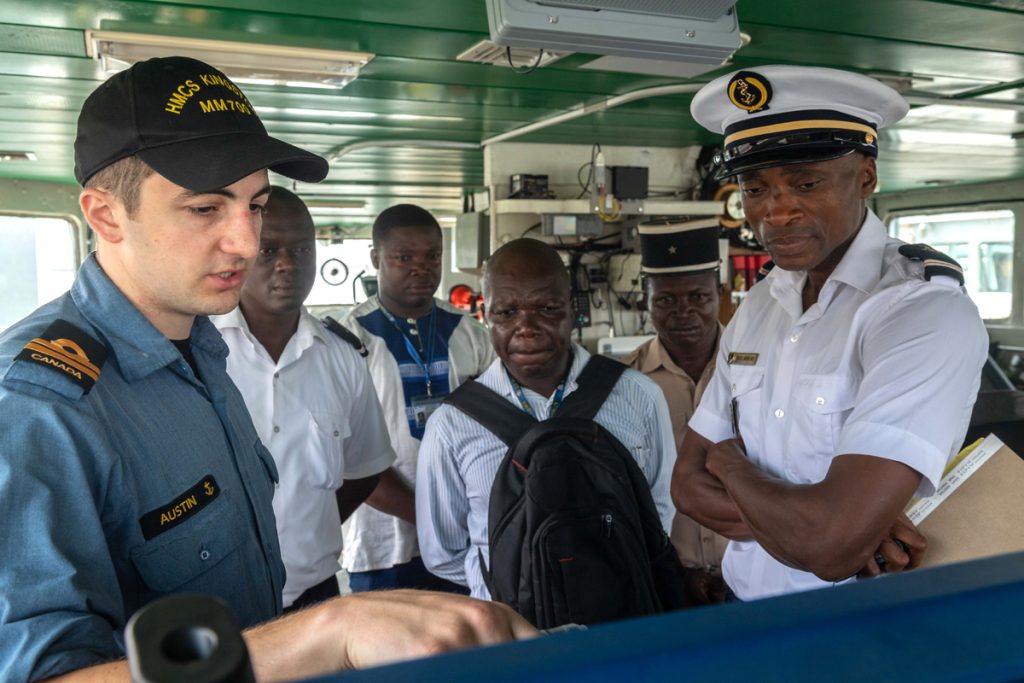
HMCS Kingston Navigating Officer Lt(N) Graham Austin discusses search-and-rescue strategies with Togolese military and government personnel on March 7. Photo by Cpl David Veldman

A Canadian first: Navy ship stops in Togo

[caption id="attachment_20467" align="alignnone" width="590"] HMCS Kingston Navigating Officer Lt(N) Graham Austin discusses search-and-rescue strategies with Togolese military and government personnel on March 7. Photo by Cpl David Veldman[/caption]Lt (N) Jeff Lura, PAO Operation Projection West Africa ~On a beautiful Tuesday morning, HMC Ships Kingston and Shawinigan came alongside in Lomé, the capital city of Togo. Deployed on Operation Projection West Africa, the ships had already visited several other African countries, but the reception this time was different. Uniformed Togolese military personnel – including the commander of Togo’s largest naval base – lined the jetty. A camera crew filmed the ships as they arrived, preserving the event for posterity. The reason? No Royal Canadian Navy ship had ever visited the country.“We’re honoured to be the first Canadian warships to visit your country,” told LCdr Jeremy Samson, Kingston’s Commanding Officer, to journalists shortly after arriving. “Building and reinforcing relationships is a large part of our mission here in Africa, and we look very much forward to spending time with you.” The visit was a busy one for the ships’ crews. Hours after entering the harbour, sailors exchanged their working uniforms for gleaming whites, and welcomed members of Togo’s military, government, and community organizations on board. Representing Canada, Ambassador Heather Cameron spoke to guests of the importance of cooperation between Canada and African partners, and the strength of the Canada-Togo relationship. “Relations between Canada and Togo are founded on almost 60 years of history,” she told attendees. “Cooperation is essential in order to ensure regional maritime security, maintain international trade, and develop coastal communities.” Following the official presentations, military personnel from both nations made fast friends, posing for photos and discussing the similarities between the Canadian navy and the Marine Nationale de Togo.The next day, sailors visited L’Espace de Fraternité, a centre that welcomes...

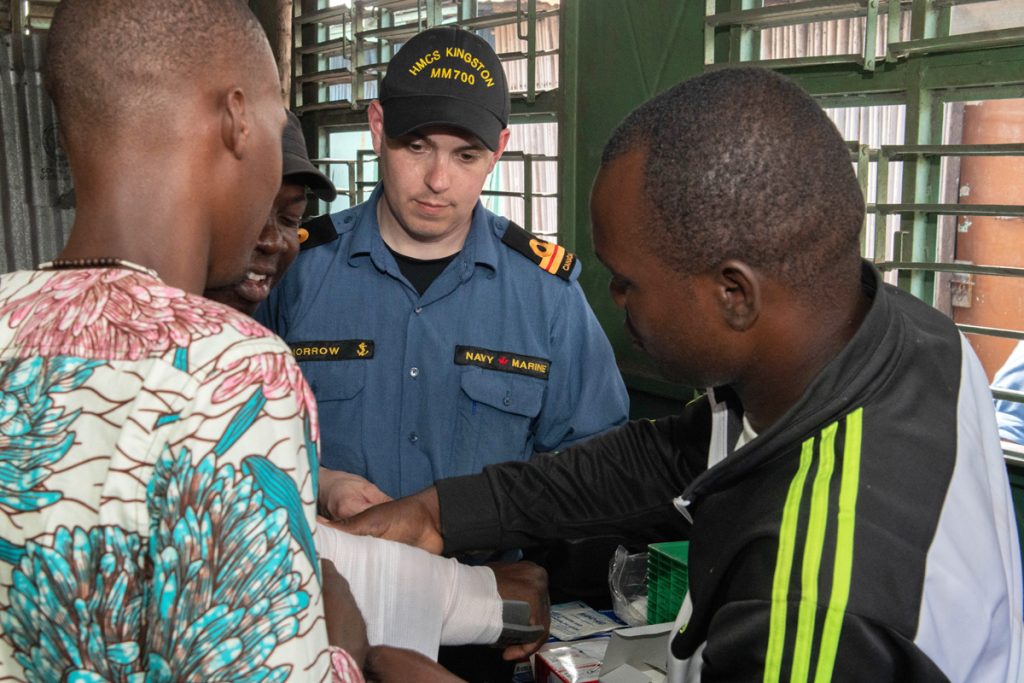
Lt(N) Greg Morrow supervises while local teachers practice first aid at Foyer Don Bosco school in Cotonou

From St. John’s to Benin – medical officer shares knowledge

[caption id="attachment_20464" align="alignnone" width="590"] Lt(N) Greg Morrow supervises while local teachers practice first aid at Foyer Don Bosco school in Cotonou, Benin, during Operation Projection West Africa. Photo by Cpl Angela Gore[/caption]Lt(N) Jeff Lura, PAO Operation Projection West Africa ~On the first day of March, sailors from HMC Ships Kingston and Shawinigan arrived at Foyer Don Bosco, a small school in Cotonou, Benin, nested within West Africa’s largest open-air market. Using their expertise coupled with good old “elbow grease”, they painted walls and repaired furniture in the school. Afterwards they played games with the children. On the same visit was medical officer Lt(N) Greg Morrow, but he had a different mission. He was there to teach basic first aid to a group of enthusiastic teachers. His lessons were made more important by the fact that ambulances and hospitals are not widespread in Benin; in many cases, teachers would be the only care available to an injured student. “It was a challenge,” said Lt(N) Morrow after the training. “We [in Canada] take for granted that medical care and supplies are available everywhere, but that’s not the case here. I had to really keep it simple, since these villages lack basic services and emergency response.” With the help of a translator, Lt(N) Morrow demonstrated how to deal with cuts, scrapes, fractures, and spinal injuries in a way that would be useful to the teachers after his departure. By all accounts, his instruction was well-received. “It was perfect,” said teacher Pascal Akakbo after the training. “We’re confronted with problems and injuries here all the time, so a better understanding of how to respond will do so much good. We will use this [newfound knowledge] very often.”When he’s not sharing his expertise to the far corners of the globe, Lt(N) Morrow spends his time...

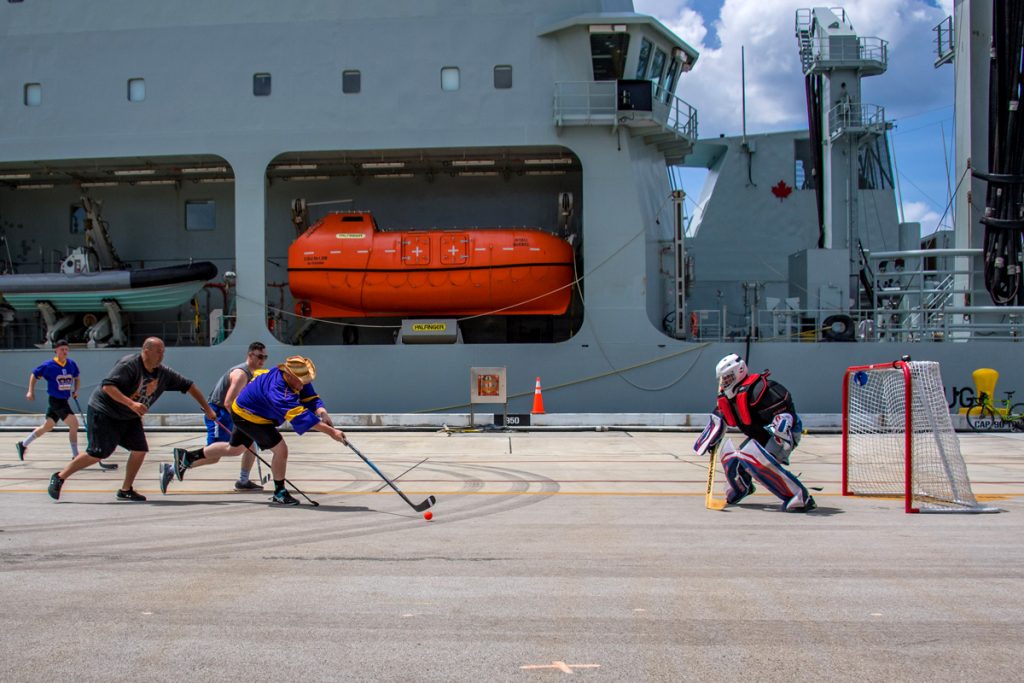
Members of the HMCS Regina and NRU Asterix’s crews play a game of ball hockey during some down time during Operation Projecton on Naval Base Guam in Guam

Hockey day in America – Regina style

[caption id="attachment_20461" align="alignnone" width="591"] Members of the HMCS Regina and NRU Asterix’s crews play a game of ball hockey during some down time during Operation Projecton on Naval Base Guam in Guam, United States Of America during Operation Projecton on March 7. Photo by Corporal Stuart Evans, Borden Imaging Services[/caption]Lt(N)  Mike Harris, HMCS Regina ~Tropical heat and a backdrop of palm trees was not enough to keep hockey out of the minds of Naval Replenishment Unit (NRU) Asterix and HMCS Regina crews. With nets set up on the jetty, where the ships were tied up at Naval Base Guam, a couple games of ball hockey broke out - all part of physical training and crew cohesionWatching the game was reminiscent of kids playing ball hockey on the street, except they didn’t have to pause and drag the nets to the side as there were no cars driving by. “We should do events like this more often. Lots of people came out, everyone loved it and it’s good for the ship as a whole,” said AB Mailloux. “It was super hot but that didn’t stop people from playing.” Two games were played, with the first game being Team Deck Department from the two ships against Team Mixed Departments. It was a close game in the first half, but the diversity of the Mixed Departments led to a final score of 6-2. Due to the incredible heat and fierce competition, an intermission in the shade had to be instated before the next game. In a post-game discussion, SLt Charlebois, with his in-depth knowledge on the subject, believed the day of the game was “hotter than Tatooine and slightly muggier.”With all the players rested and hydrated, personnel picked up their sticks and shot balls around, which, in road/jetty hockey rules, means it was time to start...

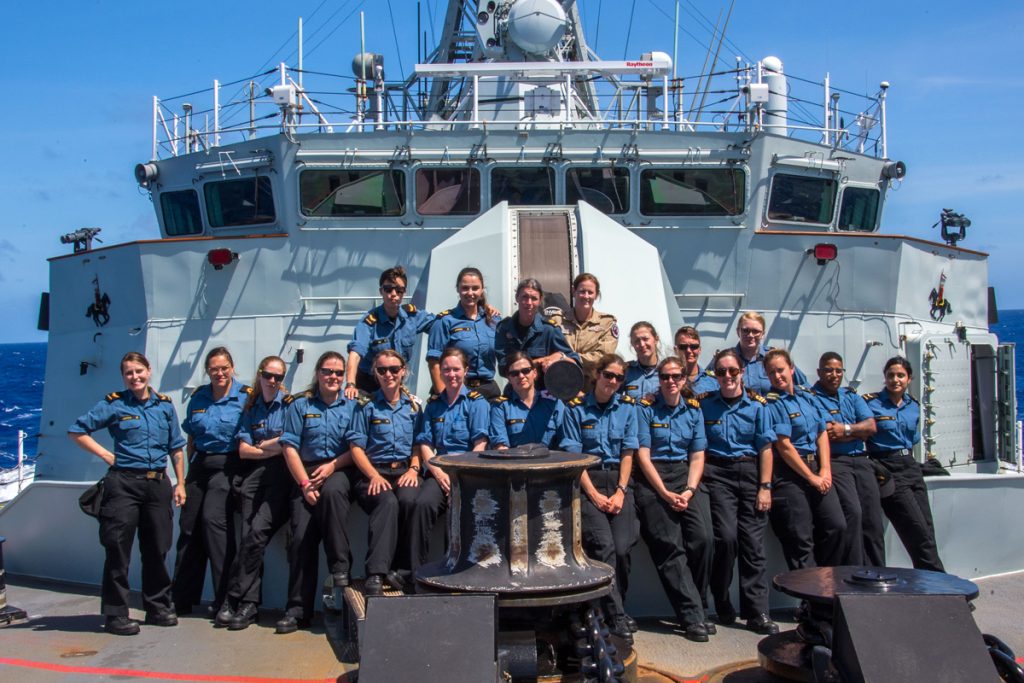
HMCS Regina’s female crew members pose for a photo to celebrate International Women's Day on the Pacific Ocean during Operation PROJECTON on March 10. Photo by Corporal Stuart Evans

Women in warships – a fading big deal

[caption id="attachment_20458" align="alignnone" width="590"] HMCS Regina’s female crew members pose for a photo to celebrate International Women's Day on the Pacific Ocean during Operation PROJECTON on March 10. Photo by Corporal Stuart Evans, Borden Imaging Services[/caption]Lt(N) Katrina Giesbrecht, HMCS Regina ~International Women’s Day came and went onboard HMCS Regina with little fanfare. The 23 female members of Regina were busy with our respective tasks, either preparing to return to sea after a port visit, providing support to repairs on the helicopter, or standing duty. Each of us joined the Canadian Armed Forces (CAF) for different reasons, but all of us view ourselves as professional members of the CAF first, and women in the CAF second. We represent all three environments and are represented in each of the three messes.Sometimes we are asked to attend events in order to highlight the diversity in our navy; however, different doesn’t mean wrong, so we appreciate the chance to highlight our experiences to the civilian world, allied navies, and generally across the globe. When asked about being a woman in the military, LS Dana Kimoto, a member of the Operations Department, said, “I joined the navy almost eight years ago. I really had no idea what to expect as a woman in the military. I’d heard stories of how it was a boy’s club and how ‘boys will be boys’, but in my experience that hasn’t really been the case at all. I’ve found the military to be more respectful and equal than other jobs I’ve had. Being able to visit countries where women’s’ rights are not as advanced, and occasionally interacting with women in other navies, has made me appreciate the freedoms we have as woman in the Canadian military.Navy newcomer MCpl Amy Kingston was struck by the navy’s motto: “a sailor first.”“In all...

Outreach visit strives to eliminate naval blinders

Outreach visit strives to eliminate naval blindness

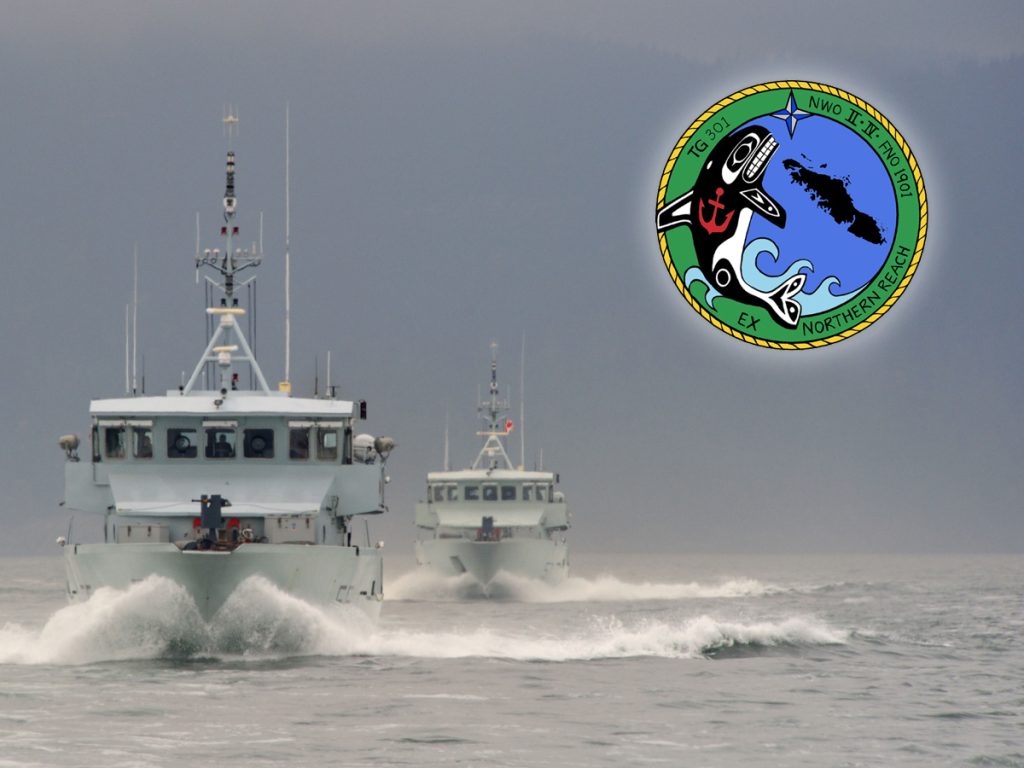
Peter Mallett, Staff Writer ~A remote community on Vancouver Island is welcoming vessels of the Royal Canadian Navy to its main harbour this weekend. Four Orca-class Patrol Craft Training (PCT) vessels and 96 crew members will come alongside Small Craft Federal Marina in Port McNeill as part of Exercise Northern Reach. Located at the northeastern tip of Vancouver Island on the Queen Charlotte Strait, the former logging town, turned summertime tourism destination, has a population of approximately 3,000 residents. Lieutenant Commander Todd Kennedy, Commander Venture Division, says “the exercise is a continued effort by the navy to combat the nation-wide phenomena of maritime blindness” by helping Canadians learn about their navy and the job it does on behalf of the country.“Many Canadians know very little about their own navy or even that it exists; so, to be relevant to the population we need to be out there and visible,” said LCdr Kennedy. “This is an effort to showcase what we do, how we train, and to demonstrate pride in our diversity as an organization. We want people to know we are the employer of choice and if there exists a desire to contribute to Canada and its international policies, that we have a job for you.”PCT vessels Orca, Caribou, Raven and Wolf will be staffed by fleet personnel and Venture students from the Fleet Navigating and Naval Warfare Officers courses needing the fundamental bridge skills training to prepare them for employment in operational ships. Each student is seeking the opportunity to advance their professional competencies. While in Port McNeill between March 29 and April 1, two vessels will take residents and community leaders to sea, showcasing interoperability with the Royal Canadian Air Force, who have tasked a Maritime Patrol Aircraft from CFB Comox, and the Canadian Coast Guard, who have tasked a...

So you think you can dance? Come do it Bollywood style

MARPAC PAO ~Maritime Forces Pacific Public Affairs has decided to go full-out Bollywood in their next video production, and they are looking for volunteers. Public Affairs is teaming up with YouTube’s Bhangra-king, Gurdeep Pandher April 3 to shoot a high-energy dance video. What is Bhangra? It’s a style of dance that mixes music and moves from India and Pakistan. It’s entertaining and also a high-energy workout. If you’re curious, just go to YouTube, or check out any Bollywood film on NetFlix and you’ll see how the pros do it. You don’t need to be a star dancer to join in the video, as Pandher will be teaching everyone. Pandher will introduce trending and commonly used Bhangra steps along with brief details on the history and background of the dance. “This video project is important to showcase wonderful diversity and inclusion in the Canadian Armed Forces,” he said.  “As we know, some elements are trying to divide people; I unite them through Bhangra. Participation is great for showing our togetherness and unity to the world. The video will also help promote the vision that Canada stands for diversity and inclusion.” The video will be shot in two locations: Damage Control School Galiano on the road next to the helo-simulator from 9 to 11 a.m. and on HMCS Ottawa in the afternoon in dockyard. Dress is Naval Combat Dress or Combats for CAF members, as we want to showcase people in uniform. Civilians are welcome too. Interested volunteers can contact Lt(N) Melissa Kia at the MARPAC PA Office to sign-up for this event at 250-363-5789 or melissa.kia@forces.gc.ca. About Gurdeep PandherGurdeep Pandher is a Whitehorse-based artist and author. His works are meant to bring people from all backgrounds together to promote inclusivity and diversity. His dance videos have gone viral on many occasions, have also been published internationally, and are watched by millions from all over the world. He has been published by BBC News, CBC National, The Globe and Mail, CTV News, and many...

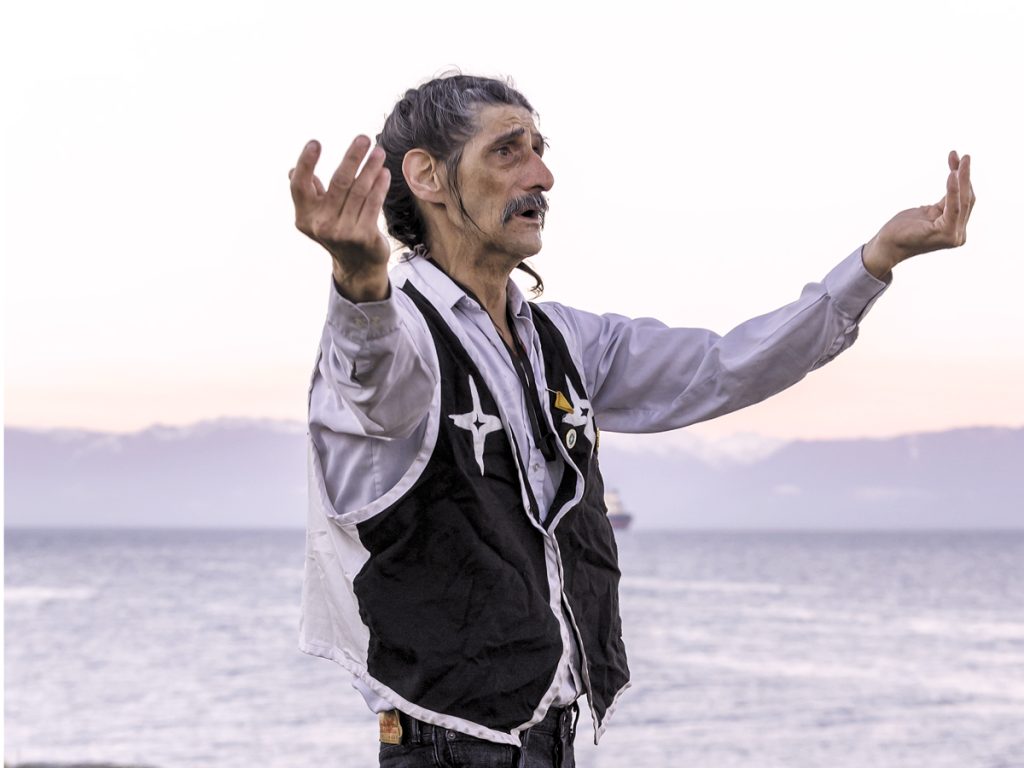
Bill Stewart

Spring Equinox celebrated at Duntze Head

 [caption id="attachment_20446" align="alignnone" width="591"] Bill Stewart, a member of the Ahousaht First Nation, recites a prayer during the Spring Equinox Sunrise Ceremony at Duntze Head on March 20. Photos by Leading Seaman David Gariepy, MARPAC Imaging Services[/caption]Peter Mallett, Staff Writer ~Each weekday morning as the sun begins to rise, Bill Stewart begins his day with an offering of song in the form a traditional Aboriginal drumming ceremony at Duntze Head.The 60-year-old technical data specialist at Fleet Maintenance Facility Cape Breton is a member of the Defence Aboriginal Advisory Group (DAAG) at Maritime Forces Pacific and a member of the Nuu-Chah-Nulth nation.Last Wednesday, his ceremony was a little special as it paid homage to the sunrise of the Spring Equinox, when the Earth’s equator passes through the centre of the sun. This happens only twice a year; the Fall Equinox is in late September.Accompanying Stewart was Sergeant Nicolette Ducharme, who also drummed, and a few observers. The ceremony honours the natural world, and Stewart says several animals have revealed their presence as he performs it.“These songs are understood by certain animal species. Birds, including eagles and ravens, herring, salmon, sea otters, whales, elk, deer and even bears come out to acknowledge the Spring Equinox.”This year’s occasion was marked by the passing of an eagle and a pair of Canada Geese.In 2017, a killer whale appeared in Esquimalt harbour.“My elders have advised me to continue with the song because the eagle spirits have come to me with the Travelling Song and that is to be good luck to all who hear it.”Stewart, who is 90 per cent hearing impaired, began his career with FMF 26 years ago. He has served as co-chair of DAAG on several occasions. In more recent years he has become highly active with his Nuu-Chah-Nulth community, which is...

Virtual career fair for military spouses

 CFMWS ~Save the date. On March 27, Military Family Services will host its second virtual career fair for military spouses across the country as part of the Military Spousal Employment Network.“The beauty of a virtual career fair is that regardless of location, people from coast to coast will have access to employers looking to hire,” says Kristy Fallon, Community Development and Stakeholder Relations Manager, Military Family Services. “This is a chance to connect people with opportunities – and not just in their communities but with remote work options too.”Nationally, there are 1,084 opportunities available that recruiters will be looking to fill, as well as several remote positions. This is in addition to new opportunities added to the Network daily.Participating employers are: Advanis, Air Canada, Alorica, Bank of Montreal, Bayshore Medical Personnel, Bell, Calian Group Ltd., Canadian Forces Morale and Welfare Services, Department of National Defence, Garda World, LiveCa, and Sykes Assistance Services. These national employers have agreed to offer military spouses equal and fair access to employment opportunities within their organizations.Growing steadily, the newly minted Military Spousal Employment Network has more than 1,200 users since it launched in the fall. The Network is a self-directed online resource with access to job postings, tools, resources, and events such as training sessions and virtual and in-person career fairs.Military spouses can register for the Military Spousal Employment Network at msen.vfairs.com and the virtual career fair at http://bit.ly/Mar27VirtualCareerFair.

WISEN member (left) Asheley MacLellan of CFB Esquimalt’s Outreach Team and WISEN founder Natallia Gagné

Network group connects Indigenous students

[caption id="attachment_20418" align="alignnone" width="591"] WISEN member (left) Asheley MacLellan of CFB Esquimalt’s Outreach Team and WISEN founder Natallia Gagné, a human resources assistant with Base Administration’s National Student Hiring team are joined by National Student Hiring Team Lead Roxana Kendall at the Base Commander’s Office on Feb. 21. Photo by Peter Mallett, Lookout[/caption]Peter Mallett, Staff Writer ~A support group that connects Indigenous students currently working for Canada’s public service with future job opportunities has been launched by two employees at CFB Esquimalt. The Western Indigenous Student Network (WISEN) is the brain child of Natallia Gagné, a 21-year-old human resources assistant who works for Base Administration’s National Student Hiring Team, following the launch of the federal government’s Indigenous Student Employment Opportunity (ISEO). The mandate of ISEO is to address the low representation levels of Indigenous students hired across the Public Service, but Gagné decided to go one step ­further with WISEN. WISEN keeps students currently working for the Federal Government networked with their peers after their short-term contract ends. Gagné believes building up those low representation levels will be achieved by letting Indigenous student employees know about other job opportunities within the Public Service. Gagné, who is Metis, is in her fourth year of Sociology and Indigenous Studies at University of Victoria. She came up with the idea for WISEN last summer while on a work-study term as a junior human resources officer for the Public Service Commission in Vancouver. In September, she found work at the base. Shortly afterwards she met 22-year-old Ashley MacLellan, who currently works for the Base Executive branch on Project Outreach, and the two teamed up to operate WISEN in their spare time. MacLellan, 22, grew up in Yellowknife, NWT, and is a member of the North Slave Métis Alliance. She also attends the University of Victoria and...

Support Our Troops accepting national scholarship applications

CFMWS ~The Scholarship Program is entering its fifth year; it was launched to address the increasing need for scholarship opportunities for military family members. The goal is to assist more youth in military families to pursue their continuing post-secondary education. In 2018, more than $75,000 was awarded to military family members through 45 scholarships with winners selected from 388 competitive applications. This year, 41 scholarships are available and range from $500 to $2,000. Both full-time and part-time post-secondary students of accredited academic institutions, career and vocational colleges are eligible. Eligible candidates are: a dependent (includes spouse) of a serving or former member of the Canadian Armed Forces; a Canadian citizen or permanent resident of Canada; and enrolled in an undergraduate program leading to a degree, diploma or certificate at an accredited Canadian college or university. Post-graduate and career college students are also eligible to apply.This year there is a new application process in place. The 2019 application process consists of the following components:A three-part essayA letter of referenceMost recent academic transcriptProof of enrollment from academic institutionA point form list of volunteer/civic engagement activitiesApplications will be accepted until May 1 at 4 p.m. EST.For more information on application requirements, eligibility and restrictions visit www.supportourtroops.ca/get-support/scholarships. For any application questions please email scholarshipsandcamps@cfmws.com

Naden Drill Shed coming to an end

LCdr Mike Erwin, Contributor ~After 78 event-filled years, the Naden Drill Shed (Building N75) is going out of service in May as the first of many steps in a far-reaching infrastructure renewal program.The Drill Shed, being centrally located and of a distinctive design, has long been an iconic landmark at the base. It was built in 1941 as a wooden frame on a concrete foundation along the east side of what was then the parade square, and is now the parking lot between N50 and N75, at a cost of $130,000. The Drill Shed was intended to augment the Drill Hall (building N33, now home to Naval Fleet School (Pacific) Small Arms and the Naden Band of the Royal Canadian Navy) and to provide space for training the burgeoning recruits entering the wartime Royal Canadian Navy, Royal Canadian Naval Reserve, and Royal Canadian Naval Volunteer Reserve. The initial structure consisted of just the mansard-style roof, with its steep sides and flat top, and supporting pillars, without the glassed-in bulkheads that have made it so recognizable since their installation prior to 1943.Although Naden saw a spate of rapid expansion during the period 1940 through 1943, most naval training activities were transferred to HMCS Cornwallis in Nova Scotia partway through the war. This shift left Naden in the unusual situation, particularly during wartime, of having a surplus of facilities. In 1944, the Drill Shed was repurposed and taken over by the Mechanical Training Establishment for use as a vehicle maintenance and training facility. It fulfilled this role until the Mechanical Training Establishment relocated in 1959 when the Drill Shed reverted to its original function.Over the years, the Drill Shed has been the site of innumerable ceremonial divisions, graduation parades, change of command parades, Guard of Honour practices, sea cadet training weekends, fund raising...

Michael Cain

Former sailor rises above addiction

[caption id="attachment_20406" align="alignnone" width="363"] Michael Cain[/caption]Peter Mallett, Staff Writer ~A former sailor of the Royal Canadian Navy who beat his drug and alcohol addiction says he will never forget the fateful life-saving call he received from Veterans Affairs Canada.Former Ordinary Seaman Michael Cain was sitting in his mom’s View Royal home on Oct. 29, 2014, during an alcohol and cocaine-induced 18-day bender. His three years in the military were ending; he had no vision of a future. “I was close to running out of drugs, depressed and planning to kill myself,” says Cain. Then the telephone rang. It was a VAC case worker named Irena, and she threw him a lifeline. She had managed to convince the operators of renowned Vancouver-based rehabilitation clinic Together We Can Addiction Recovery & Education Society to give Cain a bed, effectively saving his life. Together We Can was founded in 1993 as a treatment centre for men battling alcohol and drug addiction. The non-profit society offers 60- to 90-day immersive recovery programs followed by transitional housing and other support. Their medicine, says Cain, is exactly what he needed.“I call Irena every year on Oct. 31 and thank her because that’s the anniversary of the first day I woke up sober.”Addiction Gateway He came from a loving family who educated him about the dangers of drugs, well explained by yorba linda rehab. It was age 15 when he “crossed the line” trying marijuana for the first time. Then at 18 years old he found the substance that would eventually bring him to his knees, cocaine. “In hindsight I can see the inevitability of my downward spiral, but at the time it was simply exciting.” Cocaine led to crack, a more effective means of getting high. He knew his addiction was taking over but by then he...

Photo by LS Pascale Masse-Lefebvre

HMCS Edmonton gives back to community

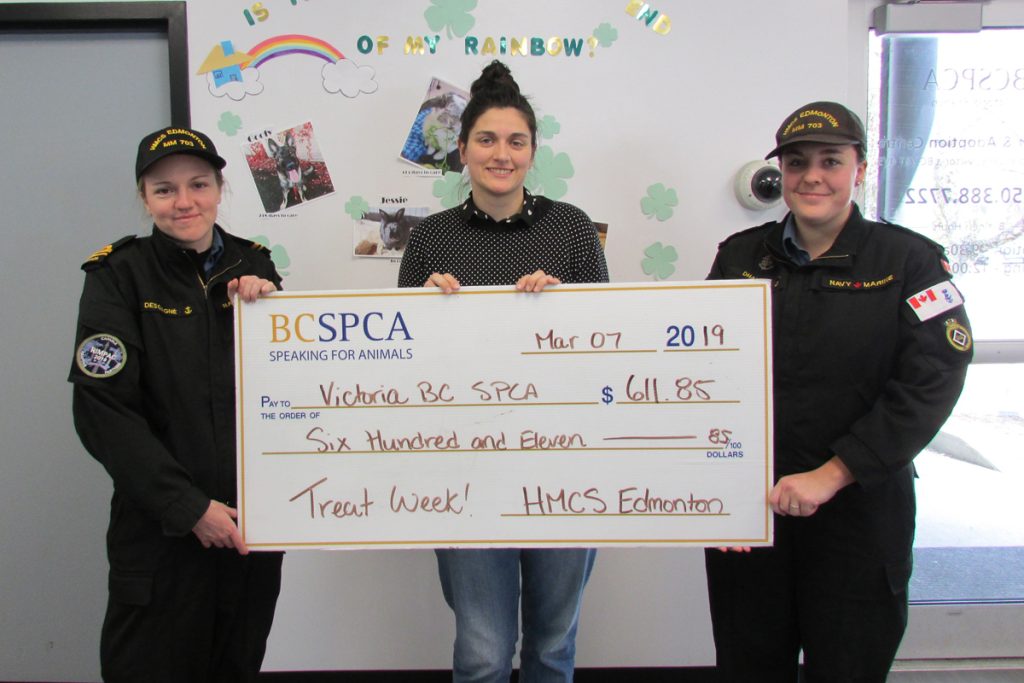
[caption id="attachment_20403" align="alignnone" width="590"] Photo by LS Pascale Masse-Lefebvre, HMCS Edmonton[/caption]SLt Nathaniel Sukhdeo, HMCS Edmonton ~Giving back to the community and supporting the less fortunate are values held close to the heart of many sailors. HMCS Edmonton’s Charity Bake Sale in support of SCPA Treat Week was just another example of how sailors are driven to find ways to give back at home, and abroad. On Friday March 1, the crew of Edmonton came together to sell baked goods, donating 100 per cent of the revenue to the local SPCA. “Helping our local B.C. SPCA is helping to protect and give a better quality of life to our furry friends,” said AB Myriam Dhaisne, who took leadership in coordinating the charity event. A few days later, AB Dhaisne, along with LS Pascale Masse-Lefebvre and SLt Anne Desgagne, presented $611.85 donation. “I was really surprised and grateful how this fundraiser brought together the crew into baking some treats, and how much participation from the base and donations we received,” said AB Dhaisne after presenting the cheque to the SPCA with SLt Desgagne. 

USS Zumwalt arrives in CFB Esquimalt. Photo by Peter Mallett

Futuristic USN vessel visits Victoria

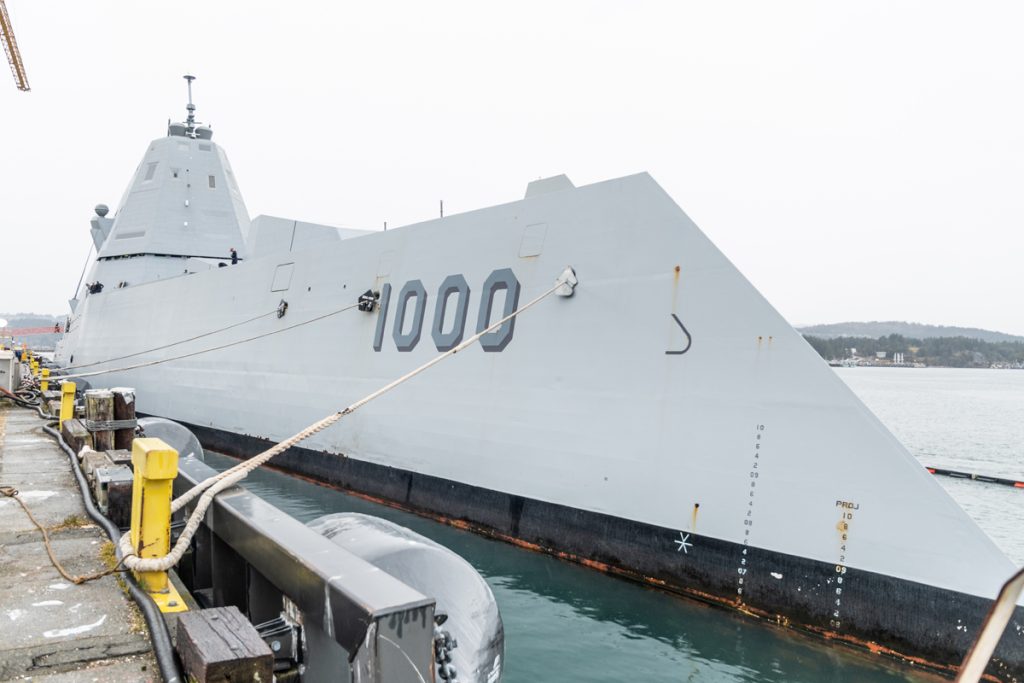
[caption id="attachment_20400" align="alignnone" width="591"] USS Zumwalt arrives in CFB Esquimalt. Photo by Peter Mallett, Lookout[/caption]Peter Mallett, Staff Writer ~The United States Navy’s newest, largest, and most expensive destroyer ever built pulled into Esquimalt Harbour last week as part of its first voyage to a foreign country. It was hard not to notice the massive 16,000 tonne, futuristic 610-foot-long guided-missile destroyer as it pulled alongside A-Jetty guided by a Queen’s Harbour Master tug on March 11. Despite its stealth-like design intended to thwart enemy detection while at sea, USS Zumwalt was an eye-popping attention grabber. Commissioned in 2016, it is the lead ship of the Zumwalt-class. It is designed as a multi-mission stealth ship with a focus on land attack.“The ship you see behind me is one of the newest platforms in the United States Navy and assists in our mission to ensure free and open flow of trade through international waters,” said Commanding Officer, Captain Andrew Carlson. “It is equipped with cutting edge technology in its combat systems, weapons systems and engineering control systems.”Members of the media were welcomed onboard Zumwalt for a brief tour conducted by Surface Warfare Officer, Lieutenant Briana Wildemann. The tour began on the massive flight deck capable of landing two medium-sized helicopters and proceeded through the ship’s hangar.The group then moved down a massive service corridor measuring approximately 15 feet wide dubbed “Broadway”, which included a pictorial tribute to the ship’s namesake, Admiral Elmo R. Zumwalt, Jr., Chief of U.S. Naval Operations during the Vietnam war, and renowned champion of equal rights and inclusion in the USN. Lt Wildermann noted to the visitors it was a pleasure to serve on board a ship named after a man who championed the cause of racial and gender equity in the U.S. military.“For me being able to come aboard...

Samples of unit identifiers embroidered on the necks of T-shirts. Personnel at wings

Wear your Air Force pride on your sleeve

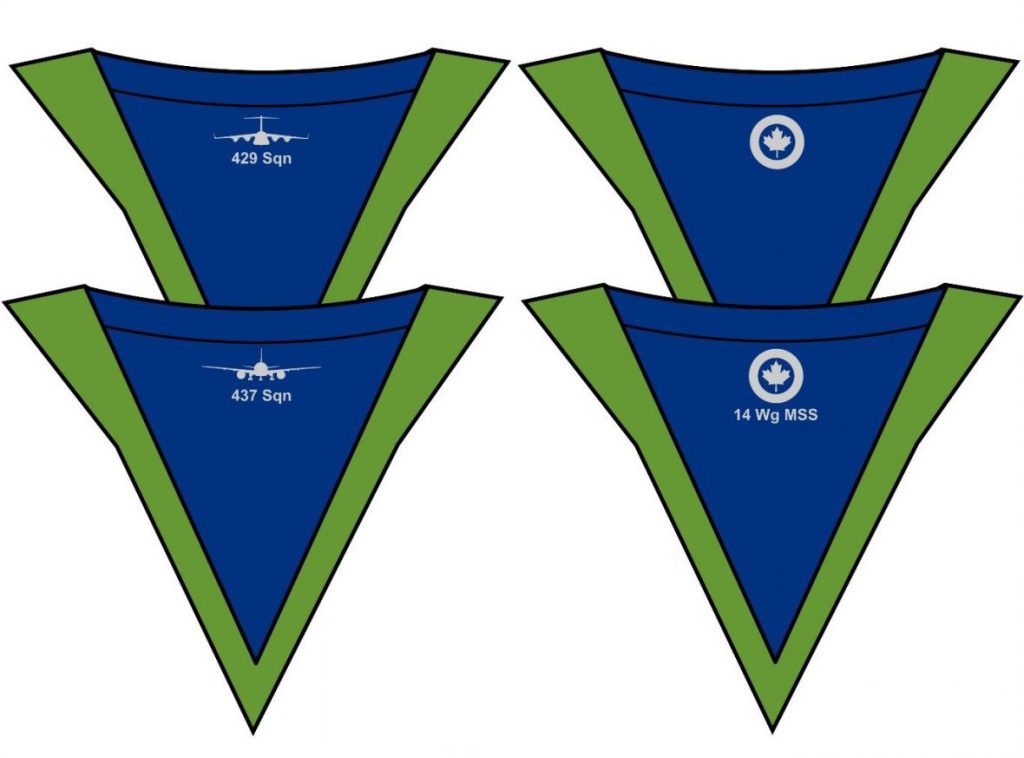
[caption id="attachment_20391" align="alignnone" width="591"] Samples of unit identifiers embroidered on the necks of T-shirts. Personnel at wings, squadrons and tactical units will soon be able to wear blue t-shirts with an embroidered logo at the neck—or, on Fridays, their own squadron coloured T-shirt.[/caption]RCAF Public Affairs ~The rules governing Royal Canadian Air Force (RCAF) personnel wearing badges or insignia on their operational uniforms are about to change.An upcoming amendment to the Canadian Air Division Orders (CADO) on operational dress will allow aviators who wear flight suits and Enhanced Combat Uniforms (ECUs)/CADPAT to add certain optional Velcro-backed badges and insignia to their sleevesThis change in the CADO is intended to enhance squadron and tactical unit morale and esprit de corps. The spirit of the RCAF unit is centered on the members and how well they work together. Part of this spirit comes from the symbols they wear: the badges and crests of the unit.The CADO amendment will allow badges, especially a unit’s heraldic badge, to be embroidered in full colour, as well as low visibility green.All other badges can be embroidered in full colour, which will be up to the unit as part of their design process. Yes, a unit can design their own patch.What other kinds of patches can there be?Units can now create and wear badges to mark a special anniversary or participation in an exercise or operation. Courses may have their own patch as well.In addition, personnel at wings, squadrons and tactical units will soon be able to wear blue t-shirts with an embroidered logo at the neck—or, on Fridays, their own squadron coloured T-shirt.Lieutenant-General Al Meinzinger, Commander RCAF, and Chief Warrant Officer Denis Gaudreault, RCAF Command CWO, noted this forthcoming direction will serve to enhance esprit de corps and identity, adding that RCAF aviators are encouraged to “take the...

Capt Chris Dare poses in his climbing gear.

A daring summit

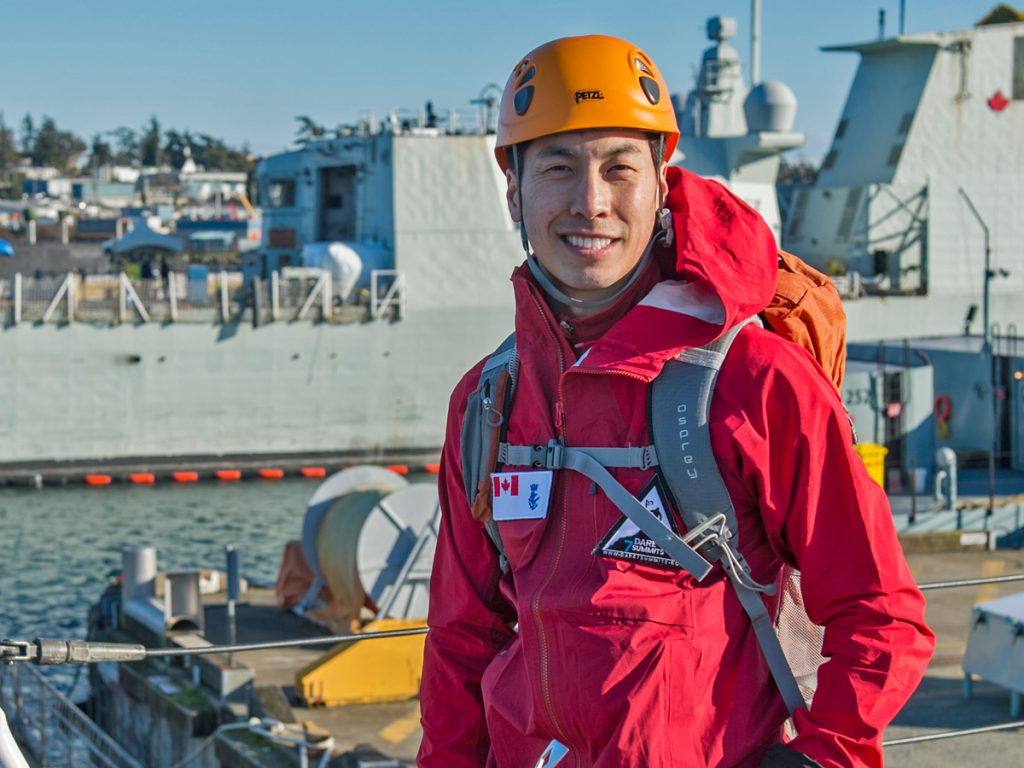
[caption id="attachment_20388" align="alignnone" width="591"] Capt Chris Dare poses in his climbing gear.[/caption]Peter Mallett, Staff Writer ~Captain Chris Dare is trading his dentist’s drill for a mountaineer’s axe.The 35-year-old army dentist who works at the Dockyard dental clinic is set to ascend 8,850 metres to the top of Mount Everest.If successful, the accomplished outdoorsman’s latest expedition will bring to fruition a nine-year journey to hike the “Seven Summits”, considered one of the top bench marks of accomplishment in the world of mountain climbing. They are the highest mountains of each of the seven continents.He tackled the first mountain while deployed to Afghanistan nine years ago. “When I returned back to Afghanistan I was feeling down as there were a lot of people I was working with getting seriously injured, dying, and there seemed to be a consistent wave of ramp ceremonies going on. I decided I would climb the Seven Summits even though it seemed like an impossible task.” While on leave, he summited Africa’s Mount Kilimanjaro, a 5,895 metre climb to the top. From there he travelled the globe climbing the continental geological behemoths in Europe’s Mount Elbrus (5642 m), Alaska’s Mount Denali (6104 m), South America’s Aconcagua (6962 m), Oceania’s Carstensz Pyramid (4884 m) and Antarctica’s Mount Vinson (4892 m).Capt Dare will fly from Vancouver to Nepal March 21 and complete several weeks of altitude training under the guidance of a Sherpa guide named Nuru. Then in late May, when conditions are good, the two will begin the journey up the mountain from Tibet side. It should take between two to three weeks to reach the summit. Weather and the amount of time waiting behind other hikers could prolong their journey.He says Alaska’s Mount Denali climb was his toughest to date because of the thin air and Arctic weather, but...

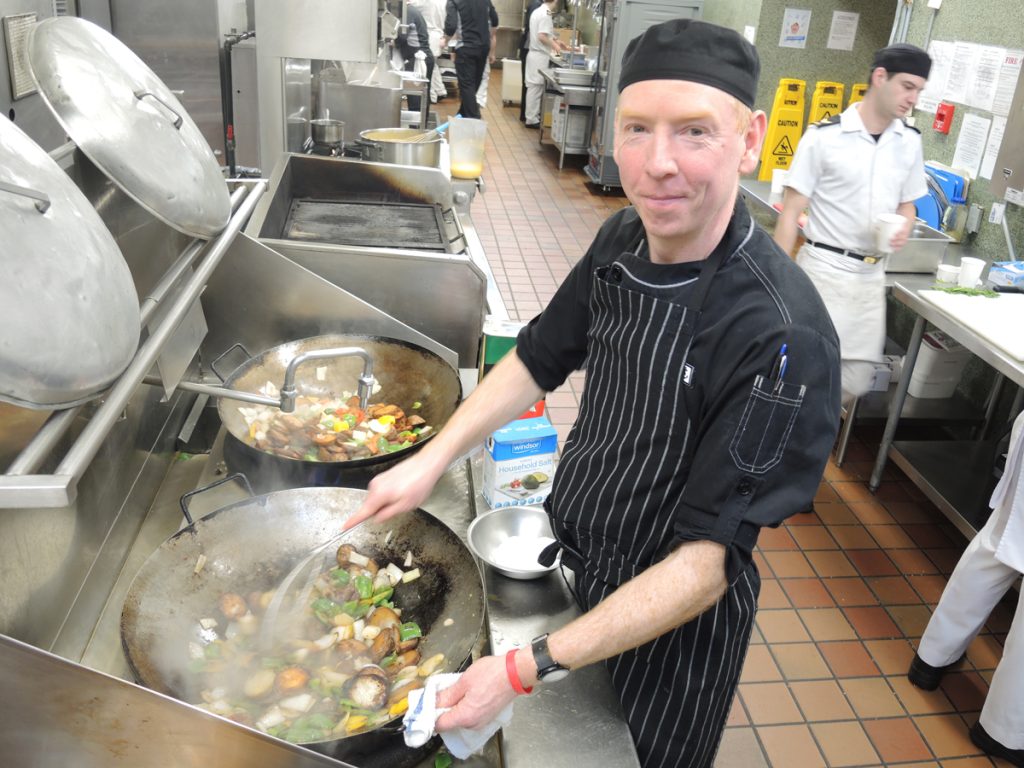
LS Robbie McDougall of Base Foods showcases his special cod fillet meal in the kitchen at Nelles Block. Photo by Peter Mallett

New recruit warms up to signing bonus

[caption id="attachment_20385" align="alignnone" width="591"] LS Robbie McDougall of Base Foods showcases his special cod fillet meal in the kitchen at Nelles Block. Photo by Peter Mallett, Lookout[/caption]Peter Mallett, Staff Writer ~A cook with formal culinary arts training says a career with Canada’s military is providing him a permanent port of stability from the topsy-turvy restaurant industry. Leading Seaman Robbie McDougall, 39, is a certified Red-Seal chef with an impressive list of credentials. He has close to 20 years of experience cooking at high-end eating establishments here in British Columbia, Europe and Great Britain. But early last year he decided to end his career in the private sector and join the Canadian Armed Forces as a cook. He is currently behind the grill at the Nelles Block galley. “I have a lot of friends cooking for the private sector who are my age and are grinding it out. I realized what I wanted for me and my wife Sylwia going forward was stability, and doing what I was doing really wasn’t getting me anywhere. I wanted to explore other options.”He also notes the great benefits that include: no seasonal work stoppage, unlike many private sector restaurants, the rewards of a steady income, and a solid benefits package. His career move was also spurred by the encouragement of a military member who lives next door.“I wanted the stability that he had in his life and while I was talking to him, I gradually began to ask the question to myself: Do I really want to be slinging burgers when I’m 64?” A never-before offered signing bonusLS McDougall also received a $20,000 signing bonus, a new incentive for the trade. It was offered about a month before his formal enrolment because of his culinary training; this also earned him an advanced promotion to Leading...

Sailor endeavours to create a positive workplace

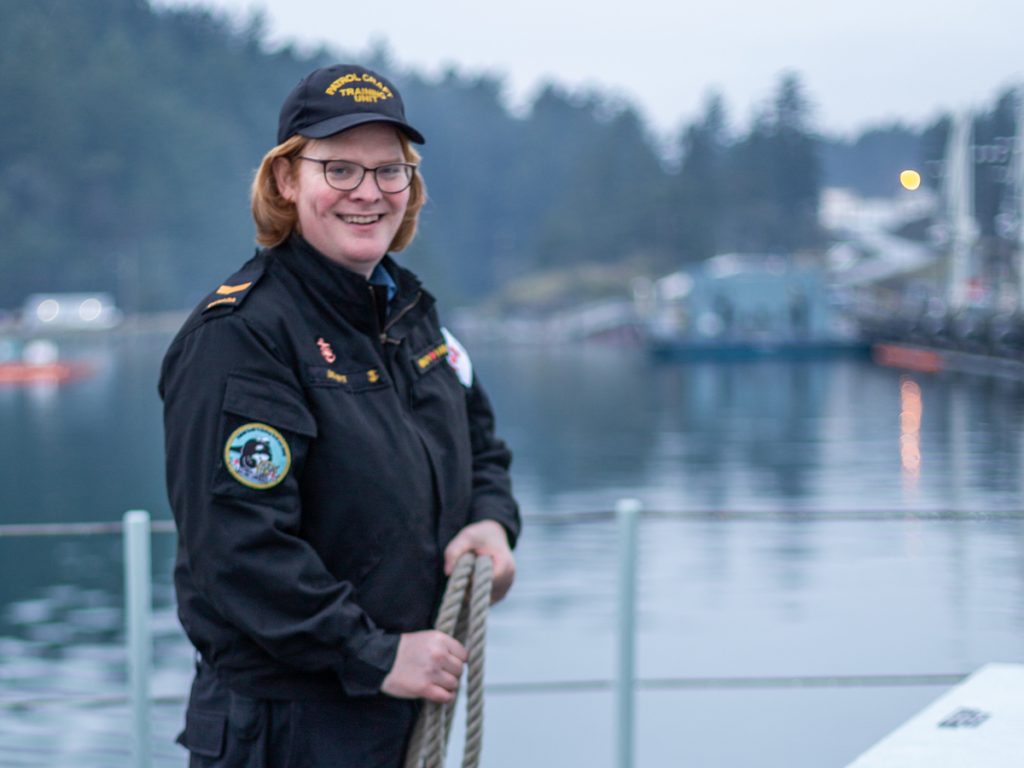
SLt M.X. Déry, MARPAC PA Office ~LS Danielle Dewitt has joined a troop of volunteers across the country dedicated to creating a welcoming and inclusive workplace for everyone, including members of the lesbian, gay, bisexual, transgender, two–spirit, intersex, and questioning (LGBTQ2) community.She recently completed Positive Space training at the base to become an ambassador at her unit - Patrol Craft Training (PCT).It’s not a new role. She completed a similar course at CFB Halifax following her transition from male to female.After coming out as transgender to her chain of command, LS Dewitt spent years navigating the complex and uncharted waters of the military medical system that did not have a process in place to assist a transitioning military member.While she was shore-posted she helped create Positive Space training and aided other military members in the same boat navigate the medical system. Her new posting as senior boatswain at PCT has her back to sea almost every week in one of the eight Orcas training junior officers.      “I’ve found a new family at this unit, so I love it here,” she said. “It is a good way to get my feet wet since it has been a couple of years since I’ve sailed.”Regular interactions with junior officers have the added benefit of introducing future naval leaders to LGBTQ2 issues. “Since being here I have had a lot of questions from junior officers about what is to be trans. I find that helpful; showing them that LGBTQ2 members are sailors first. I’ve had NWO IV (Naval Warfare Officer) graduates contact me about trans issues. Because of the networking I’ve done here, I’ve been able to point them in the right direction.”It hasn’t all been positive; not everyone appropriately handles the shift from the male to female pronoun. For those who outright...

Explore More

Categories

Top News

E-Editions Archive

News Stories Archive

Proud Supporters

Joshua Buck, Lookout Newspaper